

Pectoral Augmentation With Implants or Fat Grafting? Feel, Longevity and Recovery Compared

Key Takeaways
- Pectoral implants are solid silicone with no liquid fill, so they cannot rupture like gel breast implants, but they can shift, show edges or be squeezed by a tightening capsule.
- Grafted fat that survives the first few months is permanent living tissue, yet a variable portion is reabsorbed early and the rest rises and falls with your body weight.
- Mayo Clinic gives an average lifespan of about 10 years for breast implants and notes revisions are common; no equivalent published figure exists for the less-studied pectoral implant.
- The NHS advises about 1–2 weeks off work and roughly six weeks away from strenuous activity after implant surgery, a window surgeons commonly apply to chest implants.
- Final fat-grafting results are judged at around six months, per NHS liposuction guidance, because early swelling exaggerates the chest you will actually keep.
- Sudden breathlessness, sharp chest pain or one-sided calf swelling after either procedure can indicate a blood clot or fat embolism and needs emergency care, not a wait.
Pectoral implants are solid silicone shapes placed under the chest muscle to add firm, defined volume that does not shrink over time, while fat grafting moves your own fat into the chest for a softer, more modest change, part of which the body reabsorbs. Implants usually mean a firmer feel, a longer visible result and a harder first week; fat grafting means a softer feel, some volume loss and two healing sites. A surgeon decides suitability.
A man in his thirties stands sideways in the gym mirror. Two years of bench presses and careful eating have changed his shoulders and his back, but the middle of his chest stays flat, a shallow dip between two muscles that refuse to meet. He has typed the phrase pectoral implants vs fat grafting into his phone more than once and closed the tab every time, because each result seems to be selling something.
That flat spot is often not a training failure. The pectoralis major, the fan-shaped muscle across the front of the chest, has an inherited shape, and some chests are simply set wider or thinner than others. Surgery cannot rewrite genetics, but it can add volume in one of two ways: a shaped implant or a person’s own fat.
Which one to choose depends on what you want the chest to feel like under your hand, how long you expect the change to hold, and how much downtime your life can absorb. Those three questions are the spine of this article.
Pectoral implants vs fat grafting: what each one actually is
Both procedures add volume to the chest, but they do it with entirely different materials, and that single difference explains almost everything that follows.
A pectoral implant is a shaped piece of solid, soft silicone. Unlike most breast implants, which are shells filled with silicone gel or saline, a pectoral implant is a single solid form with no liquid inside, so it cannot leak in the way a filled shell can. The surgeon chooses a size and outline, then places it in a pocket created beneath or partly beneath the pectoralis major so the muscle drapes over it. The implant does not move with contraction, but the muscle above it does, which is why the result can look convincing when the chest is relaxed and slightly less so during a flex.
Fat grafting, also called autologous fat transfer (autologous simply means from your own body), is a two-step process in one operation. Liposuction, the suction removal of fat through small cannulas, harvests fat from an area such as the abdomen or flanks. That fat is filtered or centrifuged to remove fluid and damaged cells, then injected into the chest in many fine threads through tiny needle punctures. The grafted fat has to pick up a blood supply from surrounding tissue to survive, and a portion of it will not. Surgeons plan for that.
The practical consequences are these. Implants give a predictable, fixed volume in a predictable shape. Fat gives a variable, softer volume that blends into the existing chest and cannot create sharp edges. One is an object placed in the body; the other is living tissue that behaves like the rest of you, gaining and losing bulk with your weight.
Neither is inherently better. They answer different requests, and a consultation is largely about working out which request you are really making.
How pectoral implant surgery works, step by step
The operation is usually done under general anesthesia, meaning you are fully asleep, though some surgeons use sedation with local numbing for smaller cases. The anesthesia team decides what is appropriate for your health history.
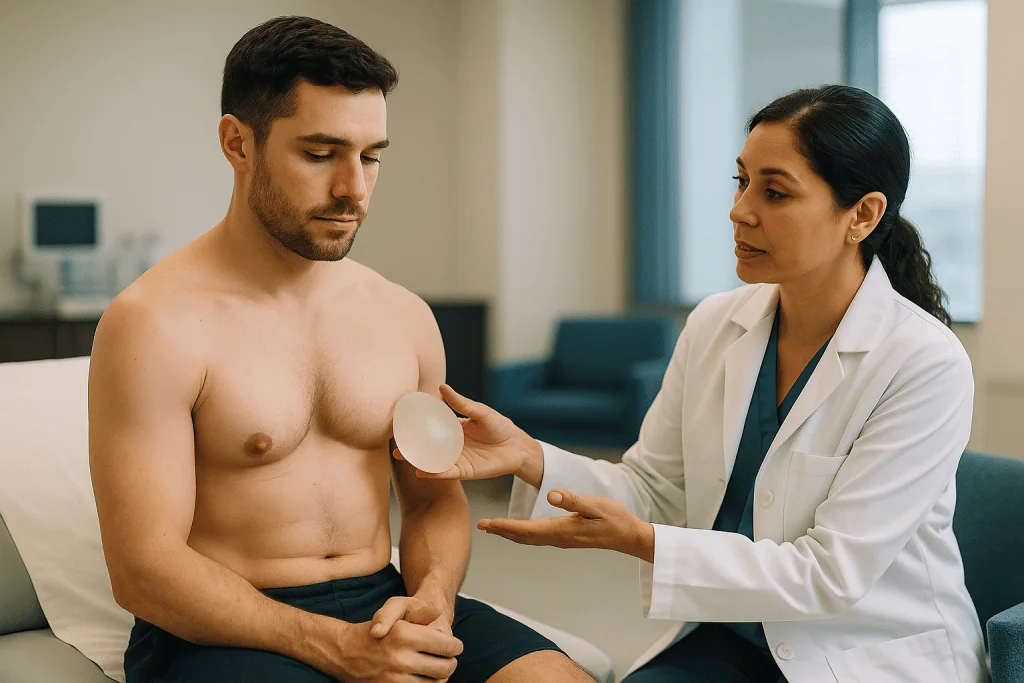
The incision is most often placed in the armpit, roughly 4–6 cm long, where skin folds hide the scar. From there the surgeon separates a space, called a pocket, between the pectoralis major and the chest wall or within the muscle itself. Getting this pocket exactly the right size matters more than most people expect: too large and the implant can shift or rotate; too small and the muscle can push it upward or leave a visible edge.
The solid implant is slid into place, its position checked against the other side, and the incision closed in layers. Drains, thin tubes that carry away fluid, are sometimes used for a day or two. A compression vest or wrap is applied to limit swelling and hold the implant still while the pocket heals around it.
Over the following weeks the body forms a thin layer of scar tissue, a capsule, around the implant. This is a normal response to any implanted device. In a minority of people the capsule tightens and thickens, a problem called capsular contracture, which can make the chest feel hard or look distorted. This is one of the best documented long-term risks of any silicone implant, and Mayo Clinic lists it among the main complications of implant surgery in the breast, the setting where the evidence is strongest.
What you gain from all this is a fixed amount of volume in a fixed shape. What you accept is a foreign object, a healing pocket that needs protection from heavy chest loading, and the knowledge that a future operation to adjust or replace the implant is possible.
How fat grafting to the chest works, and why some of it disappears
Fat grafting starts somewhere other than the chest. The surgeon injects a numbing solution into a donor area, most often the lower abdomen or flanks, then removes fat with a cannula, a thin hollow tube attached to suction. Gentle technique matters here, because fat cells damaged during harvest are far less likely to survive transfer.
The collected fat is processed to separate living fat cells from blood, oil and the numbing fluid. Methods vary, from simple settling to centrifuging to filtration systems, and no single method has been shown in high-quality trials to produce clearly better survival than the others. Surgeons tend to have a preferred approach based on training.
Injection is the slow part. Small volumes are placed in many passes across different depths of the chest, so that each thread of fat sits close to tissue with a blood supply. A single large deposit would starve in the middle and turn into an oil cyst, a pocket of liquefied fat, or a lump of fat necrosis, which is fat tissue that has died and scarred. Spreading the graft thinly is how surgeons try to avoid that.
Here is the honest part. Not all transferred fat survives, and the proportion that does varies from person to person and between studies; the surgical literature gives a wide range rather than a single number, so any surgeon quoting you a precise survival percentage is quoting an estimate. Swelling in the first weeks also exaggerates the early result, so the chest you see at week two is not the chest you will keep.
Because of this, fat grafting is sometimes planned as more than one session, and it is limited by how much spare fat you have to harvest. A very lean person may simply not have enough donor fat for a noticeable change, which is one reason implants remain the more common choice for chest augmentation in men.
Feel: does a pectoral implant feel like muscle, or does fat?
Ask people who have had either procedure what surprised them most, and the answer is rarely the appearance. It is the feel under the hand, their own or someone else’s.

A solid silicone pectoral implant is designed to approximate the density of contracted muscle. Under a relaxed pectoralis major it reads as firm and defined, closer to a flexed chest than a resting one. That firmness is exactly what some people want; it can also be the first thing they notice as unnatural, particularly when lying on their side or when the arm is raised and the muscle thins over the implant edge. Placement partly under the muscle softens the transition, and a thicker natural muscle layer hides the outline better than a thin one, which is why leaner chests can show edges more.
Fat feels like fat because it is fat. Grafted tissue that survives becomes indistinguishable from the fat that was already there, so the chest is softer and warmer to the touch and has no edge to find. The trade is that fat cannot produce the crisp lower border or the cut between the two pectorals that many men are actually picturing when they think about chest augmentation. Surgeons sometimes describe fat as adding fullness rather than definition.
Temperature and sensation differ too. An implant does not carry blood, so it can feel slightly cool through thin muscle in cold conditions; grafted fat matches body temperature. Nerve sensation over the chest can be reduced after either operation while cut or stretched nerves recover, and both the NHS and Mayo Clinic list altered sensation as a recognized effect of breast implant surgery, the closest well-documented comparison. Most changes improve over months; a small number persist.
The question to ask yourself is blunt: do you want a chest that feels like a muscle mid-flex, or one that feels like you, only fuller?
How long do pectoral implants last?
This is the most searched question about the procedure, and the truthful answer has two layers.
The material itself is durable. Solid silicone does not have a shell to rupture or gel to migrate, so the failure modes that shorten the life of a filled breast implant do not apply in the same way. In principle a solid implant can stay in place indefinitely.
The body around it is another matter. Capsules can tighten over years, the muscle covering can thin with age or weight loss, implants can shift or rotate, and a person’s taste in their own chest can change. Mayo Clinic notes that breast implants are not guaranteed to last a lifetime and gives an average lifespan of about 10 years, with rupture and capsular contracture as the usual reasons for revision. The NHS similarly advises that implants are likely to need replacing at some point. Pectoral implants are far less studied than breast implants, so no authoritative body publishes an equivalent figure for them; what surgeons say in practice is that the implant tends to outlast the reasons it was placed for.
So the realistic framing is this. A pectoral implant will hold its volume; it will not shrink or be absorbed. What may change is how it sits and how it feels, and any of those changes can prompt a second operation to adjust, replace or remove it. Anyone considering implants should plan for the possibility of future surgery rather than treating the first operation as final.
Follow-up matters. Even without symptoms, a periodic check with the surgical team lets small problems such as early tightening or asymmetry be documented, and any new hardness, pain or shape change should be reviewed rather than waited out.
Does fat grafting to the chest last?
Fat that survives the first few months after transfer is generally considered permanent, in the sense that it is now living tissue with its own blood supply and behaves like any other fat on your body. The two caveats are the size of that surviving portion and what the rest of your body does afterward.
Loss happens early. Cells that fail to connect to a blood supply die within days to weeks, are cleared by the immune system, and swelling that made the early chest look generous settles over the same period. Mayo Clinic’s guidance on liposuction describes swelling that takes several weeks to subside and a final contour that emerges over a few months, and the same timeline applies to the recipient site. Surgeons typically wait until roughly the six-month point before judging the true result, in line with NHS liposuction advice that it can take up to six months to settle fully.
After that, the graft tracks your weight. Gain and the grafted fat enlarges along with everything else; lose weight and it shrinks. People who plan a significant fat-loss phase after surgery can find their chest result quietly diminishing, which is why many surgeons prefer to operate at a stable weight.
Compared with an implant, then, fat is less predictable in the short term and less fixed in the long term, but it carries none of the device-related risks of capsule tightening, rotation or edge visibility. There is no object to replace, so there is no scheduled revision, only the possibility of a second grafting session if the surviving volume falls short.
An honest surgeon will describe fat grafting as building toward a result rather than delivering one on the day.
Pec implants recovery time versus fat grafting downtime
Recovery is where the two approaches separate most sharply in the first week, and then quietly converge over the following two months.
Implant recovery front-loads the discomfort. Creating a pocket under a large, active muscle produces soreness that many people compare to the worst chest-day stiffness they have ever had, concentrated in the first 3–5 days and easing across the first two weeks. Arm movement is deliberately limited so the implant stays seated while the pocket heals. The NHS advises that after breast enlargement most people need 1–2 weeks off work and should avoid strenuous activity for about six weeks; surgeons commonly apply a similar or slightly longer window to pectoral implants because the muscle itself was operated on. Pressing movements, wide push-ups and heavy overhead work are usually the last things cleared.
Fat grafting spreads the discomfort out. The chest is usually only mildly tender because nothing was cut beneath the muscle, but the donor site is bruised and swollen in the way liposuction always is. NHS liposuction guidance describes wearing a compression garment for several weeks and expecting bruising and swelling that gradually settle. Many people return to desk work within days, but the harvested area can stay tender and numb for weeks.
Both approaches share a few rules: sleep on your back at first, wear compression as instructed, keep incisions clean and dry, and avoid smoking, which reduces the blood flow that healing tissue and grafted fat depend on. The timelines above are typical ranges reported by mainstream sources, not guarantees; your own team’s instructions override anything written here.
By roughly the two-month mark most people from either group are back to unrestricted activity, though final appearance continues to refine for several months beyond that.
Pectoral implants vs fat grafting at a glance
Placed side by side, the two options are easier to weigh. The table summarizes what mainstream sources and standard surgical practice describe, not promises for any individual.
| Feature | Pectoral implants | Fat grafting |
|---|---|---|
| Material | Solid soft silicone, no liquid fill | Your own fat, harvested by liposuction |
| Typical feel | Firm, like a contracted muscle | Soft, like existing chest tissue |
| Definition achievable | Crisp edges and clear central cleft possible | Fullness rather than sharp definition |
| Volume predictability | Fixed; does not shrink | Variable; a portion is reabsorbed early |
| Longevity | Material durable; revision possible for capsule, position or preference | Surviving fat is permanent but tracks body weight |
| Incisions | One per side, usually in the armpit | Needle punctures on chest plus small liposuction ports |
| Hardest recovery phase | First 1–2 weeks, chest muscle soreness | Donor-site bruising over several weeks |
| Return to heavy chest training | Commonly about 6 weeks or longer, per surgeon | Commonly several weeks, once donor site allows |
| Key risks | Capsular contracture, shifting, visible edges, infection | Fat necrosis, oil cysts, under-correction, donor-site irregularity |
| Limiting factor | Skin and muscle coverage over the implant | Amount of spare fat available to harvest |
| Reversibility | Removable, leaving a healed pocket | Not removable once integrated |
Two lines deserve a second look. Reversibility runs opposite to what many assume: an implant can be taken out, while integrated fat is yours for good. And the limiting factors point in different directions, so a very lean person is steered one way by biology and a person with spare abdominal fat may have a real choice.
Who is each option usually for, and who is asked to wait
Surgeons think about candidacy in terms of anatomy, goals and health, in roughly that order.
Implants tend to suit people with a well-developed but genetically thin or flat pectoralis, a stable low body fat that leaves little to harvest, and a clear wish for definition rather than softness. They are also the usual choice when one side is structurally underdeveloped, as in Poland syndrome, a congenital condition where chest muscle is partly or wholly missing on one side; a shaped implant can rebuild the missing contour in a way fat alone struggles to do.
Fat grafting suits people who want a modest, natural-looking increase, who have donor fat to spare and who would rather accept some unpredictability than live with a device. It is also used to soften implant edges in people who already have implants, and to fill small hollows after gynecomastia surgery, the removal of enlarged male breast tissue.
Who is asked to wait, or declined? Anyone actively smoking or using nicotine products is usually asked to stop for a period before and after surgery, because nicotine narrows blood vessels and starves healing tissue. People mid-way through a large weight change are asked to reach a stable point first, since both the chest and the donor fat will shift. Uncontrolled diabetes, bleeding disorders, active infection and certain heart or lung conditions raise anesthetic and healing risk and are addressed before any cosmetic operation is scheduled. Body dysmorphic disorder, a condition in which a person is preoccupied with a perceived flaw that others barely notice, is a recognized reason for surgeons to pause and involve mental health colleagues; the NHS cosmetic surgery guidance encourages people to consider whether their expectations are realistic before committing.
None of this is gatekeeping for its own sake. The surgeon who says wait is protecting the result you would otherwise be disappointed by.
What are the downsides of a fat transfer, and the risks of implants?
Every operation carries the same baseline risks: bleeding, infection, poor scarring, reactions to anesthesia and blood clots in the legs. What differs is the set of problems specific to each technique.
Implant-specific risks cluster around the device. Capsular contracture, the tightening of the scar layer around the implant, can make the chest feel hard, look distorted or ache; it may need surgery to release the capsule or replace the implant. Implants can shift downward, sideways or rotate, especially if heavy lifting begins too early. Visible or palpable edges appear when muscle or skin is thin. Seroma, a collection of clear fluid around the implant, and hematoma, a collection of blood, can both require drainage. Rarely, infection around an implant cannot be controlled without removing it. Mayo Clinic and the NHS list these complications for breast implants, and surgeons regard them as transferable to solid chest implants.
Fat transfer has a different list. Under-correction is the most common disappointment: less fat survives than hoped, and the chest ends up smaller than the early swollen version suggested. Fat necrosis produces firm lumps; oil cysts produce soft ones. Both are usually harmless but can be worrying to feel and may need imaging or minor removal. The donor site can be left with dents, waves or asymmetry if liposuction is uneven, and NHS liposuction guidance lists lumpy or uneven results, numbness and fluid collections among recognized effects. A rare but serious risk of any fat injection is fat embolism, where fat enters a blood vessel and travels to the lungs; careful injection technique is designed to minimize it.
Asymmetry, meaning the two sides do not match perfectly, is possible with both approaches, because no chest is perfectly symmetrical to begin with. Neither list is a reason to avoid surgery; both are reasons to have it explained to you in full.
Can you combine implants and fat, and what are the non-surgical alternatives?
Some surgeons use both techniques in the same patient, and the logic is sound: an implant supplies the structure and definition, and a thin layer of grafted fat over its borders softens any edge that thin muscle might otherwise reveal. This composite approach borrows directly from breast surgery, where fat is routinely used to camouflage implant contours. It adds a donor site and the fat-related risks to the implant-related ones, so it is not a shortcut to fewer complications, only a way of trading one visual problem for a longer operation.
Before either, it is worth being frank about training. The pectoralis major does respond to progressive resistance work, and for a person who has trained for months rather than years, or who has favored one lift over others, a structured program with a coach can change the chest meaningfully. Where it cannot help is the shape of the muscle’s attachments: a high, thin insertion or a wide central gap is set by anatomy, and no volume of pressing changes it. That distinction, between a chest that is under-trained and one that is simply shaped a certain way, is something a surgeon can usually assess on examination.
Injectable fillers, gel products injected under the skin, are occasionally marketed for chest contouring. Mainstream evidence for large-volume filler in the male chest is thin, they are temporary, and injecting large amounts of filler carries its own risks of lumps and vascular problems. Neutral guidance from major health bodies does not support them as an established alternative for this purpose.
Doing nothing is also an option, and a legitimate one. Many people arrive at a consultation, hear the trade-offs laid out in plain language, and decide the flat spot in the mirror is not worth an operation. That is a good outcome too.
What people often get wrong about pectoral augmentation
Several beliefs circulate online that a seasoned surgeon would gently correct.
“Implants make the chest look flexed all the time.” Partly true, partly misunderstood. A solid implant holds one shape, but because it sits under muscle, the relaxed chest looks full rather than clenched. During a hard flex, the muscle contracts over a fixed object, and some people notice the implant does not change shape with it. The look is best judged at rest, which is how most people see a chest anyway.
“Fat transfer is risk-free because it is your own tissue.” The tissue is yours; the risks are not zero. Fat necrosis, oil cysts, donor-site irregularities and the small but serious risk of fat embolism are all specific to fat grafting and are described in mainstream liposuction guidance.
“Pectoral implants can burst.” Solid silicone has no shell and no fill, so it cannot rupture the way a gel or saline breast implant can. It can shift, be squeezed by a tightening capsule or become visible through thin tissue, which are different problems.
“Fat grafting gives a permanent result on the first try.” Surviving fat is permanent, but a portion never survives, and the visible chest at two weeks is inflated by swelling. Judgment waits until roughly six months, in line with NHS liposuction timelines, and a second session is sometimes planned.
“You can train chest again in two weeks.” Light walking early, yes. Loaded pressing over a healing implant pocket risks displacement, and the NHS advises around six weeks away from strenuous activity after implant surgery in the breast. Your own surgeon sets the actual date.
“Bigger is always more convincing.” The chest has a finite envelope of skin and muscle. Oversized implants show edges and look pasted on; overfilled fat grafts lose more of their volume. Proportion, not size, is what reads as natural.
Questions to ask your care team before choosing
A good consultation should feel like an examination and a conversation, not a pitch. These questions help you get the information that matters, and the way they are answered tells you a lot.
- Looking at my chest and muscle thickness, which approach do you think fits my anatomy, and why? Ask specifically about how much tissue would cover an implant edge, or how much donor fat you have.
- How many of each procedure do you perform, and are you able to show unedited photographs of chests similar to mine at six months or later, not two weeks?
- Where exactly will the implant sit in relation to the muscle, and how do you size and shape the pocket to keep it from shifting?
- If you recommend fat grafting, how do you estimate how much will survive in my case, and is a second session part of the plan?
- What are the specific complications you have seen in your own patients with this technique, and how were they managed?
- What does the first two weeks look like for me, including drains, compression, sleeping position and when I can lift my arms above my head?
- When can I return to my particular work and my particular training, and what is the sign that I have pushed too early?
- What is the plan if I dislike the result: can the implant be removed or exchanged, and what would that involve?
- Who do I contact after hours if something worries me, and where would I be seen?
- How is my follow-up scheduled over the first year, and is there a longer-term check for implants?
Write the answers down or bring someone with you. People consistently underestimate how much of a surgical consultation they forget, and the decision deserves to be made on the full picture rather than the half you remembered in the parking lot.
When to call your doctor after pectoral implants or fat grafting
Most recovery is uncomfortable but uneventful. A short list of signs, however, should prompt a call to your surgical team the same day, or emergency care if severe, rather than a wait-and-see approach.
Around the chest, watch for one side becoming rapidly larger, tighter or more painful than the other, which can signal a hematoma or a large fluid collection; spreading redness, heat or a foul-smelling discharge from an incision, which suggests infection; a fever that develops after the first day or two; or an implant that suddenly feels displaced, rotated or visible through the skin. New hardness or distortion appearing weeks or months later is not an emergency but should be reviewed for early capsular contracture.
After fat grafting, a firm lump that grows, becomes red or painful, or drains fluid deserves assessment, as does any area of skin over the chest or donor site that turns dusky, purple or very pale, which can indicate compromised blood supply.
Whole-body warning signs are the most urgent. Sudden shortness of breath, chest pain that is sharp and worsens with breathing, coughing up blood, a racing heartbeat or fainting can indicate a blood clot that has traveled to the lungs or, after fat injection, a fat embolism. Calf pain, swelling or warmth in one leg can indicate a clot in the leg vein. Confusion, difficulty breathing or a rapidly spreading rash after any medication is also an emergency. MedlinePlus and the NHS list these among the general warning signs after surgery. Do not drive yourself; call emergency services.
Finally, trust the sense that something is wrong. Surgical teams would far rather hear about a symptom that turns out to be nothing than learn about a complication days late. Every decision about investigation and treatment belongs with the team who operated on you, because they know exactly what was done and what to expect.
Frequently asked questions
How long do pectoral implants last?
The solid silicone itself does not wear out or shrink, so a pectoral implant can remain indefinitely. What changes is the tissue around it: capsules can tighten, muscle can thin and positions can shift, any of which may prompt revision. Mayo Clinic cites an average of about 10 years for breast implants before replacement; pectoral implants lack an equivalent published figure, so plan for possible future surgery.
Does fat grafting to the chest last?
Fat that survives transfer is permanent, because it becomes living tissue with its own blood supply. A portion never survives and is cleared in the first weeks, and swelling settles over several months, so the true result is judged at roughly six months per NHS liposuction guidance. After that the graft follows your weight, enlarging or shrinking with the rest of your body.
What are the downsides of a fat transfer to the chest?
The main downsides are unpredictability and two healing sites. Less fat may survive than hoped, leaving under-correction; lumps of fat necrosis or oil cysts can form; and the liposuction donor area can be left uneven or numb. Very lean people may lack enough spare fat. Rarely, injected fat can enter a blood vessel, which is why careful technique matters.
Is fat transfer to chest for men permanent?
Partly. The surviving fraction of grafted fat is permanent and behaves like any other fat on your body, but the fraction that fails to gain a blood supply is lost early, and the remaining volume changes with weight gain or loss. Surgeons often describe it as building a result over one or two sessions rather than delivering a fixed outcome on the day.
What do chest fat grafting results look like at a year?
By a year the chest has stabilized: swelling is long gone, the surviving fat has integrated, and the contour is soft and blended rather than sharply defined. The change is typically modest fullness, not a crisp lower border or central cleft. Any lumps that were going to form have usually declared themselves by then, and weight stability determines whether the volume holds.
How much does it cost for pectoral implants?
This magazine does not publish pricing, and figures vary too widely by region, facility and complexity to be meaningful in an article. A surgical team should provide a written itemization covering the surgeon, anesthesia, facility, implant, garments, follow-up and the policy for revision surgery. Ask how complications and any second operation would be handled before comparing numbers.
Do pectoral implants feel natural?
They feel firm, closer to a contracted muscle than a relaxed one, which some people want and others find noticeable, especially when lying on the side or raising the arms. Placement under the pectoralis major and a thicker natural muscle layer soften the edge. Grafted fat feels like existing chest tissue but cannot produce the same definition.
What is the recovery time for pec implants?
The first 3–5 days are the sorest, easing over about two weeks. The NHS advises 1–2 weeks off work and roughly six weeks away from strenuous activity after breast implant surgery, and surgeons commonly apply a similar or longer window to chest implants because the muscle was operated on. Heavy pressing is usually the last thing cleared.
Can pectoral implants move or flip?
Yes, displacement and rotation are recognized risks, particularly if heavy chest loading starts before the pocket has healed around the implant. Precise pocket sizing and compression in the early weeks are designed to prevent it. A sudden change in position or a newly visible edge should be reviewed by the surgical team rather than watched.
Can you have both implants and fat grafting?
Some surgeons combine them, using the implant for structure and a thin layer of fat over its borders to camouflage edges in a thin chest, borrowing a technique common in breast surgery. It adds a donor site and fat-specific risks to the implant-specific ones, so it is a trade of one problem for a longer operation, not a way to reduce complications.
References
- NHS: Breast enlargement (implants)
- NHS: Liposuction
- MedlinePlus: Breast augmentation
- MedlinePlus: Liposuction
This article is for general information only and is not a substitute for professional medical advice. Please consult a qualified doctor about your individual situation.

More from the Blog

Why Thigh Lift Incisions Heal Slowly Near the Groin and Which Signs Need a Call
Thigh lift incisions near the groin heal slowly because the skin there is thin, constantly moving, warm, moist and under tension every time you…

Which Concerns Can Aesthetic Genital Surgery Address? Comfort, Anatomy and Candidacy
Aesthetic genital surgery most often addresses physical discomfort from labial tissue that chafes, pulls or twists during exercise, sex or in fitted clothing; visible…
Who Is a Candidate for J Plasma? Mild Loose Skin vs Cases That Need a Surgical Lift
A typical J Plasma candidate has mild to moderate loose skin with reasonable elasticity, a stable weight, and is already planning liposuction in the…

Is It Better to Have Labiaplasty Before or After Children? How Delivery Affects the Result
There is no single right answer, but many surgeons suggest waiting until after childbearing, because pregnancy and vaginal delivery can change the size, color…

How a Brazilian Tummy Tuck Is Performed: Abdominoplasty Plus Waist Liposuction in One Session
A Brazilian tummy tuck is a marketing name, not a distinct medical operation. It usually describes a standard abdominoplasty (removing loose lower-abdominal skin and…
Is Vaser Liposuction Right for Stubborn Fat? Skin Elasticity, Weight and Other Checks
Vaser-style ultrasound-assisted liposuction suits adults who are close to a stable, healthy weight, have firm skin that snaps back, and want to reshape specific…