

Fat Transfer vs Implants for Breast Augmentation: Volume, Feel and Long-Term Follow-Up

Key Takeaways
- Fat grafting adds modest volume per session because part of every graft is reabsorbed, whereas an implant delivers its full chosen volume in one operation.
- The Mayo Clinic states that breast implants are not lifetime devices and that many people eventually need them replaced or removed.
- Capsular contracture, rupture and rippling are the main long-term implant risks; fat necrosis, oil cysts and calcifications are the main fat grafting risks.
- Silicone implants can rupture silently, which is why periodic imaging such as MRI or ultrasound is advised even when the breast looks and feels normal.
- Both methods change what mammograms show, so every screening team should be told what was done before imaging.
- Hybrid augmentation pairs a smaller implant with fat over its edges, gaining natural cover at the cost of carrying the risks of both procedures.
Fat transfer uses your own liposuctioned fat to add a modest, natural-feeling amount of breast volume, but part of the graft is reabsorbed and more than one session may be needed. Implants add larger, more predictable volume in a single operation, yet they are devices that can rupture or harden and are not expected to last a lifetime. The right choice depends on your anatomy, goals and willingness to accept ongoing follow-up.
She had two browser tabs open and had been switching between them for a week. One showed a woman who had chosen implants, the other a woman who had chosen fat grafting, and both looked pleased with themselves. What she could not see in either photo was how the result would feel under her hand, how it would look in five years, or what the surgeon had said about follow-up. Those are the things that actually decide the fat transfer vs implants question, and they rarely make it into the pictures.
Breast augmentation is one of the most common cosmetic operations performed worldwide, which means there is a great deal of experience to draw on and, unfortunately, a great deal of marketing noise around it. The evidence is quieter and more useful.
This explainer sets the two approaches side by side: what each one physically does, how much volume it can realistically add, how it feels, what can go wrong, and what the years afterward look like. The decision remains yours and your surgical team’s. Our job is to make sure you walk into that conversation already knowing the right questions.
Fat transfer vs implants: what each procedure actually does
Start with the plain mechanics, because the two operations solve the same problem in entirely different ways.
A breast implant is a manufactured device, a silicone shell filled with either silicone gel or sterile saltwater, placed into a surgically created pocket behind the breast tissue or behind the chest muscle. Volume arrives all at once, in a size chosen before surgery. Nothing about the implant is alive; it simply occupies space and pushes the breast forward.
Fat transfer, also called autologous fat grafting (autologous means it comes from your own body), takes a different route. A surgeon removes fat from another area with liposuction, a technique that suctions fat through a narrow tube called a cannula. The fat is processed to remove fluid and damaged cells, then injected into the breast in many small threads. The injected fat has to reconnect to your blood supply to survive. Fat that does not reconnect is gradually absorbed by the body, which is why final volume is known only months later.
The Mayo Clinic describes both approaches in its overview of breast augmentation, noting that fat grafting is generally used when a smaller increase in size is wanted, while implants allow a wider range of sizes. That single sentence contains most of the trade-off.
Everything else, from feel to longevity to the shape of your follow-up calendar, flows from this difference between a device and a living graft. A device is predictable but foreign and finite. A graft is your own tissue but unpredictable in how much of it stays. Neither is a shortcut, and neither is a one-time decision that you can then forget.
How does fat transfer breast augmentation work, step by step?
The operation has three stages, and each one affects how much fat ultimately survives.

Harvesting comes first. Under general anesthesia or, in smaller cases, sedation with local anesthetic, the surgeon makes a few tiny incisions in a donor area such as the abdomen, flanks or thighs and removes fat with liposuction. Gentle technique matters here: fat cells damaged during removal are less likely to live in their new location.
Processing follows. The harvested mixture contains fat, blood, anesthetic fluid and broken cells. Surgeons separate the usable fat by letting it settle, spinning it in a centrifuge (a machine that separates substances by density) or filtering it. The aim is clean, concentrated fat that can be injected in fine strands.
Injection is the stage most people underestimate. The fat is not placed as one lump. It is laid down in many thin passes at different depths, so that every strand sits close to existing blood vessels. Survival depends on this contact. A large pool of fat in one spot tends to die in the middle, forming an oil cyst or a firm area of fat necrosis, the medical term for fat tissue that has died.
Because the surgeon can only safely inject as much fat as the breast envelope will accept, a single session produces a modest increase. People wanting more are usually offered a second procedure once the first graft has settled, which the Mayo Clinic notes may be several months later. Two operations to reach a goal one implant would reach in a day is a real consideration, and it belongs in the very first conversation with your surgeon rather than the last.
How do breast implants work, and what choices are involved?
An implant operation is more standardized than grafting, but it still involves a chain of decisions that shape the result and the follow-up.
The first is filling. Saline implants are filled with sterile saltwater, sometimes after the empty shell is placed, which allows a slightly smaller incision. Silicone gel implants come pre-filled and are generally described as feeling closer to natural breast tissue. According to the NHS, both types are widely used, and the choice is guided by your anatomy and preference rather than by one being medically superior.
The second is position. The pocket can sit under the breast tissue but over the chest muscle, or partly beneath the pectoral muscle. Under-muscle placement adds soft-tissue cover in slimmer patients and may reduce visible rippling, at the cost of a somewhat longer early recovery because the muscle itself has been lifted.
The third is incision site: in the fold under the breast, around the areola or, less commonly, in the armpit. Each leaves a scar in a different place and offers the surgeon a different view.
Surface texture, shape and projection profile round out the list. Textured surfaces have been associated with a rare lymphoma discussed later in this article, and many surgeons now prefer smooth devices, though decisions vary by region and case.
What all implant options share is that the volume is chosen in advance and delivered in full at the first operation. That predictability is the implant’s great advantage. Its corresponding disadvantage is that you are now the long-term custodian of a device with a finite life, and the Mayo Clinic is clear that implants are not guaranteed to last a lifetime.
How much volume can fat transfer add compared with implants?
Volume is the question that most often decides the matter, so it deserves a straight answer.
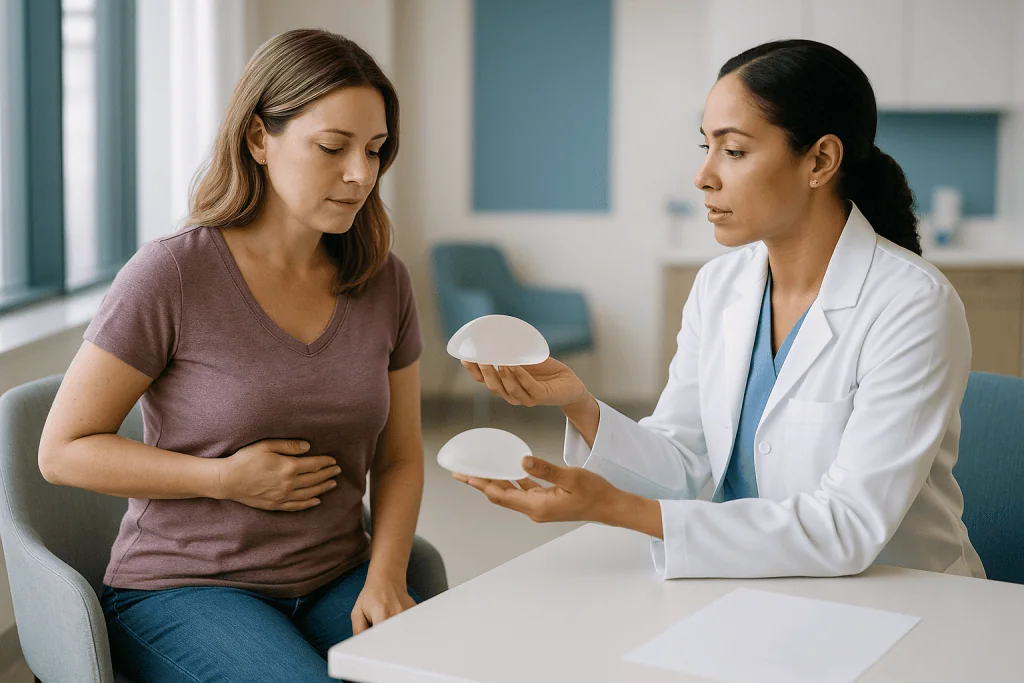
Implants scale. They are manufactured in a wide range of sizes, and a surgeon can pick one that produces anything from a subtle fill to a substantial change. The result you see in the first weeks, once swelling settles, is broadly the result you keep, subject to the long-term changes covered later.
Fat grafting is limited on three fronts. You need enough donor fat to harvest, the breast skin envelope can only stretch so far in one sitting, and a portion of every graft is reabsorbed. The Mayo Clinic frames fat grafting as suited to people wanting a relatively small increase in breast size. Surgical literature reports a wide range of graft survival, and honest surgeons will tell you they cannot promise a specific percentage for any individual; too many variables, from technique to your own circulation and weight stability, affect it.
This has two practical consequences. First, if your goal is a marked increase, fat alone will usually require repeat sessions and may still fall short. Second, slimmer patients with little spare fat may simply not have enough to harvest, which is why body type is one of the first things a surgeon assesses.
There is a middle path. Hybrid breast augmentation combines a smaller implant with fat grafting placed over its edges. The implant supplies the volume; the fat softens the transition between device and chest, disguises rippling in thin skin and can adjust cleavage or upper-pole fullness. It carries the risks of both procedures, so it is not a free upgrade, but it explains why the decision is not always binary.
How do fat transfer and implants feel and look over time?
Feel is subjective, but a few generalizations hold up.
Grafted fat is your own soft tissue, so once it has healed it is difficult to distinguish from the surrounding breast by touch. It moves with you, warms to body temperature and changes with your weight the way the rest of your fat does. Because it is distributed through the existing breast rather than sitting behind it as a single object, it tends to produce a diffuse fullness rather than a defined, rounded upper pole.
An implant is a discrete object. Silicone gel devices are generally described as softer and more tissue-like than saline, and placement under the muscle adds a further layer of natural cover. Even so, in a slim patient with thin breast tissue, the edge of an implant can sometimes be felt, and folds in the shell may show as rippling. Larger implants relative to the breast are more likely to look and feel like implants.
Time changes both. Grafted fat follows your body: significant weight loss shrinks it, weight gain enlarges it, and pregnancy or menopause alters it with the rest of the breast. Implants do not change, which sounds like an advantage until the tissue around them does. As natural breast tissue thins and descends with age, a fixed implant can become more visible or sit higher than the breast around it.
Capsular contracture, in which the scar tissue that normally forms around any implant tightens and squeezes it, is the change patients most often notice. The NHS lists it among the recognized complications of implants; it can make the breast feel firm, look distorted and sometimes ache. Fat grafting has no equivalent, though firm lumps of fat necrosis can occur.
Who is fat transfer usually for, and who is asked to wait?
Surgeons think about candidacy in terms of anatomy, goals and health rather than age alone.
Fat grafting tends to suit people who want a modest increase, already have some breast tissue for the fat to sit in, have a donor area they would also like slimmer, and prefer to avoid a device. It is also used to soften the appearance of an existing implant or to correct small asymmetries and contour irregularities.
Implants tend to suit people who want a larger or more defined change, have limited donor fat, or want the result settled after one operation and are prepared for device-related follow-up.
Several situations usually prompt a recommendation to wait or reconsider, whichever method is on the table. The NHS and the Mayo Clinic both note that breast augmentation is normally reserved for adults whose breasts have finished developing. Active smoking is a common reason to pause, because nicotine narrows blood vessels and impairs the healing that grafted fat, in particular, depends on. Recent or planned pregnancy and breastfeeding change breast size and shape unpredictably, so most surgeons prefer the breast to have settled first. Unstable weight undermines fat grafting specifically, since the graft will shrink or grow with you. Uncontrolled diabetes, bleeding disorders and certain medicines that affect clotting need to be managed with the prescribing clinician before any elective operation.
A personal or strong family history of breast cancer does not rule out either procedure, but it changes the conversation about imaging and surveillance, and it belongs on the table early. None of these are judgments; they are timing and safety questions that a good consultation will raise before you do.
Fat transfer vs implants at a glance: a side-by-side comparison
The table below summarizes the trade-offs discussed so far. Individual experiences vary, and your surgeon may weight these factors differently depending on your anatomy.
| Factor | Fat transfer | Implants |
|---|---|---|
| Volume achievable | Modest per session; limited by donor fat and skin envelope | Wide range chosen in advance |
| Predictability of size | Lower; part of graft is reabsorbed | Higher; final size largely known beforehand |
| Number of operations | Often more than one to reach goal | Usually one initially; replacement likely over a lifetime |
| Feel | Your own tissue; soft, diffuse fullness | Device; silicone gel closer to natural than saline |
| Scars | Tiny liposuction and injection sites | Incision in fold, around areola or armpit |
| Bonus effect | Contouring of donor area | None |
| Key complications | Fat necrosis, oil cysts, calcifications, asymmetry | Capsular contracture, rupture, rippling, rare lymphoma |
| Effect of weight change | Graft changes with body weight | Implant fixed; surrounding tissue changes |
| Imaging | May show calcifications needing expert interpretation | Special mammogram views; periodic imaging for silicone rupture |
| Lifespan | Surviving fat is permanent living tissue | Not lifetime devices; monitoring and eventual replacement expected |
Two rows matter more than the rest. If you want a significant increase, volume and predictability push toward implants. If you want a subtle change and are willing to accept uncertainty in exchange for avoiding a device, feel and lifespan push toward fat. Everything else is negotiable detail.
The Mayo Clinic and the NHS both emphasize that no option removes the need for a realistic conversation about limits before surgery, and that the surgeon should explain why a particular approach fits your body rather than presenting one as universally better.
What are the disadvantages of fat transfer to the breast?
Fat grafting is often marketed as the natural option, which is true as far as it goes. It also has specific drawbacks that deserve equal billing.
Unpredictable retention comes first. Some of every graft dies and is absorbed. Surgeons cannot tell you in advance which side will keep more, so mild asymmetry is a recognized outcome and a second procedure is sometimes needed to balance it.
Fat necrosis is the second. When a cluster of injected fat fails to gain a blood supply, it can form a firm lump, an oil-filled cyst or an area of calcification, which means calcium deposits within the dead tissue. These are benign, but they can be felt, and they can appear on a mammogram. Radiologists experienced with post-grafting breasts can usually distinguish them from suspicious calcifications, though further imaging or occasionally a biopsy may be needed to be sure. This is a genuine consideration for anyone entering the age range for routine screening.
Liposuction adds its own risks: bruising, contour irregularities and numbness at the donor site, along with the small but real risks any operation carries, including infection, bleeding and reaction to anesthesia. You are, in effect, having two procedures.
Limited volume and the likelihood of repeat sessions were covered earlier but bear repeating, because they surprise people most. A single session cannot deliver what a large implant can.
Finally, weight sensitivity. Because the graft is living fat, a later diet or illness that causes weight loss can reduce the result. Stability, not thinness, is what surgeons look for in a candidate.
None of this makes fat grafting a poor choice. It makes it a choice with a different risk profile, not a smaller one.
What are the risks of breast implants worth knowing before surgery?
Implants have been studied for decades, and the risk profile is well described by the NHS and the Mayo Clinic.
Capsular contracture heads the list. The body walls off any foreign object in a thin capsule of scar tissue; in some people that capsule thickens and contracts, making the breast feel hard, look unnaturally round or high, and sometimes ache. Treatment may involve surgery to release or remove the capsule, with or without replacing the implant.
Rupture is the second major issue. A saline implant that leaks deflates visibly and the body absorbs the saltwater. A silicone gel implant may rupture silently, with the gel held within the capsule and no obvious change in appearance. Because of this, the Mayo Clinic notes that people with silicone implants are advised to have periodic imaging, such as MRI or ultrasound, to check for silent rupture, even when everything feels fine.
Rippling, visible or palpable implant edges, and changes in nipple sensation are common enough to discuss with every patient. Implants can also shift position over time.
Two rarer conditions have received attention. Breast implant-associated anaplastic large cell lymphoma, a rare cancer of the immune system that develops in the scar capsule rather than the breast tissue, has been linked mainly to textured-surface implants; the NHS describes it as very rare and typically presenting as late swelling or a lump. Some patients also report a cluster of systemic symptoms such as fatigue and joint pain, sometimes called breast implant illness; the evidence for a causal link remains uncertain, and the Mayo Clinic notes that research is ongoing.
Implants also affect mammography, which needs additional views to see around the device. Telling the imaging team in advance is routine.
Does a fat transfer last forever, and what does long-term follow-up look like?
The honest answer to the question people type into search engines is: the fat that survives is permanent, but the result is not frozen.
Once grafted fat has gained a blood supply, usually judged over the first few months, it behaves like any other fat in your body. It does not dissolve on a schedule, and there is no device to wear out. What it does do is respond to your life. Weight loss, pregnancy, breastfeeding and the hormonal shifts of menopause all change breast fat, grafted or native, and gravity works on the whole breast regardless of how it was enlarged.
Follow-up after fat grafting is therefore mostly about imaging awareness. You should tell every mammography team that you have had fat grafting so that calcifications and oil cysts are interpreted in context. Beyond that, most people need no scheduled device surveillance.
Implants demand a more structured relationship. The Mayo Clinic states plainly that implants are not designed to last a lifetime and that many people eventually need them removed or replaced, whether for rupture, contracture, a change in preference or aging of the surrounding tissue. Periodic imaging to detect silent silicone rupture is recommended, and any new firmness, swelling or change in shape should prompt a review.
Neither route is maintenance-free. Fat asks you to keep your weight stable and to inform your radiologist. Implants ask you to accept scheduled imaging and the likelihood of further surgery decades from now. Which of those obligations sounds more tolerable is a legitimate part of the decision, and one worth stating out loud to your surgeon.
How painful is breast fat transfer, and what do the first weeks look like?
People expect the breast to hurt after fat grafting. In practice, many report that the donor site is the sorer of the two.
Liposuction leaves the treated area bruised, swollen and tender in a way often compared to a deep muscle strain. A compression garment is usually worn to limit swelling and support the healing tissue. The breasts themselves feel full, tight and tender rather than sharply painful, because the fat has been placed without lifting muscle or creating a large pocket.
Implant recovery follows a different pattern. The breast pocket, especially when created beneath the muscle, produces a tighter, heavier ache in the first days, and raising the arms can be uncomfortable. The NHS advises that most people can return to non-strenuous work within a week or two, should avoid heavy lifting and vigorous exercise for around six weeks, and can expect swelling to settle over several weeks to months.
Pain relief after either operation is decided by the surgical team based on your history, and the same applies to any medicines you already take; do not stop or restart anything without asking the prescribing clinician.
Timelines diverge after the first month. With implants, what you see once swelling subsides is close to the final result, though implants often settle lower over a few months. With fat grafting, the early appearance is deliberately over-full, because surgeons expect some loss; the volume that remains at around three to six months is generally considered the durable result, which is why any second session is planned after that point rather than before.
Bruising, mild asymmetry and areas of numbness during this period are common and usually temporary. Sudden change is not, and the final section explains what to do about it.
Breast implants vs fat grafting: how does each affect cancer screening?
This is the section most often missing from comparison articles, and it matters more the longer you plan to live with the result.
Neither implants nor grafted fat has been shown to cause breast cancer. The concern is about detection. Both alter what a mammogram sees, in different ways.
An implant is dense and opaque on X-ray, so it can hide part of the breast tissue behind it. Radiographers address this with additional displacement views that push the breast tissue forward and the implant back. The Mayo Clinic and the NHS both advise telling the screening service in advance so the appointment can be adjusted. There is a very small risk of implant rupture from the compression involved in mammography, which is one reason some people with silicone implants are also followed with MRI or ultrasound.
Grafted fat creates a subtler problem. Areas of fat necrosis can calcify, and calcifications are also one of the signs radiologists look for when detecting early cancer. Experienced readers can usually tell the two apart by their pattern, and oil cysts have a characteristic appearance, but additional imaging or a biopsy is sometimes required to be certain. Anyone considering fat grafting should understand that it may occasionally add a step to future screening.
Family history reshapes this conversation. If you carry a known genetic risk or have a strong family history, ask how the chosen method will interact with the surveillance you already need, and whether a breast specialist should be involved in planning.
Routine screening remains just as important after augmentation. What changes is that you become the person responsible for making sure every imaging team knows what is inside your breast.
What people often get wrong about fat transfer and implants
Several myths circulate widely enough to distort decisions. The evidence corrects them.
Fat transfer is natural, so it is risk-free. It is your own tissue, but it is still two surgical procedures under anesthesia, with recognized complications including fat necrosis, calcifications and asymmetry. Natural describes the material, not the risk.
Implants last forever. The Mayo Clinic is explicit that they are not lifetime devices. Planning for eventual replacement or removal is part of choosing an implant, not a pessimistic afterthought.
Fat transfer can match any implant if you have enough sessions. In theory more sessions add more volume; in practice the skin envelope, the supply of donor fat and diminishing returns from each graft set a ceiling that most large implants exceed easily.
All the fat you inject stays. A portion is always reabsorbed, and surgeons deliberately over-fill early to allow for it. The result you see at one week is not the result you keep.
Fat grafting doubles as weight loss. Liposuction reshapes a donor area; it does not meaningfully reduce body weight or replace metabolic health.
Silicone implants are dangerous and saline implants are safe. Both are widely used. Silicone rupture is harder to detect and needs imaging surveillance; saline deflation is obvious but leaves the breast visibly changed. Safety is comparable; the follow-up differs.
You can skip mammograms if the surgeon checks your breasts. Cosmetic follow-up is not cancer screening. Routine screening continues on the schedule your primary clinician recommends, with the imaging team informed of what was done.
The hybrid option is the best of both. It can be excellent for the right person, but it carries the risks of both procedures. It is a considered choice, not a shortcut around trade-offs.
Questions to ask your care team before choosing fat transfer or implants
A good consultation is a two-way examination. These questions tend to surface the information that photographs leave out.
- Given my breast tissue and body shape, which approach do you think fits my goal, and what result would you consider unrealistic for me?
- How much volume increase do you expect from a single fat grafting session in my case, and how likely is a second session?
- Where would the fat be harvested from, and what changes should I expect there?
- If you recommend implants, which filling, size, position and surface do you suggest, and why?
- What is your approach to capsular contracture and how would we detect a silent silicone rupture over the years?
- How will this affect my mammograms, and do you coordinate with a breast imaging specialist?
- What does the recovery timeline look like for me, including time off work and return to exercise?
- Which of my current medicines or supplements need to be reviewed with my prescribing clinician before surgery?
- What follow-up visits do you schedule, and what should I watch for between them?
- What would be your plan if I am unhappy with symmetry or size after healing?
Beyond the specific answers, listen for tone. A surgeon who explains limits without being asked, discusses complications in concrete terms and welcomes a second opinion is showing you how the relationship will feel when something needs adjusting. The NHS specifically encourages people considering cosmetic surgery to take time to reflect, to avoid feeling rushed, and to be wary of any consultation that focuses on booking rather than assessment.
Write your questions down and bring them. The most useful consultations are the ones where the patient leaves knowing why a recommendation was made, not just what it was.
When to call your doctor after breast augmentation
Most recovery is uneventful, and most of what you feel in the first weeks, from tightness to bruising to patches of numbness, is expected. A small number of signs are not, and they warrant a same-day call to the surgical team or, if you cannot reach them, urgent medical care.
Seek care promptly for a breast that becomes suddenly larger, tighter or more painful than the other, which can indicate bleeding into the pocket or a collecting fluid; for spreading redness, warmth, foul-smelling discharge or a fever, which suggest infection; for a wound that opens or exposes the implant; and for chest pain, breathlessness, or a swollen, painful calf, which can signal a blood clot in the lung or leg and need emergency assessment.
Later in recovery, contact your team if the breast becomes noticeably firmer or changes shape, if you feel a new lump, if a saline implant appears to be deflating, or if you develop unexplained swelling of one breast months or years after surgery, which the NHS lists among the features that should be checked in case of the rare implant-associated lymphoma.
After fat grafting, a firm lump that persists beyond the early healing period should be assessed rather than assumed to be harmless fat necrosis.
Do not adjust, stop or add any medicine, including over-the-counter painkillers or supplements, without checking with the prescribing clinician, since some affect bleeding and healing.
Every decision about treatment of a complication rests with the team who know your operation. Your part is simpler: notice change, and report it early. Surgeons would far rather see something that turns out to be nothing than hear about a real problem a week late.
Frequently asked questions
What are the disadvantages of fat transfer for breast augmentation?
The main disadvantages are unpredictable volume, limited size increase and the possibility of firm lumps. Some of the injected fat is always reabsorbed, so results can be uneven and a second session may be needed. Dead fat can form oil cysts or calcifications that show on mammograms, and the liposuction donor site carries its own bruising and contour risks.
Does fat transfer to the breast last forever?
Fat that survives the first few months gains its own blood supply and is permanent living tissue, but the result still changes with your body. Weight loss, pregnancy, breastfeeding and menopause affect grafted fat exactly as they affect native breast fat, and gravity acts on the whole breast over time. There is no device to wear out, however.
What is the best age for breast fat transfer?
There is no single best age. Surgeons generally require that breast development is complete, which is why augmentation is normally reserved for adults, and they look for stable weight, no smoking and no plans for pregnancy soon. Younger patients often have good skin elasticity; older patients may have more donor fat. Health and stability matter more than the number.
How painful is breast fat transfer compared with implants?
Many people find the liposuction donor site more sore than the breasts after fat transfer, describing a bruised, muscle-strain feeling controlled with a compression garment. Implant surgery, especially under the muscle, tends to produce a tighter, heavier chest ache in the first days. Pain relief after either operation is decided by the surgical team based on your history.
How much bigger can fat transfer make breasts?
Fat grafting typically produces a modest increase per session, because the amount injected is limited by available donor fat, how much the breast envelope will accept and the portion that is reabsorbed. Surgeons cannot promise a specific size or survival percentage for an individual. Larger changes usually require repeat sessions or an implant, alone or combined with fat.
Is hybrid breast augmentation better than either option alone?
It is better for some people, not for everyone. Hybrid augmentation uses a smaller implant for volume and layers fat over its edges to soften transitions and disguise rippling in thin tissue. The trade-off is that you accept the complications of both an implant and a graft, including device surveillance and possible fat necrosis, so it suits specific anatomy rather than serving as a universal upgrade.
Do breast implants need to be replaced?
Not on a fixed schedule, but eventually many are. The Mayo Clinic notes that implants are not guaranteed to last a lifetime and that people may need removal or replacement for rupture, capsular contracture, changes in preference or aging of surrounding tissue. Silicone implants also need periodic imaging to detect silent rupture. Anyone choosing implants should plan for possible future surgery.
Can I still have a mammogram after fat transfer or implants?
Yes, and routine screening remains important. Implants block part of the X-ray view, so radiographers take extra displacement views; tell the service in advance. Grafted fat can leave calcifications or oil cysts that experienced radiologists usually recognize, though occasionally further imaging or biopsy is needed to be sure. Inform every imaging team about your surgery.
Which feels more natural, fat transfer or implants?
Grafted fat generally feels most like natural breast tissue because it is your own soft tissue spread through the breast. Silicone gel implants are widely described as feeling closer to natural breast than saline, and placement under the muscle adds cover, but a device edge can sometimes be felt in slim patients, and capsular contracture can make an implant firm over time.
What recovery time should I expect after fat transfer breast augmentation?
Most people return to non-strenuous work within a week or two and are asked to avoid vigorous exercise for around six weeks, according to NHS guidance for breast enlargement. Bruising and swelling at the donor site take several weeks to settle. The breast volume that remains after roughly three to six months is generally considered the durable result, so any second session is planned after that.
References
This article is for general information only and is not a substitute for professional medical advice. Please consult a qualified doctor about your individual situation.

More from the Blog

Preparing for Vaginoplasty: The Pelvic Exam, Blood Work and Habits to Pause Beforehand
Preparing for vaginoplasty usually involves a pelvic and genital examination, routine blood tests such as a blood count, kidney and liver measures, blood sugar…

Is Tumescent Liposuction Right for You? Small Areas, Stable Weight and Honest Limits
Tumescent liposuction is usually considered for adults at or near a stable, healthy weight who have a few well-defined fat pockets that have not…
Is Classic Liposuction Right for You? Skin Elasticity, Stable Weight and Realistic Areas
A typical classic liposuction candidate is an adult at or near a stable weight for several months, with localized fat pockets that resist diet…
What the Tumescent Solution Does in Tumescent Liposuction: Bleeding, Bruising and Comfort
Tumescent solution is a large volume of very dilute salt water carrying a local anesthetic and epinephrine, infused into the fat before liposuction. It…
How Monsplasty Is Performed: Liposuction, Skin Removal and Where the Incision Sits
Monsplasty reshapes the mons pubis, the soft fatty mound over the pubic bone, using one of two approaches or both together. Liposuction removes excess…

Who Is a Candidate for Vaginoplasty? Childbirth Changes, Symptoms and Surgical Timing
A candidate for vaginoplasty is usually someone who has finished childbearing, has persistent looseness or bulging of the vaginal wall (often after vaginal birth),…