

Ponseti Method Timeline: From the First Cast to Boots and Bar to Night-Time Bracing

Key Takeaways
- Clubfoot affects about 1 in 1,000 babies and occurs in both feet in roughly half of affected children, according to the NHS and Mayo Clinic.
- Serial casting usually involves weekly cast changes for about 4 to 10 weeks, with most children needing around five to eight casts before the foot is corrected.
- Most children need a brief Achilles tenotomy, a millimeters-long release of the heel cord, followed by about three weeks in a final holding cast.
- The boots-and-bar brace is worn about 23 hours a day for roughly three months, then during sleep until around age 4 to 5 in NHS guidance.
- In a large published series, relapse occurred in roughly one in ten children and was most strongly linked to the brace not being worn as advised.
- A treated clubfoot commonly stays a size smaller with a slimmer calf than the other side, yet children typically walk within the usual age range.
The Ponseti method typically unfolds in three phases: weekly gentle stretching and plaster casting for about 4 to 10 weeks, a brief Achilles tenotomy followed by roughly three weeks in a final cast, then a boots-and-bar brace worn almost full time for about three months and during sleep until roughly age 4 to 5. Exact timing varies by child and is decided by the treating orthopedic team.
The newborn photo is perfect except for one detail a parent keeps returning to: a tiny foot turned inward and downward, the sole almost facing the other leg. Someone at the hospital said the word clubfoot. Someone else said a plaster cast would go on within the week. Now there is a folder of leaflets on the kitchen table and a question nobody has answered in one sentence: how long is all of this going to take?
The ponseti method timeline is the answer most families are looking for, and it is more knowable than the first frightening days suggest. The method has a rhythm: casts that change weekly, a small procedure on the heel cord, then a brace that becomes part of bedtime for several years. Each stage has a purpose and a typical length.
What follows walks through that sequence in order, with the ranges that mainstream references actually report, where the schedule commonly bends, and what to watch for along the way.
What is the Ponseti method and how does it actually work?
Clubfoot, known medically as talipes equinovarus, is a condition present at birth in which the foot is twisted downward and inward because the tendons and ligaments on the inner and back side of the foot are shorter and tighter than usual. According to the NHS, it affects roughly 1 in every 1,000 babies, and Mayo Clinic notes that about half of affected children have it in both feet.
The Ponseti method treats this without cutting the joints open. A clinician gently stretches the foot a little further toward the correct position, then holds that new position in a plaster cast that runs from the toes to the upper thigh. A week later the cast comes off, the tissues have relaxed into the new alignment, and the process repeats. Think of it less like forcing a door and more like coaxing a stiff hinge a few degrees at a time.
The sequence of correction matters as much as the stretching. Ponseti observed that the components of the deformity respond in a particular order. The high arch (cavus) and the inward curve of the forefoot (adductus) are addressed first, then the heel that tilts inward (varus). The pointing-down position of the ankle (equinus) is left until last, because the Achilles tendon, the thick cord running from calf to heel, is usually too short to stretch fully. That is why most children need a small release of that tendon before the final cast.
Newborn ligaments are rich in collagen that is still soft and responsive to gentle, sustained pressure. This is the biological reason the method works best when started in the first weeks of life, and the reason the whole timeline is built around that window.
Ponseti method timeline at a glance
Families often want the whole map before they walk the first mile. The table below lays out the typical sequence using ranges reported by the NHS and Mayo Clinic. Individual children move faster or slower, and the treating team sets the actual schedule.
| Phase | What happens | Typical duration |
|---|---|---|
| Diagnosis and first cast | Examination, explanation, first gentle manipulation and toe-to-thigh plaster cast | Usually within the first 1–2 weeks of life |
| Serial casting | Cast removed, foot stretched a little further, new cast applied | Weekly changes for about 4–10 weeks (NHS); often 5–8 casts (Mayo Clinic) |
| Achilles tenotomy | Small release of the heel cord to correct the downward ankle position | A single brief procedure, needed in most children |
| Post-tenotomy cast | Final cast holds the fully corrected foot while the tendon heals longer | About 3 weeks (NHS) |
| Boots and bar, full time | Brace worn nearly all day and night to prevent the foot drifting back | About 23 hours a day for around 3 months (NHS) |
| Boots and bar, sleep time | Brace worn overnight and during naps | Until roughly age 4–5 (NHS); some programs describe up to about age 3 (Mayo Clinic) |
Two things stand out. The active correction phase is short, usually a matter of weeks. The maintenance phase is long, measured in years. Most of the emotional weight of the ponseti method timeline sits in that second half, when the foot already looks corrected and the brace can feel unnecessary. It is not, and the sections that follow explain why.
Week zero: diagnosis, the first appointment and the first cast
Many families first hear the word clubfoot at a routine pregnancy ultrasound, when the foot’s position can sometimes be seen from the second trimester onward. Others learn at the newborn check, when a clinician notices the foot cannot be gently moved into a normal position. Mayo Clinic describes clubfoot as usually visible at birth and diagnosed by physical examination; X-rays are not routinely needed in a newborn.
The first orthopedic visit typically happens in the first one to two weeks of life. This is not an emergency, and a few days’ delay while a baby feeds and settles does not change the outlook. The clinician will examine both feet, check the hips and spine, and ask about family history, because clubfoot occurs slightly more often when a parent or sibling had it. The condition is called idiopathic when no underlying cause is found, which is the case for most children; a smaller number have clubfoot alongside a neuromuscular or genetic condition, and that changes the plan.
Then the first cast goes on. A parent usually holds or feeds the baby while the clinician cradles the foot, stretches it toward the corrected position for a minute or so, and wraps a thin layer of padding followed by plaster from toes to upper thigh. The knee is bent to stop the cast slipping. Babies often protest the handling more than any discomfort; the stretch itself is gentle and stops well short of pain.
Before leaving, families receive instructions on checking toe color and warmth, keeping the plaster dry, and what a slipped cast looks like. Write these down. The first week at home is when the questions come, usually at two in the morning.
Weeks one to six: what changes with each weekly cast
The middle of the casting phase can feel repetitive from the outside: drive in, cast off, stretch, cast on, drive home. Inside the foot, something different is happening every week.
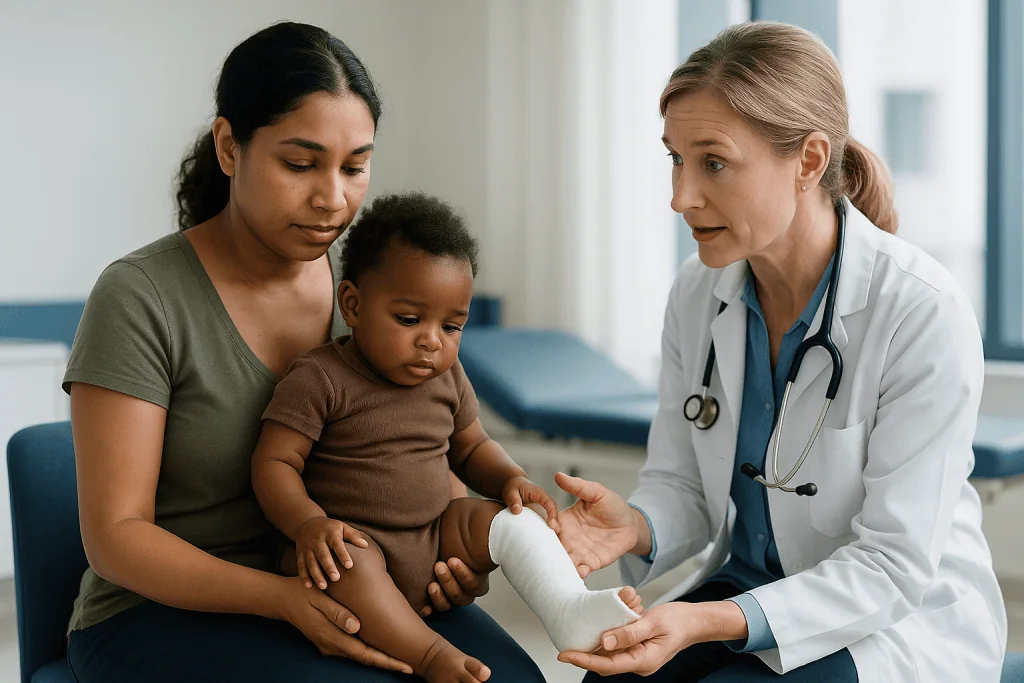
The first cast usually addresses the high arch by lifting the first toe and forefoot. This can look alarming, because the foot briefly appears more turned in, not less. It is deliberate. Aligning the forefoot with the heel first lets the rest of the foot rotate as one unit in the casts that follow. From the second cast onward, the whole foot is gradually turned outward around the head of the talus, the rounded bone at the top of the foot that acts as the pivot. By the fourth or fifth cast, the foot is often turned outward well beyond a normal resting position, sometimes to about 60 to 70 degrees in Ponseti’s original technique. That overcorrection is intentional and it relaxes afterward.
Casts come off either by soaking at home shortly before the appointment or with a cast saw in clinic. Some programs ask parents to soak the plaster in warm water and unwrap it themselves on the morning of the visit, which shortens the time the foot is unsupported.
Skin is checked at every change. Mild redness at the edges is common; pressure marks that do not fade, blisters or broken skin are not, and are addressed before the next cast.
Mayo Clinic reports that most children need around five to eight casts in total, and the NHS gives a range of about 4 to 10 weeks. A child who started later, whose foot is unusually stiff, or whose cast slipped once or twice may need more. Extra weeks here are common and are not a sign that the method is failing.
Clubfoot tenotomy recovery: what actually happens on the day
Once the foot has been rotated outward, one problem usually remains: the ankle still points downward because the Achilles tendon is too short. Stretching alone rarely fixes this, so most children have a tenotomy. A tenotomy is a tiny cut through a tendon that allows it to lengthen; in this case the heel cord is divided just above the heel so the ankle can come up to a neutral or slightly flexed position.
The procedure is brief. In many programs it is done in the clinic under a local anesthetic cream or injection, with the baby swaddled and often feeding; in others, particularly for older infants or both feet, it is done in an operating room under general anesthesia. The treating team chooses based on the child’s age, size and local practice. The skin incision is usually a few millimeters, closed with a small dressing rather than stitches.
Parents are frequently surprised by how small it is. The tendon in an infant is soft and thin, and the cut tendon ends begin to bridge with new tissue within days. Because the foot goes straight into a cast in its new position, the tendon heals at its longer length.
Recovery is quick by any adult standard. Most babies are back to normal feeding and sleeping the same day. The treating team will advise on comfort measures; any medicine decisions rest with them.
Not every child needs a tenotomy. When the ankle already comes up sufficiently after casting, the clinician may skip it. Mayo Clinic and Cleveland Clinic both describe the tenotomy as needed in the majority of children treated with this method, but the decision is made foot by foot on the day.
The three weeks after tenotomy: the last cast
The cast applied immediately after the tenotomy is different from the ones before it. It is a holding cast rather than a stretching cast. The foot sits in its fully corrected position, turned outward and with the ankle flexed up, and it stays that way for about three weeks according to the NHS. During those weeks the divided tendon fills in with new fibrous tissue at its longer length and the soft tissues around the ankle settle.
For families, this is often the calmest stretch of the whole casting phase. There are no weekly appointments to plan around. The baby is bigger and more settled than in the first weeks. The main tasks are the same as before: keep the plaster dry, check the toes are pink and warm, and watch that the cast has not slid down the leg.
A small amount of spotting on the dressing over the heel in the first day or two is expected. Blood soaking through the plaster, a foul smell, fever or a baby who is inconsolable when the leg is moved are not expected and warrant a call.
Removing this final cast is a milestone many parents photograph. The foot usually looks noticeably different from the one in the newborn pictures: flatter, turned slightly outward, with the heel down. Some swelling and dry, flaky skin are normal after weeks in plaster. A bath and a gentle moisturizer sort most of it.
The brace is fitted on the same day or very soon after. There is no rest period between cast and boots, because the corrected position needs to be held from the first hour it is free.
Clubfoot boots and bar schedule: the first three months in the brace
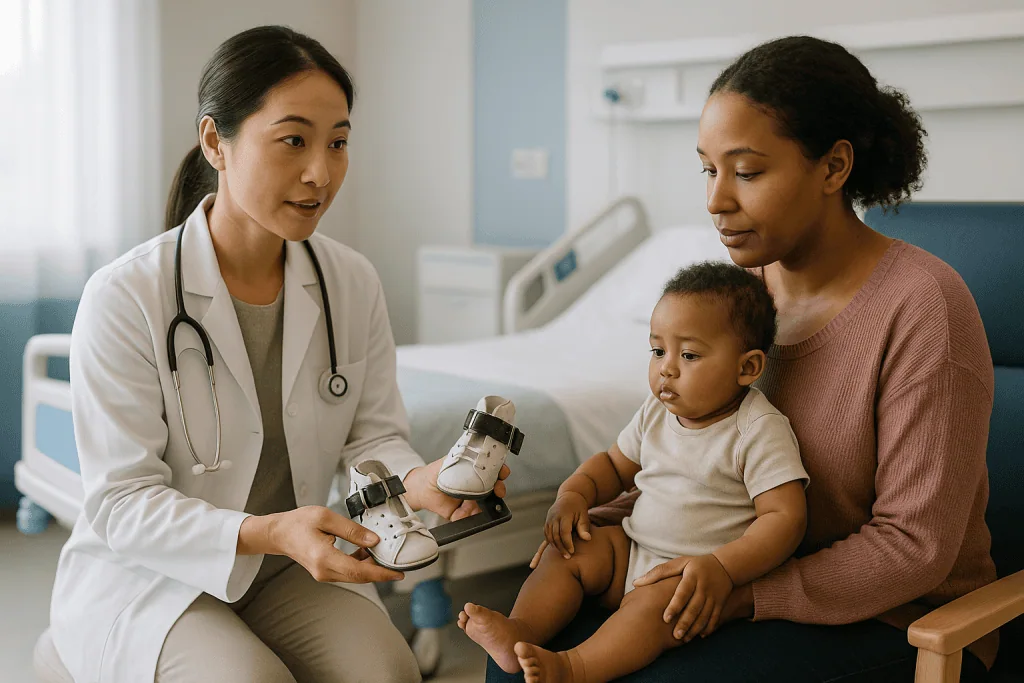
The brace used after Ponseti casting is often called boots and bar, or a foot abduction brace. It is a pair of open-toed shoes or sandals fixed to a metal bar roughly shoulder width apart, set so the corrected foot points outward and the other foot, if unaffected, sits in a more neutral angle. The word abduction simply means turning away from the midline of the body.
The purpose is straightforward. The same tendons and ligaments that were tight at birth still want to shorten as the child grows. Casting corrected the shape; the brace keeps it there while growth catches up.
In the first phase, the NHS describes the brace being worn for about 23 hours a day for roughly three months. The one hour off is for bathing, skin checks and stretching. Practically, that means the brace stays on for feeds, naps, car journeys and tummy time.
The first few nights are usually the hardest. A baby who has spent weeks in casts may kick and protest at having the legs linked together. Most settle within a week or two. Small adjustments help: dressing the child in a long onesie under the boots, tucking a folded blanket under the bar to stop it rattling against the crib, and treating the brace like a favorite toy rather than a punishment when it goes on.
Heel position is the detail that matters most. The heel must sit flat against the sole of the boot; if it lifts, the strap is too loose or the boot too large. A quick fingertip check through the heel window at every change becomes second nature.
How long do babies wear clubfoot braces? The night-time years
After the full-time phase, the brace moves to sleep hours only. The NHS advises wearing it overnight and during naps until the child is about 4 or 5 years old; Mayo Clinic describes night and nap wear continuing for up to about three years. Programs differ at the edges, but the shape of the schedule is the same everywhere: a short intensive phase, then years of bedtime wear.
Twelve to fourteen hours a night sounds like a lot until you consider what it replaces. Without bracing, the risk of the foot drifting back toward its original position, called relapse, rises sharply. In a large series published in Pediatrics by Morcuende and colleagues, relapse was uncommon overall but non-adherence with the brace was by far the strongest predictor of it. In plain terms, most relapses happen in children whose brace use lapsed.
The toddler years bring new challenges. A one-year-old can pull a boot off. A two-year-old can negotiate. Families who do well tend to make the brace non-negotiable in the way a car seat is non-negotiable, and to build it into the bedtime routine at a fixed point, such as immediately after the last story. Some children learn to walk in the brace in the morning before it comes off, swinging both legs together; this does no harm.
Boots need replacing as feet grow, and the bar width increases with the child. Most programs check fit every few months. Skin should be checked nightly for red marks that do not fade within about 20 minutes of removal.
The end date is set by the treating team, based on age, how the foot looks and behaves without the brace, and whether there has been any sign of drift.
Who the Ponseti method is usually for, and who is usually asked to wait
The method was designed for idiopathic clubfoot in newborns and young infants, and that is where the evidence is strongest. Johns Hopkins and Mayo Clinic both describe casting beginning in the first weeks of life as the standard approach. A baby with one or both feet affected, no other medical problems, and a foot that moves a little under gentle pressure is the typical candidate.
Age at the start is not an absolute barrier. Ponseti casting has been used successfully in children who present later, including toddlers, though more casts are often needed and the tissues respond less readily. A child who is already walking may need a different casting approach and closer supervision.
Some children are managed differently from the outset. When clubfoot occurs as part of a neuromuscular condition such as spina bifida or arthrogryposis, a condition in which multiple joints are stiff from birth, the foot is often stiffer and more prone to recurrence. Casting may still be the first step, but the team is more likely to plan for additional procedures.
Waiting is sometimes advised for practical rather than medical reasons. A premature baby may need to reach a certain weight or be stable enough to tolerate handling and heavy casts before starting. A newborn with a skin infection, a heart problem under investigation or another urgent issue may have casting deferred by a couple of weeks. The NHS notes that treatment usually starts within the first weeks, not the first days, and a short, planned delay does not compromise the result.
Surgery to release the joints, once the mainstay of treatment, is now generally reserved for feet that do not respond to casting or that relapse repeatedly despite good brace use. The choice of pathway rests with the treating orthopedic team.
How long does the Ponseti method take? An honest answer
The honest answer has two parts. The correction takes weeks. The maintenance takes years. Families who hear only the first part feel blindsided at month four; families who hear only the second part feel overwhelmed in week one.
Adding the ranges the NHS and Mayo Clinic report gives a typical arc: roughly 4 to 10 weeks of weekly casting, a tenotomy in most children, about 3 weeks in the final cast, around 3 months of near-continuous bracing, then sleep-time bracing until preschool age. From first cast to the last night in boots, that is commonly around four to five years, of which only two to three months involve casts.
Several things stretch the timeline. A cast that slips has to be reapplied, sometimes losing a week of progress. A stiff or previously treated foot needs more casts. Illness can postpone an appointment. A child who is bilateral takes no longer than a child with one foot affected, since both feet are casted at the same visits, but the brace phase can feel more demanding.
Relapse is the biggest variable. If the foot begins to turn back in during the brace years, the team may recommend a short return to weekly casting, often two to four casts, and sometimes a repeat tenotomy. In older children with a persistent tendency to swing the foot inward, a tendon transfer is sometimes suggested: the tibialis anterior, a muscle on the front of the shin, is moved to a new attachment on the outer side of the foot to balance the pull. That is a planned procedure rather than an emergency, and it is discussed case by case.
None of these detours mean the method has failed. They are part of what long-term follow-up is for.
Ponseti method success rate: what the evidence really shows
Parents search this phrase constantly, and the answer deserves precision rather than a reassuring number pulled from the air. Major patient references such as Mayo Clinic, Cleveland Clinic and the NHS describe the Ponseti method as the standard first treatment for clubfoot and state that it corrects the foot in most children when started early and followed by consistent bracing. They do not, and this article will not, promise a percentage for any individual child.
What published series show is consistent in direction. The Morcuende study in Pediatrics, following children treated with the method, reported initial correction in the large majority and found that relapse, which occurred in roughly one in ten children in that series, was strongly associated with the brace not being worn as advised. Extensive joint surgery, once routine, was needed in only a small fraction. That study is one center’s experience rather than a systematic review, so treat the numbers as illustrative of the pattern, not as a personal forecast.
Two caveats matter. First, a corrected clubfoot is not identical to a foot that was never affected. The calf on the treated side is often slightly slimmer and the foot may be a size or half size smaller, as the NHS and Mayo Clinic both note. Function is what the method aims for: a flat, flexible, pain-free foot that fits a normal shoe.
Second, outcomes depend heavily on the brace years. A method that corrects the foot in weeks but is abandoned in month six will not deliver the results the literature describes. The most useful question to ask a treating team is not the overall success rate but what they observe in their own follow-up and what would prompt them to change course.
Do babies with clubfoot take longer to walk?
This is one of the most common worries and, reassuringly, one where the evidence is fairly clear. Children treated for clubfoot generally walk within the usual age range. Cleveland Clinic and the NHS both describe treated children going on to walk, run and play normally, and casting in the first months of life does not interfere with the motor milestones of that period, which are mostly about head control, rolling and reaching.
The brace phase overlaps with the age when many children start pulling to stand and cruising along furniture, typically between about 9 and 15 months. By then most children are in night-time bracing only, so daytime practice is unrestricted. Some toddlers stand and take steps in the brace before it comes off in the morning; the bar does not stop them.
A few differences are worth knowing so they do not cause alarm. The treated foot may turn slightly outward when the child first walks, a leftover of the deliberate overcorrection in casting, and this usually settles. Calf size on the affected side is commonly smaller and remains so into adulthood. Shoe sizes may differ between feet in children with one-sided clubfoot. None of these predict a walking delay.
What does warrant attention is a child who consistently walks on the outer edge of the foot, whose heel does not touch the ground, or who trips more than peers. These can be early signs of relapse, and they are exactly what routine follow-up visits look for. Mention them at the next appointment rather than waiting for the foot to look visibly different.
Children with clubfoot linked to a neuromuscular condition follow a different developmental path shaped by that condition rather than by the foot.
Daily life in casts and braces: bathing, car seats, sleep and skin
The clinical timeline is one thing; the practical timeline is what families actually live. A handful of routines make the weeks in plaster and the years in boots much easier.
Bathing during casting means sponge baths. Plaster that gets wet softens and can slip, so most programs advise keeping the cast completely dry and wiping the baby down with a cloth, saving the full bath for the morning of a cast change when the plaster is coming off anyway. Once in boots and bar, the daily hour out of the brace is bath time.
Car seats fit over long-leg casts; the bar of a brace fits within most infant seats, though it may need the seat straps adjusted so the buckle does not press on the bar. Slings and carriers work with both, with the caveat that a cast-heavy leg can pull a newborn’s hips into an awkward angle in a narrow carrier.
Clothing is simpler than it looks. Footed sleepsuits do not fit over a cast, but footless ones do, and a sock over the exposed toes keeps them warm. For the brace, thin cotton socks that reach above the boot top reduce rubbing.
Skin is the daily check. At every diaper change during casting, look at the toes: they should be pink, warm and wiggling. After brace removal each morning, look at the heel, the ball of the foot and the top of the foot for redness that fades within about 20 minutes. Marks that stay, blisters or raw areas need a fit adjustment, not more padding, since padding changes the position of the foot inside the boot.
Sleep usually normalizes within one to two weeks of each transition. Consistency does more than any gadget.
What people often get wrong about the Ponseti method timeline
Myths cluster around this treatment because it looks so different from the surgery older relatives may remember. A few of the most common misunderstandings, corrected.
Myth: the casts are the treatment and the brace is optional once the foot looks straight. In fact the brace phase is where most of the long-term result is secured. The published evidence, including the Morcuende series, points to brace non-adherence as the strongest driver of relapse. A straight-looking foot at four months is the start of the maintenance job, not the end of it.
Myth: needing extra casts means the method is not working. More casts are common when the foot is stiff, the start was later, or a cast slipped. The NHS range of 4 to 10 weeks reflects that variability.
Myth: the tenotomy is a major operation. It is a small division of the heel cord through a cut a few millimeters long, done in minutes, with the baby often back to normal feeding the same day.
Myth: clubfoot happens because of how the baby lay in the womb. The cause of idiopathic clubfoot is not fully understood; Mayo Clinic and the NHS describe a mix of genetic and environmental factors, and it is not caused by anything a parent did or did not do during pregnancy.
Myth: a treated foot should look exactly like the other one. A slightly smaller foot and slimmer calf are expected and permanent. The goal is function, not symmetry.
Myth: once the brace years end, follow-up ends too. Many programs continue to review children periodically through the growing years, because a late drift is easier to manage when caught early.
Questions to ask your care team
Appointments are short and babies are loud. A written list helps. These are questions families often wish they had asked earlier, grouped by phase.
- Before the first cast: Is this idiopathic clubfoot, or is there any sign of an underlying condition that changes the plan? How many casts do you expect for a foot like this, and what would make you change your estimate?
- During casting: What does a slipped cast look like, and what should I do if it happens at night or over a weekend? Should I soak the cast off at home before appointments, or will it be removed in clinic?
- Around the tenotomy: Will this be done in clinic or under general anesthesia, and why that choice for my child? What will the heel look like in the first days, and what would worry you?
- Starting the brace: Exactly how many hours a day, and for how long, before we move to night-time wear? How do I check the heel is seated correctly? Who do I contact if the boots are rubbing?
- The brace years: How often will you check fit and growth? What early signs of relapse should I watch for at home? At what point would you consider the brace phase complete, and what happens after that?
- Long term: How long will you follow my child after bracing ends? What are the signs, years from now, that would justify a return visit?
One more question is worth asking directly: if I am struggling with the brace, will you help me problem-solve rather than judge? Teams that treat clubfoot regularly expect brace difficulties and have practical fixes. Raising a problem early is how relapse is prevented, not how a family is marked as non-compliant.
When to call your doctor
Most of the Ponseti pathway is uneventful, but a few situations need a same-day call to the treating team or, out of hours, an urgent care assessment. Do not wait for the next scheduled appointment.
During casting, call if the toes become pale, blue, dusky or cold to the touch, or if they are swollen and cannot be seen wiggling. Call if the cast has slipped so that the toes have disappeared inside the plaster or the knee is no longer bent, if the plaster is cracked, soft or soaked through, or if there is a foul smell or any drainage from inside the cast. A baby who screams inconsolably when the casted leg is touched, especially if this is new, needs to be seen. A fever without an obvious cause should also be reported, since skin under plaster cannot be inspected at home.
After the tenotomy, call if bleeding soaks through the dressing or cast, if the heel area becomes hot, red or swollen at the cast edge, or if the child develops a fever in the days following the procedure.
During bracing, call if there is a blister, broken skin or a pressure mark that does not fade within about 20 minutes of removing the boots, if the child suddenly refuses the brace after tolerating it well, or if the foot appears to be turning inward again, the heel is lifting off the ground when standing, or the child begins walking on the outer edge of the foot.
At any stage, trust the instinct that something has changed. The team would far rather check a foot that turns out to be fine than hear about a problem weeks later. Every decision about what to do next, including any change to the casting or bracing plan, sits with the treating clinicians who know the child.
Frequently asked questions
How long does the Ponseti method take from start to finish?
Active correction usually takes a few weeks, while maintenance bracing continues for years. The NHS describes weekly casting for about 4 to 10 weeks, a tenotomy in most children, roughly three weeks in a final cast, then a brace worn about 23 hours a day for around three months and during sleep until about age 4 to 5. Individual timelines vary and are set by the treating orthopedic team.
What is the Ponseti method success rate?
Major references such as Mayo Clinic and the NHS describe the method as correcting the foot in most children when started early and followed by consistent bracing, but no source can promise a percentage for an individual child. Published series report that relapse is uncommon and is most strongly linked to brace non-adherence. Ask the treating team what they observe in their own follow-up rather than relying on a single headline figure.
Do babies with clubfoot take longer to walk?
Generally no. Children treated for clubfoot typically walk within the usual age range, and the NHS and Cleveland Clinic both describe treated children going on to walk, run and play normally. Casting occurs in the early months before walking, and by the time most children pull to stand they are in night-time bracing only. A slightly outward-turned early gait and a smaller calf on the treated side are expected and do not signal delay.
How long do babies wear clubfoot braces at night?
Night and nap bracing typically continues until around age 4 to 5 according to the NHS, with some programs described by Mayo Clinic ending closer to age 3. This follows an initial phase of about three months at roughly 23 hours a day. The end date depends on how the foot looks and behaves without the brace and on whether there has been any sign of drift, and is decided by the treating team.
What does the clubfoot boots and bar schedule look like in the first weeks?
The brace goes on the same day the last cast comes off and is worn about 23 hours a day for roughly three months. The one hour off is used for bathing, skin checks and stretching. Families are taught to confirm the heel sits flat in the boot at each change and to look for red marks that do not fade within about 20 minutes. Most babies adjust to the brace within one to two weeks.
What is clubfoot tenotomy recovery like for a baby?
Recovery is usually quick. The tenotomy is a tiny cut through the Achilles tendon, done in minutes either in clinic under local anesthetic or in an operating room under general anesthesia depending on the child and local practice. A cast goes straight on and stays for about three weeks while the tendon heals at its longer length. Most babies feed and sleep normally the same day; comfort measures are guided by the treating team.
Why does the foot look more turned in after the first cast?
The first cast deliberately lifts the first toe and forefoot to correct the high arch, which can make the foot look briefly more turned in rather than less. This aligns the forefoot with the heel so the whole foot can then be rotated outward as one unit in the casts that follow. It is a planned step in the sequence Ponseti described, not a mistake.
What happens if a cast slips at home?
Contact the treating team the same day. A slipped cast is one where the toes have disappeared inside the plaster, the knee is no longer bent, or the cast has moved down the leg. It no longer holds the corrected position and may press on the skin, so it usually needs to be removed and reapplied. Programs typically give families an out-of-hours contact for exactly this situation.
Will my child's treated foot look the same as the other one?
Not exactly. The NHS and Mayo Clinic both note that a treated clubfoot commonly remains slightly smaller than the other foot and the calf on that side is slimmer, differences that persist into adulthood. The aim of treatment is a flat, flexible, pain-free foot that fits a normal shoe and allows full activity, rather than perfect symmetry.
Can clubfoot come back after the Ponseti method?
Yes, a return toward the original position is called relapse and is the main reason the brace phase lasts years. In a large series published in Pediatrics, relapse affected roughly one in ten children and was most strongly associated with the brace not being worn as advised. Relapse is usually managed with a short return to casting, sometimes a repeat tenotomy, and in older children occasionally a tendon transfer, all decided by the treating team.
References
- NHS: Club foot
- MedlinePlus: Clubfoot
- PubMed: Morcuende et al., Radical reduction in the rate of extensive corrective surgery for clubfoot using the Ponseti method (Pediatrics)
This article is for general information only and is not a substitute for professional medical advice. Please consult a qualified doctor about your individual situation.

More from the Blog

Local, Regional or General? Anesthesia Options for Finger and Toe Surgery Explained
Most finger and toe operations can be done under local anesthesia, usually a digital block that numbs only the affected digit while you stay…

Who May Be a Candidate for Proximal Fibular Osteotomy When Inner-Knee Arthritis Is Mild?
Proximal fibular osteotomy is usually considered for adults whose knee osteoarthritis is confined mainly to the inner (medial) compartment, who have mild to moderate…

Knee Pain Causes: Why Knees Hurt (and Why It Differs in Women)
Knee pain in women most often comes from patellofemoral (front-of-knee) pain, osteoarthritis, tendon or bursa irritation, meniscus wear, or ligament injury. Women see certain…

Shoulder, Elbow, Wrist or Hand: How Upper Limb Surgery Is Planned for Each Joint
Upper limb surgery covers operations on the shoulder, elbow, wrist and hand, from nerve releases and tendon repairs to fracture fixation and joint replacement.…

Life After Adult Reconstruction Surgery: Why High-Impact Sport Is Limited and What Replaces It
After adult reconstruction surgery, the orthopedic term for hip and knee replacement, most care teams advise a long-term shift away from running, jumping and…

How Foot Surgery Is Performed: Bunion Correction, Fusion and Tendon Repair Step by Step
Foot surgery is usually performed as a day procedure under a nerve block, spinal or general anesthetic. The surgeon makes one or more small…