

Prehab Before ACL Reconstruction: Why Swelling and Range of Motion Are Settled First

Key Takeaways
- Fluid inside a swollen knee reflexively switches off the quadriceps, a process called arthrogenic muscle inhibition, which is why strength work is postponed until swelling settles.
- A knee that enters surgery unable to fully straighten is much more likely to leave surgery stiff, so therapists chase symmetrical extension before a date is set.
- Mayo Clinic describes several weeks of physical therapy before reconstruction, aimed in order at swelling, motion and then strength.
- A locked knee, a combined ligament injury or repeated falls from giving way usually shorten the wait, because prehab serves the joint rather than the calendar.
- The Delaware-Oslo cohort found athletes who passed strength and hop criteria before returning to sport had an 84 percent lower re-injury rate than those who did not, making objective testing more protective than any date.
- The graft is generally described as most vulnerable during its early remodeling phase in the first months after surgery, a period when the knee often feels deceptively normal.
Prehab before ACL surgery is a period of guided physical therapy, often lasting several weeks, in which swelling is reduced and full knee straightening and bending are restored before reconstruction. Teams settle these first because a swollen, stiff knee switches off the quadriceps and raises the risk of a stiff joint after the operation. Strength work follows once the knee is calm, and the surgical team decides the timing.
The clinic hallway smells faintly of rubbing alcohol, and a nineteen-year-old midfielder is sitting on the edge of a treatment table with a knee that looks like it has swallowed a grapefruit. She wants a surgery date. What she gets instead is a tape measure around both knees, a goniometer resting on her thigh, and a physical therapist saying, gently, that the operation can wait a few weeks while the knee calms down.
That conversation happens thousands of times a year, and it frustrates almost everyone who hears it. A torn anterior cruciate ligament feels like an emergency. The knee buckles, the season is gone, and waiting seems like losing time. Yet prehab before ACL surgery is one of the few parts of this journey where the evidence, the surgeons and the therapists broadly agree.
This explainer walks through why swelling and range of motion are settled first, what the weeks before reconstruction usually involve, what to avoid, and which warning signs should send you back to your care team rather than your foam roller.
What is prehab before ACL surgery, and what actually happens?
The anterior cruciate ligament, or ACL, is a short band of tissue running diagonally through the middle of the knee that stops the shin bone sliding forward under the thigh bone and helps control twisting. When it tears, the knee bleeds into the joint, swells, and often refuses to straighten. Reconstruction replaces the torn ligament with a graft, a strip of tendon taken from elsewhere in your body or from a donor, threaded through tunnels drilled in the bone.
Prehab, short for prehabilitation, is the structured rehabilitation that happens between injury and that operation. It is not a warm-up or a motivational phase. According to Mayo Clinic, patients typically spend several weeks in physical therapy before surgery with three goals in a specific order: bring swelling and pain down, restore full range of motion, and rebuild muscle around the knee.
What that looks like in a room varies less than you might expect. Early sessions are quiet. A therapist measures how far the knee bends and straightens compared with the uninjured side, checks how much fluid sits in the joint, and asks you to tighten your thigh muscle while watching whether the kneecap actually moves. You may lie on your back sliding a heel along a wall. You may sit with a rolled towel under the ankle so gravity coaxes the knee toward straight. There is ice, compression, and a lot of walking practice with a normal heel-to-toe pattern.
Only when the knee is calm does the work start to resemble exercise as most people picture it: squats to a chair, step-ups, stationary cycling, single-leg balance. The order matters, and the next two sections explain why swelling and motion come before strength rather than alongside it.
Why does swelling get settled before anything else?
Fluid inside the knee joint is called an effusion, and after an ACL tear that fluid is often blood, a state known as hemarthrosis. Cleveland Clinic notes that a knee swelling rapidly within hours of a twisting injury is one of the classic features of an ACL rupture. That fluid is not just uncomfortable. It changes how the nervous system talks to your thigh.
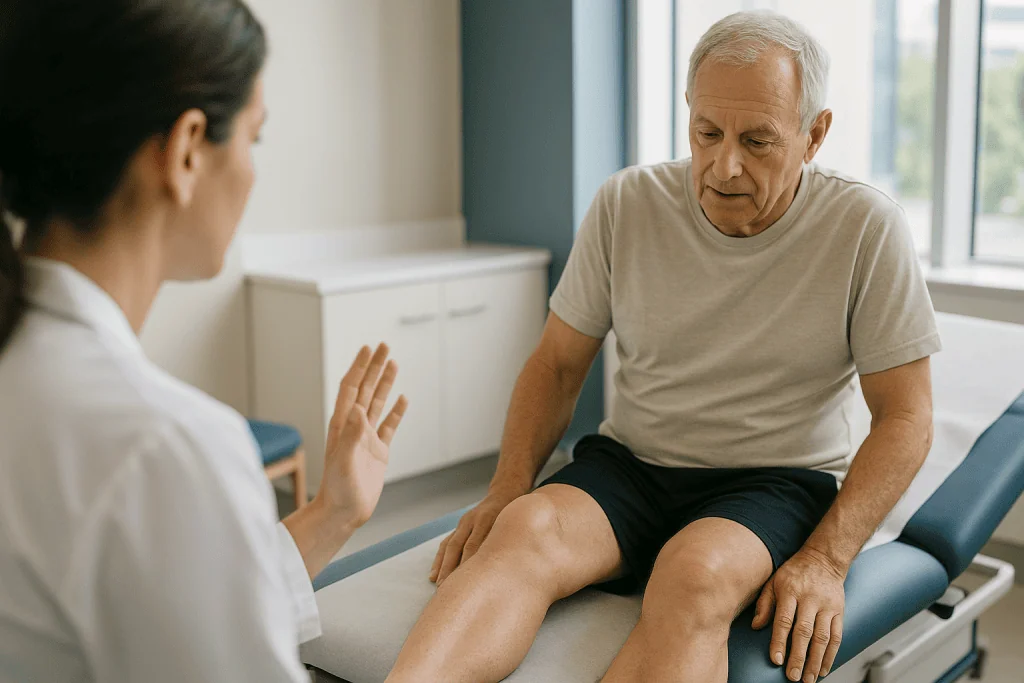
Here is the mechanism that drives the whole sequence. Stretch receptors in the joint lining sense pressure from the fluid and send signals up the spinal cord that reflexively dampen the quadriceps, the large muscle on the front of the thigh. Clinicians call this arthrogenic muscle inhibition, a plain-language version being that a swollen joint quietly switches off the muscle that protects it. You can want to contract the quad as hard as you like; the reflex still wins.
This is why a therapist watching you try a straight-leg raise in week one may see the leg lift with the knee sagging slightly into a bend. That sag is sometimes called a quadriceps lag, and it is a direct readout of inhibition, not of weakness or effort.
Trying to strengthen a knee in that state is like trying to charge a phone with the switch turned off at the wall. Reduce the fluid and the switch flips back on. So the early weeks lean on compression, elevation, cold, gentle motion to pump fluid out of the joint, and activity modification rather than heavy loading. Anti-inflammatory medicines are sometimes part of that plan; whether they are appropriate for you, and for how long, is a decision for your prescribing clinician, because they interact with other conditions and with surgical timing.
Swelling that settles and then abruptly returns after a minor twist is worth reporting, because it can point to a meniscus tear catching in the joint.
Why range of motion comes next: the extension problem
Range of motion means how far the knee bends, called flexion, and how far it straightens, called extension. Of the two, extension is the one surgeons lose sleep over. A knee that goes into the operating room unable to straighten fully very often comes out unable to straighten fully, and the graft then sits in a position that loads it abnormally with every step.
Losing even a few degrees of terminal extension changes gait. Walk down a corridor with one knee slightly bent and the calf, hip and low back on that side start working overtime within minutes. Over months, that pattern is associated with persistent front-of-knee pain and a feeling that the leg never quite belongs to you again.
The more serious complication is arthrofibrosis, a condition in which thick scar tissue forms inside the joint after surgery and physically blocks motion. The NHS lists stiffness among recognized problems after knee ligament surgery. Going in with a stiff knee is one of the strongest predictors of coming out with one, which is why therapists chase those last degrees of extension so stubbornly before a date is set.
Restoring motion is mostly patient, low-drama work. Heel props with the leg supported at the ankle so the back of the knee hovers off the surface. Prone hangs, lying face down with the lower leg off the end of a bed. Heel slides for flexion. A stationary bicycle with the seat set high so each revolution nudges the knee through its range. None of it should be forced or produce sharp pain; the target is symmetry with the other knee, measured with a goniometer, the protractor-like tool therapists use, rather than a feeling of having tried hard.
Who is prehab before ACL surgery usually for, and who is usually asked to wait?
Almost everyone heading toward reconstruction is a candidate for prehab, but the length and intensity differ, and a small group should not wait at all.
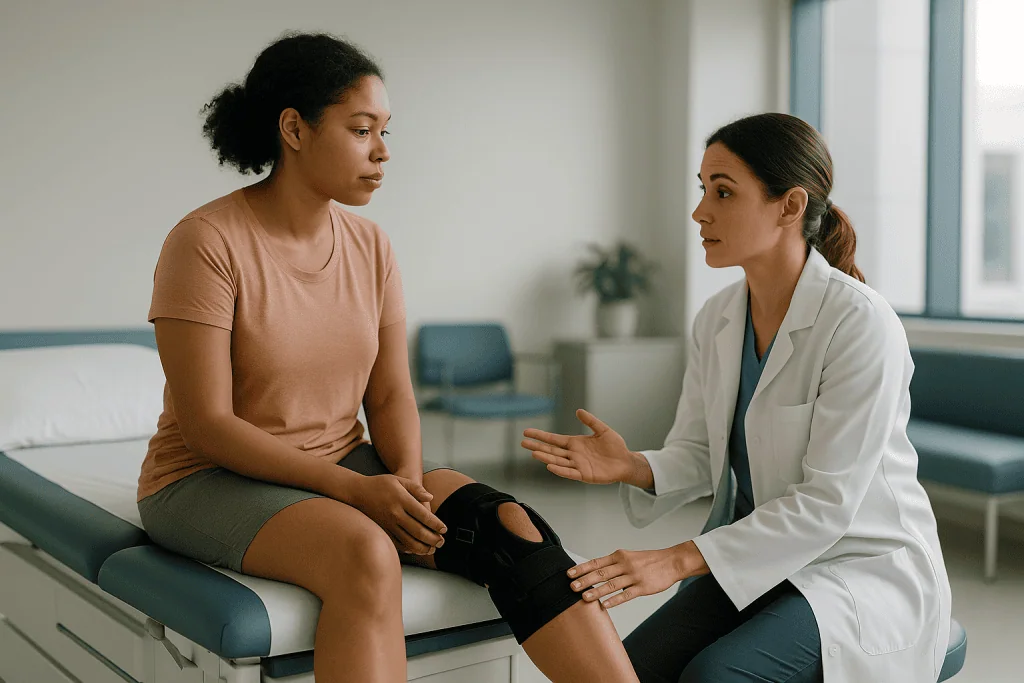
The typical candidate is someone with an isolated ACL tear, meaning no other structures in the knee need urgent attention, whose knee is swollen and guarded but mechanically free to move. For this person, MedlinePlus notes that surgery is usually delayed until swelling has gone down and motion has returned, and the weeks in between are used to build a quadriceps and hamstring base that will pay off after the operation.
People who are older, less active, or who tore the ligament during daily life rather than sport sometimes use the prehab period as a trial of non-operative management. The Mayo Clinic describes rehabilitation without surgery as a reasonable option for some people whose activities do not involve cutting or pivoting. If the knee stays stable through a full course of therapy, some of them never need the operation. Whether that path suits you is a judgment for your orthopedic team, weighing your age, goals and any other damage in the joint.
Then there are the people who are usually moved toward surgery sooner rather than later. A locked knee, one that cannot be straightened because a torn piece of meniscus, the cartilage cushion inside the joint, has flipped into the way, is the classic reason. Prolonged locking can damage the meniscus beyond repair and the joint surface beneath it. Combined ligament injuries, a bony avulsion where the ligament has pulled a fragment of bone away, and repeated giving-way episodes causing falls also shorten the waiting period in most guidelines. The team decides; the principle is that prehab serves the knee, not the calendar.
What does the evidence say prehab before ACL surgery changes?
Honesty is due here, because the online headlines promise more than the studies show.
The best-known data come from the Delaware-Oslo ACL cohort, a group of athletes followed for years through a structured program of pre-operative rehabilitation and criteria-based return to sport. A 2016 analysis in the British Journal of Sports Medicine, indexed on PubMed, found that athletes who met simple strength and hop criteria before returning, and who delayed return to pivoting sport, had substantially fewer re-injuries; the authors reported an 84 percent lower re-injury rate among those who passed the criteria compared with those who did not. That figure describes the whole pathway, of which prehab is the starting block, not prehab on its own.
Smaller randomized trials of structured prehab lasting several weeks have generally shown better quadriceps strength and single-leg hop performance in the early months after surgery compared with usual care. Two things temper that. The trials are small, and the strength advantage tends to narrow as everyone completes post-operative rehabilitation. Whether prehab changes long-term outcomes such as arthritis risk or return to the same level of sport is not established.
What is well supported, and is stated plainly by Mayo Clinic and MedlinePlus, is the reverse problem: operating on a swollen, stiff knee is associated with worse motion afterward. So the strongest argument for prehab is not that it adds a bonus. It is that skipping it removes protection against a known, avoidable complication.
Read a claim that prehab guarantees a faster or better recovery with the same skepticism you would apply to any promise about surgery. The evidence supports a calmer joint, a stronger starting point and a smoother first few weeks. It does not support certainty.
ACL prehab exercises: the categories physical therapists lean on
No single list of ACL prehab exercises fits everyone, and a program should be prescribed by a physical therapist who has examined your knee. What follows describes the categories, so the sessions make sense rather than feeling arbitrary.
Swelling control and gait come first. Ankle pumps, gentle knee bends within a comfortable range, and short, frequent walks with a deliberate heel strike encourage fluid to move out of the joint. Crutches are used for as long as the knee cannot bear weight without collapsing or limping heavily, then weaned as the pattern normalizes.
Quadriceps activation follows, and it is the heart of early prehab. Quad sets, tightening the thigh with the leg straight until the kneecap glides upward, teach the nervous system that the muscle is allowed to fire again. Straight-leg raises and terminal knee extensions, small movements from slightly bent to fully straight, target the last degrees that inhibition steals. Some clinics add neuromuscular electrical stimulation, a device that delivers pulses to the muscle to help it contract; it is an adjunct, not a substitute for voluntary effort.
Once motion approaches symmetry, closed-chain strengthening starts. Closed chain means the foot stays planted, as in squats, leg presses, step-ups and lunges, which loads the muscles while the joint stays relatively protected. Hamstring bridges and hip work are included because those muscles help restrain the shin bone from sliding forward, doing some of the absent ligament’s job.
Balance and proprioception, the sense of where your joint is in space, round things out with single-leg stance progressions. Cutting, jumping and pivoting drills are generally not part of prehab, because a knee without an ACL is exactly the knee that gives way during them.
How to prepare for ACL surgery beyond the knee itself
People searching how to prepare for ACL surgery usually mean the knee. The preparation that catches them out is everything else.
Start with the house. For a stretch of days after reconstruction you will be on crutches with a leg that does not want to bend. Stairs become a project, so a bed or sofa on the ground floor helps. Clear cords and rugs from the path between bed and bathroom. Put frequently used items at waist height. Set up a chair in the shower if you have one, and think about how you will get in and out when one leg cannot be trusted.
Arrange the people. Someone needs to drive you home after anesthesia and ideally stay the first night; the NHS advises against driving until you can perform an emergency stop comfortably, which is weeks away for most people. Meals prepared in advance, a plan for pets and children, and a frank conversation with your employer about when you might be able to work, and in what capacity, save a great deal of stress.
Talk to the anesthesia team about your medical history in full. Certain medicines and supplements affect bleeding or interact with anesthesia, and your surgical team will tell you what to stop and when; do not make those changes yourself. Smoking impairs wound and tendon healing, and stopping before surgery is one of the few preparation steps with clear benefit across almost all operations, according to the NHS.
Finally, plan the mental side. A long rehabilitation with a slow-moving knee is tedious, and the athletes who struggle most are often the ones who expected the operation to be the finish line rather than the halfway mark.
What not to do before ACL surgery
The question what not to do before ACL surgery has two answers: the medical checklist your team will give you, and the behavior patterns therapists see derail people.
On the medical side, follow the fasting instructions exactly, because eating or drinking too close to anesthesia can cancel the operation. Do not shave the surgical area yourself; clinics have their own protocol to reduce infection risk. Report any cut, rash, insect bite or infection on the leg, and any fever, cold or new illness in the days before, since an infection elsewhere in the body raises the risk of infection in the new graft and may require postponement. Do not stop or start any prescribed medicine on your own initiative.
On the behavior side, the first mistake is testing the knee. A knee without an ACL feels deceptively normal once the swelling drops, and people are tempted to jog, play a light game or twist to see how it holds. Each giving-way episode risks tearing the meniscus or bruising the joint surface, damage the surgeon then has to deal with and the joint carries for life. Cleveland Clinic and Mayo Clinic both flag instability episodes as a driver of further injury.
The second is chasing motion with force. Yanking the knee straight, having a friend lean on it, or pushing through sharp pain tends to inflame the joint and set the swelling cycle going again.
The third is stopping prehab once the knee feels better. Feeling better is the point at which strength work can finally start. Walking away from therapy then squanders the weeks the swollen phase cost you.
Milestones many teams look for before scheduling: a comparison table
Surgeons and therapists vary in how strictly they apply criteria, and some use timelines rather than benchmarks. The table below summarizes the milestones most commonly described in mainstream patient sources such as Mayo Clinic and MedlinePlus, and why each matters. It is a guide to the conversation, not a checklist that entitles anyone to a date.
| Milestone | What it means in plain terms | Why it matters before the operation |
|---|---|---|
| Minimal swelling | The knee looks close to the other side; the fluid wave test is small or absent | Fluid suppresses the quadriceps and hides true motion |
| Full extension | The knee straightens as far as the uninjured knee | Extension lost before surgery is hard to regain after |
| Near-full flexion | The knee bends enough for stairs and cycling comfortably | Stiff knees scar more after surgery |
| Quadriceps control | A straight-leg raise without the knee sagging | Shows the muscle has switched back on |
| Normal walking | Heel-to-toe gait without crutches or limp on level ground | Abnormal gait patterns persist if carried into recovery |
| Practical readiness | Home, transport and time off arranged; expectations discussed | Reduces the chance of skipped early rehabilitation |
Two caveats belong alongside it. Some teams operate earlier for younger athletes with associated meniscus tears that can be repaired, accepting a knee that is not perfectly calm because the meniscus repair cannot wait. Others delay longer when the joint keeps flaring. Neither approach is wrong; each reflects a judgment about what is inside your particular knee, which is why the person holding the scan and the scalpel makes the call.
ACL surgery recovery timeline: what the first days and weeks usually look like
The ACL surgery recovery timeline shifts with graft type, associated repairs and the individual, so the ranges below are typical rather than promised, and your team’s protocol overrides them.
The first days are about swelling, again. Most people go home the same day or the next, according to the NHS. Expect a bulky dressing, ice, elevation, and instructions to start quad sets and gentle motion almost immediately; the muscle inhibition you spent weeks reversing returns after surgery and must be reversed a second time. Crutches are standard, and a brace may or may not be used depending on the surgeon.
Through the first couple of weeks, the focus is regaining full extension, controlling pain, and walking with a heel-to-toe pattern. Wound checks happen in this window. Pain medicine is often part of the plan early on; mechanism, duration and any changes are for the prescribing clinician to decide.
Over the following months, strength work builds progressively, cycling and then jogging are introduced when motion and quad control allow, and hopping, cutting and sport-specific drills come last. Mayo Clinic notes that it can take up to a year or more before athletes are cleared to return to competitive pivoting sport, and the Delaware-Oslo data suggest that passing objective strength and hop tests before returning is more protective than any date on a calendar.
Two things surprise people. The first is how quiet the middle months feel; the knee looks normal long before it is ready. The second is that the athletes who did thorough prehab often describe the first post-operative weeks as familiar rather than frightening, because the exercises are the same ones they already know.
What week is the ACL graft the weakest?
This question comes up constantly, and it deserves a straight answer: mainstream patient sources do not give a single week, and anyone who does is simplifying.
Here is what is understood about the biology. On the day of surgery, a graft made from your own patellar tendon or hamstring tendon is strong, healthy tissue fixed firmly in bone tunnels. It then goes through a process sometimes called ligamentization, in which the body’s cells move into the tendon, strip out much of its original structure and rebuild it into something more ligament-like. During that remodeling the graft temporarily loses mechanical strength before regaining it. Surgeons commonly describe the early remodeling phase, roughly the first few months, as the vulnerable stretch, with the low point varying by graft type, fixation method and individual healing.
Two practical points follow. The first is that the graft being weakest during a phase when the knee feels fairly good is exactly why protocols limit twisting and impact in that period. Feeling ready and being ready diverge most sharply here. The second is that prehab has nothing to do with graft strength directly; the graft does not exist yet. What prehab influences is the muscle and motion around the graft, so the joint is not also fighting stiffness and weakness at the moment its new ligament is at its most fragile.
Re-tear risk is ultimately shaped more by what happens after the graft has matured: whether strength returns symmetrically, whether hop tests are passed, and how early pivoting sport resumes. The Delaware-Oslo cohort work indexed on PubMed frames those as measurable criteria, not dates. Your surgeon can tell you where you sit on that arc; a week number from the internet cannot.
What people often get wrong about prehab before ACL surgery
Myth one: waiting means losing time. The weeks between injury and surgery are usually the most efficient rehabilitation you will do, because you are training a knee without a fresh incision. The strength you build carries into the post-operative period and the motion you restore protects against stiffness. Delaying an operation for prehab is a scheduling choice, not lost ground, though the exception of a locked knee still stands.
Myth two: more exercise is better. The early phase is about doing less with intention. Heavy loading into a swollen joint tends to restart the inflammation cycle and switch the quadriceps back off. Progress in prehab is measured in millimeters of swelling and degrees of motion, not in how sore you are the next day.
Myth three: pain during stretching means it is working. Discomfort at the end of range is expected; sharp, catching or lingering pain is a signal to stop and report it. Forced motion inflames the joint and, when a meniscus fragment is involved, can worsen the tear.
Myth four: bracing protects the knee enough to play. A brace does not replace an ACL. Returning to pivoting sport before reconstruction with a brace still exposes the meniscus and cartilage to giving-way episodes, which is why Mayo Clinic and Cleveland Clinic list instability as a reason people ultimately choose surgery.
Myth five: prehab is only for athletes. The mechanisms described here, muscle inhibition from swelling and post-operative stiffness from pre-operative stiffness, apply to a fifty-year-old who slipped on ice just as much as to a college winger. If anything, the older knee has fewer reserves to spare.
Myth six: once the knee feels normal, therapy can stop. Feeling normal is the trigger for the strength phase, not the exit door.
Questions to ask your care team
The most useful visits are the ones where you leave understanding the reasoning behind the plan, not just the plan. These questions tend to open that door.
- Is there anything else torn in my knee, such as a meniscus or another ligament, and does that change how long we wait or what happens during the operation?
- Which milestones are you looking for before you set a surgery date, and how will you measure them?
- Given my age and the activities I want to return to, is non-operative rehabilitation a reasonable path to at least try, and how would we know it was not working?
- Which graft are you considering for me, and what are the trade-offs you weigh when choosing?
- What should I do if the knee gives way, locks or swells suddenly during prehab?
- How many prehab sessions per week do you recommend, and what should I be doing at home between them?
- What activities are off limits before surgery, and is there anything I am allowed to do that might surprise me?
- Which of my current medicines or supplements need to change before the operation, and when should I stop them?
- What does the first week after surgery look like practically: weight-bearing, brace, dressings, and when I will see the therapist again?
- What criteria, rather than dates, will you use to clear me for jogging, cutting and full sport?
Write the answers down. Between the emotion of the injury and the volume of information, few people remember more than a fraction of what was said, and having the reasoning on paper makes the slow weeks easier to trust.
When to call your doctor
Most of prehab is uneventful, but a handful of signs should prompt a call to your surgeon or therapist the same day rather than a wait for the next appointment. Prehab is designed for a knee that is sore and unstable; it is not designed to manage the problems below.
Before surgery, seek care promptly if the knee suddenly locks and cannot be straightened or bent past a fixed point, which can mean a meniscus fragment has moved into the joint. Report a sudden, tense new swelling after a minor twist, especially if the knee feels hot; new numbness, tingling or a cold, pale foot; a giving-way episode that caused a fall or a new injury; or fever, redness or a wound on the leg in the days before your date. Calf pain, calf swelling or tenderness behind the knee after a period of reduced activity can indicate a deep vein thrombosis, a blood clot in the leg, and warrants urgent assessment; sudden breathlessness or chest pain alongside it is an emergency.
After surgery, the NHS and MedlinePlus list similar red flags: fever, spreading redness or discharge from the wound, pain that escalates despite the prescribed plan, calf pain or swelling, chest pain or shortness of breath, and loss of sensation or movement in the foot. Any of these should be reported without waiting to see whether they settle.
Everything else, the dull ache after a session, the stiffness in the morning, the frustration at week three when progress seems to stall, belongs in the ordinary conversation with your therapist. Your treating team makes every decision about timing, medicines and clearance; this article exists to help you understand their reasoning, not to replace it.
Frequently asked questions
How to prepare before ACL surgery?
Preparation has two halves: calming and strengthening the knee through supervised physical therapy, and organizing life around a period on crutches. Mayo Clinic describes several weeks of therapy to reduce swelling, restore motion and rebuild muscle. Alongside that, arrange transport home, ground-floor sleeping if possible, meals, time off work, and a full medication review with the anesthesia team, who will tell you what to pause and when.
What should you not do before ACL surgery?
Avoid testing the knee with running, pivoting or sport, because giving-way episodes can tear the meniscus and damage cartilage. Do not force motion through sharp pain, and do not stop therapy once the knee feels better, since that is when strength work begins. Follow fasting and skin-preparation instructions exactly, report any illness or skin infection, and never stop or start medicines without your surgical team’s direction.
What I wish I knew before ACL surgery?
Patients most often say they wish they had understood that surgery is the midpoint, not the finish line, and that the exercises after the operation are largely the same ones learned in prehab. Many also describe being surprised by how normal the knee feels months before it is ready for sport, and how much objective testing, rather than dates, ended up guiding their return.
What week is the ACL graft the weakest?
No mainstream patient source pins a single week. The graft is strong on the day of surgery, then undergoes a remodeling process sometimes called ligamentization, during which it temporarily loses mechanical strength before regaining it. Surgeons generally describe the first few months as the vulnerable window, varying with graft type and fixation. That is why twisting and impact are restricted even when the knee feels good.
Which ACL prehab exercises are usually included?
Programs typically progress through categories rather than a fixed list: swelling control and walking practice, quadriceps activation such as quad sets and straight-leg raises, range-of-motion work like heel slides and prone hangs, then closed-chain strengthening including squats, step-ups and bridges, and finally balance drills. Cutting and jumping are usually excluded because an ACL-deficient knee gives way during them. A physical therapist should prescribe the specifics.
How long does prehab before ACL surgery usually last?
Mayo Clinic describes several weeks of physical therapy before reconstruction, with the exact length set by the knee rather than a fixed schedule. Teams typically look for swelling to settle, extension to match the other side and the quadriceps to fire before scheduling. Some injuries, such as a locked knee from a displaced meniscus tear, are operated on sooner; some knees that keep flaring take longer.
What does the ACL surgery recovery timeline look like?
Most people go home the same day or the next, according to the NHS, and begin gentle motion and quadriceps activation almost immediately. The first weeks center on extension, swelling and normal walking. Strength builds over months, with jogging and then cutting introduced when criteria are met. Mayo Clinic notes that return to competitive pivoting sport can take up to a year or more.
Can ACL prehab replace surgery?
For some people it becomes the treatment. Mayo Clinic describes rehabilitation without surgery as an option for those whose activities do not involve cutting or pivoting and whose knee stays stable. The weeks of prehab function as a trial: if the knee remains stable through progressive loading, surgery may not be needed. Repeated giving way during that period usually points back toward reconstruction. Your orthopedic team decides.
Why is full knee extension so important before ACL reconstruction?
Because extension lost before surgery is difficult to recover after it. A knee that cannot straighten fully changes walking mechanics, loads the new graft abnormally and is a strong risk factor for arthrofibrosis, a build-up of internal scar tissue that physically blocks motion. Restoring symmetrical extension with heel props, prone hangs and gentle terminal extension work is therefore one of the first milestones therapists measure.
Does prehab guarantee a better outcome after ACL surgery?
No. Small trials suggest structured prehab is associated with better early quadriceps strength and hop performance, and the Delaware-Oslo cohort shows a pathway of prehab plus criteria-based return is linked to fewer re-injuries. Long-term effects on arthritis or return to previous level are not established. The clearest benefit is avoiding a known harm: operating on a swollen, stiff knee is associated with worse motion afterward.
References
- MedlinePlus: Anterior cruciate ligament (ACL) reconstruction
- NHS: Knee ligament surgery
- Cleveland Clinic: ACL tear
This article is for general information only and is not a substitute for professional medical advice. Please consult a qualified doctor about your individual situation.

More from the Blog

Living With Shoulder Impingement: Posture, Desk Setup and the Overhead Habits to Change
Living with shoulder impingement usually means managing a painful arc of movement rather than enduring permanent damage. Most people improve over weeks to months…

When Is Arthroscopy Enough and When Is Open Surgery Needed? How Surgeons Decide
Arthroscopy is usually enough when the problem is inside the joint, limited in size, and reachable with a thin camera and small instruments, such…

The First Two Weeks After ACL Surgery: Crutches, Bracing, Ice and Bending the Knee
The first two weeks after ACL surgery usually focus on four jobs: walking safely with crutches, wearing any brace the surgeon has prescribed, controlling…

Rotator Cuff Surgery Cost: Pricing the Repair, Honestly
In our August 2026 guide, rotator cuff repair for international patients typically runs EUR 4,700–11,050, compared with roughly GBP 4,400–8,500 for private surgery in…

Arthroscopic Surgery for Shoulder Impingement: What Subacromial Decompression Involves
Shoulder impingement surgery, usually arthroscopic subacromial decompression, is a keyhole operation that removes inflamed bursa and shaves a few millimeters of bone from the…

How Tenosynovitis Starts: Why a Tendon Sheath Swells and How Care Is Planned
Tenosynovitis usually starts when the thin, fluid-lined sheath around a tendon becomes irritated, most often from repeated gripping, twisting or lifting, and less often…