

Preparing for a Craniotomy: Blood Thinners, Fasting, Smoking and the Anesthesia Review

Key Takeaways
- Anticoagulants such as warfarin slow the clotting cascade over days, while antiplatelet drugs such as aspirin disable platelets for their whole lifespan, so each is paused on a different timeline set by the prescriber.
- Fasting before anesthesia protects the lungs, not the brain: NHS guidance describes about six hours without food and often clear fluids until roughly two hours before a general anesthetic.
- The CDC notes carbon monoxide in the blood falls toward normal within about a day of the last cigarette, so even a late quit improves oxygen delivery to the healing scalp and bone flap.
- Fish oil, vitamin E, ginkgo and ibuprofen all affect platelets and belong on the medicine list you bring to the anesthesia review.
- The head is fixed in a padded three-pin skull clamp during a craniotomy, which is why pin-site tenderness and neck stiffness are common and usually temporary afterward.
- Jaw stiffness when chewing is a recognized consequence of lifting the temporalis muscle in operations at the side of the head, and it is the main reason early meals are soft.
Preparing for a craniotomy usually means a pre-operative assessment several weeks ahead, a carefully timed plan for any blood-thinning medicine set by the prescribing clinician, stopping smoking as early as possible, and following exact fasting instructions before anesthesia. Nothing about a blood thinner should be changed without the surgical and prescribing teams agreeing, because both bleeding and clotting risks matter during brain surgery.
The envelope arrives with a date, a time to stop eating, and a page about medicines that reads like it was written for someone else. Then the person reads it again, because the heart tablet they have taken every morning for six years is on the list, and the instruction says not to decide anything alone.
That small moment of hesitation is the whole point of this article. Preparing for craniotomy is less about packing a bag than about four quiet decisions made in the right order: what happens to blood thinners, how long the stomach stays empty, when the last cigarette is, and what the anesthesia team needs to know before anyone picks up a scalpel.
Each of those has a mechanism behind it. Once the mechanism is clear, the instructions stop feeling arbitrary and start feeling like the safety rails they are.
What actually happens during a craniotomy, and why the planning starts weeks early
A craniotomy is an operation in which a surgeon temporarily removes a section of skull bone, called a bone flap, to reach the brain, then replaces and secures it at the end. The flap is held with small plates or sutures, and over time the bone knits back. The reasons for the operation vary widely: removing a tumor, clipping an aneurysm (a weak bulge in a brain artery), draining a blood clot, treating epilepsy or relieving pressure after a head injury. MedlinePlus describes the general sequence, from shaving a strip of hair and opening the scalp to closing the layers in reverse.
Why does that matter for preparation? Because the brain sits inside a rigid box with almost no spare room. Bleeding that would be a nuisance in a knee operation can become a serious problem under the skull, where even a small volume of blood presses on tissue that cannot move out of the way. This single fact explains most of the pre-operative rules.
It also explains the timeline. Some medicines keep working for days after the last dose, so the plan for them has to be set well before the surgery date. Lungs recover from cigarette smoke over weeks, not hours. The anesthesia team wants blood tests, a review of the heart and airway, and sometimes imaging before they will commit to a date. The NHS notes that a pre-operative assessment typically happens in the weeks before a planned operation for exactly these reasons.
Most people have more time than they think. A planned craniotomy for a slow-growing tumor usually leaves room for a proper run-up. An urgent one, for a bleed or acute pressure, compresses all of this into hours and shifts the decisions to the team at the bedside. Everything below describes the planned version, with the caveat that your surgeon’s written instructions override anything general.
Why blood thinners matter so much when preparing for craniotomy
Blood thinner is a loose everyday term for two very different drug families, and the distinction shapes the entire pre-operative plan.

Anticoagulants slow the chemical cascade that turns liquid blood into a clot. Warfarin works by reducing the liver’s production of clotting proteins, which is why its effect builds and fades over days. The newer direct oral anticoagulants, such as apixaban or rivaroxaban, block one clotting factor directly, so their effect is shorter and more predictable, though it depends partly on how well the kidneys clear the drug.
Antiplatelet medicines, such as aspirin or clopidogrel, work on platelets, the small cell fragments that form the first plug at a wound. Aspirin disables a platelet permanently, so its effect lasts until the body replaces those platelets, a process measured in days rather than hours.
Here is the tension the team has to resolve. Stopping these drugs reduces bleeding risk inside the skull during and shortly after surgery. Stopping them also exposes the reason they were prescribed: a mechanical heart valve, a recent coronary stent, atrial fibrillation (an irregular heart rhythm that lets clots form in the heart), or a previous clot in the leg or lung. For some people the clotting risk of a pause is small; for others it is the more dangerous side of the ledger.
That is why the decision belongs to the prescribing clinician and the surgical team together, often with a cardiologist or hematologist. They weigh what the drug is protecting against, how long it lingers, and whether a short-acting injectable anticoagulant such as heparin should “bridge” the gap. What matters for you is practical: bring an exact list of every blood-thinning medicine, when it was started and why, and do not alter anything until you have written instructions that name the drug and the date.
Anticoagulants, antiplatelets and the supplements people forget to mention
The two drug families are handled differently because they leave the body differently. Warfarin’s effect is monitored with a blood test called the INR, which measures how long blood takes to clot; the surgical team usually wants that number back in a normal range before operating. Direct oral anticoagulants are not routinely measured by a simple test, so the plan relies on timing and kidney function instead. Antiplatelet drugs cannot be “switched off” early by any test result; the body simply needs time to make fresh platelets.
Then there is the drawer nobody mentions at the clinic. Several over-the-counter products and supplements have a measurable effect on platelets or clotting, including ibuprofen and other non-steroidal anti-inflammatory drugs, fish oil, vitamin E, ginkgo, garlic extracts and ginseng. The evidence for how much each one raises surgical bleeding varies from solid to thin, and the NIH Office of Dietary Supplements is candid that interactions are often poorly studied. Surgeons tend to err on the side of caution, which is why the NHS and MedlinePlus both advise telling the team about every supplement and herbal remedy, not just prescriptions.
A short comparison helps keep the categories straight:
| Group | Examples (generic) | How it works | Why timing matters |
|---|---|---|---|
| Vitamin K antagonist | Warfarin | Lowers production of clotting proteins | Effect fades over days; checked with INR |
| Direct oral anticoagulant | Apixaban, rivaroxaban, dabigatran | Blocks one clotting factor directly | Shorter effect; depends on kidney function |
| Antiplatelet | Aspirin, clopidogrel | Stops platelets sticking together | Lasts until new platelets replace old ones |
| Supplements and NSAIDs | Fish oil, vitamin E, ginkgo, ibuprofen | Variable effect on platelets | Evidence mixed; usually declared and reviewed |
No row in that table is a recommendation. It is a map of what the team is thinking about when they ask what you take.
Fasting before brain surgery: what the empty stomach is really for
The fasting rule is about the lungs, not the brain. Under a general anesthetic the reflexes that normally keep stomach contents out of the windpipe are switched off. If food or acidic liquid comes back up and is inhaled, it can cause a serious lung injury called aspiration pneumonia. An empty stomach makes that far less likely, which is why the anesthetist is so insistent about it.
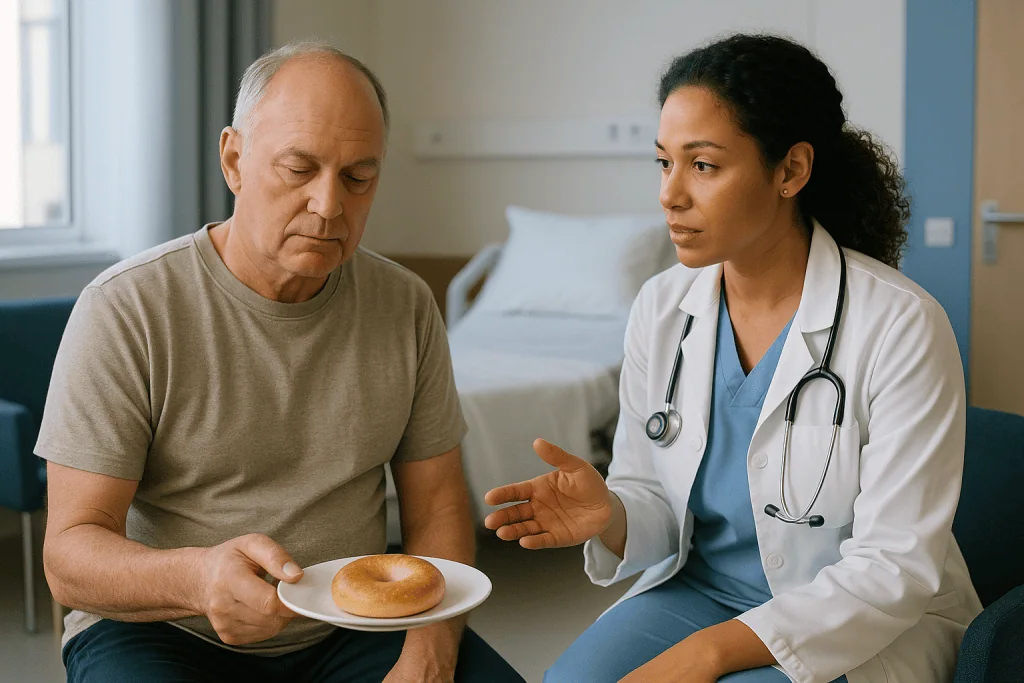
The NHS describes the usual pattern for a general anesthetic: no food for roughly six hours beforehand, with clear fluids such as water often allowed until about two hours before. Those windows exist because solid food and milk leave the stomach slowly, while clear liquids pass through quickly and may actually make the pre-operative period more comfortable. Your own written instructions may differ, and if they do, follow them rather than any general figure.
A few details trip people up. Chewing gum and boiled sweets stimulate stomach secretions and usually count as eating. Milky coffee is not a clear fluid. Diabetes changes the picture, because long fasts can push blood sugar too low; the pre-assessment team will usually give specific guidance on glucose checks and on which diabetes medicines are taken or held, and that guidance comes from them, not from this article.
Regular medicines are the other common question. Many are taken as usual on the morning of surgery with a small sip of water, because missing them does more harm than the sip does. Others are deliberately held. The anesthesia review is where that list is settled, drug by drug.
If you break the fast by mistake, say so. It is far better to delay an operation by a few hours than to proceed with a stomach that is not empty, and no competent team will be annoyed by honesty.
Smoking and nicotine: what stopping does for your brain and your wound
Cigarette smoke harms a surgical patient along three separate paths, and each one recovers on its own clock.
Carbon monoxide binds to hemoglobin and crowds out oxygen. The CDC notes that carbon monoxide levels in the blood fall back toward normal within about a day of the last cigarette, which is why even a very late quit still helps the tissues get oxygen. Nicotine narrows small blood vessels, including the tiny ones that feed a healing scalp and bone flap. The airways are the slowest to recover: smoke irritates the lining, increases mucus and weakens the small hairs that clear it, so smokers are more prone to chest infections and breathing problems after anesthesia. MedlinePlus is clear that the longer the gap between quitting and surgery, the greater the benefit, with weeks being better than days.
The scalp wound deserves special mention. A craniotomy incision is long, and the skin over the skull has a limited blood supply to begin with. Anything that constricts those vessels makes infection and slow healing more likely. The same applies to the bone flap, which relies on surrounding blood flow to reintegrate.
What about vaping or nicotine patches? The evidence here is incomplete. Nicotine replacement removes the carbon monoxide and the tar but keeps the vessel-narrowing effect of nicotine. Most anesthetists regard replacement therapy as preferable to continued smoking, while asking that you tell them you are using it. The honest summary is that stopping all nicotine is best, stopping the smoke is next best, and the decision about replacement products should be made with the team rather than in a shop aisle.
Quitting before major surgery is hard precisely when stress is highest. Ask for support at the pre-assessment visit; many hospital groups run stop-smoking services, and the evidence for combining behavioral support with medicines is stronger than for willpower alone.
What happens at the anesthesia review before a craniotomy
The anesthesia review, often called the pre-operative assessment, is a structured appointment where a nurse or anesthetist works out how safely you can be put to sleep and kept stable for several hours. The NHS describes it as a mix of questions, examination and tests, usually held in the weeks before a planned operation.
Expect a detailed medical history: heart disease, breathing problems, previous anesthetics and any reactions to them, sleep apnea, reflux, diabetes, kidney disease, allergies and bleeding tendencies. Expect to be asked about alcohol, recreational drugs and every medicine and supplement you take, because all of these change how anesthetic drugs behave.
The airway examination looks ordinary but matters a great deal. The anesthetist checks how wide you can open your mouth, the state of your teeth, the mobility of your neck and the shape of your jaw. For a craniotomy the head is fixed in one position for hours, so planning how to secure the breathing tube and protect the eyes and pressure points is part of the conversation.
Tests usually include blood counts, kidney and liver function, clotting studies and a blood group so that matched blood is available. Many people have an ECG (a tracing of the heart’s electrical rhythm), and some need a chest X-ray or heart scan. If you are on warfarin, an INR is checked.
Neurosurgical anesthesia has a few specific concerns. Blood pressure is controlled tightly to protect the brain. Some operations are done with the patient awake for part of the procedure so that speech or movement can be tested; if that applies to you, the anesthetist will explain how sedation and local anesthetic work together. Bring your questions written down. This is the appointment where the medicine plan is confirmed, in writing, with dates.
Who is usually cleared to proceed, and who is asked to wait
A planned craniotomy goes ahead when the risks of operating are judged lower than the risks of waiting, and that judgment is personal to each patient. Still, a few patterns are common enough to describe.
People are usually cleared when their blood pressure is controlled, their blood sugar is reasonably stable, their clotting results are in the expected range for the plan agreed with the prescribing clinician, and they have no active infection. A recent chest cold, a urinary infection or an infected tooth can all prompt a short delay, because infection raises the risk of a wound or bone-flap infection and makes anesthesia riskier.
Blood thinners are the most frequent reason for rescheduling. If a drug has not been paused for the agreed number of days, or if an INR is still high, most surgeons will not operate electively. The reverse also happens: someone with a very recent coronary stent may be asked to wait until the stent has settled enough for the antiplatelet regimen to be safely interrupted, a decision that sits with cardiology.
Other common reasons to pause include a new heart rhythm found on the ECG, severe anemia, kidney function that has worsened, poorly controlled sleep apnea, or a chest that is still recovering from heavy smoking. None of these is a judgment about the person. They are physiological variables that the team wants in a better place before an operation this significant.
Urgent and emergency craniotomies follow a different logic entirely. When a bleed or rising pressure threatens the brain, the team acts and manages blood thinners with reversal agents at the bedside. Those decisions are made in minutes and belong wholly to the clinicians present.
If your surgery is postponed, ask what specifically needs to change and how it will be rechecked. A clear answer turns a frustrating delay into a task list.
What is the proper position for a craniotomy?
People searching this question often expect a single answer. There is not one, because the position depends on where in the brain the surgeon needs to reach.
Common positions include lying on the back with the head turned, lying on the side, lying face down for operations at the back of the head, and a semi-sitting position for some operations near the base of the skull. In almost every case the head is held completely still in a skull clamp, a padded frame with three small pins that press into the outer table of the skull under anesthesia. The pins leave small marks that heal and may feel tender for a short while afterward.
Positioning is a shared task between surgeon and anesthetist. Pressure points at the hips, elbows, heels and face are padded. The eyes are protected and taped. The neck is kept in a range that does not kink the veins draining the brain, because poor venous drainage raises pressure inside the skull. For the semi-sitting position the anesthetist watches for air entering veins, a specific risk of having the head above the heart.
Why mention any of this to a patient who will be asleep? Partly to explain two things people notice afterward: neck stiffness and tender pin sites. The neck can be sore from several hours in one position, and the small pin wounds can itch or feel bruised. Both usually settle, and both are worth mentioning to the team if they do not.
Partly, too, because knowing that the position is chosen for your particular operation removes one more unknown. There is nothing for you to practice or decide. The only preparation that helps positioning is telling the anesthetist at the review about neck problems, prior spine surgery, shoulder injuries or anything that limits how you can lie.
Preparing for craniotomy week by week: craniotomy pre-op instructions in one table
Written craniotomy pre-op instructions vary between teams, but the shape of the run-up is remarkably consistent. The table below is a general picture built from NHS and MedlinePlus guidance, not a schedule to follow in place of your own letter.
| When | What usually happens | What you can do |
|---|---|---|
| Weeks before | Pre-operative assessment, blood tests, ECG, imaging review; medicine plan agreed between surgeon and prescriber | Stop smoking as early as possible; list every medicine and supplement; arrange time off and help at home |
| Days before | Agreed pause of specific blood thinners begins on the date set by the prescribing clinician; INR rechecked if on warfarin | Follow the written dates exactly; report any new infection, fever or cough |
| Night before | Fasting window starts; some teams ask for an antiseptic wash | Remove nail polish and jewelry; pack glasses, hearing aids, a medicine list |
| Morning of | Clear fluids may be allowed until the stated cut-off; specified morning medicines taken with a sip of water | Arrive on time; wear loose clothing; bring your instruction letter |
A few practical details sit outside the table. Hair is usually clipped only along the incision line rather than fully shaved, and the team will tell you whether to wash your hair the night before. Dentures, contact lenses and piercings come out before anesthesia. If you wear a hearing aid, ask whether you can keep it in until you are asleep, so you can hear the team.
Home preparation is the part people underestimate. MedlinePlus and NHS discharge guidance both assume someone can collect you and stay with you for the first days. Set up a place to rest that does not involve stairs, stock food that is easy to prepare, and write down the number to call after discharge before you need it.
None of this is complicated. Its value lies in doing it in order and in writing, so that the day itself holds no surprises.
The first days after a craniotomy: what recovery usually looks like
Most people wake in a recovery area or intensive care unit, where nurses check the pupils, limb strength and level of alertness every hour or so. This is routine neurological observation, not a sign that something is wrong. The head is bandaged, there may be a small drain under the scalp, and a urinary catheter and intravenous line are usually in place for the first day.
MedlinePlus notes that a hospital stay of several days to about a week is typical after brain surgery, with the exact length depending on the reason for the operation and how quickly swelling settles. Swelling is the dominant theme of the first days. The brain reacts to being handled much as an ankle reacts to a sprain, and the team may use medicines to limit it. Headache, fatigue, nausea and facial puffiness around the eye on the operated side are common and usually ease as the swelling does.
Walking starts early, often the day after surgery, both to prevent clots in the legs and to help the lungs clear. Physiotherapists and occupational therapists assess movement, balance and daily tasks. If speech or memory were near the operated area, a speech and language therapist may be involved.
Going home is the beginning of the slower phase. Fatigue tends to be the most persistent complaint, and it is often out of proportion to how the wound looks. Concentration can be poor, sleep disrupted and emotions closer to the surface. Hospital guidance in the United States and the United Kingdom describes a gradual return to usual activity over weeks, commonly one to two months for a straightforward operation, with driving, heavy lifting and contact sports resuming only when the surgeon agrees.
Stitches or staples are usually removed at a wound check in the first couple of weeks. Keep the scalp clean and dry as instructed, and resist the urge to pick at scabs along the incision.
What to eat after a craniotomy, and is jaw pain after craniotomy normal?
Two searches that look unrelated are actually the same question, because the answer to one often shapes the other.
Take the jaw first. For operations at the side of the head, the surgeon has to move the temporalis muscle, the large chewing muscle that fans across the temple. It is lifted off the bone, held aside and reattached at the end. For days to weeks afterward, opening the mouth wide and chewing firm food can be uncomfortable or stiff, and the temple may feel tight or tender. This is a recognized consequence of the approach, not a complication in itself, and most teams encourage gentle jaw movement as it settles. Jaw pain that worsens sharply, comes with swelling and redness over the temple, or is accompanied by fever should be reported, because those features point toward infection rather than muscle soreness.
That stiffness is why the first meals are usually soft: yogurt, scrambled eggs, soups, mashed vegetables, oatmeal, soft fish, well-cooked grains. Nausea from anesthesia and from medicines used to limit swelling can blunt appetite, so small, frequent portions tend to work better than three large meals.
Beyond texture, the principles are the ones that apply to healing after any major operation. Protein supports tissue repair, so include eggs, dairy, legumes, poultry or fish at each meal if you can. Fluids matter because dehydration worsens headache and constipation. Constipation is common after surgery, driven by reduced movement and by opioid-containing painkillers, and fiber from fruit, vegetables and whole grains helps; straining raises pressure in the head and is best avoided, so mention persistent constipation to the team.
If you have diabetes, the medicines used to control brain swelling can raise blood sugar, and your usual regimen may need adjusting by the prescribing clinician. Alcohol is generally advised against while on painkillers and anti-seizure medicines. The dietitian on the ward is an underused resource; ask for a visit before discharge if eating is a struggle.
What people often get wrong about preparing for brain surgery
“I’ll just stop my aspirin to be safe.” This is the most dangerous misunderstanding in the whole process. For someone with a recent coronary stent, an unplanned pause in antiplatelet therapy can cause the stent to clot. For someone with a mechanical heart valve, stopping warfarin without a plan can cause a stroke. The pause is only safe when the clinician who prescribed the drug has agreed to it and set the date.
“Clear fluids are the same as food, so I’ll drink nothing from midnight.” The NHS guidance allows water until about two hours before a general anesthetic in most cases, and arriving dehydrated makes it harder to place intravenous lines and can leave you feeling worse. Follow the specific times you are given.
“It’s too late to stop smoking now.” The CDC notes carbon monoxide levels fall within about a day of the last cigarette. The lungs need longer, but every smoke-free day before surgery is a small improvement in oxygen delivery to the wound.
“Supplements are natural, so they don’t count.” Fish oil, vitamin E, ginkgo and several herbal products affect platelets. The team cannot plan around something it does not know about.
“My whole head will be shaved.” Most surgeons clip only a strip along the incision. Ask what to expect rather than assuming.
“I’ll be back to normal in a fortnight.” The wound often looks healed before the brain feels healed. Fatigue and poor concentration can last weeks, and guidance from both US and UK sources describes a return to usual activity over one to two months for an uncomplicated recovery. Planning for that reality is kinder to you and to the people helping.
“If I feel fine, I don’t need the follow-up scan.” Follow-up imaging checks for things you cannot feel, including fluid collections and how the operated area is settling. Keep the appointment.
Questions to ask your neurosurgeon before brain surgery
Good questions do more than gather facts. They tell the team what you are worried about, and they create a record you can return to when the anesthetic fog has cleared. Take someone with you to the consultation, and write the answers down.
On the operation itself: What exactly are you planning to do, and what is the goal? Where will the incision be, and how much hair will be clipped? Will any part of the operation be done awake? How long do you expect it to take?
On medicines: Which of my current medicines will be paused, who is making that decision, and on what date does each pause start? Will I need a bridging injection? When and how will each medicine be restarted? Which medicines should I take on the morning of surgery?
On risks and alternatives: What are the specific risks for my operation, given where it is in the brain? What happens if we do not operate, or wait? Are there other approaches, and why have you chosen this one? These questions deserve neutral, honest answers, and a good surgeon will welcome them.
On recovery: How long do you expect me to be in hospital? What will I likely struggle with in the first weeks? When can I drive, work, fly or exercise? Will I need anti-seizure medicine, and for how long? Who removes the stitches, and when is the first follow-up scan?
On practicalities: Who do I call if something worries me after discharge, including at night? Is there a specialist nurse I can contact? Can you connect me with a stop-smoking service or a dietitian?
One question is worth asking plainly: “What is the single most important thing I can do between now and the operation?” The answer is often shorter than the list above, and it is specific to you.
When to call your doctor: red-flag signs before and after a craniotomy
Before the operation, contact the surgical team promptly if you develop a fever, a productive cough, a urinary infection, a skin infection anywhere, or any new illness; these can change the safety of anesthesia and may mean the date needs to move. Call the same day if you have taken a blood thinner or supplement that was supposed to be paused, if you have been unable to keep fluids down, or if you have had a fall or head knock. If you are on an anticoagulant and notice unexpected bruising, blood in urine or stool, or a nosebleed that will not stop, seek care without waiting for the planned date.
After the operation, the signs that need urgent attention are those that suggest bleeding, swelling, infection or a seizure. Call emergency services or go to the nearest emergency department for a sudden severe headache unlike your usual post-operative headache, new or worsening weakness or numbness in the face, arm or leg, new difficulty speaking or understanding, sudden confusion or unusual drowsiness that is hard to wake from, a seizure of any kind, vision loss or double vision, or repeated vomiting.
Contact the surgical team the same day for a fever, for redness, warmth, swelling or discharge along the incision, for clear fluid leaking from the wound, nose or ear (which can be cerebrospinal fluid, the liquid that surrounds the brain), for a wound edge that opens, for calf pain or swelling in one leg, or for breathlessness or chest pain, which can signal a clot in the lung.
Some symptoms are expected and can be raised at a routine check rather than urgently: mild headache that responds to the prescribed painkillers, fatigue, tenderness at the pin sites, mild jaw stiffness, and itching along the incision. The judgment call is yours to raise and the team’s to make. MedlinePlus and NHS discharge guidance both say the same thing in different words: if you are unsure, call. A phone call that turns out to be unnecessary costs nothing; a delay can.
Frequently asked questions
How long before a craniotomy do blood thinners need to be stopped?
There is no single answer, because it depends on which drug you take and why. Warfarin fades over days and is checked with an INR test; direct oral anticoagulants act for a shorter time and depend on kidney function; antiplatelet drugs last until new platelets replace the old ones. The prescribing clinician and the surgical team agree the exact dates together, and you should not change anything until you have them in writing.
What are typical craniotomy pre-op instructions the night before?
Most written instructions cover the start of the fasting window, which medicines to take or hold the next morning, whether to wash with a particular antiseptic, and what to bring. The NHS describes about six hours without food before a general anesthetic, often with water allowed until roughly two hours before. Remove nail polish and jewelry, pack glasses and hearing aids, and bring your medicine list and the instruction letter itself.
What should I eat after a craniotomy?
Soft, protein-rich foods are the usual starting point: yogurt, eggs, soups, mashed vegetables, oatmeal and soft fish. Jaw stiffness after operations at the side of the head makes firm foods uncomfortable at first, and nausea can reduce appetite, so small frequent portions help. Drink enough fluid to limit headache and constipation, include fiber to avoid straining, and ask the ward dietitian for a visit if eating is difficult.
Is jaw pain normal after craniotomy surgery?
Mild jaw stiffness and tenderness at the temple are common after operations that lift the temporalis chewing muscle away from the bone, and they generally improve over weeks as the muscle heals. Gentle jaw movement is usually encouraged. Jaw pain that worsens sharply, comes with redness, swelling or discharge over the temple, or is accompanied by fever should be reported to the surgical team, because those features suggest infection rather than ordinary muscle soreness.
What is the proper position for a craniotomy?
The position is chosen by the surgeon and anesthetist for the specific part of the brain being reached, so there is no universal answer. Options include lying on the back with the head turned, on the side, face down, or semi-sitting for some operations at the skull base. In nearly all cases the head is fixed in a padded skull clamp with three small pins, and pressure points, eyes and neck veins are protected throughout.
What questions should I ask my neurosurgeon before brain surgery?
Ask what the operation aims to achieve, where the incision will be, how long it will take, and whether any part is done awake. Ask which medicines will be paused, who decides, and on what dates. Ask about the specific risks for your operation, the alternatives, the likely hospital stay, when you can drive and work, and who to call after discharge. Writing the answers down is as important as asking.
Can I drink water before a craniotomy?
Often yes, up to a stated cut-off. NHS anesthesia guidance describes clear fluids such as water being allowed until about two hours before a general anesthetic in many cases, while food is stopped around six hours before. Milk, coffee with milk, juice with pulp, chewing gum and sweets do not count as clear fluids. Your own written instructions take priority over any general figure, and if you are unsure, call the pre-assessment team.
Does smoking really affect a craniotomy if I only have a week left?
Yes. According to the CDC, carbon monoxide in the blood falls toward normal within about a day of the last cigarette, improving oxygen delivery to the scalp wound and bone flap. MedlinePlus notes that the longer the smoke-free period before surgery, the greater the benefit, but a week still helps the airways begin to clear. Tell the anesthetist if you use nicotine replacement, and ask for stop-smoking support.
How long will I stay in hospital after a craniotomy?
MedlinePlus describes a typical hospital stay of several days to about a week after brain surgery, though the range is wide. It depends on the reason for the operation, how much swelling develops, whether any new weakness or speech difficulty needs rehabilitation, and how safely you can manage at home. Expect close neurological checks in the first day or two, early walking, and a gradual return to usual activity over the following weeks.
Will my blood thinner be restarted after brain surgery?
Usually, but the timing is one of the most carefully judged decisions in neurosurgery, because restarting too early risks bleeding into the operated area and restarting too late exposes the condition the drug was treating. The surgeon, the prescribing clinician and often a cardiologist or hematologist decide together, based on post-operative scans and your individual clotting risk. Ask before discharge exactly when and how each medicine will be resumed.
References
- Brain surgery (MedlinePlus Medical Encyclopedia)
- Smoking and surgery (MedlinePlus patient instructions)
- Having an operation (surgery): preparing (NHS)
- Anaesthesia (NHS)
This article is for general information only and is not a substitute for professional medical advice. Please consult a qualified doctor about your individual situation.

More from the Blog

What Does Video EEG Monitoring Show That a Routine EEG Cannot in Epilepsy Care?
Video EEG monitoring records brain-wave activity and a synchronized video of the person for many hours or several days, so clinicians can see what…

Can Diet Texture Changes Make Eating Safer With Dysphagia? What a Swallowing Plan Covers
Yes, changing food and drink textures can make eating safer for many people with dysphagia, but only when the textures match a swallowing assessment.…

After Stroke Medicine: How Family Can Support Swallowing Checks and Daily Medicines
Family members support a stroke patient after discharge by following the swallowing plan set by the speech and language team, using only the food…

What to Ask Before Starting a Disease-Modifying Therapy for Multiple Sclerosis
Before starting a disease-modifying therapy for multiple sclerosis, ask your neurologist how active your MS appears on MRI and clinically, why this class of…

Is FND Treatable? What the Decision Path Looks Like After Other Conditions Are Excluded
Yes, FND is treatable. Functional neurological disorder is diagnosed by positive clinical signs, not only by ruling other conditions out, and treatment is tailored…

How Do EMG, Nerve Studies and Genetic Tests Pin Down a Neuromuscular Disease Diagnosis?
EMG and genetic testing pin down a neuromuscular disease diagnosis by working from different directions. Nerve conduction studies and EMG measure how nerves carry…