

Questions Worth Asking Your Surgeon and Oncologist Before Colon Cancer Treatment
Key Takeaways
- The National Cancer Institute advises that at least 12 lymph nodes be examined after colectomy, because the count directly influences whether chemotherapy is recommended.
- Keyhole and open colectomy remove the same amount of bowel and lymph tissue; the approach changes early recovery, not the extent of the cancer operation.
- Most stomas created during colon cancer surgery are temporary and reversed in a later operation once the bowel join has healed, according to NHS guidance.
- A typical hospital stay after large bowel resection is about 3–7 days, with discharge timed to eating, passing gas and walking rather than to a fixed date.
- Heavy lifting is usually restricted for roughly 4–6 weeks after bowel surgery, which sets the earliest realistic return for physically demanding jobs.
- Fever above 101°F, worsening abdominal pain, calf swelling or sudden breathlessness after surgery are reasons to contact the surgical team the same day.
Before colon cancer surgery, ask what stage the cancer is, exactly which section of bowel will be removed, whether the operation will be keyhole or open, whether a stoma is likely and if it would be temporary, how many lymph nodes will be examined, whether chemotherapy is planned before or after, what recovery usually looks like, and who to call if problems arise at home. Write the answers down.
The appointment letter arrives on a Tuesday. By Wednesday night, the kitchen table has a notebook on it, open to a page that says only “Ask about:” and then nothing, because the mind goes blank when the word cancer sits next to the word surgery. Most people in this position do not need more information. They need a way to sort the information they already have.
That is what good questions do. The right questions to ask before colon cancer surgery turn a frightening unknown into a sequence of knowable steps: what will be removed, how, by whom, and what the weeks afterward usually hold. They also reveal something quieter and just as useful, which is how your surgeon and oncologist think, and how willing they are to say “we do not know yet.”
This guide is built around what patients actually ask, from stoma worries to the first week back at work, and it stays honest about where the evidence is firm and where it is not.
What actually happens during colon cancer surgery
The standard operation for colon cancer is a colectomy: the surgeon removes the segment of large bowel that contains the tumor, together with a margin of healthy bowel on either side and the fan of tissue (the mesentery) that carries its blood vessels and lymph nodes. Lymph nodes are small filters along the lymphatic vessels where cancer cells can collect, so removing them is both treatment and information. The two cut ends of bowel are then joined, a connection called an anastomosis, so that stool can pass normally.
Which segment comes out depends on where the tumor sits. A right hemicolectomy removes the first part of the colon, a left hemicolectomy the descending section, and a sigmoid colectomy the S-shaped portion just above the rectum. Each takes a different set of blood vessels with it, which is why the surgeon’s description of your anatomy matters more than the general label.
Pathologists then examine the removed tissue. Guideline-level advice from the National Cancer Institute notes that at least 12 lymph nodes should be examined to stage the cancer accurately, because the count affects whether chemotherapy is recommended afterward. That number is worth asking about directly.
Surgery is usually done under general anesthesia and can be performed through one longer incision (open) or several small ones with a camera (laparoscopic or robotic). MedlinePlus describes a typical hospital stay after large bowel resection of roughly 3–7 days, though your own stay will be set by how your bowel wakes up, your pain control, and your general health rather than by a calendar.
Understanding this sequence, remove, examine, reconnect, recover, gives every other question in this article a place to land.
Questions to ask before colon cancer surgery about stage and the goal of treatment
Stage is the single word that shapes everything else. In plain language, staging describes how far the cancer has grown into the bowel wall, whether lymph nodes are involved, and whether it has spread to distant organs such as the liver or lungs. It runs from stage 0 (confined to the inner lining) to stage IV (distant spread). Before surgery, staging is an estimate based on scans and the colonoscopy biopsy; the final stage only becomes clear once the pathologist has examined the removed tissue.
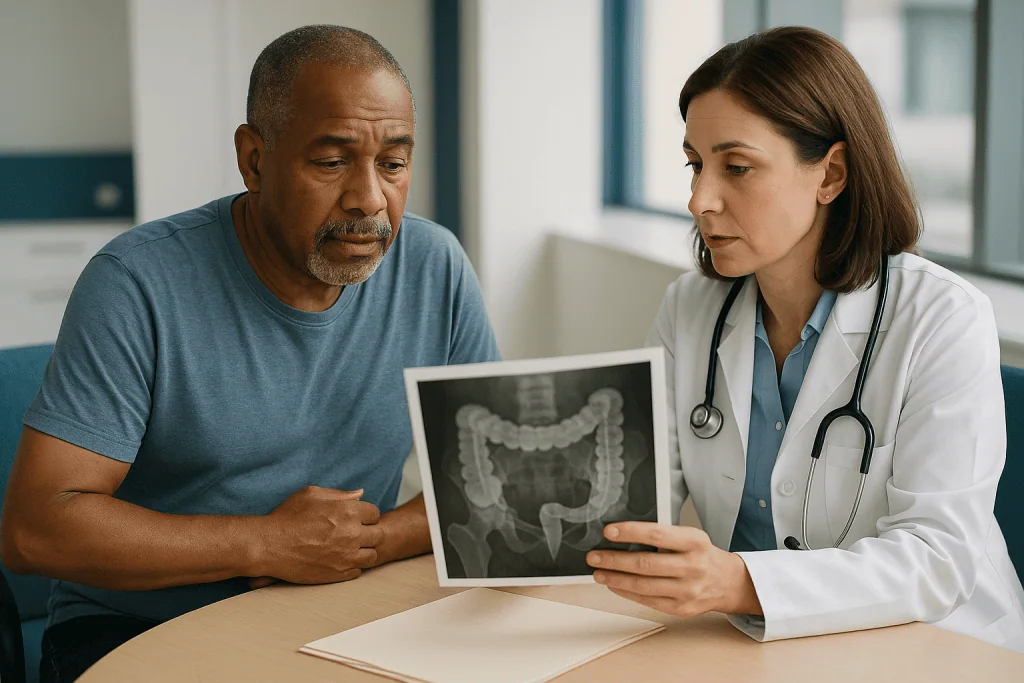
So the first question is not “what stage am I?” but “what do you think the stage is now, and what could change after surgery?” That phrasing invites honesty. It also sets up the follow-on questions:
- What is the goal of this operation: to remove all visible cancer, to relieve a blockage, or something else?
- Has the cancer been seen anywhere outside the colon on my CT scan?
- Will anything about the pathology report change the plan for chemotherapy?
- Are there gene or protein tests on the tumor that affect my options?
That last question is increasingly important. Tumors are routinely tested for mismatch repair deficiency, a feature that affects how the cancer behaves and which drug classes may be considered later; the National Cancer Institute and Mayo Clinic both describe this testing as part of standard work-up. You do not need to understand the biology before surgery, but you do need to know whether it has been ordered.
Ask, too, who holds the whole plan. In most centers a multidisciplinary team, meaning surgeons, oncologists, radiologists and pathologists meeting together, reviews each case. Knowing that your scans were discussed in that room, and what was concluded, is reassurance grounded in process rather than in promises.
Who is usually offered surgery first, and who is asked to wait
For most people with colon cancer that has not spread beyond the bowel and nearby lymph nodes, surgery is the first treatment, and often the only one needed for early-stage disease. Mayo Clinic and the NHS both describe this as the usual pathway: the tumor comes out, the pathology report guides what follows.
Some people are asked to wait, and the reasons are worth hearing in full rather than guessing at:
- When scans suggest the tumor has grown into nearby structures, a short course of chemotherapy before surgery (neoadjuvant treatment) may be discussed to shrink it first. This is more established for rectal cancer than colon cancer, so ask what the evidence shows for your specific situation.
- When the cancer has already spread to the liver or lungs, the sequence may be reversed, with systemic treatment first and surgery considered later if scans respond.
- When a person’s heart, lungs or nutrition need attention, a few weeks of preparation can lower operative risk. Anesthesia teams often ask for this time.
- When the bowel is completely blocked, a stent or a temporary stoma may come first to relieve the obstruction safely.
A very small early cancer found inside a polyp may sometimes be treated completely during colonoscopy, with no abdominal operation at all. Whether that applies depends on precise features of the polyp under the microscope, so this is a question for the gastroenterologist and surgeon together.
None of these paths is “better” in the abstract. The useful question is: “Why this order for me, and what would make you change it?” A clear answer tells you the plan was built around your scans and your health, not a default.
Keyhole or open: what to ask about the surgical approach
Patients often arrive hoping for keyhole surgery and worried that an open incision means something has gone wrong. Neither assumption holds. Laparoscopic colectomy, in which instruments and a camera pass through several small cuts, is now standard for many colon cancers, and robotic surgery is a variant of the same idea with the surgeon controlling instruments from a console. Open surgery uses a single longer incision down the abdomen.
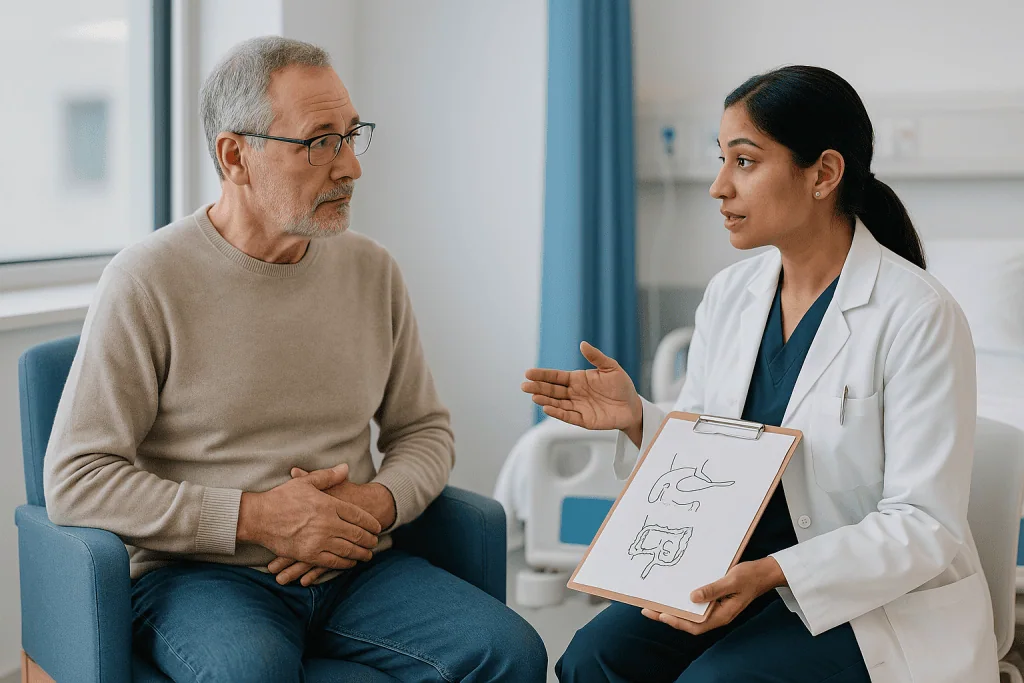
What the evidence actually shows, as summarized by the NHS and Mayo Clinic, is that keyhole approaches tend to mean smaller wounds, less pain in the first days and a somewhat quicker return to eating and moving, while removing the same amount of bowel and lymph tissue when done by an experienced team. For cancer outcomes, the approach matters less than completing the oncological operation properly.
Open surgery remains the right choice in some situations: extensive scarring from previous operations, a tumor stuck to neighboring organs, an emergency blockage, or a patient whose lungs cannot tolerate the gas used to inflate the abdomen during keyhole surgery. A planned keyhole operation can also be converted to open partway through if the surgeon cannot see safely. Ask how often that happens in your surgeon’s practice; a frank number is more reassuring than a vague one.
Three questions cover the ground:
- Which approach do you recommend for me, and why?
- What would make you convert to an open operation on the day?
- Does the approach change my likely hospital stay or recovery at home?
Listen for an answer that discusses your anatomy and your scans. That is the hallmark of a plan rather than a preference.
Will I need a stoma, and would it be temporary?
A stoma is an opening on the abdominal wall where a section of bowel is brought to the surface so that stool empties into a pouch. For many people this is the question they are most afraid to ask, which is exactly why it should be asked early and plainly.
The honest answer for colon cancer is that most colectomies do not require a stoma, because the two ends of bowel can be joined at the time of surgery. A stoma becomes more likely when the join sits low in the pelvis, when the bowel is swollen or obstructed, when the operation is an emergency, or when the surgeon judges the blood supply to the join uncertain. In those cases a temporary stoma protects the new connection while it heals, and the NHS describes reversal of temporary stomas in a later, smaller operation once healing is confirmed, often after a few months.
Permanent stomas are uncommon in colon cancer surgery and are mostly associated with very low rectal tumors, a different operation from the one discussed here.
What to ask:
- Based on my tumor’s position, how likely is a stoma, and would it be a colostomy (colon) or ileostomy (small bowel)?
- If a temporary stoma is needed, what has to happen before it can be reversed?
- Can I meet a stoma nurse before surgery so that, if it happens, I am not learning everything in a hospital bed?
That last request is worth making even when the chance is small. Specialist stoma nurses mark a suitable site on the skin beforehand, taking into account clothing and how you sit, and people who have met them in advance consistently describe the first days as less overwhelming. Fear of the unknown shrinks when the unknown has a name and a face.
What to ask the oncologist about chemotherapy and its timing
An oncologist is the physician who oversees drug treatment for cancer, and you may meet one before surgery, after it, or both. Their role is to judge whether the pathology report suggests a meaningful risk of microscopic cancer cells remaining in the body, and whether treatment aimed at those cells is likely to help more than it harms.
The pattern described in NHS and National Cancer Institute guidance is broadly this: stage I colon cancer is usually treated with surgery alone; stage III (lymph nodes involved) is usually offered adjuvant chemotherapy, meaning chemotherapy given after surgery to lower the chance of recurrence; stage II sits in between, with the decision resting on features such as how deeply the tumor grew, whether it caused a blockage, and the lymph node count. Adjuvant regimens are typically built on a fluoropyrimidine drug (fluorouracil or capecitabine), sometimes combined with oxaliplatin. These are named here only so you recognize the words; the choice, if any, belongs to your oncologist.
Useful questions before surgery, even if the answer is “it depends on pathology”:
- Under what findings would you recommend chemotherapy, and under what findings would you not?
- If chemotherapy is likely, roughly when after surgery would it start and how long would a course run?
- Which side effects would change daily life most, and which are temporary?
- Would you recommend fertility counselling before treatment, if that applies to me?
Chemotherapy generally begins once the wound has healed and eating and strength have returned, a window the oncology team sets individually. Asking about it before surgery means the two teams are visibly talking to each other, and it avoids the limbo many patients describe between discharge and the first oncology appointment.
How to prepare in the weeks before colon cancer surgery
The weeks before an operation are not dead time. Surgeons increasingly talk about prehabilitation, a plain idea with a clinical name: arriving at surgery as strong, well-nourished and well-informed as possible. Mayo Clinic and the NHS both frame preparation around fitness, nutrition, stopping smoking, and medication review.
Walking is the simplest intervention. Daily walks, lengthened gradually, improve heart and lung reserve and make the post-operative walking that nurses will ask of you feel familiar rather than daunting. Stopping smoking, even for a few weeks, lowers the risk of wound and chest complications; ask the team about support, since nicotine replacement and counselling are commonly offered.
Medication review is the step people most often underestimate. Blood thinners (anticoagulants, which slow clotting), antiplatelet drugs, diabetes medicines and some supplements may need to be paused or adjusted before surgery. Do not stop anything on your own; bring a complete list, including over-the-counter products, and ask the anesthesia or surgical team to tell you exactly what to do with each one.
Bowel preparation varies. Some surgeons ask for a full laxative preparation, some for oral antibiotics, some for neither, depending on which segment of colon is involved. MedlinePlus notes that instructions on eating, drinking and bowel preparation are given individually, so ask for yours in writing.
Practical questions worth adding:
- Will I have a pre-operative assessment with the anesthesia team, and what tests are involved?
- Should I see a dietitian now, particularly if I have lost weight?
- Is there an enhanced recovery program, and what will it ask of me before and after surgery?
Enhanced recovery protocols, which emphasize early eating, early walking and limited use of drains and tubes, are now common. Knowing you are on one explains why a nurse will ask you to sit in a chair the morning after major surgery.
What the first days after a colectomy usually look like
The first morning is mostly about three things: pain control, moving, and waiting for the bowel to wake up. Expect an intravenous line, possibly a urinary catheter for a day, and a pain plan that may include an epidural, nerve blocks or patient-controlled analgesia alongside tablets. Pain should be managed, not endured; say so if it is not.
Walking starts early, usually the day of surgery or the morning after, because moving reduces the risk of blood clots and chest infections and encourages the bowel to resume its rhythm. Clot prevention typically also includes compression stockings and small injections of a blood-thinning medicine while you are in hospital, with the team deciding whether to continue them after discharge.
Eating returns stepwise: sips of water, then clear fluids, then light food as the gut tolerates it. The passage of gas is a genuine milestone, and nurses will ask about it with complete seriousness. A temporary slowdown of the bowel, called ileus, can cause bloating and nausea for a few days and is common rather than alarming, though it may extend the stay.
MedlinePlus gives a typical hospital stay of 3–7 days after large bowel resection. Discharge tends to follow once you are eating, passing gas or stool, walking independently and managing pain with oral medicines.
Questions to settle before you leave the ward:
- How should I care for the wound, and when can I shower?
- Which medicines am I going home with, and which of my usual ones restart?
- Who do I call out of hours, and what number?
- When is the follow-up appointment, and will the pathology results be discussed then?
Write the out-of-hours number on the fridge. Nobody wants to search a discharge folder at two in the morning.
Postoperative care instructions for colectomy: the first weeks at home
Home is where recovery really happens, and the instructions matter more there than anywhere. MedlinePlus’s discharge guidance for large bowel resection covers the essentials, and most surgical teams issue a version of the same advice.
Activity first. Walk several times a day and increase the distance steadily; stairs are fine once you can manage them comfortably. Heavy lifting, including vacuum cleaners, groceries and small children, is usually restricted for roughly 4–6 weeks so the abdominal wall can heal and the risk of a hernia at the incision is reduced. Driving generally waits until you are off strong painkillers and can brake sharply without pain, which your team will confirm.
Wound care is usually simple: keep the area clean and dry, shower rather than bathe until the team says otherwise, and watch for spreading redness, increasing pain or discharge. Keyhole wounds often have glue or small dressings that come away on their own.
Bowel function takes time to settle. Looser, more frequent stools are common after part of the colon has been removed, particularly after a right hemicolectomy, because the colon’s job is to absorb water. Many people find that eating smaller meals more often, drinking enough fluid, and reintroducing high-fiber foods gradually helps. Ask whether a dietitian can advise, and ask what pattern of bowel habit would be a concern rather than a nuisance.
Energy returns unevenly. A good day followed by a tired one is normal, and the fatigue of major surgery can outlast the wound by weeks. The rule of thumb nurses offer is that if an activity leaves you more tired the next day, it was too much, not too little.
Keep the discharge sheet visible and keep the follow-up date. Both are part of the treatment, not an afterthought.
When can I go back to work after colon cancer surgery?
This is among the most searched questions and among the least answerable with a single number, because “work” ranges from answering emails on a sofa to lifting pallets. The honest framework has three parts: the wound, the energy, and what comes next.
The wound sets the floor. Because lifting restrictions commonly run for around 4–6 weeks after bowel resection, as MedlinePlus’s discharge guidance describes, physically demanding jobs generally cannot resume in full before then, and some teams advise longer. Desk-based work can often restart sooner, sometimes part-time or from home within a few weeks, once concentration and stamina allow. Keyhole surgery tends to shorten the early recovery but does not change the time the deep tissues need to heal.
Energy sets the realistic pace. People often underestimate how much a long meeting or a commute takes out of them in the first month. A phased return, shorter days building to full days, is widely recommended and worth negotiating with an employer in advance.
What comes next may matter most. If adjuvant chemotherapy is planned, the oncology team can describe how treatment days and side effects such as fatigue or hand sensitivity might interact with your role, and whether a longer period away or a flexible arrangement makes more sense than returning and then stopping again.
Questions worth putting to the surgeon and oncologist together:
- Given my job, when do you expect I could return, and in what form?
- Would a phased return be sensible, and can you document that for my employer?
- If chemotherapy follows, how would that affect the timing?
Ask for the advice in writing. Occupational health departments and employers respond better to a letter than to a patient’s recollection of a corridor conversation.
What happens 6 months after bowel resection? Follow-up explained
By six months most people have a healed wound, a settling bowel, and a new relationship with the calendar, because follow-up after colon cancer runs for years. Understanding the rhythm in advance makes each appointment feel like routine rather than a verdict.
Surveillance, the structured program of checks after treatment, is described by Mayo Clinic and the National Cancer Institute as a combination of three tools. Clinic visits with physical examination and questions about symptoms. Blood tests for carcinoembryonic antigen (CEA), a protein that some colon cancers release and that can rise before any scan shows a change; it is a signal, not a diagnosis, and it can also rise for benign reasons. Imaging, usually CT scans of the chest, abdomen and pelvis at intervals set by stage. A colonoscopy is commonly scheduled around a year after surgery to inspect the join and look for new polyps, with later intervals based on what is found.
The six-month mark often coincides with a CEA test and a clinic review, and for those who had chemotherapy, with its end or its aftermath. Lingering numbness in the fingers or feet from oxaliplatin, for example, can persist for months and is a standard topic at this visit.
Bowel habit by now is usually predictable, if different from before. If a temporary stoma was created, reversal may be scheduled around this period once the join has been checked.
Questions to ask about the long game:
- What does my follow-up schedule look like for the next five years, and who runs it?
- What symptoms between visits would you want to hear about straight away?
- Will the plan change if my CEA rises?
Knowing the schedule turns waiting into monitoring, which is a very different experience to live inside.
What people often get wrong about colon cancer surgery
Myths cluster around this operation, partly because so many people know someone who had one decades ago. A few corrections, each anchored to what current guidance says.
“Surgery spreads the cancer.” There is no credible evidence that exposing a tumor to air causes spread. Surgeons use specific techniques, such as handling the tumor minimally and dividing the blood supply early, precisely to minimize any shedding of cells. Removing the cancer is the intervention most strongly linked with controlling it.
“A stoma is for life.” As the NHS explains, most stomas created during colon cancer surgery are temporary and reversed once the join has healed. Permanent stomas are associated mainly with very low rectal cancers.
“Keyhole surgery removes less.” The amount of bowel and lymph tissue removed is determined by the cancer, not by the size of the incisions.
“If the surgeon got it all, I will not need chemotherapy.” Chemotherapy after surgery targets cells too small to see; it is recommended on the basis of stage and pathology, not on whether the operation went well.
“I should eat only soft food for months.” Diet after colectomy is usually broadened within weeks. The goal is a normal, varied diet, reintroduced at the pace the bowel allows.
“Pain or tiredness at six weeks means something is wrong.” Fatigue outlasting the wound is common after major surgery. What matters is the direction of travel, and whether anything new has appeared, which is why the next section on red flags exists.
The thread running through these myths is a single misunderstanding: that the operation is the whole treatment. It is the central step in a plan whose other parts, pathology, oncology and surveillance, are equally deliberate.
Questions to ask your care team before you sign the consent form
Consent is a conversation, not a signature. The table below sorts the questions in this article by who is best placed to answer them, so you can take the right page to the right appointment. Bring someone with you to write; most people remember a fraction of what is said in a surgical consultation.
| Question | Usually answered by | Why it matters |
|---|---|---|
| What stage do you estimate, and what could change after pathology? | Surgeon and oncologist | Sets the goal of surgery and whether chemotherapy is likely |
| Which section of bowel, and how much, will be removed? | Surgeon | Explains likely bowel habit afterward |
| Keyhole, robotic or open, and when would you convert? | Surgeon | Shapes early recovery and hospital stay |
| How likely is a stoma, and would it be temporary? | Surgeon and stoma nurse | Allows preparation and site marking in advance |
| Which of my medicines stop, and when? | Anesthesia and surgical team | Reduces bleeding and clotting risk |
| What are the main risks for someone like me? | Surgeon and anesthesia team | Personalizes risk beyond the leaflet |
| Will chemotherapy be considered, and on what findings? | Oncologist | Prevents a gap between discharge and oncology |
| What is my follow-up schedule and who coordinates it? | Oncologist and nurse specialist | Turns waiting into structured monitoring |
| When can I drive, lift and work? | Surgeon | Gives written advice for employers and family |
Risks deserve their own moment. Every colectomy carries the possibility of bleeding, infection, blood clots, injury to nearby organs, and anastomotic leak, in which the join between the bowel ends does not seal and contents escape into the abdomen. Ask how your team monitors for leak, what they would do if it happened, and whether anything about your health raises or lowers that risk. A surgeon who can describe the response calmly has thought it through. That is what you are listening for.
When to call your doctor: red-flag signs after colon cancer surgery
Recovery has normal bumps: a tender incision, a day of bloating, a loose stool. Some signs, though, need the same-day attention of the surgical team, and MedlinePlus’s discharge guidance for bowel resection lists them clearly. Contact your team promptly, or seek emergency care, if you notice:
- Fever above 101°F (38.3°C), or chills and shaking
- Abdominal pain that is worsening rather than easing, or a belly that becomes hard, swollen or very tender
- Repeated vomiting, or inability to keep fluids down
- No bowel movement or gas for several days, especially with bloating and nausea
- Redness spreading from the wound, pus or cloudy fluid draining from it, or the edges separating
- Blood in the stool beyond small streaks, or black, tarry stools
- A stoma that turns dark, purple or black, or stops producing output while the abdomen swells
- Pain, warmth or swelling in one calf, which can signal a blood clot
- Sudden shortness of breath or chest pain, which can signal a clot in the lung and is an emergency
- Dizziness, fainting, or passing very little urine
Anastomotic leak most often declares itself in the first week or two with rising pain, fever and a fast heartbeat, so a change in how you feel during that window deserves a phone call rather than a wait-and-see approach. The same applies to any symptom you cannot explain and that is getting worse.
In the months that follow, new or persistent changes in bowel habit, unexplained weight loss, or bleeding should be reported to the follow-up team between scheduled visits rather than saved for the next one. None of these signs confirms a problem on its own; they are reasons to be assessed. The decision about what they mean, and what to do next, rests with the clinicians who know your operation and your pathology.
Frequently asked questions
What are the postoperative care instructions for colectomy surgery?
Walk several times a day, keep the wound clean and dry, avoid heavy lifting for roughly 4–6 weeks, and rebuild your diet gradually from small frequent meals toward normal fiber. Take only the medicines on your discharge list, restart usual ones as instructed, and keep the follow-up appointment. Report fever, worsening pain, vomiting, wound discharge or calf swelling promptly.
What happens 6 months after bowel resection?
By six months most wounds have healed and bowel habit has largely settled, though it may remain looser or more frequent than before. Follow-up typically includes a clinic review, a CEA blood test and scans at intervals set by stage, with a colonoscopy commonly scheduled around one year. If chemotherapy was given, this visit often addresses lingering side effects such as numbness.
Is right side pain normal after colon resection?
Mild, improving discomfort around the incisions and the operated area, including the right side after a right hemicolectomy, is common for several weeks. Pain that is increasing, sharp, accompanied by fever, vomiting, a swollen abdomen or inability to pass gas is not expected and should be reported to the surgical team the same day so they can assess for infection, leak or obstruction.
When can I go back to work after colon cancer surgery?
It depends on your job, your operation and whether chemotherapy follows. Desk-based work is often possible within a few weeks, sometimes phased or part-time, while physically demanding roles usually wait until lifting restrictions of roughly 4–6 weeks have passed, and sometimes longer. Ask your surgeon for written advice and discuss timing with the oncologist if further treatment is planned.
What are the most important questions to ask before colon cancer surgery?
Ask about the estimated stage and what might change after pathology, which section of bowel will be removed, whether the approach will be keyhole or open, the likelihood of a stoma and whether it would be temporary, how many lymph nodes will be examined, whether chemotherapy is being considered, your personal risks, and exactly who to call if problems arise at home.
How long does colon cancer surgery recovery usually take?
Hospital stays after large bowel resection are typically around 3–7 days, and most people are walking and eating normally within a few weeks of going home. Deeper healing of the abdominal wall takes about 4–6 weeks, which is why lifting is restricted, and fatigue can persist beyond that. Your team will set expectations based on your operation and health.
Will I definitely need chemotherapy after colon surgery?
No. Stage I colon cancer is usually treated with surgery alone, stage III is usually offered chemotherapy afterward, and stage II depends on features in the pathology report such as how deeply the tumor grew and how many lymph nodes were examined. The oncologist weighs those findings with your overall health before making any recommendation.
What should I ask about the risk of a bowel leak after surgery?
Ask what an anastomotic leak is, how your team monitors for it in the first two weeks, which symptoms at home should prompt an immediate call, and what the plan would be if one occurred. Also ask whether anything about your health or the position of the join raises the risk, and whether a protective temporary stoma is being considered.
Can I eat normally after bowel resection?
Most people return to a varied diet within weeks. The usual path is fluids, then light meals, then gradual reintroduction of fiber, eating smaller portions more often while the bowel adjusts. Looser stools are common, especially after right-sided surgery, because the colon absorbs water. A dietitian can help if symptoms persist or weight drops.
Who coordinates my care between the surgeon and the oncologist?
In most centers a multidisciplinary team reviews each case, and a nurse specialist or care coordinator acts as the day-to-day point of contact. Ask who that person is, how to reach them, and how results from pathology and scans will be shared between the surgical and oncology teams so that nothing falls into the gap after discharge.
References
- Bowel cancer: Treatment (NHS)
- Large bowel resection (MedlinePlus Medical Encyclopedia)
- Large bowel resection – discharge (MedlinePlus)
This article is for general information only and is not a substitute for professional medical advice. Please consult a qualified doctor about your individual situation.
Add us as a Preferred Source to see more of our trusted health content across Google Search, AI Overviews and Discover.

More from the Blog
Stage 3 Lung Cancer Survival Rates: How Stages 1 to 3 Compare by Age, Treatment and Cancer Type
Stage 3 lung cancer survival rate figures are group averages, not predictions. In the SEER registry, people whose lung cancer had spread to nearby…
Which Biomarker Tests Are Run on a Lung Cancer Biopsy, and How Do They Steer Treatment?
A lung cancer biopsy is usually tested for a panel of biomarkers: gene changes such as EGFR, ALK, ROS1, KRAS, BRAF, MET, RET, NTRK…
Why CAR-T Patients Need a Caregiver: What Companions Watch for During the First Weeks
Treatment centers ask CAR-T patients to have a dedicated adult caregiver, usually for at least the first four weeks after the cell infusion, because…
Seeking a Second Opinion on a Cervical Cancer Plan: What to Bring and What to Ask
A cervical cancer second opinion means asking a different gynecologic oncology team to review your biopsy slides, imaging, and stage and say whether they…

How Skin Cancer Treatment Is Planned: Why Type and Depth Matter More Than Size Alone
Skin cancer treatment is planned around the cancer's type, its depth and its location, not simply how wide it looks. Basal cell carcinoma, squamous…
What Tumor Markers and Scans Tell Your Team Before Testicular Cancer Surgery
Before testicular cancer surgery, three blood tests, alpha-fetoprotein (AFP), human chorionic gonadotropin (hCG) and lactate dehydrogenase (LDH), together with a scrotal ultrasound and usually…