

Recovering From a Mediastinoscopy: Neck Soreness, Wound Care and When to Resume Lifting

Key Takeaways
- MedlinePlus describes mediastinoscopy as taking about 60 to 90 minutes, with many people going home the same day or after one night.
- The incision sits in the skin crease above the breastbone; because no bone is cut and the lung is not entered, most people return to ordinary activities within days.
- Sore throat and mild hoarseness come mainly from the anesthetic breathing tube and usually settle within a day or two, according to NHS anesthesia guidance.
- A closed surgical incision typically seals within one to two weeks; showering is usually allowed once the dressing is off, but soaking should wait until the skin has fully healed.
- Heavy lifting is generally paused for around one to two weeks to protect the healing wound, with the exact limit set by the surgeon rather than a general rule.
- A voice that stays weak or breathy beyond about a week, sudden breathlessness, or spreading wound redness are the signs that should prompt a call to the surgical team.
Most people go home the same day or the morning after a mediastinoscopy and feel close to normal within a few days. Neck soreness and a scratchy throat usually ease over about a week, and the small incision at the base of the neck typically heals in one to two weeks. Heavy lifting is generally paused for around two weeks, but the timing always depends on your surgeon's advice.
The mirror is the first surprise. You expected a dramatic scar, and instead there is a short strip of tape sitting just above your collarbones, a slight puffiness beneath it, and a throat that feels as if you cheered too hard at a game. Someone has told you to rest. Nobody has quite said what “rest” means when you have a toddler who wants lifting and a garage full of boxes.
That gap between the paperwork and real life is what this article fills. Mediastinoscopy recovery time is shorter than most people brace for, but the details matter: how to look after the wound, why your voice may sound different for a day or two, and when it is reasonable to pick up something heavier than a kettle.
We have kept to what mainstream evidence and major guidance sources actually say, and we have flagged where the answer is honestly “it depends on your team.”
What actually happens during a mediastinoscopy
A mediastinoscopy is a short operation that lets a surgeon look at, and take samples from, the space in the center of the chest between the lungs. That space is called the mediastinum, and it holds the heart, the windpipe, the food pipe, large blood vessels and a chain of lymph nodes, the small bean-shaped glands that filter fluid from the lungs.
The procedure is done under general anesthesia, meaning you are fully asleep with a breathing tube placed in your windpipe. The surgeon makes one small cut just above the top of the breastbone, at the base of the neck, and gently creates a tunnel down behind the breastbone alongside the windpipe. A thin, lit instrument with a camera, the mediastinoscope, slides through that tunnel. Nodes are identified, sampled with tiny forceps, and sent to the pathology laboratory. The tunnel is then allowed to close, and the skin is stitched or glued.
Nothing is removed apart from those samples. No rib is cut and the lung itself is not entered, which is the main reason recovery is measured in days rather than weeks. MedlinePlus describes the whole procedure as taking about 60 to 90 minutes, and notes that many people leave the hospital the same day or after one night.
The purpose is almost always diagnostic. Imaging such as a CT or PET scan can show that a lymph node is enlarged or metabolically active, but only tissue under a microscope can say what is inside it. That distinction drives treatment decisions in lung cancer, and it also identifies non-cancer causes such as sarcoidosis, an inflammatory condition, or infections.
How long does mediastinoscopy take, and how long will I stay in?
The operating time and the hospital stay are two different clocks, and people often confuse them.

In the operating room, MedlinePlus puts the procedure itself at roughly 60 to 90 minutes. Add the time for anesthesia to take effect beforehand and for the team to remove the breathing tube afterward, and your family should expect you to be away from the waiting area for a good part of a morning or afternoon.
The hospital stay is usually brief. Johns Hopkins Medicine notes that many people go home the same day once they are awake, breathing comfortably and able to drink, while others stay one night, particularly if the procedure finishes late, if they live far away, or if the surgeon wants a follow-up chest X-ray to confirm that no air has leaked around the lung. That X-ray is routine caution rather than a sign something went wrong.
Before discharge you will typically be asked to demonstrate a few simple things: swallowing sips of fluid without choking, walking to the bathroom steadily, and having pain that is controlled with ordinary measures. Because general anesthesia dulls judgment and reaction time for the rest of the day, the NHS advises that a responsible adult takes you home and ideally stays with you for the first night.
The other timeline that matters is results. Lymph node samples need to be processed, sliced and stained, and in cancer staging they are frequently reviewed by more than one specialist. Waiting one to two weeks for a report is common, and your team should tell you the expected date at discharge rather than leaving you to guess.
Who is usually offered mediastinoscopy, and who is asked to wait
The most frequent reason is staging: finding out whether a known or suspected lung cancer has reached the lymph nodes in the middle of the chest. The NHS lists mediastinoscopy among the tests used after a scan suggests lung cancer, alongside bronchoscopy and needle biopsies. Whether cancer is present in those nodes shapes everything that follows, from whether surgery is an option to whether chemotherapy or radiotherapy comes first.
Beyond cancer, a surgeon may recommend it when enlarged nodes need explaining and a less invasive needle test has already come back inconclusive. Sarcoidosis, lymphoma, tuberculosis and fungal infections can all enlarge these nodes, and each is treated in a completely different way.
Some people are usually asked to wait, or offered an alternative. A previous mediastinoscopy leaves scar tissue that makes a repeat approach technically harder, so a needle-based method is often preferred. A very large goiter, an enlarged thyroid gland sitting low in the neck, can block the path. Previous radiotherapy to the neck or upper chest stiffens tissues. Certain aortic aneurysms, bulges in the main artery leaving the heart, sit directly in the operating field. Blood that clots poorly, whether from disease or anticoagulant medicines, raises bleeding risk, so surgeons generally coordinate with the prescribing clinician about pausing and restarting those drugs rather than leaving the decision to the patient.
Fitness for general anesthesia is the final filter. Someone with severe heart or lung disease may be steered toward endobronchial ultrasound, which can be done under lighter sedation. None of these are fixed rules; they are the factors a multidisciplinary team weighs, and the recommendation you receive reflects your own scans and history.
Mediastinoscopy recovery time: what the first 48 hours feel like
Waking from general anesthesia is usually gradual and a little disorienting. The first sensations most people report are a dry, scratchy throat from the breathing tube and a dull ache at the front of the neck, roughly where a tight collar would sit. Both are expected.
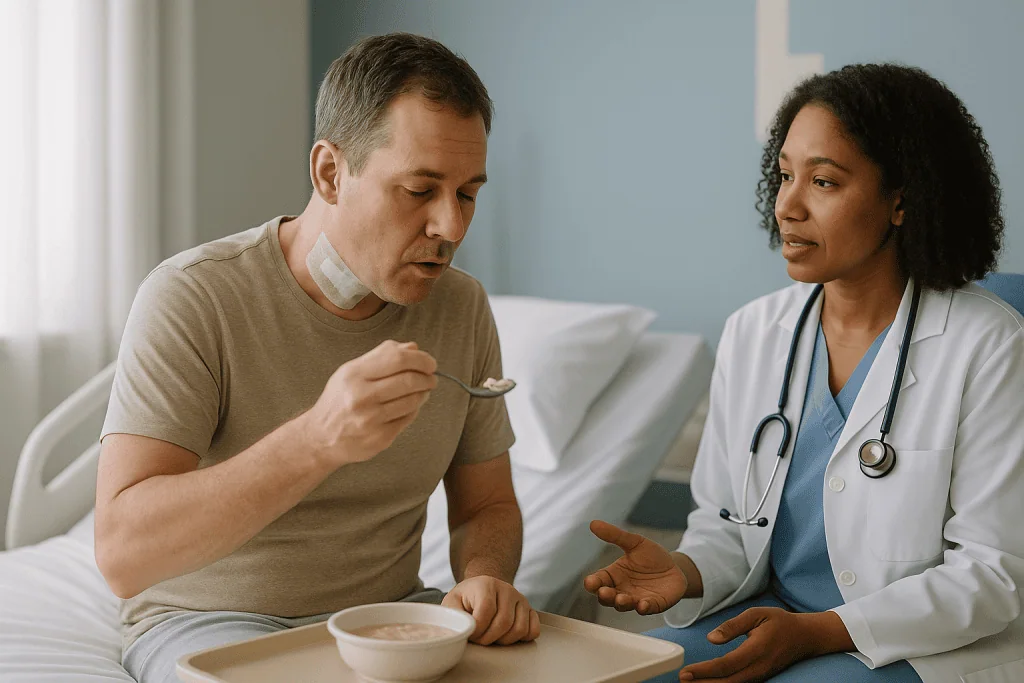
The recovery nurse will check your breathing, oxygen level and blood pressure at short intervals. Sips of water come next, then something light to eat if swallowing feels comfortable. You may notice your voice sounds slightly hoarse; the breathing tube rests against the vocal cords and irritates them, and this typically settles within a day or two.
Pain is generally modest. Most people describe it as soreness rather than sharp pain, worse when turning the head or swallowing and eased by keeping the neck relaxed and the head slightly raised. Your team will advise on pain relief; the point here is simply that needing very strong medicines for this operation is unusual, and if your pain feels out of proportion, say so.
By the evening of surgery or the next morning, walking around the room is encouraged. Gentle movement helps the lungs re-expand fully after anesthesia and lowers the risk of blood clots in the legs. Deep breaths and coughing may feel awkward around the dressing but are safe and useful.
Tiredness is the part people underestimate. General anesthesia lingers in mood and energy for a day or so, according to NHS guidance, and the emotional weight of waiting for a diagnosis adds its own fatigue. Planning nothing beyond rest, fluids and short walks for the first two days is not overcautious; it is how most mediastinoscopy recovery time is actually spent.
Why the neck and throat feel sore, and how long it lasts
Three separate things are happening in a small area, which is why the soreness can feel bigger than the incision suggests.
First, the skin and the thin muscles at the base of the neck have been opened and stretched to admit the mediastinoscope. Any cut tissue swells and aches for several days as it heals.
Second, the surgeon has gently pushed tissue aside along the front of the windpipe to reach the nodes. That tissue behind the breastbone has been stretched, and although you cannot see it, it registers as a deep ache or pressure when you swallow or turn your head.
Third, the breathing tube used for general anesthesia has been sitting against the vocal cords and the lining of the throat for the length of the operation. The NHS lists a sore throat as one of the most common short-lived aftereffects of a general anesthetic, usually lasting a day or two.
Put together, the pattern most people describe is a peak of discomfort on the first and second days, then a steady fade so that by the end of the first week it is a background stiffness rather than pain. Warm drinks, soft food and keeping the head propped on an extra pillow at night tend to help. Avoid straining the neck to look over your shoulder; turn your whole body instead for a few days.
Hoarseness deserves a separate mention. A slightly husky voice for a day or two is ordinary tube irritation. A voice that is clearly weak or breathy, or that has not recovered after about a week, should be reported. It can signal bruising of the recurrent laryngeal nerve, the nerve that runs beside the windpipe and controls one vocal cord. MedlinePlus lists this as an uncommon but recognized risk, and most cases improve over weeks, though some need a voice specialist.
Caring for the wound at the base of your neck
The incision is short, sits in a natural skin crease above the breastbone, and is usually closed with dissolving stitches under the skin, surgical glue, or small adhesive strips. A light dressing covers it for the first day or two.
Your discharge instructions will be specific, and they override anything general written here. That said, MedlinePlus guidance on closed surgical wounds gives a sensible framework:
- Keep the dressing dry and in place for as long as instructed, often 24 to 48 hours.
- Once permitted, shower normally and let water run over the wound rather than scrubbing it. Pat dry with a clean towel.
- Do not soak the area in a bath, hot tub or pool until the skin has fully sealed, which MedlinePlus puts at roughly one to two weeks for a typical closed incision.
- Leave adhesive strips to peel off by themselves; skin glue flakes away on its own over a week or two.
- Check the wound once a day in good light for spreading redness, swelling, warmth or discharge.
A little pinkness along the line and a small firm ridge underneath are part of normal healing. Mild bruising in the skin nearby is also common and fades like any other bruise. What is not normal is thick or cloudy fluid, a foul smell, edges that pull apart, or redness marching outward from the wound; these are described in the red-flag section later.
Choose soft, loose collars for the first week. Necklaces and shirt buttons that rub the area are best avoided until the tape or glue is gone. Sunlight is the last consideration: fresh scars darken permanently if they burn, so once the skin has closed, cover the area or use sunscreen outdoors for the first year.
What will the mediastinoscopy scar look like?
People searching for images of a mediastinoscopy scar often expect a chest surgery scar and are relieved to find something closer to a short pencil line. The cut sits horizontally in the small hollow at the top of the breastbone, between the collarbones, and follows the natural crease there. MedlinePlus describes it simply as a small cut above the breastbone.
In the first weeks the line is pink or red and slightly raised. The color comes from the extra blood supply that healing tissue recruits. Over the following months it flattens and lightens as collagen, the protein that knits skin together, remodels itself. Scar maturation is slow; dermatology guidance from major centers generally describes the process as continuing for a year or more, so the appearance at three months is not the final result.
A few factors influence how visible it ends up. Darker skin tones can develop a scar that is lighter or darker than surrounding skin. Some people are prone to raised scars, a tendency you may already know from previous cuts or piercings. Tension across a wound also widens scars, which is one reason surgeons ask you to limit neck strain and lifting early on.
Simple measures are worth doing. Keep the area protected from sun for the first year, since ultraviolet exposure darkens immature scars. Once the skin has fully closed and your team agrees, gentle massage with a plain moisturizer is commonly suggested to keep the scar soft, though evidence for silicone sheets or gels is mixed and any product choice is best discussed with your surgeon or a dermatologist rather than chosen from an advertisement. Most people find that within a year the line blends into the crease and is noticed mainly by themselves.
When can I resume lifting, driving and exercise?
This is the question the title promised, and the honest answer has two layers: what general surgical guidance suggests, and what your surgeon writes on your discharge sheet. The second always wins.
The reason lifting is restricted is not the lung, which was not cut, but the wound. Straining raises pressure in the chest and pulls on the healing tissues of the neck, which can cause bleeding into the wound, delayed healing or a wider scar. Because no bone has been cut, the pause is far shorter than after open chest surgery.
| Activity | Typical guidance | Why the wait |
|---|---|---|
| Walking, stairs, light housework | From the day after surgery | Aids lung expansion and clot prevention |
| Showering | Usually within 24 to 48 hours, once dressing removed | Wound needs to be sealed before soaking |
| Driving | Once off sedating pain medicines and able to turn the head freely | Anesthesia impairs reaction time on day one; neck stiffness limits checking mirrors |
| Desk work | Often within a few days | Fatigue rather than the wound is the limiting factor |
| Lifting over roughly a bag of groceries | Commonly paused for about one to two weeks | Straining stresses the healing incision |
| Vigorous exercise, contact sport, swimming | Typically two weeks or after surgical review | Wound must be fully closed; swimming requires sealed skin |
These ranges echo MedlinePlus and Johns Hopkins descriptions of a quick return to normal activity within days and a healed incision within one to two weeks. They are typical, not guaranteed, and a surgeon who found a bleeding point or a fragile wound may extend them.
Driving carries a legal as well as a medical dimension. Your insurer may require that you are free of restrictions imposed by your surgeon, so ask directly and note the answer. For anyone whose job involves heavy manual work, a fit-for-work conversation before discharge saves an awkward call from a supervisor later.
Mediastinoscopy side effects and complications explained
It helps to separate expected side effects from true complications. Side effects are the predictable price of the procedure; complications are events the team works to prevent and watches for.
Expected side effects, all described in MedlinePlus and NHS anesthesia guidance, include a sore throat and hoarseness from the breathing tube, aching at the incision, neck stiffness, tiredness for a day or two, and mild nausea as the anesthetic wears off. Bruising of the skin around the wound is common and harmless.
Complications are uncommon. MedlinePlus lists the recognized ones as bleeding, infection at the wound, a collapsed lung caused by air leaking into the space around it (a pneumothorax), injury to the recurrent laryngeal nerve causing a weak voice, and, rarely, damage to the food pipe or a large blood vessel. Because the great vessels run through the mediastinum, surgeons are trained to recognize and control bleeding immediately, and this is one reason the operation is done in a full operating room rather than a clinic.
Frequencies matter to people, and it is fair to say that major guidance sources describe serious complications as rare without attaching a single universal percentage, because rates vary with the reason for the procedure, the patient’s other conditions and the experience of the team. Your surgeon can quote local figures if you ask, and that is a reasonable question to put to them directly.
Anesthesia carries its own small risks, which the NHS sets out clearly: allergic reactions, chest infection, and, very rarely, more serious events. Your anesthetist will review your history for these before the day.
The practical takeaway is that the things most likely to trouble you are minor and short-lived, while the serious problems are rare and tend to announce themselves with the red-flag symptoms listed later. Knowing which is which turns anxiety into a checklist.
Mediastinoscopy vs EBUS: how recovery compares
Many people reading about mediastinoscopy recovery are also weighing, or have already been offered, endobronchial ultrasound, usually shortened to EBUS. This is a procedure in which a flexible bronchoscope carrying an ultrasound probe is passed through the mouth into the airways, and a needle is guided through the airway wall into a lymph node to draw out cells. The NHS lists it alongside mediastinoscopy as a way of sampling chest lymph nodes.
The two approaches reach overlapping groups of nodes. EBUS is done under sedation or light general anesthesia, leaves no incision, and most people go home within hours with a scratchy throat and a mild cough as their main complaints. Mediastinoscopy requires a general anesthetic, a small wound and a somewhat longer recovery, but it yields larger pieces of tissue and can reach certain nodes that a needle passed through the airway cannot.
Guideline bodies generally recommend a needle-based technique such as EBUS as the first test for staging when it is available, with mediastinoscopy reserved for cases where the needle result is negative but suspicion remains high, or where a large tissue sample is needed for conditions such as lymphoma. This staged approach is why some people end up having both.
From a recovery standpoint, EBUS is lighter: no wound care, no lifting restriction beyond the day of sedation, and typically no scar. Mediastinoscopy asks for a week or two of wound attention and reduced strain. Neither is “better” in the abstract; the choice depends on which nodes need sampling, what the imaging shows, and what the pathologists need to make a confident diagnosis. If you have been offered one rather than the other, it is entirely reasonable to ask your team why, and to expect a clear answer.
What the following weeks usually look like
Recovery from this procedure tends to follow a recognizable arc. What follows is a typical shape drawn from the guidance sources cited in this article, not a schedule you will be marked against.
Days 1 to 3. Soreness at the neck and throat peaks and begins to fade. Voice may be husky. Energy is low, appetite returns gradually, and short walks feel like enough. The dressing comes off around the second day and showering resumes.
Days 4 to 7. Most people are back to desk work, light errands and normal meals. The wound is dry and pink. Neck stiffness lingers when looking over the shoulder. Hoarseness should be gone or nearly so; if it is not, mention it to your team.
Week 2. The incision is generally sealed, adhesive strips have fallen away and lifting restrictions are often lifted at a surgical review, or by phone if all is well. MedlinePlus and Johns Hopkins both describe the wound as healed within about one to two weeks for most people.
Weeks 3 to 6. The physical recovery is essentially complete. The scar begins to flatten. Attention shifts entirely to the results conversation and whatever plan follows from it, which may involve oncology, respiratory medicine or reassurance that nothing serious was found.
Months 2 to 12. The scar continues to fade and soften, and any residual numbness in the skin around it, caused by tiny sensory nerves cut during the incision, usually improves.
The emotional timeline runs on a different track. Waiting for pathology is often harder than the operation itself, and patients repeatedly describe the days before results as the worst part. Asking for a firm results date, and knowing who to call if it slips, is a legitimate part of mediastinoscopy recovery time, not an afterthought.
What people often get wrong about recovering from a mediastinoscopy
A handful of misunderstandings crop up in nearly every clinic conversation. Correcting them early spares needless worry.
“It’s chest surgery, so I’ll be off work for weeks.” The instrument passes behind the breastbone, but no bone is cut and the lungs are not opened. MedlinePlus and Johns Hopkins describe a return to ordinary activity within days. Heavy manual work is the exception, and even that is usually a matter of one to two weeks.
“If they needed a biopsy, it must be cancer.” A biopsy is how a team finds out. Enlarged mediastinal nodes have many causes, including sarcoidosis and old infections, and a mediastinoscopy is often the test that rules cancer out rather than in.
“A hoarse voice means the nerve is damaged.” Mild huskiness for a day or two is breathing-tube irritation and settles by itself. Nerve bruising is uncommon and usually improves over weeks. Persistent weakness beyond a week is worth reporting, but it is not the likeliest explanation on day one.
“I should keep the wound covered until it’s fully healed.” After the first day or two, MedlinePlus guidance for closed incisions favors a clean, dry, uncovered wound that you can inspect, with showering allowed. Soaking is the thing to avoid, not air.
“No news from pathology means bad news.” Pathology reports take time because the work is careful, not because the finding is grim. Multiple stains and a second pathologist’s review are routine in cancer staging.
“Rest means bed.” Lying still increases the risk of leg clots and slows lung recovery after anesthesia. Rest after this operation means avoiding strain, not avoiding movement. Walking is treatment, not a violation of the rules.
Questions to ask your care team before you go home
A discharge conversation is short and often happens while you are still foggy from anesthesia. Writing questions down beforehand, or handing the list to whoever is collecting you, makes the answers stick.
- Which lymph node stations did you sample, and were there any that you could not reach?
- Was there anything unusual during the operation, such as extra bleeding, that changes my recovery advice?
- When exactly will my results be ready, who will give them to me, and how should I contact you if that date passes?
- How should I care for this specific wound: dressing on or off, shower from when, and what closure did you use?
- What is my personal lifting limit and for how long? Does it apply to my job, my child, my dog?
- When may I drive, and will you note that in my discharge letter for insurance purposes?
- Which of my regular medicines, particularly any blood thinners, should I restart and when? I would like the answer to come from you or the prescribing clinician rather than a leaflet.
- What symptoms should make me call the ward, and what should send me to an emergency department?
- Will I have a follow-up appointment, and is it in person or by phone?
- If the results show cancer in the nodes, what happens next and how quickly?
- If the results are clear, does that end the investigation or is more testing likely?
None of these are awkward or unusual questions; they are exactly the ones surgical teams expect. If an answer is “it depends,” ask what it depends on. The aim is to leave with a written plan you can reread the next morning when the anesthetic fog has lifted, rather than a memory of reassuring tones and no detail.
When to call your doctor
Serious problems after a mediastinoscopy are uncommon, but the ones that do occur tend to give clear signals. Knowing them turns a vague sense of unease into a decision.
Seek emergency care immediately if you notice sudden shortness of breath or chest pain, especially if it worsens with breathing, since MedlinePlus lists a collapsed lung among the recognized complications and it can develop after discharge. The same urgency applies to brisk bleeding from the wound that soaks a dressing, coughing up blood, a rapidly swelling neck that makes swallowing or breathing feel tight, or fainting.
Call your surgical team the same day for a fever, spreading redness or warmth around the incision, cloudy or foul-smelling discharge, wound edges that have opened, pain that is increasing rather than settling after the second day, or difficulty swallowing that is getting worse rather than better.
Mention at your next contact a voice that remains weak or breathy beyond about a week, numbness around the scar that is not improving over a couple of months, or a scar that is becoming raised and itchy.
One more red flag sits outside the wound. Calf pain, swelling of one leg, or unexplained breathlessness in the days after any general anesthetic can indicate a blood clot; reduced mobility after surgery raises that risk, which is why early walking is encouraged. Do not wait for a routine appointment to report these.
If you are unsure whether a symptom counts, the answer is to ring the number on your discharge sheet and ask. Surgical wards would far rather field an unnecessary call than miss an early problem, and every decision about what to do next belongs with the team that knows your case.
Frequently asked questions
How long does mediastinoscopy take from start to finish?
The operation itself takes about 60 to 90 minutes according to MedlinePlus. Allowing for anesthesia beforehand and waking up afterward, expect to be away from your family for several hours. The hospital stay is separate: many people go home the same day once they are alert, drinking and comfortable, while others stay one night, particularly if a follow-up chest X-ray is planned.
What is the typical mediastinoscopy recovery time before I can go back to work?
Most people with desk-based jobs return within a few days, once fatigue from the anesthetic has lifted and neck soreness has eased. Johns Hopkins and MedlinePlus describe a quick return to normal activities. Jobs involving heavy lifting or strenuous work usually need a pause of around one to two weeks while the incision heals, and your surgeon should confirm the timing in writing for your employer.
What are the most common mediastinoscopy side effects?
A sore throat and husky voice from the breathing tube, aching and stiffness at the base of the neck, bruising near the incision, tiredness and mild nausea for a day or two are the expected side effects listed by MedlinePlus and NHS anesthesia guidance. Serious complications such as bleeding, infection, a collapsed lung or nerve injury affecting the voice are uncommon and usually produce clear warning symptoms.
Will the mediastinoscopy scar be visible?
The scar is short and horizontal, tucked into the natural hollow at the top of the breastbone between the collarbones. It is pink and slightly raised at first, then flattens and fades over many months. Protecting it from sun during the first year helps prevent permanent darkening. Most people find it blends into the skin crease and is noticed mainly by themselves.
How is mediastinoscopy vs EBUS different for recovery?
EBUS samples lymph nodes with a needle passed through the airway under sedation, leaves no incision and usually means going home within hours with only a scratchy throat. Mediastinoscopy needs a general anesthetic and a small neck wound, so recovery involves a week or two of wound care and lifting restrictions. Guidance bodies often use EBUS first and mediastinoscopy when a larger sample or a negative needle result needs confirming.
Why is my voice hoarse after mediastinoscopy?
Mild hoarseness for a day or two almost always comes from the breathing tube resting against the vocal cords during general anesthesia, and it resolves on its own. Less commonly, the recurrent laryngeal nerve that controls one vocal cord is bruised during the procedure, producing a weak or breathy voice. MedlinePlus lists this as an uncommon risk; if hoarseness persists beyond about a week, tell your team.
When can I shower and get the wound wet?
Follow your discharge instructions, but MedlinePlus guidance on closed surgical wounds generally allows showering once the dressing is removed, often within 24 to 48 hours, letting water run over the incision without scrubbing and patting it dry. Soaking in a bath, hot tub or pool should wait until the skin has fully sealed, typically one to two weeks, to reduce the risk of infection.
When can I lift my child or carry groceries again?
Light loads such as a small bag of groceries are usually fine within days. Lifting a child, moving furniture or anything that makes you strain is commonly paused for around one to two weeks so the incision heals without bleeding or widening. The precise limit varies with what the surgeon found, so ask for your own number and timeframe before you leave the hospital.
How long do results from a mediastinoscopy take?
Pathology results commonly take one to two weeks, because tissue must be processed, sliced, stained and sometimes reviewed by more than one specialist, especially in cancer staging. A delay does not indicate bad news; it reflects careful analysis. Ask your team for the expected date and the name of the person who will deliver the results before you are discharged.
Is it safe to fly soon after a mediastinoscopy?
There is no single universal rule, and the decision belongs to your surgeon. Because a collapsed lung is a recognized though uncommon complication, teams usually want confirmation on a chest X-ray that no air has leaked before you fly, and they may ask you to wait until the wound has healed. If travel is unavoidable, discuss timing, keep mobile on the journey, and arrange follow-up at your destination.
References
- MedlinePlus: Mediastinoscopy with biopsy
- NHS: Lung cancer: Diagnosis
- MedlinePlus: Surgical wound care – closed
- NHS: General anaesthesia
This article is for general information only and is not a substitute for professional medical advice. Please consult a qualified doctor about your individual situation.

More from the Blog

How Are COPD Stages Determined? Spirometry Results and What They Mean for Treatment
COPD stages are determined mainly by spirometry, a breathing test that measures how much air you can force out of your lungs and how…
When Does a Lung Abscess Need Drainage or Surgery? What Your Team Watches For
Most lung abscesses are treated with several weeks of antibiotics and do not need a procedure. A care team usually considers drainage or surgery…

Living With Asbestosis: Pulmonary Rehabilitation, Vaccinations and Protecting Your Lungs
Living with asbestosis means managing permanent lung scarring rather than reversing it. The evidence supports four things most: joining a supervised pulmonary rehabilitation program,…

Is a Bronchoscopy Done Under General Anesthesia? Sedation Options Explained
Most bronchoscopies are not done under general anesthesia. A flexible bronchoscopy is usually performed with local anesthetic sprayed into the nose and throat plus…

How Family Can Support Someone Through a Smoking Cessation Program Without Nagging
The most effective way to support someone quitting smoking is to ask how they want help, then follow their lead: listen without lecturing, keep…

What Does Asbestosis Follow-Up Involve? Lung Tests, Imaging and Complication Checks
Asbestosis follow-up monitoring usually combines a clinical review, breathing tests such as spirometry and gas transfer, a check of resting and exertional oxygen levels,…