

Recovery After an Implanted Neuromodulation Device: Wound Care, Programming Visits and Activity

Key Takeaways
- The skin incisions typically seal within about two weeks, but the leads rely on scar tissue that takes roughly six to eight weeks to form, which is why activity limits outlast the visible healing.
- Bending, lifting and twisting are restricted because the spinal canal changes length with movement and can slide an unanchored lead a few millimeters, enough to shift or weaken coverage.
- Most people attend a programming visit within the first two weeks and several more over the first three months, because swelling, lead settling and posture all change how current spreads.
- CDC guidance notes that most surgical site infections appear within 30 days of surgery, with surveillance extended to 90 days or longer when an implant is present.
- Sub-perception programs are designed to work without any tingling, so the absence of paresthesia is not by itself a sign of device failure.
- New leg weakness, numbness, or a change in bladder or bowel control after the implant is an emergency, not a wait-for-callback symptom.
Recovery after a neuromodulation implant such as a spinal cord stimulator usually means keeping two small incisions clean and dry for the first one to two weeks, avoiding bending, lifting and twisting for roughly six to eight weeks so the leads can scar into place, and attending several programming visits while the team fine-tunes settings. Timelines vary, and your treating team sets your specific restrictions.
The bandage on your lower back is smaller than you expected. Two strips of tape, a little swelling above the hip where the generator sits, and a remote control on the kitchen table that you are half afraid to touch. The surgery took under two hours. Now comes the part nobody rehearsed with you: six weeks of not bending.
Recovery after neuromodulation implant surgery is quieter than most operations. There is no cast, no crutches, and often no overnight stay. Yet the rules are oddly specific, and they exist for one reason: thin wires resting beside the spinal cord need time to scar into place before the body starts moving normally again.
This guide walks through what those weeks usually look like, why the restrictions are shaped the way they are, what actually happens at a programming visit, and which signs mean you should pick up the phone rather than wait for your next appointment.
What does recovery after neuromodulation implant surgery actually involve?
Neuromodulation means using small, controlled electrical pulses to change how nerves carry signals, including pain signals, to the brain. The most common implanted version for pain is a spinal cord stimulator. Two parts do the work. The leads are thin insulated wires carrying a row of metal contacts, threaded into the epidural space, which is the narrow gap just outside the tough membrane surrounding the spinal cord. The pulse generator is a battery-powered unit about the size of a small stopwatch, placed in a pocket under the skin of the buttock, flank or lower abdomen. A short tunnel under the skin connects the two.
Almost everyone has a trial first, with temporary leads taped to the skin and an external battery. Johns Hopkins describes the trial as lasting about a week, long enough to judge whether stimulation changes daily pain. The permanent implant follows if the trial is judged worthwhile, and Cleveland Clinic notes that many people go home the same day.
Recovery therefore has two separate clocks running at once. The fast clock belongs to the skin: two incisions, one over the spine and one at the generator pocket, that seal within a couple of weeks. The slow clock belongs to the leads. At first they are held only by a small anchor sewn to tissue near the spine. Over the following six to eight weeks the body wraps them in scar tissue, and that scar, not the stitch, becomes the long-term anchor. Nearly every rule about bending and lifting exists to protect that slow clock.
Other pain devices, such as dorsal root ganglion stimulators (targeting the nerve cluster beside the spine) and peripheral nerve stimulators (leads placed near a single nerve in a limb), follow the same broad principles with site-specific adjustments from the implanting team.
Who is usually offered an implant, and who is asked to wait?
Spinal cord stimulation is usually considered for long-standing nerve-type pain that has not responded adequately to medicines, physical therapy and less invasive procedures. Johns Hopkins and Cleveland Clinic list persistent pain after back surgery, complex regional pain syndrome (a disproportionate limb pain that follows an injury), painful diabetic neuropathy and some nerve injury pain among the usual reasons. A meaningful response during the trial week is the gate almost every program uses before offering the permanent device.

Being asked to wait is common and rarely means never. Teams typically postpone when there is an active infection anywhere in the body, including a urinary or dental infection, because bacteria travelling in the blood can settle on new hardware. Poorly controlled blood sugar slows wound healing and raises infection risk, so many surgeons want it steadier first. People taking blood-thinning medicines need a plan agreed between the surgeon and the prescribing doctor for pausing and restarting; that plan is individual and never something to improvise. Skin problems over the planned incision sites, recent steroid injections near the spine and pregnancy are other reasons for a pause.
A psychological assessment is part of many pathways. It is not a test to pass or fail. Untreated depression, unrealistic expectations or a chaotic home situation can make the demanding first weeks much harder, and identifying that early lets the team offer support rather than exclude anyone.
Anyone who will need frequent MRI scans, or who has another implanted electrical device such as a pacemaker, needs a device-specific conversation before proceeding. Whether and when to go ahead always sits with the treating team, weighing your history against realistic benefits and the risks described later in this article.
The first 48 hours: what the incisions and the pocket usually feel like
Most people describe two different kinds of discomfort in the first two days. The back incision, where the leads entered the spine, tends to feel sharp and superficial, worse when the tape pulls. The generator pocket is different: a deeper, bruised ache, because the surgeon created a space between fat and muscle to hold the device, and that space has to settle. Sitting directly on a buttock pocket, or bending so a waistband presses a flank pocket, brings it to attention quickly.
Swelling and a firm ridge around the generator are expected. So is bruising that tracks along the tunnel between the incisions, sometimes appearing a day or two later and looking more dramatic than it feels. Numbness in a patch of skin near the incisions is common and usually fades over weeks.
The stimulator is normally switched on before you leave, using a simple starting program. Do not judge the device on these first days. Swelling around the leads alters how the pulses spread, so the tingling (called paresthesia, the buzzing sensation some programs produce) may sit in the wrong place or feel uneven. That is what the first programming visit is for.
Practical points for the first 48 hours: leave the dressings alone unless told otherwise; walk a little every hour you are awake, which eases stiffness and lowers clot risk; sleep on your back or the side away from the generator with a pillow between your knees; do not drive; and expect constipation if you were given opioid pain relief, which walking, fluids and fiber help counter. Any medicine plan, including what to take for pain and when to restart regular prescriptions, comes from your team, not from a general article.
How do I handle spinal cord stimulator wound care at home?
Spinal cord stimulator wound care is straightforward but unforgiving of shortcuts, because the tissue beneath one of those incisions now contains a foreign object that bacteria find easy to colonize. The basic rules echo NHS advice for any stitched wound: keep it clean, keep it dry for the period your team specifies, and resist the urge to peek underneath the dressing.
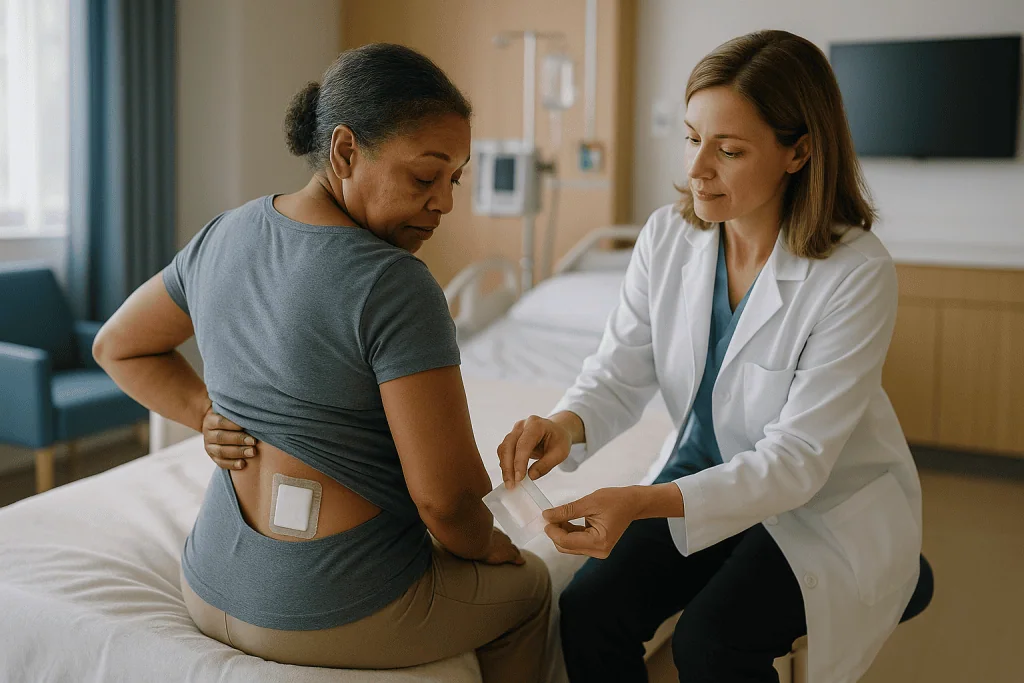
- Most teams allow a brief shower after the first day or two, with the incisions covered or with water running over them and no scrubbing. Pat dry with a clean towel; do not rub.
- Baths, hot tubs, pools and lakes are off limits until the skin has fully sealed, because soaking softens the closure and lets water carry bacteria in. Ask when soaking is allowed rather than guessing.
- Skip creams, powders, antiseptic sprays and home remedies unless your team specifically prescribes them. They can trap moisture or irritate healing skin.
- Wash your hands before touching the area, every time.
- Choose loose, soft clothing. An elastic waistband over a flank pocket, or a belt riding over a buttock pocket, rubs exactly where the skin is thinnest.
Closure varies. Some surgeons use dissolving stitches under the skin plus a strip of glue; others use external stitches or staples removed at the first follow-up. NHS guidance gives ranges of roughly one to two weeks for removing stitches on the body, depending on site, and your team will give a date. A small amount of clear or pinkish fluid on the dressing in the first days is normal. Thick yellow or green fluid, spreading redness or an incision edge that gapes open are not, and MedlinePlus advises reporting those changes promptly rather than waiting to see if they settle.
Once sealed, the scar keeps remodeling for months. Protecting it from sun and friction helps it fade, but the timeline is the body’s, not yours.
Spinal cord stimulator recovery time: a phase-by-phase guide to recovery after neuromodulation implant
Spinal cord stimulator recovery time is best pictured as overlapping phases rather than a single finish line. The ranges below are typical guidance drawn from Cleveland Clinic and Johns Hopkins patient information; your team may shorten or extend them based on your anatomy, lead type and job.
| Phase | What is usually happening | Typical guidance |
|---|---|---|
| Days 1–3 | Incision soreness, pocket ache, swelling; stimulation on a basic program | Rest with short frequent walks; dressings stay on; no driving; no bending, lifting or twisting |
| Days 4–14 | Skin edges seal; bruising peaks then fades; first programming visit | Showering usually permitted; stitches or staples removed if used; desk-type work sometimes resumes |
| Weeks 2–6 | Scar tissue forming around leads; settings refined at one or more visits | Walking increases; still no bending, lifting beyond light items, twisting or reaching overhead |
| Weeks 6–8 | Leads considered anchored by many teams | Restrictions usually lifted in stages; return to physical work and exercise discussed |
| Months 3–6 | Programming settles into a stable pattern; scar softens | Routine follow-up; reprogramming as needed; long-term device habits established |
The six-to-eight-week restriction window appears consistently across both sources, and it is the figure most people underestimate. By week three most incisions look healed and feel fine, which is precisely when the temptation to test the rules is strongest and the leads are still only partly scarred in.
Pain relief itself does not follow this table neatly. Some people notice a change during the trial and again as soon as the permanent device is switched on; others find that the settled effect only emerges after several programming sessions, once swelling has resolved and the contacts sit in their final position. Neither pattern predicts the other, and no source can promise a particular result.
Activity restrictions after spinal cord stimulator surgery: why bending, lifting and twisting matter
Lead migration is the term for a lead shifting from the spot where the surgeon placed it. It is the practical reason behind almost every activity rule, and understanding the mechanism makes the rules easier to keep.
The spinal canal is not a fixed-length tube. When you bend forward, the back of the canal stretches; when you arch, it shortens. A lead lying in the epidural space is pulled and pushed along with those changes. Once scar tissue has wrapped around it, the lead moves with the tissue as a unit. Before that, it is held by a small anchor and the friction of surrounding fat, and a hard bend, a heavy lift that braces the trunk, or a sharp twist to check a blind spot can slide it a few millimeters. A few millimeters is enough to shift which nerve fibers receive the pulses, so the tingling or relief moves to a different part of the body, weakens or disappears.
Activity restrictions after spinal cord stimulator surgery therefore focus on three movements: bending at the waist, lifting anything heavier than a light household object, and twisting the trunk. Reaching high overhead stretches the leads from the other direction and is often included. In everyday terms that means no vacuuming, no laundry baskets, no lifting toddlers or pets, no golf swing and no reaching into a low oven for the six to eight weeks described by Cleveland Clinic and Johns Hopkins.
Walking is the exception and the encouragement. It keeps the spine neutral, prevents stiffness and lowers clot risk. Sit-to-stand technique matters too: slide to the edge of the chair and rise using your legs rather than folding forward.
If migration happens, it is not necessarily a disaster. Reprogramming can often redirect the current using different contacts along the lead. Only when that fails does the team discuss a revision procedure.
What happens at spinal cord stimulator programming visits, and why so many?
Spinal cord stimulator programming is the process of choosing which electrode contacts fire, how strongly, how often and for how long each pulse lasts, so that stimulation covers the painful area and nothing else. A clinician or trained device specialist does this wirelessly with a tablet held near the generator, adjusting while you report what you feel.
Expect the first visit within the first two weeks, several more across the first three months, and then a slower rhythm of check-ins. That density surprises people. The reasons are physical: swelling around the leads changes how current spreads and takes weeks to resolve; the leads settle slightly as scar forms; and your posture changes as soreness eases and you move more normally. A program that felt right lying on the operating table often needs adjusting for standing, sitting and sleeping.
Two broad styles of stimulation exist. Paresthesia-based programs replace pain with a deliberate tingling you can feel; the programmer maps where the tingling lands and steers it onto the painful region. Sub-perception programs, including high-frequency and burst patterns, are set below the level you can feel and are judged over days by pain diaries rather than in the room. Many current devices offer both, and part of early programming is discovering which suits you.
Your hand-held remote lets you switch programs and adjust intensity within limits the clinician sets. It cannot exceed those limits, and it cannot damage the leads. Position sensors in some generators automatically change intensity when you lie down or stand up.
Come prepared. A simple diary noting pain levels, where the tingling sits, what you did and which program you used gives the programmer far more to work with than a vague “it’s okay, I think.” Bring the remote and the charger to every visit.
Pain relief and other medicines during recovery: what changes and what must not
Medicines during recovery fall into three groups, and each carries a decision that belongs to your prescriber rather than to you or to any article.
The first group covers surgical pain. Acetaminophen is often the backbone because it does not affect bleeding or wound healing. Anti-inflammatory painkillers are sometimes limited in the first days because they can increase bleeding into the generator pocket; whether and when to use them is a surgeon-specific call. Some people are given a short course of an opioid for the pocket ache. These dampen pain signals in the spinal cord and brain, and their side effects, constipation and drowsiness in particular, are the main reason teams keep courses short.
The second group is your existing pain regimen: the nerve pain medicines, muscle relaxants or long-term opioids you were taking before surgery. Do not change them because the device seems to be working. Stimulation and medicines act on different parts of the pain system, and reducing a long-standing medicine too quickly can produce withdrawal symptoms or a rebound in pain that is then wrongly blamed on the device. If the stimulator creates room to reduce medicines, that is a supervised conversation, usually started after programming has stabilized.
The third group is everything else: blood thinners paused before surgery, diabetes medicines, blood pressure medicines. Restart timing for blood thinners in particular is a negotiated decision between the surgeon, worried about bleeding into the pocket, and the prescribing doctor, worried about clots. Ask for that plan in writing before you leave.
A single dose of antibiotic before the incision is standard infection prevention, in line with CDC surgical site infection guidance. Prolonged antibiotic courses afterward are not routine and are prescribed only if a problem develops.
Sleeping, showering, driving and going back to work with a new stimulator
Sleep is the first practical puzzle. Lying on the generator is uncomfortable for weeks, and lying on your stomach arches the spine. Most people settle on their back with a pillow under the knees, or on the side opposite the pocket with a pillow between the knees. Getting into bed matters as much as position: sit on the edge, lower onto your side, then roll, keeping shoulders and hips moving together. Reverse the sequence to get up.
Showering follows the wound care rules above. Washing hair without reaching overhead is awkward; a handheld shower head or a helper for the first two weeks solves it.
Driving carries two separate cautions. First, you should not drive while taking sedating pain medicine or while the twisting needed to check mirrors is restricted; many teams ask people to wait at least one to two weeks and to resume only when they can turn comfortably and brake hard without hesitation. Second, device manufacturers generally advise switching paresthesia-type stimulation off while driving or operating machinery, because a sudden change in sensation with posture could distract. Your team will tell you whether that applies to your device and program.
Work depends entirely on what the job asks of your trunk. Desk-based roles are often possible within one to two weeks, with breaks to stand and walk. Roles involving lifting, bending or long periods of driving wait until restrictions are lifted, usually in the six-to-eight-week window described by Cleveland Clinic and Johns Hopkins, sometimes with a phased return.
Sex can resume when comfortable, avoiding positions that bend or twist the trunk. Exercise begins with walking; swimming waits for sealed skin; gym work, yoga, cycling and sports return in stages after the team confirms the leads are anchored. Ask specifically about anything involving rotation, such as golf or tennis.
Living with the device: charging, MRI scans, airports and other procedures
Once the incisions are a memory, the device becomes a set of habits.
Charging applies only to rechargeable generators. These are topped up through the skin with a charging paddle held over the pocket, on a schedule that depends on settings and battery size. Cleveland Clinic and Johns Hopkins describe rechargeable batteries as lasting many years, while non-rechargeable generators are replaced in a minor procedure when the battery runs down after a shorter span. Letting a rechargeable battery drain completely can be hard to recover from, so a routine, such as charging while reading in the evening, is worth building early.
MRI compatibility is the most common long-term question. “MRI conditional” means a scan is permitted, but only under specific conditions: particular scanner strengths, certain body regions, the device switched to a designated mode, and sometimes only with specific lead and generator combinations. Carry your device identification card at all times and tell every radiology department about the implant before booking. The radiology team, not the referring doctor, makes the final call.
Airport security scanners and shop anti-theft gates rarely cause trouble, but walking through briskly rather than lingering is sensible, and the identification card explains any alarm.
Other procedures need planning. Electrocautery during surgery, diathermy used by some physical therapists and certain cardiac devices can interfere with or damage the generator, so every surgeon, dentist and therapist you see should know it is there. Having a pacemaker or defibrillator is not an automatic barrier, but it requires coordination between the two device teams.
Household electronics, cell phones and induction stoves are generally not a concern, though keeping strong magnets away from the generator site is prudent.
Risks, complications and alternatives, in plain clinical language
Every implanted device carries risks, and an honest account of them is part of a fair decision. The list below uses neutral clinical language and does not replace the specific figures your team will quote from their own experience and from device documentation.
Infection is the complication that most concerns surgeons, because hardware makes it hard to clear and often requires removing the device until the infection resolves. CDC surgical site infection guidance notes that most such infections appear within 30 days of surgery, and that with an implant, surveillance extends to 90 days or longer because deep infections around hardware can declare themselves late. That is why wound care and early reporting matter so much.
Bleeding into the generator pocket (a hematoma) or a collection of clear fluid there (a seroma) can cause swelling that usually settles but occasionally needs drainage. Lead migration and, less often, lead fracture can reduce coverage and may need reprogramming or revision. Pain over the generator is a recognized problem when the pocket is shallow or the device edge rubs. A headache that is worse when upright can follow an accidental puncture of the membrane around the spinal cord during lead placement. Nerve injury and bleeding inside the spinal canal are rare but serious, and they underlie several of the red flags in the final section. Over months and years, some people find the effect fades, and a proportion eventually have the device removed.
Alternatives exist and remain available after implantation. They include continued medicine management, structured physical therapy, pain psychology programs, targeted spinal injections, radiofrequency treatment of specific nerves, dorsal root ganglion or peripheral nerve stimulation for focal pain, and implanted medicine pumps for selected people. None is universally superior; the appropriate choice depends on the pain source, prior treatments and personal priorities, and it is made with the treating team.
What people often get wrong about recovering from a stimulator implant
Waiting-room conversations circulate a few ideas that the evidence does not support.
“If the incisions look healed, I can lift again.” Skin heals in roughly two weeks; the scar anchoring the leads takes six to eight. The healed-looking incision is the moment of maximum risk, not the all-clear.
“The tingling stopped, so the device is broken.” Not necessarily. You may have been switched to a sub-perception program, the battery may need charging, the lead may have shifted slightly, or the generator may be in a mode you selected by accident. Check the remote and the charge level, then call the programming team. Very few of these calls end in surgery.
“It should work instantly.” Some people feel a difference at switch-on. Many find the settled benefit emerges over several programming sessions as swelling resolves. Judging the device in week one is like judging new glasses before the prescription is finalized.
“I must feel the tingling for it to be working.” Sub-perception programs are designed to be noticed only as pain change, not as sensation. Absence of tingling is a design feature in those modes.
“I can never have an MRI again.” Many current systems are MRI conditional. Conditions apply and the radiology department decides, but a blanket ban is often untrue.
“Now I can stop my other pain medicines.” Any reduction is supervised and gradual, for the reasons described earlier.
“Pocket pain at week two means something is wrong.” Tenderness where the generator sits commonly lasts several weeks, and a firm ridge can persist for months. Worsening pain, spreading redness or fever are different, and those belong in the final section.
What matters most, in this writer’s reading of the guidance, is patience with the slow clock. Protect the leads through the boring middle weeks and most of the rest tends to follow.
Questions to ask your care team before and after the implant
A short list, written down and taken to the pre-operative visit and the first follow-up, turns a rushed appointment into a useful one. The wording below is deliberately specific.
- Which type of device and stimulation mode are you recommending for me, and why that one?
- Where exactly will the generator pocket be, and can I choose a side based on how I sleep or sit?
- How are the incisions closed, when can I shower, and when can I soak in a bath or swim?
- What are my specific bending, lifting and twisting limits, in everyday terms, and for exactly how many weeks?
- Which of my current medicines do I pause, which do I continue, and who gives the go-ahead to restart blood thinners?
- When is my first programming visit, how many should I expect in the first three months, and is remote programming available?
- Should stimulation be off while I drive, and when may I drive at all?
- Is this system MRI conditional, and what does that mean for scans I may need?
- What is the plan if the leads move or the effect fades, and how often does your team see that?
- Who do I call at night or on a weekend if the wound changes or I develop a fever?
- If we decide the device is not helping, what does removal involve?
Answers to the last two questions are the ones people most regret not having. Knowing the after-hours number and the realistic pathway if things do not go to plan removes a great deal of the anxiety that otherwise fills the six-week wait. Write the answers on the same sheet, and keep it with the device identification card.
When to call your doctor: red-flag signs after a neuromodulation implant
Recovery after a neuromodulation implant is usually uneventful, and most concerns can wait for a phone call during office hours. A short list cannot wait. Treat the following as reasons to contact your team the same day, or to seek emergency care if they are severe or rapidly worsening.
- Fever or chills, especially in the first month, when CDC guidance notes most surgical site infections declare themselves.
- Redness spreading outward from either incision, increasing warmth, thick yellow or green discharge, a bad smell, or an incision edge that has opened.
- Pain at either site that was improving and has now clearly worsened.
- Rapidly enlarging swelling at the generator pocket, or fluid leaking from the pocket incision.
- A severe headache that is markedly worse when sitting or standing and eases lying flat, which can follow a leak of spinal fluid.
- New weakness or numbness in the legs, difficulty walking, or any change in bladder or bowel control. These can signal bleeding or infection pressing on the spinal cord and are emergencies; go to an emergency department rather than waiting for a callback.
- Calf pain or swelling, chest pain or sudden breathlessness, which can indicate a blood clot.
- A sudden, unpleasant change in stimulation, such as shocks or painful jolts, that does not resolve when you turn the device off.
For less urgent changes, such as tingling that has drifted to a new area, a remote that will not connect, or a battery that will not charge, call the programming team during working hours. MedlinePlus advises that wound changes are easier to treat when reported early, so err toward calling. Nobody on a well-run team minds a phone call about a wound that turns out to be fine; they mind the infection that was watched at home for a week.
Frequently asked questions
How long is spinal cord stimulator recovery time overall?
Most people are past the visible healing within about two weeks and past the main activity restrictions within six to eight weeks, according to Cleveland Clinic and Johns Hopkins patient information. Programming continues to be refined for roughly three months, and pocket tenderness can linger for weeks. Your team may set different limits based on your anatomy, lead type and job, and those instructions override any general range.
What does spinal cord stimulator wound care involve day to day?
Keep both incisions clean and dry for the period your team specifies, shower briefly without scrubbing once permitted, pat dry, avoid creams and powders, and do not soak in a bath or pool until the skin has fully sealed. Wear loose clothing that does not rub the generator site. Report spreading redness, thick discharge, an opening wound or fever promptly, as MedlinePlus and NHS guidance advise.
What are the activity restrictions after spinal cord stimulator surgery?
The core restrictions are no bending at the waist, no lifting beyond light household items, no twisting the trunk and often no reaching overhead, typically for six to eight weeks. They protect the leads while scar tissue anchors them. Walking is encouraged from day one. Your surgeon will confirm the exact limits and when they are lifted, sometimes in stages.
What happens at spinal cord stimulator programming visits, and how many will I have?
A clinician or device specialist uses a wireless tablet to choose which contacts fire and how strongly, while you report what you feel or bring a pain diary for sub-perception programs. Expect a first visit within about two weeks and several more over the first three months, then fewer. Settings change because swelling resolves, leads settle and your posture returns to normal.
When can I drive after a neuromodulation implant?
Many teams ask people to wait at least one to two weeks, and to resume only when they are off sedating pain medicine and can turn to check mirrors and brake hard without hesitation. Device manufacturers also generally advise switching paresthesia-type stimulation off while driving, because sensation can change with posture. Confirm both points with your team, since guidance varies by device and program.
When can I shower or bathe after the implant?
A brief shower is usually allowed after the first day or two, with the incisions covered or with water running over them and no scrubbing, then patting dry. Soaking in a bath, hot tub or pool waits until the skin has completely sealed, which typically takes a couple of weeks. Your surgeon gives the specific dates, and they depend on how the incisions were closed.
Why has the tingling moved or disappeared?
Several benign explanations come first: you may be on a sub-perception program that is not meant to be felt, the battery may need charging, or you may have switched programs accidentally. Swelling settling in the first weeks also changes where stimulation lands. Lead migration is another possibility, and reprogramming often compensates. Check the remote and charge level, then call the programming team rather than adjusting blindly.
Can I have an MRI with a spinal cord stimulator?
Often yes, but only if your specific system is MRI conditional, and only under the conditions its documentation sets out, such as scanner strength, body region and a designated device mode. Carry your device identification card, tell every radiology department about the implant before booking, and let the radiology team make the final decision. A blanket ban on MRI is often untrue for current systems.
How should I sleep after stimulator surgery?
Most people are most comfortable on their back with a pillow under the knees, or on the side opposite the generator with a pillow between the knees. Sleeping on the stomach arches the spine and is usually discouraged early on. Get into bed by sitting on the edge, lowering onto your side and rolling with shoulders and hips together, then reverse the sequence to rise.
How long does the battery last, and what does charging involve?
Rechargeable generators are topped up through the skin with a paddle held over the pocket, on a schedule that depends on your settings, and Cleveland Clinic and Johns Hopkins describe them as lasting many years. Non-rechargeable generators run down sooner and are replaced in a minor procedure. Avoid letting a rechargeable battery drain fully, and bring the charger and remote to every programming visit.
References
This article is for general information only and is not a substitute for professional medical advice. Please consult a qualified doctor about your individual situation.

More from the Blog

How Long Does a Cortisone Shot Last? Duration, Honestly Answered
Relief from a cortisone shot most often lasts between six weeks and six months, though the range is wide: some people feel better for…

How Long Sciatica Lasts and Whether It Goes Away on Its Own
Most episodes of sciatica ease within about four to six weeks, and the majority of people improve without surgery. Pain often fades gradually and…

PRP Injections: What Platelet-Rich Plasma Can Do: Per the Evidence
PRP (platelet-rich plasma) injections concentrate platelets from your own blood and inject them into damaged tissue to encourage healing. Evidence is strongest for chronic…
Epidural Steroid Injections: What to Expect, What They Can and Cannot Fix
An epidural steroid injection delivers anti-inflammatory medicine into the space surrounding irritated spinal nerves, most often to calm leg or arm pain from a…

Inside an Epidural Injection for Sciatica: Imaging, Contrast and the Minutes That Follow
An epidural injection for sciatica places a corticosteroid, usually with a local anesthetic, into the epidural space around irritated spinal nerves, guided by live…

How Long Does Facet Denervation Relief Last and What Happens When Nerves Regrow?
Relief after facet denervation, a procedure that heats the tiny medial branch nerves so they stop carrying pain signals from an arthritic spinal joint,…