

PRP Injections: What Platelet-Rich Plasma Can Do: Per the Evidence
Key Takeaways
- PRP concentrates your own platelets to roughly two to ten times normal blood levels and reinjects them at an injury site to trigger growth-factor release: it is not stem cell therapy.
- The most rigorous knee osteoarthritis trial to date (288 patients, JAMA 2021) found PRP no better than a salt-water placebo for pain or cartilage volume at one year.
- Chronic tennis elbow holds PRP's strongest supportive evidence, while a well-designed Achilles tendinopathy trial found no benefit over placebo, tendon location changes the answer.
- When PRP helps, improvement typically builds over four to twelve weeks, and most studies track benefits for six to twelve months; scalp results fade without maintenance sessions.
- US prices commonly run $500–$2,500 per injection, and insurance rarely pays because the FDA has cleared PRP preparation devices but has not approved PRP as a treatment for any orthopedic or cosmetic condition.
- Because PRP comes from your own blood, allergic reactions are essentially a non-issue; the main risks are a temporary pain flare in the first 72 hours and, rarely, infection, which makes sterile, licensed medical settings essential.
PRP (platelet-rich plasma) injections concentrate platelets from your own blood and inject them into damaged tissue to encourage healing. Evidence is strongest for chronic tennis elbow, mixed for knee osteoarthritis, and mostly negative for Achilles tendinopathy. When PRP helps, improvement builds over weeks and often lasts six to twelve months. It is generally safe, but costly and rarely covered by insurance.
The pitch usually arrives courtside. A pickleball partner rolls up a sleeve, points to an elbow that ached for a year, and says two words: platelet-rich plasma. Professional athletes have been getting it since the late 2000s, the story goes, and now the clinic down the road offers it too, for a price that would cover a decent used bicycle.
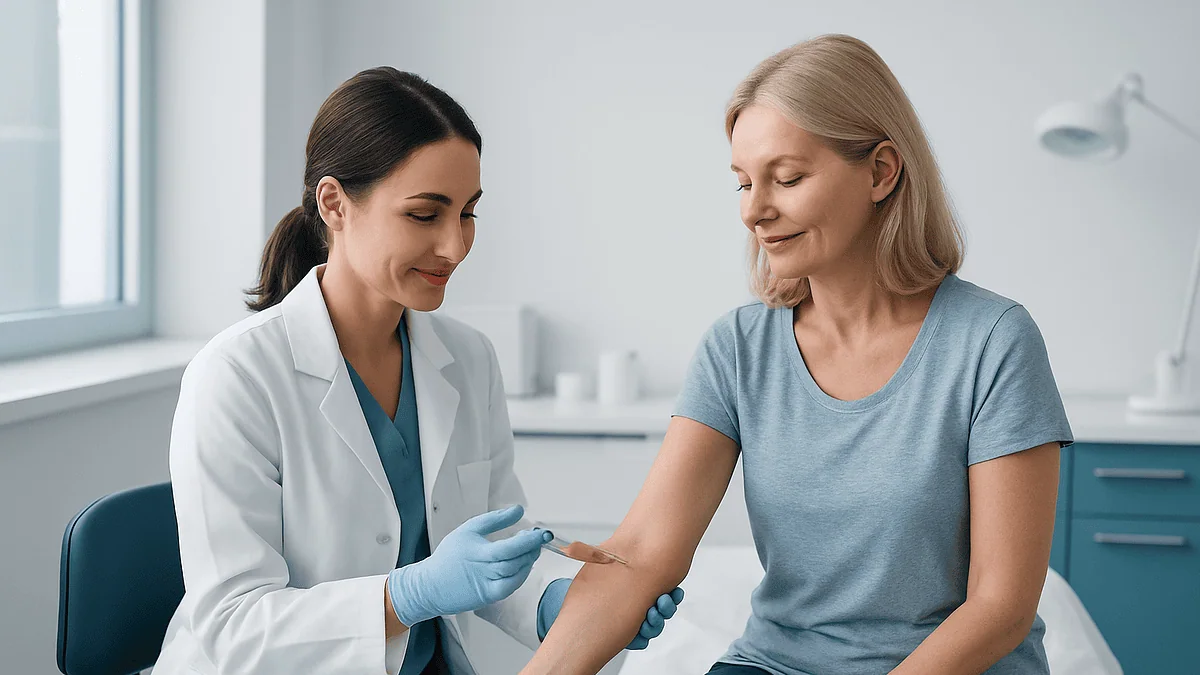
The procedure itself looks almost theatrical. A technician draws a few tubes of your blood, loads them into a centrifuge, and spins them at thousands of revolutions per minute until the platelets separate into a straw-colored layer. Minutes later, that layer goes back into you: this time, straight into the sore spot.
Between the hype and the skepticism sits a genuinely interesting body of research. Some of it is encouraging. Some of it is flatly negative. Knowing which is which can save you real money and real time.
What is a PRP injection, exactly?
Platelet-rich plasma is your own blood, re-engineered on the spot. A clinician draws a sample, often somewhere between 15 and 60 milliliters, roughly one to four tablespoons, and spins it in a centrifuge for about ten to fifteen minutes. The spin separates blood into layers: red cells at the bottom, plasma on top, and a thin, platelet-dense band in between.
That concentrated layer is the product. Depending on the system used, it contains anywhere from two to ten times the platelet concentration of ordinary blood. The clinician draws it into a syringe and injects it into the injured area, a tendon, a joint, the scalp, often using ultrasound to place it precisely.
Because the material comes entirely from your own body, doctors call it autologous. That single fact explains much of PRP’s safety profile: your immune system has no reason to reject your own platelets, so allergic reactions are essentially a non-issue.
One point worth pinning down early, because clinics sometimes blur it: PRP is not stem cell therapy. Platelets are cell fragments, not cells that grow into new tissue. They act more like messengers than builders: a distinction that matters when you hear claims about “regenerating” a joint. The Cleveland Clinic and Johns Hopkins both describe PRP as a way to support the body’s own repair process, not to rebuild tissue outright.
How is PRP supposed to work in the body?
Platelets are your bloodstream’s first responders. When you cut a finger, they rush to the site, clump together to plug the leak, and release a cascade of proteins from internal storage sacs called alpha granules. Those proteins, growth factors with names like PDGF, VEGF, and TGF-beta, summon repair cells, stimulate new blood vessel formation, and coordinate the cleanup crew.
The theory behind PRP borrows that script. Chronic tendon problems, in particular, tend to smolder in tissue with famously poor blood supply; the Achilles and the tendons of the elbow get relatively little circulation compared with muscle. Deliver a concentrated payload of platelets directly into that neglected zone, the reasoning goes, and you jump-start a healing response the body couldn’t mount on its own.
It’s an elegant hypothesis, and laboratory studies do show that PRP can stimulate cells involved in tendon and cartilage maintenance in a dish. The honest caveat: a plausible mechanism is not the same as a proven result. Plenty of treatments with beautiful biological logic have failed in careful human trials, and PRP has collected both wins and losses on that scoreboard.
So the right question is never “does the theory make sense?” It’s “what happened when researchers compared PRP against a placebo, for my specific condition, in people like me?” The next sections walk through exactly that.
What is a PRP injection good for? The condition-by-condition scorecard
PRP’s reputation suffers from a lumping problem: a positive elbow study gets cited to sell knee injections, and a negative knee study gets used to dismiss the elbow. The evidence is condition-specific, and it looks roughly like this:
| Condition | What trials show | Confidence |
|---|---|---|
| Chronic tennis elbow | Several trials report better pain and function at 6–12 months than some comparison injections | Moderate, cautiously positive |
| Knee osteoarthritis | Early small studies looked promising; the most rigorous placebo-controlled trial found no benefit at one year | Mixed |
| Patellar tendinopathy (jumper’s knee) | Small studies suggest improvement when paired with structured rehab | Limited |
| Pattern hair loss | Small trials show modest gains in hair density with repeated sessions | Limited |
| Rotator cuff tendinopathy | Results are inconsistent across studies | Mixed |
| Chronic Achilles tendinopathy | A well-designed randomized trial found no benefit over a salt-water placebo | Mostly negative |
| Back pain, skin rejuvenation, acute muscle tears | Small, low-quality studies only | Insufficient |
Notice the pattern: the strongest signals cluster around chronic tendon problems near the elbow and knee, while the loudest marketing often surrounds uses, joints, faces, backs, where the science is thinnest. If a clinic quotes you “studies show PRP works,” the fair follow-up is simple: studies of what, in whom, compared with what?
Does PRP work for knee osteoarthritis?
This is the question with the most money riding on it, because osteoarthritis affects over 32 million American adults and offers no quick fix. For years, small studies suggested PRP eased arthritic knee pain at least as well as other common injectables, and enthusiasm grew.
Then came a tougher test. In 2021, Australian researchers published a randomized trial in JAMA involving 288 people with mild-to-moderate knee osteoarthritis. Half received a series of PRP injections; half received a salt-water placebo, delivered with identical ceremony. Neither patients nor assessors knew who got what. At twelve months, the PRP group’s pain scores were no better than the placebo group’s, and MRI scans showed no difference in cartilage volume either.
Two lessons hide in that result. First, PRP did not slow the disease or regrow cartilage, which directly contradicts a common sales claim. Second, both groups improved meaningfully, which says something humbling about injections in general: the ritual of a needle in a sore knee produces a strong placebo response all by itself. Earlier PRP studies that compared PRP only against other active injections, never against placebo, couldn’t detect that effect.
Does this close the book? Not entirely. Trials continue, and some researchers argue that specific PRP formulations or earlier-stage arthritis might respond differently. But right now, the most rigorous evidence available does not support PRP as a reliable arthritis treatment, and major orthopedic guidelines reflect that hesitancy.
Tennis elbow, jumper's knee, Achilles pain: where tendons stand
Tendons are where PRP has earned whatever credibility it has, and also where it suffered its most decisive defeat.
Start with the win. Chronic lateral epicondylitis, better known as tennis elbow, is a stubborn overuse condition of the tendons on the outside of the elbow. Multiple randomized trials have found that people receiving PRP report better pain and function six to twelve months out than those receiving certain other commonly used injections, and some follow-ups suggest the advantage holds at two years. The effect isn’t dramatic, and rehabilitation exercises remain the backbone of treatment, but the direction of the evidence is genuinely favorable here.
Now the loss. In 2010, Dutch researchers published a landmark trial in JAMA on chronic Achilles tendinopathy: 54 patients, all doing the same proven eccentric exercise program, randomized to PRP or a salt-water placebo injection. At six months, the groups were statistically indistinguishable. Longer follow-up didn’t rescue the result. For the Achilles, PRP simply hasn’t shown it adds anything to good rehab.
Between those poles sits everything else. Patellar tendinopathy shows early promise in small studies. Rotator cuff research is a coin flip, with trials pointing in both directions. The takeaway is unglamorous but useful: tendon location matters, and the elbow evidence cannot be transplanted to the heel. Ask your clinician which body of research applies to your tendon, singular.
Does PRP help with hair loss?
Scalp PRP has become a fixture of dermatology and aesthetic clinics, marketed mostly for androgenetic alopecia: the common, hormonally driven pattern thinning that affects both men and women. Here the theory is that growth factors released by platelets may nudge shrinking hair follicles back toward a more active growth phase.
The research consists largely of small trials, and many report something real: modest increases in hair count and hair shaft thickness after a series of monthly sessions, typically three treatments over three months. “Modest” is the operative word. Participants often gain density measurable under magnification rather than transformation visible across a dinner table, and some studies show no benefit at all.
Two practical realities deserve equal billing. First, protocols vary enormously, different platelet concentrations, session counts, and injection depths, so one clinic’s results say little about another’s. Second, whatever benefit occurs appears to fade without maintenance sessions every few months, which turns a one-time cost into a standing subscription. PRP does not address the underlying hormonal driver of pattern hair loss, so thinning resumes when treatment stops.
A reasonable summary, consistent with how Harvard-affiliated and academic dermatologists describe it: PRP for pattern hair loss is a plausible option with limited supporting evidence, best considered with clear eyes about cost, upkeep, and the modest scale of likely improvement.
Where the evidence is thin, or missing entirely
Walk past the well-studied conditions and the ground gets soft quickly.
Low back pain and disc problems attract heavy PRP marketing, yet the supporting studies are small, often lack placebo controls, and measure outcomes inconsistently. Given how strongly back pain responds to time, movement, and expectation, uncontrolled studies here tell us almost nothing. The same applies to PRP injected during surgeries, into rotator cuff repairs or ligament reconstructions, where trials have mostly failed to show faster or stronger healing.
Cosmetic “vampire facials,” in which PRP is microneedled or injected into facial skin, rest on even less: laboratory findings and before-and-after photos rather than rigorous comparative trials. And this corner of the industry carries a caution worth stating plainly. The CDC has documented infections, including bloodborne ones, traced to unlicensed spa settings that reused equipment during PRP facials. The lesson isn’t that PRP is dangerous, done properly, with sterile, single-use equipment, it’s quite safe. The lesson is that “it’s just your own blood” is only reassuring when the needles, tubes, and handling are beyond reproach. A medical setting with clear infection-control practices is non-negotiable.
Acute muscle tears in athletes round out the list: despite headlines about star players flying to PRP specialists, controlled studies have not shown that it reliably speeds return to play. Fame is not a study design.
What happens during a PRP procedure, step by step
The whole visit usually runs 45 to 90 minutes, and most of that is preparation rather than injection.
It starts like a routine lab draw: a needle in your arm, a few tubes filled. Those tubes go into a centrifuge, and for the next ten to fifteen minutes you wait while physics does the sorting. The clinician then extracts the platelet-rich layer, sometimes adding an agent to activate the platelets, sometimes letting your tissue do the activating.
The injection itself takes minutes. For deep targets, a hip tendon, the inside of a knee, many clinicians use ultrasound guidance to confirm the needle sits exactly where the injury lives, which likely matters more than patients realize. A numbing agent may be applied to the skin, though the deep part of the injection can still ache sharply for a moment.
Then comes the counterintuitive part. Expect the area to feel worse before it feels better, soreness, stiffness, sometimes swelling for 24 to 72 hours. That flare is considered part of the process, since PRP works by provoking an inflammatory healing response rather than suppressing one. For the same reason, your clinician will likely ask you to avoid anti-inflammatory pain relievers for a window before and after treatment, and to hold off on hard training temporarily. A graded return to activity, often alongside physical therapy, typically follows over several weeks.
What is the downside of PRP injections?
The physical risks are genuinely small; the practical downsides are not.
Start with the body. Because PRP is your own blood, the serious-complication list is short: a small risk of infection (as with any injection), rare nerve or blood vessel irritation, bleeding or bruising at the site, and the expected pain flare in the first few days. People with certain blood or platelet disorders, active infections, or some other medical conditions may not be candidates, which is one reason a real medical evaluation should precede any injection.
Now the wallet and the calendar. PRP commonly costs hundreds to a few thousand dollars per injection, insurance rarely pays, and many protocols call for a series of two or three treatments. For conditions where the evidence is mixed or negative, that’s a substantial bet on a coin flip, or worse.
There’s also a quieter cost that deserves more attention: the opportunity cost. Every month spent on injections with uncertain benefit is a month not spent on treatments with strong evidence, structured exercise therapy for tendinopathy and knee arthritis chief among them. Some patients also delay definitive care, such as a needed surgical consultation, while waiting for PRP to work.
Finally, there’s the standardization problem: because preparations vary so widely between clinics, you can’t fully know what product you’re buying. More on that below, because it explains much of PRP’s contradictory research record.
How long do PRP injections last?
The honest answer has two parts: what studies measured, and what the biology implies.
Most clinical trials tracked patients for six to twelve months, so that’s the window where evidence actually exists. In knee osteoarthritis studies where PRP recipients improved, the benefit generally held through about a year, with some research suggesting it fades between twelve and eighteen months, consistent with PRP easing symptoms rather than changing the arthritis itself. Since the 2021 placebo-controlled trial found no cartilage difference at twelve months, there’s no evidence the clock gets reset structurally.
Tendons may be a different story. If PRP genuinely helps a chronic tendon heal, the most optimistic reading of the tennis elbow data, then the improvement isn’t a drug effect that wears off; it’s repaired tissue that stays repaired, provided you don’t re-injure it. Some elbow trials reporting benefit at one and two years support that interpretation, though “may persist” is as far as the data lets anyone go.
Hair is the clearest case of a temporary effect: density gains from scalp PRP diminish without maintenance sessions, typically recommended every three to six months.
A useful mental model: PRP is not a lubricant that gets used up on a schedule. Where it works, durability depends on whether it actually changed the tissue, and for most uses, science hasn’t yet settled that question.
What does a PRP injection cost, and why insurance rarely pays
In the United States, a single PRP injection typically runs somewhere between $500 and $2,500, depending on the body part, the region, the preparation system, and whether imaging guidance is used. Scalp treatments for hair loss often price out at $400 to $1,500 per session, and remember, those come in series with ongoing maintenance. A full initial course for any indication can easily clear $2,000 to $5,000 out of pocket.
Why out of pocket? The regulatory picture explains it. The FDA has cleared various centrifuge systems as devices for preparing PRP, but it has not approved PRP as a treatment for arthritis, tendinopathy, hair loss, or cosmetic use. Clinicians may still offer it, that’s legal and common, but insurers, including Medicare in most circumstances, classify it as unproven and decline coverage. Cleveland Clinic’s patient guidance says as much directly: expect to pay yourself.
That structure creates an incentive worth naming without cynicism: PRP is a cash service, and cash services get marketed enthusiastically. None of that makes any individual clinician dishonest. It does mean the burden falls on you to ask for the total cost in writing, all sessions, imaging, and follow-ups included, before agreeing, and to weigh that figure against the evidence grade for your specific condition. For a mixed-evidence use, some households will reasonably say yes; others will reasonably put the money toward a year of physical therapy instead.
Why do PRP results vary so much from study to study, and clinic to clinic?
Read enough PRP research and a frustrating truth emerges: “PRP” is not one thing. It’s a family of loosely related products that share a name.
Consider the variables in play. Platelet concentration can range from double to ten times baseline depending on the centrifuge protocol. Some preparations retain white blood cells (leukocyte-rich PRP), which may suit tendon problems but might aggravate joints; others filter them out (leukocyte-poor). Volumes differ. Activation methods differ. One clinic gives a single injection; another schedules three, spaced weeks apart. Even the patient’s own blood matters, platelet counts and growth factor content vary from person to person and possibly day to day.
Now imagine pooling twenty studies that each used a different recipe and asking, “does PRP work?” The mixed answers stop being mysterious. This is a real scientific weakness, and researchers have called for standardized reporting so trials can be meaningfully compared. Until that happens, systematic reviews will keep reaching lukewarm conclusions partly because they’re averaging apples, oranges, and the occasional pineapple.
For you as a patient, the practical translation is specific: ask what preparation the clinic uses, whether it’s leukocyte-rich or leukocyte-poor, what platelet concentration their system targets, and whether that formulation matches the ones used in the positive studies for your condition. A clinic that can answer crisply has done its homework. A clinic that waves the question away has told you something too.
Questions worth asking before you book a PRP appointment
A good clinician will welcome scrutiny; the evidence here is uncertain enough that scrutiny is simply appropriate. Bring these to the consultation:
- What does the published evidence show for my exact condition, and was it compared against a placebo, or only against other treatments?
- Have I exhausted first-line care with stronger evidence, such as a structured exercise or physical therapy program?
- Which PRP preparation do you use, and how does it compare to the formulations in the supportive studies?
- How many injections do you anticipate, and what is the all-in cost, in writing?
- How will we define success, and at what point, if I’m not improving, do we stop and change course?
- Will the injection be image-guided, and who performs it?
That last pair matters more than it seems. One of the most common disappointments in PRP care isn’t a complication; it’s drift: a second series, then a third, without a predefined endpoint. Agreeing in advance on what “working” looks like (a pain score, a functional goal, a timeline of roughly three months) protects both your budget and the therapeutic relationship.
And a note on setting: for any PRP procedure, cosmetic ones included, choose a licensed medical environment with sterile, single-use equipment. The safety record of PRP is excellent precisely because it’s usually delivered under those conditions.
When should you see a doctor about joint, tendon, or persistent pain?
PRP conversations usually start with pain that’s overstayed its welcome, and some pain shouldn’t wait for a wellness-magazine deep dive. See a clinician promptly if you notice any of the following:
- Joint or tendon pain lasting more than a few weeks despite rest and activity changes
- A sudden pop, snap, or giving-way during activity, especially with immediate weakness
- Inability to bear weight, or a joint that locks or buckles
- Significant swelling, warmth, or redness around a joint, particularly with fever, which can signal infection and needs urgent care
- Pain that wakes you at night or steadily worsens rather than fluctuating
- Numbness, tingling, or weakness spreading beyond the painful area
These signs matter because conditions that mimic simple tendinopathy, a partial tendon rupture, an inflamed joint, a stress fracture, call for entirely different treatment, and no injection should proceed without an accurate diagnosis. Mayo Clinic’s guidance on tendon pain draws the same line: persistent or severe symptoms deserve evaluation, not guesswork.
If you’ve already had a PRP injection, contact your clinician if pain intensifies after the first 72 hours instead of easing, or if you develop fever, spreading redness, drainage at the injection site, or new numbness. Those symptoms are uncommon, but they’re exactly the ones worth a same-day phone call. Routine post-injection soreness, by contrast, should be clearly fading by day three or four.
Frequently asked questions
What is a PRP injection good for?
The best-supported use is chronic tennis elbow, where several trials show better pain and function at six to twelve months. Evidence is mixed for knee osteoarthritis and rotator cuff problems, limited but somewhat promising for jumper’s knee and pattern hair loss, and mostly negative for Achilles tendinopathy. For back pain, cosmetic facials, and acute muscle tears, high-quality evidence is essentially absent. Always ask what the research shows for your specific condition.
What is the average cost of a PRP injection?
In the US, a single PRP injection typically costs between $500 and $2,500, with scalp sessions for hair loss often running $400 to $1,500 each. Many protocols involve two or three injections, so a full course frequently totals $2,000 to $5,000. Insurance and Medicare rarely cover it because PRP is not FDA-approved for these uses, so get the all-in price in writing before committing.
What is the downside of PRP injections?
The main downsides are cost, uncertain benefit, and time. Physical risks are small, temporary pain flare, bruising, and rarely infection or nerve irritation, because the material comes from your own blood. The bigger concerns are paying thousands out of pocket for mixed evidence, the lack of standardization between clinics, and the opportunity cost of delaying treatments with stronger proof, such as structured exercise therapy.
How long do PRP injections last?
Where PRP works, studies generally document benefits for six to twelve months, with some knee arthritis research suggesting effects fade by twelve to eighteen months. Tendon improvements may last longer if the tissue genuinely healed, and some tennis elbow trials report benefit at two years. Hair density gains are clearly temporary, requiring maintenance sessions every three to six months. No study shows PRP permanently changes joint structure.
How painful is a PRP injection?
Expect brief, sharp discomfort during the injection, often more than a routine shot, since the target is already injured tissue, followed by soreness, stiffness, and sometimes swelling for 24 to 72 hours. That flare is considered part of the intended inflammatory healing response. Clinicians often apply a skin-numbing agent first and may advise ice, relative rest, and avoiding anti-inflammatory pain relievers for a period afterward.
How soon will I notice results from PRP?
Not quickly. PRP is designed to stimulate a gradual repair process, so most people who improve notice change over four to twelve weeks, not days, and the area often feels worse for the first few days. Many clinicians reassess at about three months before deciding whether to repeat, continue, or stop. Any clinic promising immediate results is describing something the biology and the research don’t support.
Is PRP FDA approved?
No. The FDA has cleared various centrifuge devices used to prepare PRP, but it has not approved PRP itself as a treatment for arthritis, tendon problems, hair loss, or cosmetic purposes. Clinicians may legally offer it, and many do, but this regulatory status is the main reason insurers classify PRP as unproven and decline to cover it, leaving patients to pay out of pocket.
Can PRP regrow cartilage in an arthritic knee?
Current evidence says no. In the most rigorous trial to date, published in JAMA in 2021, people with knee osteoarthritis who received PRP showed no difference in cartilage volume on MRI at twelve months compared with those who received a placebo injection, and no difference in pain, either. Claims that PRP rebuilds cartilage or reverses arthritis go beyond anything demonstrated in controlled human research.
Does PRP work for hair loss?
Small trials in pattern hair loss show modest improvements in hair count and thickness after a series of monthly sessions, though some studies find no benefit and protocols vary widely between clinics. Gains fade without maintenance treatments every three to six months, because PRP doesn’t address the hormonal cause of thinning. It’s a plausible option with limited evidence, reasonable to try with realistic expectations about scale and ongoing cost.
How many PRP injections will I need?
It depends on the condition and the clinic’s protocol. Tendon problems are often treated with one to three injections spaced several weeks apart; knee arthritis protocols commonly use a series of three; hair loss typically starts with three monthly sessions plus maintenance. Because there’s no standardized regimen, agree in advance on how many injections you’ll try and what improvement would justify continuing: a predefined stopping point protects your budget.
This article is for general information only and is not a substitute for professional medical advice. Please consult a qualified doctor about your individual situation.

More from the Blog

How Long Does a Cortisone Shot Last? Duration, Honestly Answered
Relief from a cortisone shot most often lasts between six weeks and six months, though the range is wide: some people feel better for…

How Long Sciatica Lasts and Whether It Goes Away on Its Own
Most episodes of sciatica ease within about four to six weeks, and the majority of people improve without surgery. Pain often fades gradually and…

Recovery After an Implanted Neuromodulation Device: Wound Care, Programming Visits and Activity
Recovery after a neuromodulation implant such as a spinal cord stimulator usually means keeping two small incisions clean and dry for the first one…
Epidural Steroid Injections: What to Expect, What They Can and Cannot Fix
An epidural steroid injection delivers anti-inflammatory medicine into the space surrounding irritated spinal nerves, most often to calm leg or arm pain from a…
Inside an Epidural Injection for Sciatica: Imaging, Contrast and the Minutes That Follow
An epidural injection for sciatica places a corticosteroid, usually with a local anesthetic, into the epidural space around irritated spinal nerves, guided by live…

How Long Does Facet Denervation Relief Last and What Happens When Nerves Regrow?
Relief after facet denervation, a procedure that heats the tiny medial branch nerves so they stop carrying pain signals from an arthritic spinal joint,…