

Recovery After Scaling and Root Planing: Tenderness, Slight Bleeding and the First Week

Key Takeaways
- Scaling and root planing removes plaque and tartar from below the gum line and smooths the root so inflamed gums can reattach, which is why some soreness and slight bleeding are expected rather than alarming.
- The Mayo Clinic describes gum pockets deeper than about 4 millimeters as a sign of periodontitis, and the re-evaluation visit weeks later re-measures those pockets to judge how well the tissue has healed.
- Soreness typically peaks around day two and eases over the first week, while cold sensitivity from newly exposed root surfaces can last a few weeks according to Cleveland Clinic guidance.
- Gums that look lower on the teeth after deep cleaning usually reflect swelling going down and the true attachment level becoming visible, not damage from the instruments.
- Gentle brushing and daily cleaning between teeth should continue from the first day, because plaque re-forms within hours and avoiding tender areas is the fastest route back to deep pockets.
- Smoking slows gum healing and reduces treatment response according to the NHS, making it the single lifestyle factor with the largest effect on how well deep cleaning works.
Recovery after scaling and root planing usually involves gum tenderness, slight bleeding when brushing and temporary sensitivity to cold, mostly settling within the first week, with sensitivity sometimes lasting a few weeks. Gentle brushing, careful flossing, soft foods and warm salt-water rinses help. Steady bleeding, swelling, fever or worsening pain should be reported to the dental team promptly.
The numbness is wearing off in the car, and that is when the questions start. The hygienist said the gums would feel bruised. She did not say how bruised, or for how long, or whether the pink tinge in the sink tomorrow morning means something went wrong. The appointment took an hour. The worrying, left unchecked, can take the whole week.
Recovery after scaling and root planing is one of those topics where the clinic handout and the internet rarely agree. One says you will barely notice; the other warns of agony. The evidence sits somewhere calmer than either, and it is worth knowing where.
This explainer walks through what the procedure does below the gum line, why the tissue reacts the way it does, what the first seven days typically look like, and which signs are ordinary healing versus which ones deserve a phone call.
How scaling and root planing actually works below the gum line
Scaling and root planing, often called a deep cleaning, is a non-surgical treatment for periodontitis, the stage of gum disease in which infection has moved from the gum surface down toward the bone that holds teeth in place. The procedure has two parts. Scaling removes plaque (a sticky bacterial film) and tartar (hardened plaque, also called calculus) from the tooth above and below the gum. Root planing then smooths the root surface so bacteria have fewer rough patches to cling to and the gum can reattach more closely.
Why does this matter? A healthy gum sits in a shallow groove around each tooth. The Mayo Clinic describes pockets deeper than about 4 millimeters as a sign that the supporting tissue has pulled away and periodontitis may be present. Inside those pockets, bacteria sit out of reach of a toothbrush. A routine cleaning polishes what you can see; scaling and root planing goes where the brush cannot.
Dentists and hygienists use a mix of hand instruments and ultrasonic tips that vibrate and spray water to break tartar loose. Because the work is under the gum, a local anesthetic is usually given, which is why the lip and cheek feel thick afterward. Many practices treat one half or one quarter of the mouth per visit, so the full course may span two to four appointments.
The goal is not to make the gums perfect in a day. The goal is to remove the irritant so the body can do the rest. Inflamed tissue, once the bacterial load drops, tends to shrink, tighten and bleed less. That biological response is the whole point, and it also explains much of what you feel during recovery.
Who is usually offered scaling and root planing, and who is asked to wait
Deep cleaning is typically recommended when a dental examination finds pockets that are deeper than healthy, bleeding on probing, visible tartar below the gum, or bone loss on X-rays. Gum disease is common: the NIH National Institute of Dental and Craniofacial Research notes that nearly half of adults aged 30 and older show some degree of periodontal disease, rising with age. Many of those people are candidates for this treatment rather than something more invasive.

Early gingivitis, where gums are red and bleed but there is no bone loss, is usually managed with a standard cleaning and better home care. Scaling and root planing is reserved for the next stage, when the infection has started to affect the attachment between tooth and bone.
Some patients are asked to wait or to prepare first. A few examples the treating team may weigh:
- Uncontrolled diabetes, because high blood sugar slows healing and the dentist may coordinate with the person’s physician.
- Certain heart conditions or recent joint replacement, where the care team decides whether any preventive antibiotic is appropriate; that decision rests with the clinicians involved.
- Blood-thinning medicines, which can increase bleeding during and after treatment; the dentist will ask about these and may contact the prescriber, but the patient should never stop a prescribed medicine on their own.
- Active smoking, which does not rule out treatment but does reduce how well gums respond, according to the NHS.
- Pregnancy, where treatment is generally considered safe, though timing is sometimes adjusted for comfort.
In every case the decision about whether, when and in how many visits to proceed sits with the dentist or periodontist (a gum specialist) who has examined the mouth and the medical history.
What recovery after scaling and root planing feels like on the first day
The first few hours are dominated by the anesthetic. Cleveland Clinic describes numbness that wears off within a few hours, and until it does, the main risk is biting the inside of the cheek or lip without noticing. Hot drinks are also a hazard, since a numb mouth cannot judge temperature. Most dental teams advise waiting until full sensation returns before eating anything that needs chewing.
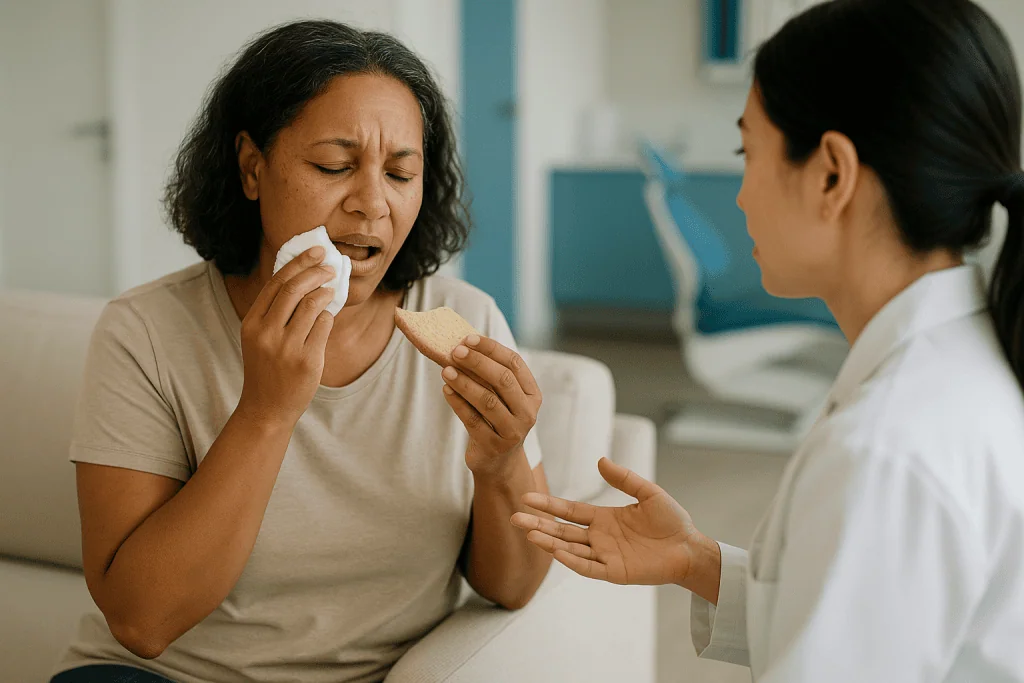
Once feeling comes back, the gums usually feel bruised rather than sharply painful. Patients often describe it as the ache you get after a vigorous session with a stiff toothbrush, multiplied. The teeth themselves may feel odd, almost too clean, because tartar that had been wedged between them for months is gone. Some people notice tiny gaps they had not seen before. Those gaps were there all along; the tartar was filling them.
Slight bleeding is expected on day one. The instruments have been working inside inflamed tissue, and inflamed tissue bleeds easily. A pink tinge to saliva, or a little blood on the floss, fits the picture. Pooling blood, or bleeding that needs repeated pressure to stop, does not, and should be reported.
Tenderness in the jaw muscles is also common after a long appointment with the mouth held open, and it tends to ease by the second day. Mild sensitivity to cold water may begin on day one or appear a day or two later as the gum settles.
What about work? Most people return to normal activities the same day or the next, since the procedure is done under local anesthetic and involves no incisions. Heavy exercise is sometimes deferred for a day because raised blood pressure can encourage oozing. Anyone who received sedation rather than local anesthetic alone follows the specific instructions given for that, including not driving.
Deep cleaning recovery time: what the first week usually looks like
Timelines vary with how deep the pockets were, how many teeth were treated and whether the person smokes, but a broadly similar arc appears in guidance from the Mayo Clinic and Cleveland Clinic: soreness that peaks early and fades over days, with tooth sensitivity that can linger longer. The table below summarizes what is typical, not what is promised.
| Timing | What is common | What helps |
|---|---|---|
| First 2 to 4 hours | Numbness, thick lip, risk of cheek biting | Avoid chewing and hot drinks until sensation returns |
| Day 1 | Bruised-feeling gums, slight bleeding, jaw muscle ache | Soft foods, gentle brushing, rest |
| Days 2 to 3 | Tenderness usually at its most noticeable; cold sensitivity may start | Warm salt-water rinses, lukewarm foods |
| Days 4 to 7 | Gums less sore, bleeding on brushing reducing, gums may look slightly receded as swelling drops | Return to normal flossing technique |
| Weeks 2 to 6 | Sensitivity fading; gums firmer and pinker | Toothpaste for sensitive teeth if advised |
| Around 4 to 8 weeks | Re-evaluation visit; pockets measured again | Ask what was found and what comes next |
Two points deserve emphasis. First, the day-two dip is normal. Many people feel better on the evening of treatment while residual anesthetic and adrenaline are still at work, then feel worse the next morning. That is not a setback. Second, the gums looking lower on the teeth by the end of the week is usually a sign of success rather than damage: swollen tissue has deflated, revealing the true gum line.
Recovery is also staged when treatment is spread across several visits. One side of the mouth may be a week ahead of the other, which is handy because it leaves a comfortable side to chew on.
Is gum bleeding after deep cleaning normal, and when is it too much?
Yes, a small amount of bleeding in the first few days is expected. Periodontitis makes gums fragile; the tiny blood vessels in inflamed tissue are dilated and close to the surface. The MedlinePlus entry on periodontitis lists bleeding gums as a core feature of the disease itself, so it would be surprising if treatment of that tissue produced none at all.
The pattern matters more than the presence. Typical bleeding after scaling and root planing is:
- Light, appearing as pink saliva or streaks on the toothbrush or floss.
- Triggered by brushing, flossing or eating rather than starting on its own.
- Decreasing day by day, often noticeably less by day three or four.
- Stopping within a minute or two of gentle pressure.
Bleeding that soaks gauze, fills the mouth, restarts spontaneously at night or continues beyond the first week without improving sits outside that pattern and warrants a call to the dental office. People taking anticoagulants or antiplatelet medicines, which reduce the blood’s ability to clot, may bleed a little more and for longer; the dentist should already know about these, and any question about them goes to the prescriber, not to a decision made at home.
A practical tip from NHS gum disease guidance applies here: bleeding is not a reason to stop brushing the area. Avoiding a tender spot lets plaque rebuild, which keeps the gum inflamed, which keeps it bleeding. Soft bristles, light pressure and a methodical approach usually bring bleeding down faster than avoidance ever will.
Spitting rather than vigorous rinsing on day one helps too. Forceful swishing can dislodge the delicate clots forming in the pockets.
Why teeth feel sensitive and gums look different after the first week
Cold sensitivity catches many people off guard, because the appointment was about gums, not teeth. The explanation is anatomical. The crown of a tooth is covered by enamel, which has no nerve supply. The root is covered by a softer layer called cementum over dentin, and dentin is riddled with microscopic tubules that lead toward the nerve. While tartar and swollen gum were covering those roots, cold never reached them. Root planing removes the tartar, and healing lets the swollen gum shrink. Suddenly a strip of root is exposed to air and ice water.
That is why sensitivity can appear a day or two after treatment and sometimes last longer than the soreness. Cleveland Clinic describes sensitivity that may persist for a few weeks, gradually easing as the exposed dentin lays down its own defenses and the gum tightens around the tooth.
Toothpastes marketed for sensitive teeth work by plugging those tubules or calming the nerve response, and dental teams commonly suggest using one for a while. Any specific product choice is a conversation with the hygienist rather than a recommendation this article can make.
Gum appearance changes as well. Inflamed gums are puffy, dark red and glossy. Healing gums are firm, pale pink and slightly stippled, like orange peel. Because puffiness goes down, teeth can look longer and the small triangular gaps between them may be more visible. Patients sometimes read this as the cleaning having damaged the gum. In reality, the attachment was already lost to disease; the swelling was disguising it. A gum that sits where the bone supports it is healthier than one propped up by inflammation.
Scaling and root planing aftercare: brushing, flossing and rinsing without setting healing back
The single most useful thing a patient can do in the first week is keep the treated area clean. That sounds obvious, yet fear of hurting tender gums leads many people to skip brushing exactly when bacteria are trying to recolonize freshly smoothed roots. The NHS, Mayo Clinic and NIH all return to the same core routine: brush twice a day with fluoride toothpaste and clean between teeth daily.
Technique can be adjusted for comfort without being abandoned:
- Use a soft or extra-soft brush and hold it like a pen rather than a hammer. Pressure should be enough to feel the bristles bend, no more.
- Angle the bristles toward the gum line at roughly 45 degrees and use small, gentle circles or short strokes.
- An electric toothbrush with a pressure sensor is fine and can make gentle brushing easier; a manual brush used well is also fine.
- Floss or use interdental brushes from the first day unless the dental team said otherwise. Expect a little bleeding and continue anyway.
- On the first day, spit toothpaste out rather than rinsing hard, to protect clots.
Warm salt-water rinses, a teaspoon or so of salt dissolved in a cup of warm water, are a low-risk comfort measure that most dental teams suggest for the first few days. Strong alcohol-based mouthwashes tend to sting raw tissue and are usually best avoided for a while.
Some dentists prescribe an antiseptic mouth rinse such as chlorhexidine for a short period after deep cleaning. It works by reducing bacterial numbers on the gum surface. The trade-offs, chiefly temporary brown staining of teeth and altered taste, are why it is used for limited courses. Whether to use it, and for how long, is the dentist’s call; follow the specific instructions given with it.
What to eat after deep cleaning, and what is better left for later
Nobody needs a special diet after scaling and root planing, but the first few days go more smoothly with a little planning. The principle is simple: nothing that needs numb lips to manage, nothing that scrapes raw gums, and nothing that stings.
Until the anesthetic has fully worn off, stick to foods that do not need chewing, such as yogurt, smoothies without seeds, soup that is warm rather than hot, or mashed potato. Once sensation returns, soft but normal meals are reasonable: scrambled eggs, pasta, fish, well-cooked vegetables, oatmeal, soft fruit.
Foods people commonly regret in the first 48 hours include:
- Crusty bread, tortilla chips and granola, whose sharp edges jab the gum line.
- Popcorn, sesame seeds and small berries with seeds, which lodge in tender pockets.
- Very hot drinks, which both scald numb tissue and increase blood flow to oozing gums.
- Citrus, vinegar-heavy dressings and spicy sauces, which sting exposed roots.
- Ice-cold drinks, if cold sensitivity has started.
Chewing on the untreated side of the mouth, when treatment is being done in stages, keeps mealtimes comfortable. Lukewarm, rather than hot or cold, is the temperature most tender mouths tolerate best in the first few days.
There is a longer-term food point that outlasts the first week. Sugary snacks and drinks feed the plaque bacteria that caused the pockets in the first place, and the NHS lists cutting down on sugar among the measures that help keep gums healthy. Nothing about deep cleaning changes that arithmetic; it simply gives a cleaner surface to start from.
Alcohol in the first day or two is usually discouraged because it can irritate tissue and interact with any pain reliever the dentist recommends. Smoking, as the next sections explain, is a separate and bigger issue.
Managing tenderness: what the evidence actually supports
Most soreness after deep cleaning is mild to moderate and responds to simple measures. Guidance from the Mayo Clinic and Cleveland Clinic typically mentions over-the-counter pain relievers as sufficient for the majority of patients. Two classes are commonly discussed. Non-steroidal anti-inflammatory drugs reduce the inflammatory chemicals that cause swelling and pain; they are not suitable for everyone, including some people with kidney disease, stomach ulcers or on certain blood thinners. Acetaminophen (paracetamol) works through a different pathway and does not affect clotting. Which, if either, is appropriate, and how it should be taken, is a question for the dental team or pharmacist, who can weigh medical history.
Beyond medicine, the measures with the most practical value are unglamorous:
- Warm salt-water rinses several times a day, especially after meals.
- A cool compress on the cheek for short periods if the jaw feels swollen or the muscles ache.
- Sleeping with the head slightly raised the first night, which some people find reduces throbbing.
- Avoiding smoking, which constricts blood vessels and starves healing tissue of oxygen; the NHS is explicit that smoking makes gum disease worse and treatment less effective.
Occasionally a dentist places an antibiotic gel or chip directly into deep pockets, or prescribes a short oral antibiotic course, in cases of persistent infection. The Mayo Clinic describes these as adjuncts used selectively, not as routine. If one is prescribed, finishing the course as directed matters; stopping early because the gums feel better can leave resistant bacteria behind. Any question about that medicine belongs with the prescriber.
Pain that climbs rather than fades after day three is the exception to all of this and is covered in the red-flag section below.
What the re-evaluation visit checks, and why periodontal maintenance follows
Deep cleaning is not a one-off. Some weeks after the final quadrant is treated, the dentist or hygienist re-measures the pockets with a thin probe marked in millimeters. The Mayo Clinic describes this probing as the standard way to gauge gum health, with shallow readings and little bleeding indicating that tissue has tightened around the teeth. This visit is where the real result becomes visible, because healing takes time the first week cannot show.
Three outcomes are possible. Pockets have shrunk to a maintainable depth, and the person moves to a periodontal maintenance schedule. Some areas have improved but a few deep sites remain, and the team may repeat scaling in those spots or add a localized antibiotic. Or several pockets remain deep despite good home care, in which case surgical options such as flap surgery, where the gum is lifted to clean the root under direct vision, may be discussed. The NHS and Mayo Clinic both describe surgery as a next step for disease that does not respond to non-surgical cleaning, not as a first choice.
Periodontal maintenance differs from a routine six-monthly cleaning in both frequency and depth. Visits are usually closer together, commonly every three to four months according to Mayo Clinic guidance, because bacteria recolonize treated pockets within weeks and the goal is to clear them before they regain a foothold. Each visit includes probing, cleaning below the gum where needed and reinforcement of home technique.
Why so much follow-up? Because periodontitis is a chronic condition. Treatment controls it; it does not make a person immune. Bone that has been lost does not regrow on its own. The payoff of maintenance is keeping what remains, and the evidence consistently links regular professional care plus daily home care with slower progression and fewer teeth lost over time.
Risks, side effects and alternatives in plain language
Scaling and root planing is among the safest procedures in dentistry, but no treatment is free of downsides, and patients deserve the neutral version.
Common, usually temporary effects include gum soreness, slight bleeding, tooth sensitivity, and gums appearing to recede as swelling resolves. Less common effects include a bruised feeling at the anesthetic injection site, a tooth that feels slightly loose for a few days as inflamed tissue reorganizes, and jaw stiffness after a long appointment. Rarely, bacteria stirred up during cleaning can cause a localized abscess, a pocket of pus that produces swelling and throbbing pain; this needs prompt dental attention. People with certain heart conditions are sometimes given a preventive antibiotic before gum procedures, a decision made by the dentist and physician together based on current guidelines, not something a patient requests or declines alone.
What are the alternatives? For periodontitis, the honest answer is that there is no equivalent home remedy. Options the care team might discuss include:
- Doing nothing beyond improved home care, which may be reasonable for borderline cases but risks ongoing bone loss in established disease.
- Scaling and root planing with adjuncts such as local antibiotics, for stubborn pockets.
- Laser-assisted cleaning, which some practices offer; evidence that lasers add benefit over conventional instruments remains limited and mixed, so it should be presented as an option rather than a superior method.
- Periodontal surgery, for pockets that stay deep after non-surgical treatment.
The Mayo Clinic frames the choice as a ladder: non-surgical treatment first, surgery if needed, and maintenance throughout. Where a person sits on that ladder is determined by examination and X-rays, and the decision belongs to the treating team in conversation with the patient.
What people often get wrong about recovery after scaling and root planing
A handful of myths circulate in waiting rooms and comment threads. Each one has a kernel of logic and a wrong conclusion.
Myth: Bleeding means the cleaning damaged my gums. Bleeding is a sign of inflammation, which was there before the appointment. The MedlinePlus description of periodontitis lists bleeding gums as a symptom of the disease. Treatment exposes that inflammation briefly; as bacteria are removed, bleeding falls. Rising bleeding after the first week is the thing to watch, not bleeding on day one.
Myth: I should leave the sore areas alone until they heal. Avoidance is the quickest route back to deep pockets. Plaque reforms within hours. Gentle cleaning from day one is the consistent advice across NHS, Mayo Clinic and NIH guidance.
Myth: My gums have shrunk, so the treatment went too far. Reduced swelling reveals where the gum truly attaches. Tissue lost to disease was already lost. A firmer, lower gum line is a healing gum line.
Myth: Deep cleaning fixes gum disease permanently. Periodontitis is managed, not eliminated. Without maintenance visits and daily cleaning between teeth, pockets refill with bacteria and the process restarts.
Myth: Sensitivity means a tooth is dying or needs a root canal. Cold sensitivity from exposed root surfaces is expected and usually fades over weeks. A root canal treats infection inside the tooth’s nerve, a different problem with different signs, such as pain that lingers after heat or wakes you at night. Only an examination can tell the two apart.
Myth: Mouthwash can replace brushing while the gums are tender. Rinses reach the gum surface, not the biofilm stuck to teeth. They are a supplement, never a substitute.
Questions to ask your care team before and after the appointment
Good questions turn a procedure into a plan. These are the ones experienced hygienists say they wish more patients asked, grouped by when they are most useful.
Before treatment:
- How deep are my pockets, and which teeth are most affected?
- Will the whole mouth be treated in one visit or in stages, and why?
- What anesthetic will be used, and how long should I expect numbness?
- Do any of my medicines or health conditions change how you will approach this?
- Should I eat before the appointment?
Immediately after:
- What level of bleeding and soreness should I expect from this specific session?
- Can I brush and floss tonight, and is there any area I should treat differently?
- Did you place any medication in the pockets, and does that change my rinsing or eating?
- What would make you want to hear from me before my next visit?
- Which pain-relief approach fits my medical history?
At the re-evaluation:
- Which pockets improved and which did not?
- Am I being moved to periodontal maintenance, and how often?
- Is there any area where you are considering further treatment?
- What is the one change in my home routine that would make the biggest difference?
Writing the answers down is worth the thirty seconds it takes. Probing depths in particular are numbers a patient can track from visit to visit, and seeing a 6 become a 3 is a more persuasive reason to keep flossing than any lecture. If an answer is unclear, asking for it to be shown on the X-ray or chart usually helps; most dental teams are glad to explain what they are measuring.
When to call your doctor or dental team
Most recovery after deep cleaning is uneventful, and most concerns can wait for the scheduled follow-up. A short list of signs, however, should prompt a same-day call to the dental office, or to a physician or emergency service if the dental office cannot be reached and the symptoms are severe.
Call promptly if you notice:
- Bleeding that is heavy, fills the mouth, or does not stop after ten to fifteen minutes of firm pressure with clean gauze.
- Pain that increases after day three instead of easing, or pain that is not controlled by the measures the team recommended.
- Swelling of the gum, face or jaw that is growing rather than settling, or a tender lump on the gum.
- Fever, chills or feeling generally unwell, which can signal spreading infection.
- Pus or a foul taste that persists despite cleaning.
- Numbness or tingling in the lip, chin or tongue that has not resolved by the next day.
- A tooth that feels markedly loose, or a change in how the teeth meet when biting.
Seek urgent medical care, not just a dental call, for swelling that makes it difficult to swallow or breathe, a rapidly spreading area of redness on the face or neck, or a high fever with confusion. These are rare after scaling and root planing, but infections in the mouth can occasionally spread into the tissues of the neck, and they are treated as emergencies.
People with diabetes, heart valve conditions, suppressed immune systems or on anticoagulants should have a lower threshold for calling, because their risk of bleeding or infection is higher and their care may need coordination between the dentist and physician.
Every decision about further treatment, medication or investigation belongs with the clinicians who examined you. This article describes what is typical; it cannot see your mouth.
Frequently asked questions
What should we do after teeth scaling?
Keep the mouth clean gently and eat soft, lukewarm foods for the first day or two. Wait for numbness to wear off before chewing, brush with a soft brush that evening, clean between teeth daily, and use warm salt-water rinses for comfort. Avoid smoking, alcohol-based mouthwash and sharp or very hot foods. Follow any specific instructions about prescribed rinses or pain relief from the dental team, and keep the re-evaluation appointment.
Can I brush my teeth after a dental cleaning or deep cleaning?
Yes, and you should. Brushing twice daily with fluoride toothpaste is standard advice from the NHS and Mayo Clinic even after deep cleaning. Use a soft brush, light pressure and small strokes along the gum line. On the first day, spit rather than rinsing forcefully to protect clots in the pockets. A little bleeding on the brush is expected and should reduce over the week.
How long is deep cleaning recovery time?
Most soreness settles within about a week, with tenderness often most noticeable on days two and three. Cold sensitivity can continue for a few weeks as exposed root surfaces adapt, according to Cleveland Clinic guidance. Full gum healing is assessed at a re-evaluation visit some weeks after the last session. Smokers, people with diabetes and those with very deep pockets may take longer, and the dental team can give a more individual estimate.
Are gums bleeding after deep cleaning a sign of a problem?
Light bleeding when brushing or flossing in the first few days is normal, because the treated gums were already inflamed. It should lessen each day. Bleeding that is heavy, starts on its own, fills the mouth or does not stop with gentle pressure after ten to fifteen minutes is not typical and should be reported to the dental office the same day, especially for anyone taking blood-thinning medicines.
What to eat after deep cleaning in the first few days?
Soft, lukewarm foods that need little chewing: yogurt, smoothies without seeds, scrambled eggs, soup, mashed potato, pasta, soft fish and well-cooked vegetables. Avoid crusty bread, chips, popcorn, seeds, citrus, spicy sauces and very hot or very cold drinks until tenderness eases. Chewing on the untreated side helps when treatment is done in stages. Reducing sugary snacks long term supports the gums far beyond the first week.
How many days off work do I need after scaling and root planing?
Usually none. The procedure is done under local anesthetic without incisions, and most people return to work the same day or the next. Some choose a lighter afternoon because numbness makes talking and eating awkward for a few hours. Anyone who had sedation follows the specific instructions given, including not driving. Strenuous exercise is sometimes deferred for a day to reduce oozing from the gums.
Why do my teeth look longer or have gaps after deep cleaning?
Because swelling has gone down and tartar has been removed. Inflamed gums are puffy and sit higher on the tooth; healing gums shrink back to where the bone actually supports them, which can expose more tooth and reveal small triangular spaces. The attachment in those areas was already lost to disease. Firmer, paler pink gums at a lower level are a sign of healing, and the dental team can confirm this at follow-up.
Is sensitivity after deep cleaning a sign I need a root canal?
Usually not. Cold sensitivity after scaling and root planing comes from root surfaces that were covered by tartar and swollen gum becoming exposed, and it tends to fade over weeks. A root canal treats infection inside the tooth’s nerve, which more often causes lingering pain after heat, spontaneous throbbing or pain that disturbs sleep. If sensitivity is severe, one-sided or worsening, ask the dentist to examine that tooth.
What should I do after a root canal treatment compared with deep cleaning?
They are different procedures with different aftercare. A root canal removes infected pulp from inside a single tooth, and the main advice is to avoid chewing on that tooth until it has a permanent filling or crown. Deep cleaning treats gums across many teeth, so care focuses on gentle brushing, flossing and soft foods. For either, follow the specific instructions given, and report worsening pain or swelling promptly.
How often will I need cleanings after scaling and root planing?
More often than before, at least for a while. Mayo Clinic guidance describes periodontal maintenance visits commonly every three to four months, because bacteria recolonize treated pockets within weeks. Each visit includes measuring pocket depths and cleaning below the gum where needed. The exact interval is set by the dentist or periodontist based on how the gums respond, and it may lengthen if pockets stay shallow and home care is consistent.
References
- NHS: Gum disease
- MedlinePlus: Periodontitis
- Cleveland Clinic: Periodontitis
- NIH National Institute of Dental and Craniofacial Research: Periodontal (Gum) Disease
This article is for general information only and is not a substitute for professional medical advice. Please consult a qualified doctor about your individual situation.
Add us as a Preferred Source to see more of our trusted health content across Google Search, AI Overviews and Discover.

More from the Blog
Preparing for Wisdom Teeth Removal: Imaging Review, Medication List and Fasting Rules
Preparing for wisdom teeth removal usually means three things: reviewing your X-rays with the surgeon so you understand which teeth are impacted and how…

What to Do When the Jaw Locks: TMJ Locking in the Moment and When It Needs Urgent Care
If your jaw locks, stop forcing it, let the muscles relax, and apply warmth to the cheek if the mouth is stuck partly closed;…

When Bad Breath Needs a Dentist: Halitosis That Outlasts Brushing and Mouthwash
Bad breath that persists for more than a couple of weeks despite brushing twice a day, cleaning between teeth and cleaning the tongue is…
After Laser Assisted Dental Procedures: Short-Lived Sensitivity vs Swelling That Needs a Call
Mild gum tenderness, tooth sensitivity to cold, slight seepage of blood-tinged saliva and a little puffiness are common in the first two or three…

When a Night Guard Is Not Helping Bruxism: Adjustment, Replacement and Next Steps
A night guard that is not working usually means one of three things: it fits poorly or has worn out, it is the wrong…

What an Oral Health Therapy Visit Involves: Cleaning, Gum Checks and a Personal Plan
An oral health therapy appointment is a preventive dental visit led by a hygienist or oral health therapist. It usually includes a review of…