

Recovery After Torsion Surgery: Scrotal Support, Wound Care and the Return to Sport

Key Takeaways
- Cleveland Clinic reports the testicle can usually be saved in over 90 percent of cases treated within about six hours, falling to roughly 10 percent after twenty-four hours, which is why torsion is an emergency and the surgery itself is not the dangerous part.
- During orchiopexy the surgeon stitches the testicle to the scrotal wall and usually fixes the unaffected side too, because the bell-clapper anatomy that permits twisting is often present on both sides.
- Supportive underwear works by lifting the scrotum so fluid drains, taking weight off the fixation stitches and shielding the incision; snug but not tight is the target.
- Walking is usually encouraged the same day and reduces clot risk, bowel sluggishness and back stiffness, while lifting, straining and cycling are typically paused for weeks.
- Contact and collision sports return last, commonly beyond the several weeks of strenuous-activity restriction described in patient guidance, and a fitted protective cup is standard advice afterward.
- One testicle produces enough testosterone for normal puberty and sexual function, and while some studies show reduced sperm measures after torsion, the evidence does not show that infertility is likely.
Recovery after testicular torsion surgery usually involves a few days of scrotal support, simple wound care and gentle walking, followed by a gradual return to normal activity over several weeks, with contact sport typically waiting longest. Pain eases steadily, bruising and swelling settle over days to weeks, and the surgical team sets the exact timeline depending on whether the testicle was saved or removed.
The phone call came at 3 a.m. By breakfast, a sixteen-year-old who had gone to bed with a stomachache was in a recovery bay with an ice pack wedged between his knees, a parent asleep in a plastic chair beside him, and a surgeon explaining that the twist had been untwisted and both testicles stitched into place. The emergency was over in under an hour. The questions had barely started.
That is the strange shape of testicular torsion surgery recovery. The operation itself is quick and, by surgical standards, straightforward. What follows is a couple of weeks of practical decisions that nobody prepared you for: how snug the underwear should be, whether the pink stain on the dressing matters, when a walk around the block becomes a jog, and how long a goalkeeper has to sit on the bench.
This guide walks through that stretch honestly, with the evidence attached and the decisions left where they belong, with the team who looked inside.
Is testicular torsion a serious surgery? Why the clock mattered more than the scalpel
Seriousness, in torsion, is about time rather than technique. Testicular torsion is a twisting of the spermatic cord, the bundle of blood vessels and tubes that suspends each testicle, which pinches off the blood supply. Without blood, testicular tissue begins to die within hours, which is why torsion is treated as a surgical emergency rather than a scheduled operation.
The numbers make the point. Cleveland Clinic reports that the testicle can usually be saved in more than 90 percent of cases when surgery happens within about six hours of pain starting, that the chance falls to roughly 50 percent by twelve hours, and to around 10 percent after twenty-four hours. Mayo Clinic describes the same steep decline. So the drama of a torsion night, the rush to imaging or straight to theatre, reflects the biology, not a dangerous procedure.
The condition is uncommon but not rare. Cleveland Clinic estimates it affects about 1 in 4,000 males under 25, and Mayo Clinic notes it is most frequent between ages 12 and 18, although it can happen to newborns and adults. Many people who develop torsion have a variation called a bell-clapper deformity, in which the testicle hangs more freely inside the scrotum than usual and can swing and twist like the clapper of a bell.
Once the cord is untwisted and the testicle is secured, the operation is a minor scrotal procedure done under general anesthesia. The main risks, described in neutral terms by Mayo Clinic and Johns Hopkins, are bleeding, infection, loss of the testicle if it could not be saved, and later shrinkage of a testicle that was rescued after a long period without blood. Those risks are the reason follow-up matters, and they are also the reason the rest of this article exists.
What actually happens in the operating room
Knowing what was done makes the healing easier to interpret. The surgeon makes a small cut in the scrotum, finds the twisted cord and unwinds it. The testicle is then watched for a few minutes, sometimes wrapped in warm, moist gauze, to see whether its color returns from dusky purple toward healthy pink.
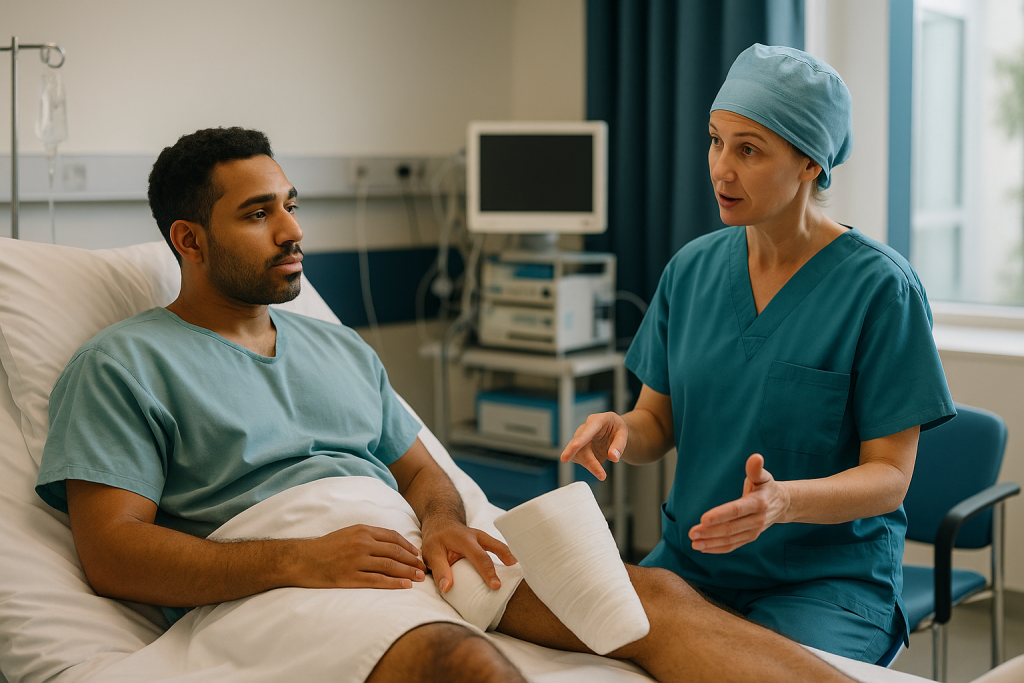
If the testicle recovers, the surgeon performs an orchiopexy, which means fixing the testicle to the inner wall of the scrotum with a few fine stitches so it cannot twist again. Because the bell-clapper anatomy that allows torsion often exists on both sides, the other testicle is usually secured at the same time even though it did not twist. Mayo Clinic and Cleveland Clinic both describe this two-sided fixation as standard practice, and it explains why someone with one painful testicle wakes up with a wound on both sides or a single midline incision.
If the testicle has already died, the surgeon performs an orchiectomy, which means removing it. Leaving dead tissue in place would invite infection and, some evidence suggests, may provoke an immune response affecting the remaining testicle, which is why removal is chosen rather than hoping for the best.
The skin is closed with stitches that dissolve on their own over a few weeks, sometimes with surgical glue or a light dressing on top. Nothing needs to be removed at a clinic visit in most cases. A local anesthetic is often injected around the wound or the cord before you wake, which is why the first few hours can feel surprisingly comfortable and why pain sometimes rises later that evening as the numbing wears off.
Who goes home the same day, and who is asked to stay or wait
Most people leave the hospital within hours of waking, or after one night if surgery finished late. Going home depends on a short list: pain controlled with oral medicine, able to pass urine, able to keep fluids down, and walking safely. Children and teenagers are usually discharged once a parent has heard the wound and activity instructions.
Some people are asked to stay longer. Anyone who had nausea or vomiting from the anesthetic, whose pain is not settling, who had significant bleeding, or who has another condition such as a bleeding disorder or poorly controlled diabetes may be kept for observation. Newborns with torsion are managed differently again, often in a neonatal unit, and their pathway is set entirely by the pediatric team.
The word wait applies in two other situations. First, someone who had a testicle removed and is considering a testicular prosthesis, an implant shaped to restore the appearance of the scrotum, is usually asked to wait until the wound has fully healed and, in adolescents, until growth is complete so the size can be matched. Second, a person with intermittent torsion, meaning episodes of severe pain that resolve on their own as the cord untwists, may be offered a planned orchiopexy on an ordinary operating list rather than an emergency one. Mayo Clinic describes both the emergency and the planned versions of the procedure.
None of this is a menu to choose from. The urologist weighs the state of the tissue, the person’s age and health, and the imaging, then explains the reasoning. Your job in recovery is to follow that plan and report anything that departs from what you were told to expect.
How painful is testicular torsion recovery?
Less than the torsion itself, almost always. People who have felt both describe the twisting pain as sudden, severe and nauseating, and the post-operative ache as dull, bruised and predictable. The wound and the scrotum are sorest during the first few days, then the discomfort tapers to a tenderness that is noticed mainly when sitting down, standing up or catching the area against clothing.

Pain in the scrotum often refers upward. The testicles share nerve pathways with the groin and lower abdomen, so a cramping feeling low in the belly after surgery is common and does not by itself mean something is wrong. Mayo Clinic notes the same shared nerve supply as the reason torsion can first show up as abdominal pain.
Managing it is usually a matter of simple medicines and physical measures. Acetaminophen works centrally on pain signaling; non-steroidal anti-inflammatory drugs, a class that dampens the inflammatory chemicals released by injured tissue, reduce both pain and swelling. Which of these is appropriate, in what amount and for how long, is the prescribing clinician’s decision, particularly for children and for anyone with kidney, stomach or bleeding concerns. Stronger prescription pain relief is uncommon for this operation but is sometimes given for the first day or two.
Cold helps. An ice pack or bag of frozen peas wrapped in a cloth and rested against the scrotum for short spells eases throbbing by narrowing blood vessels and slowing fluid leaking into the tissues. Never place ice directly on skin. Keeping bowel movements soft matters too, because straining raises pressure in the abdomen and pulls on the fresh repair; plenty of fluids and fiber, or a stool softener if your team suggests one, spare you that particular grimace.
Torsion surgery scrotal support: why the snug underwear matters
The single most useful piece of recovery equipment is the least glamorous. Supportive underwear does three things at once. It lifts the scrotum toward the body so that gravity is no longer pulling fluid downward into the loosest, most swellable skin on the body. It takes the weight of the testicle off the spermatic cord and the fresh fixation stitches. And it stops the wound rubbing against a trouser seam every time you take a step.
Snug briefs, compression shorts or an athletic supporter all do the job; the material matters less than the fit. Aim for firm but not tight. Underwear that leaves red marks or forces the scrotum upward into the groin creases has gone too far and can trap moisture around the incision. Two pairs are worth having, so one can dry while the other is worn.
Lying down changes the physics. When you are flat, a small rolled towel placed under the scrotum keeps it elevated above the level of the thighs, which is why hospital nurses often tuck one there before you have even fully woken.
How long to keep wearing support is a team decision, but the common instruction from surgical discharge guidance is to wear it during the day for the first week or two and for longer during exercise, easing off as the swelling recedes. Cleveland Clinic’s patient information frames the broader restriction as several weeks away from strenuous activity, and support is part of how you bridge that period comfortably. A useful test: if you notice a dragging ache by afternoon once you stop wearing it, you stopped too soon.
Wound care after orchiopexy: dressings, dissolvable stitches and showering
Scrotal skin is thin, wrinkled and generous with blood supply, which makes it heal quickly but look alarming while it does. Expect the incision to be a little raised, pink and firm, with a ridge you can feel under the skin for weeks as the deeper stitches dissolve.
Most surgical teams ask that the dressing stay dry for the first day or two and then be removed or allowed to fall off. After that, a daily shower is usually fine and actively encouraged; running water over the wound rinses away crust without scrubbing. Baths, hot tubs and swimming pools are typically held off until the skin has fully sealed, because soaking softens the closure and pool water carries bacteria. Pat the area dry with a clean towel, or use a hairdryer on a cool setting if patting stings.
Small amounts of pink or clear ooze in the first few days are normal. So is a tiny amount of dark, dried blood at the stitch line. What is not normal is thick yellow or green discharge, a wound edge that gapes, or redness that spreads outward day by day; those belong in the red-flag section below.
Leave the stitches alone. They are designed to break down over several weeks and will sometimes poke out as a stiff little thread before falling away. Do not pull them, and do not apply creams, antiseptics or powders unless your team specifically suggested one, since most of these products slow healing more than they help. Loose cotton trousers or shorts over your supportive underwear finish the job. The NHS advises that any new lump, swelling or change in the testicles should be checked by a clinician, and that applies to a healing scrotum as much as to any other.
How long after testicular torsion surgery can you walk?
Usually the same day. Walking is not a milestone to earn but a part of the treatment. The first few laps of the ward corridor will feel stiff and slow, with a wide, careful gait that people describe as walking like a cowboy. That is normal and improves within days.
Movement does real work. Any operation under general anesthesia, combined with lying still and being sore, slows blood flow in the leg veins and modestly raises the risk of a clot. Scrotal surgery is short and the risk is low, but the protective measures are the same ones the American Heart Association recommends for anyone recovering from surgery or a long period of inactivity: get up regularly, walk to the kitchen rather than asking, flex your ankles and calves while sitting, and drink enough fluid to keep urine pale.
Walking also helps the bowel wake up after anesthesia, which reduces the straining that pulls on the repair, and it eases the low-back ache that comes from lying rigid with an ice pack.
Stairs are fine, taken slowly. Standing for long periods is not, because a hanging scrotum swells; alternate walking with sitting or lying with the towel roll under the scrotum. Lifting heavy objects, including small children and school bags packed like anvils, is generally paused for a couple of weeks because it spikes abdominal pressure.
Driving comes later than walking. The usual conditions, which your team will confirm, are that you can perform an emergency stop without hesitation, twist to check mirrors without wincing, and are no longer taking any medicine that dulls reaction time. Cycling waits longer still, for reasons the saddle makes obvious.
Orchiopexy recovery time: what the first weeks usually look like
Timelines here are typical ranges drawn from patient guidance published by Mayo Clinic, Cleveland Clinic and MedlinePlus, not promises. A testicle that was untwisted early and pinked up quickly behaves differently from one that was borderline, and a person who had a removal heals a slightly different wound. Your surgeon’s instructions override this table.
| Stage | What usually happens | What you are commonly asked to do |
|---|---|---|
| Day of surgery to day 2 | Local anesthetic wears off; ache peaks; scrotum swells and may bruise purple | Rest, ice in short spells, scrotal support, short walks, simple pain relief as prescribed |
| Days 3 to 7 | Pain easing; bruising turns yellow-green; dressing off; showering resumes | Return to school or desk work if comfortable; avoid lifting and straining |
| Weeks 2 to 3 | Swelling largely down; firm ridge at incision; stitches beginning to dissolve | Light exercise such as brisk walking; ask about swimming and gentle cycling |
| Weeks 4 to 6 and beyond | Skin healed; residual firmness fading; testicle position settled | Graduated return to running, then non-contact, then contact sport, with team clearance |
Two patterns catch people out. The first is the second-day dip, when the nerve block has gone and the swelling has arrived; many people feel worse on day two than on day one and assume something has failed. It usually has not. The second is the long tail of tenderness, a sensitivity to knocks and pressure that can persist for weeks after everything looks healed, because deep scar tissue is still remodeling.
Follow-up is typically a clinic visit a few weeks out, sometimes with an ultrasound months later to check the size and blood flow of a rescued testicle. Keep that appointment even if you feel fine.
Return to sport after orchiopexy: a staged approach
The athlete’s question is always the same and the honest answer is always layered. Different activities load the scrotum in different ways, so the return happens in stages rather than on a single date.
Walking comes first, as described. Once the incision is sealed and swelling is down, usually somewhere in the second or third week for uncomplicated cases according to typical surgical guidance, low-impact cardio follows: a stationary bike with a wide seat, an elliptical, gentle swimming once the team has cleared water contact. Running is a step up because each stride bounces the scrotum; good compression shorts make the difference between possible and miserable.
Non-contact sport with sudden direction changes comes next: tennis, basketball drills, track. Contact and collision sports, along with anything involving a ball or a knee arriving at speed, wait longest. Cleveland Clinic frames the overall restriction as several weeks away from strenuous activity, and many surgeons ask contact athletes to sit out for a period beyond that, particularly if a testicle was removed and the remaining one is now the only one. That is a conversation to have explicitly, sport by sport.
Protection is not optional afterward. A properly fitted protective cup is standard advice for anyone returning to contact or ball sports after scrotal surgery, and it is reasonable lifelong advice for someone with a single testicle.
Listen for two signals. Pain during activity that lingers into the next day, or swelling that returns after training, means you have moved a stage too fast; step back rather than push through. School and college athletes should ask for a written note covering physical education and team training, since coaches respond better to paper than to a teenager’s own account of what the doctor said.
Swelling, bruising and the shape of things: what is normal afterward
The scrotum is designed to stretch, and after surgery it demonstrates this with enthusiasm. Swelling to two or three times the usual size in the first days is common and is fluid, not damage. Bruising can spread across the whole scrotum and sometimes into the groin or the base of the penis, moving through purple, green and yellow over a week or two exactly as a bruise on the shin would.
Position changes are expected. A testicle that has been stitched to the scrotal wall no longer hangs and swings freely; it may sit higher, lower or more to one side than it used to, and it will feel anchored when you touch it. That is the point of the operation. A firm cord or ridge along the incision, and a small hard knot where the deeper stitches sit, can persist for weeks or months and gradually soften.
Size is the question people ask quietly. A rescued testicle that went a long time without blood may shrink over the following months, a process called atrophy, meaning the tissue reduces in size because some of it did not survive the injury. Mayo Clinic lists this as a recognized outcome of delayed treatment. It is not something you can influence during recovery, and it is one of the reasons for a later ultrasound. Some size difference between the two testicles is common in the general population anyway, so a modest asymmetry is not automatically a sign of atrophy.
What should prompt a call rather than patience: swelling that keeps increasing after the first two or three days instead of plateauing, a scrotum that becomes tense and shiny, or a new lump that feels distinct from the incision. The NHS guidance on testicular lumps and swellings applies fully here.
What is life like after testicular torsion surgery? Fertility, hormones and the long view
For most people, life after testicular torsion surgery looks like life before it, with a scar and a story. The body’s hormonal and reproductive systems have generous reserve, and understanding that reserve answers the questions people are often too embarrassed to ask.
Testosterone first. One healthy testicle produces enough testosterone for normal puberty, muscle, mood, libido and sexual function. Adolescents who lose a testicle to torsion generally progress through puberty on the usual timetable, and adults do not typically need hormone replacement. Blood tests are sometimes checked at follow-up, and any decision about hormones sits with the endocrinology or urology team.
Fertility is more nuanced, and the honest position is that the evidence is mixed. Many people with a single testicle father children without difficulty. Some studies of men who had torsion in adolescence have found lower sperm counts or reduced sperm quality years later, even when the testicle was saved, and researchers have debated whether the injury, an immune reaction, or the underlying anatomy is responsible. What the evidence does not show is that torsion makes infertility likely. If having children is a concern, a semen analysis in adulthood is a straightforward test to discuss with a clinician, and it is more informative than worrying.
Recurrence after two-sided orchiopexy is uncommon because the fixation removes the anatomy that allowed twisting, but it is not impossible, and the same sudden severe pain in either testicle should be treated as an emergency again rather than dismissed because you have already been fixed.
Monthly self-examination becomes a sensible habit. Get to know the new shape, the fixed position and the firm stitch line, so that anything genuinely new stands out. Sexual activity can resume when the wound is healed and it is comfortable, a point most teams place a few weeks out.
If the testicle was removed: prosthesis, body image and the part nobody scripts
Around one person in every few who reach surgery, depending on how quickly they arrived, wakes to learn the testicle could not be saved. The surgeon will have told you, or your parents, but the news often lands properly only at home, in the shower, when the asymmetry is visible.
Physically, the recovery is much the same as after orchiopexy: the same incision care, support, walking and staged return to activity. The remaining testicle is usually fixed at the same operation so that it cannot twist, and it is now carrying the full hormonal and reproductive load, which it is generally well able to do.
A testicular prosthesis is an implant, typically a soft silicone shell filled with saline or gel, shaped and sized to sit in the scrotum and restore its appearance and feel. It has no hormonal or reproductive function. Placement is a planned, separate operation, and teams commonly wait until the scrotum has healed and, in adolescents, until growth is complete so the match is right. Choosing one is entirely personal; many people want one, many never think about it again, and there is no clinical need either way.
The emotional side deserves the same attention as the wound. Teenagers in particular may worry about locker rooms, about future partners, about whether they are somehow less. Those worries are common, rarely voiced, and usually eased by plain information: one testicle is enough, nobody can tell through clothing, and a prosthesis exists if it matters to you. If low mood, avoidance of sport or withdrawal from friends persists beyond the first weeks, ask the care team about counseling. Adjustment support is part of good surgical aftercare, not an admission of weakness.
What people often get wrong about testicular torsion surgery recovery
Recovery advice travels by word of mouth, and much of what travels is wrong. A few corrections, each grounded in mainstream guidance.
“It was caused by an injury or tight underwear.” Torsion usually happens spontaneously, often during sleep, in people with the bell-clapper anatomy. Mayo Clinic notes that trauma is a trigger in only a minority of cases and that most people can do nothing to prevent it. Normal snug underwear does not cause torsion, and after surgery it is your friend.
“Once the stitches dissolve, I’m healed.” Skin closes within a couple of weeks; the deeper tissues keep remodeling for months. Tenderness to knocks after the scar looks fine is expected, and it is the reason contact sport waits.
“Pain on the other side is just sympathy pain.” The other testicle was operated on too and will be sore. Sudden, severe, escalating pain in either testicle, however, is never assumed to be sympathy. It is checked.
“The surgery fixed it, so follow-up is optional.” Follow-up is where atrophy is detected, hormones are checked if needed, sport clearance is given and prosthesis options are discussed. Skipping it removes the safety net.
“Ice straight on the skin works faster.” It causes cold injury to thin scrotal skin. Always wrap it.
“With one testicle I can’t have children.” Many men with one testicle father children. The evidence shows a possible reduction in some sperm measures after torsion, not infertility.
“More rest is always safer.” Lying completely still increases clot risk, stiffens the back and delays bowel recovery. Rest with the scrotum elevated, but walk regularly.
“Any swelling means infection.” Early swelling and bruising are the body’s normal response. Infection announces itself with spreading redness, fever, heat and pus, usually after the third day rather than the first.
Questions to ask your care team before you leave and at follow-up
Discharge conversations happen when you are groggy and your parent is exhausted, so write questions down. These are the ones that shape the next month.
- Was the testicle saved, and how did it look when the blood flow returned? Was the other side fixed as well?
- What kind of stitches or glue were used, and when can the dressing come off and showering begin?
- How long should scrotal support be worn each day, and for how long overall?
- Which pain relief has been prescribed, how is it meant to be used, and what should I do if it is not enough?
- When is it reasonable to return to school or work, to drive, to cycle, to swim and to lift?
- Which sports are involved, and roughly when might each stage of return be cleared? Is a protective cup advised afterward?
- What swelling, bruising and wound appearance should I expect, and what would make you want to see me sooner?
- Will there be a follow-up ultrasound or blood test to check the testicle’s size, blood flow or hormone levels, and when?
- If the testicle was removed, when is the right time to discuss a prosthesis, and who does that conversation involve?
- Are there any implications for fertility worth discussing now or later, and is a semen analysis something to consider in adulthood?
- Whom do I contact after hours if something changes, and which symptoms should send me straight to the emergency department?
Bring the answers to the follow-up appointment and compare them with how recovery actually went. Discrepancies, a wound that took longer, pain that lingered, a testicle that feels smaller, are exactly the things the clinic wants to hear about, and they are far easier to describe with notes than from memory.
When to call your doctor: red-flag signs after torsion surgery
Most recoveries are uneventful, and most calls to the ward end with reassurance. Make the call anyway when any of the following appears; the cost of asking is a phone conversation, and the cost of waiting can be a testicle.
Go to the emergency department or call emergency services immediately for sudden, severe pain in either testicle, particularly if it comes on quickly, is accompanied by nausea or vomiting, or the testicle sits higher or at an odd angle. Fixation makes re-twisting unlikely but not impossible, and Cleveland Clinic and Mayo Clinic are unequivocal that torsion-type pain is treated as an emergency every time. Seek urgent care too for chest pain, sudden breathlessness, or a painful, swollen calf, which can signal a blood clot.
Contact the surgical team the same day for signs of wound infection: redness spreading outward from the incision, skin that is hot and increasingly tender, thick yellow or green discharge, a wound edge that has opened, or a fever. Call for swelling that keeps enlarging after the first two or three days, a scrotum that becomes tense and shiny, bleeding that soaks through a dressing, or a new lump that feels separate from the incision.
Call as well if pain is not controlled by the medicine you were given, if you cannot pass urine, if vomiting stops you keeping fluids down, or if you simply feel unwell in a way you cannot explain. Parents should trust their instinct about a child who is unusually quiet, pale or reluctant to move.
In the longer term, report a testicle that seems to be shrinking, persistent aching months after surgery, low mood that is not lifting, or concerns about puberty or fertility. None of these are emergencies, but all of them belong in front of the treating team, who hold the full picture and make the decisions that follow.
Frequently asked questions
Is testicular torsion a serious surgery?
The condition is serious; the operation is minor. Torsion cuts off blood to the testicle, and Cleveland Clinic notes the chance of saving it drops from over 90 percent within six hours to about 10 percent after a day. The surgery itself is a short scrotal procedure under general anesthesia with the usual small risks of bleeding and infection, plus the possibility that the testicle cannot be saved or later shrinks.
How long after testicular torsion surgery can you walk?
Usually the same day, and it is encouraged. Short, regular walks lower the risk of blood clots, help the bowel recover from anesthesia and ease back stiffness from lying still. Expect a slow, wide gait for a few days. Standing for long periods, heavy lifting and cycling are typically paused for longer because they increase swelling or pressure on the repair; your surgical team confirms the specifics.
How painful is testicular torsion recovery?
Far less painful than the torsion itself. Most people describe a dull, bruised ache that peaks in the first two or three days, especially once the local anesthetic wears off, then tapers to tenderness when sitting or moving. Simple pain relievers prescribed by the team, wrapped ice in short spells, scrotal support and avoiding constipation manage it for most people. Sudden severe pain is different and needs urgent assessment.
What is life like after testicular torsion surgery?
For most people, essentially normal. A saved testicle sits in a fixed position and may feel anchored; a single remaining testicle produces enough testosterone for puberty, libido and sexual function. Some studies show reduced sperm measures years after torsion, but many men with one testicle father children. Monthly self-examination, a protective cup for contact sport and attending follow-up are the main lasting changes.
What is the typical orchiopexy recovery time?
Patient guidance from Mayo Clinic and Cleveland Clinic describes a few days of rest and support, a return to school or desk work within about a week if comfortable, and several weeks away from strenuous activity. Skin heals in roughly two weeks; deeper tissue stays tender longer. These are typical ranges, not promises, and the surgeon adjusts them to how the testicle looked in theatre.
How long should I wear scrotal support after torsion surgery?
Commonly during the day for the first week or two, and during exercise for longer, though your team sets the exact period. Support lifts the scrotum so swelling drains, takes weight off the stitches and protects the wound from friction. If a dragging ache develops by afternoon once you stop wearing it, resume support and mention it at follow-up.
When is it safe to return to sport after orchiopexy?
In stages, with clearance from the team. Walking comes first, then low-impact cardio once the incision has sealed and swelling has settled, then running and non-contact sport, and finally contact or ball sports, which typically wait beyond the several weeks of strenuous-activity restriction described in patient guidance. A fitted protective cup is standard advice afterward, particularly for anyone with a single testicle.
Can I shower or bathe after torsion surgery?
Showering usually resumes after the first day or two once the dressing is off, and running water over the incision is helpful. Baths, hot tubs and swimming are typically delayed until the skin has fully sealed, because soaking softens the closure and pool water carries bacteria. Pat the area dry gently, avoid creams or antiseptics unless advised, and leave dissolving stitches alone.
Can testicular torsion happen again after surgery?
Rarely, but not never. Orchiopexy stitches the testicle to the scrotal wall, removing the loose anatomy that allowed twisting, and the other side is usually fixed at the same time. Because recurrence is possible, sudden severe pain in either testicle after surgery is treated as an emergency again, never dismissed because the repair has already been done.
Will losing a testicle to torsion affect fertility or testosterone?
Testosterone is generally unaffected, since one testicle meets the body’s needs and puberty proceeds normally. Fertility evidence is mixed: many men with one testicle conceive without difficulty, while some studies find lower sperm counts or quality after torsion. A semen analysis in adulthood is a straightforward way to answer the question personally, and a testicular prosthesis can be discussed later if appearance matters to you.
References
- Cleveland Clinic – Testicular Torsion
- MedlinePlus – Testicular torsion
- NHS – Testicle lumps and swellings
This article is for general information only and is not a substitute for professional medical advice. Please consult a qualified doctor about your individual situation.

More from the Blog

Before Peritoneal Dialysis Starts: Catheter Placement and the Training Sessions That Follow
Peritoneal dialysis catheter placement is a short operation in which a soft silicone tube is tunneled through the abdominal wall so its tip rests…

Urine Flow Tests for Children: How Uroflowmetry Is Adapted for Daytime Wetting Evaluations
Uroflowmetry in children is a painless test that records how fast and how smoothly a child's urine flows while they urinate into a special…
Bladder Stones vs Kidney Stones: Why They Form Differently and Why Treatment Differs
Kidney stones form when minerals crystallize in concentrated urine inside the kidney and typically cause severe, wave-like flank pain as they travel down the…

Why Testicular Torsion Is a Surgical Emergency: The Twisted Cord and Blocked Blood Flow
Testicular torsion is a surgical emergency because the spermatic cord, which carries the testicle's blood supply, twists and cuts off blood flow. Without oxygen,…

Which Blood and Urine Tests Identify the Type of Renal Tubular Acidosis?
Doctors identify the type of renal tubular acidosis with a blood gas and basic metabolic panel showing a normal anion gap metabolic acidosis, then…

When Burning Urination Points to Urethritis: Why an Early Urology Visit Matters
Burning when you urinate is not always a bladder infection. In urethritis, the urethra itself is inflamed, usually by a sexually transmitted or other…