

Recovery After Xanthelasma Removal: Eyelid Swelling, Ointments and Stitch Care Week by Week

Key Takeaways
- Eyelid swelling and bruising after xanthelasma excision peak around day two and generally settle within ten to fourteen days, according to Mayo Clinic guidance on eyelid surgery.
- Non-dissolvable eyelid stitches are typically removed after about a week, while NHS guidance notes most dissolvable stitches start to break down within one to two weeks.
- A prescribed ointment keeps the wound moist and shielded so skin cells can close the gap; it does not reduce swelling or speed bruise clearance.
- Contact lenses are usually off limits for about two weeks after eyelid surgery because inserting them tugs the lid and introduces bacteria.
- The scar keeps remodeling for months, so sun protection matters most in weeks three to twelve, long after the stitches are out.
- Removal takes out the deposit, not the cause: xanthelasma can recur after any technique, and a cholesterol check is a sensible companion step.
Xanthelasma surgery recovery usually follows a predictable arc: eyelid swelling and bruising peak in the first two to three days and largely settle within ten to fourteen days, stitches are typically removed at about one week, and the fine scar keeps softening for several months. Most people manage with cool compresses, a prescribed ointment and rest, while the treating team decides when work, contact lenses and makeup can resume.
The mirror moment usually comes on the second morning. You went to bed feeling reasonably fine, and now the eyelid that had a small yellow patch removed is puffy, tight and a shade of violet you did not order. The instruction sheet is somewhere on the kitchen counter. Is this normal? Should the stitch line be that shiny? Can you go to work?
For most people, the answer is yes, this is exactly what xanthelasma surgery recovery looks like at 48 hours. The eyelid has some of the thinnest skin on the body and one of its richest blood supplies, which is why it swells so dramatically and also why it heals so quickly. Knowing which changes are expected on which day takes most of the worry out of the process.
What follows is the honest week-by-week version: what swells, what oozes, what the ointment is for, when stitches come out, and which signs mean you should stop reading and call.
What xanthelasma surgery recovery actually involves
Xanthelasma are soft, yellowish plaques of cholesterol-rich cells that collect just under the skin of the upper or lower eyelids, usually near the inner corner. They are harmless in themselves, but they are visible, and they can be a signal that blood lipids deserve a look. MedlinePlus groups them with xanthomas, the family of fatty skin deposits that often accompany raised cholesterol.
Surgical removal, called excision, means the surgeon numbs the area with a local anesthetic injection, cuts around the plaque in a line that follows the natural eyelid crease where possible, lifts the deposit out, and closes the small wound with very fine stitches. The whole procedure is typically done awake and takes well under an hour. Other techniques exist, including carbon dioxide or erbium lasers, chemical agents such as trichloroacetic acid, and cryotherapy, which freezes the tissue. Each produces a slightly different kind of wound, which is why aftercare instructions vary.
Recovery is really the story of a small eyelid wound healing in three overlapping phases. The inflammatory phase, roughly the first three days, brings swelling, warmth and bruising as fluid and repair cells rush in. The proliferative phase, from about day three to day fourteen, lays down new tissue and closes the skin. The remodeling phase quietly reorganizes the scar for months afterward. Mayo Clinic’s guidance on eyelid surgery notes that bruising and swelling generally subside in ten to fourteen days, while the scar itself may take months to fade. That single sentence explains most of what patients will see.
Everything in this article is a typical pattern, not a promise. Your surgeon knows how deep the deposit sat, how the wound was closed and how your skin tends to heal, so their instructions override anything printed here.
Who is usually offered xanthelasma removal, and who is asked to wait
Because xanthelasma cause no pain and do not threaten vision, removal is a choice rather than a necessity. People who ask about it are usually bothered by the appearance, or find the plaques catching on glasses or makeup. Clinicians generally consider excision when the deposit is well defined, the surrounding eyelid skin is healthy, and the person understands that new plaques can form later.

A number of situations lead a team to suggest waiting or to steer toward a different approach:
- Very large or deep plaques that wrap toward the eyelid margin, where removing all the tissue could pull the lid out of position.
- Active skin infection, blepharitis flare or conjunctivitis on or near the eyelid, which raises wound-infection risk.
- Untreated or newly discovered high cholesterol. Many teams prefer to check a lipid panel, the blood test measuring cholesterol and triglycerides, and address it first, since Cleveland Clinic notes that xanthelasma can be a marker of raised lipids and cardiovascular risk.
- Recent eyelid surgery on the same side, when tissues are still remodeling.
- A history of thick, raised scars, called keloids, which prompts a careful conversation about scar risk on such visible skin.
- Blood-thinning medicines that cannot safely be paused, which increase bruising and bleeding. Never stop a prescribed anticoagulant on your own; the prescribing clinician decides.
Age itself is not a barrier. What matters is eyelid laxity, skin reserve and general health. People with dry eye, thyroid eye disease or previous facial radiation are not excluded, but they are examined more closely because their eyelids may tolerate tightening less well. The decision, in every case, sits with the treating team after an in-person examination.
The first 48 hours: why the eyelid swells so much
The eyelid swells out of proportion to the size of the cut, and there is a simple anatomical reason. Eyelid skin is thin and loose, it has almost no fat beneath it, and it sits over a dense web of tiny blood vessels. When those vessels leak plasma and a little blood into the loose tissue, there is nothing to hold the fluid in, so it pools. Gravity adds to the effect overnight, which is why mornings look worse than evenings.
Expect the lid to feel tight, heavy and mildly sore rather than sharply painful. A thin, watery or slightly pink ooze along the stitch line in the first day is common. Bruising, medically called ecchymosis, usually appears on day one or two and may track down toward the cheek because blood follows the path of least resistance.
Cool compresses are the workhorse of this phase. Mayo Clinic advises applying cool packs gently to the closed eyes to reduce swelling, and both Mayo and the NHS recommend sleeping with the head raised higher than the chest for the first few days so fluid drains away from the face. A clean cloth around a bag of frozen peas, pressed lightly for short spells, does the job; direct ice on the skin can damage it.
Keep the wound dry and untouched apart from ointment, and avoid rubbing or squinting hard. Reading, watching television and light walking are fine. Bending, lifting and anything that makes you strain raise blood pressure in the head and can restart oozing, so the NHS advice to avoid strenuous activity for a few weeks starts on day one.
Days 3 to 7: bruising, ointments and what they actually do
By the third day the swelling usually plateaus and starts, slowly, to retreat. The bruise changes color from purple toward green and yellow as the body breaks down leaked blood; that palette shift is a sign of normal clearance, not of spreading. The stitch line may look slightly raised or crusted, and a mild itch is common as nerve endings recover.
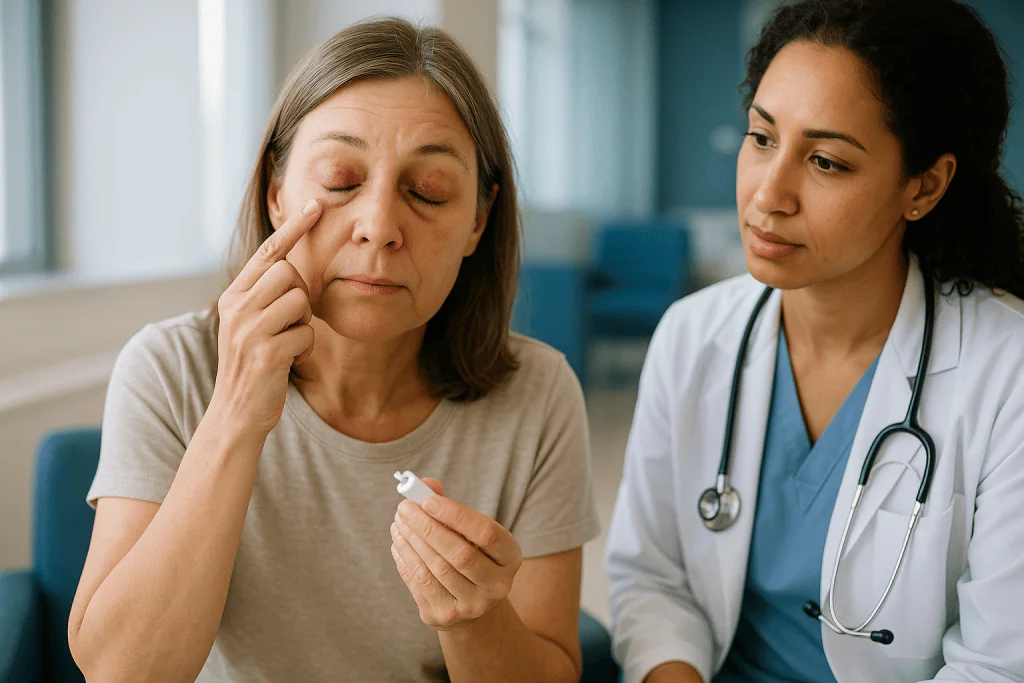
This is the week when the ointment matters most, and it is worth understanding what it does. Surgeons often prescribe a topical antibiotic ointment, sometimes a plain petroleum-based one. Its job is twofold: it keeps the wound surface moist, which allows skin cells to migrate across the gap faster than they can under a dry scab, and it forms a barrier against surface bacteria while the skin is still open. It does not speed up bruise clearance and it does not shrink swelling. Apply only the thin layer and frequency your team specified, using a clean fingertip or cotton bud, and stop when they tell you to; prolonged use of some antibiotic ointments can cause contact irritation of its own. If the eyelid becomes redder or itchier after each application, tell the team rather than switching products yourself.
Some patients are also given lubricating eye drops, because swelling can stop the lid closing fully at night, leaving the eye surface dry. The drops replace the tear film; they are not treating the wound.
Gentle cleaning is allowed once your surgeon confirms it, usually with cooled boiled water or sterile saline dabbed along the stitch line to lift crusts. Do not pick. Crusts are the body’s own dressing, and pulling them off can widen the scar.
Stitch care and when the stitches come out
Eyelid wounds are closed with exceptionally fine sutures, the medical word for stitches, often thinner than a hair. Two kinds are common. Non-dissolvable stitches are removed in clinic; Mayo Clinic notes this usually happens after about a week, and the NHS gives the same typical timing for eyelid surgery. Dissolvable stitches are broken down by the body, and NHS guidance explains that most begin to dissolve within one to two weeks, though some types take longer to disappear completely.
Until removal, the aim is simple: keep the line clean, moist and undisturbed.
- Wash hands before touching the area, every time.
- Dab rather than wipe when cleaning, moving along the stitch line in one direction.
- Avoid soaking the face, swimming, saunas and steam rooms, which soften the wound edges and carry bacteria.
- Do not apply makeup, creams or serums over or near the stitches until cleared.
- Sleep on your back if you can; a sleep mask or pillow edge pressing on the lid can tug the sutures.
Stitch removal itself is quick and usually more strange than painful, a tugging sensation as each loop is snipped and slid out. Afterward the line may look pink and slightly indented. Tiny gaps or a single loose stitch are worth a phone call but rarely an emergency. Your team may apply skin tape for a few days to support the edges.
The scar is not finished when the stitches come out. It has roughly a fraction of its eventual strength at that point, so the no-rubbing, no-straining rules continue into the following weeks.
Week 2: returning to work, screens, contact lenses and makeup
The second week is when most people ask how long they have to stay home. Xanthelasma excision is a smaller operation than a full blepharoplasty, the surgery that removes excess eyelid skin, but the timelines quoted for eyelid surgery in general are the best available guide. Mayo Clinic suggests avoiding strenuous activity for about a week and describes bruising and swelling as generally settling over ten to fourteen days. The NHS notes that recovery from eyelid surgery can take several weeks and that people usually need some time off work, depending on the job.
A desk job with understanding colleagues may be manageable within a few days, with a light bruise covered by glasses. Roles involving dust, heat, heavy lifting or public-facing appearance often need the full two weeks. Screen time is fine in itself; the risk is that concentrating dries the eye and reduces blinking, so take breaks and use any prescribed lubricating drops.
Contact lenses are a firm no while the lid is healing. Mayo Clinic advises avoiding them for about two weeks after eyelid surgery, because inserting a lens pulls on the lid and introduces bacteria. Glasses are the safer choice, and dark sunglasses also protect the wound from wind and sun.
Eye makeup deserves patience. Powders and mascara lodge in the stitch line and can seed infection, and removing them means rubbing exactly where you should not. Most teams ask people to wait until the wound is fully closed and stitches are out, and then a little longer; ask for your specific date rather than guessing. Camouflage of the bruise on the cheek, away from the wound, is usually acceptable sooner.
Weeks 3 to 12: the xanthelasma removal scar and how it matures
Once swelling has gone, attention turns to the line itself. A fresh eyelid scar is typically pink or red, slightly firm and sometimes a little raised. Over the following weeks it softens and pales as the body remodels the collagen laid down in a hurry during the first fortnight. Mayo Clinic puts it plainly: scars from eyelid surgery may take months to fade.
Eyelid scars generally heal well for three reasons. The skin is thin, so there is little bulk to thicken. Surgeons hide the incision in the natural crease, so it folds out of sight when the eye is open. And the region has a generous blood supply, which supports repair. Even so, several things influence the final result:
- Sun exposure darkens immature scars. Sunglasses and a wide-brimmed hat for the first few months are worth the mild inconvenience.
- Smoking narrows small blood vessels and slows healing; Mayo Clinic lists not smoking among its standard post-surgical advice.
- Rubbing, picking and vigorous cleansing stretch the young scar and can widen it.
- Individual skin type matters. Deeply pigmented skin may show temporary lightening, called hypopigmentation, or darkening around the line; both often improve with time but not always completely.
Gentle scar massage or silicone-based products are sometimes suggested once the wound is fully closed. The evidence for silicone is modest but reasonable for raised scars; ask your team before starting anything, and do not begin while stitches or crusts remain.
Small lumpiness or a slightly indented line at week four is common and usually not the final picture. Most surgeons prefer to judge the scar somewhere between three and six months, when remodeling has done most of its work.
Xanthelasma surgery recovery timeline at a glance
People remember the shape of a recovery better than a list of rules, so here is the whole arc in one place. Every timing below is a typical range drawn from Mayo Clinic and NHS guidance on eyelid surgery; your own course may run faster or slower, and your surgeon’s instructions take priority.
| Stage | What you will usually notice | What usually helps | Typical cautions |
|---|---|---|---|
| Day 0 to 2 | Tight, heavy lid; swelling peaks; watery or pink ooze; bruise appears | Cool compresses, head elevated in bed, prescribed ointment, rest | No rubbing, straining, bending or heavy lifting |
| Day 3 to 7 | Bruise turns green and yellow; swelling starts to fall; mild itch; light crusting | Continue ointment as instructed; gentle cleaning if approved; lubricating drops if given | No soaking, swimming, makeup or contact lenses |
| About day 7 | Non-dissolvable stitches typically removed; line looks pink | Skin tape if applied; keep protecting the line | Scar still weak; avoid tugging |
| Day 10 to 14 | Bruising and swelling generally settled | Gradual return to normal activity and desk work | Contact lenses usually still on hold until cleared |
| Week 3 to 6 | Scar pink and firm, may feel slightly raised or dented | Sun protection, no smoking, scar care if advised | Do not judge the final result yet |
| Month 3 to 6 | Scar pales and softens; final contour visible | Follow-up review; lipid check if recommended | Watch for new plaques and report them |
Two patterns are worth underlining. First, the visible drama is front-loaded: the worst you will look is usually day two, and improvement from there is steady. Second, the invisible work is back-loaded: the scar keeps changing long after friends have stopped noticing. Keeping both in mind prevents the twin mistakes of panicking early and giving up on sun protection too soon.
Does recovery differ between excision, laser and chemical treatment?
Not everyone with xanthelasma has a scalpel excision, and the wound type shapes the aftercare. It helps to know which you had.
Surgical excision produces a sutured line. Swelling and bruising are the dominant features, stitch care is the main task, and the scar is a thin line hidden in the crease. It is the approach most often chosen for well-defined, moderate plaques, and it allows the surgeon to send tissue for examination if there is any doubt about the diagnosis.
Laser ablation, using a carbon dioxide or erbium laser, vaporizes the plaque layer by layer. There are no stitches; instead the surface heals as a shallow abrasion that weeps, crusts and re-epithelializes, meaning new skin grows across, over roughly one to two weeks. Redness can persist for weeks, and pigment changes are the more common cosmetic concern rather than a line scar.
Chemical treatment with agents such as trichloroacetic acid causes a controlled burn that frosts white, then peels. Healing resembles a laser wound, sometimes with several sessions spaced weeks apart. Cryotherapy, or freezing, produces a blister and then a scab.
Across all methods, the honest position on evidence is this: published comparisons are mostly small case series rather than large randomized trials, so no technique can be called clearly superior for every plaque. Cleveland Clinic lists surgery, laser, chemical peels and cryotherapy as options and notes that recurrence can follow any of them. The right choice depends on plaque size, depth, location, your skin type and the surgeon’s experience, and it is settled in consultation, not by reading about it. If you are unsure which method was used, ask, because it changes what “normal” looks like in week one.
What are the risks of xanthelasma removal?
Any procedure on the eyelid carries risks, and a good consent conversation covers them plainly. Most are minor and temporary; a few are uncommon but matter because the eyelid protects the eye.
- Bleeding and bruising are the most frequent. A hematoma, a collection of blood under the skin, is rare on the eyelid but can need drainage if it is tense and expanding.
- Infection is uncommon in such a well-supplied area but presents as increasing redness, warmth, pain and yellow discharge after the second day, which is the opposite of the expected trajectory.
- Scarring that is more visible than hoped, including thickened, widened or discolored lines. Mayo Clinic lists noticeable scarring among the risks of eyelid surgery.
- Pigment change, either lightening or darkening, is more likely after laser or chemical methods and in darker skin types.
- Eyelid position problems. If too much skin is removed, especially on the lower lid, the lid can pull away from the eye, called ectropion, or on the upper lid fail to close fully, called lagophthalmos. Both can cause dryness and irritation and may need further treatment. This is the reason surgeons are conservative with large plaques.
- Dry eye, blurred vision and light sensitivity, usually temporary while swelling settles.
- Incomplete removal or recurrence, which is not a complication so much as the nature of the condition.
- Very rarely, injury to deeper eyelid structures or, with any surgery near the eye, vision-threatening bleeding behind the eye, which Mayo Clinic flags as a rare but serious risk of eyelid surgery.
The alternative to accepting these risks is doing nothing, which is entirely reasonable for a harmless plaque. A neutral discussion weighs how much the appearance troubles you against a small but real chance of a visible scar or lid change on the most looked-at part of the face.
Will it come back? The cholesterol connection during recovery
The question people most want a firm answer to is the one with the least comfortable evidence. Xanthelasma can recur after any removal method, and Cleveland Clinic states this directly. Recurrence is more common when plaques were large, involved all four lids, or occurred alongside lipid disorders that remain untreated. Published figures vary widely between small studies and are not reliable enough to quote as a personal likelihood, so be cautious of anyone offering a precise percentage.
Why do they return? The surgeon removes the deposit, not the process that made it. Xanthelasma form when certain immune cells in the skin take up cholesterol from the blood and swell into foamy, yellow clusters. If blood lipids stay high, or if there is a local tendency in that eyelid, the same thing can happen again nearby.
This is why the weeks after removal are a sensible moment to think about the bigger picture. MedlinePlus notes that xanthomas are often associated with raised cholesterol and related conditions, and Cleveland Clinic points out that xanthelasma can be linked to higher cardiovascular risk even in people whose cholesterol reads as normal. The American Heart Association’s overview of cholesterol explains how low-density lipoprotein, the so-called bad cholesterol, deposits in vessel walls in much the same way.
None of this means you must take a medicine. It means a lipid panel and a conversation with your primary clinician are worthwhile if they have not happened recently. Lipid-lowering medicines, where a clinician judges them appropriate for cardiovascular risk, work by reducing the amount of cholesterol circulating; whether they reduce the chance of new eyelid plaques is not well proven. Any decision about them belongs to the prescribing clinician, not to an aesthetics appointment.
What people often get wrong about xanthelasma healing time
Recovering patients tend to make the same handful of errors, most of them born of good intentions.
“The swelling is getting worse, so something is wrong.” Swelling normally peaks around day two, and morning puffiness after lying flat can look alarming. Worsening after day three, especially with pain, warmth or spreading redness, is a different matter and warrants a call.
“More ointment heals faster.” A thin film keeps the wound moist; a thick smear traps debris, blurs vision and can irritate skin. Follow the amount and duration your team gave you.
“Once the stitches are out, I’m done.” Stitch removal marks the end of the closure phase, not of healing. The scar keeps remodeling for months, and sun exposure in weeks three to twelve is the commonest cause of a darker line than necessary.
“Ice directly on the lid is best.” Cool, not frozen. Eyelid skin is thin enough to suffer cold injury from direct ice contact. A cloth-wrapped pack for short spells is the standard advice.
“Removal fixes the cholesterol problem.” It does the reverse of that: it removes a marker while leaving the cause. A lipid check is the sensible companion step.
“Home remedies can remove the plaque instead.” Garlic, castor oil, apple cider vinegar and similar suggestions circulate online. There is no reliable evidence that any of them remove xanthelasma, and applying acidic or irritant substances near the eye risks chemical injury. Nothing should go on the eyelid that a clinician has not approved.
“Any eyelid procedure recovers the same way.” Excision, laser and chemical methods heal differently, as does surgery for other eyelid conditions. Compare notes with people who had the same technique, not just the same body part.
Questions to ask your care team before and after removal
The most useful appointment is the one where you leave with answers you can act on. Take these along, and write down what you hear.
- Which technique are you recommending for my plaques, and why this one over the alternatives?
- How deep does the deposit sit, and does that change the risk to my eyelid position?
- Will you send the tissue for examination?
- What exactly should my eyelid look like on day two, day seven and day fourteen?
- Which ointment or drops are you prescribing, how thinly, how often, and for how many days? Please write it on the sheet.
- Are my stitches dissolvable or do they need removal, and when is that appointment?
- When may I wash my face normally, use contact lenses, wear eye makeup, exercise and swim?
- How many days off work do you expect for my particular job?
- What is your after-hours number, and which signs should make me use it?
- How will we judge the scar, and at what point would you consider it settled?
- What is my realistic chance of recurrence given the size and number of my plaques, and what would we do if it happens?
- Should I have my cholesterol checked, and who should I see for that?
- Do any of my regular medicines or supplements need to pause, and who makes that call?
After the procedure, a shorter list matters: is this amount of swelling expected for me, is the stitch line closing as you hoped, and is there anything you want me to change? Photographs on your phone taken at the same time each day, in the same light, help both you and the team see the trend rather than the moment.
When to call your doctor: red-flag signs after xanthelasma removal
Most recoveries never need an unscheduled call. The point of knowing the warning signs is not to worry but to act early on the small number of problems where timing matters. Contact your surgical team the same day, or seek urgent care if you cannot reach them, for any of the following:
- Sudden or severe pain in or around the eye, especially with a tense, rapidly swelling lid or a feeling of pressure. Bleeding behind the eye is rare but is treated as an emergency because it can threaten sight.
- Any change in vision: blurring that does not clear with blinking, double vision, loss of part of the visual field or new flashes.
- Swelling or bruising that worsens after day three rather than easing.
- Spreading redness, increasing warmth, thick yellow or green discharge, or a foul smell from the wound, particularly with fever or feeling generally unwell.
- Bleeding that does not stop after ten minutes of gentle, steady pressure with a clean cloth.
- The wound edges pulling apart, or a stitch line that gapes after stitches come out.
- The eyelid unable to close fully, or the lower lid pulling away from the eye, causing persistent gritty dryness.
- Numbness, tingling or weakness spreading beyond the immediate wound area.
Less urgent but still worth a routine call: an itchy, bumpy rash where the ointment goes, a small firm lump under the scar, crusting that will not lift after gentle cleaning, or simply not being sure whether what you see is normal. Teams would far rather answer a cautious question than treat a late complication. Keep the after-hours number saved in your phone before the procedure, not after.
Frequently asked questions
How long does xanthelasma surgery take to heal?
Visible healing takes about two weeks; full scar maturation takes months. Mayo Clinic notes that bruising and swelling after eyelid surgery generally subside in ten to fourteen days, with stitches out at roughly one week, while the scar may take months to fade. Your own timeline depends on plaque size, technique and skin type, so ask your surgeon what to expect.
How long do you have to stay home after eyelid surgery?
Usually a few days to two weeks, depending on your job. Mayo Clinic advises avoiding strenuous activity for about a week, and the NHS notes that eyelid surgery recovery can take several weeks with some time off work. Desk-based roles often resume sooner than jobs involving dust, heat or lifting. Your care team will tailor the advice.
How long does it take to recover from a mullerectomy surgery?
A mullerectomy is a different eyelid operation, performed from inside the lid to lift a drooping eyelid, so it does not involve xanthelasma. Its swelling and bruising follow a broadly similar eyelid-surgery pattern of settling over about two weeks, but the specifics differ. Ask the surgeon who performed it for the timeline that applies to you.
What are the risks of xanthelasma removal?
The main risks are bruising, infection, a visible or discolored scar, pigment change, eyelid position problems such as the lid pulling away or not closing fully, temporary dry eye, and recurrence of the plaque. Very rarely, bleeding behind the eye can threaten vision. Mayo Clinic lists similar risks for eyelid surgery generally; your surgeon will explain how they apply to you.
What is the best xanthelasma removal aftercare in the first week?
Cool compresses, head elevation in bed, the prescribed ointment applied thinly, and leaving the wound alone. Mayo Clinic recommends cool packs and sleeping with the head above the chest, and advises against rubbing the eyes, strenuous activity, smoking and contact lenses. Gentle cleaning is added only when your team says the wound is ready.
Will the xanthelasma removal scar be visible?
Usually a fine line hidden in the eyelid crease, though it looks pink and firm for weeks first. Mayo Clinic notes eyelid scars may take months to fade. Sun exposure, smoking, rubbing and individual skin type all influence the final appearance. Most surgeons judge the settled result between three and six months rather than earlier.
Can I wear eye makeup after xanthelasma removal?
Not until the wound is fully closed, the stitches are out and your team has cleared it. Powders and mascara lodge in the stitch line and can seed infection, and removing them means rubbing the very area that should be left alone. Covering the bruise on the cheek, away from the wound, is usually acceptable earlier.
Why is my eyelid so swollen after such a small procedure?
Because eyelid skin is thin, loose and richly supplied with tiny blood vessels, so leaked fluid pools with nothing to contain it. Swelling normally peaks around day two and looks worse in the morning after lying flat. Worsening after day three, especially with pain or spreading redness, is not expected and should prompt a call.
Does xanthelasma come back after removal?
It can, after any removal method, and Cleveland Clinic states this directly. Recurrence is more likely with large plaques, involvement of several lids, or untreated lipid disorders, because removal takes out the deposit but not the process that formed it. Reliable personal percentages do not exist, so treat precise figures with caution and ask your team.
Should I have my cholesterol checked after xanthelasma removal?
It is a reasonable step if it has not been done recently. MedlinePlus links xanthomas with raised cholesterol, and Cleveland Clinic notes xanthelasma can signal higher cardiovascular risk even with normal readings. A lipid panel and a conversation with your primary clinician cover this; any decision about lipid-lowering treatment belongs to the prescribing clinician.
References
This article is for general information only and is not a substitute for professional medical advice. Please consult a qualified doctor about your individual situation.

More from the Blog

Recovery After Retinal or Glaucoma Laser Treatment: Blurry Hours, Follow-Up and Milestones
After most retinal or glaucoma laser treatments, vision is blurry or dazzled for a few hours, mainly because of dilating drops, the bright treatment…
Flap or Graft? How Reconstructive Surgeons Choose Between the Two Ways to Rebuild Tissue
A skin graft is tissue detached completely from one site and laid onto a wound, where it must grow a new blood supply from…
Acne Scar Treatment for Darker Skin: Why Pigment Risk Changes the Method and the Prep
Acne scar treatment for darker skin usually starts by calming active acne and fading post-inflammatory hyperpigmentation before any resurfacing, because melanin-rich skin reacts to…

Realistic Results From Cellulite Treatment: Softer Texture, Not a Different Body
Realistic cellulite treatment results mean a softer, smoother skin texture and shallower dimples, not a different body and not permanent removal. Cellulite comes from…

Neck Laxity Surgery: Real Options for a Sagging Neck, From Lifts to Non-Surgical Care
Surgery for a sagging "turkey neck" usually means a neck lift (lower rhytidectomy), often combined with platysmaplasty to tighten the paired neck muscles, or…
Why Skin Grafts Sometimes Fail: Pressure, Infection, Smoking and the Signs Your Team Watches
Skin grafts fail most often because something separates the graft from the wound bed before new blood vessels can grow into it: a pocket…