

Reverse Tummy Tuck vs Traditional Abdominoplasty: Incision Placement and What Each Corrects

Key Takeaways
- A reverse tummy tuck places its scar in the fold beneath the breasts and lifts skin upward, so it treats only the zone between the ribs and the navel.
- A traditional tummy tuck uses a hip-to-hip incision, repositions the navel, and usually repairs separated abdominal muscles along their full length, which the reverse approach does not routinely do.
- Neither operation removes visceral fat around the organs or acts as a weight-loss method; the tissue removed is skin and subcutaneous fat only.
- Mayo Clinic guidance cautions against any abdominoplasty in people who smoke, have a body mass index above 30, plan pregnancy, or plan significant further weight loss.
- NHS patient guidance describes a compression garment for about 6 weeks and roughly 4 to 6 weeks off work after a full abdominoplasty, with strenuous exercise deferred for around 6 weeks.
- The reverse procedure is described mainly in small surgical case series, so no reliable comparison of overall safety with the traditional operation exists.
A reverse tummy tuck places the incision in the fold beneath the breasts and lifts loose skin of the upper abdomen upward, without addressing the lower belly. A traditional tummy tuck uses a hip-to-hip incision low on the abdomen, removes excess lower skin, and usually repairs separated abdominal muscles. The right choice depends on where loose skin sits, and a surgeon assesses that in person.
She stood sideways in the mirror after her second pregnancy and pinched the skin just under her ribs. The lower belly, oddly, looked fine. It was the crepey fold above the navel that bothered her, the part no plank or kettlebell had ever reached. Her friend had a tummy tuck years ago and loved it, but her friend’s problem lived below the belly button. Hers did not.
That small difference, upper versus lower, is the whole story behind the reverse tummy tuck vs traditional tummy tuck question. Both are versions of abdominoplasty, the surgical removal of excess abdominal skin and fat. They pull skin in opposite directions, hide their scars in different places, and correct different things.
This explainer walks through how each is done, who tends to be offered which, what the following weeks look like, and the honest limits of what the medical evidence can tell you.
What is a reverse tummy tuck, in plain language?
A reverse tummy tuck, sometimes called a reverse abdominoplasty, is a procedure that tightens the skin of the upper abdomen by pulling it upward and anchoring it beneath the breasts. The incision runs along the inframammary fold, which is the natural crease where the underside of each breast meets the chest wall. In some patients the two curved incisions are joined across the midline; in others a short gap of untouched skin is left over the sternum.
Once the incision is made, the surgeon lifts the skin and fat layer off the upper abdominal wall down toward the navel, draws the loosened tissue upward, trims the excess, and closes the wound so the scar settles into the breast crease. Because the pull is upward, the belly button is not moved, and the lower abdomen is left largely as it was.
Why would anyone choose this direction? Gravity, pregnancy, and significant weight loss do not always loosen skin evenly. Some people are left with a soft, wrinkled band between the ribs and the navel while the lower belly stays reasonably taut. A conventional tummy tuck pulls skin downward toward a low incision, and it simply cannot reach that upper zone with much force. The reverse approach is designed for exactly that gap.
It is worth saying early that this is a niche operation. The general medical literature on abdominoplasty, which agencies such as the Mayo Clinic and the NHS summarize for patients, is built overwhelmingly on the traditional version. Descriptions of reverse abdominoplasty come mainly from surgical case series rather than large comparative studies, so many of the confident claims you will read online rest on thinner evidence than they appear to.
How a traditional abdominoplasty actually works
A traditional tummy tuck starts with a long, gently curved incision low on the abdomen, typically placed so that it can sit beneath underwear or a swimsuit line. It runs roughly from one hip bone to the other. The surgeon then lifts the skin and fat as a single sheet up toward the ribs, exposing the abdominal wall underneath.
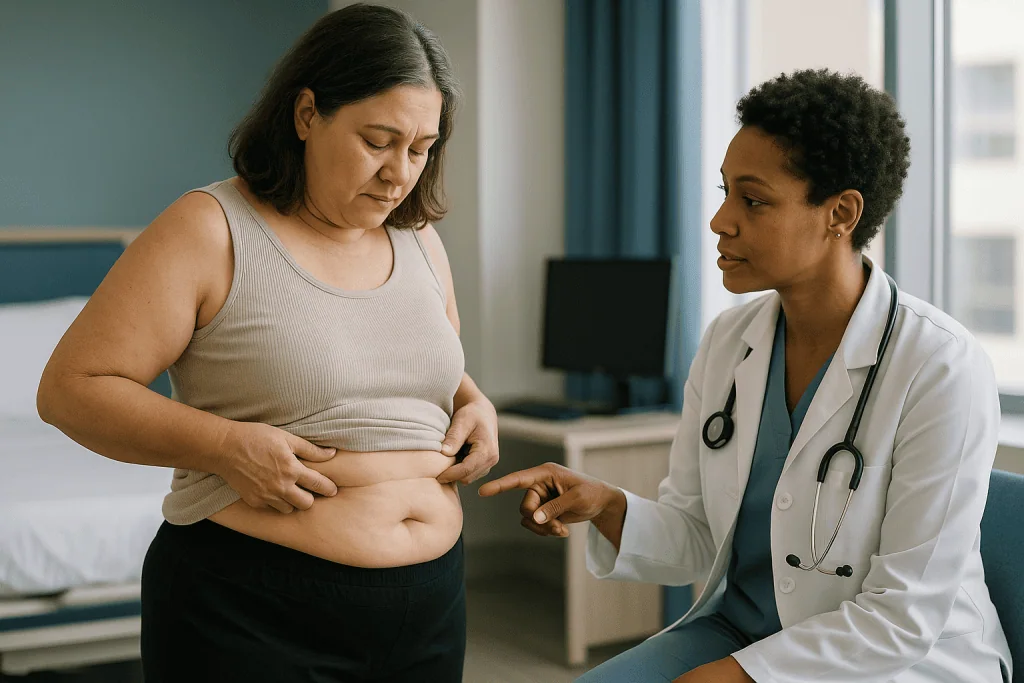
Two things happen in that exposed space. First, if the paired vertical muscles of the abdomen, the rectus abdominis, have drifted apart, the surgeon stitches the connective tissue between them back together. This separation is called diastasis recti, and it is a common legacy of pregnancy. Repairing it is what gives many patients a flatter profile and a firmer feel, not just tighter skin. Second, the surgeon may use liposuction to thin the fat layer in the flanks or upper abdomen, although this depends on individual anatomy and surgeon judgment.
The skin sheet is then pulled downward, the excess is cut away, and the navel, which has stayed attached to the abdominal wall on its own stalk, is brought out through a newly made opening. This is why a full tummy tuck leaves a second, small scar around the belly button. Drains, thin tubes that carry fluid out of the wound, are often placed for a few days, as the NHS patient guidance describes.
The operation is done under general anesthesia and, in the NHS description, usually takes 2 to 5 hours, followed by a hospital stay of a few nights. That is a substantial procedure by any measure, and it is the benchmark against which the reverse version should be judged, not the other way round.
Reverse tummy tuck vs traditional tummy tuck: where the incision goes
Incision placement is the single most practical difference between the two operations, because it decides where your permanent scar will be and which direction the skin can be tightened. A scar is not a footnote in cosmetic surgery; it is the trade you make. The table below sets the two side by side.
| Feature | Reverse tummy tuck | Traditional tummy tuck |
|---|---|---|
| Main incision | Along the fold under each breast, sometimes joined at the center | Low on the abdomen, hip to hip |
| Direction of skin pull | Upward, toward the chest | Downward, toward the pubic area |
| Zone treated | Upper abdomen, ribs to about the navel | Whole abdomen, emphasis on the area below the navel |
| Navel | Left in place | Repositioned through a new opening; second small scar |
| Muscle repair | Possible in the upper abdomen only, not routinely done | Commonly repaired along the full length |
| Typical companion procedures | Breast lift or breast reduction | Liposuction of flanks |
| Evidence base | Mostly small case series | Large body of surgical literature and patient guidance |
A few points deserve underlining. The reverse scar sits where a bra band would normally rest, which makes it discreet in clothing but not invisible in a swimsuit, especially where the incisions meet at the center of the chest. The traditional scar is longer, sits lower, and is generally easier to hide, though the NHS notes scars can become thick or raised in some people regardless of position. Neither scar fades to nothing.
What each procedure corrects, and what it leaves alone
Think of the abdomen as having three layers a surgeon can influence: skin, fat, and the muscle wall beneath. Each operation touches those layers differently.
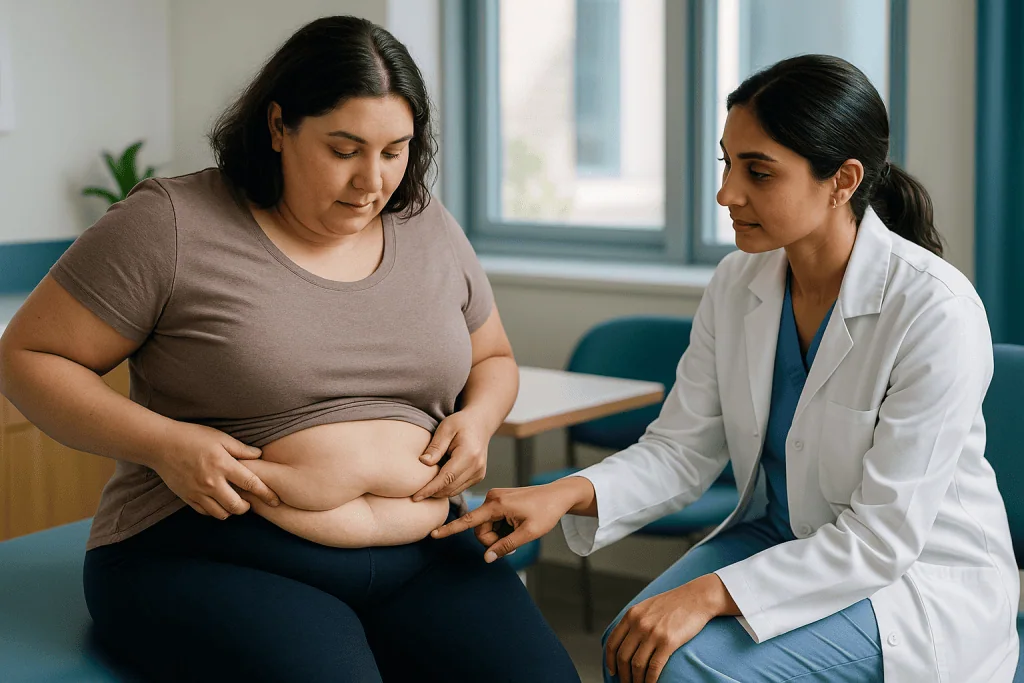
A traditional tummy tuck addresses all three across most of the belly. It removes loose lower skin, including stretch-marked skin below the navel that comes away with the excised strip. It can thin fat by direct excision and liposuction. Most importantly, it tightens the muscle wall through diastasis repair. The Mayo Clinic describes the procedure as removing excess skin and fat and, in most cases, restoring weakened or separated muscles, which is why it can improve a lower belly that bulges even in someone at a healthy weight.
A reverse tummy tuck concentrates on the skin layer of the upper abdomen. It is well suited to the wrinkled, deflated skin that hangs just under the ribs, and to the fold that forms over the bra band in some people after weight loss. It can be combined with breast surgery through the same incision, which is one of its practical advantages when both areas need attention.
What it does not do is reach the lower abdomen. Loose skin below the navel, stretch marks around the pubic area, and a separated muscle wall in the lower belly are outside its reach. Upper diastasis can sometimes be repaired through the reverse approach, but this is not the routine, full-length repair of a conventional tummy tuck.
Neither operation is a weight-loss method. The tissue removed weighs far less than most people imagine, and body weight afterward is governed by the same things it always was. Both operations also leave visceral fat, the fat inside the abdominal cavity around the organs, completely untouched, because no skin-level surgery can reach it.
Who is a reverse tummy tuck usually for, and who is asked to wait?
The typical candidate is someone whose loose skin is confined to the upper abdomen, often after significant weight loss, after pregnancy, or with age, and whose lower belly is comparatively tight. It is also considered for people who have already had a traditional tummy tuck and later find the upper zone has loosened, since a second downward pull would put tension on an already lowered navel. And it is discussed with people planning breast surgery, because a lift or reduction already requires an incision in the same fold.
The people who are usually asked to wait, or steered elsewhere, tend to fall into the same groups the Mayo Clinic lists for any abdominoplasty. Those planning a future pregnancy are advised to postpone, since pregnancy re-stretches the very skin and muscle that have been tightened. Those planning to lose a significant amount of weight are asked to reach and hold a stable weight first, because further loss creates fresh laxity. Smokers are asked to stop well before surgery; nicotine narrows small blood vessels and is strongly associated with wound-healing problems and skin necrosis, meaning death of skin at the wound edge.
Body mass index above 30 raises the risk of complications after abdominoplasty, and many surgeons set a threshold below which they prefer to operate. People with poorly controlled diabetes, bleeding disorders, or serious heart or lung conditions need those problems assessed and optimized before any elective operation.
Someone with genuine upper laxity but also a soft, protruding lower abdomen is the tricky case. A reverse procedure alone would leave the lower belly unchanged and might look unbalanced. That patient is more often offered a traditional tummy tuck, or in some cases a staged plan, and the decision belongs with the surgical team who can examine the tissue directly.
Who is usually offered a traditional tummy tuck instead?
The traditional operation remains the default because the pattern it corrects is by far the most common one. After pregnancy, the lower abdomen bears the brunt of stretching. The skin below the navel loosens, stretch marks concentrate there, and the rectus muscles separate along the midline. After major weight loss the same zone sags into an apron of skin and fat that can hang over the pubic area and chafe.
If any of those describe the main concern, a downward pull toward a low incision is the logical direction, and the reverse approach would miss the target entirely. The traditional operation also gives the surgeon direct access to repair diastasis along its full length, which no upper incision can offer.
Within the traditional family there is a spectrum. A mini tummy tuck uses a shorter low incision, tightens skin below the navel only, and leaves the belly button alone; it suits a small pouch of skin with little or no muscle separation. An extended tummy tuck lengthens the incision around the hips to gather loose skin from the flanks and lower back, which matters after very large weight loss. A fleur-de-lis abdominoplasty adds a vertical incision up the midline, trading a visible central scar for the ability to remove excess in both directions; it is reserved for the most extensive skin surplus.
The same wait-list rules apply: stable weight, no planned pregnancy, no smoking, and any chronic conditions well managed. The NHS patient information is blunt that abdominoplasty is not a treatment for being overweight and that people are generally expected to be near a stable, healthy weight first. A candid surgeon will sometimes say that the honest answer is not yet.
Will a reverse tummy tuck give you shape?
This is one of the most searched questions on the topic, and the honest answer is: some, in one place, and less than the phrase suggests. The reverse procedure smooths and tightens the skin between the ribs and the navel. When the loose fold that used to sit over the bra band is gone, the upper torso can look leaner and the transition from ribcage to waist can look cleaner. For someone whose only complaint is that upper fold, that is exactly the shape they wanted.
What it does not do is create a waist. A defined waistline comes from the relationship between the ribcage, the flanks, and the hips, and from the tone of the muscle wall beneath. The reverse approach does not tighten the lower muscle wall and does not remove skin or fat from the flanks unless liposuction is added. Liposuction, the removal of fat through a thin tube, can be combined with either operation and is where much of the contouring in body surgery actually comes from.
Compare that with a traditional tummy tuck, in which muscle repair pulls the whole front wall inward and skin is removed across a wider area. That is why the traditional operation is the one most often associated with a visibly flatter profile in the general surgical literature and patient guidance, while the reverse operation is described in terms of upper skin tightening.
None of this can be promised for an individual. Outcomes depend on skin quality, how much elasticity remains, the underlying fat distribution, and how the scars heal. Reputable surgeons show typical results, discuss the range, and are careful not to guarantee a particular silhouette. If someone guarantees one, that is a reason for caution.
What are the potential downsides of a reverse tummy tuck?
Every operation has a cost beyond the anesthetic, and the reverse approach has a particular set worth knowing before a consultation.
The scar is the first. A traditional scar hides low under clothing; a reverse scar lives in the breast fold and, where the incisions join across the sternum, crosses skin that is visible in low necklines and swimwear. The central chest is also an area prone to thick or raised scarring in some people. The NHS lists thick, obvious scars among the recognized risks of abdominoplasty, and placement here makes that risk more consequential.
Limited reach is the second. Because the pull is upward, the lower abdomen is untouched. Patients who expected an all-over result can be disappointed, and a later second operation on the lower belly adds another recovery and another scar.
The third downside is that muscle repair is limited. Full-length diastasis repair, one of the main structural benefits of a traditional tummy tuck, is not part of the standard reverse operation.
Then there are the general surgical risks shared by both procedures. The Mayo Clinic lists fluid accumulation under the skin, called a seroma, poor wound healing, unexpected scarring, tissue damage, and changes in skin sensation. The NHS adds bleeding under the skin, wound infection, and blood clots. Because a reverse dissection runs close to the breast, changes in breast or nipple sensation are a specific consideration when it is combined with breast surgery.
Finally, the evidence gap itself is a downside. There are far fewer published outcomes for the reverse approach, so a surgeon cannot draw on the same depth of data when counseling you. Ask directly how many they have performed and what complications they have seen.
Is there a safest tummy tuck? What the evidence actually shows
People often ask which version is the safest, hoping for a ranking. The evidence does not support a clean one, and it helps to understand why.
Complication risk after abdominoplasty tracks more closely with the patient and the extent of surgery than with the name of the procedure. The factors that consistently raise risk in the surgical literature summarized by Mayo Clinic and Johns Hopkins are smoking, a body mass index above 30, diabetes, previous abdominal surgery with heavy scar tissue, and longer operations that combine several procedures. A mini tummy tuck in a healthy non-smoker at a stable weight carries less risk than a full extended abdominoplasty combined with liposuction in someone who smokes, regardless of which is theoretically the gentler design.
Where does the reverse operation sit? On paper it involves a smaller area of dissection than a full traditional tummy tuck and does not move the navel, which removes one site of potential healing trouble. Against that, the incision crosses the chest, the published series are small, and when it is combined with breast surgery the total operating time rises. Nobody can say from current data that it is safer or riskier overall.
The most serious shared risk is venous thromboembolism, a blood clot forming in a deep leg vein that can travel to the lungs. Abdominoplasty is recognized as one of the higher-risk cosmetic procedures for clots because of operating time, positioning, and reduced mobility afterward. Standard prevention includes early walking, compression, and in some cases clinician-prescribed blood-thinning medicine, which works by slowing the clotting cascade for a defined period. Whether you need it, and for how long, is a decision for your surgical and anesthetic team based on your personal risk profile.
So the safest tummy tuck is the one that matches your anatomy, performed on a well-prepared body, by a team that takes clot prevention seriously.
Types of tummy tuck: where the reverse approach fits among the rest
It is easy to get lost in the menu of names, so here is the whole family in one place, organized by the problem each is designed for rather than by marketing label.
- Mini tummy tuck: short low incision, skin below the navel only, navel untouched, little or no muscle repair. For a small lower pouch.
- Full or traditional tummy tuck: hip-to-hip incision, navel repositioned, full-length muscle repair, skin removed from the whole front. The standard operation after pregnancy or moderate weight loss.
- Extended tummy tuck: the full operation with the incision continued around the hips to gather flank and lower back skin. After large weight loss.
- Fleur-de-lis tummy tuck: full operation plus a vertical midline incision, removing skin in two directions at the cost of a visible central scar. For the most extensive excess.
- Reverse tummy tuck: incision in the breast fold, upward pull, upper abdomen only, navel untouched. For isolated upper laxity, often alongside breast surgery.
- Circumferential body lift: incision all the way round the torso, addressing abdomen, flanks, back and buttocks together. After massive weight loss.
Notice that only one of these pulls upward. Every other design tightens toward the pubic area, which is why the reverse operation is often described as complementary rather than competitive. Some patients with laxity above and below the navel end up having a traditional procedure first and a reverse procedure later, or the two in one session in selected cases, with the trade-off of more scarring and a longer operation.
The names matter less than the map. A good consultation starts with a surgeon pinching the skin in each zone and testing how the muscle wall behaves when you tense it, then explaining which incision reaches the problem. If the explanation starts with the procedure name instead of your anatomy, ask them to begin again.
Tummy tuck recovery time: what the following days and weeks usually look like
Recovery from either operation is measured in weeks, not days, and it is one of the parts patients most often underestimate. The ranges below are drawn from NHS and Mayo Clinic patient guidance for abdominoplasty in general; the reverse procedure is usually described as somewhat lighter because less tissue is lifted, but there is no large dataset to put a firm number on that difference.
In the first few days there is a hospital stay, often a few nights after a full traditional operation. Drains may stay in place for several days. Walking, slightly bent at first, starts early to reduce clot risk. Pain and tightness are expected; your team manages these with prescribed medicine, and the plan is theirs to set. After a reverse operation the tightness sits under the breasts and across the upper chest instead of low on the belly, which some patients find affects breathing depth and sleeping position in the first week.
Through weeks one to three, swelling and bruising peak and then begin to settle. A compression garment is typically worn for about 6 weeks according to NHS guidance, to support healing tissue and limit fluid build-up. Driving is generally avoided for a few weeks until an emergency stop is possible without pain.
By weeks four to six, most people are back at desk work, with the NHS suggesting about 4 to 6 weeks off depending on the job. Strenuous exercise and heavy lifting are usually deferred for around 6 weeks.
Scars take far longer. They are typically red and firm for months and continue to soften and fade over a year or more. The Mayo Clinic notes that results are long-lasting provided weight stays stable, which is a way of saying the surgery removes tissue, but the body keeps its habits.
What people often get wrong about reverse tummy tuck vs traditional tummy tuck
Several ideas circulate so widely that they deserve direct correction.
Myth: the reverse tummy tuck is the newer, better version. It is neither newer in any meaningful sense nor better. It is a different tool for a different zone. Choosing it for lower-belly laxity would be like fixing a leaking tap by repainting the ceiling.
Myth: a reverse tummy tuck leaves no visible scar. It leaves a scar in the breast fold, sometimes joined across the center of the chest. It is discreet in a bra or fitted top; it is not invisible in swimwear.
Myth: either operation removes fat from around the organs. Neither does. Visceral fat inside the abdominal cavity is beyond the reach of any skin-level surgery and responds only to diet, activity and, where appropriate, medical treatment guided by a clinician.
Myth: a tummy tuck fixes a weak core. Muscle repair stitches separated muscles back toward the midline. It does not strengthen them. Strength still comes from training, once your team clears you.
Myth: the reverse version has a trivial recovery. It is generally a smaller dissection than a full traditional tummy tuck, but it is still a general-anesthetic operation with weeks of restrictions, and no published data support calling it minor.
Myth: results are permanent no matter what. Pregnancy, significant weight change and time all loosen skin again. The Mayo Clinic frames durability as conditional on maintaining a stable weight.
Myth: photos on a website tell you your result. Before-and-after galleries show selected patients with selected lighting. They are useful for judging a surgeon’s aesthetic sense, not for predicting your own outcome, which depends on your skin and your healing.
Questions to ask your care team before deciding
A consultation goes better when you arrive with questions that force specificity. These are the ones worth asking about the reverse tummy tuck vs traditional tummy tuck decision in particular.
- Looking at my abdomen, where exactly is the loose skin, and which incision reaches it? Ask them to show you on your own body rather than on a diagram.
- Do my abdominal muscles show separation, and if so, would the plan repair it? Which operation allows that repair?
- Where precisely will the scar lie, how long will it be, and can you show me how it looks on someone with similar skin at one year?
- Will the incisions be joined across the center of my chest, and what does that mean for scar visibility?
- How many reverse abdominoplasties have you performed, and what complications have you personally seen?
- Would you recommend combining this with breast surgery or liposuction, and how does that change operating time and risk?
- What is my personal risk of blood clots, and what will you do to reduce it during and after surgery?
- What should my weight be doing before surgery, and how long should it be stable?
- What would you expect if I became pregnant afterward?
- Who do I contact at night or on a weekend if something worries me, and what is your policy on revision if healing is uneven?
- Is there a non-surgical path that would address part of my concern, and what does the evidence say about it?
Listen for answers that reference your anatomy, acknowledge uncertainty, and describe risks without minimizing them. A team that is comfortable saying this operation is not right for you, or not yet, is a team taking your safety seriously. Take notes, bring someone with you, and never feel pressured to book on the day.
When to call your doctor after a tummy tuck
Most recovery discomfort is expected: tightness, bruising, swelling that shifts from day to day, itching along the incision, patches of numbness. Some signs, though, need a same-day call to your surgical team or emergency care, and knowing them in advance removes the temptation to wait and see.
Call urgently or seek emergency help for pain, swelling, warmth or tenderness in one calf or thigh, or for sudden breathlessness, chest pain, or coughing up blood. These can signal a clot in the leg or lungs, the most serious complication of abdominoplasty, and the NHS advises treating suspected deep vein thrombosis as urgent.
Contact your team the same day for a fever, increasing redness or heat spreading from the incision, pus or a foul smell from the wound, or a wound edge that opens or turns dark. Sudden one-sided swelling of the abdomen with tightness or bruising can indicate bleeding under the skin, a hematoma, which sometimes needs draining. A soft, sloshing swelling that grows over days may be a seroma, a collection of clear fluid that the Cleveland Clinic describes as common after this type of surgery and usually manageable, but it should be assessed rather than ignored.
Also report persistent vomiting, inability to pass urine, a drain that stops working or falls out, or pain that escalates rather than easing after the first few days.
After a reverse procedure specifically, tell your team about any change in breast or nipple color or a rapidly enlarging breast, since the dissection sits close to breast tissue.
Before you leave hospital, make sure you have a direct number that works out of hours. Your treating team knows your operation and is the right first call for anything that concerns you.
Frequently asked questions
What is a reverse tummy tuck and how is it different from a regular one?
A reverse tummy tuck tightens the upper abdomen by lifting loose skin upward and anchoring it through an incision in the fold under the breasts. A regular tummy tuck pulls skin downward toward a low hip-to-hip incision, repositions the navel, and usually repairs separated muscles. The reverse version leaves the lower belly and navel untouched.
What are the potential downsides of a reverse tummy tuck?
The main downsides are a scar in the breast fold that may cross the center of the chest, no correction of the lower abdomen, and limited muscle repair. It shares general surgical risks such as seroma, infection, bleeding, delayed healing, sensation changes and blood clots. Published outcome data are also sparser than for the traditional operation.
What is the safest tummy tuck procedure?
No version is proven safest. Risk depends more on the patient and the scale of surgery than on the procedure name: smoking, a body mass index above 30, diabetes, previous abdominal surgery and combining several procedures all raise complication rates. A smaller operation in a well-prepared, non-smoking patient at a stable weight generally carries the lowest risk.
Will a reverse tummy tuck give you shape?
It smooths and tightens the skin between the ribs and navel, which can make the upper torso look leaner and the ribcage-to-waist line cleaner. It does not create a waist or flatten the lower belly, because it does not repair the lower muscle wall or remove flank tissue unless liposuction is added. Results vary with skin quality and healing.
What is the average cost of a reverse tummy tuck?
This magazine does not publish prices, and a single average would be misleading because the total depends on surgeon time, anesthesia, facility, whether breast surgery or liposuction is combined, and follow-up care. Ask any team you consult for a complete written quotation that itemizes each component and states what revision policy applies.
What are the main types of tummy tuck?
The main types are the mini tummy tuck for a small lower pouch, the full traditional tummy tuck with navel repositioning and muscle repair, the extended tummy tuck reaching around the hips, the fleur-de-lis with an added vertical scar for extensive excess, the reverse tummy tuck for upper laxity, and the circumferential body lift after massive weight loss.
How long is tummy tuck recovery time?
NHS guidance for abdominoplasty describes a hospital stay of a few nights, drains for several days, a compression garment for about 6 weeks, roughly 4 to 6 weeks off work depending on the job, and no strenuous exercise for around 6 weeks. Scars keep softening for a year or more. The reverse procedure is often described as lighter, but firm comparative data are lacking.
Can a reverse tummy tuck be combined with breast surgery?
Yes, and this is one of its common uses, because a breast lift or reduction already requires an incision in the fold beneath the breast. Combining them avoids a separate scar but lengthens the operation, which raises anesthetic and clot risk, and brings the dissection close to breast tissue. Whether combination is sensible for you is a decision for your surgical team.
Does a tummy tuck remove belly fat around the organs?
No. Both operations remove skin and the fat layer directly beneath it. Visceral fat, which sits inside the abdominal cavity around the organs and drives a hard, rounded belly, is untouched by any skin-level surgery. It responds to diet, physical activity and, where a clinician considers it appropriate, medical management, not to abdominoplasty.
Who should wait before having any type of tummy tuck?
Mayo Clinic guidance suggests postponing if you plan to become pregnant, intend to lose a significant amount of weight, smoke, have a body mass index above 30, or have a serious chronic condition that is not well controlled. Reaching a stable weight and stopping smoking beforehand reduce wound-healing and other complications. Your treating team makes the final assessment.
References
This article is for general information only and is not a substitute for professional medical advice. Please consult a qualified doctor about your individual situation.

More from the Blog

Surgical vs Non-Surgical Cosmetic Gynecology: What Each Approach Can and Cannot Address
Surgical vaginal rejuvenation (labiaplasty, vaginoplasty, perineoplasty) physically removes or repairs tissue and can change anatomy that non-surgical methods cannot. Non-surgical options such as lasers,…
Monsplasty Candidacy: Excess Mons Pubis Skin, Fat and What Surgeons Assess First
A typical monsplasty candidate is an adult whose mons pubis (the soft mound over the pubic bone) has loose, sagging skin, stubborn fat, or…
How Hi Def Liposuction Is Performed: Mapping Muscle Lines Before Fat Is Sculpted
Hi def liposuction is performed by first marking the patient standing up, with muscles flexed, to map where the abdominal, chest and flank muscle…

Can Body Contouring Be Done in One Operation? How Surgeons Sequence Multiple Stages Safely
Body contouring after major weight loss can sometimes be completed in a single operation, but surgeons often split it into two or more stages…

Do You Need a Reverse Tummy Tuck? Upper Abdominal Laxity and Who Actually Qualifies
A reverse tummy tuck is usually considered only for people whose loose skin sits mainly above the navel, in the upper abdomen, while the…

How Fat Transfer Works Step by Step: Harvesting, Purifying and Injecting Your Own Fat
Fat transfer, also called fat grafting, is done in three stages during one procedure. A surgeon removes fat from an area such as the…