

Robotic Partial Nephrectomy Recovery: Early Walking, Lifting Limits and the First Six Weeks

Key Takeaways
- Walking within hours of surgery is a deliberate part of recovery that reduces blood clots, chest infection and sluggish bowels, not a hospital shortcut.
- The typical hospital stay after robotic partial nephrectomy is one to three days, with catheter and drain usually removed before discharge.
- Skin incisions close in roughly ten days, but fascia and the stitched kidney take about six weeks to regain strength, which is why lifting limits outlast visible healing.
- Shoulder-tip pain after robotic surgery comes from carbon dioxide gas irritating the diaphragm and usually disperses within a day or two of moving about.
- Fresh red blood or clots in the urine in the weeks after surgery can signal delayed bleeding from the kidney repair and needs same-day medical attention.
- Anti-inflammatory painkillers act on kidney blood flow, so their use after partial nephrectomy should be agreed with the prescribing clinician rather than assumed.
Robotic partial nephrectomy recovery usually means walking within hours of surgery, a hospital stay of one to three days, and light activity within one to two weeks. Most surgical teams ask patients to avoid lifting anything heavy for about four to six weeks while the kidney repair and abdominal wall heal. Timelines vary, and the treating team sets the pace for each person.
The discharge sheet said “no heavy lifting,” and the first thing she thought about was the bag of cat litter in the garage. Then the toddler who expects to be scooped up. Then the sixth-floor walk-up at work. Nobody on the ward had mentioned any of those things, because they were busy explaining the drain, the catheter and the surprisingly firm instruction to get out of bed and walk before dinner.
That gap, between the clinical plan and the kitchen-table reality, is where most questions about robotic partial nephrectomy recovery live. The operation itself is well described in consent forms. What people want to know is how the next six weeks actually feel: how sore, how tired, how soon they can drive, sit at a desk, run, or carry a child.
This explainer follows that timeline honestly, drawing on mainstream surgical guidance rather than reassurance. It also flags what deserves a phone call to the care team, because a good recovery is partly about knowing which twinges are ordinary and which are not.
What actually happens during a robotic partial nephrectomy
A partial nephrectomy removes a tumor and a thin rim of surrounding tissue while leaving the rest of the kidney in place. “Robotic” means the surgeon operates through several small incisions using instruments controlled from a console a few feet away; the robot does not make decisions, it translates the surgeon’s hand movements into smaller, steadier motions inside the body. The Mayo Clinic describes both the open and the minimally invasive versions of this operation, and notes that the aim of the partial approach is to preserve working kidney tissue.
Inside, the sequence is fairly consistent. The abdomen is inflated with carbon dioxide gas to create working room. The surgeon frees the kidney from surrounding fat, identifies the main artery and vein at the hilum (the kidney’s “stalk” where vessels enter), and often clamps them briefly so the tumor can be cut out without heavy bleeding. That pause in blood flow is called ischemia time, and surgeons try to keep it short because the kidney tolerates only a limited period without oxygen. The edge of the defect is then stitched closed in layers, the clamp is released, and the tissue is checked for bleeding and for any leak of urine from the collecting system.
Before the incisions are closed, a small drain may be left near the kidney to carry away fluid, and a urinary catheter is usually placed in the bladder. Both are typically removed within a day or two, according to Cleveland Clinic’s patient guidance. The whole operation commonly takes two to four hours, though complex tumors take longer. Knowing these steps helps later, because several of the early sensations of recovery, the shoulder-tip ache, the bloating, the pull at the largest incision, trace directly back to them.
Who is usually offered robotic partial nephrectomy, and who is asked to wait
Partial nephrectomy is generally considered for smaller kidney tumors, typically those confined to the kidney and positioned where a rim of healthy tissue can be left behind. The NHS notes that the choice between removing part of the kidney and the whole organ depends on the tumor’s size and location and on how well the other kidney works. Preserving tissue matters most for people who already have reduced kidney function, a single kidney, diabetes or high blood pressure, because their long-term kidney health has less margin to spare.

The robotic route specifically suits people who can tolerate a general anesthetic and the head-down, side-lying position used during surgery. Previous abdominal operations, severe lung disease or a very large tumor may push a surgeon toward an open incision instead, or toward removing the whole kidney. None of these are failures; they are matches between anatomy and technique.
Some people are asked to wait rather than proceed straight to the operating room. Very small tumors in older adults or in people with other serious illness are sometimes monitored with periodic scans, an approach called active surveillance, because many such tumors grow slowly and the risks of surgery may outweigh the benefit at that moment. Others wait for practical reasons: an uncontrolled blood pressure that needs settling, a blood thinner that must be managed with the prescribing clinician, an infection that has to clear, or a nutrition and fitness plan aimed at making the anesthetic safer.
The decision belongs to the treating team, ideally a multidisciplinary one that includes a urologist and, where relevant, a kidney specialist. What patients can usefully do is ask why this operation, why now, and what the alternative paths would look like for their particular scan.
The first 24 hours: waking up, the catheter and the first walk
Most people wake in a recovery area with a dry mouth, a slightly sore throat from the breathing tube, and a heaviness across the abdomen that is more pressure than sharp pain. The catheter draining the bladder feels odd rather than painful; the urine it collects is often pink for the first day because the kidney’s cut edge weeps a little. Nurses watch that color closely, along with blood pressure, and it usually clears toward straw-yellow within a day or two.
Then comes the instruction that surprises almost everyone: get up. Enhanced recovery programs, the structured pathways many surgical units now follow, aim for the first steps within hours of surgery rather than the next morning. The first walk is short, often to the door and back with a nurse, and it is usually the moment the shoulder ache announces itself. That ache comes from carbon dioxide gas irritating the diaphragm, not from anything in the shoulder; moving and changing position helps it disperse over a day or two.
Sips of water tend to start the same evening, progressing to light food once the stomach has woken from the anesthetic. Deep breathing and coughing exercises, sometimes with a small handheld device, are part of the routine to keep the lung bases open. Hugging a pillow against the belly when coughing takes the sting out of it.
MedlinePlus describes a typical hospital stay after kidney removal surgery of about one to three days, and Cleveland Clinic quotes a similar range for the partial operation. The drain, if one was placed, usually comes out before discharge once the fluid is minimal and not suggestive of a urine leak. Leaving hospital requires walking independently, passing urine after catheter removal, eating, and having pain controlled by tablets rather than an intravenous line.
Why early walking matters more than most people think
The push to walk on day one is not a hospital efficiency measure. It targets three specific risks that rise after abdominal surgery, and each is worth understanding because the habit needs to continue at home.
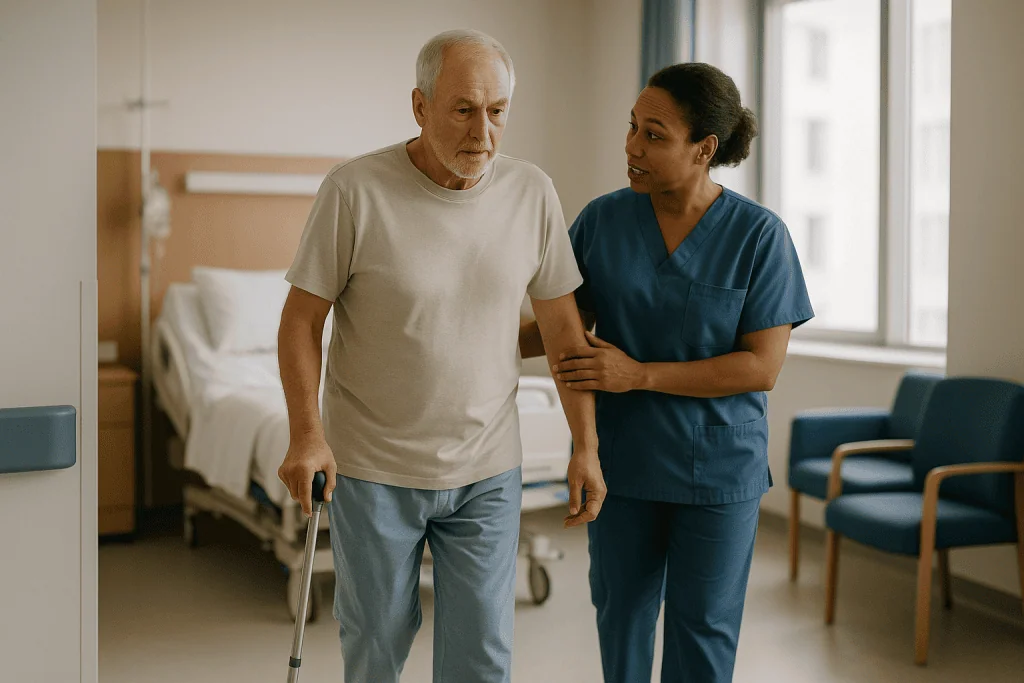
The first is blood clots. Lying still after an operation slows blood flow in the deep veins of the legs, and surgery itself tips the clotting system toward forming clots. A clot that breaks free can travel to the lungs. Calf-muscle contraction during walking is the body’s own pump for leg veins, which is why nurses will also fit compression stockings and, for many patients, give a short course of an injectable anticoagulant, a medicine that thins the blood. Whether that continues after discharge is a decision for the surgical team based on individual risk.
The second is the gut. Anesthesia and handling of the abdomen put the intestines to sleep, a state called ileus that leaves people bloated, nauseated and unable to pass wind. Gentle upright movement is one of the few things reliably shown to help the bowel restart, which is also why chewing gum and early light food appear in many enhanced recovery protocols.
The third is the lungs. Shallow breathing from pain and inactivity lets the small air sacs at the base of the lungs collapse, raising the chance of a chest infection. Walking forces deeper breaths without any special effort.
At home, the same logic applies. Several short walks spread across the day beat one long one, especially in the first week. A reasonable pattern many teams suggest is walking every couple of waking hours, adding a few minutes each day, and stopping short of breathlessness or a pulling sensation at the incisions. Sitting in a chair rather than lying in bed during the day also counts as activity for the lungs and the veins.
Is a partial nephrectomy painful? What the soreness usually feels like
People searching this question deserve a straight answer: yes, it hurts, but for most the pain is moderate, peaks in the first two or three days and fades steadily through the first two weeks. The robotic approach avoids the long flank incision of open surgery, which the Mayo Clinic notes generally means less pain and a quicker return to activity, though not zero pain.
The discomfort comes in several distinct flavors. There is incisional soreness, sharpest at the slightly larger cut through which the tumor was removed. There is the gas-related shoulder ache described earlier. There is deep, dull flank pressure from the repaired kidney itself and the bruised tissue around it. Many people also describe a bloated, crampy belly until the bowels move, typically two to four days after surgery.
Pain control usually layers medicines by mechanism. Acetaminophen and, where the kidney specialist and surgeon agree it is safe, an anti-inflammatory form a base; opioids are added for breakthrough pain in the early days and are meant to taper quickly. Anti-inflammatory drugs deserve a specific mention because they act on the kidney’s blood flow, and some teams ask people with reduced kidney function to avoid them after this particular operation. Which medicines, how much and for how long is a decision for the prescribing clinician, and it should be revisited at the first follow-up rather than continued on autopilot.
Practical measures do real work alongside tablets. Splinting the abdomen with a pillow when coughing or laughing, sleeping propped on the unoperated side, warmth on the shoulder, and keeping bowels soft with fluids and fiber all reduce the demand for medicine. A steady rise in pain after it had been improving is not part of normal healing and belongs in the “call the team” category.
Partial nephrectomy recovery time: the first six weeks, week by week
No two recoveries run to the same clock, but the shape is consistent enough that a typical timeline is genuinely useful. The ranges below reflect patient guidance from MedlinePlus, Mayo Clinic and Cleveland Clinic; individual teams adjust them, and their instructions override anything printed here.
| Period | What is usually happening | Typical activity level |
|---|---|---|
| Day 0 to 1 | Catheter and possibly a drain in place; urine may be pink; first walks with a nurse | Short corridor walks, chair sitting, breathing exercises |
| Day 2 to 3 | Drain and catheter usually removed; bowels start to move; discharge for many | Independent walking, stairs slowly, showering |
| Week 1 | Fatigue is prominent; incisional soreness easing; appetite returning | Several short walks daily; light household tasks; no lifting |
| Week 2 | Off strong painkillers for most; first clinic check often falls here | Longer walks; desk-type work from home if energy allows |
| Weeks 3 to 4 | Incisions healed on the surface; deep tissue still knitting | Driving once pain-free and off opioids; light stationary cycling if cleared |
| Weeks 5 to 6 | Abdominal wall and kidney repair regaining strength | Gradual return to lifting and moderate exercise as the team allows |
Two features of this timeline catch people off guard. The first is fatigue, which outlasts pain by weeks; the body is spending energy on tissue repair and on recovering from anesthesia, and an afternoon nap in week two is normal rather than a sign of trouble. The second is the mismatch between how the small incisions look and how the inside feels. Skin closes in about ten days, but the muscle layers and the stitched kidney take considerably longer, which is precisely why the lifting limit stretches to six weeks even when the scars look finished.
Lifting after partial nephrectomy: why the six-week rule exists
MedlinePlus patient instructions for kidney removal surgery advise avoiding lifting anything heavy, roughly the weight of a full grocery bag, for about four to six weeks. The limit protects two separate structures, and understanding both makes the rule easier to respect.
The first is the abdominal wall. Each robotic port passes through skin, fat, muscle and the fascia, the tough fibrous sheet that holds the abdominal contents in. Fascia heals slowly, gaining strength over weeks rather than days. Straining against a heavy load spikes pressure inside the abdomen and can push tissue through a weak port site, producing an incisional hernia, a bulge that may later need its own repair.
The second is the kidney itself. The defect where the tumor sat has been closed with stitches, sometimes reinforced with a sealant. In the early weeks that repair is held together by sutures and young scar tissue. A sudden rise in blood pressure from heavy straining, a fall, or a direct blow to the flank can disturb it. Delayed bleeding after partial nephrectomy, though uncommon, tends to occur within the first few weeks, which is one reason surgeons are conservative about exertion in that window.
In practice the rule catches everyday movements rather than gym sessions. Lifting a toddler, hauling a laundry basket up stairs, moving a wet dog, carrying luggage, and vacuuming with a heavy upright cleaner all count. Pushing and pulling, such as mowing or shoveling, load the same muscles. Bending at the knees to pick something light off the floor is fine; holding your breath and heaving is not.
Lifting limits are lifted gradually, not on a single morning. Many teams reintroduce moderate weight in the sixth week and heavier training after a clinic review, and that conversation is worth having explicitly rather than assuming.
What kind of exercise should I do after kidney surgery?
Walking is the exercise of the first month, and it is more than a placeholder. It maintains circulation, restores lung volume, steadies mood and rebuilds the stamina that anesthesia and bed rest strip away. A workable plan is to start with five to ten minutes several times a day in week one, add a few minutes per session as tolerated, and aim for continuous walks of half an hour or more by the end of week three. Pace should allow easy conversation.
Stairs are permitted from the start, taken slowly with a hand on the rail. Gentle stretching of the neck, shoulders and hips eases the stiffness of guarding the abdomen. Pelvic floor and deep breathing exercises can begin once the catheter is out.
What waits until the team clears it, usually around the sixth week, includes anything that loads the core or jolts the flank: running, cycling on the road, swimming, yoga poses that twist or brace the trunk, sit-ups, planks, and resistance training. Contact sports and activities with fall risk, such as skiing or horse riding, are often held back longer because a direct blow to the operated side carries particular risk while the kidney repair matures.
Swimming deserves its own note. Immersion is generally discouraged until all incisions are fully sealed and any scabs have gone, to reduce infection risk, and the strokes themselves work the trunk muscles.
People who were fit before surgery sometimes find the slow build frustrating. The evidence-based reassurance is that cardiovascular fitness returns quickly once training resumes, whereas a port-site hernia or a bleed sets recovery back by months. When exercise does restart, a graded approach works best: lighter loads and shorter sessions than before, increasing weekly, and stopping for any new flank pain, dizziness or blood in the urine.
Return to work after kidney surgery: matching the job to the healing
How long after kidney surgery you can go back to work depends far more on the job than on the operation. Mayo Clinic guidance notes that most people return to their usual activities within a few weeks of minimally invasive kidney surgery, and that broad range covers very different realities.
Desk-based roles, particularly those that can be done from home with flexible hours, are often resumed on a part-time basis within one to two weeks. The limiting factor is rarely pain by then; it is concentration and stamina. Many people find a full eight-hour day exhausting in week two and manage half days comfortably. Commuting adds its own load, especially where it involves standing on transport, carrying a laptop bag, or driving before pain-free movement and freedom from opioids allow it.
Roles with moderate physical demands, such as nursing, teaching younger children, retail, or hospitality, generally wait until the lifting limit begins to relax, around four to six weeks, and may need a phased return with restricted duties.
Heavy manual work, including construction, warehousing, farming, or any job involving repeated lifting, pushing, or vibration, commonly needs the full six weeks and sometimes longer, with a clinic review before full duties resume. Occupational health teams can help design modified duties in the interim.
Fitness-to-work notes typically come from the surgical team at discharge and can be extended at follow-up. It helps to arrive at that conversation with a clear description of what the job actually involves physically, hour by hour, rather than a job title. Fatigue, not incision pain, is the symptom most likely to push a return date back, and pacing the first weeks with shorter days protects against the common pattern of returning too early and then needing further time off.
Life after partial nephrectomy: kidney function, blood pressure and follow-up
The point of a partial rather than a total nephrectomy is to leave as much working kidney behind as possible, and for most people the operated kidney continues to contribute alongside its partner. Kidney function is tracked with a blood test that estimates the glomerular filtration rate, or eGFR, a measure of how much blood the kidneys filter each minute. A modest dip immediately after surgery is expected, reflecting the removed tissue and the brief interruption of blood flow, and the number often recovers partially over the following weeks as the remaining tissue adapts.
The National Institute of Diabetes and Digestive and Kidney Diseases advises people with reduced kidney reserve to have blood pressure and kidney function checked regularly, to keep blood pressure and blood sugar well controlled, and to be cautious with medicines that stress the kidney. That last point usually means discussing over-the-counter anti-inflammatory painkillers with a clinician rather than reaching for them by habit. Staying well hydrated, limiting excess salt, not smoking, and maintaining a healthy weight support the kidneys in the same way they support the heart.
Follow-up after kidney cancer surgery involves periodic imaging, blood tests and clinic visits over several years. The NHS describes this surveillance as routine and its intensity is tailored to how the tumor looked under the microscope. Scan anxiety is real and worth naming to the team; many people find it eases as the pattern becomes familiar.
Day-to-day life is otherwise largely unchanged. There is no special diet for a repaired kidney beyond general heart-healthy eating, alcohol in moderation is generally acceptable once off strong painkillers, and travel is fine once the surgical team is satisfied with healing. The main long-term shift is a lower threshold for checking in when something feels off, particularly infections or new medicines.
Complications worth knowing about, in neutral terms
Most recoveries are uneventful, but an honest explainer names the problems that can occur so that they are recognized early rather than feared vaguely. The Mayo Clinic and Cleveland Clinic list the following among the recognized risks of partial nephrectomy.
Bleeding can happen during surgery or, less commonly, in the days to weeks afterward. Delayed bleeding sometimes arises from a pseudoaneurysm, a weak spot in a small artery within the repaired kidney that leaks into the urinary tract or the tissue around the kidney. It typically shows as fresh blood in the urine, flank pain, or feeling faint, and is usually treated by a radiologist who blocks the vessel from inside using a thin catheter, avoiding another operation.
Urine leak occurs when the collecting system, the internal drainage channels of the kidney, has been opened during tumor removal and the seal is incomplete. It may be picked up by a drain that keeps producing fluid or by a collection seen on a scan, and is often managed by leaving a drainage tube or a small internal stent in place while it heals.
Infection can affect an incision, the urinary tract or the chest. Blood clots in the leg or lung remain a risk for several weeks, which is why walking and, where prescribed, blood-thinning injections continue after discharge.
Less common events include injury to nearby organs such as the bowel or spleen, a hernia at a port site, conversion to an open operation if the robotic approach proves unsafe, and a greater-than-expected loss of kidney function, particularly where the other kidney is already weak. Rarely, the whole kidney has to be removed during the operation if the tumor cannot be safely separated.
Knowing these possibilities is not a reason for alarm. It is the basis for the red-flag list that follows and for the honest conversation every patient is entitled to have before signing consent.
What people often get wrong about robotic partial nephrectomy recovery
Several persistent myths make recovery harder or riskier than it needs to be.
“Small incisions mean a small operation.” The skin wounds are small; the work inside is not. A kidney has been partly cut and sewn, and the abdominal wall has been breached in several places. Judging readiness for activity by how the scars look is the most common route to overdoing it in week three.
“Rest is the fastest way to heal.” Bed rest raises the risk of clots, chest infection and sluggish bowels. Structured, frequent, gentle movement is the evidence-based path, with rest between walks rather than instead of them.
“The robot did the surgery.” The surgeon did. The system is a set of instruments under continuous human control. This matters for expectations: outcomes depend on the surgical team’s judgment and experience, not on the presence of a machine.
“I have half a kidney now.” Most partial nephrectomies remove a small fraction of the organ. The remaining tissue continues to filter, and the other kidney is unaffected. Kidney function is measured, not guessed, at follow-up.
“Any painkiller from the pharmacy is fine.” Anti-inflammatory medicines act on kidney blood flow, and some teams advise avoiding them after this operation, especially where kidney function is already reduced. Checking with the prescribing clinician takes a moment.
“Once I feel normal, I am healed.” Energy and comfort return before deep tissue strength does. The six-week lifting guidance exists precisely for the period when people feel fine but fascia and kidney repair are still maturing.
“Pink urine means something has gone wrong.” Faint pink tinging in the first days is expected. Fresh red blood, clots, or bleeding that returns after clearing is different and warrants a call.
Questions to ask your care team before and after surgery
Consultations move quickly, and the questions that matter most for recovery are often the ones patients forget to ask. Writing them down beforehand, and bringing someone to take notes, tends to produce a more useful conversation.
Before the operation, the questions that shape the plan include: Why is a partial rather than a total nephrectomy being recommended for me, and what would change that decision during surgery? How much of my kidney is expected to remain, and how will my kidney function be monitored afterward? What is your team’s usual hospital stay and lifting guidance for this operation? Will I go home with a drain, a stent or a catheter? Which of my current medicines should be paused or adjusted, and who will manage that? Will I need blood-thinning injections at home?
At discharge, the practical list takes over: What exactly counts as “heavy” lifting in your instructions, and when does the limit start to relax? When may I drive, shower, bathe and swim? Which painkillers are safe for my kidneys, and which should I avoid? What should the incisions look like at one week and at two? Who do I call out of hours, and for which symptoms? When is my first follow-up, and what tests will it involve?
Later, at the first clinic review, it is reasonable to ask: What did the pathology report show, and what does it mean for my follow-up schedule? How has my kidney function changed since before surgery? When can I return to my specific job and my specific sports? Are there any long-term restrictions or precautions I should know about?
None of these questions are a challenge to the team. Surgeons generally welcome them, because a patient who understands the plan is one who follows it and who calls promptly when something deviates from it.
When to call your doctor
Most of what happens in the first six weeks is ordinary healing: soreness, tiredness, bloating, a little pink in the urine early on, itching around the incisions as they close. A short list of signs is different, and each one justifies contacting the surgical team the same day, or emergency services where marked.
Call urgently, or seek emergency care, for fresh red blood or clots in the urine, especially if it returns after the urine had cleared; heavy bleeding or a rapidly expanding, tense swelling at an incision; feeling faint, dizzy or having a racing heartbeat, which can signal internal bleeding; sudden shortness of breath, chest pain or coughing up blood, which may indicate a clot in the lung; or a painful, swollen, warm calf, a possible deep vein clot.
Call the team the same day for a fever or shaking chills; increasing rather than decreasing pain, particularly in the flank or abdomen; redness, warmth, pus or a foul smell at any incision; persistent vomiting, or an abdomen that becomes hard and swollen with no bowel movement or wind for several days; inability to pass urine, or burning and urgency suggesting a urinary infection; and fluid leaking from an incision that is clear and watery, which can occasionally indicate a urine leak.
Also worth a call, though less urgent, are new leg swelling on one side, a rash after starting a new medicine, low mood that is not lifting, or any concern that simply will not settle. Surgical teams would rather hear about a false alarm than miss an early complication, and nobody on the receiving end of the phone will regard the call as a nuisance.
Keep the ward or clinic number, and the out-of-hours contact, somewhere visible from day one. In an emergency, the local emergency number takes priority over trying to reach the surgical team first.
Frequently asked questions
What is life like after a partial nephrectomy?
For most people, daily life returns to normal within a few weeks, with no special diet and no long-term activity restrictions once healing is complete. The lasting changes are practical: periodic scans and blood tests to monitor the kidney and check for recurrence, attention to blood pressure, and caution with medicines that stress the kidneys, particularly anti-inflammatory painkillers, which should be discussed with a clinician.
Is a partial nephrectomy painful?
Yes, though the robotic approach generally causes less pain than open surgery. Discomfort is usually moderate, peaks in the first two to three days and eases over about two weeks. Expect incisional soreness, gas-related shoulder ache, deep flank pressure and bloating until the bowels move. Pain that increases after it had been improving is not typical and should prompt a call to the team.
What is the typical partial nephrectomy recovery time?
Patient guidance from major medical centers describes a hospital stay of one to three days, light activity within one to two weeks and avoidance of heavy lifting for about four to six weeks. Fatigue often lingers longer than pain. Full return to strenuous exercise or manual work is usually agreed at a follow-up visit rather than fixed to a date.
How long after kidney surgery can I go back to work?
It depends on the job. Desk-based work is often resumed part-time within one to two weeks, moderately physical roles around four to six weeks, and heavy manual work after the six-week mark with a clinic review. Fatigue, rather than incision pain, is the symptom most likely to delay a return, and a phased schedule works better than a sudden full week.
What are the rules for lifting after partial nephrectomy?
Most surgical teams ask patients to avoid lifting anything heavier than a full grocery bag for about four to six weeks. The limit protects the healing fascia at the port sites from hernia and the stitched kidney from delayed bleeding. Everyday tasks such as lifting children, laundry baskets, luggage and pets all count, and the restriction is usually relaxed gradually.
What kind of exercise should I do after kidney removal surgery?
Walking is the main exercise for the first month, starting with short frequent walks and building toward half an hour or more by week three. Stairs and gentle stretching are fine early. Running, cycling, swimming, core work and resistance training usually wait until the team clears them, often around six weeks, with contact sports held back longer.
When can I drive after robotic partial nephrectomy?
Driving is generally reasonable once you are no longer taking opioid painkillers and can brake, twist and turn the wheel without hesitation from pain, which for many people is two to three weeks after surgery. Insurance policies sometimes specify a waiting period after abdominal surgery, so checking the policy and confirming with the surgical team is sensible.
Does the remaining kidney tissue still work after a partial nephrectomy?
Yes. A partial nephrectomy removes the tumor and a thin rim of tissue, leaving most of the kidney to continue filtering. Kidney function, measured by eGFR blood tests, often dips slightly after surgery and then partially recovers over the following weeks. The other kidney is unaffected. Long-term monitoring of blood pressure and kidney function is standard.
Why do I have shoulder pain after robotic kidney surgery?
The abdomen is inflated with carbon dioxide gas during robotic surgery, and residual gas irritates the diaphragm, which shares nerve pathways with the shoulder. The resulting ache is felt at the shoulder tip rather than in the joint. It typically fades within a day or two as the gas is absorbed, and walking, changing position and gentle warmth help it settle faster.
What does life after partial nephrectomy mean for follow-up scans?
Follow-up after kidney cancer surgery involves periodic imaging and blood tests over several years, with the schedule tailored to the tumor’s features on the pathology report. Scans check the operated kidney and other organs for any recurrence and track kidney function. Many people find the anxiety around scans eases as the routine becomes familiar; raising it with the team is worthwhile.
References
- MedlinePlus – Kidney removal – discharge
- MedlinePlus – Kidney removal
- NHS – Kidney cancer: treatment
- NIH NIDDK – Solitary Kidney
This article is for general information only and is not a substitute for professional medical advice. Please consult a qualified doctor about your individual situation.

More from the Blog
What Debulking Surgery for Ovarian Cancer Removes and Why Completeness Matters
Debulking surgery for ovarian cancer, also called cytoreductive surgery, removes the ovaries, fallopian tubes, uterus, omentum and every visible tumor deposit a surgeon can…
Life After Vulvar Cancer Treatment: Intimacy, Body Image and Emotional Support
Life after vulvar cancer treatment usually involves a slow physical recovery, changes in how the genital area looks and feels, and an emotional adjustment…
Chemotherapy Before or After Breast Cancer Surgery? How Oncologists Choose the Order
Chemotherapy can be given before breast cancer surgery (neoadjuvant) or after it (adjuvant), and pooled data from randomized trials show the order does not…

Questions to Ask the Transplant Team Before a Bone Marrow Transplant
Before a bone marrow transplant, ask the team which type is planned (your own cells or a donor's) and why it is recommended over…

Surgical Oncology Preparation: Staging Scans, Blood Tests and the Anesthesia Assessment
Preparing for cancer surgery usually means three things happening in parallel: staging scans such as CT, MRI or PET-CT to map where the cancer…
What Neck Cancer Follow-Up Looks Like: Physical Exams, Imaging and Side-Effect Reviews
Follow-up after neck cancer treatment usually combines a hands-on physical exam of the neck, mouth and throat at each visit, a camera check of…