

Seeking a Second Opinion on a Brain Tumor Plan: What to Bring and Which Questions to Ask
Key Takeaways
- The current WHO classification grades brain tumors from 1 to 4 and defines many types by molecular markers such as IDH, 1p/19q and MGMT, so a pathology report lacking these may be incomplete rather than wrong.
- More than 120 tumor types can arise in the brain and spinal cord, which is why independent pathology review is often the most decision-changing part of a second opinion.
- Bring the raw DICOM imaging files and the pathology slides or tissue block, not just the typed reports; the second team needs the evidence, not the summary.
- Molecular tests can usually be run on existing tissue, so a second pathology review does not require a repeat biopsy.
- Signs of rising pressure inside the skull, such as severe headache with vomiting, a first seizure, new weakness or falling alertness, are emergencies that take priority over any scheduled second opinion.
- Personality changes with a brain tumor are usually explained by frontal or temporal lobe involvement, swelling, seizures or steroid medicines rather than by the person, and several of these causes can be managed.
A brain tumor second opinion is a review of your scans, pathology and proposed plan by a separate neuro-oncology team. Bring the actual imaging files, the pathology report and slides or tissue block, operative notes, medication list and a written summary of your questions. Ask how the diagnosis was confirmed, what alternatives exist, and how urgency affects timing. Final decisions stay with your treating team.
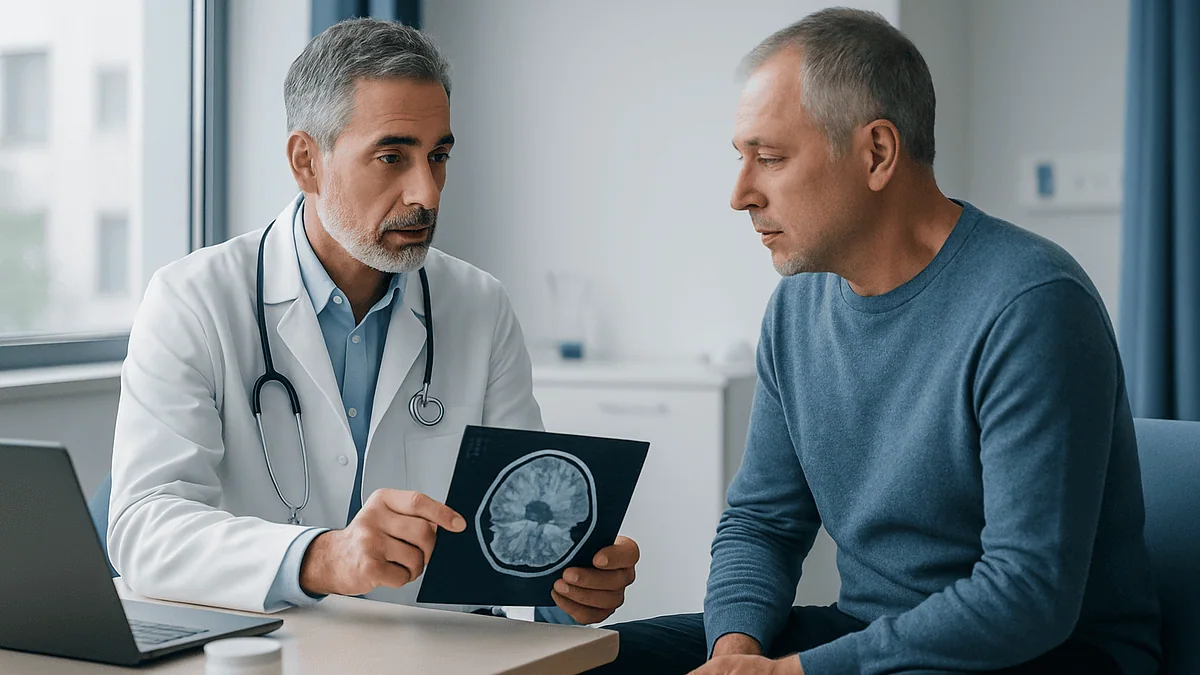
The neurosurgeon has finished explaining. There is a scan on the screen with a pale shadow where nothing should be, a proposed operation date, and a word you have already looked up on your phone twice. Someone in the room says, quietly, “Should we ask someone else?” and then feels guilty for saying it out loud.
That guilt is misplaced. Reviewing a serious diagnosis with a second, independent team is routine in medicine, and brain tumors are one of the situations where clinicians themselves most often suggest it. More than 120 tumor types can arise in the brain and spinal cord, and two of them can look nearly identical on a scan while calling for very different plans.
A brain tumor second opinion is not a vote of no confidence in the person who first sat across from you. It is a way of asking the same evidence a second question, and arriving at the plan with fewer doubts trailing behind you.
Why a brain tumor second opinion is normal, not disloyal
Most people hesitate for the same reason: they worry the first doctor will be offended. In practice, brain tumor care is already built around multiple opinions. Neuro-oncology teams typically present each new case at a tumor board, a scheduled meeting where surgeons, radiation oncologists, medical oncologists, neuroradiologists and pathologists look at the same scans and slides together and argue, politely, about what to do. A second opinion simply extends that habit to a team outside your current hospital.
There are practical reasons the habit exists. Brain tumors are relatively uncommon compared with, say, breast or colon cancer, so some clinicians see only a handful of a particular subtype in a career. Grading and classification also depend on molecular tests that not every pathology laboratory runs in-house. And the stakes are unusually concrete: a tumor near the speech area or the motor strip forces a real trade-off between how much is removed and what abilities are preserved.
The National Cancer Institute, part of the NIH, describes second opinions as a standard part of cancer care and notes that insurers commonly expect them before major surgery. Patient guidance from the NHS likewise treats asking for one as an ordinary right rather than a special request.
What a second opinion cannot do is remove uncertainty altogether. Two excellent teams can look at the same tumor and weigh the same risks differently, because the evidence for many brain tumor decisions is genuinely incomplete. The point is not to find the “right” answer hidden somewhere; it is to make sure the answer you eventually choose has been stress-tested from more than one angle.
How a brain tumor second opinion actually works
Strip away the paperwork and a second opinion has three parts: someone re-reads your imaging, someone re-examines your tissue if a biopsy or operation has already happened, and someone re-thinks the plan in light of both.
The imaging review is done by a neuroradiologist, a radiologist who specializes in scans of the brain and spine. They look at the original digital files, not the typed report, because subtle features such as the pattern of contrast enhancement, restricted diffusion, or the way a tumor sits against the ventricles can shift the list of likely diagnoses. Sometimes the second reader suggests an additional sequence, for example perfusion imaging or MR spectroscopy, before anyone commits to surgery.
The pathology review is where the biggest surprises tend to arise. A neuropathologist examines the stained glass slides under a microscope and checks whether the molecular tests required by the current World Health Organization classification of central nervous system tumors were performed. Since the fifth edition of that classification, many diagnoses depend on genetic markers rather than appearance alone, so a report that lacks them can be incomplete rather than wrong.
The clinical review pulls everything together. The second team asks the same questions the first one did: Where exactly is the tumor? What is it likely to be? Is surgery feasible, and how much can safely come out? Would radiation or chemotherapy add something, or should the tumor simply be watched for now?
Increasingly, the first two steps happen remotely. Scans travel as digital files and slides can be scanned or physically mailed, so a written second opinion can be produced without you leaving home. A video or in-person visit then lets you ask questions, which is the part that no report can replace.
Who usually benefits most, and who may be asked not to wait
Almost anyone with a new brain tumor diagnosis can reasonably ask for a second look, but some situations make it especially valuable, and a few make delay unwise.
The strongest case for a second opinion is a tumor whose grade or type is uncertain, or where the pathology report does not list the molecular markers the WHO classification now expects. Another is a tumor in or near a functionally critical area, where one surgeon may propose an awake operation with language mapping while another suggests a smaller resection followed by radiation. A third is any rare subtype, because the treating team’s experience with that exact diagnosis matters and can legitimately vary. Fourth, if you have been told nothing more can be done, or that only one option exists, a fresh set of eyes is worth having before you accept either statement.
Then there are people who are usually asked not to wait. If a tumor is causing rapidly rising pressure inside the skull, blocking the flow of cerebrospinal fluid, or bleeding, neurosurgeons operate to protect the brain first and refine the diagnosis afterwards. Mayo Clinic and the NHS both describe sudden severe headache with vomiting, new weakness, a first seizure, or a declining level of alertness as emergencies. In those cases a second opinion can still happen, but about what comes after surgery rather than whether it should occur.
Between those poles sits a middle group with slow-growing, low-grade tumors, where the honest answer from many teams is that weeks of careful deliberation are unlikely to change the outlook. For these patients a second opinion is easy to schedule and often reassuring, whichever way it lands.
Second opinion before brain surgery: what can change and what usually does not
People often expect a second opinion to overturn everything. More commonly it confirms the broad direction and refines the details, and refinement in neurosurgery is not a small thing.

What can change is the surgical strategy. One team may favor a craniotomy, an operation that opens a window in the skull, with the goal of removing as much visible tumor as possible. Another may recommend a stereotactic biopsy, a needle procedure guided by imaging, to establish the diagnosis before deciding whether a larger operation is justified. Teams also differ on the use of intraoperative tools such as awake language mapping, fluorescent dyes that highlight tumor tissue, or MRI performed during the operation. None of these is universally better; each fits some tumors and some patients more than others.
What can also change is the sequence. For certain tumors, radiation or drug therapy may be proposed before surgery, or instead of it. For others, the second team may suggest observation with repeat scans, a strategy sometimes called watchful waiting, particularly for small, symptom-free lesions that appear benign.
What usually does not change is the diagnosis itself when molecular pathology has already been completed by an experienced laboratory. Nor does the underlying biology: a second opinion cannot make a fast-growing tumor slow, and no responsible clinician should imply otherwise.
The practical risk of seeking one is time. Ask the first team directly how much delay is medically acceptable for your tumor, and ask the second team to work within that window. Both should be able to answer, and the answer belongs on your written plan.
What to bring to a brain tumor second opinion: the records that matter
Second-opinion visits stall for one dull reason more than any other: a piece of the record is missing. The typed report arrives but the actual scan does not, or the pathology summary comes without the slides. Gathering everything beforehand is the single most useful thing you can do.
| Item | Why it matters | Where to request it |
|---|---|---|
| Imaging files (DICOM format) for every MRI and CT, on disc or via a secure link | The second radiologist needs the raw images, not a report; older scans show growth over time | Radiology or medical records department |
| Radiology reports | Show what the first reader concluded and which sequences were used | Same department, or your patient portal |
| Pathology report plus slides or tissue block | Allows independent microscopic and molecular review | Pathology laboratory; slides are loaned, usually returned |
| Operative note and discharge summary, if surgery has occurred | Describes what was removed and what was seen | Neurosurgery office or records |
| Clinic letters and treatment plan | Lets the second team respond to the actual proposal | Treating oncologist or surgeon |
| Medication list, allergies and other diagnoses | Steroids, anti-seizure drugs and blood thinners all affect planning | Your pharmacy printout or portal |
| Your written questions and a companion | Memory is unreliable under stress | You |
Most hospitals have a release-of-information form; sign it early because processing can take longer than you expect, and pathology slides in particular may need to be physically shipped. The National Cancer Institute suggests asking your first team to send records directly, which avoids gaps and signals that everyone is cooperating.
One last item that rarely appears on official lists: a short timeline in your own words. When symptoms started, what changed, what you have been told and by whom. It orients the new team faster than any document can.
Why brain tumor pathology review is often the most valuable step
If you have room to ask for only one thing, ask for the tissue to be looked at again. A tumor’s name on paper determines nearly everything that follows, and that name now rests on genetics as much as on appearance.
The WHO classification of central nervous system tumors assigns grades from 1 to 4, with grade 1 tumors generally slow-growing and grade 4 the most aggressive. In the current edition, many diffuse gliomas, the family of tumors that arise from the brain’s supporting cells, are defined by specific molecular findings. Whether an enzyme gene called IDH is mutated, whether a pair of chromosome arms known as 1p and 19q are missing, and whether a repair gene called MGMT is chemically switched off can each move a tumor into a different category. The National Cancer Institute’s adult brain tumor treatment summary explains that these markers help predict behavior and guide treatment choices.
Not every laboratory runs the full panel, and some reports describe a tumor only by its microscopic look. A pathology review checks whether the recommended tests were done and, if not, can request them on the existing tissue block, meaning no repeat biopsy is needed.
Disagreement between pathologists is not a sign that someone was careless. Brain tumors can be heterogeneous, with different regions showing different features, and a small biopsy may have sampled the least aggressive corner. This is one reason surgeons try to obtain enough tissue and why a second neuropathologist can add genuine information rather than just confirmation.
Ask the second team plainly: is the diagnosis established to the current WHO standard, and if not, what is missing? That single question resolves a surprising share of second-opinion visits.
Why the scan files matter more than the scan report
A radiology report is one expert’s interpretation typed on a busy day. The images themselves are the evidence. Bring the evidence.
MRI, the standard imaging for brain tumors, produces many different sequences, each highlighting different tissue properties. Contrast enhancement, where an injected dye lights up areas with leaky blood vessels, is often used as a rough marker of tumor activity, though some low-grade tumors do not enhance at all and some non-tumor conditions do. Diffusion imaging measures how freely water moves through tissue and can help separate a dense tumor from an abscess. Perfusion imaging estimates blood flow, which can hint at grade. A second neuroradiologist may notice that a sequence is missing, that the tumor’s edges are less distinct than reported, or that a second, smaller lesion was not mentioned.
Older scans are as valuable as new ones. A lesion that looks identical on images taken months apart tells a very different story from one that has grown, and the treating team cannot judge growth from a single snapshot. Mayo Clinic notes that repeated imaging over time is itself a diagnostic tool for slow-growing tumors.
The files should be in DICOM format, the standard used by hospital imaging systems, rather than screenshots or printed pictures. Ask the radiology department for a disc or a secure electronic transfer. Many hospitals can now exchange images directly through shared networks, which is faster and avoids lost discs.
Once the second team has looked, ask them to explain the scan to you with the images on screen. Seeing where the tumor sits relative to the structures that control movement, vision or language turns an abstract decision into one you can actually picture.
How to get a second opinion for cancer of the brain: the practical steps
The process is more administrative than medical, and knowing the sequence spares you frustration.
Start by telling your current team. Most will help, and some will suggest a colleague or a center with a dedicated neuro-oncology program. If your health system requires a referral for specialist visits, this conversation is where you obtain it. If you feel awkward, a plain sentence works: “This is a big decision and I’d like another team to look at it before we go ahead.”
Next, check coverage. Many insurers, including public programs, routinely cover a second opinion before major surgery or a cancer diagnosis, but rules about referrals and in-network providers vary. A quick call to the number on your card, before booking, prevents surprises. Do not let this step delay the medical timeline your team has set; you can gather records while the paperwork moves.
Then choose the second team. Guidance from the National Cancer Institute suggests looking for a center that treats a high volume of brain tumors and holds a regular neuro-oncology tumor board. Volume is not everything, but rare diagnoses are handled more confidently by teams that see them often. Some centers offer remote written opinions based on records alone, followed by a video visit, which removes the need to travel.
Finally, request the records described earlier and confirm that the second team has received them at least a few days before the appointment. Ask them, too, whether they will send their conclusions back to your first team. An opinion that stays in a drawer helps no one; the goal is a conversation between the two teams, with you in the middle and in charge.
Questions to ask your neurosurgeon and the wider care team
Write these down, hand a copy to whoever comes with you, and tick them off as you go. Doctors generally welcome a list; it makes the visit more efficient, not less.
About the diagnosis:
- What exactly do you think this tumor is, and how confident are you?
- Has the pathology been reviewed against the current WHO classification, including molecular markers?
- What else could it be, and what would settle the question?
About the tumor’s position:
- Which brain functions sit next to or within it?
- How does that change what can safely be removed?
About the options:
- What are all the reasonable approaches, including observation?
- Why do you favor the one you are proposing?
- How many operations or treatments like this does your team perform, and who would actually be in the room?
About risk and recovery:
- What are the most likely complications, and what is the plan if they occur?
- What would the first weeks after treatment look like for someone in my situation?
- What could I lose, and what could I keep?
About time:
- How urgently does this need to happen, and what is the medical cost of waiting?
About the future:
- How will we know whether treatment is working?
- Are there clinical trials I might be eligible for?
End with a question the NHS recommends for any major decision: “If you were advising a member of your own family with this exact scan and this exact pathology, what would you want them to understand?” The answer is often the most candid sentence of the visit.
Questions about treatment beyond surgery
Surgery tends to dominate the conversation because it comes first and feels most dramatic, but for many brain tumors the plan after surgery matters just as much. A good second opinion addresses all of it.
Radiation therapy uses focused beams to damage tumor cells’ ability to divide. It can be delivered over several weeks in daily fractions, or in a small number of highly focused sessions sometimes called stereotactic radiosurgery, which despite the name involves no incision. Ask which approach is proposed, why, and how the team protects nearby structures such as the optic nerves or the hippocampus, a region important for memory.
Chemotherapy for brain tumors most often relies on drugs that damage tumor DNA, chosen partly on the basis of molecular markers such as MGMT status. Targeted therapies, which block specific molecular signals, exist for a limited set of tumor types. Ask whether your pathology results make any of these relevant, and how the team decides.
Supportive medicines deserve their own questions. Corticosteroids reduce swelling around a tumor and can ease headaches and weakness within days, but they carry side effects with prolonged use, and the prescribing team will manage how long they are needed. Anti-seizure medicines are commonly prescribed after a seizure and sometimes around surgery. Never adjust either without speaking to the clinician who prescribed it.
Clinical trials are worth asking about at every visit. The National Cancer Institute maintains public listings of trials for brain tumors, and eligibility often depends on the precise molecular diagnosis, another reason complete pathology matters.
Finally, ask about the team itself: who coordinates care, who you call with a new symptom, and how the surgeon, oncologist and radiation specialist communicate. Good plans are held together by that plumbing.
What happens if the two opinions disagree?
Sometimes the second team says something different, and the relief of having asked turns into the discomfort of having to choose. This is uncomfortable but not unusual, and it is manageable.
Start by sorting the disagreement into a category. Is it about the diagnosis, which is a question of fact that further testing can often resolve? Is it about strategy, where two reasonable approaches exist and the evidence does not clearly favor one? Or is it about judgment, where each team weighs the same risks differently based on experience and on how they read you as a person?
Diagnostic disagreements are the easiest to settle: ask both pathologists to confer, or request that the tissue be reviewed by a third neuropathologist. Laboratories do this routinely and it does not require another biopsy.
Strategic disagreements call for a direct conversation. Ask each team to explain, in plain words, why they would not do what the other proposes. Ask what evidence supports each path and how strong that evidence is. Many brain tumor decisions rest on observational studies rather than large randomized trials, and an honest clinician will tell you where the guideline ends and expert opinion begins.
Judgment disagreements are where your own values enter. A more aggressive operation may offer a better chance of removing all visible tumor but a higher risk of speech or movement changes. Only you can say how you weigh those. Say it aloud, and notice which team listens.
It is entirely acceptable to ask the two teams to speak with each other. It is also acceptable to seek a third view. What is not helpful is choosing based on who was kinder in the waiting room; kindness matters, but it is a separate question from which plan is right.
What the following days and weeks usually look like
People imagine a second opinion as a single appointment. In reality it unfolds over a stretch of weeks, and knowing the rhythm makes the waiting easier.
The first stretch is gathering. Signing release forms, chasing the radiology disc, confirming the pathology slides have shipped. Ask the second team’s coordinator to tell you when everything has arrived; an appointment held before the slides are in hand is usually a half-appointment.
Then comes review, which happens out of your sight. The neuroradiologist reads the scans, the neuropathologist examines the tissue and may order additional molecular tests, and your case is placed on the next tumor board agenda. Molecular testing takes longer than standard staining, so a delay at this point often means the team is being thorough rather than slow. If your first team has set a medical deadline, share it and ask the second team whether they can meet it.
The consultation itself is the visible part. Expect a neurological examination, a walk through your images, and a discussion that may end with a firm recommendation, a request for one more test, or an honest statement that two paths are equally reasonable.
Afterwards the written opinion is sent to you and, if you have asked, to your original team. This is the moment to arrange a follow-up conversation with whichever clinician will actually carry out the plan, so that the two views are reconciled into one course of action.
Throughout, keep taking prescribed medicines exactly as directed, keep the appointments already booked, and keep a notebook. Symptoms that change during the waiting period, new headaches, a new weakness, a first seizure, are not something to save for the next meeting; they are a reason to call the team that is currently looking after you.
Can you live a normal life with a brain tumor, and can it change personality?
These two questions arrive in almost every consultation, usually asked by a family member rather than the patient, and both deserve an answer that is neither bleak nor falsely bright.
Whether life feels normal depends on the tumor’s type, grade, location and how it responds to treatment, and on how much of daily life the treatment itself disrupts. Many people with slow-growing or benign tumors work, drive after any required seizure-free interval, raise families and travel while attending scans every few months. Others with aggressive tumors face treatment that occupies much of a year and leaves lasting fatigue. The NHS and Mayo Clinic both describe rehabilitation, occupational therapy and speech therapy as ordinary parts of brain tumor care rather than signs of failure; recovering a skill after surgery is expected work, not a setback.
Personality and behavior can change, and it helps to know why. The frontal lobes govern planning, impulse control, motivation and social judgment, and a tumor pressing on or growing within them can make someone flatter, more irritable, more disinhibited, or simply less like themselves. Swelling around a tumor, seizures, corticosteroid medicines and the ordinary exhaustion of illness all contribute as well. Johns Hopkins lists changes in personality or behavior among the recognized effects of brain tumors, particularly frontal and temporal ones.
The practical value of knowing this is twofold. Families stop interpreting a symptom as a choice, and clinicians can sometimes ease it, since swelling responds to treatment and seizures can be controlled. Bring specific examples to the consultation: what changed, when, and how it affects daily life. That information helps the second team judge the tumor’s effect on function, which in turn shapes how much surgical risk is worth accepting.
What people often get wrong about brain tumor second opinions
Some misconceptions cause real harm, mostly by delaying care or by souring relationships that patients will depend on for years.
The first is that asking will offend the surgeon. It rarely does. Specialists refer their own family members for second opinions, and many hospital systems require one before certain operations. A clinician who reacts with hostility is giving you useful information about how they handle disagreement.
The second is that a second opinion is only for people who distrust the first. In fact confirmation is the most common outcome, and it has value of its own: people who go into a difficult operation without lingering doubt tend to cope better with the recovery, and a confirmed plan removes an entire category of regret.
The third is that the tumor’s name on the first report is final. As explained above, classification now depends on molecular tests that not every laboratory runs, so a report can be incomplete without being careless.
The fourth is that a second opinion must involve travel. Imaging and pathology are routinely reviewed remotely, and a video consultation can cover most of the discussion. Where an in-person visit adds value, the team will say so.
The fifth is that more opinions always mean a better decision. Beyond two or three, the returns shrink and the delay grows. If three experienced teams broadly agree, further shopping usually reflects fear of the decision rather than doubt about the evidence.
The last is the belief that a second opinion changes the biology. It can change the plan, refine the diagnosis and sharpen your understanding. It cannot make a grade 4 tumor into a grade 1, and any source implying otherwise, whether a website or a clinic, is selling something other than medicine.
When to call your doctor
Seeking a second opinion should never mean drifting between teams with nobody watching. Until a new plan is agreed, the team that made your diagnosis remains responsible for your care, and their number is the one to call.
Contact them the same day if you notice a new or clearly worsening headache, especially one that wakes you, is worse on lying flat, or comes with vomiting; a first seizure, or seizures that are more frequent or longer than usual; new weakness, numbness or clumsiness on one side; new difficulty speaking, understanding speech, or finding words; new problems with vision such as double vision or loss of part of the visual field; or increasing drowsiness, confusion or a marked change in behavior noticed by others. Mayo Clinic, the NHS and MedlinePlus list these among the signs that a brain tumor may be causing rising pressure or swelling and that warrant prompt assessment.
Call emergency services rather than the clinic if someone is having a seizure lasting more than five minutes, cannot be roused, suddenly cannot move or speak, or develops the worst headache of their life over seconds to minutes.
Also call, without embarrassment, for the quieter problems: side effects from steroids or anti-seizure medicine, mood changes, trouble sleeping, or simply feeling unable to cope with the wait. Neuro-oncology teams have nurses and coordinators whose job is precisely this, and a symptom mentioned early is far easier to manage than one saved for the next scheduled visit.
Whatever the second opinion concludes, the decision about what to do next belongs to you and the team that will carry it out. Their job is to give you the clearest possible picture. Yours is to ask until you have it.
Frequently asked questions
Can I live a normal life with a brain tumor?
Many people do, depending on the tumor’s type, grade and location and on how treatment affects them. People with slow-growing or benign tumors often work, drive after any required seizure-free interval and travel while having periodic scans. Aggressive tumors demand more intensive treatment and often leave fatigue. Rehabilitation, speech and occupational therapy are routine parts of care, and your treating team can describe what daily life is likely to involve in your specific situation.
Will Medicare pay for a second opinion for cancer?
Coverage for second opinions before surgery or after a cancer diagnosis is common across public and private plans in the United States, but rules about referrals, in-network providers and prior authorization vary between plans. The most reliable answer comes from calling the number on your insurance card before booking. Do not let the paperwork delay a medically urgent timeline; records can be gathered while coverage is confirmed.
Can brain cancer go into remission?
Clinicians use terms such as remission, stable disease or no evidence of disease on imaging to describe tumors that have shrunk or stopped growing after treatment. Whether this happens, and for how long, depends heavily on the tumor’s type and molecular features. Follow-up MRI scans at intervals set by your team are how response is monitored. Your neuro-oncologist can explain what the terms mean for your particular diagnosis without guessing at numbers.
Can brain tumors affect personality?
Yes. Tumors in or near the frontal lobes, which govern planning, motivation and impulse control, can make a person flatter, more irritable or more disinhibited. Swelling around the tumor, seizures and corticosteroid medicines add to this. Recognizing the change as a symptom rather than a choice helps families, and some causes, especially swelling and seizures, can be managed by the treating team. Describe specific examples at your consultation.
How do I get a second opinion for cancer without offending my doctor?
Tell your doctor directly that you would like another team to review the plan before a major decision. Most specialists expect this, many suggest it themselves, and some health systems require it before surgery. A plain sentence is enough. Ask them to send records to the second team and to receive the resulting opinion, so the two views can be reconciled into one plan with you involved.
What is a brain tumor pathology review and do I need another biopsy?
A pathology review is an independent examination of your existing tumor tissue by a second neuropathologist, checking the diagnosis and whether the molecular tests required by the current WHO classification were performed. It almost never requires a new biopsy, because additional tests can be run on the stored tissue block. Slides are loaned between laboratories and returned. Ask the second team whether the diagnosis meets the current classification standard.
Is a second opinion before brain surgery worth the delay?
For most tumors, yes, provided the delay stays within the window your treating team considers medically safe. Ask the first team how long you can reasonably wait and ask the second team to work inside that limit. For emergencies such as rising pressure or bleeding, surgery comes first and a second opinion focuses on the treatment that follows. The balance between thoroughness and timing is a decision to make openly with both teams.
What questions should I ask a neurosurgeon at a second opinion?
Ask what the tumor is and how confident they are, which brain functions lie next to it, what all the reasonable options are including observation, why they favor their proposal, what complications are most likely, how urgent the timing is, and how progress will be measured. Ask who will actually perform the procedure and how often the team treats this diagnosis. Bring the list written down and a companion to take notes.
Can a second opinion be done remotely?
Often, yes. Imaging files and scanned or mailed pathology slides can be reviewed by a distant team, and many centers provide a written opinion followed by a video consultation. An in-person visit adds a neurological examination and a chance to meet the team, which matters if they may end up treating you. Ask the center which parts of the process they can complete without a visit.
What if the second opinion is different from the first?
Work out whether the disagreement is about diagnosis, strategy or judgment. Diagnostic differences can often be settled by a third pathology review of the same tissue. Strategic differences call for each team to explain why they would not choose the other’s plan and how strong the evidence is. Judgment differences involve your own values about risk. Asking the two teams to speak with each other is reasonable and common.
References
This article is for general information only and is not a substitute for professional medical advice. Please consult a qualified doctor about your individual situation.

More from the Blog

FND Recovery: How Movement Retraining Progresses From First Sessions to Daily Routines
There is no fixed FND recovery timeline. Movement retraining for functional neurological disorder usually begins with a clear explanation of the diagnosis, moves into…
Can You Return to Work After a Traumatic Brain Injury? Pacing, Fatigue and Gradual Steps
Many people do return to work after a traumatic brain injury, but the path is usually gradual rather than a single return date. Clinicians…

Can Medicines Make Tremor Worse? What Your Neurology Team Reviews Before Treating It
Yes. Several common medicines can start a new tremor or amplify one you already have, most often by heightening the body's normal fine shake…

When Is Thymectomy Considered for Myasthenia Gravis? How Neurologists and Surgeons Decide
Thymectomy is usually recommended for anyone with myasthenia gravis who also has a thymoma, a tumor of the thymus gland, regardless of how mild…

Is Preventive Migraine Treatment Different From Acute Relief? What Each Part of the Plan Does
Yes. Acute migraine treatment is taken once an attack has started and aims to stop pain and nausea within hours; preventive treatment is taken…

What Happens During a Craniotomy: From Skin Incision to Replacing the Bone Flap
During a craniotomy, a surgeon makes a scalp incision, drills small holes in the skull and cuts between them to lift out a piece…