

Shock Wave Therapy Side Effects: Redness, Soreness and What the First Two Days Feel Like
Key Takeaways
- Redness, warmth, small bruises and a deep ache that peaks over the first one to two days are the expected reactions to shockwave, and published reviews describe them settling within days.
- Pinpoint bruises called petechiae are more likely with radial devices because the pressure wave is strongest at the skin surface rather than deep in the tendon.
- Serious complications such as tendon rupture and nerve injury are rare and have been reported mainly with high-energy treatment given under anesthesia, when patients could not signal pain.
- Standard contraindications include pregnancy, a tumor at the site, bleeding disorders or undiscussed anticoagulant use, open growth plates in children, infection at the site and treatment over lung tissue.
- Benefit is usually judged over weeks to a few months after a short course of roughly weekly sessions, not session by session.
- For plantar fasciitis, the Mayo Clinic describes results as promising in some studies but not consistently effective, so a low-risk profile should never be mistaken for guaranteed benefit.
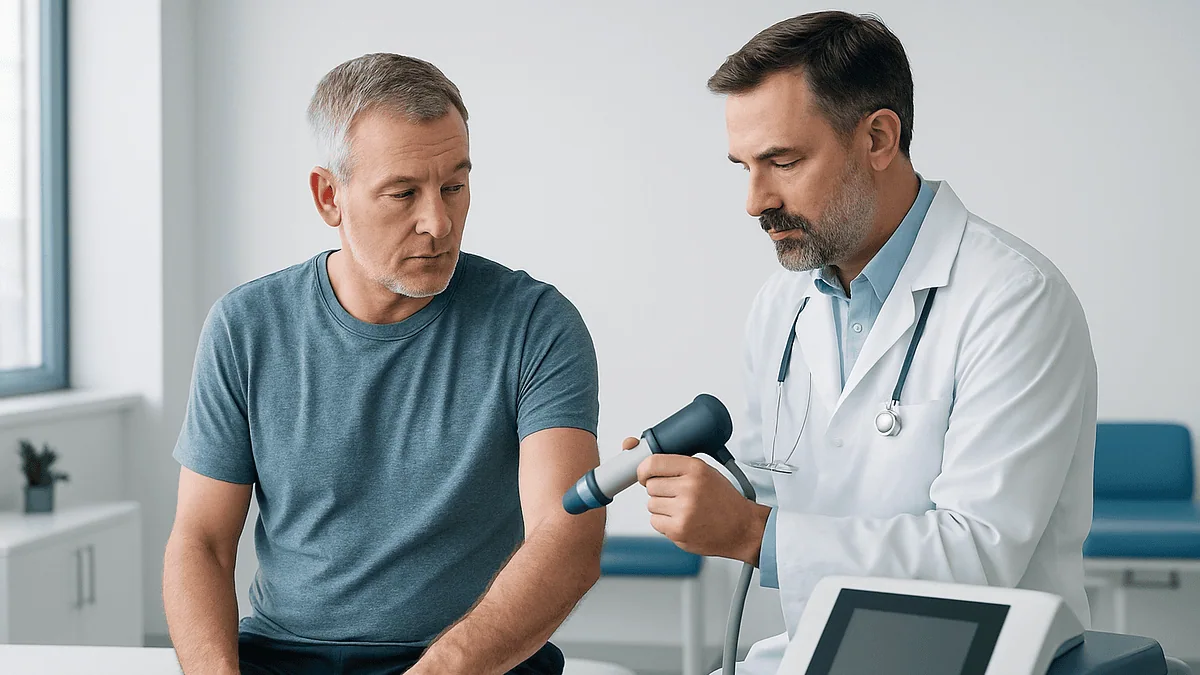
Shockwave therapy side effects are usually mild and short-lived: temporary redness, warmth, slight swelling, small pinpoint bruises and a deep, bruised-feeling soreness at the treated spot that peaks over the first one to two days and typically settles within a few days. Serious problems, such as tendon damage or nerve irritation, are rare when standard safety checks are followed. Any decision about treatment rests with the treating team.
The clinic hallway is quiet except for a sound like a staple gun firing through a pillow. Behind the door, a runner with eight months of heel pain grips the edge of the table, counting pulses under her breath, wondering whether the throbbing she already feels is the treatment working or a sign that something has gone wrong.
That question sits behind almost every search for shockwave therapy side effects. People are rarely afraid of the procedure itself. What they want to know is what the pink patch on their skin means tonight, why the ache feels deeper tomorrow than it did on the table, and how to tell an ordinary reaction from one that needs a phone call.
Here is what the evidence describes for the first two days, what tends to happen after, and the handful of situations where clinicians ask people to wait or choose another path.
Shockwave therapy side effects: what most people actually feel
Extracorporeal shock wave therapy, usually shortened to ESWT or simply shockwave, delivers pressure pulses generated outside the body (that is what “extracorporeal” means) through the skin to a painful tendon, ligament or bone. Ask people what they remember about it and they rarely mention the machine. They talk about the evening after.
The common shockwave therapy side effects are local and brief. During treatment the pulses sting or ache; afterward the skin over the spot often looks pink, feels warm and may swell slightly. Small pinpoint bruises called petechiae can appear where the applicator sat. The treated tissue usually feels bruised or heavy, and that soreness tends to build over the first day rather than fade the moment the session ends. A review published in EFORT Open Reviews lists pain, reddening, swelling and small collections of blood under the skin as the typical reactions and describes them as transient, generally resolving within days.
Serious harm is a different category. Tendon rupture, nerve irritation and bone damage have been reported, but mainly from the era when high-energy treatment was given under anesthesia, so people could not signal that the intensity was too much. Modern low- and medium-energy protocols, applied while the patient is awake and able to give feedback, carry a much smaller footprint of complications, according to that review and to an earlier summary in the Journal of Orthopaedic Surgery and Research.
So the honest headline is this: expect a sore, pink, occasionally bruised patch for a day or two. Do not expect a wound. And if what you feel does not match that picture, the section on when to call your doctor is the one to read first.
How does shockwave therapy work?
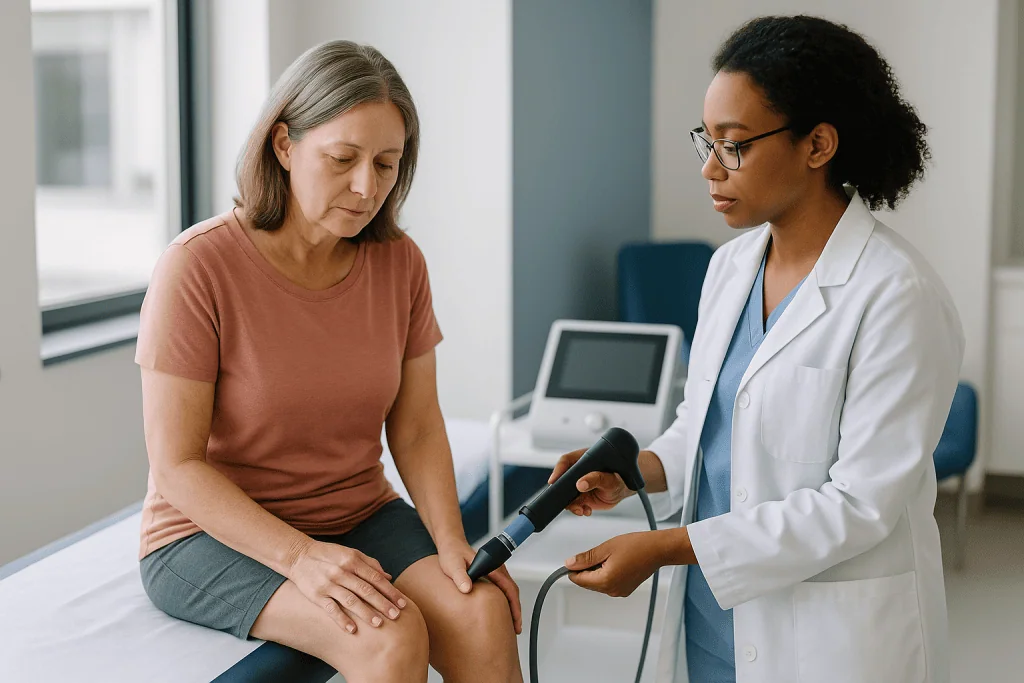
A shock wave is a very short, very steep pressure pulse: an acoustic event closer to a single clap than to the hum of therapeutic ultrasound. Two families of device exist. Focused devices concentrate the wave at a chosen depth, so the peak pressure lands inside the tendon rather than on the skin. Radial devices fire a small projectile inside the handpiece against the applicator; the pulse is strongest at the surface and fans out as it travels inward. Both are called shockwave, which is why two people can describe quite different sensations from what sounds like the same treatment.
What the pulse does once it arrives is only partly understood, and honest clinicians say so. The leading explanation is mechanotransduction: cells sense mechanical stress and change their behavior. In laboratory and animal work summarized by Wang in the Journal of Orthopaedic Surgery and Research, shock waves increased the release of growth factors, encouraged new small blood vessels at the tendon–bone junction and stimulated cells that build tendon and bone. In calcific tendinitis of the shoulder, chalk-like calcium deposits sitting inside the rotator cuffthe waves appear to help fragment those deposits so the body can clear them.
There is a pain-signalling effect too. Repeated pulses seem to reduce the concentration of a chemical messenger called substance P in nearby nerve endings, which may explain why some people notice easing before any tissue has had time to remodel.
The practical consequence for side effects is that the treatment is deliberately provocative. It nudges a stubborn, under-healing tissue into a fresh, controlled inflammatory response. Redness, warmth and soreness are the visible edge of that response, not a sign the machine has misfired.
What actually happens during a session
The room does not look like an operating theater. You sit or lie with the painful area exposed, the clinician feels for the most tender spot and marks it, and a layer of gel goes on so the wave passes from applicator to skin without an air gap. Then the noise starts: a fast, mechanical clacking that unsettles more people than the sensation itself.
Each pulse feels like a firm flick or a deep tap. On the first pass many people rate it uncomfortable rather than painful; directly over the tender spot it can be sharp. Because most current protocols are done without anesthetic, your feedback matters. Clinicians typically start gently and adjust intensity to what you can tolerate, and telling them it is too much is part of the method, not a failure of nerve. The EFORT Open Reviews update notes that treating awake patients lets the operator use pain as a guide to correct positioning and energy.
A session over one area usually lasts a few minutes. The same review describes courses of roughly three to five sessions, spaced about a week apart, as the common pattern, though your team sets the plan for your tissue and your response.
One clarification saves confusion. Shock wave lithotripsy for kidney stones uses far higher energies, usually with sedation or anesthesia, and can cause blood in the urine and flank bruising afterward, as MedlinePlus describes. That is a different procedure with a different side-effect profile. Musculoskeletal shockwave sits at a much lower energy, which is why you can walk out of the room and, in most cases, drive yourself home.
The first 24 hours: redness, warmth and a heavy ache
Redness shows up first. Within minutes the skin over the treated spot flushes, partly from the mechanical stimulation and partly from the increase in local blood flow the treatment is meant to trigger. It looks a little like the mark a firm massage leaves. Warmth follows, and in thinner-skinned areas such as the heel or the outside of the elbow, a modest puffiness.
The ache is the part people underestimate. On the table, the last few pulses often feel easier than the first, because the area becomes slightly numb. That numbness wears off over the next hour or two, and what replaces it is a dull, bruised heaviness: the feeling of having knocked the spot hard the day before. Standing up from a chair, the first steps of the morning, gripping a mug: the ordinary movements that provoked the original pain may provoke it a little more for now.
What usually helps is unglamorous. Keep moving gently, avoid the sport or task that hammers the tissue, and let the area rest without immobilizing it. Ice is a judgment call; some clinicians prefer people not to chase the inflammatory response away, since it may be part of how the treatment works. Ask your team what they want you to do rather than defaulting to what you would do for a sprain.
Tingling or a brief patch of altered skin sensation near the applicator site is reported and generally short-lived, according to the EFORT review. What should not happen in the first 24 hours is a rapidly enlarging swelling, spreading dark bruising, or pain so severe that you cannot bear weight or move the limb at all.
Day two: soreness, stiffness and the “worse before better” question
Day two is when doubt creeps in. The soreness that felt reasonable on the first evening can feel heavier the next morning, especially in weight-bearing tissues such as the Achilles or the plantar fascia, the thick band under the foot. Sleep, stillness and cooling tissue combine to make the first steps stiff. Then, over the first hour, most people find it loosens.
The pattern has a plausible mechanical basis. The treatment has created a controlled, low-grade injury signal in tissue that had stopped healing properly. Inflammation peaks over roughly the first 48 hours after almost any tissue stimulus, and shockwave is no exception; the reviews of the field describe treatment-related pain and swelling as typically fading over a few days. That is a pattern, not a promise, and the length of the flare varies with the area treated, the intensity used and how much load you put through it.
The question everyone asks on day two is whether to take something for the pain. Here the evidence gives a reason to pause rather than a rule. Because part of the proposed mechanism is an inflammatory response, some protocols ask people to avoid nonsteroidal anti-inflammatory drugs, the class that dampens inflammation, around sessions. Others do not. Whether to take, avoid or continue any pain medicine is a decision for the clinician who knows your history and other medicines; never stop a prescribed medicine on your own because of a treatment appointment.
By the end of day two, the picture the reviews describe is a pink or faintly bruised patch, a manageable ache with movement, and the first sense that the flare has stopped climbing.
Why the skin bruises: petechiae, small marks and swelling
Look closely at the skin after a session and you may see a scatter of pinprick red or purple dots. These are petechiae, tiny bleeds from the smallest blood vessels just under the skin surface, where the pressure pulse has been strongest. They are more common with radial devices, because the wave peaks at the skin, and they fade like any small bruise, turning yellowish before disappearing.
A larger single bruise or a soft lump can also form. A hematoma is a pocket of blood collecting in tissue; small ones are listed among the expected minor reactions in the EFORT Open Reviews update and are usually reabsorbed without treatment. What separates an expected mark from a concern is size, speed and spread. A palm-sized bruise that appears over a day or two and slowly changes color is ordinary. A swelling that enlarges by the hour, feels tense, or spreads well beyond the treated zone is not.
Two factors change the odds of skin marking. The first is the energy used and how many pulses land in one place; higher settings mark more. The second is your own clotting. Anyone taking an anticoagulant, a medicine that slows blood clotting, or with a known bleeding disorder is usually screened out or treated only after specific discussion, which is why clinicians ask about these before the first session. Do not adjust any blood-thinning medicine yourself to reduce bruising; that conversation belongs with the prescriber.
Swelling deserves the same lens. Mild puffiness that goes down over a few days is part of the response. A joint that fills, becomes hot and stops bending is a different signal, and one that warrants a call.
Shockwave therapy side effects at a glance: common, uncommon and rare
Every clinic hands over a consent form; few of them sort reactions by how likely they are and when they appear. This table does, drawing on the reactions catalogued in the EFORT Open Reviews update and the earlier Journal of Orthopaedic Surgery and Research summary. Frequencies are given in words because published rates vary widely with device, energy and body region, and a single percentage would suggest a precision the literature does not have.
| Reaction | How often reported | Typical onset | Typical course | Usual response |
|---|---|---|---|---|
| Pain or stinging during pulses | Very common | Immediately | Eases within the session as the area numbs | Clinician adjusts intensity to tolerance |
| Redness and warmth | Very common | Minutes | Hours to a day | None needed |
| Deep, bruised-feeling ache | Very common | One to four hours | Peaks days one to two, settles over days | Gentle movement, reduced load |
| Petechiae, small bruises | Common, especially with radial devices | Same day | Fades like an ordinary bruise | None needed |
| Mild swelling | Common | Hours | A few days | Monitor |
| Tingling, altered sensation | Uncommon | Same day | Usually brief | Report if persistent |
| Larger hematoma | Uncommon | Hours to a day | Weeks to reabsorb | Clinical review |
| Tendon rupture, nerve or bone injury | Rare; mostly with high energy under anesthesia | Days | Requires assessment | Urgent contact |
Two patterns stand out. Almost everything in the top half of the table is expected, self-limiting and needs nothing beyond patience. Almost everything in the bottom half is rare and, historically, linked to treating people who could not feel what was happening. Keeping the patient awake and able to speak is, in a real sense, the main safety device in the room.
Is shockwave therapy safe? What the evidence actually shows
Asked plainly, is shockwave therapy safe?: the evidence supports a plain answer: for the conditions where it is commonly used, applied at low to medium energy by a trained clinician who screens for the standard contraindications, it is a low-risk, noninvasive treatment whose side effects are overwhelmingly mild and temporary. Both the EFORT Open Reviews update and Wang’s earlier review reach that conclusion, and neither is a marketing document.
Safe is not the same as effective, and this is where honesty is owed. For plantar fasciitis, the Mayo Clinic notes that some studies show promising results while the treatment has not been shown to be consistently effective. For calcific tendinitis of the shoulder and for lateral elbow pain, the reviews describe supportive evidence of varying quality; for other uses, including several that circulate widely online, the trials are small, inconsistent or absent. A low side-effect profile makes it reasonable to try. It does not make it work.
The safety record also has a boundary. The reassuring data come mainly from tendons and ligaments in the limbs. Treatment over the lung, over a growing child’s growth plate, over a tumor or over an implanted electronic device sits outside that evidence, and clinicians decline those areas rather than test them.
What the literature does not contain is any long-term signal of harm from properly delivered treatment, no accumulating tendon degeneration, no late bone problems, but it also lacks large registries following people for many years. The fair statement is that after decades of use no such pattern has emerged, not that one has been ruled out with certainty. That is the language a careful clinician uses, and it is the language worth expecting.
Can shockwave therapy go wrong? The rare shockwave therapy risks
Yes, though rarely, and the reported ways are specific. Knowing them makes the red flags easier to recognize.
Tendon rupture is the complication people fear most. Case reports exist, particularly involving the Achilles and the rotator cuff, and the pattern behind them is instructive: high energy, sometimes repeated sessions to an already degenerated tendon, and in older reports, anesthesia that removed the patient’s ability to protest. The reviews treat rupture as very rare under current low- and medium-energy protocols. The tendon most at risk is one that is already badly frayed, which is one reason imaging is sometimes reviewed before treatment begins.
Nerve irritation shows up as numbness, tingling or a burning quality that outlasts the session, or as weakness in a nearby muscle. Most reported cases have been temporary, neuropraxia, a bruised nerve that recovers, but persistent symptoms deserve assessment. Areas where nerves run close to the surface, such as the inside of the elbow, are treated with extra care for this reason.
Bone concerns are mainly theoretical in adults. In children, the growth plate, the cartilage zone near the end of a growing bone, is vulnerable to mechanical energy, and shockwave over an open growth plate is avoided. In adults with thinning bone, clinicians weigh whether a high-energy focused protocol is appropriate.
Skin breakdown is reported when treatment is delivered over fragile or previously irradiated skin, and infection becomes a risk only if the skin is broken. Treating over an area of active infection is avoided.
Finally, the wrong diagnosis is a risk in its own right. Shockwave applied to pain that actually comes from a stress fracture, a nerve entrapment or an inflammatory disease will not help and can delay the right treatment. A reliable diagnosis, not the machine, is the first step.
Who should avoid shockwave therapy, and who is usually asked to wait
Shockwave is most often offered to adults with a chronic tendon or fascia problem that has not settled with time, activity changes and a structured exercise program: the plantar fasciitis that has lasted six months, the tennis elbow that keeps returning, the shoulder with calcium visible on the X-ray, the Achilles that aches every morning. The Cleveland Clinic lists it among options considered when plantar fasciitis has resisted simpler measures rather than as a first step. That ordering matters: it is a treatment for stubborn problems, not fresh ones.
Who should avoid shockwave therapy is a shorter and firmer list. The reviews and standard clinical practice converge on these situations:
- Pregnancy, because of uncertainty about the effect of pressure waves on a developing baby.
- A tumor at or near the treatment site.
- Treatment over lung tissue, the brain, the spine, or major blood vessels and nerves.
- A bleeding disorder, or anticoagulant treatment that has not been discussed with the prescriber.
- Open growth plates in children and adolescents.
- Infection or a skin wound at the site.
A second group is usually asked to wait rather than refused outright. People who have had a corticosteroid injection into the same tendon recently are often asked to allow an interval, because steroids can weaken tendon tissue for a time. Anyone with an acute rupture, a suspected fracture or recent surgery to the area is generally directed to sort that out first. Someone with a pacemaker or other implanted electronic device is usually offered treatment only if the site is well away from the device and the device team agrees. And a person whose pain has not yet had a clear diagnosis is asked to wait for one.
None of these lists replaces the conversation. The clinician who examines you decides where you fall.
What the following weeks usually look like, and how long results last
The first two days are the loudest; the following weeks are where the actual treatment happens, quietly. Once the flare settles, most people return to usual daily activities, with the specific movement or sport that overloads the tendon held back or scaled down as the team advises. Sessions typically repeat at roughly weekly intervals for a short course, as the EFORT Open Reviews update describes, and each one brings its own smaller version of the redness-and-soreness cycle.
Improvement, when it comes, is usually gradual. The reviews describe benefit being assessed over weeks to a few months rather than session by session, which fits the proposed mechanism: new blood vessels, altered cell activity and remodeling of collagen take time. A person who feels no different after the second session has not necessarily failed the treatment; a person who feels dramatically better after the first should also hold judgment, because pain-signalling effects can precede structural change.
How long results last is the question with the least satisfying answer. Follow-up in most trials runs from a few months to about a year, and within that window the reviews describe maintained improvement in many participants for conditions such as plantar fasciitis and calcific shoulder tendinitis. Beyond a year, data thin out. What the broader tendon literature makes clear is that the load that caused the problem will cause it again if nothing changes. Shockwave is not a substitute for the strengthening, footwear, technique or workload adjustments that address why the tissue broke down.
The team will usually set a review point, often after the course is complete and a few more weeks have passed, to judge whether to continue, stop or consider a different route. That judgment, and its timeline, belongs to them and to you.
What people often get wrong about shockwave therapy
The most common misunderstanding is that soreness means damage. A flare over the first two days is the expected reaction of a tissue that has been deliberately stimulated; it is listed as a routine effect in every review of the treatment. Damage announces itself differently, with swelling that grows, weakness, or pain that escalates rather than plateaus.
The mirror-image error is that no soreness means the session was too weak to work. Sensation varies enormously with body region, skin thickness and device type. A quiet response is not evidence of an ineffective treatment.
Many people assume shockwave is a version of ultrasound therapy. The two share gel and a handpiece and little else; ultrasound delivers continuous low-pressure vibration, shockwave delivers discrete high-pressure pulses. Others assume it is a form of electrical stimulation. It is not, no current passes through the skin.
A third myth holds that more energy or more sessions means faster results. The complication reports in the literature cluster around high energy, and the reviews describe standard courses as short; there is no evidence that pushing beyond a standard protocol adds benefit, and some reason to think it adds risk.
People also treat it as a stand-alone fix. The trials with the most convincing results generally combine shockwave with a loading or stretching program, and the conditions it treats are almost always overload injuries with a cause upstream.
Finally, the internet stretches its uses. Musculoskeletal shockwave for chronic tendon pain has a substantial evidence base; several other advertised applications rest on small or preliminary studies. A treatment that is low-risk for one problem is not automatically effective for another, and a careful clinician will say which category yours falls into.
Questions to ask your care team
A good consultation should leave you able to answer these yourself. If it does not, ask.
- What exactly is the diagnosis, and how confident are you in it? Shockwave treats specific tendon and fascia problems; it does not diagnose them.
- What has been tried already, and why is this the next step rather than a structured exercise program alone?
- Which type of device will be used, focused or radial, and what does that mean for what I will feel and how my skin may mark?
- Will I be awake and able to ask you to reduce the intensity? Under what circumstances would you stop?
- How many sessions are you planning, how far apart, and at what point will we decide whether it is helping?
- What should I do about the medicines I already take, especially anything that thins the blood or reduces inflammation, before and after sessions, and who will confirm that with my prescriber?
- Have I had a steroid injection into this area recently, and does that change the timing?
- What pattern of redness, soreness and bruising do you usually see for this body region, and how long does it typically last in the people you treat?
- What activity should I avoid in the first days, and what should I keep doing?
- Which signs would you want me to call about, and how do I reach the team outside clinic hours?
- If this does not help, what are the alternatives, and what would you be weighing between them?
Write the answers down. The first two days after a session are exactly when memory of “what did they say about ice?” turns fuzzy, and a page of notes does more for peace of mind than any search result. If any answer is a promise of a particular result, treat that as a reason for a second conversation.
When to call your doctor
Most people never need to make this call. The point of knowing the signs is to spend the first two days noticing your body rather than fearing it.
Contact the treating team the same day if you notice any of the following after a session:
- Swelling that keeps enlarging over hours, feels tense or hard, or spreads well beyond the treated area.
- Bruising that is rapidly expanding or accompanied by a large, painful lump.
- Numbness, tingling, burning or weakness in the limb that persists beyond the first day or is getting worse.
- A sudden snap, pop or giving way in the treated tendon, a visible gap or dent in its outline, or an inability to push off the foot, lift the arm or grip.
- Pain that escalates steadily instead of peaking and settling, or pain that prevents you from bearing weight or moving the limb at all.
- Skin that breaks, blisters or begins to weep.
Seek urgent care, the emergency department or your local emergency number, for fever with a hot, red, spreading area of skin, which could signal infection; for a calf that becomes swollen, tender and warm after a period of reduced activity, since a blood clot must be excluded; or for chest pain or breathlessness, which are never a shockwave side effect and always need immediate assessment.
For anything in between: a bruise you are unsure about, soreness that seems to be dragging on past the few days the reviews describe, or a question about whether to keep a scheduled session: a phone call to the clinic is the right size of response. The clinician who treated you has seen many first days and can tell you whether yours fits the pattern. Every decision about continuing, pausing or changing treatment rests with that team.
Frequently asked questions
Is shockwave therapy safe to use?
For chronic tendon and fascia problems in the limbs, shockwave delivered at low to medium energy by a trained clinician is considered a low-risk, noninvasive treatment. Published reviews describe side effects as mostly mild and temporary, redness, soreness, small bruises, with serious complications rare and largely tied to high-energy treatment under anesthesia. Safety does not guarantee effectiveness, so ask your team what the evidence shows for your specific condition.
Can shockwave therapy go wrong?
Rarely, yes. Reported complications include tendon rupture in already degenerated tendons, temporary nerve irritation with numbness or weakness, larger bruises in people with clotting problems, and skin damage over fragile skin. Most such reports involve high energy or treatment under anesthesia. Treating an undiagnosed problem is another way it goes wrong, since the wrong target delays the right care. Persistent weakness, a sudden snap or growing swelling should prompt a same-day call.
Who should avoid shockwave therapy?
People who are pregnant, have a tumor at or near the site, have a bleeding disorder or take anticoagulants without prescriber discussion, have open growth plates, or have infection or a wound at the site are usually not treated. Treatment over the lung, brain, spine or major vessels is avoided. Those with a recent steroid injection, suspected fracture, acute rupture, recent surgery or an implanted electronic device are generally asked to wait or seek specific advice first.
How long do shockwave therapy results last?
Most trials follow people for a few months to about a year, and within that window reviews describe maintained improvement in many participants for conditions such as plantar fasciitis and calcific shoulder tendinitis. Data beyond a year are thin. Because these are overload injuries, the durability of any benefit depends heavily on whether the underlying load, footwear, technique or strength problem has been addressed alongside the treatment.
What is the typical shockwave therapy recovery time?
There is no formal recovery period in the surgical sense. Soreness, redness and mild swelling usually peak over the first one to two days and, according to published reviews, fade over a few days. Most people continue ordinary daily activities immediately, while the specific sport or task that overloads the tissue is reduced as the team advises. Benefit itself is judged over weeks to a few months rather than in the days after a session.
What are the main shockwave therapy contraindications?
The consistent contraindications in reviews and clinical practice are pregnancy, a tumor at the treatment site, treatment over lung tissue or major nerves and vessels, bleeding disorders or undiscussed anticoagulant use, open growth plates in children, and infection or broken skin at the site. Relative cautions include recent corticosteroid injection into the same tendon, implanted electronic devices near the area, and pain without a clear diagnosis. Your clinician confirms which apply to you.
Why do I feel worse the day after shockwave therapy?
Because the treatment is meant to provoke a controlled inflammatory response in tissue that had stopped healing properly, and inflammation typically peaks over the first 48 hours. Stiffness after sleep and a deep, bruised ache with the first movements are the usual pattern, and reviews describe them settling over a few days. Pain that keeps escalating, growing swelling, weakness or a sudden snap are different signals and warrant a call to your team.
Can I take pain medicine after a session?
Ask the clinician who treated you. Some protocols ask people to avoid nonsteroidal anti-inflammatory drugs around sessions because dampening inflammation may work against the proposed mechanism; others make no such request. Any decision about taking, avoiding or pausing a medicine, especially one already prescribed for another condition, belongs with your treating team and prescriber, never with a general article, and prescribed medicines should not be stopped on your own.
Can I exercise after shockwave therapy?
Gentle movement is usually encouraged, and immobilizing the area is generally not advised. What most teams ask you to hold back is the specific high-load activity that overloads the treated tendon, running on a sore heel, heavy gripping with a sore elbow, for a period they will specify. Structured strengthening or stretching is often prescribed alongside the course, since the strongest trial results combine shockwave with a loading program.
Does shockwave therapy hurt during treatment?
Most people describe it as uncomfortable rather than unbearable: a rapid series of firm flicks or deep taps that feels sharpest directly over the tender spot and eases as the area numbs during the session. Because current protocols are performed without anesthetic, you can ask the clinician to reduce intensity at any point, and doing so is part of how the treatment is kept safe rather than a sign of low tolerance.
References
- Extracorporeal shock wave therapy: an update (EFORT Open Reviews, via NIH PMC)
- Extracorporeal shockwave therapy in musculoskeletal disorders (Journal of Orthopaedic Surgery and Research, via NIH PMC)
- Cleveland Clinic: Plantar Fasciitis
- MedlinePlus: Lithotripsy
This article is for general information only and is not a substitute for professional medical advice. Please consult a qualified doctor about your individual situation.

More from the Blog

What Happens During a Joint Injection: Positioning, Ultrasound Guidance and the Needle
A joint injection procedure typically takes a few minutes. You are positioned so the joint space opens, the skin is cleaned with antiseptic, and…

Who May Be a Candidate for Spinal Cord Stimulation After Conservative Care Falls Short?
Spinal cord stimulation is usually considered for adults with chronic neuropathic pain, most often persistent leg or back pain after spine surgery, complex regional…

PRP Injection Cost: Per-Session Pricing and How Many Sessions Trials Use
PRP injections are priced per session. For a knee PRP injection, our guide range is EUR 450-900 per session (Turkey market average EUR 350-700),…
Who Is a Candidate for Shock Wave Therapy? Plantar Fasciitis, Tennis Elbow and More
Shockwave therapy is usually considered for adults with a chronic tendon or fascia problem, most often plantar fasciitis, tennis elbow or calcific shoulder tendinopathy,…

Interventional Pain Management: What Image-Guided Injections and Procedures Involve
Interventional pain management procedures are targeted treatments, most often injections, delivered under live X-ray or ultrasound guidance so a needle reaches a specific nerve,…

How Long Does a Cortisone Shot Last? Duration, Honestly Answered
Relief from a cortisone shot most often lasts between six weeks and six months, though the range is wide: some people feel better for…