

Simple vs Surgical Wisdom Teeth Removal: How the Approach Depends on the Tooth’s Position

Key Takeaways
- The simple-or-surgical label describes the route to the tooth, not the difficulty of the patient: a fully erupted upright tooth is lifted out whole, while a buried or angled one needs the gum opened, bone trimmed, and often the tooth sectioned.
- Wisdom teeth usually arrive between ages 17 and 25, and the common impaction patterns are angled toward the second molar, toward the back of the jaw, lying horizontally, or upright but trapped in bone.
- A Cochrane systematic review found insufficient evidence that removing symptom-free, disease-free impacted wisdom teeth as a precaution does more good than harm, which is why guidelines reserve removal for teeth with a specific problem.
- Most surgical wisdom tooth removals are performed under local anesthetic alone; sedation is an option for anxiety or long procedures, and general anesthesia is uncommon and usually hospital-based.
- NHS guidance puts full recovery at up to two weeks, with swelling peaking in the first few days, jaw stiffness easing over 7 to 10 days, and dissolvable stitches going in the same window.
- Dry socket affects roughly 2 to 5 percent of extractions and announces itself as worsening pain three to five days after removal, often with a bad taste, after the first days seemed to be improving.
A simple wisdom tooth extraction is used when the tooth has fully erupted and can be loosened and lifted out with hand instruments. A surgical extraction is needed when the tooth is partly or fully buried, angled, or held by bone, so the clinician opens the gum, removes a little bone, and often divides the tooth. The tooth's position on an X-ray largely decides which approach is used.
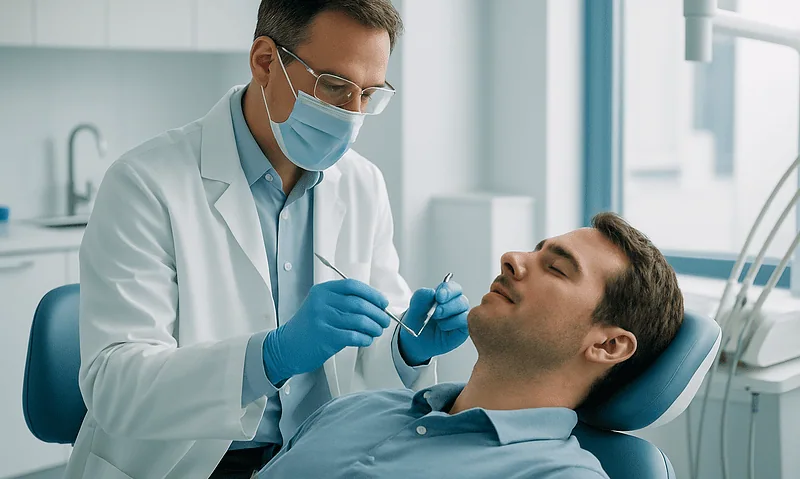
The dental chair has been tilted back, the X-ray is glowing on the screen, and the dentist is pointing at a pale shape sitting sideways under the gum at the very back of the jaw. Then comes the sentence that lands with a thud: this one will need to be a surgical removal, not a simple one. For most people, that is the first time they learn there are two ways to take out the same tooth.
The distinction behind simple vs surgical wisdom tooth removal is not about how brave the patient is or how experienced the dentist happens to be. It is about geometry. How far the tooth has come through, which way it is leaning, and how much bone is wrapped around its roots decide whether it can be eased out through the gum or has to be reached, exposed, and sometimes cut into pieces first.
This explainer walks through that decision the way a clinician makes it, then covers what each approach feels like, how the following days usually go, and which questions are worth asking before anyone picks up an instrument.
What does simple vs surgical wisdom tooth removal actually mean?
Dentists sort extractions into two broad categories, and the labels describe the route to the tooth rather than the tooth itself. A simple extraction is one where the tooth is visible above the gum line and can be gripped, rocked, and lifted from its socket with hand instruments. A surgical extraction is one where the tooth cannot be reached that way, so soft tissue is opened, bone may be trimmed, and the tooth is sometimes divided before it comes out.
Wisdom teeth, the third molars at the very back of each side of the jaw, straddle both categories more than any other tooth. They are the last to arrive, usually between the ages of 17 and 25 according to Mayo Clinic, and by then the jaw has often finished growing and run out of room. A wisdom tooth that finds space and erupts upright behaves like any other molar. One that runs into the tooth in front of it, or into the bony wall at the back of the jaw, ends up stuck at an angle or buried entirely.
The words used in the consent conversation follow that reality. A fully erupted upper wisdom tooth with a single conical root is a classic simple case. A lower wisdom tooth lying on its side beneath the gum, with roots curved around a nerve canal, is a surgical case by definition. Between those two ends sits a long gray zone where the dentist has to judge from the images, and occasionally a case that starts simple becomes surgical in the chair if a root fractures or the tooth refuses to move.
Neither label is a verdict on the person in the chair. The same patient can have one of each on opposite sides of the mouth, decided entirely by how each tooth happened to grow.
How does the tooth's position decide the approach?
Three features on a dental X-ray do most of the deciding: how much of the tooth has emerged, the angle it sits at, and what is covering it.

Eruption comes first. A tooth that has broken through fully, with its whole crown above the gum, offers something to hold. A tooth that has broken through partially leaves a flap of gum over part of the crown, and a tooth that has not broken through at all gives the dentist nothing to grip without opening the tissue.
Angle comes second, and Mayo Clinic describes the usual patterns. A wisdom tooth can point forward toward the second molar, backward toward the rear of the mouth, straight down as if lying on its side, or straight up but trapped within the jawbone. An upright tooth follows a straight path out of its socket. An angled one has to be turned or divided so its pieces can travel along a path that the neighboring tooth and jawbone allow.
Cover comes third. Clinicians often speak of a soft-tissue impaction, where only gum overlies the crown; a partial bony impaction, where some bone sits over part of the crown; and a full bony impaction, where the entire tooth is encased in bone. Each step adds work, because bone that covers a tooth has to be removed before the tooth can move.
Root shape and the tooth’s neighbors matter too. Lower wisdom teeth sit near the inferior alveolar nerve, the nerve that supplies feeling to the lower lip and chin, and upper wisdom teeth sit beneath the maxillary sinus, the air-filled space behind the cheek. Roots that curve, splay, or hook around these structures push a case toward a more careful surgical plan, and often toward three-dimensional imaging to map exactly where everything lies.
Impacted wisdom teeth removal: what impacted really means
Impacted is one of those words that sounds dramatic but has a plain meaning: a tooth that has not been able to erupt into its normal position because something is in the way. For wisdom teeth, the obstacle is usually the second molar in front, the bone behind, or simply a jaw that is too short for a fourth molar-sized tooth.
An impacted tooth is not automatically a problem tooth. Plenty of people carry fully buried, upright wisdom teeth for decades without symptoms. Trouble tends to arise in a few predictable ways, and Mayo Clinic lists the main ones: partially erupted teeth trap food and bacteria under the gum flap and become prone to decay and gum infection; angled teeth press on the second molar and can damage its root or the bone between the two; and, less commonly, the sac that surrounded the developing tooth fills with fluid and forms a cyst that can hollow out bone.
Impaction is also the main reason a wisdom tooth ends up in the surgical column. A partially erupted tooth sitting under a gum flap may only need that flap lifted, which is a minor surgical step. A tooth angled forward under the second molar needs bone removed from around its crown and the crown separated from the roots so each part can be lifted out without levering against the tooth in front. A horizontal tooth encased in bone is the most involved pattern, and it is the one most likely to be referred to an oral surgeon, a dentist with several additional years of hospital-based training in surgery of the mouth and jaws.
Knowing the type of impaction turns a vague conversation into a specific one. Asking the dentist to show the angle and depth on the X-ray, and to name the type of impaction, gives a patient a far clearer sense of what is being planned and why.
Surgical extraction vs simple extraction: what actually happens step by step
Both procedures begin the same way. The dentist injects local anesthetic, a numbing medicine, into the gum around the tooth and often around the nerve that supplies that side of the jaw. The NHS notes that you may feel pressure during the extraction but should not feel pain, and if you do, the clinician can add more anesthetic before continuing.

In a simple extraction, the clinician uses an elevator, a thin instrument that slides between tooth and bone to loosen the fibers holding the root, and then forceps to rock the tooth gently until the socket widens enough for it to lift free. Patients describe firm pushing and a creaking sensation rather than pain. The NHS says a straightforward removal can take a few minutes.
In a surgical extraction, several steps are added. The clinician makes a small cut in the gum and lifts the tissue back to expose the crown and surrounding bone. A drill under a stream of water removes a thin layer of bone from around the tooth. If the tooth is angled or its roots diverge, it is cut into two or more pieces, each of which is lifted out along its own path. The socket is rinsed, sharp bone edges are smoothed, and the gum is closed with stitches, usually a dissolvable type. The NHS puts the more complicated procedures at over 20 minutes.
The drill is the part people worry about, and the sensation is vibration and noise rather than pain, because the bone itself is numb. Gauze is placed over the socket afterwards to encourage a clot to form. That clot is the foundation of healing, which is why so much of the aftercare advice is about protecting it.
Who is usually offered wisdom tooth removal, and who is usually asked to wait?
Guidance from the NHS is clear on the first group: wisdom teeth are generally removed when they are causing problems or are very likely to. The common triggers are repeated infection of the gum around a partially erupted tooth, decay that cannot be repaired because the tooth is too far back or too angled to fill properly, damage to the second molar, gum disease affecting the area, a cyst, or a tooth that interferes with planned orthodontic or other dental treatment.
A second group is often advised to remove wisdom teeth on a planned basis rather than an urgent one. Someone whose lower wisdom tooth has caused two or three bouts of gum infection, for instance, may be advised that another episode is likely and that removal on a calm day is preferable to removal during an acute flare, when swelling makes anesthesia and access harder.
Then there is the large group asked to wait, or simply to keep watching. A fully buried wisdom tooth that is upright, sits well away from the nerve, and has never caused symptoms does not, on current evidence, need removing just because it exists. Periodic X-rays let the dentist check that nothing is changing.
Certain people are asked to pause or to plan more carefully rather than to skip removal altogether. Someone taking medicines that affect bleeding or bone healing, someone with a heart valve condition or immune suppression, or someone who is pregnant will usually have the timing and setting discussed with their physician as well as the dentist. Those are conversations for the treating team, and the right answer varies from person to person.
Why do experts say not to remove wisdom teeth if they are not causing trouble?
For much of the twentieth century, removing all four wisdom teeth in the late teens was close to routine in some countries, on the logic that they would probably cause problems eventually and were easier to remove while roots were still forming. The evidence has since been examined more carefully, and the picture is less confident than that habit suggests.
A Cochrane systematic review, the type of study that pools all reliable trials on a question, looked at surgical removal versus retention of impacted wisdom teeth that were free of disease and causing no symptoms. Its conclusion was that the available evidence was insufficient to say whether taking such teeth out early does more good than harm. The reviewers found only a small number of low-certainty studies, one of which hinted that keeping the tooth might raise the risk of gum pocketing behind the second molar, but the data were too thin to guide policy either way.
That is why bodies such as the NHS advise against removing wisdom teeth purely as a precaution when they are healthy and not causing problems. Every extraction carries a small but real risk of nerve injury, infection, and a difficult recovery, and those risks are hard to justify for a tooth that may never misbehave.
None of this means impacted teeth are harmless, or that a dentist who recommends removal is being overzealous. It means the recommendation should rest on something specific: a visible cavity, recurrent infection, damage to a neighbor, a cyst, or a clear pattern of worsening. When a dentist proposes removing a symptom-free tooth, a reasonable question is what finding on the X-ray or in the mouth is driving that advice.
Simple vs surgical wisdom tooth removal at a glance
Seeing the two approaches side by side makes the logic easier to hold in mind. The table below summarizes what usually distinguishes them; individual cases vary, and the treating clinician’s plan takes precedence over any general description.
| Feature | Simple extraction | Surgical extraction |
|---|---|---|
| Tooth position | Fully erupted, upright, crown visible above the gum | Partially or fully buried, angled, or encased in bone |
| Gum | Not cut; instruments work at the gum line | Small incision, tissue lifted to expose the tooth |
| Bone | Left intact; socket widened by gentle rocking | Thin layer removed around the crown with a drill |
| Tooth | Removed whole | Often divided into sections |
| Stitches | Usually none | Usually placed, often dissolvable |
| Usual anesthesia | Local anesthetic | Local anesthetic, sometimes with sedation; general anesthetic occasionally, in a hospital setting |
| Time in the chair (NHS) | A few minutes | Can exceed 20 minutes |
| Typical aftermath | Mild soreness, little swelling | More swelling and jaw stiffness, easing over days |
Two caveats keep this honest. First, the boundary is porous. A tooth that looks simple can crack during removal, and the clinician then opens the gum and finishes surgically; that is a change of technique, not a complication. Second, the intensity of recovery tracks the amount of bone disturbed and the length of the procedure far more than the label. A brief surgical removal of a soft-tissue impaction can leave a patient more comfortable than a prolonged simple removal of a stubborn, curved-rooted tooth.
The value of the table is in setting expectations. If a surgical extraction is planned, swelling and stitches are part of the normal course rather than signs that something went wrong.
Does wisdom tooth removal hurt, and is it really one of the most painful surgeries?
Two questions hide inside this one: does it hurt during, and does it hurt after. The honest answers differ.
During the procedure, the aim is no pain at all. Local anesthetic blocks the nerves that carry pain signals from the tooth, gum, and bone. What remains is sensation: pressure, pushing, vibration from the drill, and the odd noise of a tooth being loosened. The NHS is explicit that you should not feel pain, and that the clinician will give more anesthetic if you do. People who describe extraction as painful are usually describing the anxiety of the sounds and pressure, or an infected tooth where the acid environment made numbing harder to achieve.
Afterward is where the reputation comes from. Once the anesthetic wears off, typically within a few hours, the socket aches. The NHS notes that pain is worse when the extraction was difficult or complicated, which usually means surgical. Swelling of the cheek peaks over the first few days and then eases, and a stiff, sore jaw is common for up to 7 to 10 days. Most people manage this with over-the-counter pain relief of the kind their dentist recommends, and with cold packs and rest in the first day or two. Choices about which pain medicine suits an individual, and how to use it, belong with the prescribing clinician.
Is it among the most painful surgeries? That claim does not hold up against procedures on joints, the abdomen, or the chest. Wisdom tooth removal is uncomfortable in a concentrated, hard-to-ignore way because the face is so richly supplied with nerves and because eating and talking keep disturbing the area. Discomfort that is easing by day three or four is the expected pattern; pain that gets sharply worse after a few good days is not, and it is covered in the section on red flags.
Which anesthesia is used, and does surgical always mean being put to sleep?
A surgical extraction does not require sedation or general anesthesia. Most surgical wisdom tooth removals, including many involving bone removal and sectioning, are completed under local anesthetic alone with the patient awake and comfortable. The choice of anesthesia depends on the complexity of the case, the patient’s anxiety and medical history, and the setting.
Local anesthetic works by temporarily blocking sodium channels in nerve fibers so pain signals cannot travel to the brain. Its effect on the lower jaw often spreads to the lip, chin, and half the tongue, because the same nerve trunk supplies all three; that heavy, rubbery feeling fades over a few hours as the medicine is cleared.
Sedation adds a medicine that relaxes the patient and dulls memory of the procedure while local anesthetic still does the numbing. It can be given through a vein or, in some settings, breathed in. The NHS describes sedation as an option for people who are very anxious or facing a longer procedure. Someone who has been sedated cannot drive afterward and needs an adult to accompany them home.
General anesthesia, where the patient is fully unconscious, is used less often and, as the NHS notes, usually in a hospital rather than a dental practice. It tends to be reserved for very complex cases, for several difficult teeth removed at once, or for people who cannot tolerate treatment awake for medical or developmental reasons.
Each step up in anesthesia brings its own preparation, monitoring, and small set of risks, so the decision is made jointly by the dentist or surgeon, the patient, and sometimes an anesthetist. Asking directly what level of anesthesia is planned, and why, is a fair and useful question at the consultation.
Wisdom teeth removal recovery time: what the first two weeks usually look like
Recovery follows a recognizable arc, and knowing its shape makes the low points easier to tolerate. The NHS gives an overall figure of up to two weeks to recover fully from wisdom tooth surgery, with most of the discomfort concentrated in the first few days.
The first 24 hours are about the clot. Blood fills the socket and firms into a plug that seals the bone and seeds new tissue. The NHS advises avoiding rinsing, spitting, hot drinks, alcohol, and anything that creates suction during this window, because any of them can dislodge the plug. Some oozing onto the gauze is expected; a steady flow that soaks pad after pad is not. Numbness fades, and aching sets in as it does.
Days two and three are usually the peak for swelling. The cheek can look noticeably fuller and feel tight, and opening the mouth may be limited. Sleeping with an extra pillow, as the NHS suggests, helps the swelling drain. Soft, cool foods are easier, and gentle warm salt-water rinses can begin once the first day has passed, if the clinician has advised them.
From about day four, most people notice a turn. Swelling recedes, bruising on the cheek or jaw may appear and then yellow and fade over up to two weeks, and jaw stiffness loosens gradually over 7 to 10 days. Dissolvable stitches typically fall out or dissolve in the same 7 to 10 day range. Strenuous exercise is best avoided for a few days because raised blood pressure can restart bleeding.
Surgical removals sit toward the longer end of these ranges and simple ones toward the shorter, but the ranges themselves are general guides from the NHS rather than promises about any one recovery. Time off work or study is worth discussing with the clinician, who can judge from the procedure planned.
What are the risks of simple and surgical extraction, and how common are they?
Every extraction carries risk, and the honest way to describe it is by naming the specific problems, how they present, and which approach they follow most often.
Dry socket, medically called alveolar osteitis, is the best known. It occurs when the protective clot is lost or fails to form, leaving bone exposed. Cleveland Clinic puts it at roughly 2 to 5 percent of extractions overall, with lower wisdom teeth and surgical removals at the higher end. The signature is a dull, throbbing ache that begins three to five days after the procedure, often with a bad taste or smell, after the first days had seemed to be improving. It is not an infection and it does heal, but it is genuinely unpleasant and a clinician can dress the socket to ease it.
Nerve injury is specific to lower wisdom teeth, whose roots may lie close to the nerve supplying the lower lip and chin, or to the lingual nerve that supplies the tongue. The NHS describes the result as tingling or numbness that is usually temporary, lasting weeks or months, but which in a small number of cases is permanent. The closer the roots sit to the nerve canal on imaging, the more carefully the surgical plan is built around it.
Infection of the socket, delayed healing, and prolonged bleeding are the other named complications in NHS guidance. Upper wisdom teeth carry a separate, uncommon risk of opening a communication into the sinus above them, which usually closes on its own but sometimes needs a repair.
Simple extractions are not risk-free; a root can fracture and need surgical retrieval, and dry socket can follow any extraction. Even so, the sum of risk rises with the amount of bone removed and the time spent, which is one more reason clinicians reserve the more involved approach for the teeth that require it.
What people often get wrong about simple vs surgical wisdom tooth removal
Misunderstandings cluster around a handful of ideas, and each one is worth correcting because it changes how people prepare.
The first is that surgical means more dangerous or means being asleep. Surgical describes access, not peril. Most surgical wisdom tooth removals happen under local anesthetic in an ordinary dental chair, and the added steps exist precisely to remove the tooth with less force and less risk to the neighboring tooth and bone.
The second is that everyone should have wisdom teeth out before they cause trouble. As the Cochrane review discussed earlier found, the evidence does not support removing symptom-free, disease-free impacted teeth as a routine precaution. Removal is advised when there is a reason, and a good clinician can point to that reason on an X-ray or in the mouth.
The third is that the procedure itself is agonizing. With adequate local anesthetic, the experience is pressure and noise. The post-operative days are the uncomfortable part, and they follow a predictable curve that peaks early and eases.
The fourth is that a socket should be rinsed vigorously and kept spotless from the first hour. The opposite is true for the first day. The clot needs to be left alone; cleaning begins gently afterward, on the clinician’s advice.
The fifth is that a smaller, cheaper-looking simple extraction is always preferable and that asking for one is a choice. The approach is dictated by the tooth’s position. Forcing a whole, angled tooth out through a narrow opening risks fracturing it, damaging the second molar, or breaking bone, and skilled clinicians section teeth to avoid exactly that.
The last is that all four have to come out together. Some people do have all four removed in one session under sedation; others have one troublesome tooth removed and the rest monitored. Both are legitimate plans, and the choice depends on the teeth, the patient, and the treating team.
Questions to ask your care team before wisdom tooth removal
A consultation goes better when the patient arrives with specific questions. The following are the ones clinicians are usually glad to be asked, because they lead to a clearer plan.
- Can you show me on the X-ray which way this tooth is angled and how much bone is covering it, and does that make this a simple or a surgical removal?
- What specifically is the reason to remove this tooth now: infection, decay, damage to the next tooth, a cyst, or something else?
- How close are the roots to the nerve canal or the sinus, and does that change the plan or call for three-dimensional imaging?
- Will this be done under local anesthetic alone, with sedation, or under general anesthetic, and why that choice for me?
- Are you removing one tooth or several, and what is the reasoning for doing them together or separately?
- Do any of my medicines or medical conditions need to be discussed with my physician before the appointment?
- What should I expect in the first 24 hours, and which signs would mean I should call you?
- Roughly how long might I need away from work, school, or exercise for this particular procedure?
- Who do I contact if I have a problem in the evening or at the weekend?
- If the tooth is left in place instead, how would we monitor it and how often?
The last question matters as much as the first. A clinician who can explain both the case for removal and the case for watching is offering a genuine choice rather than a foregone conclusion. Writing the answers down, or bringing someone along to listen, helps, because the details of anesthesia and aftercare are easy to lose once the appointment is booked and the mind moves on to worrying about it.
When to call your doctor or dentist after wisdom tooth removal
Most recoveries follow the arc described earlier, and most worries turn out to be ordinary healing. A few signs are different in kind and deserve a same-day call to the dental team, or to emergency services if they are severe.
Bleeding that continues steadily after firm pressure with clean gauze for a sustained period, or that restarts heavily hours after the procedure, needs assessment. A little oozing that tints saliva is expected; a socket that fills repeatedly is not.
Pain that improves for two or three days and then becomes markedly worse, particularly with a foul taste or smell, is the pattern of dry socket and should be seen so the socket can be dressed. Pain that is severe from the outset and not controlled by the measures the clinician advised also warrants a call.
Swelling that keeps increasing beyond the third day, especially if the skin over it is hot and red, if there is pus, or if a fever develops, may indicate infection. Swelling that spreads toward the eye, down the neck, or under the tongue, or any difficulty swallowing saliva, breathing, or opening the mouth more than a finger’s width, is an emergency and needs urgent care rather than a routine appointment.
Numbness of the lip, chin, or tongue that persists once the anesthetic should have worn off, generally after several hours, should be reported so it can be documented and followed. It is often temporary, but early recognition matters.
Fluid or air passing between mouth and nose when drinking, after an upper wisdom tooth removal, suggests a sinus communication and should be checked.
None of these signs can be interpreted reliably at home. The treating team knows what was done, what was seen during the procedure, and what the images showed, and they are the right people to decide whether a symptom is part of healing or a problem that needs attention. Calling early is never the wrong choice.
Frequently asked questions
What is the difference between surgical extraction vs simple extraction for a wisdom tooth?
A simple extraction lifts a fully erupted tooth out of its socket with elevators and forceps without cutting the gum. A surgical extraction opens the gum, removes a thin layer of bone, and often divides the tooth so a buried or angled wisdom tooth can come out in pieces. Both use local anesthetic; the surgical version usually adds stitches and produces more swelling afterward.
How painful is a simple tooth extraction?
During the procedure, a properly numbed simple extraction should not hurt; the sensations are pressure, rocking, and a creaking feeling as the tooth loosens. Afterward, the socket aches once the anesthetic wears off over a few hours, and mild soreness typically settles over several days. Pain tends to be greater after difficult or surgical removals, according to NHS guidance.
Is wisdom teeth removal one of the most painful surgeries?
No, though it has that reputation because the face is densely supplied with nerves and eating and talking keep disturbing the site. The procedure itself is painless under anesthetic. Post-operative discomfort peaks in the first two to three days and eases over the following week. It is uncomfortable and inconvenient rather than comparable to major joint, abdominal, or chest surgery.
Why do experts say not to remove wisdom teeth that are not causing problems?
Because the evidence does not show a benefit that outweighs the risks. A Cochrane systematic review found insufficient evidence to support or refute removing symptom-free, disease-free impacted wisdom teeth as a precaution. Since every extraction carries a small risk of nerve injury, infection, and dry socket, guidelines advise removal when a tooth is decayed, repeatedly infected, damaging its neighbor, or associated with a cyst.
Does wisdom tooth removal hurt more when it is surgical?
Not during the procedure, because local anesthetic numbs gum and bone alike; the drill is felt as vibration and noise. Afterward, surgical removals generally involve more swelling, jaw stiffness, and soreness because more bone has been disturbed and the procedure took longer. The NHS notes that pain is worse after difficult extractions, and that jaw stiffness can last 7 to 10 days.
How long is wisdom teeth removal recovery time?
The NHS gives an overall guide of up to two weeks to recover fully. Swelling usually peaks in the first few days, bruising can take up to two weeks to fade, a stiff jaw eases over 7 to 10 days, and dissolvable stitches go in about the same period. Simple extractions tend toward the shorter end and surgical ones toward the longer, but individual recoveries vary.
Does impacted wisdom teeth removal always need an oral surgeon?
Not always. Many general dentists perform surgical extractions, including those involving bone removal and sectioning. Referral to an oral surgeon is more likely when the tooth is fully encased in bone, lies horizontally, has roots close to the nerve canal or sinus, or when sedation or general anesthesia is needed. The referring dentist judges this from the X-ray and the patient’s medical history.
Can I ask for a simple extraction instead of a surgical one?
The approach is determined by the tooth’s position rather than preference. Trying to remove an angled or buried tooth whole through a narrow opening risks fracturing the tooth, damaging the second molar, or breaking bone. Sectioning the tooth and removing a little bone is how clinicians take such teeth out with less force. If a case looks borderline, asking the dentist to explain the choice is entirely reasonable.
What is dry socket and how would I know I have it?
Dry socket is the loss or breakdown of the blood clot that should protect the empty socket, leaving bone exposed. Cleveland Clinic estimates it affects roughly 2 to 5 percent of extractions, more often after lower wisdom teeth. The typical sign is a dull, throbbing pain starting three to five days after removal, often with a bad taste or smell, after the first days seemed to be improving.
Will a surgical wisdom tooth removal leave me numb permanently?
Permanent numbness is uncommon. Lower wisdom tooth roots can sit close to the nerves supplying the lip, chin, and tongue, and the NHS describes any resulting tingling or numbness as usually temporary, lasting weeks or months, with a small number of cases becoming permanent. Clinicians assess the nerve’s position on imaging beforehand and plan the surgery to reduce that risk.
References
- NHS: Wisdom tooth removal, What happens
- NHS: Wisdom tooth removal, Recovery
- Cleveland Clinic: Dry socket (alveolar osteitis)
- MedlinePlus: Tooth extraction
This article is for general information only and is not a substitute for professional medical advice. Please consult a qualified doctor about your individual situation.

More from the Blog

Root Canal Recovery: What the First Days Feel Like and When to Check In
Most people recover from a root canal within a few days. Mild soreness or tenderness when biting typically peaks in the first 24 to…
How Long Does Dental Numbness Last? Anesthetics, Timelines and Safe Waiting
Numbness from a routine dental injection usually lasts two to five hours in the lips and cheek, while the tooth itself often regains feeling…

Tooth Decay Treatment Visit: Numbing, Removing Damaged Tissue and Restoring the Tooth
A cavity treatment procedure usually has three steps: the dentist numbs the area with a local anesthetic, removes the softened, decayed part of the…

How a Smile Makeover Is Planned: Photographs, Digital Impressions and Smile Design
A smile makeover is planned in stages: a dental health examination first, then a set of standardized photographs, a digital scan of the teeth,…

Gum Recession Treatment Results: How Grafted Gum Matures and What It Can and Cannot Restore
Gum graft results develop in stages: the graft attaches over the first one to two weeks, swelling and a pale or reddish look settle…

How to Read a Smile Makeover Plan: Questions About Each Step and Temporary Teeth
A smile makeover treatment plan is a written, sequenced document that lists each proposed procedure, the order it will happen in, what temporary teeth…