

Skin Rash Types: How Common Rashes Look, What Causes Them and When to See a Doctor

Key Takeaways
- Clinicians classify skin rash types first by shape (flat, raised, blistered, pus-filled, scaly or weals) and only then by cause, because shape narrows the field faster than color.
- A rash that does not fade when a clear glass is pressed against it is an emergency sign of meningococcal infection or sepsis, according to the NHS.
- Allergic contact dermatitis is delayed, appearing 12 to 72 hours after exposure per the CDC, which is why the trigger is often missed.
- Each individual hive fades within 24 hours while new ones appear; hives recurring for more than 6 weeks are classed as chronic (NHS).
- Bacterial rashes such as cellulitis are warm, swollen, painful and spreading, whereas viral rashes are widespread, flat and arrive after fever.
- The CDC reports that shingles blisters scab over in 7 to 10 days and the rash clears in 2 to 4 weeks, with pain often preceding the rash by 1 to 5 days.
Most skin rash types fall into a few groups: eczema and contact dermatitis (dry, itchy patches), hives (raised weals that move), viral rashes (flat pink spots with fever), bacterial infections (hot, spreading redness or honey-colored crusts), fungal rings and scabies burrows. Most settle with simple care. A rash that does not fade under a pressed glass, or comes with fever, facial swelling or breathing difficulty, is an emergency.
It usually starts with a sleeve pushed up at the kitchen table. A patch that was not there yesterday, a few spots on a child’s back after a bath, a ring on the forearm that a colleague swears is ringworm. Then the phone comes out and the search begins.
Skin rash types are confusing for a simple reason: skin has only a handful of ways to react, so very different causes can look alike. An allergic reaction to a wristwatch, a virus, a fungus and a flare of psoriasis can all produce pink, itchy skin. The clues that separate them are rarely the color. They are the shape, the spread, the timing and what else is happening in the body.
This guide walks through the common and usually harmless rashes first, then the ones that need a clinician’s eye, and ends with the small set of signs that should send you to emergency care without waiting for a photo comparison.
Skin rash types: the direct answer before the detail
Clinicians sort skin rash types by two things: what the spots look like, and what caused them. By appearance, a rash is flat (macular), raised (papular), fluid-filled (vesicular), pus-filled (pustular), scaly, or made of soft swollen weals (urticarial). By cause, the big groups are inflammatory skin conditions such as eczema and psoriasis, allergic or irritant reactions, infections (viral, bacterial, fungal, parasitic), and reactions to medicines.
The reassuring part comes first. MedlinePlus notes that most rashes are not dangerous and many fade on their own within days to a couple of weeks. Dry, itchy patches that come and go are far more likely to be eczema than anything exotic. A crop of flat pink spots in a child with a mild fever is usually a self-limiting virus.
The urgent part is short and worth memorizing. Seek emergency care if a rash does not fade when a clear glass is pressed firmly against it, if it appears with a high fever, stiff neck or drowsiness, if the face, lips or tongue swell, if breathing becomes difficult, or if the skin blisters, peels or hurts out of proportion to how it looks. The NHS lists the non-fading rash among the signs of meningitis and blood poisoning (sepsis), and warns not to wait for it to appear if other symptoms are present. Everything else in this article can wait for a routine appointment.
What are the five types of rashes?
There is no official list of exactly five, but the question captures something real: dermatologists describe rashes by their basic building blocks, and five or six patterns cover almost everything.
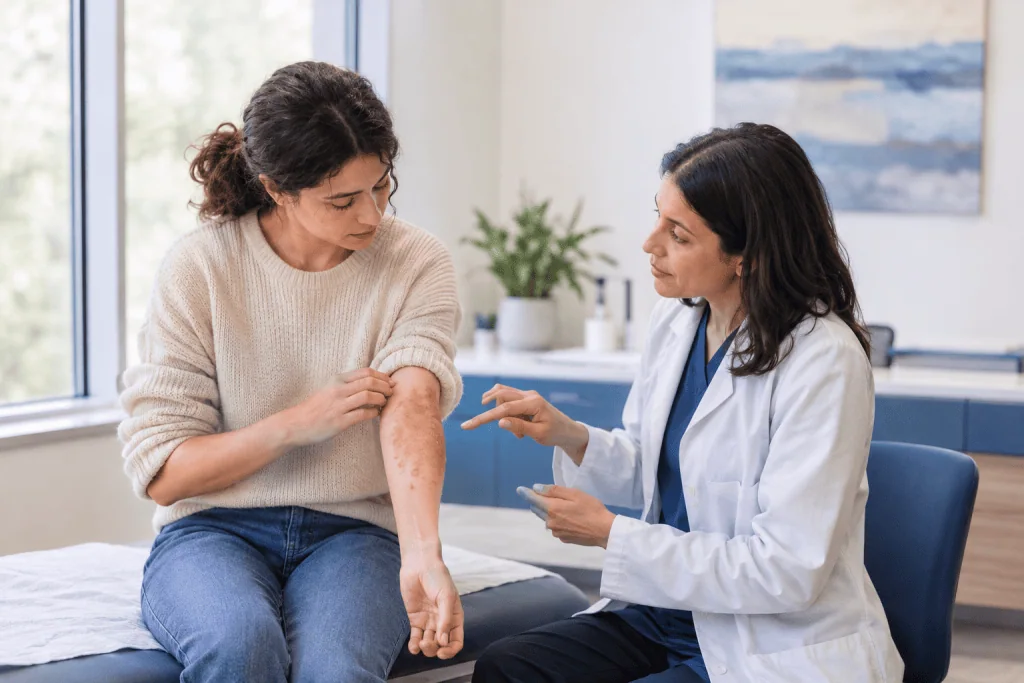
- Macular: flat areas of changed color you can see but not feel. Measles and many drug rashes start this way.
- Papular: small raised bumps. Insect bites, early scabies and some viral rashes fit here. Many rashes are “maculopapular”, a mix of flat and raised.
- Vesicular: small, clear fluid-filled blisters. Chickenpox, shingles, hand, foot and mouth disease and acute contact dermatitis produce these. Larger blisters are called bullae.
- Pustular: blisters filled with pus. Folliculitis, acne and impetigo belong here, as does a rare form of psoriasis.
- Urticarial: soft, raised, pale-centered weals that shift position within hours. This is the signature of hives.
A sixth descriptor, scaly or plaque-like, covers the thickened, flaking patches of psoriasis, chronic eczema and fungal infections.
Why does this matter to you? Because the shape narrows the field more than the color does. Red and itchy describes half of all skin complaints. “Clear blisters in a band on one side of the chest” or “a ring with a clear center and a scaly edge” is a description a clinician can act on, and it is what a telephone or video appointment will ask you for.
What causes skin rashes most often? Eczema and dry skin
If you could only learn one rash, learn atopic dermatitis, the medical name for the commonest form of eczema. The NHS reports that it affects around 1 in 5 children, and the National Institute of Arthritis and Musculoskeletal and Skin Diseases (NIAMS) describes it as a long-term condition driven by a weakened skin barrier and an over-reactive immune response, often running in families alongside asthma and hay fever. The International Study of Asthma and Allergies in Childhood (ISAAC) Phase Three, published in 2009, found that childhood eczema symptoms were common across every region surveyed, though rates varied widely between countries.
How it looks: dry, rough, intensely itchy patches. In babies it favors the cheeks and the outer sides of the limbs; in older children and adults it settles into the creases of elbows, knees, wrists and neck. On lighter skin the patches look pink or red; on darker skin they may appear purple, gray or darker brown, and can leave lighter or darker marks as they heal. Scratching thickens the skin over time.
What goes with it: a pattern of flares and calm periods, worse in winter air or after hot showers, and a personal or family history of allergies. There is usually no fever. Eczema is not contagious.
The close relative is seborrheic dermatitis: greasy, flaky patches on the scalp, eyebrows, sides of the nose and chest, linked to a normal skin yeast rather than allergy. In infants it is the familiar cradle cap.
Contact dermatitis and hives: the itchy, reactive rashes
Contact dermatitis is the skin’s response to something it touched. There are two mechanisms. Irritant contact dermatitis is direct damage from soaps, detergents, solvents or repeated wet work, and it shows up as dry, cracked, sore skin, classically on the hands. Allergic contact dermatitis is an immune reaction to a specific substance such as nickel, fragrance, hair dye or plant oils. The skin becomes red, swollen and itchy, sometimes with tiny blisters, and the rash often traces the shape of the trigger: a band under a watch, a line where a necklace sat, streaks where a poison ivy leaf brushed past.

Timing is the tell. Allergic contact dermatitis is delayed; the NIOSH page at the CDC describes poison ivy reactions appearing 12 to 72 hours after exposure, which is why people rarely connect the rash to the walk two days earlier.
Hives (urticaria) behave differently. They are raised, smooth weals, pale or skin-colored in the middle with a flushed border, and they move. The NHS explains that an individual weal usually fades within 24 hours while new ones appear elsewhere; hives that keep recurring for more than 6 weeks are called chronic. Triggers include infections, foods, medicines, heat, cold, pressure and stress, and in many chronic cases no trigger is ever found. Hives on their own are uncomfortable rather than dangerous. Hives together with lip or tongue swelling, wheeze or faintness point to anaphylaxis and need emergency care.
Viral rash in adults and children: how it looks and how it behaves
Viral rashes share a rhythm: feeling unwell first, rash second. Most are flat or slightly raised pink spots, widespread rather than in one patch, mildly itchy or not itchy at all, and they resolve as the illness does.
A few have recognizable scripts. In roseola, the NHS describes a high fever lasting 3 to 5 days that drops just as a pink, spotty rash appears on the chest and spreads outward; the child usually looks better by the time the rash arrives. Hand, foot and mouth disease produces mouth ulcers plus small blisters on palms, soles and sometimes the buttocks, and clears within 7 to 10 days according to the NHS. Chickenpox arrives in crops: red spots that become clear blisters, then crusts, with new and old stages side by side. Slapped cheek syndrome (parvovirus) gives bright red cheeks followed by a lacy rash on the body.
Measles deserves respect. The CDC describes a high fever, cough, runny nose and red eyes, then a rash that begins at the hairline 3 to 5 days after symptoms start and travels down the body. Tiny white spots inside the mouth (Koplik spots) may appear 2 to 3 days after symptoms begin. Measles is highly contagious and should be reported to a clinician by phone before attending in person.
Pityriasis rosea is the adult example people search for most: a single oval “herald patch”, followed a week or two later by smaller scaly ovals along the skin lines of the trunk, sometimes in a fir-tree pattern. The NHS notes it usually clears on its own within about 12 weeks. It is thought to follow a viral infection and is not considered contagious.
What do bacterial skin rashes look like?
Bacterial rashes tend to be localized, warm and progressive rather than widespread and stable. Three patterns cover most cases.
Impetigo is a superficial infection, common in children, that starts as small blisters or sores and quickly forms honey-colored or golden crusts, often around the nose and mouth. It is contagious by touch. The NHS advises that a person remains infectious until the sores have dried and crusted over, or until 48 hours after starting prescribed treatment.
Cellulitis is deeper. The skin becomes red (or darker than the surrounding skin on deeper skin tones), hot, swollen and painful, usually on one lower leg, and the edge creeps outward over hours. Fever and chills may follow. Cellulitis needs same-day assessment because it can spread into the bloodstream. Drawing a pen line around the edge, a trick clinicians use, makes spread easy to see.
Scarlet fever follows a strep throat. The NHS describes a fine, rough, “sandpaper” rash that often begins on the chest and tummy, a flushed face with a pale ring around the mouth, and a red, bumpy “strawberry” tongue. It responds to antibiotic treatment prescribed by a clinician, and children are usually no longer infectious 24 hours after treatment begins.
Two bacterial rashes that are not warm or crusted still matter. The erythema migrans of early Lyme disease is an expanding round or oval patch, sometimes with central clearing, appearing 3 to 30 days after a tick bite in 70 to 80 percent of infected people according to the CDC. And the pinpoint purple spots of meningococcal infection do not fade under a glass; that rash is an emergency.
Less common skin rash types that need a check: fungal, scabies, shingles, psoriasis
Ringworm (tinea) has nothing to do with worms. It is a fungal infection that forms a ring with a raised, scaly, sometimes blistered edge and a clearer center, slowly enlarging over weeks. On the feet it is athlete’s foot; in the groin it is jock itch; on the scalp it causes patchy hair loss. The CDC notes it spreads by skin contact, shared towels and contact with infected animals, and a clinician can confirm it with a skin scraping if the picture is unclear.
Scabies is caused by a mite that burrows into the top layer of skin. The itch is ferocious, worse at night, with fine gray lines or tiny bumps between the fingers, on the wrists, waistline and genitals. The CDC explains that in someone never infested before, symptoms can take 4 to 8 weeks to appear, so household contacts can be infested without knowing. Everyone in the household is usually treated together under a clinician’s direction.
Shingles is the chickenpox virus reactivating years later. The CDC describes pain, tingling or itching in one area for 1 to 5 days before a stripe of blisters appears on one side of the body or face. Blisters scab over in 7 to 10 days and the rash clears in 2 to 4 weeks. Shingles near the eye, or in anyone with a weakened immune system, warrants prompt review because antiviral treatment works best when started early.
Psoriasis produces well-defined, thickened plaques with silvery scale on the elbows, knees, scalp and lower back, often with pitted nails. NIAMS describes it as an immune-driven condition in which skin cells multiply far faster than normal. It is not contagious and is managed rather than resolved, usually with a dermatologist involved.
Skin rash types at a glance: cause, typical features and usual next step
Use this table as a map, not a verdict. Several rashes can share features, and the final call belongs to the clinician who can examine the skin.
| Cause | Typical features | Usual next step |
|---|---|---|
| Atopic eczema | Dry, itchy patches in skin creases; flares and remissions; family history of allergy | Emollients and trigger avoidance; routine review if not settling |
| Contact dermatitis | Itchy, red, sometimes blistered area matching the shape of a trigger; delayed 12–72 hours | Remove trigger; routine review; patch testing if recurrent |
| Hives | Raised weals that move within 24 hours; may follow infection, food or medicine | Routine review; emergency care if lip, tongue or airway swelling |
| Viral rash | Widespread flat pink spots after fever or cold symptoms; child generally well | Home care; phone ahead if measles is possible |
| Impetigo | Honey-colored crusts around nose and mouth; contagious | Same-week appointment for prescribed treatment |
| Cellulitis | Hot, swollen, spreading, painful area, usually one leg; may have fever | Same-day assessment |
| Ringworm | Slowly enlarging ring with scaly edge and clearer center | Pharmacist or routine review; scraping if unclear |
| Scabies | Severe night itch; burrows between fingers, wrists, waist; others in household itchy | Routine review; whole household treated together |
| Shingles | Pain or tingling, then one-sided band of blisters | Prompt review, urgent if near the eye |
| Non-fading purple spots | Do not blanch under glass; fever, drowsiness, stiff neck | Emergency services immediately |
One pattern cuts across every row: a rash with the person otherwise well is rarely urgent, and a rash with the person unwell, feverish or in pain is the one to escalate.
How to identify a rash: how clinicians actually tell them apart
People expect a dermatologist to glance and name the rash. Often that is exactly what happens, but the glance is backed by a structured set of questions, and knowing them helps you prepare.
The history. When did it start, where did it begin, and where has it spread? Does it itch, burn, hurt or do nothing? Is there fever, sore throat, joint pain or a recent illness? Any new medicines, including supplements, in the past few weeks? New cosmetics, detergents, jewelry, pets, gardening or travel? Does anyone at home have the same thing? Drug rashes, for instance, commonly appear within days to a couple of weeks of starting a new medicine, and the prescribing clinician, not the patient, decides whether to change anything.
The examination. The clinician looks at the whole skin in good light, including scalp, nails, mouth and skin folds, because distribution is diagnostic: creases suggest eczema, extensor surfaces suggest psoriasis, one-sided bands suggest shingles, finger webs suggest scabies. They press on spots to see whether they blanch, and feel for warmth and scale.
Simple tests when needed. A skin scraping examined under the microscope or sent for culture confirms fungus or scabies. A swab identifies bacteria in impetigo or infected eczema. Blood tests help when a rash comes with fever, joint pain or suspected drug reaction. Patch testing, done over several days by an allergy or dermatology service, pins down contact allergens. A small skin biopsy under local anesthetic settles persistent or unusual rashes.
Photographs taken on day one, before creams blur the picture, are genuinely useful at the appointment.
What will make a rash go away? Reasonable home care
For the common, mild rash types, the measures mainstream guidance supports are modest and surprisingly effective, mainly because they stop the skin being irritated further.
- Protect the barrier. Lukewarm rather than hot water, short showers, fragrance-free soap substitutes and a plain moisturizer applied generously and often. The NHS places emollients at the center of eczema care because they reduce water loss and itching.
- Remove the suspect. New detergent, jewelry, cosmetic, plant exposure or gloves: stop it and watch for a week. Contact dermatitis fades once the trigger is gone, though the MedlinePlus page on poison ivy notes a reaction can take 2 to 3 weeks to clear fully.
- Cool, don’t scratch. A cool, damp cloth eases itch and heat. Keeping nails short limits the scratch-itch cycle that thickens eczema and lets bacteria in.
- Loose, breathable fabrics. Cotton over wool or synthetics on inflamed skin.
- Avoid overheating. Heat and sweat worsen hives, eczema and heat rash alike.
Pharmacies stock low-strength anti-itch creams, antihistamines and antifungal creams for ringworm and athlete’s foot; a pharmacist can advise on suitability. Anything prescribed, including steroid creams, antibiotics or antivirals, comes with instructions from the prescribing clinician, and those instructions override anything read online.
Some rashes simply need time. Viral rashes, pityriasis rosea and most hives fade on their own schedule. The reason to watch rather than wait blindly is the short list of changes that signal something else: spreading warmth and pain, fever, pus, blisters that break and weep, or a rash that is worsening after a week of sensible care.
What people often get wrong about rashes
“Red means infection.” Redness is inflammation, and inflammation has many causes. Eczema, hives and psoriasis are all red and none is infectious. Infection is suggested by heat, swelling, spreading edges, pus or crusts, and by the person feeling unwell.
“If it’s not itchy it’s nothing.” Some of the rashes that most need attention barely itch: the expanding Lyme patch, the non-blanching purple spots of meningococcal disease, the painful band of early shingles. Itch is a feature, not a severity scale.
“Rashes look the same on everyone.” They do not. On brown and Black skin, inflammation often reads as purple, gray or dark brown rather than red, and the pale-centered weals of hives can be hard to see without good light. NIAMS specifically notes that eczema may look different on darker skin and can leave lighter or darker patches. Photo galleries built mostly from light skin mislead.
“A bleach bath, essential oil or scrub will clear it.” Anything that strips or irritates the skin barrier prolongs most rashes. Diluted bleach baths have a narrow, clinician-directed role in infected eczema and are not a home experiment.
“It went away, so it was nothing.” Early Lyme disease, syphilis and some drug reactions produce rashes that fade while the underlying problem continues. A rash that followed a tick bite, a new medicine or a new sexual partner is worth mentioning to a clinician even after it has gone, in the same neutral way you would mention a cough.
“I can stop the prescribed cream as soon as it looks better.” Many treatment courses are designed to run past the point of visible improvement. The clinician who prescribed it sets the stopping point.
When to see a doctor about a rash
Most rashes earn a routine appointment, some need same-day care, and a few are emergencies. The split below follows NHS and MedlinePlus guidance.
Call emergency services or go to the emergency department now if:
- The rash does not fade when a clear glass is pressed firmly on it, especially with fever, headache, stiff neck, drowsiness or cold hands and feet.
- The rash appears with swelling of the face, lips or tongue, wheeze, difficulty breathing or faintness.
- The skin is blistering, peeling or painful over large areas, or sores appear in the mouth, eyes or genitals, particularly within weeks of starting a new medicine.
- A baby under 3 months has a rash with a fever, or any child with a rash is floppy, hard to wake or breathing fast.
Arrange same-day care if: an area of skin is hot, swollen, spreading and painful; a rash comes with a high fever that is not settling; blisters appear on one side of the face near the eye; or a rash appears in pregnancy together with fever or after contact with chickenpox, measles or slapped cheek syndrome, since those infections carry specific risks that the maternity team will want to assess.
Book a routine appointment if: a rash lasts more than 2 weeks without improving, keeps returning, disturbs sleep, weeps or crusts, spreads to others in the household, appears after a tick bite, or follows a new medicine without any of the urgent features above.
If you are unsure which category applies, a telephone health line or a pharmacist can help you decide, and a clear photo taken in daylight will make that conversation faster.
Frequently asked questions
How do I identify the rash I have?
Describe it the way a clinician would: shape (flat, bumpy, blistered, scaly, weals), where it started and spread, whether it itches or hurts, how long it has been there and whether you feel unwell. Note new medicines, products, plants, pets or household contacts with the same rash. That description, plus a daylight photo, lets a pharmacist or doctor narrow the possibilities; a self-diagnosis from pictures alone is unreliable.
What are the five types of rashes?
There is no official five, but dermatologists describe rashes by five or six building blocks: macular (flat), papular (raised bumps), vesicular (clear blisters), pustular (pus-filled), urticarial (moving weals) and scaly plaques. Most real rashes combine two, such as the maculopapular spots of many viral illnesses. Knowing which pattern you see is more useful than guessing the cause.
What do bacterial skin rashes look like?
Bacterial rashes are usually localized and progressive: honey-colored crusts around the nose and mouth in impetigo, a hot, swollen, painful and spreading area in cellulitis, or a rough sandpaper rash with a strawberry tongue in scarlet fever. Warmth, pus, spreading edges and fever point toward bacteria. Purple spots that do not fade under a glass signal a bloodstream infection and need emergency care.
What will make a rash go away?
For mild rashes, removing the trigger, protecting the skin barrier with lukewarm water and fragrance-free moisturizer, keeping cool and not scratching are the measures mainstream guidance supports. Viral rashes and most hives fade on their own. Infections, shingles and persistent eczema or psoriasis need treatment chosen by a clinician, who also sets how long any prescribed cream or tablet is used.
What causes skin rashes in adults most often?
In adults the commonest causes are eczema and contact dermatitis (reactions to soaps, metals, fragrances or plants), hives, fungal infections such as athlete’s foot and ringworm, and viral illnesses. Medicine reactions, shingles and psoriasis follow. Age matters: shingles becomes more common after 50, and a new widespread rash within weeks of starting a medicine should always be mentioned to the prescriber.
How can I tell a viral rash from an allergic rash?
Viral rashes usually follow fever, sore throat or cold symptoms, spread widely in flat pink spots and itch little. Allergic rashes are itchy, appear as weals (hives) or as a red, sometimes blistered patch matching the shape of a trigger (contact dermatitis), and the person is otherwise well. Hives with lip swelling or wheeze suggest anaphylaxis and need emergency care.
Is my rash contagious?
It depends on the cause. Impetigo, scabies, ringworm, chickenpox, measles and hand, foot and mouth disease spread between people; eczema, psoriasis, hives, contact dermatitis and pityriasis rosea do not. Shingles cannot pass shingles to others, though fluid from its blisters can give chickenpox to someone who has never had it. When unsure, cover the area and ask a pharmacist or clinician.
How long does a rash normally last?
Most viral rashes clear within about a week to 10 days, contact dermatitis within 2 to 3 weeks once the trigger is removed, shingles in 2 to 4 weeks and pityriasis rosea within around 12 weeks, according to CDC, MedlinePlus and NHS guidance. Eczema and psoriasis are long-term conditions with flares. A rash that is not improving after 2 weeks of sensible care deserves a review.
What is the glass test for a rash?
Press the side of a clear drinking glass firmly against the rash. Most rashes fade or blanch under pressure. Spots that stay visible through the glass may be bleeding under the skin, a sign of meningococcal infection or sepsis, and need emergency care. The NHS cautions that the rash can be harder to see on darker skin and may appear late, so do not wait for it if other symptoms are present.
Can stress cause a skin rash?
Stress does not create a rash from nothing, but it reliably worsens conditions that are already present, including eczema, psoriasis and chronic hives, by increasing itch and altering immune signaling. Stress-related scratching also thickens and infects skin. A new rash is best explained by examining the skin rather than assuming stress; a clinician can look for an underlying cause before attributing it to pressure at work or home.
References
This article is for general information only and is not a substitute for professional medical advice. Please consult a qualified doctor about your individual situation.

More from the Blog

Preparing Your Child for Congenital Nevus Surgery: How Parents Can Support Each Step
Parents support a child through congenital nevus surgery by learning the planned approach (simple excision, staged removal or tissue expansion), preparing the child with…

What Causes Brittle Nails? Why They Split, Peel or Crack and How the Cause Is Treated
Brittle nails most often result from repeated wetting and drying, harsh nail products and age-related changes that dry out the nail plate, which then…
Scalp vs Face: Why Seborrheic Dermatitis Treatment Differs by Area and Rarely Fits One Plan
Seborrheic dermatitis is treated differently on the scalp and the face because the two areas differ in skin thickness, oil output, hair cover and…
How Atopic Dermatitis Treatment Escalates: Barrier Repair, Topicals, Phototherapy and Beyond
Atopic dermatitis treatment steps move up a ladder: daily barrier repair with moisturizers and gentle bathing first; then anti-inflammatory creams such as topical corticosteroids…

When Is It Time to See a Dermatologist for Acne? Signs Over-the-Counter Care Is Not Enough
It is usually time to see a dermatologist for acne when a consistent over-the-counter routine has not helped after roughly two to three months,…

When Does Cellulitis Need Hospital Care? How Doctors Decide Between Tablets and IV Antibiotics
Most cellulitis is treated at home with oral antibiotics, usually for about a week. Doctors move to hospital care and intravenous antibiotics when the…