

Skincare Alongside Rosacea Treatment: Gentle Cleansers, Daily Sunscreen and Tracking Triggers
Key Takeaways
- NHS and Mayo Clinic guidance both set the sunscreen floor for rosacea at broad-spectrum SPF 30, worn daily including cloudy days, because sunlight is among the most consistently cited flare triggers.
- Topical prescription treatments for rosacea commonly take several weeks to show visible benefit, so judging a cream after one week almost always gives a false verdict.
- Hot water, friction from cloths or scrubs, alcohol-based toners and fragranced products are the four most common ways a skincare routine makes rosacea worse.
- Rosacea is not acne; benzoyl peroxide and drying acne washes typically aggravate it, and topical steroids can produce short relief followed by rebound.
- A two-to-four-week diary rating redness on a 0–3 scale alongside food, weather, exercise and products is the most reliable way to identify your own triggers, since they differ between people.
- Gritty, red or light-sensitive eyes with rosacea are a reason to contact your clinician, not a skincare problem to manage at home.
A rosacea skincare routine works alongside prescribed treatment, not instead of it. Guidance from the NHS and Mayo Clinic centers on three habits: washing with a mild, fragrance-free cleanser and lukewarm water, applying a broad-spectrum sunscreen of at least SPF 30 every day, and keeping a simple diary to identify personal triggers such as sun, heat, alcohol or spicy food. Prescription choices stay with your clinician.
The tube of prescription cream sits on the bathroom shelf, and next to it a small crowd of half-used bottles: the foaming wash that stung, the toner that promised calm, the serum a friend swore by. Most people starting rosacea treatment recognize that shelf. They have been told the medicine will take weeks, and in the meantime they want to know what they can actually do with their own hands, twice a day.
That is the honest purpose of a rosacea skincare routine. It does not replace what a dermatologist prescribes. It lowers the background irritation that keeps a reactive face on edge, so the treatment has a fair chance to work and flares have fewer excuses to start.
This explainer walks through the three parts that mainstream guidance agrees on, gentle cleansing, daily sunscreen and trigger tracking, and is candid about where the evidence runs thin, including the questions people ask about Korean skincare and “natural” fixes.
What a rosacea skincare routine is actually for
Rosacea is a long-term inflammatory skin condition that mostly affects the central face: cheeks, nose, chin and forehead. Its hallmark is flushing that lingers, sometimes with persistent redness, visible small blood vessels, and bumps or pus-filled spots that look like acne but behave differently. The NHS notes that it typically begins in adulthood and tends to come and go in flares.
Three things are happening under the surface. The skin barrier, the outermost layer that holds water in and irritants out, is often weaker than average, so ordinary products sting. Tiny facial blood vessels dilate too readily and stay open too long, which produces the flush. And the skin’s innate immune system reacts more strongly to everyday prompts such as heat, ultraviolet light, certain microbes and friction.
A skincare routine can only address the first of those directly. Gentle cleansing and consistent moisturizing support the barrier. Sunscreen removes one of the most reliable inflammatory prompts. A trigger diary helps you avoid the others you can control. None of these steps shrinks a dilated vessel or clears inflammatory papules on its own; that is the job of prescribed treatment or procedures, decided by the treating clinician.
Why bother, then? Because the reverse is also true. A stinging cleanser, a scented moisturizer or an unprotected afternoon in the sun can keep skin inflamed enough that a good prescription looks as if it is failing. Mayo Clinic’s self-care advice for rosacea puts skin-friendly habits and sun protection alongside medication for exactly this reason: the two approaches are meant to run in parallel.
How rosacea treatments work, and where skincare fits
Understanding the mechanism helps explain why patience matters. According to Mayo Clinic and the NHS, prescription options for rosacea fall into a few groups, each aimed at a different feature of the condition.
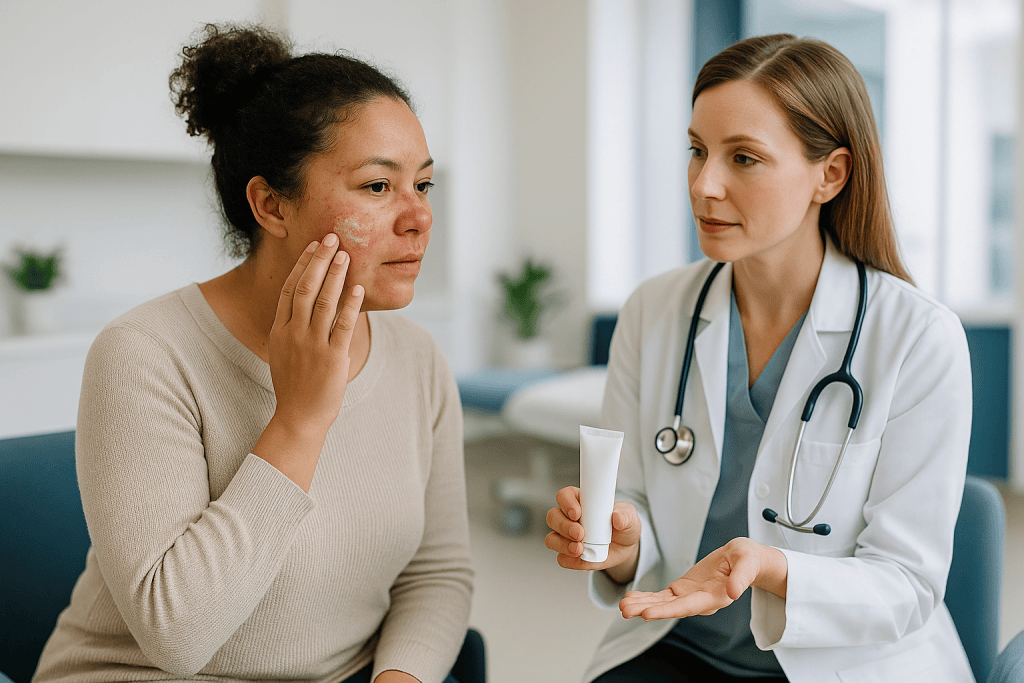
Topical anti-inflammatory creams and gels, such as metronidazole, azelaic acid or ivermectin, calm the immune response in the skin and, in the case of ivermectin, reduce Demodex mites, tiny organisms that live in hair follicles and are found in higher numbers on rosacea-prone skin. These products usually need several weeks before improvement is visible, per Mayo Clinic.
Vessel-constricting gels, such as brimonidine or oxymetazoline, temporarily narrow the small blood vessels that cause persistent redness. Mayo Clinic notes their effect appears within hours and wears off, so they address appearance rather than the underlying process.
Oral antibiotics from the tetracycline group are used at anti-inflammatory rather than infection-fighting levels for bumps and pustules. Courses typically run for a number of weeks; the NHS describes treatment lasting several weeks to a few months before review. For severe or resistant disease, a clinician may discuss oral isotretinoin, which reduces oil-gland activity, with close monitoring. Laser or intense pulsed light treatment targets visible vessels and is generally a procedure rather than a daily therapy.
Where does skincare sit? It is the platform every one of these works on. A cleanser that strips the barrier makes topical medicines sting more, which leads people to skip doses. Daily sunscreen protects skin that some treatments make more light-sensitive, a point Mayo Clinic makes about tetracyclines. Skincare will not change what is prescribed, and it should never be a reason to alter a prescription without talking to the prescriber.
Who a structured routine is for, and who is usually asked to wait
Almost anyone with a rosacea diagnosis benefits from the basics of gentle cleansing, moisturizing and sun protection. These habits carry little risk and are recommended across NHS, Mayo Clinic and Cleveland Clinic guidance regardless of how mild or severe the condition is.
The people who gain most are those whose skin reacts to nearly everything. If your current wash burns, if your face reddens after a hot shower, or if you have quietly abandoned every product but water, a deliberately minimal routine gives your barrier time to recover and gives your clinician a clearer picture of what the disease is doing versus what irritation is doing.
Some situations call for holding back rather than adding.
If you have not yet been assessed, wait before buying anything labeled for rosacea. Cleveland Clinic points out that rosacea can be confused with acne, seborrheic dermatitis, lupus and allergic reactions, and the routine that suits one may aggravate another. A diagnosis comes first.
If you are in the first weeks of a new prescription, most dermatologists prefer you change nothing else. Introducing a new serum at the same time makes it impossible to tell which one caused a flare.
If your eyes are involved, with grittiness, redness or swollen lids, the NHS advises medical review, and eye-area products should be discussed rather than experimented with.
If you are pregnant, planning pregnancy or breastfeeding, some topical and oral treatments are avoided; product choices around the face are best confirmed with the prescribing clinician.
The pattern is simple: the everyday basics are for everyone, while additions and “active” ingredients are introduced slowly, one at a time, and ideally with your care team aware.
Choosing a gentle cleanser for rosacea
Cleansing is where most self-inflicted damage happens, and also where the fix is cheapest in effort. The goal is to remove sweat, sunscreen and grime without stripping the lipids that hold the barrier together.
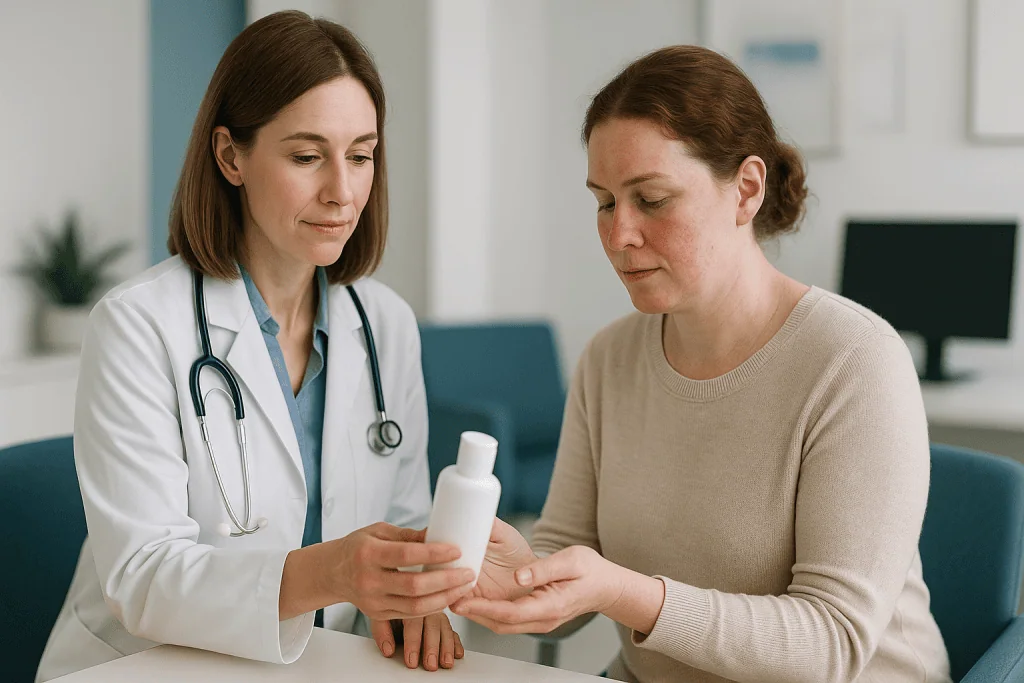
Mayo Clinic and the NHS converge on the same principles. Look for a cleanser described as mild, fragrance-free and non-foaming or low-foaming. Cream, lotion or gel-cream textures tend to leave more of the skin’s own oils in place than high-lather washes. Products labeled for sensitive skin are a reasonable starting point, but the label is marketing, not regulation, so read the ingredient list for alcohol (listed as alcohol denat or SD alcohol), fragrance or parfum, menthol, camphor, eucalyptus and witch hazel.
Technique matters as much as the bottle. Use lukewarm water; hot water dilates facial vessels and is a well-recognized trigger. Apply the cleanser with fingertips, not a cloth, brush or scrubbing pad. Rinse gently and pat dry with a soft towel rather than rubbing. Cleveland Clinic advises washing twice daily, morning and evening, and the evening wash is the one not to skip, because sunscreen and pollution particles sitting on the skin overnight add to irritation.
Two practical points people miss. First, stinging that lasts more than a moment is a signal to stop, not to push through; a good cleanser should feel neutral. Second, if a prescribed topical is applied after washing, wait until the skin is fully dry. Mayo Clinic notes that applying medicated products to damp skin can increase irritation and absorption in ways your prescriber did not intend.
You do not need a separate exfoliant. Rosacea-prone skin sheds adequately on its own, and mechanical or acid exfoliation is one of the most common reasons a routine backfires.
Moisturizer: the quiet workhorse of barrier repair
If cleansing is about doing less harm, moisturizing is where a routine does active good. A weakened barrier loses water faster and lets irritants in more easily, and a plain moisturizer applied twice daily partially compensates for both.
Mayo Clinic’s self-care guidance for rosacea recommends moisturizing regularly, particularly after cleansing and before any medicated cream if your prescriber advises that order. The ideal formula is unremarkable: fragrance-free, without added botanicals or essential oils, and built around barrier-supporting ingredients such as glycerin, ceramides, petrolatum or dimethicone. Ceramides are fats naturally present between skin cells; petrolatum is the occlusive found in ordinary petroleum jelly. Neither is exotic, and both have decades of dermatology use behind them.
Texture is a personal choice. People with the bumpy, acne-like form of rosacea often prefer lighter lotions that do not feel heavy over pustules. Those with mainly redness and dryness may find a thicker cream more comfortable, especially in winter or air-conditioned offices, where low humidity pulls water from the skin.
Timing with medication is worth clarifying with your clinician rather than guessing. Some prescribers suggest applying the medicated product to clean, dry skin first and moisturizing over it once absorbed; others reverse the order to buffer irritation. Both approaches are used, and the right one depends on the specific product and how your skin responds.
What a moisturizer cannot do is reduce established redness or vessels. Products marketed with green tint or “anti-redness” claims are mostly color correction and soothing agents such as niacinamide or allantoin. There is some evidence that niacinamide supports barrier function, but no moisturizer has been shown to treat rosacea itself, and any product should be judged by whether it feels comfortable and stays that way.
Daily sunscreen: why it belongs in every rosacea skincare routine
Ask a dermatologist for the single non-negotiable step in a rosacea skincare routine and sunscreen is the usual answer. The NHS lists sunlight among the most common triggers of flare-ups and advises using a high-protection sunscreen of at least SPF 30 daily, even on cloudy days. Mayo Clinic gives the same threshold and adds a broad-spectrum label, meaning it filters both UVA and UVB.
Ultraviolet light does two things to rosacea-prone skin. It directly triggers inflammatory signaling in the epidermis, and over years it degrades the collagen that supports small blood vessels, making them more visible. Sunscreen addresses both in a way no other daily step can.
The practical problem is that many sunscreens sting. Chemical filters such as avobenzone or octocrylene absorb UV energy and can irritate reactive skin, while alcohol-based sprays are a common offender. Mineral filters, zinc oxide and titanium dioxide, sit on the surface and reflect or scatter light; they are generally better tolerated and are the most frequent recommendation for rosacea in dermatology guidance, though they can leave a white cast on deeper skin tones. Tinted mineral formulas partially solve that and double as light color correction.
Application habits people often get wrong: too little product, no reapplication after sweating or swimming, and skipping the ears, neck and hairline where flushing also shows. A wide-brimmed hat and shade between late morning and mid-afternoon reduce the load on the sunscreen itself.
A specific medical reason applies to some. Mayo Clinic notes that oral tetracycline-class antibiotics can increase sun sensitivity, so anyone on these should treat sunscreen as part of the prescription, not an optional extra, and check with the prescriber about how long that caution lasts after the course ends.
What skincare to avoid with rosacea
People searching “what skincare to avoid with rosacea” usually want a list, so here is one, drawn from Mayo Clinic and NHS guidance on irritants and triggers. The items are grouped by why they cause trouble.
- Alcohol-based products: toners, astringents, aftershaves and many spray sunscreens. Alcohol dissolves surface lipids and provokes flushing.
- Fragrance and essential oils: including “natural” scents such as lavender, tea tree, peppermint and citrus. These are among the most frequent contact irritants in sensitive-skin studies.
- Cooling or tingling agents: menthol, camphor, eucalyptus and witch hazel. The tingle is a mild irritant response, not a sign of effectiveness.
- Physical exfoliants: scrubs, cleansing brushes, loofahs and rough cloths. Friction is a mechanical trigger for flushing.
- Strong chemical exfoliants: high-strength glycolic or salicylic acid products and at-home peels. Low strengths may be tolerated by some, but only introduced gradually and ideally after discussing with a clinician.
- Over-the-counter retinol products: these can be irritating, and their use with prescribed treatments should be a clinician decision.
- Hot water, steam facials and saunas: heat is a leading trigger in both NHS and Mayo Clinic lists.
- Waterproof or heavy makeup that needs vigorous removal.
Two habits deserve special mention. Topical steroid creams bought for redness or borrowed from a family member can improve rosacea briefly and then worsen it; Cleveland Clinic and Mayo Clinic both warn that steroid use on the face can aggravate rosacea and should not be started without medical advice. And multi-step routines that layer five or six products give a reactive barrier five or six chances to react. Fewer, plainer products are the safer starting point.
What is the biggest trigger for rosacea? A rosacea triggers list
There is no single trigger that applies to everyone, which is exactly why tracking is worth the effort. Across the NHS, Mayo Clinic and Cleveland Clinic, the same items recur: sun exposure, heat, cold wind, hot drinks, alcohol (red wine is often singled out), spicy food, emotional stress, strenuous exercise, hot baths, certain cosmetics and some medicines that dilate blood vessels, including some blood pressure treatments.
If one trigger deserves the label “biggest”, sunlight is the most consistently cited across major guidance, and it is also the easiest to do something about, which is why sunscreen leads the routine. Heat in its various forms, weather, showers, exercise, kitchens, comes a close second. Alcohol and spicy food are real triggers for many but not for all, and cutting them out without evidence they affect you removes pleasure for no gain.
The diary method is straightforward. For two to four weeks, note each day: how red or bumpy your face looks on a simple 0 to 3 scale, what you ate and drank, the weather and your time outdoors, exercise, stress level, and any product applied. A note on your phone works. Patterns usually emerge within a few weeks, though the NHS notes that reactions can be delayed by hours, so look at the day before as well as the day itself.
Resist the urge to eliminate everything at once. Change one variable, watch for a week, then decide. A trigger you can confidently identify is one you can plan around: a cold drink instead of hot coffee before a meeting, a fan by the treadmill, a hat at the school gate. Bring the diary to your appointment. Clinicians find a month of real data far more useful than a general impression that “everything sets it off”.
Building the routine around prescribed treatment: a summary table
The most common practical question is not which cleanser but which order. The table below shows a typical structure that dermatology guidance supports. Your prescriber’s instructions for the medicated step override anything here, because product-specific advice varies.
| Step | Morning | Evening | Why it matters |
|---|---|---|---|
| 1. Cleanse | Lukewarm water, mild fragrance-free cleanser, fingertips only, pat dry | Same; this is the wash not to skip | Removes irritants without stripping barrier lipids |
| 2. Prescribed topical | If prescribed for morning use, apply to fully dry skin | Most anti-inflammatory topicals are applied at night; follow the prescription | Timing and order affect tolerance; confirm with the prescriber |
| 3. Moisturize | Fragrance-free, barrier-supporting formula | Same, possibly a richer texture in dry weather | Reduces water loss and buffers irritation |
| 4. Sunscreen | Broad-spectrum SPF 30 or higher, mineral filters usually best tolerated | Not needed | UV is a leading trigger and a long-term driver of visible vessels |
| 5. Makeup (optional) | Light, fragrance-free, mineral or tinted sunscreen | Remove fully but gently | Heavy products increase the friction of removal |
A few notes on reading the table. The gap between a medicated product and the next layer is usually a few minutes, long enough for the surface to feel dry; a prescriber may suggest longer. Vessel-constricting gels for redness, when prescribed, are morning products by design and are placed before moisturizer. Oral treatments are not affected by the routine but do change the sunscreen conversation, as described earlier.
Notice what is absent: toner, exfoliant, essence, eye cream, face oil. None is required. If you enjoy one and your skin tolerates it, that is a reasonable choice to discuss, but the evidence base for rosacea rests on the four core steps above.
What the first weeks of a new routine usually look like
Expectations shape whether people stick with treatment, so it helps to know the usual arc. According to Mayo Clinic, topical prescription treatments for rosacea often need several weeks before improvement is noticeable, and the NHS describes reviewing progress after a course of treatment lasting weeks to a few months. Skincare changes follow a similar, sometimes slightly faster, timeline for comfort even when redness lags behind.
Week one often feels like nothing, or slightly worse. Switching to a plainer cleanser can leave skin feeling less “clean” if you were used to lather; that sensation is the barrier being left alone rather than a sign the product is not working. Some prescribed topicals cause mild dryness or tingling as skin adjusts. Persistent burning is different and should be reported.
Weeks two to four are when most people notice the first real change: fewer stinging moments during washing, less tightness in the afternoon, and a face that recovers from a hot room a little quicker. The trigger diary is usually starting to show patterns by now.
By around six to eight weeks, prescription anti-inflammatory treatments are typically at the point where a clinician can judge whether they are helping with bumps and pustules; background redness tends to be slower and may not respond to topical medication at all, which is why procedures are sometimes discussed later.
Flares will still happen during this period. A single bad day after a wedding or a heat wave does not mean the routine has failed; it means a trigger got through. Keep the basics steady, note the trigger, and let the treating team decide whether anything needs adjusting at the scheduled review rather than changing course mid-way.
What do Koreans use for rosacea? Separating routine from evidence
The question comes up constantly, and it deserves a straight answer rather than either dismissal or hype. There is no national approach to rosacea in Korea, or anywhere else, that has been shown in clinical trials to treat the condition. Dermatologists in Korea prescribe the same classes of medicine described earlier, because those are what the evidence supports.
What people usually mean by the question is Korean-style skincare: multi-step layering, hydrating toners and essences, and ingredients such as centella asiatica, snail mucin, mugwort, rice water and heartleaf. Some of these are marketed as soothing, and a few have small laboratory or short-term studies suggesting anti-inflammatory or moisturizing effects. None has robust trial evidence in rosacea, and none is mentioned in NHS, Mayo Clinic or Cleveland Clinic treatment guidance.
The parts of that approach that align with mainstream advice are worth borrowing: an emphasis on daily sunscreen, gentle low-foam cleansing, and a general culture of not scrubbing the face. The parts that conflict are the number of steps and the botanical load. A ten-step routine means ten opportunities for a fragrance, a plant extract or a preservative to trigger a reactive barrier, and “natural” origin does not make an ingredient gentle; many essential oils are recognized contact irritants.
If you want to try a soothing product from any tradition, the safe method is the same as for anything else: one new product at a time, a fragrance-free version if available, patch-tested on the jawline for several days, and introduced when your prescription is stable so that any flare can be attributed correctly. Tell your clinician what you are using. A product that feels pleasant and does no harm is a reasonable personal choice; it is not a treatment, and it should not delay one.
Makeup, shaving and other everyday details that irritate
The routine on paper is four steps, but real days involve concealer, razors and gym showers, and each carries a small friction cost that adds up.
Makeup is compatible with rosacea and, for many people, an important part of feeling ordinary in public. Mayo Clinic suggests choosing products labeled non-comedogenic and fragrance-free, and notes that green-tinted primers or concealers can neutralize redness optically. Mineral powder foundations and tinted mineral sunscreens tend to be well tolerated and remove easily. What to avoid is the removal ritual: waterproof formulas that need oil cleansers and rubbing, and makeup wipes, which combine friction with preservatives and often alcohol. A gentle cleanser applied with fingertips should remove light makeup in one pass.
Shaving is a daily mechanical trigger for many men and some women. Cleveland Clinic advises an electric razor over a blade for people whose skin flares after shaving, since it reduces both the closeness that irritates and the risk of nicking inflamed bumps. Shave after washing when skin is soft, use a fragrance-free shaving cream or the same gentle cleanser, and skip alcohol-based aftershave entirely; a plain moisturizer does that job.
Exercise is worth protecting rather than avoiding. The NHS lists strenuous exertion among triggers, but the benefits of activity are too large to give up. Practical adjustments include working out in cooler parts of the day or an air-conditioned space, keeping a cold drink at hand, splashing the face with cool water afterward, and showering lukewarm rather than hot.
Small household habits matter too: fragrance-free laundry detergent for pillowcases and towels, a humidifier in heated rooms, and stepping away from the oven door or the barbecue when you can. None of these is dramatic, which is precisely why they are easy to keep.
What people often get wrong about rosacea skincare
Some myths are harmless. Others cost people months of unnecessary flares. These are the ones dermatology guidance most often has to correct.
“It is just adult acne, so acne products should work.” Cleveland Clinic explicitly notes that rosacea is not acne, and acne treatments built around benzoyl peroxide, strong salicylic acid and drying alcohol typically worsen rosacea. The bumps look similar; the mechanism is different.
“Redness means dirt, so I should wash harder.” Redness in rosacea is vascular and inflammatory. Scrubbing adds friction, one of the most reliable triggers, and strips the barrier. The right response to a flushed face is cooler water and less contact, not more.
“Natural is gentler.” Essential oils, citrus extracts and many botanical actives are among the most common causes of irritant and allergic reactions on the face. The word natural describes origin, not tolerance.
“Rosacea is caused by poor hygiene or drinking.” The NHS states that the cause is not fully understood and involves genetics, immune response, blood vessel reactivity and environmental factors. Alcohol can trigger flushing in people who already have rosacea, but it does not cause the condition, and many people with rosacea drink little or nothing.
“If the cream has not worked in a week, it has failed.” Mayo Clinic is clear that topical treatments often take several weeks to show benefit. Stopping early, or adding three new products in frustration, is one of the most common reasons treatment appears not to work.
“Sunscreen is only for sunny days.” UVA passes through cloud and window glass. The NHS advice is daily use, year round.
“A steroid cream from the pharmacy will calm it.” It may, briefly, and then rebound with worse redness and bumps. Facial steroid use is a decision for a clinician, not the medicine cabinet.
Questions to ask your care team about your rosacea skincare routine
A consultation goes further when you arrive with specific questions. These are the ones that tend to change what you do at home, drawn from the issues covered above.
- Which type of rosacea do I have, mainly redness and flushing, mainly bumps and pustules, or eye involvement, and how does that change my skincare priorities?
- In what order should I apply my prescribed topical, moisturizer and sunscreen, and how long should I wait between layers?
- Should the medicated product go on before or after moisturizer for my skin?
- How many weeks should I give this treatment before we judge whether it is helping, and what would “helping” look like?
- Does my treatment make me more sensitive to sunlight, and for how long after the course ends?
- Are mineral or chemical sunscreen filters better for me, and is a tinted product a reasonable substitute for makeup?
- Is there anything in my current cleanser, moisturizer or makeup you would like me to stop?
- Can I use a low-strength exfoliant, retinol or vitamin C product, and if so, when and how should I introduce it?
- How should I manage shaving, exercise and hot weather without giving them up?
- My diary suggests these triggers; do they fit what you see, and is any of them worth testing formally?
- Could any of my other medicines be contributing to flushing?
- If my eyes feel gritty or my eyelids swell, who should I contact and how quickly?
- What symptoms would make you want to see me before the next scheduled review?
Write the answers down. The order-of-application question in particular is one people forget by the time they reach the bathroom, and it is the one most likely to affect how comfortable the prescription feels day to day. If instructions from a pharmacist, a leaflet and a clinician seem to differ, ask the prescriber which to follow; the treating team’s guidance for your specific product takes priority over general advice, including everything in this article.
When to call your doctor
Most rosacea flares are uncomfortable rather than dangerous, and a steady routine plus scheduled reviews handles them. Some signs, however, mean the treating team should hear from you sooner, and a few mean same-day care.
Contact your clinician promptly if your eyes become red, gritty, watery or unusually sensitive to light, if your eyelids swell or develop crusting, or if your vision blurs. The NHS notes that eye involvement, known as ocular rosacea, can affect the surface of the eye and needs medical assessment; do not treat it with over-the-counter eye drops or skincare.
Seek advice if a prescribed topical causes burning, peeling or worsening redness that does not settle within the first days, rather than stopping it on your own. The prescriber may adjust the timing, order or product; that is their decision to make with you.
Arrange an earlier review if bumps or pustules multiply quickly, become painful or leave open sores, if the nose or another area is thickening or changing shape, or if redness is spreading to the ears, neck or chest in a way that is new for you. Thickened skin, called phymatous change, responds better when addressed early.
Seek urgent care if you develop fever alongside a rapidly spreading, hot, painful area of facial skin, which can indicate a bacterial skin infection rather than a rosacea flare, or if facial swelling is accompanied by difficulty breathing or swallowing after using a new product, which can signal a serious allergic reaction.
Finally, if a rash on the face is joined by joint pain, mouth ulcers, unusual fatigue or a rash that worsens sharply with sun exposure, tell your clinician; Cleveland Clinic notes that lupus can resemble rosacea, and the distinction matters. When in doubt, a call is never the wrong choice.
Frequently asked questions
What is the best skin care for rosacea?
The best skincare for rosacea is the plainest: a mild fragrance-free cleanser used with lukewarm water, a fragrance-free moisturizer twice daily, and a broad-spectrum sunscreen of at least SPF 30 every morning, as advised by the NHS and Mayo Clinic. No over-the-counter product treats rosacea itself; the routine exists to support prescribed treatment and reduce irritation. Introduce anything beyond these basics one item at a time, and tell your clinician what you use.
What skincare to avoid with rosacea?
Avoid alcohol-based toners and astringents, fragrance and essential oils, menthol, camphor and witch hazel, physical scrubs and cleansing brushes, high-strength acid exfoliants, and hot water or steam. These are recognized irritants or triggers in Mayo Clinic and NHS guidance. Also avoid acne products built around benzoyl peroxide and any topical steroid not prescribed for your face, since both commonly worsen rosacea. When unsure about an ingredient, patch test on the jawline first.
What is the biggest trigger for rosacea?
Sunlight is the most consistently cited trigger across NHS, Mayo Clinic and Cleveland Clinic guidance, followed closely by heat in its many forms: hot weather, hot showers, exercise, saunas and hot drinks. Alcohol, spicy food, stress, cold wind and certain cosmetics affect many people but not all. Because triggers vary between individuals, a short diary is more useful than any general list for working out what matters most for you.
What do Koreans use for rosacea?
Dermatologists in Korea prescribe the same evidence-based treatments used elsewhere, such as anti-inflammatory topicals and, when needed, oral medicines. What people usually mean is Korean-style skincare with ingredients like centella, snail mucin or mugwort. These have limited laboratory or small-study evidence for soothing effects and no robust trials in rosacea, and they are not part of NHS or Mayo Clinic guidance. Borrow the gentle cleansing and daily sunscreen; be cautious with multi-step layering and botanicals.
What is the best sunscreen for rosacea?
Guidance from the NHS and Mayo Clinic calls for a broad-spectrum sunscreen of at least SPF 30 worn daily. Mineral filters, zinc oxide and titanium dioxide, are usually best tolerated by rosacea-prone skin because they sit on the surface rather than absorbing into it, and tinted mineral versions reduce the white cast on deeper skin tones. Avoid alcohol-based sprays and fragranced formulas. The one that works is the one you will apply every morning without stinging.
Can I use a gentle cleanser for rosacea instead of my prescription?
No. A gentle cleanser reduces irritation and supports the skin barrier, but it does not calm the immune activity or blood vessel changes that drive rosacea. Prescribed topicals and oral treatments address those directly, and Mayo Clinic notes they typically need several weeks to work. Skincare and treatment run in parallel. Never stop or change a prescribed medicine because a routine feels good; discuss any change with the prescriber at your review.
How long does it take for a rosacea skincare routine to work?
Comfort often improves within two to four weeks of switching to a plain cleanser and consistent moisturizer, with less stinging and tightness. Redness and bumps follow a slower timeline governed by prescribed treatment, which Mayo Clinic says usually needs several weeks before benefit is visible; the NHS describes reviewing progress after a course lasting weeks to a few months. Flares will still occur during this period. Keep the basics steady and let your clinician judge progress at the planned review.
Should I exfoliate if I have rosacea?
In most cases, no. Rosacea-prone skin sheds adequately on its own, and both physical scrubs and strong acid exfoliants are common reasons a routine backfires, because friction and irritation are recognized triggers. Some people tolerate a low-strength chemical exfoliant once skin is stable on treatment, but that is a decision to make with your clinician, introduced gradually, not a default step. If your skin feels rough, a richer moisturizer usually helps more than exfoliation.
Can I wear makeup with rosacea?
Yes. Mayo Clinic suggests fragrance-free, non-comedogenic products, and green-tinted primers or concealers can optically neutralize redness. Mineral powder foundations and tinted mineral sunscreens tend to be well tolerated and remove easily with a gentle cleanser. The main risk is removal: waterproof formulas, oil cleansers and makeup wipes add rubbing and often alcohol. Apply makeup after sunscreen has settled, keep layers light, and remove everything in the evening without scrubbing.
Does hot water make rosacea worse?
Yes. Heat is one of the most reliable rosacea triggers in NHS and Mayo Clinic guidance, and hot water on the face dilates the small blood vessels that produce flushing while also stripping barrier lipids. Wash with lukewarm water, keep showers on the cooler side, avoid steam facials and saunas, and let hot drinks cool slightly. After exercise or a hot room, a splash of cool water on the face helps the flush settle faster.
References
This article is for general information only and is not a substitute for professional medical advice. Please consult a qualified doctor about your individual situation.

More from the Blog

What to Expect From Psoriasis Treatment: How Improvement Is Measured and Why Care Continues
Psoriasis treatment aims to control, not eliminate, an overactive immune response in the skin. Creams and ointments usually take several weeks to show benefit,…

Sebaceous Filaments vs Blackheads: The Difference and Why Squeezing Backfires
Sebaceous filaments are the normal, thread-like columns of oil and skin cells that line every pore, most visibly on the nose; blackheads are blocked…
How to Get Clear Skin: The Dermatology Basics
Clear skin comes from consistency, not quick fixes. Wash your face gently no more than twice a day, use a non-comedogenic moisturizer and broad-spectrum…
What to Bring to a Contact Dermatitis Appointment: Products, Exposures and a Rash Timeline
For a contact dermatitis appointment, bring the actual products that touch the affected skin (or clear photos of their ingredient labels), a dated timeline…

What Folliculitis Looks Like, and Does It Go Away on Its Own?
Folliculitis usually looks like clusters of small red, pink, or skin-colored bumps, each centered on a hair, sometimes with a white or yellow pus-filled…
Is It Dandruff, Dry Scalp or Scalp Psoriasis? How Dermatologists Tell Flaking Causes Apart
Dandruff, dry scalp and scalp psoriasis all cause flaking but differ in how the flakes look and where they appear. Dandruff produces oily, yellowish…