

What to Bring to a Contact Dermatitis Appointment: Products, Exposures and a Rash Timeline
Key Takeaways
- Irritant contact dermatitis is the more common form and does not show up on a patch test, so a record of how often and how long your skin meets water, gloves or chemicals can be as diagnostic as any product label.
- Allergic contact dermatitis typically appears hours to days after exposure and can persist for two to four weeks, which means the trigger is often something met well before the rash arrived.
- Bring products in their original containers or photograph the full ingredient panel, and include anything you stopped using recently, because discontinued items are often the ones worth testing.
- Patch testing involves at least two and usually three visits over about a week, with patches kept dry and in place for roughly two days before the first reading.
- Recent sun exposure to the back, creams applied on the day, and certain medicines can blunt patch test reactions; tell the team what you take and let them set the timing rather than changing anything yourself.
- A positive patch test only becomes a diagnosis when the substance can be matched to something that actually touches your skin, which is why the exposure list you bring shapes how the result is interpreted.
For a contact dermatitis appointment, bring the actual products that touch the affected skin (or clear photos of their ingredient labels), a dated timeline of when the rash started, flared and settled, photos of the rash at its worst, a list of work and hobby exposures, and your current medicines. This history is what lets a clinician distinguish irritant from allergic dermatitis and decide whether patch testing is worthwhile.
It is 10 p.m. and the bathroom counter looks like a crime scene. Twelve bottles, a tube of hand cream from a coat pocket, the new fragrance-free detergent that was supposed to fix everything. The rash on the wrists has been coming and going for three months, and tomorrow morning someone is finally going to look at it. The only question left is which of these suspects to put in the bag.
That instinct is the right one. Contact dermatitis appointment preparation matters more than for most skin visits, because the examination can show a clinician a pattern but rarely names the culprit. The name comes from you: from what you touched, when the rash arrived, and how it behaved on days you were somewhere else.
This guide walks through exactly what to gather, how to describe the rash without guessing at a diagnosis, what not to do if patch testing is on the table, and which signs mean the appointment should not wait.
Why contact dermatitis appointment preparation changes the outcome of the visit
Contact dermatitis is skin inflammation caused by something touching the skin. It comes in two main forms. Irritant contact dermatitis happens when a substance damages the skin’s surface directly, the way repeated hand washing or a solvent might; allergic contact dermatitis happens when the immune system has learned to react to a specific substance and mounts a delayed response each time it meets it. Mayo Clinic notes that the irritant form is the more common of the two.
Most skin conditions announce themselves through their appearance. A clinician can often recognize psoriasis or a fungal infection across the room. Contact dermatitis is different. Two people can have identical-looking rashes on the eyelids, one from nail polish transferred by fingertips and the other from a shampoo rinsed down the face. The skin cannot tell those stories apart. Only the history can.
That is why the preparation you do at home carries so much weight. A clinic visit is short, and a vague recollection that “something changed a while ago” leaves the clinician with a rash and no leads. A dated note that the rash began ten days after a new job started, improved over a two-week vacation and returned within four days of going back gives the same clinician a hypothesis they can test.
Think of it as arriving with the evidence rather than the verdict. You are not expected to know whether your dermatitis is irritant or allergic, or which ingredient is responsible. You are expected, ideally, to bring the products, the timeline and the photographs that let a trained eye work it out. Everything that follows is built around those three things.
What does a doctor do for contact dermatitis at the first appointment?
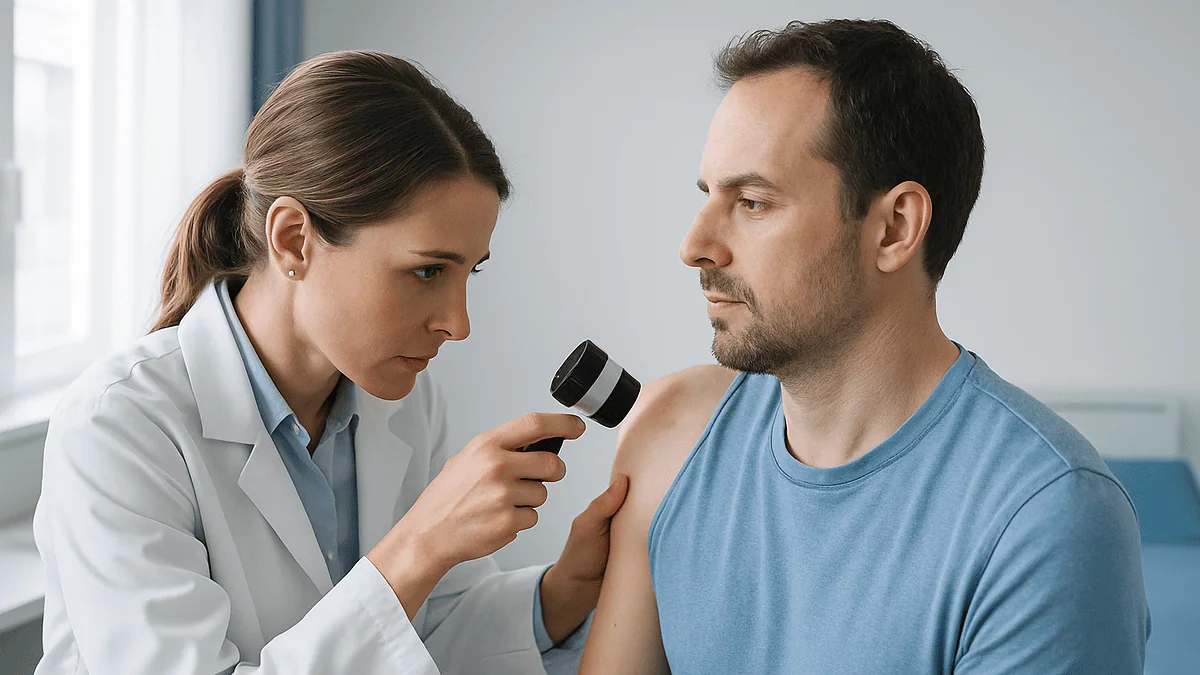
The visit usually opens with questions rather than an examination, because the questions decide what the examination is looking for. Expect to be asked where the rash started, how it spread, what your job and hobbies involve, which products you use on that part of the body, and whether the skin improves when routines change.
The examination itself is a study of geography. Clinicians look at where the rash sits and, just as importantly, where it stops. A rash that ends sharply at the edge of a watch strap, a waistband button or a glove cuff points toward something that rested there. Linear streaks on an arm or leg suggest a plant brushed the skin. Eyelid involvement raises the question of products applied elsewhere and carried by the hands. The texture matters too: tiny blisters and weeping suggest an active reaction, while thickened, cracked skin suggests something that has been going on for weeks.
From there, a few things can happen. The clinician may reach a working diagnosis and suggest a plan built on avoiding the likely trigger and repairing the skin barrier. They may prescribe an anti-inflammatory cream, most commonly a topical corticosteroid, which dampens the inflammatory response in the skin; how long it is used and where is a decision for the prescriber, not something to adjust on your own. Mayo Clinic describes both steps as the mainstay of early management.
If the cause is unclear, the rash keeps returning, or an allergic cause is suspected, the clinician may arrange patch testing, a procedure that places small amounts of possible allergens on the back to see which ones provoke a reaction. Other diagnoses, such as atopic eczema or a fungal infection, are usually considered alongside, since they can look similar and sometimes coexist.
How do I build a rash timeline a clinician can actually use?
A useful timeline is short, dated and honest about gaps. Nobody expects a diary going back years. What helps is a single page with one line per event, written before the visit while the details are fresh.
Start with the first day you noticed anything, even a patch of dryness you ignored. Note the body site. Then work backward through the two to three weeks before that date and list anything new: a product, a job task, a pair of gloves, a new pet, a season that meant more sweating or more washing. Allergic contact dermatitis typically appears hours to days after exposure and can last two to four weeks, according to Mayo Clinic, so the trigger is often something met well before the rash showed up rather than the morning it appeared.
Next, record the rhythm. Did it settle over a weekend and worsen by Wednesday? Did it vanish on vacation? Did it spread from one wrist to both, or from the hands to the face? Patterns tied to place and routine are among the strongest clues a clinician has.
Finally, list what you tried and what happened. A cream that helped for a week and then stopped, a product you dropped with no change, a switch of detergent that seemed to make things worse. All of it is data.
- Week 1: dryness on right wrist, started new office job the previous week, wearing a metal-buckled watch daily
- Week 3: itchy bumps under the watch, spreading to the left wrist
- Week 5: two weeks away, no watch, skin nearly clear by day ten
- Week 7: back at work, rash returned within four days
That format takes ten minutes to write and can save a great deal of guesswork.
Which products should I bring to a contact dermatitis appointment?
Bring everything that touches the affected skin, and be generous with the definition of “touches.” The list is longer than most people expect, because so much reaches the skin indirectly.
For any body site, that means cleansers, moisturizers, sunscreens, deodorants and any medicated or anti-itch cream you have applied, whether prescribed or bought over the counter. Mayo Clinic lists topical antibiotic creams among common causes of allergic reactions, so the very product used to soothe a rash can sometimes be sustaining it. Include the laundry detergent and fabric softener used on clothing or bedding that contacts the area.
For rashes on the face, eyelids or neck, add hair products, nail products, makeup, makeup remover and fragrance. For hands, add hand sanitizer, gloves, dish soap and anything handled at work. For the feet, the shoes themselves matter, since rubber, glues and leather treatments are recognized culprits. For the ears, wrists and waist, bring the jewelry, watch or belt.
Bring the original containers rather than decanted samples. The ingredient list on the label is what the clinician needs, and a similar product with a different formula can send the search in the wrong direction. If a dozen bottles will not fit in a bag, photograph each label so the ingredient panel is legible and bring the photos instead.
Do not leave out products you recently stopped using. If you dropped a soap two weeks ago, note the date you stopped and bring it anyway. Those discontinued items are often exactly the ones worth testing. Products used by a partner or child that reach your skin through close contact belong on the list too.
A labeled zip bag, a phone folder of label photos and your timeline page together make up the core of a well-prepared visit.
How to describe a contact dermatitis rash: words and photos that help
Rashes change hour by hour, and the one that finally sends someone to a clinic is rarely the one that appears on the day. Photographs bridge that gap. Take them in daylight or a well-lit room, in focus, from the same angle over several days. Take one wide shot that shows where on the body the rash sits and one close-up that shows its texture. A coin or ruler in frame gives scale. Skip filters and heavy makeup, and photograph the skin before applying any cream that day.
When it comes to words, describe what you feel and see rather than what you think it is. A few distinctions are worth making clear. Itch is different from burning or stinging; Cleveland Clinic notes that allergic reactions tend to itch, while irritant reactions more often sting or burn. Small fluid-filled blisters differ from dry, scaly patches. Weeping or crusting differs from thickening. Note whether edges are sharp or fade gradually.
Color deserves care, because it shows differently across skin tones. On lighter skin, inflammation often looks pink or red. On brown or Black skin, the same inflammation may appear purple, gray, dark brown or simply darker than surrounding skin, and the change may be easier to feel as warmth or roughness than to see. Describe what you observe in your own skin rather than reaching for textbook colors.
Mention the sequence too: whether the rash began as bumps that merged, or as a single patch that spread, and how long each stage lasted. None of this is a checklist for diagnosing yourself. It is a vocabulary that lets a clinician build an accurate picture from a moment that has already passed.
Exposures at work, home and hobbies: the inventory most people forget
Products are only half the exposure story. The other half is what your hands, face and body meet during an ordinary week, much of which never gets thought of as a “product” at all.
Work exposures are the most frequently missed. Wet work, meaning hands in water or gloves for long stretches, is a classic route to irritant dermatitis in healthcare, cleaning, catering and hairdressing. Cement, epoxy resins, metalworking fluids, hair dyes, disinfectants and rubber gloves are all recognized causes in the NHS and Mayo Clinic overviews. If safety data sheets exist for what you handle, bring them or photograph them. Note when protective gloves were introduced, changed or removed, because gloves can protect against one problem while creating another.
Hobbies deserve the same scrutiny. Gardening brings plant contact; Mayo Clinic highlights the oily resin urushiol in poison ivy, oak and sumac as a common cause of allergic reactions. Woodworking, painting, jewelry making, home nail art with gel or acrylic systems, leathercraft and model building each involve substances that can sensitize the skin over time.
Home is subtler. Nickel in belt buckles, jeans buttons, keys and phone cases sits against skin for hours. Pet shampoos transfer to the hands and then the face. A partner’s hair product can end up on your pillow and your cheek. Nail polish on your own fingers reaches your eyelids every time you rub your eyes.
Write it all down under three headings, work, home and hobbies, and add one line about whether the rash behaves differently when you are away from each. Improvement away from work followed by relapse on return is a pattern clinicians specifically look for, and it is worth documenting with dates.
Irritant or allergic contact dermatitis? The comparison that shapes what you record
You do not need to decide which type you have. It does help, though, to understand why a clinician cares, because it explains why some of the questions and requests can seem oddly specific. The two forms arise from different mechanisms and leave different fingerprints in a history.
| Feature | Irritant contact dermatitis | Allergic contact dermatitis |
|---|---|---|
| Mechanism | Direct damage to the skin barrier by a substance | Delayed immune response to a substance the body has become sensitized to |
| Who reacts | Anyone, given enough exposure | Only people sensitized to that specific substance |
| Typical onset | Minutes to hours after a strong exposure, or gradually with repeated mild ones | Hours to days after contact, per Mayo Clinic |
| Common sensation | Stinging, burning, soreness | Itch, often intense |
| Usual location | Exactly where the substance touched, often the hands | Where it touched, but may spread or appear at transfer sites such as eyelids |
| Role of patch testing | Not diagnostic; the history carries the diagnosis | The main way to confirm and identify the allergen |
| Most useful thing to bring | A record of frequency: how many times a day hands are washed, hours in gloves | The products themselves, with labels, including ones recently stopped |
The practical lesson sits in the last row. If the clinician suspects irritation, they will want to know about repetition: how often, how long, how hot the water, how many changes of gloves. If they suspect allergy, they will want the ingredient lists and the time gap between contact and rash. Bringing both kinds of information covers you either way, and the two forms frequently overlap, since irritated skin is more easily sensitized.
Sources agree that the distinction is often not obvious from appearance alone, which is why neither you nor the clinician should feel certain after a first look.
Who is usually offered patch testing, and who is usually asked to wait
Patch testing is a diagnostic procedure in which small amounts of common allergens are applied to the skin of the back under adhesive patches and left in place for about two days, after which the skin is examined for reactions. It looks for the delayed type of immune response behind allergic contact dermatitis, not the immediate reactions involved in hives, hay fever or food allergy, which are investigated differently.
Clinicians tend to suggest patch testing when the rash keeps returning despite reasonable avoidance and treatment, when an allergic cause seems likely from the pattern, when the hands, face or eyelids are involved, when the problem may be work-related, or when the trigger simply cannot be identified from the history. The NHS describes it as the route used when an allergic reaction is suspected and the cause is unclear.
Some people are asked to wait, and the reasons are practical rather than dismissive. The test needs a stretch of clear skin on the back; if the back is currently inflamed, results become hard to read. Recent significant sun exposure or tanning of the back can blunt reactions. Medicines that dampen the immune response, including oral corticosteroids and some immunosuppressants, can mask results, so the team will ask what you take and decide on timing with you and with whoever prescribes them. Some services also postpone testing during pregnancy as a precaution, and will discuss the reasoning if it applies.
People whose history points clearly to irritation, such as a cleaner whose hands settle every weekend, may not be offered testing at all in the first instance, because the diagnosis is already reasonably clear from the story. Children can be tested in specialist settings when the picture warrants it. In every case, whether to test, when, and with which panel of substances sits with the treating team.
What not to do before a patch test for skin allergy
Most of the ways a patch test goes wrong happen before the patches go on, and nearly all are avoidable with a little notice.
Do not stop, start or change any medicine on your own account. Tell the team about everything you take, including steroid creams, steroid tablets, immunosuppressants and any recent injections. Some of these can suppress the reaction the test is trying to provoke, and the clinicians will advise on timing in coordination with your prescriber. Making the decision unilaterally can leave you either untested or unprotected.
Do not sunbathe, use tanning beds or spend long periods with your back exposed to strong sun in the weeks before. Cleveland Clinic and Mayo Clinic both note that recent sun exposure to the test site can interfere with results.
Do not apply moisturizer, oil, lotion or any cream to your back on the day of application. The patches need clean, dry skin to stick and to allow the test substances to contact it evenly.
Do not plan a heavy training week. Once the patches are on, they must stay dry and in place for about two days, which means no showers that wet the back, no swimming, no saunas and no exercise that leads to heavy sweating. Mayo Clinic is explicit that soaking or sweating can loosen patches and spoil the reading.
Do not wear your favorite shirt. Marker ink used to map the patches can transfer to clothing.
Do not clear your schedule for one visit only. Patch testing involves at least two and usually three appointments across roughly a week, and missing a reading can mean repeating the whole process. Confirm the dates before you leave the first visit.
What the patch-testing week usually looks like, day by day
The rhythm of patch testing surprises people who expect a single test with instant results. It is a slow test by design, because the immune response it measures takes days to develop.
On the first visit, the back is cleaned and rows of small chambers containing test substances are applied under hypoallergenic tape, then outlined with marker so each position can be identified later. Application takes a few minutes and is painless. You go home with the patches in place and instructions to keep them dry and undisturbed. Mild itching under a patch during this period is common and is worth noting, along with the time it started, but scratching or lifting the tape should be avoided.
Around two days later, at the second visit, the patches are removed and the skin is examined for the first time. Some reactions are already visible; others have not appeared yet. The marks are often refreshed so the map survives a few more days.
A further reading follows a few days after removal. Mayo Clinic describes checking the skin for reactions over several days after the patches come off, because delayed responses can emerge late. This final reading is usually where the discussion of results happens. If a substance produces a reaction, the team explains what it is, where it appears in everyday products, and how to check labels for it. If your own products were tested alongside the standard panel, those results are reviewed as well.
Occasionally a reaction appears after the last scheduled reading. If a new itchy spot develops on the back in the week or two afterward, photograph it and let the team know. Some clinicians also suggest a repeated open application test, in which a personal product is applied to a small area of skin at home over several days to see whether it provokes a reaction under real conditions.
Contact dermatitis diagnosis: what the results can and cannot tell you
A positive patch test tells you that your immune system is sensitized to a particular substance. That is valuable, but it is not the whole diagnosis. The next question is whether that substance actually reaches your skin in daily life, and whether it explains the rash you came in with. This is called relevance, and it is precisely why the product list and exposure inventory matter: a positive result to a preservative means one thing if it appears in your moisturizer and something quite different if you never encounter it.
A negative patch test does not mean nothing is wrong. It usually means the rash is unlikely to be driven by allergy to the substances tested. Irritant dermatitis will not show on a patch test at all, because it is not an immune reaction. Nor will every possible allergen be included; standard panels cover the most common culprits, and personal products or workplace materials may need to be tested separately.
Results can also be muddied. A strongly irritating substance can produce a red patch that looks like an allergic reaction but is not, and experienced readers interpret each site in context. Sometimes a person has more than one thing going on, for instance long-standing atopic eczema with a newly acquired contact allergy on top, and both need attention.
Whatever the outcome, management rests on the same foundation: identify and avoid the trigger where possible, protect and repair the skin barrier, and treat active inflammation as the clinician advises. The NHS notes that the rash usually settles once the cause is removed, though Mayo Clinic’s two-to-four-week figure for a single allergic episode is a reminder that patience is part of the plan. Recovery timelines vary, and no one can promise a date.
What people often get wrong about preparing for a contact dermatitis visit
The most common mistake is also the most understandable: stopping everything the week before the appointment in the hope of arriving with clean, calm skin. It feels responsible. It also removes evidence. If the rash fades because a trigger was withdrawn, no one can tell which one, and the clinician meets healed skin and a blank page. Better to note what you stopped and when, bring those products anyway, and let the team decide what to reintroduce or test.
The second mistake is ruling out old favorites. “I have used that for years, so it cannot be the cause” is one of the most frequently heard sentences in a dermatology clinic, and it is often wrong. Sensitization builds with repeated exposure; the immune system can learn to react to something after months or years of untroubled use. Long familiarity is not an alibi.
Third, labels such as “natural,” “hypoallergenic” or “dermatologist tested” get treated as guarantees. They are not. Fragrance components and plant extracts are among the substances most commonly identified in allergic contact dermatitis, and a product can carry a soothing label while containing them.
Fourth, people assume an allergy test is an allergy test. Skin-prick and blood tests look for immediate, antibody-driven allergy of the kind behind hay fever or peanut reactions. Contact allergy involves a different immune pathway and is investigated by patch testing. A clear prick test says nothing about it.
Fifth, a cream that calms the rash is taken as proof the rash was “just eczema.” Anti-inflammatory creams reduce inflammation regardless of what caused it. Relief tells you the skin responded to treatment, not why it flared.
Finally, many assume the rash must be where the substance touched. Transfer by the hands, airborne exposure and products carried on a partner’s skin all break that rule, which is why eyelids and the neck so often puzzle people.
Questions to ask your care team about a suspected contact dermatitis
A prepared list of questions makes a short appointment feel less rushed and helps you leave with a plan you actually understand. Choose the ones that fit your situation; you do not need to ask them all.
- Based on what you see and what I have told you, does this look more like irritation, allergy, or something else entirely?
- Which of the products I brought would you like me to keep using, pause, or bring back for testing?
- Is patch testing appropriate for me, and if so, when, and what should I do in the meantime?
- Are there medicines I take that could affect the timing of testing, and who will coordinate that with my other prescriber?
- What is the purpose of each cream or treatment you are suggesting, how will I know it is working, and when should I check back if it is not?
- What should I record between now and the next visit: photos, a diary, product changes?
- If this turns out to be work-related, what documentation would help, and is there any occupational health input available?
- Which everyday items commonly contain the substance you suspect, and how do I read a label for it?
- What would make you reconsider the diagnosis?
Take notes, or ask whether the plan can be written into your visit summary. Names of suspected substances are often unfamiliar and easy to misremember, and an accurate spelling makes label reading far easier later. If a diagnosis of allergic contact dermatitis is eventually confirmed, ask for the written allergen information sheets most services provide; they list synonyms and hidden sources that would take hours to compile alone.
One question is worth asking at every stage: what would you like me to do if it gets worse before I see you again?
When to call your doctor
Most contact dermatitis is uncomfortable rather than dangerous, and it can reasonably wait for a scheduled appointment. Some situations should not.
Contact your care team promptly if the rash is spreading quickly, covers a large area of the body, or involves the eyes, mouth or genitals. Do the same if the skin becomes increasingly painful, hot or swollen, if yellow crusting or pus develops, or if you feel feverish or unwell, since these can indicate a bacterial infection that has taken hold in damaged skin. Blistering across large areas, especially after contact with a plant or a chemical, also warrants a call. Mayo Clinic and the NHS both list severe, widespread or infected-looking rashes as reasons to seek medical attention rather than wait.
Seek emergency care immediately if there is swelling of the face, lips or tongue, difficulty breathing or swallowing, or a feeling of faintness. These are features of a different and more urgent type of allergic reaction, and they do not belong on a dermatology waiting list.
Get in touch, less urgently, if a rash shows no sign of settling several weeks after you have removed the suspected trigger, if it keeps returning without an obvious pattern, or if itch is disrupting your sleep or your work. Persistent dermatitis on the hands deserves attention in its own right, because cracked skin is slow to heal and easy to infect.
During patch testing, call the team if a patch site becomes intensely painful or blisters, if a reaction spreads well beyond the marked area, or if the patches come loose early. After the final reading, report any new itchy spots that appear on the back over the following couple of weeks; late reactions are uncommon but informative.
When in doubt about whether something can wait, the safer choice is to ask. Every decision about treatment, testing and timing belongs with the clinicians who can see your skin.
Frequently asked questions
How do I prepare for a dermatologist appointment about a rash?
Arrive with three things: the products that touch the affected skin, a dated timeline of when the rash started and how it behaved, and photographs of it at its worst. Add a list of current medicines and a short note on work and hobby exposures. Avoid applying creams or makeup to the area that morning so the skin can be examined as it is, and write down your questions in advance.
What should I not do before a patch test?
Avoid sunbathing or tanning the back in the weeks before, do not apply lotion or oil to the back on the day, and do not plan swimming, showers that wet the back, or sweaty exercise while patches are on. Tell the team about every medicine you take, especially steroids and immunosuppressants, and let them advise on timing rather than stopping anything yourself.
Should I stop using my products before the appointment?
Generally, no, unless a clinician has told you to. Stopping everything can clear the rash without revealing which product caused it, leaving the clinician with healed skin and no leads. If you have already stopped something, note the date and bring it anyway. The team can then decide what to keep, pause, or test based on the full picture.
What questions should I ask a dermatologist about a rash?
Ask whether the pattern suggests irritation, allergy or something else; whether patch testing is appropriate and when; how each suggested treatment works and when to check back; what to record between visits; and which everyday items contain any substance they suspect. It also helps to ask what would make them reconsider the diagnosis and what to do if things worsen before your next visit.
How long does it take to get a contact dermatitis diagnosis?
Sometimes one visit is enough, particularly when the history points clearly to an irritant such as frequent hand washing. When allergy is suspected, patch testing adds roughly a week, with patches applied, removed about two days later, and a final reading a few days after that. Confirming relevance and seeing whether avoidance helps can take several more weeks, since a single allergic episode may last two to four weeks.
Can I take antihistamines before patch testing?
Ask your testing team, and do not change any medicine on your own. Patch tests measure a delayed, cell-driven immune response rather than the histamine release involved in hives or prick tests, so teams often handle antihistamines differently from steroids or immunosuppressants, which can mask results. The safest approach is to list everything you take and let the clinicians set the plan.
Do I need photos if the rash is visible on the day?
Yes, because the rash you show on the day is rarely the rash at its worst, and clinicians want to see the full arc. Photos taken in daylight, in focus, from the same angle over several days show spread, blistering and healing that a single examination cannot. Include one wide shot for location and one close-up for texture, ideally with a coin for scale.
Can children have a patch test for contact dermatitis?
Yes, patch testing can be carried out in children in specialist settings when the history suggests an allergic cause and the results would change management. The procedure is the same in principle, with adaptations for a smaller back and for keeping patches undisturbed. Whether it is appropriate, and when, is a decision for the treating team based on the individual child.
What does a doctor do if the patch test is negative?
A negative result shifts attention away from allergy to the substances tested and toward other explanations, most often irritant dermatitis, atopic eczema, or an allergen not included in the standard panel. The clinician may test personal or workplace products, review the exposure history again, focus on barrier repair and avoiding irritants, or reconsider the diagnosis entirely. It is a useful result, not a dead end.
How do I describe a rash to a doctor over the phone or in a message?
Give the location, when it started, whether it is spreading, and what it feels like: itch, burning or pain. Describe the surface, such as blisters, weeping, dryness or thickening, and any color change in your own skin tone. Mention anything new you touched in the preceding two weeks, treatments tried, and whether you have fever or increasing pain. Attach dated photos if the system allows.
References
This article is for general information only and is not a substitute for professional medical advice. Please consult a qualified doctor about your individual situation.

More from the Blog

What to Expect From Psoriasis Treatment: How Improvement Is Measured and Why Care Continues
Psoriasis treatment aims to control, not eliminate, an overactive immune response in the skin. Creams and ointments usually take several weeks to show benefit,…

Sebaceous Filaments vs Blackheads: The Difference and Why Squeezing Backfires
Sebaceous filaments are the normal, thread-like columns of oil and skin cells that line every pore, most visibly on the nose; blackheads are blocked…

Skincare Alongside Rosacea Treatment: Gentle Cleansers, Daily Sunscreen and Tracking Triggers
A rosacea skincare routine works alongside prescribed treatment, not instead of it. Guidance from the NHS and Mayo Clinic centers on three habits: washing…

How to Get Clear Skin: The Dermatology Basics
Clear skin comes from consistency, not quick fixes. Wash your face gently no more than twice a day, use a non-comedogenic moisturizer and broad-spectrum…

What Folliculitis Looks Like, and Does It Go Away on Its Own?
Folliculitis usually looks like clusters of small red, pink, or skin-colored bumps, each centered on a hair, sometimes with a white or yellow pus-filled…

Is It Dandruff, Dry Scalp or Scalp Psoriasis? How Dermatologists Tell Flaking Causes Apart
Dandruff, dry scalp and scalp psoriasis all cause flaking but differ in how the flakes look and where they appear. Dandruff produces oily, yellowish…