

Sleep Restriction Therapy: The Counterintuitive Insomnia Treatment That Works
Key Takeaways
- Sleep restriction therapy limits time in bed to roughly the hours a person already sleeps, typically with a floor of five to five and a half hours, then widens the window in 15-minute steps.
- Sleep efficiency, the percentage of time in bed spent asleep, is the control number: above 85 percent the window grows, below 80 percent it shrinks.
- The 2023 HABIT trial of 642 adults in primary care found nurse-delivered sleep restriction lowered insomnia severity by roughly three points more than sleep hygiene advice at six months.
- Daytime sleepiness peaks in the first one to two weeks and then recedes, which is why people who drive for work, have seizures, bipolar disorder or untreated sleep apnea need clinical supervision or a different approach.
- Guidelines from the American Academy of Sleep Medicine in 2021 and the European Insomnia Guideline in 2023 rank CBT-I, which includes sleep restriction, ahead of sleep medication as first-line treatment for chronic insomnia.
- A fixed wake time kept within about an hour every day of the week is the single habit most associated with holding onto gains after the program ends.
Sleep restriction therapy is a structured part of cognitive behavioral therapy for insomnia that temporarily limits time in bed to roughly the hours a person actually sleeps, then expands that window as sleep becomes more solid. Randomized trials show it improves sleep onset, night waking, and sleep efficiency for chronic insomnia. Early daytime sleepiness is expected, so people who drive for work, have seizures, bipolar disorder, or untreated sleep apnea should only use it under clinical guidance.
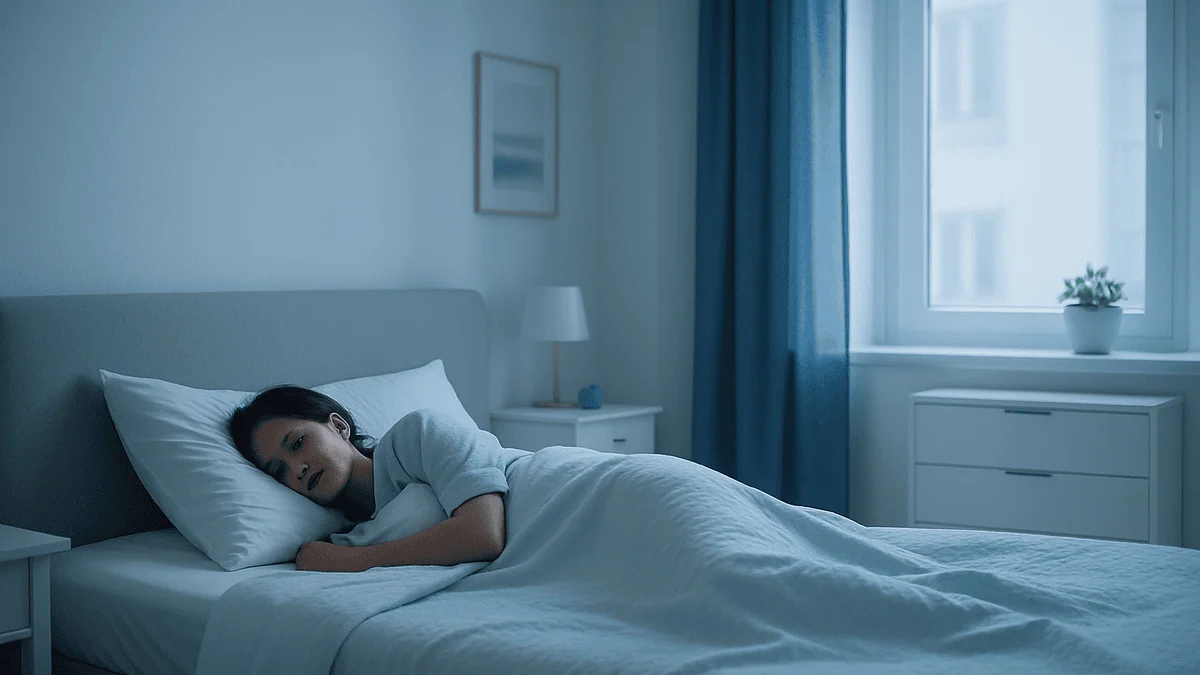
The video that keeps landing in people’s feeds shows a woman setting her alarm for 5:30 a.m. and announcing, with the glee of someone who has found a loophole, that she is going to bed at midnight on purpose. She has insomnia. She has had it for years. And she is going to treat it by sleeping less. The comments are a split screen of “this saved my life” and “this sounds like torture.”
Both reactions are understandable, and both miss what is actually going on. As of September 2026, sleep restriction therapy is trending for two reasons that have little to do with social media: a large primary care trial published in The Lancet in 2023 showed nurses with a few hours of training could deliver it effectively, and clinical guidelines on both sides of the Atlantic now place the behavioral program it belongs to ahead of sleeping pills as the first treatment for chronic insomnia.
The idea looks reckless from the outside. Underneath, it is one of the most carefully measured interventions in sleep medicine, and it works for reasons that are worth understanding before anyone tries it.
What is sleep restriction therapy, and why does it sound so wrong?
Start with the problem it was built to solve. Chronic insomnia disorder is defined as trouble falling asleep, staying asleep, or waking too early at least three nights a week for three months or more, with daytime consequences. Mayo Clinic and the NHS both describe it as one of the most common sleep complaints adults bring to a doctor.
People with insomnia almost always respond the same way: they go to bed earlier, stay in bed later, and nap when they can. It feels like the responsible thing to do. The trouble is that the bed becomes a place where a great deal of lying awake happens, and the brain learns that lesson well. A person might spend nine hours in bed to get five hours of broken sleep.
Sleep restriction therapy, developed by psychologist Arthur Spielman in the 1980s, reverses that pattern. Time in bed is deliberately reduced to roughly match the amount of sleep a person is already getting, typically with a floor of five to five and a half hours. Sleep is squeezed into a shorter window. The window is then widened, usually in 15-minute steps, once sleep inside it becomes consistent.
The name is slightly misleading, which is part of why the approach gets misunderstood. Nobody is restricting sleep. What is being restricted is wakeful time in bed. Some clinicians prefer the phrase “sleep scheduling” or “bedtime restriction” for exactly this reason.
It is rarely used on its own. Sleep restriction is one of several components of cognitive behavioral therapy for insomnia, usually shortened to CBT-I, a structured program that also includes stimulus control, cognitive work on sleep-related worry, relaxation methods, and education. Among those components, sleep restriction is widely regarded as the one that does the heaviest lifting, and the one that demands the most of the person doing it.
What changed recently
Three developments explain why a 40-year-old technique is suddenly a search trend.

The first is a guideline shift. In February 2021 the American Academy of Sleep Medicine published a clinical practice guideline on behavioral and psychological treatments for chronic insomnia. It gave multicomponent CBT-I a strong recommendation, meaning the panel judged that nearly all informed patients would choose it. Sleep restriction as a stand-alone treatment received a conditional recommendation, reflecting good but thinner evidence when it is separated from the rest of the program. In December 2023 the updated European Insomnia Guideline reached the same conclusion: CBT-I first, medication only when that fails or is unavailable.
The second is the HABIT trial, published in The Lancet in August 2023. Researchers in England randomized 642 adults with insomnia disorder in general practice to either a sleep hygiene booklet or four short sessions of sleep restriction therapy delivered by practice nurses who had received brief training. Six months later, the sleep restriction group reported insomnia severity scores roughly three points lower on a 28-point scale than the booklet group, along with better sleep quality and lower depressive symptoms. The result mattered because it showed the treatment does not require a sleep psychologist to deliver.
The third is cultural. Clips of people describing their own “five-hour sleep window” have spread widely across short-form video, often stripped of the parts that make the method safe: the sleep diary, the floor on time in bed, the screening for other sleep disorders.
Mainstream patient guidance has caught up. Mayo Clinic’s treatment page now lists sleep restriction by name as a CBT-I technique, and the NHS directs people with persistent insomnia toward CBT-I before any prescription. The approach is no longer a specialist secret; it is standard care that most people have simply never been offered.
How does sleep restriction therapy work?
Two biological systems decide when a person sleeps, and insomnia tends to disrupt both.
The first is sleep drive, sometimes called homeostatic pressure. A chemical called adenosine accumulates in the brain during every waking hour and is cleared during sleep; the longer someone is awake, the stronger the pull toward sleep. Daytime naps, long lie-ins and early bedtimes all bleed off that pressure before night arrives, which is why a person can feel exhausted all day yet oddly alert at 11 p.m.
The second is the circadian rhythm, the roughly 24-hour internal clock that times sleepiness and alertness. It is anchored largely by a consistent wake time and morning light. Insomnia sufferers often drift: later on bad nights, earlier on good ones, with the clock never quite settling.
Sleep restriction therapy acts on both at once. By compressing time in bed, it forces adenosine to build to a level the brain cannot ignore. Sleep comes faster and runs deeper, with fewer awakenings, because the pressure behind it is higher. By fixing the wake time to the minute, seven days a week, it gives the circadian clock a reliable anchor.
There is a third mechanism that is psychological rather than chemical. After months of lying awake, the bed itself becomes a conditioned cue for frustration and vigilance, in the same way a dentist’s waiting room can raise a pulse before anyone touches a tooth. When a shortened window produces several nights of falling asleep quickly, that association starts to break. Confidence returns, and the anxious effort to sleep, which is itself a powerful cause of wakefulness, begins to fade.
Harvard Health describes CBT-I as targeting the thoughts and behaviors that keep insomnia going rather than whatever started it. Sleep restriction is the clearest example of that logic in action.
Sleep efficiency calculation: the number that runs the whole program
Everything in sleep restriction turns on one figure. Sleep efficiency is the percentage of time in bed that is actually spent asleep. The calculation is simple: total sleep time divided by total time in bed, multiplied by 100.

Take a person who gets into bed at 10 p.m., rises at 7 a.m., and estimates five and a half hours of sleep in between. That is 5.5 divided by 9, or 61 percent. Healthy sleepers typically run at 85 to 90 percent or higher. Sixty-one is the signature of insomnia: a bed that is occupied far longer than it is used.
Clinicians do not take a single night’s number. The program begins with a one- to two-week sleep diary, filled in each morning, recording bedtime, estimated time to fall asleep, number and length of awakenings, final wake time, and time out of bed. Average total sleep across those nights becomes the starting sleep window.
Why estimates rather than a wearable? Partly because wrist trackers are poor at telling quiet wakefulness from light sleep, and partly because the diary itself is therapeutic. People with insomnia tend to overestimate how little they sleep; seeing a two-week average of five hours and forty minutes, rather than the “two or three hours” that lives in memory, is often the first corrective moment.
Weekly, the number guides the next step. The common thresholds, which vary slightly between programs, look like this:
- Sleep efficiency at or above 85 percent for a week: extend the window by 15 minutes, usually by moving bedtime earlier.
- Between 80 and 85 percent: hold the window where it is.
- Below 80 percent: shorten the window by 15 minutes, never below the program’s floor.
The rule is mechanical on purpose. It removes the nightly negotiation that insomnia thrives on.
What a sleep restriction therapy schedule looks like, week by week
Here is how the process usually unfolds in a supervised CBT-I program, using the example above of a person averaging five and a half hours of sleep in a nine-hour bed window.
Week one is the diary. Nothing changes except that each morning takes two minutes of honest note-taking. Many people are tempted to skip this step. It is the step that makes every later decision defensible.
Week two sets the window. The clinician and patient agree on a fixed wake time that works every day of the week, say 6 a.m., and count backward by the average sleep time, giving a bedtime of 12:30 a.m. Before 12:30, the person stays up, out of the bedroom, doing something quiet. Lying on the sofa dozing is not allowed; that is sleep stolen from the window.
Weeks three to six are the adjustment phase. Each week the diary is averaged and the window is widened, held or narrowed according to the efficiency thresholds. A typical trajectory sees efficiency jump into the high 80s within the first week or two, as sleep pressure takes over, followed by gradual expansion of the window toward six and a half or seven hours.
Several ground rules run alongside the schedule:
- No napping, because every nap spends sleep pressure that is needed at night.
- The wake time holds on weekends, holidays and after terrible nights alike.
- If sleep does not come within about 20 minutes, get up and return only when sleepy, which is the stimulus control component working in tandem.
- Bright light soon after waking, to reinforce the circadian anchor.
Programs typically run four to eight weeks. The HABIT trial used just four nurse-led sessions spread across that time, which suggests the critical ingredient is adherence rather than contact hours. The schedule is simple to describe and genuinely hard to follow, especially around day four, when fatigue peaks and the temptation to abandon it is strongest.
Why can't I stay asleep? What sleep restriction does for 3 a.m. waking
Falling asleep is only half of insomnia. For many adults, especially past midlife, the complaint is waking at 2 or 3 a.m. and lying there until the birds start. Searches for “why can’t I stay asleep” outnumber those about trouble falling asleep, and the causes are worth sorting before blaming the sleep schedule.
Some are medical. Obstructive sleep apnea, in which the airway repeatedly collapses during sleep, produces dozens of brief arousals an hour and is often mistaken for insomnia. Nocturia, an overactive thyroid, chronic pain, menopause-related hot flashes, depression and several medications can all fragment the night. Alcohol in the evening reliably causes rebound waking three to four hours later as its sedative effect wears off.
Once those are addressed or ruled out, what remains is often conditioned waking. Sleep naturally lightens every 90 minutes or so at the end of each cycle. Good sleepers surface briefly and drop back without memory of it. A person with insomnia surfaces, checks the clock, registers alarm, and the nervous system switches to full wake.
Sleep restriction helps here in a specific way. With time in bed compressed, sleep pressure stays high right through the early morning hours, so those natural cycle transitions are less likely to tip into full awakening. The later bedtime also means the 3 a.m. wake, if it happens, lands closer to a rising time that has been fixed and accepted rather than hours before it.
The Cleveland Clinic and the NHS both note that CBT-I addresses sleep maintenance insomnia as effectively as sleep onset insomnia. In diary data from trials, wake time after sleep onset typically falls by a substantial fraction of its starting value, and that gain tends to hold at follow-up months later.
How CBT-I sleep restriction fits with stimulus control and the rest of the program
Sleep restriction is almost never prescribed alone, and understanding its companions explains why some people fail with the shortened window while others succeed.
Stimulus control is its closest partner. The term describes a set of rules designed to make the bed a cue for sleep and nothing else: go to bed only when sleepy, use the bed only for sleep and intimacy, get up if awake for more than about 20 minutes, and rise at the same time daily. Where sleep restriction builds pressure, stimulus control teaches the brain what to do with it. The two overlap so much that the HABIT trial folded stimulus-control principles into its “sleep restriction” package.
Cognitive therapy tackles the beliefs that keep the engine running: “If I get less than eight hours I cannot function,” or “one bad night will ruin tomorrow.” These thoughts are not trivial. They turn an ordinary bad night into a threat, and the threat response is incompatible with sleep.
Relaxation training, such as paced breathing or progressive muscle relaxation, gives the body a way to lower arousal during the deliberately late evenings that sleep restriction creates.
Sleep hygiene, the familiar list about caffeine, screens and bedroom temperature, rounds out the program. Taken alone it is weak; the HABIT control group received a well-written hygiene booklet and improved far less than the restriction group. As a supporting layer, it removes avoidable obstacles.
The full package is what guidelines mean by CBT-I. Mayo Clinic describes it as generally recommended as the first line of treatment, and the NHS says it should be offered before sleeping tablets are considered. Someone trying only the sleep window, without the stimulus control rules or the cognitive work, is using a strong tool with the handle removed.
What the evidence actually says
The honest answer has layers, and they deserve to be graded separately.
For multicomponent CBT-I, the evidence is as strong as behavioral medicine gets. Dozens of randomized controlled trials and multiple meta-analyses show meaningful improvements in time to fall asleep, time awake during the night and sleep efficiency, with benefits that persist for a year or more after treatment ends. The 2021 American Academy of Sleep Medicine guideline rated this a strong recommendation.
For sleep restriction on its own, the evidence is good but narrower. A 2014 systematic review found medium-to-large effects on sleep diary measures across the handful of trials that isolated the component, while flagging small sample sizes. The HABIT trial in 2023 added a large, well-run randomized study with six-month follow-up and a real-world delivery model. On a conventional scale, that moves single-component sleep restriction from “promising” to “established for most adults with insomnia disorder,” though guideline panels still rank it below the full program.
Where evidence thins out: older adults with multiple health conditions, people with severe psychiatric illness, and anyone with untreated sleep apnea were often excluded from trials. Claims about sleep restriction for those groups rest on expert opinion rather than data.
| Approach | Evidence strength | Typical benefit | Main drawback |
|---|---|---|---|
| Full CBT-I (including sleep restriction) | Strong: many RCTs, meta-analyses, guideline first line | Durable gains in onset, maintenance, daytime function | Effort over 4–8 weeks; limited access to trained providers |
| Sleep restriction alone | Moderate: several small RCTs plus one large 2023 trial | Faster onset, fewer awakenings, higher efficiency | Transient daytime sleepiness; needs screening and supervision |
| Sleep hygiene education alone | Weak: often used as the control condition | Minor improvements at best | Rarely sufficient for chronic insomnia |
| Prescription sleep medicines | Strong for short-term use; limited beyond a few weeks | Quick relief of onset or maintenance symptoms | Tolerance, next-day effects, no lasting change after stopping |
The practical reading: sleep restriction is the most powerful single piece of a treatment that is itself the standard of care, and its risks are predictable rather than mysterious.
What the first week feels like, and who should not try it alone
Nobody should start this expecting to feel good for a few days. The early phase of sleep restriction reliably produces daytime sleepiness, irritability and reduced concentration, because the person is now getting roughly the same total sleep as before but without the compensating hours of rest in bed. Trials have measured this: subjective sleepiness scores rise during the first one to two weeks and then return to baseline or better as sleep consolidates.
That sleepiness is the reason the method carries real exclusions, and it is the part the viral clips tend to leave out.
Clinicians typically advise against unsupervised sleep restriction, or against it altogether, for people who:
- Drive long distances or operate heavy machinery for work, because sleepiness impairs reaction time in ways comparable to alcohol.
- Have a seizure disorder, since sleep loss is a well-documented seizure trigger.
- Have bipolar disorder, where reduced sleep can precipitate a manic episode.
- Have untreated obstructive sleep apnea, which needs its own treatment first.
- Have a history of parasomnias such as sleepwalking, which deeper, pressured sleep can intensify.
- Are pregnant, or have unstable heart, respiratory or psychiatric illness.
For everyone else, the discomfort is usually tolerable and short-lived. Several practical measures help: scheduling the start for a week without critical deadlines or long drives, avoiding alcohol as a shortcut to sleep, getting outside in daylight, and keeping the evening hours before the late bedtime active rather than sedentary.
The floor on the sleep window exists for safety. Most programs never set it below five hours, and some use five and a half, regardless of how little the diary suggests the person is sleeping. The goal is pressure, not deprivation, and a clinician who knows the person’s health history is the right judge of where that line sits.
Is 6 hours of sleep enough, and is this just sleep deprivation in disguise?
Two questions arrive together whenever sleep restriction comes up, and they point at the same anxiety.
Sleep deprivation is a state of getting less sleep than the body needs, acutely or over time. The CDC links chronically short sleep with higher rates of obesity, type 2 diabetes, high blood pressure, heart disease and depression. Most adults need seven or more hours; six hours, sustained, is below that range for the large majority of people, whatever the productivity culture says.
So is sleep restriction therapy a program of sleep deprivation? In the strict sense, no. The window is set to match the sleep a person is already getting, not to cut it. Someone averaging five and a half hours in a nine-hour bed window is not losing sleep when the window shrinks to five and a half hours; they are losing three and a half hours of lying awake. In the first week, total sleep often stays flat or dips slightly while efficiency climbs. From the second or third week on, as the window is extended, total sleep typically rises above where it started.
The distinction between deprivation and insomnia also matters for the long-term worry. The health associations the CDC describes come largely from people who are short on sleep because they do not allow time for it. Insomnia is different: time is allowed, and sleep does not come. The disorder itself carries its own risks for mood and quality of life, which is precisely why treating it is worthwhile.
A fair summary: six hours is not enough as a permanent arrangement for most adults, and sleep restriction never aims for it as a permanent arrangement. It uses a short, controlled period of high sleep pressure to rebuild a night that then grows back toward a healthy length, with the hours actually asleep rather than merely in bed.
Common myths about sleep restriction therapy
The social media version of this treatment has grown a mythology that deserves a direct correction.
“You train yourself to need less sleep.” Sleep need is biologically set and does not shrink with practice. The therapy changes how efficiently a person sleeps inside a given window, and that window is widened as sleep improves. Anyone who ends a program sleeping five hours a night has stopped too early.
“Just pick five hours and power through.” The starting window comes from a diary average, not a round number. Choosing a window well below actual sleep time creates genuine deprivation, drives up sleepiness and risk, and tends to backfire by making people abandon the method within days.
“It works in a week.” Sleep efficiency often improves quickly, but the full program runs four to eight weeks, and the durable results seen in trials come from completing the extension phase and keeping the fixed wake time afterward.
“It’s safe for everyone because it’s drug-free.” Drug-free is not the same as risk-free. The exclusions around driving, seizures, bipolar disorder and sleep apnea are real, which is why guidelines describe the treatment as something a trained provider delivers rather than a life hack.
“If a wearable says I slept 7 hours, I don’t have insomnia.” Consumer trackers routinely misclassify quiet wakefulness as light sleep. Diagnosis rests on symptoms and a clinical history, not on a ring or a watch.
“Naps are fine if they’re short.” During the active phase, even a 20-minute nap spends sleep pressure that is needed at night. Programs typically ban them entirely until the window has expanded and sleep is stable.
None of these corrections make the method less effective. They make it the method that was tested, rather than the one that was filmed.
Can sleep restriction be combined with sleeping pills, melatonin or a sleep aid?
Many people arrive at sleep restriction already taking something for sleep, whether a prescription hypnotic, an over-the-counter antihistamine or melatonin. The question of what to do with it is common and the answer belongs to the prescribing clinician, but the evidence gives useful context.
Trials have run CBT-I both with and without ongoing medication. In general, people on a stable prescription can begin behavioral treatment without changing anything, and several studies suggest the combination performs about as well as CBT-I alone in the short term. Where medication is eventually reduced, doing it gradually, with a clinician’s plan, after sleep has consolidated tends to go better than stopping at the start of the program. Abruptly discontinuing some prescription sleep medicines can cause rebound insomnia or, with certain drug classes, more serious withdrawal effects. That decision should never be made alone.
Melatonin is a hormone the body produces in the evening, and over-the-counter products in the United States are sold as dietary supplements with variable quality. The NIH Office of Dietary Supplements notes that evidence for melatonin in chronic insomnia is modest, with stronger support for timing-related problems such as jet lag. Whether it has any role alongside sleep restriction, and in whom, is a conversation for a doctor or pharmacist.
The larger point mirrors what guidelines say about insomnia generally: behavioral treatment is intended to replace the need for a nightly tablet in most people, not to be stacked on top of one indefinitely. Mayo Clinic’s treatment guidance describes medicines as an option when CBT-I is not enough, and the NHS lists them as a short-term measure.
Anyone who wants to pursue sleep restriction while on a sleep medication should tell the clinician who prescribed it. Both the schedule and the medicine may need adjusting as the program progresses, and that coordination is part of safe care.
How do I overcome insomnia for good? Keeping the gains after the program ends
The most searched question about insomnia is also the most reasonable: does it stay fixed? The honest answer is that insomnia is a condition people learn to manage rather than one that is settled forever, and sleep restriction leaves behind a set of skills that make relapses shorter and less frightening.
Follow-up data from CBT-I trials show that most of the improvement in sleep onset and night waking holds at six and twelve months. The people who maintain it tend to share habits that were drilled during the program.
The fixed wake time is the keystone. Long after the restricted window has expanded, holding a consistent rising time, within about an hour, seven days a week, keeps the circadian clock anchored. Weekend lie-ins are the most common way gains erode.
Bed is for sleep. The stimulus control rules continue: no working, scrolling or lying awake in frustration under the covers. A bad night is answered by getting up, not by staying put.
A short re-run is the planned response to a slip. Illness, travel, a new baby, grief or a stressful month can bring insomnia back. Rather than drifting toward early bedtimes and naps, people who have done the program can repeat a brief, self-directed sleep restriction for two or three weeks, using the same diary and efficiency rules, before patterns re-form.
Worry about sleep is treated as a symptom. One of the quiet achievements of the program is that it removes the dread. People learn, from their own diaries, that a poor night is followed by a better one when they keep the schedule, and that knowledge is protective.
What the evidence does not support is the idea of a single intervention that ends the matter. Insomnia tends to be chronic and relapsing. The realistic goal is to go from fearing the night to managing it, and most people who complete a program get there.
When to see a doctor
Sleep restriction therapy is a medical treatment, and the right moment to involve a clinician is before starting rather than after something goes wrong.
See a doctor or sleep specialist if insomnia has lasted more than three months, if it is affecting work, mood or safety, or if self-help has not helped. The NHS and Mayo Clinic both recommend evaluation at that point, partly to confirm the diagnosis and partly to look for conditions that mimic insomnia and need different treatment.
Certain signs call for evaluation before any behavioral program:
- Loud snoring, gasping or witnessed pauses in breathing during sleep, which suggest sleep apnea.
- An irresistible urge to move the legs in the evening, pointing to restless legs syndrome.
- Falling asleep without warning during the day, or episodes of sudden muscle weakness with emotion, which can indicate narcolepsy.
- Sleepwalking, acting out dreams or other complex behaviors during sleep.
- Chest pain, breathlessness or palpitations that wake you.
Seek urgent help for thoughts of self-harm, for a period of unusually elevated mood with little need for sleep, or for a seizure. People with bipolar disorder, epilepsy or a job that involves driving should discuss the sleepiness phase with their doctor and may need a modified approach or a different treatment entirely.
Once a program is under way, contact the clinician if sleepiness becomes severe enough to affect driving or safety, if mood deteriorates sharply, or if sleep efficiency fails to improve after three or four weeks of consistent adherence, which can mean another problem is in play.
Anyone taking a prescription for sleep, anxiety or mood should keep the prescriber informed and should not stop or change a medicine on their own. The decision about whether sleep restriction is appropriate, how it is set up, and how it fits with existing treatment rests with the treating clinician, who knows the whole picture.
Frequently asked questions
How does sleep restriction therapy work for insomnia?
It works by raising sleep pressure and stabilizing the body clock at the same time. Compressing time in bed lets adenosine, the chemical that drives sleepiness, build to a level the brain cannot resist, so sleep comes faster and is less fragmented. A fixed daily wake time anchors the circadian rhythm. Over several weeks, the window is widened as sleep efficiency improves, and the bed stops being associated with lying awake.
What is a typical sleep restriction therapy schedule?
A one- to two-week sleep diary establishes average sleep time, which becomes the initial window, usually not below five to five and a half hours. A fixed wake time is chosen and bedtime is counted backward from it. Each week, if sleep efficiency is 85 percent or higher, the window grows by about 15 minutes; between 80 and 85 it holds; below 80 it shortens. Programs generally last four to eight weeks.
How do I do the sleep efficiency calculation at home?
Divide the total time you estimate you slept by the total time you spent in bed, then multiply by 100. Six hours asleep in an eight-hour bed window is 75 percent. Use a morning diary over at least a week rather than a single night, and rely on your own estimates rather than a wearable, which often counts quiet wakefulness as light sleep. Healthy sleepers usually score 85 percent or above.
Is sleep restriction the same as CBT-I?
No. Sleep restriction is one component of cognitive behavioral therapy for insomnia, alongside stimulus control, cognitive therapy for sleep-related worry, relaxation training and sleep hygiene. It is often considered the most powerful piece, and some trials have delivered it largely on its own, but guidelines give the full multicomponent program a stronger recommendation. Using the sleep window without the stimulus control rules tends to produce weaker results.
Why can't I stay asleep even though I fall asleep fine?
Night waking has many causes, including sleep apnea, evening alcohol, pain, hot flashes, an overactive bladder, depression and some medications, so those deserve a medical check first. When none applies, the pattern is often conditioned: natural brief arousals at the end of each sleep cycle tip into full wakefulness and clock-watching. Sleep restriction helps by keeping sleep pressure high through the early morning hours, so those transitions are more likely to pass unnoticed.
Is 6 hours of sleep enough if I'm doing sleep restriction?
Six hours is below the seven or more that most adults need, and sleep restriction does not aim to leave anyone there. The window begins near current actual sleep time and is extended as efficiency improves, so total sleep usually ends up higher than before treatment. A six-hour window may appear briefly during the program, under supervision, but it is a stage rather than a destination.
What is sleep deprivation, and is sleep restriction therapy dangerous?
Sleep deprivation means getting less sleep than the body needs, and over time it is linked to higher rates of heart disease, diabetes and depression. Sleep restriction is different: it removes wakeful time in bed, not sleep, and it is widened as sleep consolidates. The main risk is temporary daytime sleepiness, which is why people who drive for work or have seizures, bipolar disorder or untreated sleep apnea need clinical guidance.
How long before sleep restriction therapy starts working?
Sleep efficiency often rises within the first one to two weeks as sleep pressure builds, and many people notice falling asleep faster almost immediately. Feeling rested takes longer, because the window is still short at that stage. The full program typically runs four to eight weeks, and trials show that the benefits measured at the end are largely maintained at six and twelve months in people who keep the fixed wake time.
Can I do sleep restriction while taking sleeping pills or melatonin?
Often yes, but the plan should come from the prescribing clinician. Trials have run CBT-I alongside stable medication with similar results, and any later reduction is usually done gradually after sleep has consolidated. Stopping some prescription sleep medicines abruptly can cause rebound insomnia or withdrawal effects. Over-the-counter melatonin has modest evidence for chronic insomnia; whether it has a role for you is a question for your doctor or pharmacist.
How do I overcome insomnia if sleep restriction doesn't work?
Talk to a doctor or sleep specialist rather than pushing harder on the schedule. Lack of improvement after three or four weeks of consistent adherence can signal another condition such as sleep apnea, restless legs, a mood disorder or a circadian rhythm problem that needs its own treatment. Full CBT-I with a trained provider, a sleep study, or a review of medications may be appropriate, and that assessment belongs with a clinician.
References
- NHS: Insomnia
- Cleveland Clinic: Insomnia
- MedlinePlus: Insomnia
- NIH National Heart, Lung, and Blood Institute: Insomnia
This article is for general information only and is not a substitute for professional medical advice. Please consult a qualified doctor about your individual situation.

More from the Blog
Blue Light and Sleep: How Much Screens Really Matter, According to the Research
Blue light from screens can delay melatonin release and shift the body clock, but the effect of typical evening phone use is modest. Laboratory…

Mattress Firmness and Back Pain: What the Evidence Says About Medium-Firm
The best-studied answer is medium-firm. In a randomized trial of 313 adults with chronic low back pain, people given a medium-firm mattress reported less…
Sleep Positions Explained: Back, Side or Stomach: What Each Does to Breathing, Spine and Reflux
No single sleep position is best for everyone. Side sleeping suits most adults: it keeps the upper airway more open, reduces snoring and, on…
Exercise Before Bed: Does Evening Training Ruin Sleep? What the Trials Say
For most healthy adults, exercise before bed does not ruin sleep. Randomized trials show moderate evening workouts leave total sleep time and deep sleep…
Sleeping Too Much: When Long Sleep Is a Symptom Rather Than a Luxury
Sleeping too much is usually defined as regularly needing more than nine hours a night and still feeling unrefreshed. It can be a normal…
Cognitive Shuffling: The Fall-Asleep Trick Backed by a Small Study
Cognitive shuffling is a bedtime technique in which you picture a random series of unrelated, emotionally neutral objects, often by working through the letters…