

Smart Baby Monitors: What Oxygen and Breathing Sensors Can and Cannot Do
Key Takeaways
- No randomized trial has ever tested whether a consumer smart baby monitor reduces SIDS, and the largest observational study, CHIME, found that the events monitors detect do not reliably identify at-risk infants.
- In a 2018 JAMA comparison, the best consumer pulse-oximetry sock caught about 89% of low-oxygen episodes with 86% specificity, while an abdominal-band device missed every episode and alarmed often.
- FDA clearance of infant oximetry socks in 2023 covers measurement of oxygen and pulse only; the labeling excludes any claim of preventing or diagnosing SIDS.
- Movement pads, diaper clips and camera trackers register motion, not airflow or oxygen, so a baby with a blocked airway whose chest is still moving looks normal to them.
- CDC counts roughly 3,700 sudden unexpected infant deaths a year in the United States, about 1 in 1,000 births, a rate essentially unchanged since the early 2000s despite the spread of home monitors.
- Back sleeping, a firm flat surface with no soft bedding, room-sharing without bed-sharing, breastfeeding, pacifier use and a smoke-free home are the measures with population-level evidence behind them.
Smart baby monitors with oxygen or breathing sensors can track a sleeping infant's pulse, blood oxygen level or body movement and send alerts to a phone, and the better pulse-oximetry socks measure these values reasonably accurately. No monitor has been shown in clinical trials to prevent sudden infant death syndrome, and pediatric and public-health bodies do not recommend them for that purpose. Safe sleep practices remain the evidence-backed protection.
Scroll through any parenting feed this spring and you will meet the same short video: a phone lights up red at 2:40 a.m., a parent sprints down a hallway, and a caption promises that a wearable sock saved a life. As of spring 2026 those clips, together with the arrival of the first consumer oxygen-sensing socks to pass formal regulatory review in the United States, have pushed the smart baby monitor from nursery gadget to a genuine source of medical questions in pediatric clinics.
The questions are fair ones. Can a sensor wrapped around a foot really see trouble before a parent can? Does a mattress pad that counts movements catch the breathing pause everyone fears? Why do pediatric organizations keep saying these devices should not be bought for protection against sudden infant death, even as the technology improves?
This explainer walks through the sensors, the studies and the gaps between them, so you can decide with clear eyes rather than with a 2 a.m. alarm ringing in your ears.
What is a smart baby monitor, and what makes it 'smart'?
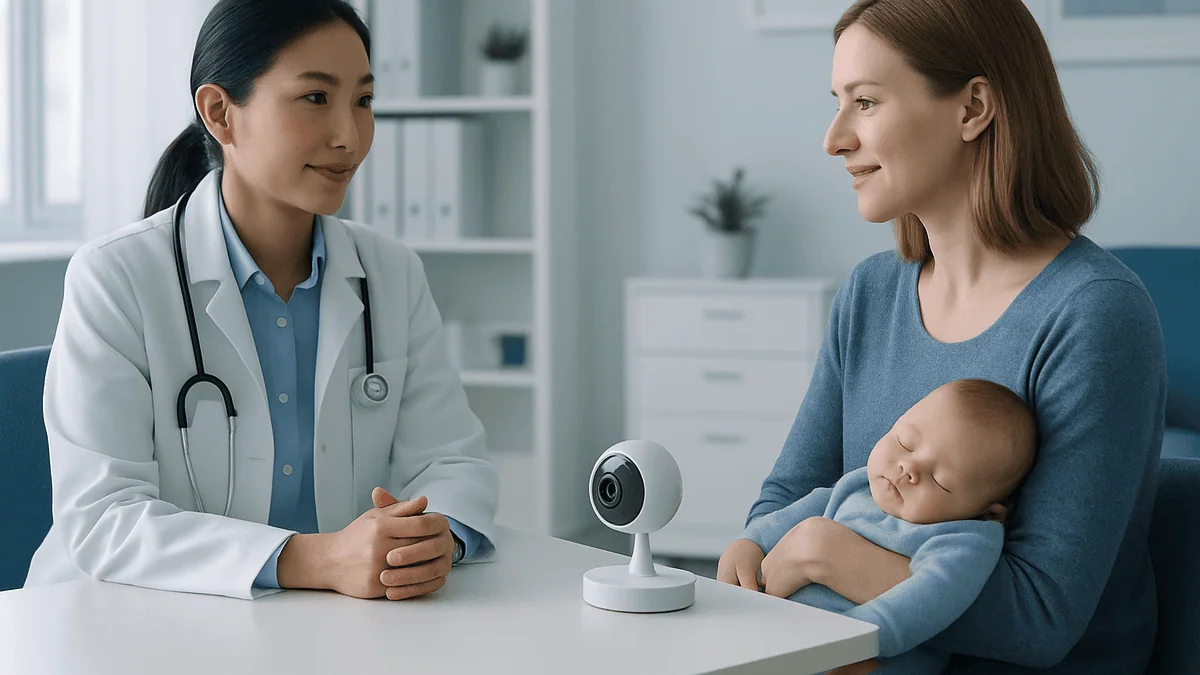
A conventional baby monitor is a one-way radio or camera: you hear or see the crib, nothing more. A smart baby monitor adds sensors, software and a smartphone app, and it usually sends its readings through your home Wi-Fi to a cloud service that pushes notifications to your phone. The word “smart” describes connectivity and analysis, not a medical pedigree.
Three sensor families dominate the market. Wearable pulse-oximetry socks or ankle bands estimate blood oxygen and pulse rate. Movement sensors, either flat pads placed under the mattress or small clips attached to the diaper, detect the tiny body motions that accompany breathing and alarm when motion stops for a set interval. Camera-based systems use computer vision, which is software that interprets video, to watch the rise and fall of the chest and report a breathing rate without touching the baby.
Regulatory status matters more than the packaging suggests. Most of these products are sold as “wellness” devices, a category that is not reviewed by regulators for medical performance. A small number have been cleared by the US Food and Drug Administration, which means the agency examined evidence that the device measures what it claims to measure in the population it names. Clearance does not mean the device has been shown to prevent any illness or death, and the labeling of the cleared infant socks says so plainly.
The condition driving most purchases is sudden infant death syndrome, or SIDS: the unexplained death of a baby under one year, usually during sleep, that remains unexplained after a full investigation. SIDS sits inside a broader category, sudden unexpected infant death (SUID), which also includes accidental suffocation and deaths of undetermined cause. Keeping those definitions straight is the first step to reading any monitor claim critically.
How does a baby oxygen monitor sock actually work?
The sock is a consumer version of pulse oximetry, the technique behind the fingertip clip used in clinics. A small module shines red and infrared light through the side of the foot. Hemoglobin that is carrying oxygen absorbs these two wavelengths differently from hemoglobin that is not, so by comparing how much of each color passes through with every heartbeat, the device estimates oxygen saturation, written SpO2, which is the percentage of hemoglobin molecules currently carrying oxygen. The same pulsing signal yields a heart rate.
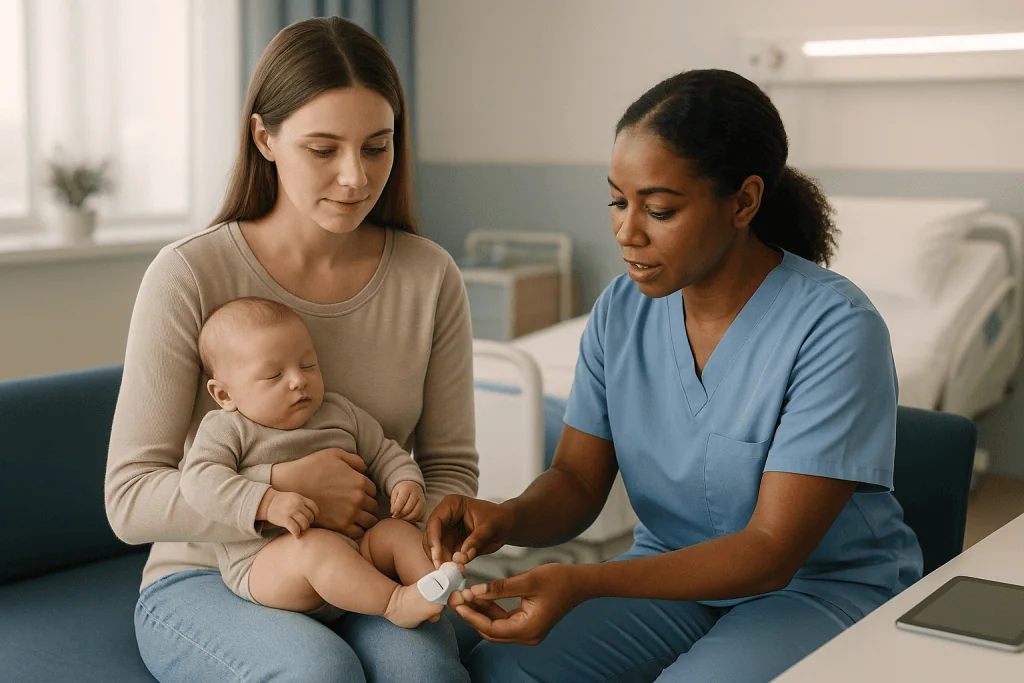
Healthy infants typically run at an SpO2 of 95–100% while awake. During sleep, especially in the first weeks, brief dips are normal and settle on their own within seconds; newborns also show periodic breathing, a pattern of short pauses of up to about ten seconds followed by faster breaths, which hospital teams consider ordinary at that age. A device that averaged readings over a very short window would alarm constantly, so consumer socks apply smoothing and a delay before notifying, and manufacturers set the alert thresholds themselves.
Several things degrade the signal. Movement blurs the pulsing light pattern. Cold feet with poor blood flow produce a weak signal. A loose or shifted sock lets ambient light leak in. Pulse oximetry in adults has been shown to overestimate oxygen levels in people with darker skin, and the data on infant consumer devices across skin tones are still thin, so that remains an open question rather than a settled one.
The practical takeaway is that a sock reading is an estimate produced under home conditions by a device built for healthy babies. It can be informative; it is not the continuous, clinician-reviewed monitoring used in a neonatal unit.
Baby breathing monitors: pads, clips and cameras explained
A baby breathing monitor rarely measures breathing directly. It measures movement and assumes that movement equals breathing, which is true most of the time and misleading at exactly the moments that matter most.
Under-mattress pads contain pressure or vibration sensors sensitive enough to pick up the chest and belly motion of a sleeping infant through a firm mattress. If no motion is detected for a preset interval, often 15–20 seconds, the base unit sounds an alarm. Diaper clips work on the same principle with an accelerometer, a small motion sensor, resting against the abdomen. Camera systems analyze pixel changes in the video frame to count breaths, and they need a clear line of sight, enough light and an uncovered chest or back to do it.
Each design has a characteristic blind spot. Pads can be triggered falsely when a baby wriggles to the edge of the mattress beyond the sensor’s reach, and they can be falsely reassured by vibration from a fan, a passing truck or a parent leaning on the crib. Clips fall off or twist. Cameras lose the signal when a baby rolls, when a swaddle hides the chest or when a sibling walks past.
The more important limit is physiological. Obstructive apnea, a blocked airway with continued effort to breathe, keeps the chest moving while no air flows, so a movement sensor registers nothing wrong. A baby who is breathing but with a falling oxygen level, for example during a viral illness, also looks normal to a motion pad. None of these devices measures airflow or oxygen, and none can tell you why movement stopped.
What changed recently
Three developments explain why this topic is surging now, and each carries a date worth knowing.
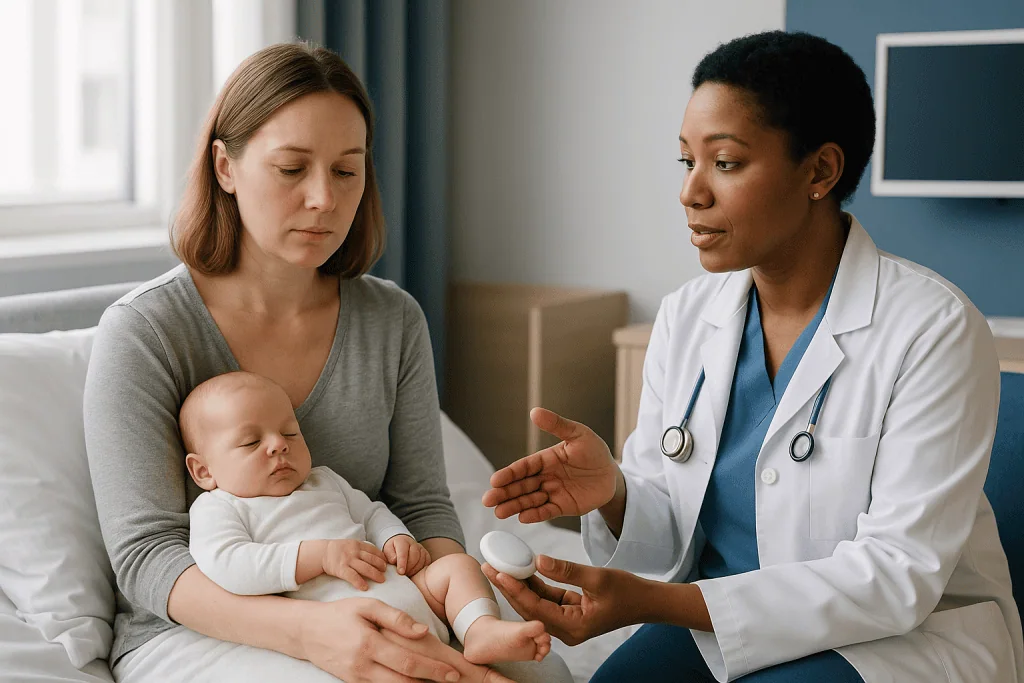
In June 2022 the American Academy of Pediatrics published its updated safe sleep policy, which states in plain language that home cardiorespiratory monitors should not be used as a strategy to reduce the risk of SIDS. The National Institutes of Health’s Safe to Sleep campaign echoes that position, noting that no product marketed to reduce SIDS has been shown to do so.
In 2023 the regulatory picture shifted. In June the FDA cleared a prescription-only infant pulse-oximetry monitor intended for babies with diagnosed conditions whose clinicians want oxygen and pulse data at home. In November the first over-the-counter consumer sock was cleared to display oxygen saturation and pulse rate and to send notifications for healthy infants within a defined age and weight range. Both clearances came with labeling that excludes any claim of preventing or diagnosing SIDS. This followed a period in late 2021 when the agency had warned that an earlier consumer version was functioning as an unapproved medical device, which led the maker to remove its oxygen alerts until clearance was obtained.
The epidemiology has not improved. CDC data count roughly 3,700 sudden unexpected infant deaths in the United States in 2022, about 1 in every 1,000 live births, a figure that has barely moved in more than a decade after the steep decline of the 1990s. The same CDC pages that report those numbers list the sleep-environment changes that drove the earlier fall, and monitors are not among them.
Put those facts together and you get the current moment: better engineered sensors, clearer regulatory limits, unchanged guidance, and a social-media stream that tends to show only the alarms that ended well.
Do baby monitors prevent SIDS? What pediatric guidance says
No. That answer comes from the organizations that review the evidence most closely, and the reasoning behind it is more instructive than the verdict.
The prevailing scientific model describes SIDS as the result of three overlapping factors: a vulnerable infant, a critical window of development, usually between one and four months, and an external stressor such as face-down sleep or soft bedding. In this model the baby fails to rouse and recover from a challenge that a less vulnerable infant would shrug off. A monitor cannot change the vulnerability or the developmental window; it can only shorten the time between a dangerous event and a parent’s response, and only if the event produces a signal the device can see and the parent can act on in time.
The most ambitious attempt to test the premise was the Collaborative Home Infant Monitoring Evaluation, known as CHIME, published in 2001. Researchers monitored more than 1,000 infants, including healthy term babies, premature babies and siblings of SIDS victims, through more than 700,000 hours of home recording. Prolonged pauses and slow heart rates turned out to be common even in healthy term infants, and the extreme events clustered in premature babies before 43 weeks post-conceptional age, which is earlier than the peak age for SIDS. The authors concluded that home monitoring was unlikely to identify the babies at risk of SIDS.
Guidance also weighs harm. Pediatric groups worry that a glowing green reading can tempt an exhausted parent to relax the practices that do have evidence: placing the baby on the back, on a firm flat surface, in the parents’ room without soft bedding. A device that nudges families away from those habits could, in principle, raise risk rather than lower it, and that is why the recommendation against relying on monitors is firm.
What the evidence actually says, graded by strength
Grading the evidence means asking what kind of study produced each claim, because a bench test and a randomized trial answer very different questions.
Randomized controlled trials: none exist testing whether a consumer monitor reduces SIDS or SUID. Such a trial would need to enroll hundreds of thousands of infants to detect a difference in an outcome that affects about 1 in 1,000, so the gap is unlikely to be filled. Claims of prevention therefore rest on no trial evidence at all.
Large observational cohorts: the CHIME study is the strongest, and it supports the opposite of the marketing message: the events monitors detect do not reliably mark the infants who go on to die.
Device accuracy studies: a 2018 comparison published in JAMA tested two popular consumer monitors against hospital-grade equipment in 30 hospitalized infants. The pulse-oximetry sock detected low-oxygen episodes with a sensitivity of about 89%, meaning it caught roughly 9 in 10 true events, and a specificity of about 86%, meaning it stayed quiet during roughly 86% of normal periods. The abdominal-band device in the same study missed every episode of low oxygen and produced frequent false alarms. This is moderate-quality evidence about measurement, not about outcomes.
Surveys of parents: several, some funded or co-authored by manufacturers, report high satisfaction and a sense of reassurance. Surveys capture opinion, not safety, and they cannot measure the babies who were not helped.
Expert consensus: the pediatric and public-health position against using monitors for SIDS prevention is unanimous across the organizations cited in this article.
Read together, the evidence supports a narrow conclusion. A well-engineered sock can measure oxygen and pulse with useful accuracy in the right conditions. Nothing supports the leap from a decent measurement to a prevented death.
Oxygen sock, movement pad or smart camera: a side-by-side comparison
Parents often compare these products on battery life and app design. The comparison that matters is what each sensor can and cannot physically detect, and how strong the supporting evidence is.
| Sensor type | What it measures | Can flag | Cannot detect or guarantee | Evidence for the measurement | Evidence for preventing SIDS |
|---|---|---|---|---|---|
| Pulse-oximetry sock or band | Oxygen saturation (SpO2) and pulse rate from light through the foot | Sustained low oxygen or abnormal pulse, if the sock fits and the baby is still | Why oxygen fell; events shorter than its averaging window; readings during movement or cold feet | Moderate: small lab comparisons; one consumer model FDA-cleared for measurement | None |
| Under-mattress movement pad | Body motion through the mattress | Absence of motion for a set interval | Blocked airway with chest still moving; falling oxygen while breathing; baby beyond sensor range | Weak: few independent studies | None |
| Diaper clip motion sensor | Abdominal movement via accelerometer | Absence of motion for a set interval | Same limits as pads; detached or twisted clip | Weak | None |
| Camera-based breathing tracker | Chest rise counted by video analysis | Change or loss of visible breathing motion | Covered chest, poor light, baby out of frame, obstructive apnea | Weak: mostly manufacturer data | None |
| Standard audio or video monitor | Sound and picture only | Crying, obvious distress | Any physiological change | Not applicable | None |
One column stays identical down the page. Whatever the sensor, the evidence that it prevents SIDS is absent, and that is not a gap waiting for the next firmware update; it is a reflection of what the condition is and how it unfolds.
The differences that do exist are about measurement quality. A cleared oximetry sock is the only consumer category with independent accuracy data, which is why it dominates clinical conversations, and why its limits deserve the closest reading.
False alarms, missed events and what accuracy means at home
Two statistics describe any alarm system. Sensitivity is the share of real events the device catches. Specificity is the share of normal nights it leaves alone. Both numbers sound reassuring in the high 80s until you multiply them by thousands of nights.
Consider a baby monitored for ten hours a night for a year, about 3,650 hours. Genuine dangerous events in a healthy infant are vanishingly rare, so almost every alarm that sounds will be a false one, even with a specificity well above 90%. In the 2018 JAMA comparison, the better-performing sock still produced false alarms, and the abdominal band alarmed repeatedly while never catching a true low-oxygen episode. Pediatricians describe the downstream effects: families arriving in emergency departments after an alarm with a baby who looks perfectly well, and parents who stop responding to the alert tone because it has cried wolf too often. Alarm fatigue is a well-documented hazard in hospitals, and nurseries are not immune.
Missed events are the quieter problem. A sock that has slipped reads nothing. A pad that has lost contact with a wriggling baby may register the vibrations of a ceiling fan as breathing. A camera cannot see through a sleep sack. Each of these failure modes produces a screen that looks normal, which is more dangerous than a screen that looks alarming.
There is also the question of what a true alarm buys you. Oxygen levels in a baby with a blocked airway or an interrupted drive to breathe can fall within tens of seconds. By the time a notification travels from sock to base station to cloud to phone, and a parent wakes and reaches the crib, the window for a simple stimulus to help may already be closing. The device may document an event with great precision and still arrive after the moment it could have changed.
When might a doctor prescribe a home monitor for a baby?
Medical home monitoring exists, and it is a different product used for a different purpose. Understanding the difference clarifies where consumer devices fit.
Neonatologists sometimes send a premature baby home with a cardiorespiratory monitor for apnea of prematurity, a condition in which an immature brainstem intermittently forgets to trigger breaths. The monitor is prescribed for a defined period, usually until the pattern has resolved on its own, and its stored recordings are downloaded and reviewed by the care team. Babies discharged on home oxygen for chronic lung disease of prematurity may be sent home with a prescription pulse oximeter so parents and clinicians can track oxygen during weaning. Certain airway abnormalities, some heart conditions and selected cases after a brief resolved unexplained event, or BRUE, which is a sudden, short episode of color change, breathing change or limpness that has fully resolved by the time the baby is examined, can also prompt a clinician to recommend monitoring while a cause is sought.
Several features separate these arrangements from a consumer purchase. The device is chosen for the diagnosis, the thresholds are set by the clinician, the data are reviewed by someone trained to interpret them, and the family receives instruction in infant cardiopulmonary resuscitation before discharge. The monitoring is also time-limited, with a plan for when it stops.
The 2023 prescription clearance of an infant oximetry sock brought the consumer form factor into this clinical space, but it did not change the logic: a monitor prescribed for a known condition is part of a treatment plan, not a general safety net. Whether any baby needs one, which device, and for how long are decisions that belong to the treating pediatrician or neonatologist, who can weigh the individual history against the evidence.
Can a smart baby monitor help parents sleep, or does it add anxiety?
The honest answer is that both happen, often to the same parent in the same week, and the research is too thin to predict which way it will go for you.
Surveys of owners, including large manufacturer-sponsored ones, report that most parents feel reassured and say they sleep better knowing a sensor is watching. Pediatricians report the opposite pattern in a meaningful minority: parents who check the app dozens of times a night, who cannot settle until the oxygen number climbs back to where it was an hour ago, and who describe a red alert at 3 a.m. as the most frightening moment of early parenthood even after the baby turned out to be fine. Neither account is wrong; they describe different families.
Postpartum anxiety is common, affecting a substantial share of new parents in the first year, and it feeds on checkable numbers. A device that offers a fresh reading every few seconds can become a focus for worry in someone already prone to it, in the same way a home blood pressure cuff can for an anxious adult. The expert view, which is opinion rather than trial data, is that a monitor earns its place only if it reduces nighttime checking; if it increases it, the device is working against you.
A few practical signals help. If you find yourself waking to look at the app when no alarm has sounded, if a single dip in the graph keeps you up afterward, or if you have begun to resent the device yet feel unable to switch it off, that pattern is worth raising with your own doctor or midwife. Help for perinatal anxiety is effective, and no gadget is a substitute for it.
Safe sleep: the measures with the strongest evidence
If the goal is a lower risk of sudden infant death, the interventions with real evidence are inexpensive, low-tech and backed by decades of population data. SIDS rates in the United States fell by roughly half after the 1994 Back to Sleep campaign persuaded parents to stop placing babies face down, one of the clearest public-health successes of the era.
The current recommendations from the CDC, NIH, NHS and major pediatric bodies converge on the same list:
- Place the baby on the back for every sleep, naps included, until the first birthday.
- Use a firm, flat, non-inclined surface with a fitted sheet and nothing else: no pillows, bumpers, loose blankets, soft toys or positioners.
- Keep the baby’s sleep space in the parents’ room, but not in the parents’ bed, ideally for the first six months.
- Avoid overheating; dress the baby in one more light layer than an adult would wear and keep the head uncovered.
- Breastfeed if you can; any breastfeeding is associated with lower risk, and longer duration with lower risk still.
- Offer a pacifier at sleep time once feeding is established.
- Keep the home and car smoke-free, and avoid smoking, alcohol and sedating drugs during pregnancy and after birth.
- Keep routine childhood immunizations up to date; vaccinated infants have lower observed SIDS rates in multiple studies.
These measures work on the stressor side of the triple-risk model. They do not require a baby to reach a threshold, a sock to stay snug or a phone to be off silent mode. A smart baby monitor can sit alongside them without harm, provided it never displaces them; the moment a parent chooses a stomach position because the oxygen number looks fine, the device has quietly made the night less safe.
Baby monitor with smartphone app: connectivity, privacy and failure points
Most smart monitors can connect to a phone app, and the chain between sensor and screen is longer than the glossy product page implies. A typical path runs sock to base station by short-range radio, base station to home router by Wi-Fi, router to the manufacturer’s cloud, cloud to your phone’s notification service, and finally to a device whose settings you control. A weak link anywhere produces silence, and silence looks identical to safety.
The common breaks are mundane. A phone set to Do Not Disturb or low-power mode may delay or suppress notifications. A router reboot after a power flicker drops the base station offline. A battery that slipped to 5% during a long nap dies at midnight. A cloud outage at the company’s end, which has happened to several brands across the industry, stops every alert for every customer at once. Firmware updates occasionally change default thresholds. None of this is unique to baby products; all of it is worth knowing before you trust the system with your sleep.
Privacy is the second concern. A camera streaming video of a sleeping child to a remote server is only as secure as the password protecting it, and default or reused passwords have led to publicized intrusions on home cameras. Choosing a unique password, enabling two-factor authentication where offered, keeping the app updated and reading what the company does with health data are reasonable minimums.
Treat the app as a notifier that can fail, not a guardian that cannot. The base station alarm in the room, which does not depend on the internet, is the more reliable layer, and a parent sleeping within earshot remains the most reliable layer of all.
Common myths about smart baby monitors
Viral clips travel faster than footnotes. These are the claims that circulate most, and what the evidence says about each.
“FDA cleared means proven to prevent SIDS.” Clearance means the device measures oxygen and pulse acceptably in the population named on the label. The labeling of the cleared infant socks explicitly disclaims any role in preventing or diagnosing SIDS.
“The alarm went off, so the device saved my baby.” Most alarms are false, and many true ones capture brief dips that resolve on their own in healthy infants, as the CHIME study documented thousands of times. A baby who is fine after an alarm was most often going to be fine without it. Individual stories cannot distinguish the two, which is exactly why trials exist.
“If the reading is normal, tummy sleeping is safe.” A normal reading describes the previous few seconds. Back sleeping reduces risk across the whole night and is the single best-supported protective measure.
“A movement pad will catch choking or a blocked airway.” Pads detect motion. A baby struggling against an obstruction keeps moving, and the pad stays quiet.
“Consumer socks are as accurate as hospital monitors.” The best consumer device studied caught about 9 in 10 low-oxygen episodes under controlled conditions, which is useful and clearly short of hospital-grade continuous monitoring with trained staff reading the trace.
“A night of green readings proves the baby had no breathing problem.” A slipped sock, a dead battery or a phone on silent all produce the same uneventful screen. Absence of alarms is not evidence of absence of events.
None of these corrections means the devices are useless. They mean the devices are instruments with defined capabilities, and the safest way to own one is to know those limits as well as the manufacturer does.
When to see a doctor
A monitor is never the reason to seek care, and never the reason to delay it. Your eyes, ears and hands remain the primary sensors, and the signs below call for medical attention whatever the app says.
Call emergency services immediately if your baby:
- Stops breathing for longer than about 20 seconds, or has repeated shorter pauses with color change.
- Turns blue, gray or very pale, especially around the lips, tongue or face.
- Is limp, floppy or unusually difficult to wake.
- Has a seizure, or stiffens and jerks rhythmically.
Contact your pediatrician or an urgent care service the same day if you notice:
- Breathing that is persistently fast, more than about 60 breaths a minute at rest.
- Grunting with each breath, flaring nostrils or the skin pulling in between or below the ribs.
- Any fever in a baby under three months, or a temperature that worries you at any age.
- Poor feeding, far fewer wet diapers than usual, or a baby who seems “not themselves” in a way you cannot pin down.
- Any brief episode of color change, limpness or breathing change that resolved on its own; this is the pattern clinicians call a BRUE, and it should be evaluated even when the baby looks well afterward.
Repeated monitor alarms also deserve a conversation, not because the device has diagnosed anything, but because a pediatrician can examine the baby, check the sock fit and settings, and decide whether any investigation or a prescription-grade monitor is warranted. Skin marks, redness or sores under a sock or band are a reason to stop using it and ask for advice. Decisions about whether to monitor at all, which device to use and when to stop belong to the clinician who knows your baby’s history.
Frequently asked questions
What is the best smart baby monitor?
There is no single best model, and no model has been shown to prevent SIDS, so the question is really which device measures most reliably and disturbs you least. Look for a device with published, independent accuracy data, clearance for the specific function you want, a low rate of false alarms in real homes, a base-station alarm that works without the internet, and clear privacy protections. Then ask your pediatrician whether your baby has any reason to need monitoring at all.
Do baby monitors prevent SIDS?
No. Pediatric and public-health organizations in the United States and the United Kingdom agree that home cardiorespiratory monitors should not be used as a strategy to reduce SIDS risk. The largest study of home monitoring found that the pauses and slow heart rates monitors detect are common in healthy infants and do not pick out the babies who go on to die. Safe sleep practices, led by back sleeping, remain the evidence-based protection.
Is a baby oxygen monitor sock safe to wear all night?
For most healthy babies within the age and weight range on the label, nightly wear appears to be tolerated, and the cleared models were reviewed for skin safety. Pressure marks, redness or small sores on the foot do occur, usually from a sock that is too tight or worn in the same position for many nights. Check the skin daily, alternate feet if the instructions allow, and stop using it and ask your doctor if any mark does not fade quickly.
What oxygen level is normal for a baby?
Healthy infants usually read between 95% and 100% while awake, and brief dips during sleep are common and resolve within seconds, particularly in newborns. Consumer socks apply averaging and delays so these normal dips do not trigger alerts, and the thresholds are set by the manufacturer. A single home reading should not be interpreted on its own; if you are worried about a pattern of low numbers, bring the data to your pediatrician rather than acting on it yourself.
Which baby monitors connect to smartphone apps?
Nearly all smart monitors do, across every sensor type: oximetry socks, under-mattress pads, diaper clips and camera-based breathing trackers. The app typically shows live readings, trend graphs and sleep summaries and sends push notifications. Because that route runs through Wi-Fi, a cloud server and your phone settings, it can fail silently; a base station with its own alarm, placed where a parent will hear it, is the more dependable layer for any alert.
Does a smart baby monitor have anything to do with SMART goals or the SMART methodology?
No. Searches for these terms overlap only because of the word itself. SMART goals and the SMART methodology refer to a management framework for writing objectives that are Specific, Measurable, Achievable, Relevant and Time-bound. A smart baby monitor is a nursery device whose name simply means it has sensors and connects to a phone app. The two share a spelling and nothing else.
Can a baby breathing monitor detect choking or reflux?
No. Movement-based monitors detect only whether the body is moving, and a baby who is choking, coughing or working against a blocked airway continues to move, so the device stays quiet. Oxygen socks may eventually register a drop in saturation if an episode is prolonged, but by then the event is well under way. Choking and significant reflux are recognized by watching and listening to the baby, and any episode involving color change needs medical assessment.
My monitor alarmed but my baby looked fine. What should I do?
Look at the baby first, every time, before you look at the screen: color, breathing effort, responsiveness. If all three are normal, a false alarm from movement, a loose sensor or cold feet is by far the most likely explanation. If anything about the baby looked wrong, even briefly, treat it as a possible brief resolved unexplained event and contact your doctor or emergency services. Mention repeated alarms at your next visit so the pediatrician can review the pattern and the device setup.
Can a smart monitor replace room-sharing or safe sleep rules?
No. Room-sharing without bed-sharing, back sleeping, a firm flat surface and a bedding-free crib are associated with large reductions in risk across whole populations, while monitors have no outcome evidence at all. A monitor placed in a separate nursery substitutes a notification chain with several failure points for a parent who can hear and reach the baby directly. If you use a device, it should sit on top of the safe sleep basics, never in place of them.
Should a premature baby use a consumer monitor at home?
That decision belongs to the neonatal team who discharged the baby. Premature infants with apnea of prematurity or on home oxygen are sometimes sent home with prescription-grade monitors whose alarms are set and reviewed by clinicians, along with training in infant resuscitation. Consumer socks are labeled for healthy babies within specific age and weight ranges, and a preterm infant may fall outside them. Ask the neonatologist before buying anything, and follow their plan for when monitoring should stop.
References
- CDC: About Sudden Unexpected Infant Death and Sudden Infant Death Syndrome
- NIH Safe to Sleep: Ways to Reduce Baby's Risk
- NHS: Sudden infant death syndrome (SIDS)
This article is for general information only and is not a substitute for professional medical advice. Please consult a qualified doctor about your individual situation.

More from the Blog
Garmin Body Battery and HRV Status: What the Scores Actually Mean
Garmin Body Battery is a 5-to-100 estimate of your energy reserves, modeled from heart rate, heart rate variability, stress and sleep rather than measured…

AI Scribes: Why Your Doctor’s Note Is Now Written by Software, and What It Means for You
An AI scribe is software that listens to a medical visit, usually through a phone or room microphone, and drafts the clinical note the…
Chest Strap vs Wrist Heart Rate: Why the Strap Still Wins for Accuracy
A chest strap heart rate monitor reads the heart's electrical signal through electrodes on the skin, so it typically tracks within about one beat…
Apple Watch ECG and AFib Alerts: What a Single-Lead Trace Can and Cannot Detect
The Apple Watch ECG records a single-lead electrocardiogram from the wrist and fingertip in 30 seconds and can classify the rhythm as sinus rhythm,…

AI in Healthcare: What It Already Does in Hospitals, and Where It Falls Short
AI in healthcare currently helps hospitals read medical images, flag patients at risk of deterioration such as sepsis, draft clinical notes from recorded visits,…
Home Blood Pressure Monitors: Wrist vs Arm and How to Take a Reading That Counts
For most adults, the best home blood pressure monitor is an automatic upper-arm cuff that has passed independent validation testing and fits your arm…