

Snap-In Dentures Cost: Implant-Retained Options Priced Honestly
Key Takeaways
- An implant-retained snap-in denture runs EUR 2,600–5,850 per jaw in our guide range, versus GBP 3,000–7,000 typical in the UK and USD 6,000–18,000 in the US.
- Implant count is the biggest price lever: lower jaws often need only two implants, while upper jaws usually require four because the bone is softer.
- Snap-in dentures typically cost less than fixed All-on-4 bridges (guide range EUR 3,250–8,450 per jaw) and often need less bone grafting.
- The nylon attachment inserts are consumables that wear with daily snapping and need periodic replacement: a recurring cost most headline prices omit.
- Bone grafts (EUR 130–600 per site) and sinus lifts (EUR 800–1,950) are the most common unquoted extras, so insist on a price given after 3D imaging, not before.
- Insurance often covers the denture portion but excludes or caps the implants, so request a written pre-treatment estimate before committing to a plan.
An implant-retained snap-in denture typically runs EUR 2,600–5,850 per jaw in our guide range, covering two to four implants plus the overdenture. UK patients usually pay GBP 3,000–7,000 and US patients USD 6,000–18,000 for comparable treatment. Final cost depends on implant count, attachment system, any bone grafting, and whether extractions and temporary teeth are included.
There’s a tube of denture adhesive in a lot of bathroom drawers, and it tells a quiet story: teeth that move when they shouldn’t. The corn on the cob passed along at a barbecue. The apple sliced thin, just in case. According to the CDC, roughly one in six American adults over 65 has lost all their natural teeth, and a conventional lower denture, resting on a shrinking ridge of gum, is famously hard to keep still.
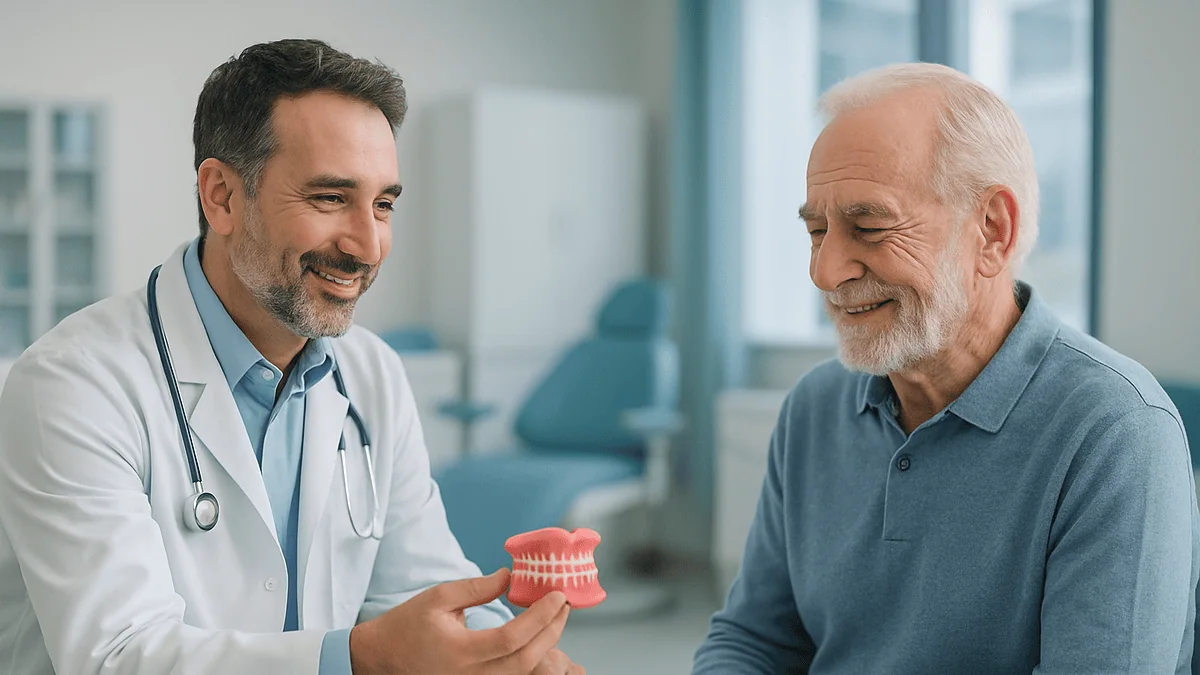
Snap-in dentures were designed to end that negotiation. Two to four small titanium implants anchor the denture with click-in attachments, so it stays put through a steak and comes out at night for cleaning. The engineering is elegant. The pricing, across clinics and countries, is anything but.
So let’s do what a good consumer magazine should: put real ranges on the table, explain what drives them, and name the costs that rarely make it into the headline figure.
How much do snap-in dentures cost per jaw?
The honest answer is a range, not a number, because a snap-in denture is really two projects in one: implant surgery and a custom prosthesis. Here is how the main figures compare across markets, alongside the procedures most often quoted next to them.
| Procedure | Turkey market average | Our guide range | UK typical | US typical |
|---|---|---|---|---|
| Implant-retained snap-in denture (2–4 implants, per jaw) | EUR 2,000–4,500 | EUR 2,600–5,850 | GBP 3,000–7,000 | USD 6,000–18,000 |
| Single dental implant incl. crown | EUR 400–1,400 | EUR 500–1,800 | GBP 1,800–3,500 | USD 3,000–6,000 |
| All-on-4 (per jaw, incl. fixed provisional) | EUR 2,500–6,500 | EUR 3,250–8,450 | GBP 10,000–18,000 | USD 18,000–30,000 |
| Dental bone graft (per site) | EUR 100–450 | EUR 130–600 | GBP 200–1,500 | USD 300–3,000 |
| Sinus lift | EUR 600–1,500 | EUR 800–1,950 | GBP 800–2,500 | USD 1,500–5,000 |
| Same-day/immediate-load implant premium over standard | EUR 0–300 | EUR 0–400 | GBP 200–700 | USD 500–1,500 |
Prices last reviewed: August 2026. These are guide ranges for international patients, based on published market data – not a quote. Your exact price depends on your clinical assessment; you will receive a personalised treatment plan and fixed quote after consultation.
Notice the spread in the US column especially. A two-implant lower overdenture with basic attachments sits at the bottom; a four-implant version with a bar-retained design and premium components sits at the top. Neither is a trick: they’re genuinely different treatments wearing the same name.
What exactly is a snap-in denture, and why implants change the math?
A conventional denture holds on by suction and gravity. A snap-in denture, dentists call it an implant-retained overdenture, holds on by hardware. Small titanium posts are placed in the jawbone, where they fuse with the bone over several months through a process called osseointegration, as the Mayo Clinic describes it. The denture itself carries sockets on its underside, usually lined with nylon inserts, that click onto ball- or locator-style attachments on the implants.
The engineering matters most in the lower jaw. After teeth are lost, the bone that once held them gradually resorbs, and the lower ridge in particular becomes a narrow, slippery foundation. That’s why lower dentures are the classic complainers, and why research on implant overdentures has focused there. Prosthodontic consensus going back two decades holds that a two-implant lower overdenture should be considered the minimum standard of care for a toothless lower jaw, precisely because stability and chewing function improve so consistently.
The upper jaw is a different calculation. Uppers get natural suction from the palate, so a conventional upper denture behaves better, but if you want an implant-retained upper, most clinicians will want four implants rather than two, because upper bone is softer. That single anatomical fact can add meaningfully to the surgical fee.
So when you compare quotes, the first question is never “how much?” It’s “how many implants, in which jaw, with which attachment system?” Everything downstream of price flows from those three answers.
Why does the snap-in dentures price vary so much between quotes?
Two quotes for “snap-in dentures” can differ by thousands and both be fair. Here’s what actually moves the figure:
- Implant count. Two implants versus four is the single biggest lever. A lower two-implant overdenture is the entry point; a four-implant upper is the other end of the range.
- Attachment system. Individual stud attachments are simpler and cheaper. A milled bar connecting the implants distributes force better in some cases but adds laboratory work and cost.
- The denture itself. Acrylic teeth on an acrylic base is standard; reinforced frameworks and premium tooth materials cost more and resist wear longer.
- Bone condition. If the ridge has resorbed significantly, grafting (EUR 130–600 per site in our guide range) or a sinus lift for the upper jaw (EUR 800–1,950) enters the plan.
- Extractions and temporaries. If failing teeth must come out first, extractions plus an interim denture to wear during healing add real money, sometimes inside the quote, sometimes not.
- Imaging and planning. 3D cone-beam CT scanning and guided surgery improve precision; some clinics bundle it, others itemize.
- Geography and overheads. The same components and comparable surgical training cost dramatically different amounts in Istanbul, London, and Chicago, which is why the table above reads the way it does.
A useful habit: when a quote looks surprisingly low, assume something from this list has been left for later, and ask which item it is. Reputable clinics will tell you plainly.
Are snap-on dentures cheaper than implants?
Mostly yes, and the reason is arithmetic, not quality. Replacing a full arch with individually implanted teeth would take many implants and many crowns; at EUR 500–1,800 per single implant with crown in our guide range, a mouthful of them multiplies quickly. A snap-in denture achieves full-arch function with just two to four implants because the denture spreads chewing forces across the whole ridge, with the implants acting as anchors rather than doing all the load-bearing themselves.
The fairer comparison is with fixed full-arch implant bridges like All-on-4, and there the snap-in option still comes in lower: EUR 2,600–5,850 per jaw versus EUR 3,250–8,450 in our guide ranges, with the gap widening sharply in UK and US pricing.
But “cheaper” needs one asterisk. A removable overdenture carries ongoing costs, replacement inserts, periodic relines, an eventual new denture, that a fixed bridge structures differently. Over a decade, the gap narrows somewhat, though the snap-in route usually stays the more affordable path into implant dentistry.
There’s also a strategic point worth an opinion: a snap-in denture is often the smartest first move for someone leaving conventional dentures behind. It delivers the biggest single quality-of-life jump, stability, at the lowest implant count, and in many cases the implants can later support an upgraded prosthesis if you choose to invest more down the road. Cheapest and shrewdest are not always the same thing; here, they frequently are.
Snap-in dentures vs All-on-4: which actually suits you?
These two get pitched as rivals, but they answer different questions. All-on-4 fixes a full bridge to four (or more) implants permanently: you clean it in your mouth, like natural teeth, and only a dentist removes it. A snap-in denture comes out every night.
Cost favors the snap-in route in every market. Beyond price, the trade-offs run roughly like this:
- Stability under load: a fixed bridge wins; it doesn’t move at all. A snap-in denture is dramatically more stable than a conventional denture but can still have micro-movement.
- Hygiene: the snap-in wins for many people, especially those with dexterity issues. Taking the denture out makes cleaning implants straightforward; cleaning under a fixed bridge takes technique and diligence.
- Bulk and speech: fixed bridges are usually slimmer. Upper snap-in dentures can often be made without full palate coverage, but some acrylic bulk remains.
- Bone requirements: snap-in designs are frequently viable with less bone, since two well-placed lower implants may suffice, sometimes avoiding grafts that a fixed solution would need.
- Repairs: a removable denture is easier and cheaper to adjust, reline, or remake.
The Cleveland Clinic’s patient guidance on dentures makes a point worth underlining: the best prosthesis is the one matched to your anatomy, habits, and maintenance tolerance, not the one with the most impressive name. Someone who wants to forget they ever had dentures may find the fixed option worth its premium. Someone who values easy cleaning and a lower entry price often lands, happily, on the snap-in side.
What's included in the quoted price, and what quietly isn't?
Two clinics can quote the same figure for very different baskets of care. Before comparing numbers, compare contents. A genuinely complete snap-in denture quote should cover:
- Consultation, 3D imaging, and treatment planning
- The implants themselves, plus the attachment abutments (a component surprisingly often itemized separately)
- Surgical placement and standard local anesthesia
- The final overdenture, made to fit the attachments
- Follow-up visits and initial adjustments, new dentures almost always need fine-tuning
The items that most often live outside the headline price:
- Extractions of remaining failing teeth, and any surgical extractions
- A temporary denture for the healing months between surgery and the final prosthesis: you will want teeth during this period
- Bone grafting or a sinus lift if the assessment reveals insufficient bone (see the table for guide ranges)
- Sedation beyond local anesthesia, if you choose it
- Replacement attachment inserts, which are consumables, not a one-time purchase
- Travel and accommodation, for anyone treating abroad, plus the return visit some protocols require
My standing advice for any dental quote applies doubly here: ask for the price in writing as a single all-inclusive figure with exclusions listed by name. A clinic that itemizes confidently is telling you something reassuring about how it runs everything else.
What are the disadvantages of snap-in dentures?
An honest cost article owes you the downsides, because several of them are costs in disguise.
First, it’s still a removable denture. It comes out at night, most dentists advise removing any denture while you sleep so gum tissue can rest, guidance the NHS echoes for dentures generally, and some people simply dislike that ritual. There’s acrylic in your mouth, and uppers may still cover part of the palate depending on design.
Second, the attachments are consumables. The nylon inserts that create the satisfying snap wear down with daily clicking in and out. Expect them to need replacing periodically, often every year or two, sooner for heavy use, and expect that to be a recurring line in your dental budget.
Third, the denture needs maintenance the implants don’t. Gum ridges keep remodeling under a removable prosthesis, so relines (refitting the denture’s underside) become necessary over time, and the denture itself won’t last forever; the acrylic teeth wear and the base fatigues.
Fourth, it’s surgery. Implant placement carries the usual small risks, infection, implant failure to integrate, nerve irritation in the lower jaw, which the Mayo Clinic outlines candidly in its patient material. Success rates are high, but not universal, and smokers and people with uncontrolled diabetes face higher failure risks.
Finally, micro-movement. A snap-in denture is a revelation compared with a loose conventional denture, but it is not the immovable feel of a fixed bridge. Set expectations there, and satisfaction tends to follow.
The ongoing costs nobody puts in the headline price
Here’s the part the ads skip. The purchase price of a snap-in denture is the beginning of the spending, not the end of it, and a realistic budget looks past year one.
Attachment inserts. Those small nylon liners lose grip with use. When the denture starts feeling loose despite healthy implants, worn inserts are the usual culprit. Swapping them is a quick chairside job, but it recurs for as long as you wear the denture.
Relines. The bone and gum under a denture continue to change shape slowly: a normal process after tooth loss, as MedlinePlus notes in its overview of denture care. Periodic relines keep the fit snug and protect both comfort and the implants from uneven loading.
A replacement denture, eventually. Acrylic teeth flatten with years of chewing, and bases wear. Most overdentures are remade after a stretch of years rather than repaired indefinitely. The implants, if healthy, stay: you’re replacing the removable part, not restarting the surgery.
Professional maintenance. Implants are not immune to gum disease; a condition called peri-implantitis can threaten them, and prevention is routine hygiene visits plus scrupulous home cleaning. Those check-ups belong in the lifetime cost, and skipping them is the most expensive economy available.
None of this is an argument against snap-in dentures, fixed bridges and conventional dentures carry their own maintenance ledgers. It’s an argument for asking every clinic one question: “What will this cost me in year three?” The quality of the answer is diagnostic.
Will I need a bone graft or sinus lift first?
Possibly, and it’s one of the most common reasons two people with “the same treatment” pay different amounts. Implants need enough bone to grip, and jawbone shrinks steadily once teeth are gone. Someone who lost their teeth last year usually has more to work with than someone who has worn dentures for two decades.
The good news is that snap-in dentures are often the most graft-avoidant implant option. Two implants placed in the front of the lower jaw, where bone tends to remain densest longest, can anchor a lower overdenture even in mouths that couldn’t support a fixed bridge without major grafting. That’s part of why the per-jaw price stays comparatively modest.
The upper jaw is where surprises live. Bone there is softer, and the sinus cavities sit close above the back teeth. If an upper snap-in plan calls for implants toward the back, a sinus lift (EUR 800–1,950 in our guide range) raises the sinus floor and builds bone height first. Smaller localized grafts run EUR 130–600 per site. Both add healing time as well as money.
You can’t know your bone situation from a mirror. A 3D cone-beam CT scan settles it in minutes, which is why any serious quote should follow imaging, not precede it. Treat a price given before a scan as a placeholder, useful for orientation, binding on no one.
Will insurance pay for snap-on dentures?
Sometimes partially, rarely fully, and the details vary enough that generalizations are dangerous. Here’s the honest lay of the land.
In the US, traditional dental insurance often covers dentures as a major service, typically at a percentage after deductibles, but many plans classify implants as elective and exclude them or cap them under a low annual maximum. Some plans will cover the denture portion of an implant-retained treatment while declining the implants themselves. Original Medicare historically excluded most routine dental care, though some Medicare Advantage plans include dental benefits with their own limits. The only reliable move is a written pre-treatment estimate from your insurer before you commit.
In the UK, the NHS provides conventional dentures under its banded charge system, but implant treatment is generally available on the NHS only in limited clinical circumstances, such as after cancer surgery or trauma. Most implant-retained dentures in the UK are private treatment, which is why the typical GBP 3,000–7,000 figure sits where it does.
Everywhere, tax-advantaged accounts (such as US health savings and flexible spending accounts) can often be applied to medically necessary dental treatment, softening the net cost.
One caution worth stating plainly: don’t let insurance categories choose your treatment. A plan that covers a conventional denture fully but a snap-in denture barely is answering an accounting question, not a clinical one. Get the clinical recommendation first, then work out the financing, not the other way around.
Why is the same treatment so much cheaper abroad, and is it safe?
Look again at the table: a snap-in denture that runs USD 6,000–18,000 in the US sits at EUR 2,600–5,850 in our guide range for treatment in Turkey. That’s not a typo, and it’s not, as a rule, a quality discount.
The gap is mostly structural. Clinician salaries, laboratory wages, rent, insurance, and staffing costs are simply lower in some countries, while the implants themselves often come from the same handful of global manufacturers whose components a US or UK clinic would use. High patient volumes at dedicated implant centers add economies of scale. The result is a genuinely lower cost of production, passed through as a lower price.
That said, distance changes the risk calculus in ways worth respecting. Implant treatment is not one appointment; it’s a sequence, surgery, healing over several months, fitting, adjustments, and adjustments are where removable dentures earn their keep. Sensible questions for any clinic abroad:
- How many visits does the full protocol require, and how long is each stay?
- Which implant brand and attachment system will be used, and will I receive documentation (an implant passport) so any dentist can service it later?
- What happens if an insert wears out or the fit drifts once I’m home, can a local dentist maintain this system?
- What is the complication policy, in writing?
Treatment abroad rewards the organized patient. Budget for travel and a follow-up trip, choose widely available component systems, and keep every record. Done that way, the savings in the table are real and keepable.
Who is a good candidate, and who should think twice?
The classic snap-in candidate is someone with a full lower denture that won’t behave: it lifts on chewing, needs adhesive, and has narrowed the menu. For that person, two implants can be transformative, and the cost-per-improvement is arguably the best value in implant dentistry.
Good candidacy generally means:
- Healthy gums and enough bone for the planned implant sites, or willingness to graft
- General health compatible with minor oral surgery; conditions like diabetes need to be well controlled, as the Cleveland Clinic notes in its implant guidance
- Commitment to daily cleaning and routine dental visits, since implants can develop gum disease just as teeth do
- Realistic expectations: dramatically more stable than a conventional denture, not identical to natural teeth
Reasons to pause or plan differently:
- Smoking, which measurably raises implant failure rates; many surgeons ask patients to stop before and after surgery
- Heavy grinding or clenching, which accelerates wear on attachments and teeth, sometimes manageable with a night-time removal routine, sometimes a reason to reconsider design
- Certain medical treatments affecting bone healing, which need discussion with both your physician and dentist before surgery is scheduled
- An upper jaw with severe bone loss, where the grafting required may shift the cost-benefit conversation toward other options
None of these is a verdict you can reach alone. A clinical exam plus 3D imaging turns “maybe” into a plan, and turns a guide range into a fixed quote.
How to read a snap-in denture quote like an editor
After years of comparing medical pricing, I’ve learned that the most revealing part of any quote is its specificity. Vague quotes hide variables; precise ones surrender them. Put every snap-in denture quote through this filter:
- Implant count and brand, named. “Implant-retained denture” without a number is a placeholder. Two versus four implants is the difference between the bottom and top of the range.
- Attachment system, named. Stud attachments and bar systems carry different lab bills and different maintenance profiles.
- Exclusions, listed. Extractions, temporary denture, grafting contingency, sedation. If the quote doesn’t mention them, the invoice eventually will.
- Timeline, stated. Standard protocols wait several months for osseointegration before the final denture; immediate-load options exist for suitable cases, usually at a modest premium (EUR 0–400 in our guide range). A quote that promises everything instantly to everyone deserves skepticism.
- Maintenance, priced. Ask what insert replacements and relines will cost. Clinics that answer readily are planning to see you again; that’s a good sign.
- Warranty terms, in writing. What’s covered if an implant fails to integrate, and for how long?
Then compare quotes on contents, not totals. A EUR 4,000 quote including extractions, temporaries, and follow-ups can beat a EUR 3,000 quote that includes none of them, and frequently does.
Living with snap-in dentures: what daily care really looks like
The daily routine is simple, but it is daily, and it protects a four-figure investment, so it belongs in any honest cost discussion.
Each night, the denture comes out. It gets brushed (a soft brush, no abrasive toothpaste, over a folded towel in case of drops, acrylic cracks on porcelain sinks) and soaks per your dentist’s instructions. Meanwhile, the attachments in your mouth get their own gentle brushing, along the gumline around each implant, because plaque there is what threatens the whole system. MedlinePlus and the NHS both emphasize that dentures and the tissues beneath them need cleaning as consistently as natural teeth ever did.
Mornings, the denture clicks back in, no adhesive, which for long-time denture wearers is half the point. Eating expands quickly: most wearers find that foods long ago abandoned, from raw carrots to crusty bread, come back onto the menu within weeks, though extremely sticky or hard items still warrant sense.
Twice a year (or as advised), a professional visit checks the implants, the gum health around them, the wear on the inserts, and the fit of the base. This is where small, cheap interventions, a fresh set of inserts, a minor adjustment, prevent large, expensive ones.
The pattern to internalize: the implants are the permanent asset, the denture is the serviceable component, and hygiene is the insurance policy you pay in minutes rather than money. People who treat it that way tend to be the ones still delighted a decade in.
When denture problems deserve a professional visit
Most snap-in denture hiccups are minor and fixable in one appointment, but a few signals shouldn’t wait for the next routine check-up.
See your dentist promptly if you notice:
- Bleeding, swelling, or tenderness around an implant that persists beyond a few days, possible early gum inflammation, which is far easier to reverse early
- An implant that feels loose, or a metallic clicking that’s new, never normal, and worth same-week attention
- Sores or persistent irritation under the denture that don’t heal within two weeks; the NHS advises having any non-healing mouth sore examined
- Sudden loss of the snapusually just worn inserts, occasionally a damaged attachment, either way a quick fix that prevents uneven forces on the implants
- Pain, numbness, or tingling in the lip or chin after lower-jaw surgery, which needs assessment without delay
- Fever or spreading facial swelling after any implant procedure, seek urgent care rather than waiting for a dental appointment
And a broader point: keep routine dental visits even with no natural teeth left. Dentists screen the soft tissues of the mouth for problems that have nothing to do with dentures, including oral cancers: a check that takes minutes and matters more with age. A snap-in denture removes the daily struggle; it doesn’t remove the mouth from medical attention.
If in doubt, call. Dental teams universally prefer a five-minute reassurance call to a preventable complication.
Frequently asked questions
Are snap-on dentures cheaper than implants?
Yes, in almost every comparison. A snap-in denture uses only two to four implants to stabilize a full arch, while replacing teeth individually would require many implants at EUR 500–1,800 each in our guide range. Against fixed full-arch bridges like All-on-4, the snap-in option is also cheaper: EUR 2,600–5,850 per jaw versus EUR 3,250–8,450. Factor in ongoing insert replacements and relines, though, when comparing lifetime costs.
How much does a full set of snap-on dentures cost for both jaws?
Budget roughly double the per-jaw figure, since upper and lower are separate treatments. Our guide range is EUR 2,600–5,850 per jaw, with the upper often landing higher because it typically needs four implants in softer bone rather than two. UK patients typically pay GBP 3,000–7,000 per jaw and US patients USD 6,000–18,000. Any extractions, temporary dentures, or grafting are usually additional.
Will insurance pay for snap-in dentures?
Usually only partially. Many US dental plans cover the denture component as a major service but exclude or cap the implants, and annual maximums are often low relative to total cost. In the UK, the NHS provides conventional dentures but funds implant-retained versions only in limited clinical circumstances, so most are private. Always obtain a written pre-treatment estimate from your insurer, and check whether health savings or flexible spending accounts can be applied.
What are the main disadvantages of snap-in dentures?
They remain removable dentures: they come out nightly, contain acrylic bulk, and allow slight micro-movement compared with a fixed bridge. The nylon attachment inserts wear out and need periodic replacement, the base needs relining as gums remodel, and the denture itself is eventually remade. Implant surgery also carries small risks, infection, failed integration, nerve irritation, with higher failure rates in smokers and people with uncontrolled diabetes.
How many implants do snap-in dentures need?
Two implants is the accepted minimum for a lower snap-in denture, and prosthodontic consensus treats a two-implant lower overdenture as the minimum standard of care for a toothless lower jaw. Upper jaws usually need four implants because the bone there is softer and the sinuses limit placement. More implants generally mean more stability and higher cost, so the right number is a clinical decision based on your 3D scan.
Should I sleep with my snap-in denture in?
Most dentists advise removing it at night. Taking any denture out while you sleep lets the gum tissue underneath rest and recover, reduces the risk of fungal irritation, and gives you the chance to clean both the denture and the attachments thoroughly. Nightly removal also reduces wear from clenching and grinding during sleep. Your own dentist may tailor this advice, so follow their specific instructions.
How long do snap-in dentures last?
Think in layers. Well-maintained implants can last decades, dental implants generally show high long-term survival when gum health is kept up. The nylon inserts wear fastest, often needing replacement every year or two. The denture base needs periodic relining as the ridge changes shape, and the denture itself is typically remade after a number of years as the acrylic teeth wear. Routine dental visits keep all three layers on schedule.
Is getting snap-in dentures painful?
The surgery itself is done under local anesthesia, so you shouldn’t feel pain during placement, and sedation options exist for anxious patients. Afterward, expect soreness, minor swelling, and bruising for several days, comparable to a tooth extraction, manageable with your dentist’s aftercare instructions. Placing only two to four implants is generally a shorter, gentler procedure than full-arch fixed treatments. Persistent or worsening pain after the first week warrants a call to your dentist.
Can my existing denture be converted to snap in?
Sometimes, if it’s in good condition and fits well. After implants are placed and healed, a laboratory can retrofit attachment housings into the underside of an existing denture, which trims the prosthesis cost. However, older dentures with worn teeth or poor fit usually justify a new overdenture designed around the attachments from the start. Your dentist will assess the denture’s age, base condition, and bite before recommending either route.
How long does the whole snap-in denture process take?
Typically three to six months from surgery to final denture, sometimes longer. The implants need several months to fuse with the jawbone, the osseointegration process the Mayo Clinic describes, before they can bear the snapping forces. You wear a temporary denture during healing. Immediate-load protocols can shorten this for suitable candidates, usually at a modest premium of EUR 0–400 in our guide range, but candidacy depends on bone quality.
References
- Cleveland Clinic: Dentures
- Cleveland Clinic: Dental Implants
- MedlinePlus: Dentures
- NHS: Dentures (false teeth)
This article is for general information only and is not a substitute for professional medical advice. Please consult a qualified doctor about your individual situation.

More from the Blog
Dental Bone Graft Cost: When Grafting Is Needed and How It Changes Your Budget
In our guide range for international patients, a dental bone graft costs EUR 130-600 per site, compared with roughly GBP 200-1500 in the UK…

Tooth Implant Cost in the UK: Why Prices Are High and How Patients Compare Options
A single dental implant including the crown typically costs £1,800–£3,500 in the UK, while full-arch All-on-4 treatment runs £10,000–£18,000 per jaw. High British prices…
Dental Implants Cost: What Determines the Price, and What a Fair Quote Includes
The price of a dental implant reflects the implant fixture, abutment, and crown, plus imaging, surgery, and any bone work. As a guide for…
Does Insurance Cover Dental Implants? Coverage Realities and Out-of-Pocket Planning
Most standard dental insurance plans do not fully cover dental implants. Many classify them as a major or elective service, reimburse only a portion…
All-on-4 Dental Implants Cost: What Is (and Is Not) in the Price
All-on-4 dental implants generally cost EUR 3,250–8,450 per jaw in our guide range for international patients in Turkey, versus roughly GBP 10,000–18,000 in the…
Tooth Replacement Cost: Bridge vs Denture vs Implant Over 10 Years
Over 10 years, a single dental implant is usually the most economical way to replace one tooth despite its higher upfront price: our guide…