

Speech, Occupational or Physical Therapy for Developmental Delay: How the Plan Is Matched
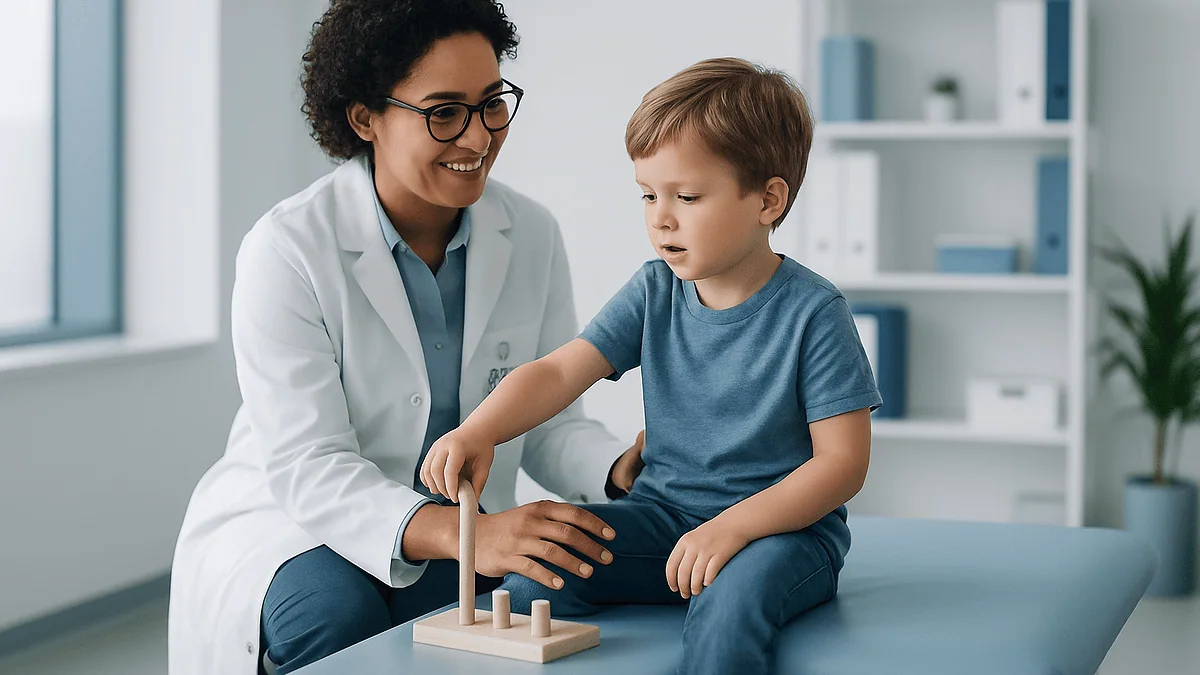
Key Takeaways
- Developmental delay is sorted by domain, not diagnosis: speech-language pathologists take communication and swallowing, occupational therapists take fine motor, self-care and sensory regulation, and physical therapists take gross motor skills and tone.
- The American Academy of Pediatrics schedule cited by the CDC calls for developmental screening at the 9-, 18- and 30-month visits and autism-specific screening at 18 and 24 months, and a positive screen leads to evaluation, not a diagnosis.
- A hearing test is part of nearly every speech and language evaluation because a child who startles at a slammed door can still miss the soft consonants that distinguish words.
- Occupational therapy does not teach words, but by improving regulation, posture and the ability to handle objects it can widen the window in which a child is able to learn them.
- Loss of previously acquired skills at any age, such as words or gestures that disappear, is a reason to seek evaluation promptly rather than wait and watch.
- In the United States, parents can request an early intervention evaluation directly from their state program without a physician's referral, and services are often delivered through coaching the family in daily routines.
Speech therapy, occupational therapy and physical therapy are matched to the specific area where a child's development is behind, not to the label of developmental delay itself. A speech-language pathologist works on communication and feeding, an occupational therapist on hand skills, self-care and sensory regulation, and a physical therapist on movement and balance. After a developmental evaluation, the care team recommends one or more and adjusts the mix as the child grows.
The waiting room has a basket of board books, and the toddler in the corner is not reading one. He is turning it over, banging it on the chair, watching it drop. His mother has a folded questionnaire in her lap with more boxes left blank than she expected. When the pediatrician says the word ‘referral’, she hears three unfamiliar job titles in a row and has no idea which one her son needs.
Parents searching speech therapy vs occupational therapy for developmental delay are usually standing exactly there: a screening result, a vague sense that something is off, and a menu of professions that all seem to involve toys on a mat. The confusion is understandable. The three therapies overlap in method, share the same waiting rooms and often see the same child.
The matching, though, follows a fairly clear logic once you see it. It starts with what a child is doing, not with what a diagnosis is called.
Why one label of developmental delay can lead to three different therapists
Developmental delay is a description, not a single condition. It means a child has not reached one or more expected milestones by the age most children do, and it says nothing on its own about why. The CDC organizes early milestones into four broad areas: social and emotional, language and communication, cognitive (thinking and learning), and movement and physical development. A child can lag in one area and be right on time in the other three.
That is the first reason a single referral can split into three. Each therapy profession grew up around a cluster of skills. Speech-language pathologists trained in communication and swallowing. Occupational therapists trained in the practical activities of daily life, from feeding oneself to holding a crayon. Physical therapists trained in how the body moves through space. The child in the waiting room is not being sorted by label; he is being sorted by where the gap sits.
Delays are common enough that this sorting happens constantly. The CDC reports that roughly 1 in 6 children aged 3 to 17 years in the United States has one or more developmental disabilities, a group that includes speech and language problems, learning differences, autism and cerebral palsy. Most of those children were first flagged as simply ‘behind’ in something.
When a child is significantly behind in two or more areas, clinicians may use the phrase global developmental delay. That wording matters for planning because it signals that more than one therapy is likely to be involved and that a broader medical workup, including hearing and vision checks, is usually part of the picture. A delay confined to talking, in a child who runs, stacks blocks and plays happily with others, points somewhere narrower.
Neither pattern predicts a specific outcome. It shapes who gets called first.
Speech therapy vs occupational therapy for developmental delay: what each one actually treats
Strip away the toys and the two professions are easier to tell apart. A speech-language pathologist, often shortened to SLP, is a clinician who evaluates and treats communication and swallowing. Communication here is wide: understanding words (receptive language), producing them (expressive language), making speech sounds clearly (articulation), using gesture and eye contact to connect with another person (social communication) and, in some cases, chewing and swallowing safely.
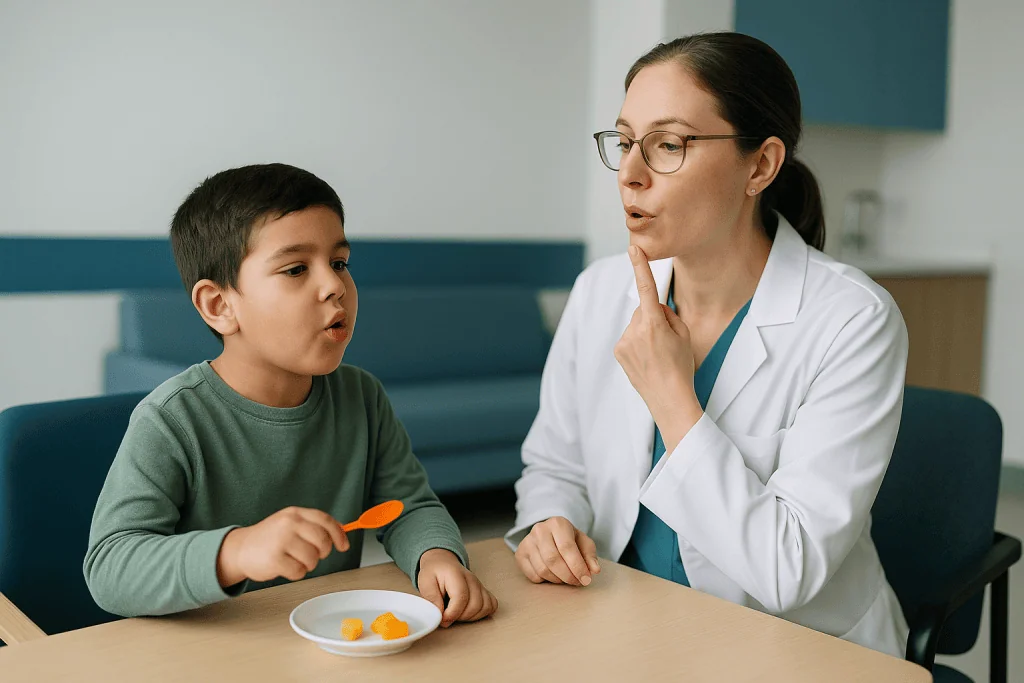
An occupational therapist, or OT, is a clinician who helps a person do the ordinary activities that fill a day. For a toddler, the ‘occupations’ are play, feeding, dressing, sleeping and exploring. OTs pay particular attention to fine motor skills, which are the small precise movements of the hands and fingers, and to sensory processing, which is how the nervous system takes in and organizes sights, sounds, touch and movement. A child who cannot tolerate a shirt tag, who mouths everything long past infancy, or who cannot pick up a raisin with a pincer grasp is in OT territory.
The confusion arises in the middle. Both therapists may work on feeding, since eating involves the mouth (SLP) and the hands, posture and sensory tolerance (OT). Both may work on play, because play is how toddlers practice everything. Both may recommend the same picture schedule or the same chewy snack. What differs is the goal written on the plan.
An SLP watching a child bang a book is thinking about whether the child can request more, imitate a sound or share attention. An OT watching the same moment is thinking about grasp, bilateral coordination (using two hands together) and whether the banging is a way of seeking sensory input.
The NHS describes occupational therapy as help to carry out daily activities when an illness, disability or developmental difference gets in the way. That practical framing is a good tiebreaker: if the problem is doing, think OT; if it is understanding or expressing, think SLP.
What does a speech therapist do with a toddler who is not talking yet?
The image most parents carry is a child repeating sounds at a table. For a two-year-old with few words, the reality looks more like floor play with a running commentary. The SLP is building the scaffolding underneath speech before asking for speech itself.
That scaffolding has recognizable pieces. Joint attention is the ability to share focus on the same object with another person, such as a child looking at a ball, then at the adult, then back at the ball. Imitation is copying an action or a sound. Turn-taking is the rhythm of back-and-forth that conversation depends on. The National Institute on Deafness and Other Communication Disorders (NIDCD) lists early milestones such as babbling with long strings of sounds by around 12 months and combining two words by around 24 months, but each of those rests on the earlier, quieter skills.
A session might therefore involve blowing bubbles and pausing until the child does anything, a look, a reach, a grunt, to ask for more. The therapist then treats that anything as a word and responds instantly. Over weeks, the target moves from a glance to a gesture to a sound to a word. Gestures are not a detour. Pointing and waving are treated as language because they are.
Receptive work happens alongside. A child who does not yet follow ‘give me the cup’ may be helped with simpler phrases, exaggerated intonation and a gesture paired with every request. Understanding usually runs ahead of talking, and an SLP will want to know how far ahead.
A hearing test almost always comes first or in parallel. MedlinePlus notes that hearing problems are one cause of speech and language delay, and even mild or fluctuating loss from repeated ear infections can muffle the sounds a child needs to copy. No amount of floor play compensates for an input the child cannot hear.
Feeding evaluation may also sit with the SLP when chewing, gagging or swallowing are concerns, because the same muscles serve both jobs.
Occupational therapy for a speech delay toddler: what actually happens on the mat
Parents are sometimes puzzled when a child referred for late talking is also booked with an occupational therapist. The OT is not there to teach words. The OT is there because talking sits on top of a body that has to be calm, upright and organized enough to attend.
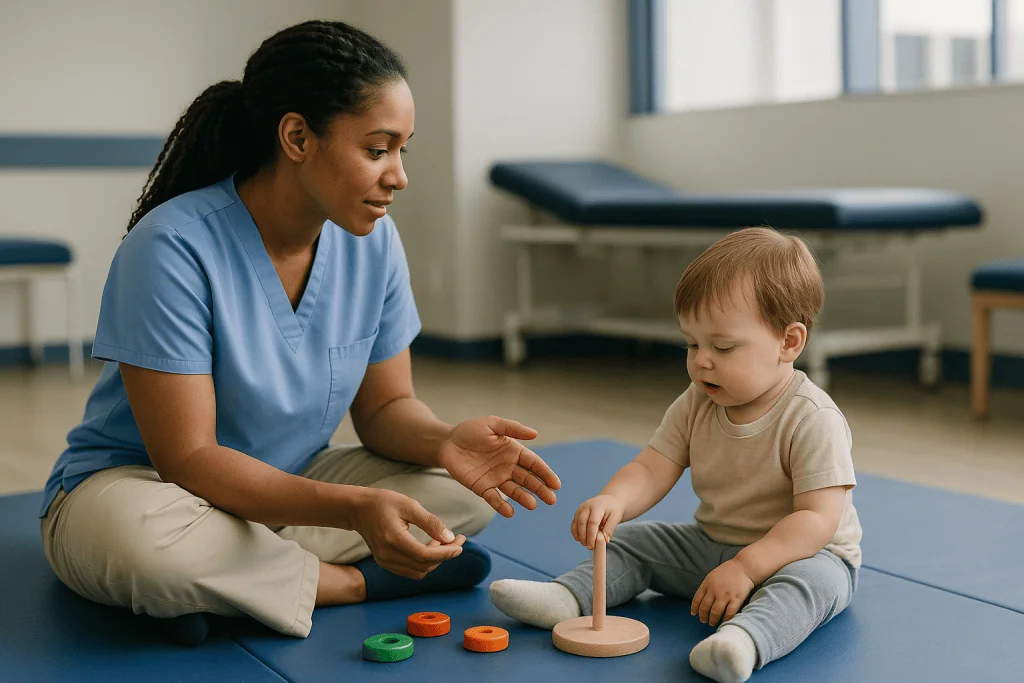
Consider a toddler who cannot sit on the floor without toppling, who crams a fistful of crackers into his mouth at once, who flaps and spins when the room gets loud. Every one of those observations is about regulation and motor control. A child spending all his energy staying balanced or filtering noise has little left for the demanding work of imitating a sound. An OT’s first job is often to find the physical conditions under which this particular child can focus.
What that looks like varies. Some children need more movement to settle: swinging, bouncing, pushing a heavy cart. Others need less input: a quieter corner, a snug seat, a chewy tool instead of mouthing toys. The therapist tries these systematically and watches what the child does afterward. Does he look up? Does he stay at an activity longer? Does he vocalize more? Those observations are shared with the SLP.
Fine motor practice also earns its place. Picking up small objects, stacking, fitting shapes, turning pages: the CDC’s milestone lists include several of these across the first three years, and children who cannot manipulate objects often cannot fully explore them, which limits what they have to communicate about.
Feeding is the other bridge. An OT may address how a child sits at the table, tolerates textures on his hands and face, and brings a spoon to his mouth, while the SLP addresses what happens once food is inside. Both are working toward a child who can eat with the family without distress.
None of this replaces speech therapy. It is the ground the speech work is planted in.
OT vs PT vs speech therapy: where physical therapy comes in
Physical therapy is the third door, and for many children with a communication delay it never opens. It does open when the movement column of the milestone chart has gaps. A physical therapist, or PT, is a clinician who evaluates and treats how the body moves: strength, balance, coordination and the gross motor skills, meaning the large movements of the trunk, arms and legs such as rolling, sitting, crawling, walking and climbing.
The CDC’s milestone checklists give a sense of the typical timetable. Most children sit without support by around 9 months, pull to stand by around 12 months, and walk without holding on by around 18 months. A child well outside those windows, or one who moves in an unusual way, such as walking only on toes, favoring one side, or feeling unusually stiff or floppy when held, is the child a pediatrician sends to PT.
Low muscle tone is a frequent reason. Tone is the baseline tension in resting muscle, and children with low tone often reach movement milestones late and tire quickly. PTs work on core strength and positioning so the child has a stable base for everything else, including the fine hand work the OT wants and the upright, alert posture the SLP wants.
The three professions therefore stack. PT builds the trunk. OT builds the hands and the ability to stay regulated. SLP builds the words. A child with global developmental delay may see all three, sometimes in a combined session, and the therapists will share notes on what carries over.
Where the lines blur, teams draw them pragmatically. A toddler who cannot climb the playground steps might be seen by PT for the climbing and by OT for the fear of the height. A baby who cannot sit for a meal might be seen by PT for the sitting and by SLP for the swallowing. The referral follows the observed gap, and the team decides who owns which goal.
How the plan is matched: what a developmental evaluation looks at
Matching starts before any therapist is involved. The CDC describes two layers of watching a child’s development. Developmental monitoring is the ongoing, informal tracking that parents and pediatricians do at every visit. Developmental screening is a brief, structured check, usually a validated questionnaire, that the American Academy of Pediatrics recommends at the 9-, 18- and 30-month visits, with additional screening specifically for autism at 18 and 24 months. A screen does not diagnose; it flags.
A flag leads to a developmental evaluation, which is the deeper look. Depending on where a family lives, this may be done by a developmental pediatrician, a psychologist, an early intervention team, or the therapists themselves. The evaluation typically includes standardized assessments in each domain, direct observation of play, a detailed history, and a hearing test if one has not been done. Vision may be checked. Depending on findings, the physician may order further medical investigation, since a delay is sometimes the first sign of an underlying condition.
The output is a profile, not a score. It shows which areas are on track and which are behind, and by how much. Therapists read that profile and write goals against the specific gaps. A child behind only in expressive language gets an SLP. A child behind in language and fine motor, with sensory differences noted on observation, gets an SLP and an OT. A child behind across the board gets a coordinated team.
In the United States, children under three who qualify are typically served through a state early intervention program, and the plan is written as an Individualized Family Service Plan, a document that sets goals for the child and family together and is reviewed on a schedule. After age three, services often shift to the school system. The CDC’s Learn the Signs. Act Early. materials describe how to ask for these evaluations directly, without waiting for a referral.
The plan is provisional by design. It is meant to be rewritten as the child changes.
Speech, occupational and physical therapy compared at a glance
Seen side by side, the three professions divide up a child’s day into three questions: can the child move, can the child do, and can the child connect. The table summarizes where each usually focuses, what a session commonly involves, and the typical observation that prompts the referral. Overlap is real and intentional; the columns describe emphasis, not fences.
| Area | Speech-language pathology (SLP) | Occupational therapy (OT) | Physical therapy (PT) |
|---|---|---|---|
| Core question | Can the child understand, express and connect? | Can the child do everyday tasks and stay regulated? | Can the child move, balance and build strength? |
| Skills addressed | Receptive and expressive language, speech sounds, gesture, social communication, swallowing | Fine motor skills, feeding, dressing, play, sensory processing, attention and self-regulation | Gross motor skills, muscle tone, posture, coordination, mobility |
| Typical referral trigger | Few or no words, not pointing or gesturing, hard to understand, trouble with textures or swallowing | Weak grasp, avoids messy play, extreme reactions to sound or touch, can’t manage spoon or cup, difficulty settling | Late to sit, crawl or walk; asymmetry; toe walking; stiffness or floppiness |
| What a session often looks like | Floor play with pauses for requests, imitation games, picture supports, feeding trials | Swings, obstacle courses, fine motor toys, feeding at a table, calming or alerting activities | Positioning, supported standing, stairs, balance tasks, strengthening through play |
| Parent’s homework | Narrate, wait, respond to every attempt | Set up the environment; offer movement or quiet before demanding tasks | Practice positions and movements during daily routines |
Two features of the table deserve emphasis. Feeding appears in more than one column, because eating is a whole-body task. So does play, because for a toddler, play is the work. When two therapists share a domain, the team designates who leads that goal so parents are not given contradictory instructions.
A third feature is what is absent: none of the columns lists a diagnosis. The referral is triggered by what the child is observed to do, which is why two children with the same label can end up with different teams.
Who is usually referred straight away, and who is asked to wait and watch
Not every gap on a milestone chart leads to a therapy referral, and parents are sometimes frustrated when a pediatrician suggests checking again in a few months. There is reasoning behind both paths.
Immediate referral is the norm when a delay is significant, involves more than one domain, or comes with specific concerns. The CDC lists loss of previously acquired skills at any age as a reason to act promptly rather than wait. A child who used to say words and has stopped, who used to wave and no longer does, is evaluated quickly. So is a child with no babbling, pointing or gestures by around 12 months, no single words by around 16 to 18 months, or no two-word combinations by around 24 months, thresholds that appear in NIDCD and Mayo Clinic milestone summaries. Concerns about hearing, unusual movement patterns, feeding difficulties with choking or poor weight gain, or a known medical condition that raises risk of delay, such as prematurity or a genetic diagnosis, also move a child to the front.
Watchful waiting is more often suggested for a mild, isolated delay in a child who is otherwise developing well. The classic example is the late talker: a toddler around age two with a small vocabulary but good understanding, normal hearing, plenty of gesture and eye contact, typical play and normal motor skills. Some of these children catch up without formal therapy, and clinicians sometimes prefer a short period of home strategies and a recheck. That preference is a judgment call, and the evidence on which late talkers catch up on their own is not precise enough to make individual predictions.
Two points protect families in the waiting scenario. First, waiting should be time-limited, with a specific recheck date, not an open-ended reassurance. Second, in the United States a parent can request an early intervention evaluation directly; the CDC’s Act Early guidance says a referral from a doctor is not required. If a parent’s worry outlasts the pediatrician’s, that route exists.
The decision, either way, belongs to the treating clinician who has examined the child and knows the history.
Is my child autistic or just speech delayed? How teams tell the difference
This is the question underneath many of the others, and it deserves a straight answer: a therapist cannot tell from a late-talking toddler alone, and neither can a parent reading a list online. What clinicians can do is look at the shape of the delay.
A child with an isolated expressive language delay typically understands more than he says, uses gesture generously, looks at faces, shares interest by pointing or showing, imitates actions, and plays in varied, pretend ways. Communication is happening; it is happening without many words.
Autism spectrum disorder is a developmental condition that affects social communication and involves restricted or repetitive patterns of behavior or interest. In autism, the delay in words is often accompanied by differences in the non-verbal side: less consistent response to name, limited pointing to share interest, reduced eye contact during play, and less imitation. Play may be repetitive, focused on parts of objects, or on lining up and spinning. Unusual sensory reactions are common. Language, when it comes, may include echoing phrases rather than building them.
Overlap is substantial, and that is why the CDC recommends autism-specific screening at 18 and 24 months in addition to general developmental screening. A positive screen leads to a diagnostic evaluation by a specialist team, which is the only place a diagnosis is made. Speech and occupational therapy do not wait for that answer. A child can and usually does start therapy for the observed gaps while the diagnostic question is being worked through, and the goals shift if the diagnosis clarifies.
What changes if autism is confirmed? Speech therapy remains central, with more emphasis on social communication and, when appropriate, alternative and augmentative communication, meaning pictures, signs or devices that supplement speech. Occupational therapy often plays a larger role because of sensory and regulation needs. Other approaches may be added by the team. The professions stay the same; the weighting shifts.
Asking the pediatrician directly whether autism screening has been done is reasonable and welcome.
Can occupational therapy help toddlers with speech delay? Why one child may see two therapists
Strictly, no: occupational therapy does not teach speech. Practically, yes: it often removes obstacles to learning it, and that is why the two referrals so frequently arrive together.
Three mechanisms explain the pairing. The first is regulation. A toddler who is chronically over-aroused, bolting around the room and melting down at transitions, is not in a state to attend to a face and copy a sound. OT strategies that help the child reach a calmer, alert state widen the window in which speech work can happen. The second is posture. Speech is a motor act performed by a body, and a child slumped or wobbling has less breath support and less stable jaw control. Work on trunk stability, sometimes shared with PT, feeds directly into clearer, more sustained vocalization. The third is exploration. Children talk about what they can do. A toddler who can open a container, fit a lid, poke a button and knock down a tower has more to request, comment on and share than one who cannot manipulate the objects around him.
Feeding ties the threads. Oral-motor skills, the strength and coordination of the lips, tongue and jaw, serve both eating and talking. When a child gags on lumps, refuses textures or pockets food in his cheeks, the OT may address the sensory tolerance and the hand-to-mouth mechanics while the SLP addresses the chewing and swallowing pattern. Parents see one meal; the team sees two skill sets.
Does adding OT speed up talking? The honest answer is that the research on sensory-based approaches is mixed and the quality of studies varies, so no clinician should promise that OT will produce words. What the team can say is that it addresses documented gaps in the child’s own profile. If regulation, fine motor and feeding are on track, the OT referral may not be made at all. It is added for the child, not for the diagnosis.
What the first weeks of therapy usually look like
Families often expect the first session to be intensive. It is usually quiet. The therapist is watching.
The opening visits, whether at home, in a clinic or in a daycare setting, are spent establishing what the child does when left to play, what draws his attention, what he avoids, and how he responds when an adult joins in. Standardized measures may be completed if they were not part of the evaluation. Parents are asked detailed questions about routines: mealtimes, bath, bedtime, the car seat, the grocery store. Those routines are where therapy will actually live.
Goals are then written in plain, observable terms. Not ‘improve communication’ but something like ‘uses a gesture or word to request a preferred item in three out of four opportunities during snack’. Parents should expect to see the goals and to have a say in which ones matter most at home. A goal about getting through a haircut without distress can legitimately outrank a goal about stacking blocks if that is what the family is struggling with.
Session frequency and length vary with the child’s profile, the program and family circumstances, and there is no single evidence-based schedule that fits all children. Early intervention programs typically write the frequency into the service plan and revisit it at scheduled reviews. What the research does support is that gains come from practice spread across the week, not from the session alone, which is why the therapist’s attention shifts quickly toward the adults in the room.
Progress in the early weeks is often invisible to parents and visible to the therapist. A child who looks at the bubble wand and then at the adult, a new gesture, a tolerated texture: these are the first bricks. Word counts, if they come, come later. Families who understand that sequence tend to find the first month less discouraging.
Plateaus and regressions during illness, teething or big life changes are common and are not evidence the plan is wrong. They are noted, and the plan adjusts.
Why the therapist spends so much time coaching the parent
A common complaint from parents after a few weeks is that the therapist talks to them as much as to the child. That is not a shortcut. It is the model.
The arithmetic is simple. A young child is awake perhaps 12 hours a day. A therapy session covers a fraction of one of them. The other hours belong to the people who feed, dress, bathe and play with the child, and those hours contain hundreds of natural opportunities to practice exactly the skills on the plan. A parent who learns to pause before handing over the cup, so the child has a chance to reach or vocalize, creates more requesting practice at one breakfast than a therapist can in a session.
Speech-language pathologists teach a handful of responsive strategies that show up repeatedly in the literature on early language: get face to face at the child’s level, follow the child’s lead rather than directing play, narrate what the child is doing in short phrases, wait longer than feels natural for a response, and treat any response, a glance or grunt included, as communication by answering it. The NIDCD’s guidance for parents echoes these: talk, read and respond, and keep the interaction going back and forth.
Occupational therapists coach differently. Their homework is often about set-up: which activity before the demanding task, how the highchair is positioned, what the lighting and noise are like at dinner, where the child can go to reset. Physical therapists coach positions and movements folded into routines, such as how to carry the child or where to place the toy so he has to rotate to reach it.
Coaching also protects against a misunderstanding: that therapy is something done to the child, and progress is the therapist’s job. In pediatric developmental care, the evidence favors the reverse. The family is the intervention’s delivery system, and the therapist is the person who tunes it.
What people often get wrong about speech therapy vs occupational therapy for developmental delay
The myths cluster in predictable places, and correcting them saves families time.
The first is that one profession is ‘harder’ or ‘better’ than the other. Both require graduate-level training and licensure, and neither outranks the other clinically. They answer different questions. Asking whether OT is better than speech therapy for a delay is like asking whether a dentist is better than an optometrist; it depends entirely on what is wrong.
The second is that speech therapy is only for children who talk unclearly. Clarity of speech sounds is one part of the job. Understanding, vocabulary, gesture, social back-and-forth and swallowing are the rest, and for the youngest children they are most of it.
The third is that a bilingual home causes delay. Children raised with two languages may distribute their early words across both, so a count in one language looks small, but the total vocabulary and the milestones for combining words track similarly to monolingual peers. Families are not asked to drop a home language.
The fourth is that boys are simply late and will catch up. Some late talkers do catch up. Others do not, and the ones who do not lose ground during the waiting. Sex is not a reason to skip an evaluation.
The fifth is that a hearing test is unnecessary because the child startles at loud sounds. Startling at a slammed door says nothing about hearing the soft consonants that distinguish one word from another. Hearing is checked with an audiology test, not a clap.
The sixth is that therapy is a course with a fixed end, like a round of antibiotics. Plans are reviewed and revised, and discharge happens when goals are met or when the team judges that the child is progressing without it, not on a calendar.
The seventh, and the most consequential, is that starting therapy means accepting a diagnosis. It does not. Therapy addresses observed gaps; diagnosis is a separate process that may or may not follow.
Questions to ask your care team before and after the evaluation
Parents get more from the process when they arrive with questions written down. The list below is not exhaustive, and no one will mind if some answers are ‘we do not know yet’.
- Which areas of development were behind on the evaluation, and by roughly how much? Ask to see the profile, not just the conclusion.
- Has a formal hearing test been done or ordered? If the answer is no, ask why not.
- Has autism screening been completed at the recommended ages, and what did it show?
- Which therapist is being recommended for which gap? If two are recommended, who leads on the overlapping goals such as feeding or play?
- What will the first goals be, in plain language, and how will we know if they are being met?
- How often are sessions planned, and when is the first scheduled review of the plan?
- What should we be doing at home between sessions, and can you show us rather than tell us?
- If you are suggesting we wait and watch, what exactly are we watching for, and what is the date of the recheck?
- Are there any medical investigations you are considering, and what would prompt them?
- What signs would mean we should contact you before the next scheduled visit?
After a few weeks of therapy, a second set of questions becomes useful: what have you noticed changing, what has not moved, and does that change your thinking about the plan? A therapist who welcomes these questions and adjusts in response is doing the job as intended.
Families sometimes hesitate to ask about the possibility of autism or another diagnosis for fear of putting the idea into the clinician’s head. Clinicians are already thinking about it. Asking simply opens the conversation earlier.
Every one of these questions leaves the decision where it belongs, with the team that has examined the child, while making sure the family understands the reasoning behind it.
When to call your doctor
Most of the matching described in this article happens at a measured pace: screening, evaluation, plan, review. Some situations should not wait for the next appointment.
Contact your child’s doctor promptly, or the early intervention team if you are already enrolled, if your child:
- Loses skills he or she previously had, at any age: stops using words, stops waving or pointing, stops responding to his or her name, or stops playing in ways that were established.
- Does not respond to sounds or voices, or you have any new concern about hearing, including after repeated ear infections.
- Shows a sudden change in movement: new stiffness or floppiness, weakness on one side, loss of balance, or an unusual walk that was not there before.
- Has feeding difficulties with choking, coughing during meals, frequent chest infections, refusal of most foods, or poor weight gain.
- Has a seizure, unusual episodes of staring or stiffening, or periods of unresponsiveness.
- Shows a marked change in behavior alongside the delay, such as persistent inconsolable crying, extreme withdrawal, or self-injury.
Seek emergency care immediately for breathing difficulty, a seizure lasting more than a few minutes or a first seizure, sudden severe weakness or inability to move part of the body, or unresponsiveness.
Outside of those red flags, the CDC’s guidance is straightforward: if you are worried about your child’s development, say so, even if a screening questionnaire came back reassuring and even if relatives insist the child will grow out of it. A parent’s concern is itself a recognized reason for evaluation. In the United States, a family can contact the state early intervention program directly to request one without a physician’s referral.
The therapists, the pediatrician and any specialists involved make the decisions about what to evaluate and what to treat. Your part is to bring what you have noticed, ask what it means, and keep asking until the reasoning is clear.
Frequently asked questions
What is harder, OT or SLP?
Neither profession is harder or more advanced than the other; both require graduate training and state licensure and they address different skills. Occupational therapists focus on daily activities, fine motor and sensory regulation, while speech-language pathologists focus on communication and swallowing. For a child, the relevant question is not which is harder but which matches the specific gaps found on evaluation, and many children benefit from both working in coordination.
Can occupational therapy help toddlers with speech delay?
Indirectly, yes, when the child also has regulation, posture, fine motor or feeding difficulties that get in the way of attending and communicating. Occupational therapy does not teach speech, and evidence for sensory-based approaches on language outcomes is mixed, so it is added for documented gaps in the child’s own profile rather than for the speech delay itself. Speech therapy remains the direct treatment for language.
Is occupational therapy better than speech therapy for developmental delay?
No; they treat different domains, so one cannot be better than the other in general. If a child’s delay is confined to understanding or producing language, speech therapy is the match. If the gaps involve hand skills, self-care, sensory tolerance or attention, occupational therapy is the match. Global developmental delay across several areas usually means both, and sometimes physical therapy too, with the team deciding who leads each goal.
Is my child autistic or just speech delayed?
A late-talking toddler alone cannot answer that question; only a diagnostic evaluation by a specialist team can. Clinicians look at the shape of the delay: children with isolated language delay usually point, gesture, imitate, look at faces and play in varied ways, while autism often involves differences in those non-verbal areas as well. The CDC recommends autism screening at 18 and 24 months, and therapy can begin before the diagnostic question is settled.
What does a speech therapist do with a two-year-old who has no words?
Mostly floor play designed to build the skills underneath speech: shared attention, imitation, turn-taking and gesture. The therapist creates moments where the child needs to communicate, such as pausing with bubbles, and responds to any attempt as if it were a word. Understanding is worked on alongside talking, a hearing test is arranged if not already done, and parents are coached to use the same strategies during daily routines.
How do doctors decide between OT vs PT vs speech therapy for a toddler?
They match the referral to the domain that is behind on screening and evaluation. Late sitting, crawling or walking, unusual tone or asymmetry point to physical therapy. Weak grasp, difficulty with spoon or cup, extreme reactions to touch or noise point to occupational therapy. Few words, little gesture, or feeding and swallowing concerns point to speech-language pathology. Children behind in several areas are referred to more than one.
Does a bilingual home cause speech delay?
Mainstream guidance does not support that idea. Children learning two languages may spread their early words across both, so a count in one language can look small, but combined vocabulary and the timing of two-word combinations track similarly to single-language peers. Families are not advised to drop a home language. A bilingual child with a true delay is delayed in both languages and should be evaluated in the same way.
How long does early intervention therapy usually last?
There is no fixed course; plans are written with goals and reviewed on a schedule, and discharge happens when goals are met or the team judges the child is progressing without support. In the United States, children under three are typically served through state early intervention programs with a written family service plan, and services often transition to the school system at age three. The treating team sets frequency and duration for each child.
Should I wait to see if my late talker catches up on his own?
Some late talkers with good understanding, normal hearing, plenty of gesture and typical play do catch up, and a clinician may reasonably suggest home strategies with a set recheck date. Waiting should be time-limited and specific, not open-ended. Any loss of skills, concerns about hearing, absence of pointing or gesture, or delays in more than one area are reasons for prompt evaluation rather than waiting.
Can I ask for a developmental evaluation without a referral from my pediatrician?
In the United States, yes. The CDC’s Learn the Signs. Act Early. guidance explains that parents can contact their state early intervention program directly for children under three, or the local public school system for children three and older, to request an evaluation. A physician referral is not required, though sharing your concerns with the pediatrician is still valuable so hearing, vision and medical causes are checked in parallel.
References
- NIH NIDCD: Speech and Language Developmental Milestones
- NHS: Occupational therapy
- MedlinePlus: Speech and Language Problems in Children
This article is for general information only and is not a substitute for professional medical advice. Please consult a qualified doctor about your individual situation.
Add us as a Preferred Source to see more of our trusted health content across Google Search, AI Overviews and Discover.

More from the Blog

What to Expect After Whooping Cough Treatment: Lingering Cough, Fatigue and Follow-Up Visits
After whooping cough treatment, antibiotics clear the bacteria and shorten the time you can spread it, but they rarely shorten the cough itself. Coughing…

When Is It Safe to Get the Site Wet After Pediatric Plastic Surgery? Bathing and Play Return
Most children can have a brief shower or careful wash around the incision 24 to 48 hours after pediatric plastic surgery, but soaking in…

When Is Pediatric Physical Therapy Recommended? Injuries, Delays and Neuromuscular Conditions
A child is usually referred to pediatric physical therapy when movement is delayed, painful, uneven or limited: for example, missing motor milestones such as…

Which Conditions Do Pediatric Surgeons Treat? Congenital, Abdominal and Soft-Tissue Cases
Pediatric surgeons treat surgical conditions in children from before birth through the teenage years. Their work falls into three broad groups: congenital problems present…

How Is ROP Treatment Performed? Sedation, the Retinal Procedure and the Minutes It Takes
ROP laser treatment is performed while a premature baby is sedated or under general anesthesia and continuously monitored by the neonatal team, either at…

Packing for a Kawasaki Disease Admission: Fever Records, History and Comfort Items
For a Kawasaki disease hospital admission, pack a written fever record (dates, times, readings, and what was given), a one-page medical history with allergies…