

When Is Pediatric Physical Therapy Recommended? Injuries, Delays and Neuromuscular Conditions

Key Takeaways
- The CDC's milestone checklists mark the age by which 75 percent or more of children reach each skill, so a missed milestone is a prompt to talk to the pediatrician, not a diagnosis.
- Children are referred for three main reasons: developmental delays, injury or post-surgical recovery, and neuromuscular or orthopedic conditions present from birth.
- Asymmetry, abnormal tone and loss of a previously held skill carry more weight in a clinician's eyes than a child simply being a few weeks late.
- Newborn conditions such as torticollis and clubfoot are treated in the first weeks of life because soft, growing tissue responds far more easily than it will later.
- There is no age limit for physical therapy; what changes with age is the format, from parent-delivered positioning in infancy to adult-style exercise in adolescence.
- Most of the progress in pediatric therapy happens through the home program, which is why therapists build activities into routines such as diaper changes and tooth brushing.
A child is usually referred to pediatric physical therapy when movement is delayed, painful, uneven or limited: for example, missing motor milestones such as sitting or walking by expected ages, recovering from a fracture, sprain or surgery, or living with a neuromuscular or orthopedic condition such as cerebral palsy, torticollis or clubfoot. The pediatrician or specialist decides whether therapy is appropriate after an assessment.
At the playground, Priya watches a cluster of toddlers lurch between benches while her own 16-month-old, Theo, scoots along on his bottom, cheerful and fast, but never on his feet. Her mother says he will walk when he is ready. Her neighbor mentions a therapist. Priya is left holding the same quiet question thousands of parents type into a search bar at night: when does a child need physical therapy, and when is waiting the wiser choice?
The honest answer is that there is no single trigger. Children land in a pediatric physical therapy gym for three broad reasons: an injury, a developmental delay, or a condition that affects nerves and muscles from birth. Each follows a different pathway, and each has a different sense of urgency.
This explainer walks through all three, what actually happens in a session, who is usually referred and who is usually told to wait, and the signs that should move you from watchful waiting to a phone call.
Why do kids go to physical therapy?
Adults tend to picture physical therapy as something that follows a knee replacement or a bad back. For children, the picture is broader and often starts earlier in life. Pediatric physical therapists are licensed clinicians trained to assess how a child moves, balances, builds strength and uses their body for play, school and daily life. Their job is to find the gap between what a child’s body can do and what their stage of development asks of it, then close that gap through guided movement.
Referrals cluster into three groups. The first is developmental: a baby who is not rolling, sitting, crawling or walking in the expected window, or a preschooler whose running and climbing look noticeably less steady than peers’. The second is injury: fractures, sprains, growth-plate injuries and the stiffness that follows weeks in a cast or after surgery. The third is medical: conditions present from birth or early childhood that change muscle tone, joint alignment or nerve control, such as cerebral palsy, spina bifida, muscular dystrophy, torticollis and clubfoot.
Numbers help with perspective. The NHS estimates that cerebral palsy affects about 1 in every 400 children, which makes it the most common childhood physical disability, yet it accounts for only a slice of pediatric referrals. Far more children arrive because of a sprained ankle or because a routine well-child check flagged a milestone concern.
What unites these very different children is that early, structured movement practice tends to matter more in a growing body than in a mature one. Bones, joints and the nervous system are still being shaped, which is both the opportunity and the reason not to leave questions unanswered for too long.
When does a child need physical therapy for a developmental delay?
A developmental delay means a child is reaching a skill later than the age by which most children have reached it. Physical therapy for developmental delay focuses on gross motor skills: the large movements of rolling, sitting, crawling, standing, walking, running and jumping.

Pediatricians in the United States lean on the CDC’s developmental milestone checklists, which were revised so that each milestone reflects the age by which 75 percent or more of children have reached it. On that scale, most babies roll from tummy to back by 6 months, sit without support by 9 months, pull up to stand by 12 months and walk without holding on by 18 months. A child who has not reached one of these by the listed age is not automatically delayed, but the CDC advises that the gap should prompt a conversation with the child’s doctor rather than more waiting.
That conversation usually leads one of three ways. Some children are simply late within normal variation, and the doctor rechecks in a few weeks. Others are referred for a formal motor assessment, often through early-intervention programs that evaluate children under 3. A smaller group is sent for further medical workup first, because a motor delay can occasionally be the first visible sign of a neurological or muscular condition.
Two details matter in that assessment. One is quality, not just timing: a baby who sits at 8 months but only with a rounded back and splayed legs may still benefit from therapy. The other is symmetry. A child who always rolls one way, or reaches with one hand well before the other, is more likely to be referred than a child who is uniformly a bit slow. Neither observation is a diagnosis; both are good reasons to be seen.
Signs a toddler needs physical therapy: what clinicians actually look for
Online lists of warning signs can make any parent anxious, so it helps to understand how a clinician reads a toddler rather than memorizing a checklist. A pediatric physical therapist is watching for patterns, and the patterns fall into four buckets.
The first is tone, meaning the resting tension in a muscle. A toddler who feels unusually floppy when lifted, or unusually stiff with legs that scissor or toes that point, is showing something a clinician will want to examine. The second is asymmetry: a persistent head tilt to one side, a strong preference for one hand before the first birthday, or a gait where one leg swings differently from the other. The third is how the child problem-solves movement. Children with weak core muscles often avoid the floor, resist tummy time or pull themselves up with their arms rather than pushing through their legs. The fourth is persistence of patterns that usually fade. Walking on tiptoes is common early on; according to Mayo Clinic, habitual toe walking that continues past about age 2 is worth raising with a doctor, since it can occasionally reflect a short Achilles tendon or an underlying neurological condition.
None of these observations means a child needs therapy. A head tilt in a newborn may be positional and resolve with simple repositioning. A late walker may be a bottom-shuffler, a well-recognized variant that often walks a little later without any underlying problem.
The practical point is that these are observations to bring to the pediatrician, who can decide whether a referral is warranted. The decision about therapy, and the type of therapy, always sits with the child’s treating team after a hands-on assessment.
How pediatric physical therapy actually works
Walk into a pediatric therapy space and the first surprise is how much it looks like a playroom. Foam wedges, therapy balls, low steps, a scooter board, bubbles, perhaps a small climbing frame. The toys are not decoration; they are the treatment delivered in the only format a 2-year-old will accept for 45 minutes.
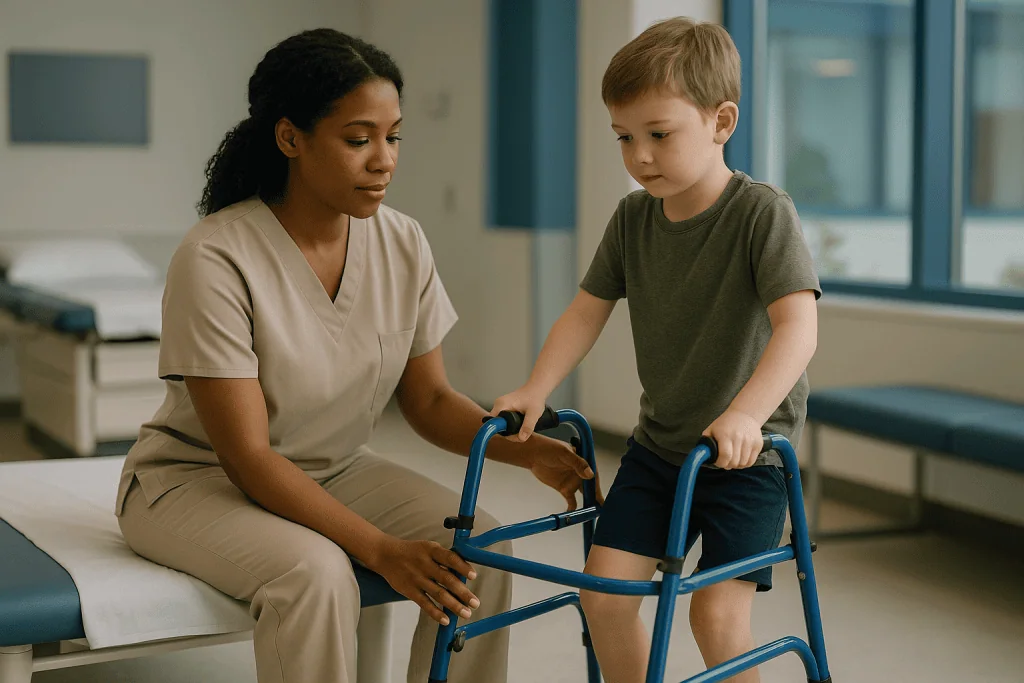
Behind the play sits a structured process. The first visit is an evaluation, typically 45–60 minutes, in which the therapist takes a history, observes the child moving freely, and runs standardized tests of strength, range of motion, balance and motor skills appropriate to the child’s age. From that, they set measurable goals: sitting independently for 30 seconds, walking 10 steps without support, climbing stairs with alternating feet, returning to soccer without pain.
Treatment then works through repetition. The developing nervous system strengthens the movement patterns it practices, so the therapist designs activities that force the child to use the weaker side, the lazy muscle group or the underused joint range, over and over, in ways that feel like games. Hands-on techniques such as gentle stretching, positioning and guided movement are layered in. Some children also use supports like orthotics (custom shoe inserts or braces), taping or adaptive equipment, which the therapist fits and adjusts.
Equally important is the home program. Most of the real practice happens between sessions, so parents are coached on carrying positions, floor play, stretches and daily routines. The NHS describes physiotherapy as a combination of education and advice, movement and exercise, and manual therapy, and in pediatrics the education half lands squarely with the family.
Progress is remeasured at intervals, goals are rewritten, and therapy is tapered when the child is meeting age-level expectations or has reached a stable plateau that the team agrees is appropriate.
When does a child need physical therapy after an injury or surgery?
Children heal fast, which is both a gift and a trap. A fractured wrist knits in weeks, but the joint that sat in a cast often emerges stiff, and the muscles around it noticeably smaller. Whether that child needs formal therapy depends on the joint involved, the length of immobilization, and what the child needs to return to.
Common injury referrals include ankle sprains in active school-age children, fractures around the elbow, knee and ankle, growth-plate injuries (damage to the soft cartilage zone near the ends of growing bones), overuse problems such as heel pain in young athletes, and recovery after orthopedic surgery, for example scoliosis correction or ligament repair. The sports-medicine concern specific to children is that a joint that returns to play before strength and balance are restored tends to be re-injured, and a growth plate injured twice can affect how the bone grows.
The therapist’s work after injury follows a familiar arc: restore range of motion, rebuild strength, retrain balance and coordination, and finally reintroduce sport-specific movements such as cutting, jumping and landing. The timeline is set by tissue healing, not enthusiasm, and the treating surgeon or pediatrician usually dictates when weight-bearing and loading can progress.
Not every injury needs a referral. A mild sprain that is walking normally within a week and a half rarely does. The signals that typically push a clinician toward therapy are a limp that persists after the cast comes off, a joint that will not fully straighten or bend, visible wasting of one limb compared with the other, or a child who is avoiding the activity they loved because something still hurts or feels unstable. Those are decisions for the treating team, made at follow-up rather than guessed at home.
Neuromuscular conditions: where physical therapy is part of lifelong care
For some children, physical therapy is not a short course but a thread running through childhood. These are the neuromuscular conditions, a term for disorders in which the brain, spinal cord, nerves or muscles themselves do not control movement in the usual way.
Cerebral palsy is the most common. It results from injury to or abnormal development of the brain before, during or shortly after birth, and it changes muscle tone, posture and movement in ways that vary enormously from child to child. Mayo Clinic describes physical therapy as a cornerstone of management, aimed at improving strength, flexibility, balance and mobility, and at preventing the contractures (permanent shortening of a muscle or tendon) that tight muscles can produce over years of growth. Therapy here often involves orthotics, standing frames, walkers and close coordination with occupational therapists and orthopedic specialists.
Spina bifida, in which the spinal column does not close fully before birth, can leave varying degrees of leg weakness and sensory loss. Physical therapy supports mobility, whether that means walking with braces or efficient wheelchair skills, and protects skin and joints that the child may not feel normally.
Muscular dystrophies are inherited conditions in which muscle fibers progressively weaken. The therapy goal shifts over time: preserving range of motion and function, maintaining chest expansion for breathing, and adapting equipment as needs change. Here the therapist is as much a planner as a trainer.
Other referrals in this group include developmental coordination disorder, a condition the NHS describes as affecting physical coordination enough to interfere with daily tasks, hypotonia (low muscle tone) from genetic syndromes such as Down syndrome, and recovery after a brain or spinal cord injury. In every one of these, the therapist works inside a team, and medical decisions, including any medication or surgery, remain with the treating physicians.
Orthopedic and newborn conditions: torticollis, clubfoot, toe walking and hypermobility
A surprising share of pediatric referrals arrive within the first months of life, before any milestone could possibly be missed. These are structural or positional problems that are far easier to correct while the tissues are soft.
Congenital muscular torticollis is the clearest example. One of the neck muscles, the sternocleidomastoid, is tight, so the baby holds the head tilted to one side and rotated to the other. Cleveland Clinic describes a program of gentle stretching, positioning and encouragement of head-turning to the tight side as the primary treatment, started as early as possible, often alongside attention to the flat spot on the skull that can develop when a baby always rests on the same side. The stretches are simple, but the technique matters, which is why a therapist teaches them rather than a handout.
Clubfoot, in which one or both feet are turned inward and downward at birth, is managed with a sequence of gentle manipulation and casting that Mayo Clinic notes typically begins in the first weeks after birth, followed by bracing that continues for several years. Physical therapy supports this pathway by maintaining flexibility, guiding parents on brace use, and working on normal gait once the child walks.
Idiopathic toe walking, where no cause is found, is often watched in younger children; as noted earlier, persistence beyond about age 2 is the point at which Mayo Clinic suggests a medical review, which may lead to stretching programs, casting or bracing.
Joint hypermobility, when joints move beyond the usual range, is common and usually harmless, but a child whose hypermobility causes pain, frequent sprains or fatigue may be referred for strengthening around the loose joints. In each of these cases the physician identifies the problem; the therapist translates the plan into daily practice.
Who is usually referred, and who is usually asked to wait
Parents often assume that a referral is either granted or refused. In practice, pediatricians sort children into three groups, and the middle group is the largest.
Children who are usually referred promptly include those with a known diagnosis affecting movement, such as cerebral palsy, spina bifida, Down syndrome or a muscular dystrophy; newborns with torticollis, clubfoot or a brachial plexus injury (nerve damage in the shoulder that can occur during birth); children with a clear asymmetry, abnormal tone or loss of skills they previously had; and children whose injury recovery has stalled or who need rehabilitation after surgery. For these children, waiting carries a cost, because tight tissue tightens further and compensations become habits.
Children who are usually asked to wait, with a recheck scheduled, include babies a few weeks past a milestone age who are otherwise moving well and symmetrically, bottom-shufflers with normal tone, mildly late walkers whose parents walked late, and toddlers with intermittent toe walking under age 2. For these children, the CDC’s guidance is not to ignore the concern but to re-evaluate at the next visit rather than refer immediately.
The third group is referred for an assessment rather than for treatment. A single evaluation can settle whether a child’s movement is within normal variation, and many families leave with a home program and no further appointments.
Two factors tip borderline cases toward earlier referral: prematurity, since babies born early are assessed against their corrected age and are at higher risk of motor difficulty, and parental instinct. Pediatric guidance consistently treats a parent’s persistent concern as a legitimate screening tool. If something looks wrong to you week after week, that in itself is a reason for a closer look. The final call belongs to the treating team.
Pediatric physical therapy referral pathways at a glance
The table below summarizes how the three main reasons for referral differ in timing, goals and typical duration. Durations are broad ranges drawn from the mainstream clinical sources cited in this article and vary widely with the individual child; they are a frame for conversation with your care team, not a schedule.
| Reason for referral | Typical age at referral | Main therapy goals | Usual course |
|---|---|---|---|
| Developmental delay (gross motor) | Infancy to preschool, often after a milestone check | Build strength, balance and age-appropriate skills; coach family on play and positioning | Weeks to months, often tapered as milestones are met |
| Injury or post-surgical recovery | School age and adolescence most often | Restore range of motion and strength, retrain balance, safe return to sport | Several weeks to a few months, set by tissue healing and surgeon’s plan |
| Newborn orthopedic conditions (torticollis, clubfoot) | First weeks to months of life | Stretch tight tissue, correct alignment, support bracing, guide symmetrical development | Months, with bracing for clubfoot continuing for years per Mayo Clinic |
| Neuromuscular conditions (cerebral palsy, spina bifida, muscular dystrophy) | Infancy onward, often lifelong | Maintain mobility and joint range, prevent contractures, fit equipment, adapt to growth | Ongoing, in blocks of more and less intensive therapy |
Reading across the rows, two things stand out. First, the goals for a child with a neuromuscular condition are as much about prevention as progress, which is why therapy continues even when a child seems stable. Second, the shortest courses belong to children with a single, correctable problem and a family that practices at home. In every row the pace of discharge is a joint decision between the therapist, the referring physician and the family, reviewed against measured goals rather than the calendar.
What the first weeks of pediatric physical therapy usually look like
The evaluation visit sets the tone. Expect questions about pregnancy, birth, early milestones, feeding, sleep and anything that worries you, followed by a period where the therapist simply watches your child play. Standardized testing comes next, but much of it looks like coaxing a toddler to reach for a toy or step over a cushion. You will leave with a written summary of findings, a handful of goals and two or three home activities.
Early sessions are often weekly, sometimes twice weekly for post-surgical rehabilitation or intensive blocks for children with neuromuscular conditions, and spaced out as skills consolidate. Session length for young children is usually 30–45 minutes, because attention, not muscle, is the limiting factor.
The home program is where progress is made or lost. For a baby with torticollis, that might mean positioning the crib so the baby turns toward the tight side to see the room, carrying the baby in a way that stretches the neck, and a few repetitions of a gentle stretch at each diaper change. For a child recovering from an ankle sprain, it might be balance practice on one foot while brushing teeth. Therapists choose activities that attach to existing routines precisely because tired parents do not add new ones.
Comfort matters. Babies may cry during neck stretches; a skilled therapist pauses, soothes and resumes, and teaches you to do the same. Older children do better when they understand the goal, so a therapist will often frame it in the child’s terms: getting back on the team, keeping up on the stairs.
Reassessment typically happens every few weeks. If the original goals are met, therapy tapers to a home program and a follow-up check. If progress stalls, the therapist communicates with the referring physician, who may adjust the medical plan.
Is there an age limit for physical therapy?
There is no lower age limit and no upper one. Newborns are treated in the first days of life for torticollis, clubfoot and brachial plexus injuries, and therapists work in neonatal intensive care units with premature babies on positioning and movement that supports development. At the other end, adolescents are treated for sports injuries and scoliosis up to the point at which they transition to adult services, usually in the late teens, and adults continue to receive physical therapy into their nineties.
What changes with age is the format. Infant therapy is almost entirely delivered through the parent: positioning, handling, stretches and play set up at home. Toddler therapy is disguised as games. School-age therapy can include explicit exercises with reps and sets, and teenagers are treated much like adults, with the additional consideration that growth plates are still open.
A related question parents ask is whether a late start loses the opportunity. The nervous system is most adaptable in early childhood, and conditions such as torticollis and clubfoot are far easier to correct in infancy, which is why early referral matters. That is not the same as saying later therapy is pointless. Strength, balance and coordination can be improved at any age; the goals simply shift from shaping development to maximizing function within it.
For families whose children have ongoing conditions, the age that matters most is the transition from pediatric to adult services. Pediatric therapists increasingly plan for that handover in the mid-teens, teaching adolescents to manage their own stretching, equipment and appointments. Asking early how that transition will work is a reasonable question for any care team supporting a child with a lifelong condition.
What people often get wrong about pediatric physical therapy
Myths about children’s movement are durable, partly because they contain a grain of truth. Several deserve correcting.
“They will grow out of it.” Many children do grow out of mild delays and quirks, which is why pediatricians sometimes advise waiting. The error is applying this to everything. A persistent head tilt, true asymmetry or a loss of previously held skills do not resolve with time alone, and tight tissue in a growing body tends to get tighter, not looser.
“Walkers and jumpers help babies walk sooner.” Mainstream pediatric advice is the opposite: infant walkers do not teach walking, can encourage tiptoe posture, and carry a well-documented injury risk. Floor time, including tummy time, is what builds the strength walking requires.
“Physical therapy means something is seriously wrong.” Most children referred have common, correctable issues. A referral is an assessment, not a verdict, and many families attend a handful of sessions before being discharged with a home program.
“More sessions mean faster progress.” Beyond a point, the limiting factor is what happens at home. A child seen once a week by a therapist and daily by a coached parent generally does better than one seen three times a week with no carryover.
“Toe walking is always a sign of autism.” Toe walking appears in some autistic children, but Mayo Clinic notes that most children who toe walk have no underlying condition at all. It warrants a medical review if it persists, not a leap to a diagnosis.
“The therapist will tell me the diagnosis.” Therapists assess function and refer back to the physician when findings suggest an underlying condition. Diagnosis and any decision about medication, surgery or further testing stay with the child’s medical team.
Questions to ask your care team before and during therapy
Good questions turn a referral into a partnership. These are the ones that experienced pediatric therapists say they wish more parents asked.
Start with the purpose. Ask what specifically the therapist found at evaluation and which goals the plan is built around. A goal you can picture, such as climbing stairs with alternating feet, is one you can help practice. Ask how progress will be measured and when it will be reassessed, so that “a few more weeks” has a definition.
Then ask about your role. Which two or three activities matter most at home? How many times a day, and attached to which routines? What should you do if your child cries, resists or seems in pain during a stretch? What is normal discomfort and what is a reason to stop? For an infant with torticollis or a child in a brace, ask to be shown the technique and then to demonstrate it back before you leave.
Ask about the bigger picture. Should any other professional be involved, such as an occupational therapist, speech therapist, orthotist or developmental pediatrician? Does the therapist communicate with the referring doctor, and how often? If there is an underlying condition, how will therapy change as your child grows, and when will the transition to adult services be planned?
Practical questions matter too. What should your child wear? Can siblings attend? Will sessions move to school or daycare, or to telehealth for coaching? What happens if you miss an appointment or if the child is unwell?
Finally, ask what would prompt discharge and what would prompt a change in plan. A team that can answer both clearly is one that is measuring, and measuring is what separates therapy from well-meaning play.
When to call your doctor
Most movement questions in childhood can wait for the next well-child visit. Some cannot, and it helps to know the difference before it is 10 p.m. and you are searching for reassurance.
Contact your child’s doctor promptly, rather than waiting for a scheduled check, if you notice that your child has lost a skill they previously had, such as a baby who stopped rolling or a toddler who stopped walking. Regression is treated differently from delay. Call as well for a limp or refusal to bear weight that lasts more than a day or two, especially without an obvious injury; a persistent head tilt in a baby; a noticeable difference in movement, strength or size between the two sides of the body; a child who is unusually floppy or unusually stiff; or pain that wakes a child from sleep.
Seek urgent care the same day if a limp or limb weakness comes with fever, a swollen, hot or very tender joint, or a child who appears unwell. Those combinations can signal joint or bone infection, which needs prompt medical assessment. Go to emergency care for a sudden inability to move a limb, weakness that spreads, severe pain after a fall, a limb that looks deformed, or any weakness or loss of balance following a head injury.
During a course of therapy, tell the therapist and the referring doctor if your child develops new pain, swelling, skin breakdown under a brace or orthotic, or seems to be going backward rather than forward. Therapists adjust the plan in response to those reports, and they loop in the physician when something is outside their scope.
Everything in this article is general information. The decision about whether, when and how your child receives physical therapy belongs to the pediatrician, specialists and therapists who have examined them.
Frequently asked questions
Why do kids go to physical therapy?
Kids go to physical therapy to improve how they move when something is delaying, limiting or disrupting movement. The most common reasons are gross motor delays such as late sitting or walking, recovery after fractures, sprains or surgery, newborn orthopedic conditions like torticollis and clubfoot, and neuromuscular conditions such as cerebral palsy. The child’s doctor decides whether a referral is appropriate after an examination.
What are the signs a toddler needs physical therapy?
The patterns clinicians look for include a persistent head tilt, a strong preference for one side of the body, unusual floppiness or stiffness, difficulty with floor play, and skills that are lost rather than gained. Missing CDC milestones such as walking without support by 18 months is a reason for a conversation with the pediatrician, who decides whether assessment is needed.
How does physical therapy for developmental delay work?
It works by giving a child repeated, structured practice of the movements their development has not yet produced, disguised as play. After a standardized evaluation, the therapist sets measurable goals, uses activities that target weak muscles or underused movement patterns, and coaches parents on daily positioning and play. Progress is remeasured every few weeks and therapy tapers as the child meets age-level skills.
Is there an age limit for physical therapy?
No. Physical therapy is provided from the first days of life, including in neonatal intensive care units, through adolescence and into old age. The format changes with age: infants are treated mainly through parent handling and positioning, toddlers through play, and teenagers with exercise programs similar to those used for adults, adjusted for open growth plates.
Can a baby be too young for physical therapy?
A baby is never too young. Conditions such as congenital muscular torticollis, clubfoot and brachial plexus injury are typically treated within the first weeks of life, and Mayo Clinic notes that clubfoot casting usually begins soon after birth. Early treatment takes advantage of soft, rapidly growing tissue, which is why pediatricians refer newborns rather than waiting for milestones.
How long does pediatric physical therapy usually last?
It depends entirely on the reason. A single correctable problem such as a mild delay or a sprained ankle may need a few weeks to a few months of sessions tapering to a home program. Newborn torticollis is often treated over months. Neuromuscular conditions such as cerebral palsy involve ongoing therapy in blocks across childhood. Your care team sets and reviews the timeline.
What is the 8 minute rule in physical therapy?
The 8-minute rule is a billing convention used by some United States insurers, including Medicare, for timed therapy services. In simple terms, a therapist must spend at least 8 minutes on a timed activity to record one unit of that service. It affects how sessions are documented and billed, not how a child is treated, and families can ask the clinic how their sessions are recorded.
What should I major in to become a pediatric physical therapist?
In the United States, physical therapists complete a Doctor of Physical Therapy degree after a bachelor’s degree, so the major matters less than meeting prerequisite science courses. Common choices include kinesiology, exercise science, biology and health sciences. After licensure, therapists gain pediatric experience through residencies or clinical work and can pursue board certification as a pediatric clinical specialist.
Does my child need a diagnosis before starting physical therapy?
Not always. Many children are referred for a functional problem, such as a motor delay or post-injury stiffness, without a named condition. In some states and insurance plans a physician referral is required, while others allow direct access to a therapist for evaluation. If the assessment suggests an underlying condition, the therapist refers back to the doctor for diagnosis and medical decisions.
Will physical therapy hurt my child?
Most pediatric therapy is play-based and comfortable. Gentle stretching, for example for torticollis or after a cast is removed, can cause brief discomfort, and babies may cry; therapists pause, soothe and teach parents to do the same. Pain that is sharp, lasting or worsening is not expected and should be reported to the therapist and the referring doctor so the plan can be adjusted.
References
- CDC: Developmental Milestones (Learn the Signs. Act Early.)
- NHS: Physiotherapy
- NHS: Cerebral palsy
- Cleveland Clinic: Torticollis
This article is for general information only and is not a substitute for professional medical advice. Please consult a qualified doctor about your individual situation.

More from the Blog

Which Conditions Do Pediatric Surgeons Treat? Congenital, Abdominal and Soft-Tissue Cases
Pediatric surgeons treat surgical conditions in children from before birth through the teenage years. Their work falls into three broad groups: congenital problems present…
How Is ROP Treatment Performed? Sedation, the Retinal Procedure and the Minutes It Takes
ROP laser treatment is performed while a premature baby is sedated or under general anesthesia and continuously monitored by the neonatal team, either at…

Packing for a Kawasaki Disease Admission: Fever Records, History and Comfort Items
For a Kawasaki disease hospital admission, pack a written fever record (dates, times, readings, and what was given), a one-page medical history with allergies…

Bronchiolitis in Babies: Why Small Airways Swell and How the Illness Usually Runs Its Course
Bronchiolitis in babies is caused by common respiratory viruses, most often respiratory syncytial virus (RSV), that infect the smallest airways in the lungs. The…

Neonatal Sepsis Treatment in the NICU: Blood Cultures, IV Lines and Round-the-Clock Monitoring
Neonatal sepsis treatment in the NICU usually begins the moment infection is suspected: a blood culture is drawn, intravenous antibiotics that cover the most…

Who Needs Medical Treatment for Chickenpox Beyond Comfort Care? Higher-Risk Groups Explained
Most healthy children with chickenpox need only comfort care at home, because the illness usually clears on its own within one to two weeks.…