

Stapled, Laser and Artery-Ligation Hemorrhoid Techniques: What Each Changes for Recovery

Key Takeaways
- Stapled hemorrhoidopexy removes a ring of rectal lining above the pain-sensitive dentate line, which is why early pain is lower than after conventional excision.
- In the 777-patient eTHoS trial, symptom recurrence at 24 months was about 32% after stapling versus about 14% after conventional excision, and quality of life favored excision.
- A Cochrane review reached the same conclusion: stapling trades a more comfortable recovery for a higher long-term chance of recurrent prolapse.
- Laser hemorrhoidoplasty shrinks hemorrhoids by heat from inside and has mostly short-term, small-study evidence, so claims that it beats stapling or excision are unproven rather than established.
- Hemorrhoidal artery ligation ties off the feeding vessels above the dentate line; UK trial data found recurrence higher than expected when compared with office rubber band ligation.
- Stapling, laser and ligation all leave external skin tags in place by design, so a visible tag after surgery is not the same as recurrence.
Stapled hemorrhoidopexy, laser hemorrhoidoplasty and hemorrhoidal artery ligation all aim to spare the sensitive anal skin that conventional excision cuts through, so early pain is usually lower and return to routine is often quicker. The trade-off, shown most clearly in randomized trials of stapling, is a higher chance that symptoms return over the following years. The right choice depends on hemorrhoid grade, symptoms and priorities, and rests with the treating team.
The conversation usually happens in the car park, not the consulting room. Someone has just been told that the bleeding and the lump they have quietly managed for three years will probably need surgery, and the surgeon mentioned three or four different ways of doing it. One involved staples. One involved a laser. One involved tying off arteries. They nodded, and now they cannot remember which was supposed to hurt less, and which was supposed to last.
That confusion is understandable, because the question of stapled hemorrhoidopexy vs conventional excision, and where laser and artery-ligation techniques fit alongside them, is genuinely one of trade-offs rather than a single winner. Each method changes something specific about the days after surgery and something else about the years after it.
This explainer walks through what each technique physically does, what the randomized trials found when they followed people for two years and longer, and the questions worth taking back into that consulting room.
What is stapled hemorrhoidopexy, and why is it also called the Longo procedure?
Hemorrhoids are not a disease that appears from nowhere. They are the normal cushions of blood vessels and connective tissue that help the anal canal close, and they become a problem when they enlarge, bleed or slide downward. The National Institute of Diabetes and Digestive and Kidney Diseases estimates that about 1 in 20 people in the United States have symptomatic hemorrhoids, and that about half of adults over 50 are affected.
Stapled hemorrhoidopexy is a surgical method that treats internal hemorrhoids without cutting them out. A hemorrhoidopexy, in plain terms, is an operation that lifts and refixes prolapsed tissue back where it belongs. The surgeon uses a circular stapling device to remove a ring of loose rectal lining a few centimeters above the hemorrhoids, then closes that gap with a circle of tiny titanium staples. Two things happen at once: the sliding tissue is drawn back up into the canal, and the small arteries feeding the hemorrhoids are partly interrupted, so the cushions shrink.
The technique was popularized by the Italian surgeon Antonio Longo in the late 1990s, which is why many people searching for the Longo procedure for piles are looking for exactly this operation. You may also see it called PPH, short for procedure for prolapse and hemorrhoids, or simply hemorrhoid stapling.
The anatomical detail that explains almost everything else in this article is the dentate line. That is the boundary where the sensitive skin of the anal opening meets the much less sensitive mucous lining of the rectum. A conventional hemorrhoidectomy creates wounds below that line, in tissue dense with pain nerves. Stapling works above it. That single difference accounts for the gentler early recovery that the trials consistently report, and it also sets up the compromise discussed later.
Stapled hemorrhoidopexy vs conventional hemorrhoidectomy: what actually happens in the operating room
Picture the two operations side by side, because the difference in recovery starts with the difference in the wound.
A conventional hemorrhoidectomy is an excision: the surgeon removes the enlarged hemorrhoidal tissue itself. In the open technique, often called Milligan-Morgan, the wounds are left to heal gradually from the base upward. In the closed technique, often called Ferguson, the edges are stitched together. Either way, there are one, two or three raw areas at the anal opening, and every bowel movement for the next week or two passes over them. Mayo Clinic describes it as the most effective and complete way to treat severe or recurring hemorrhoids, and also notes it tends to involve the most postoperative discomfort.
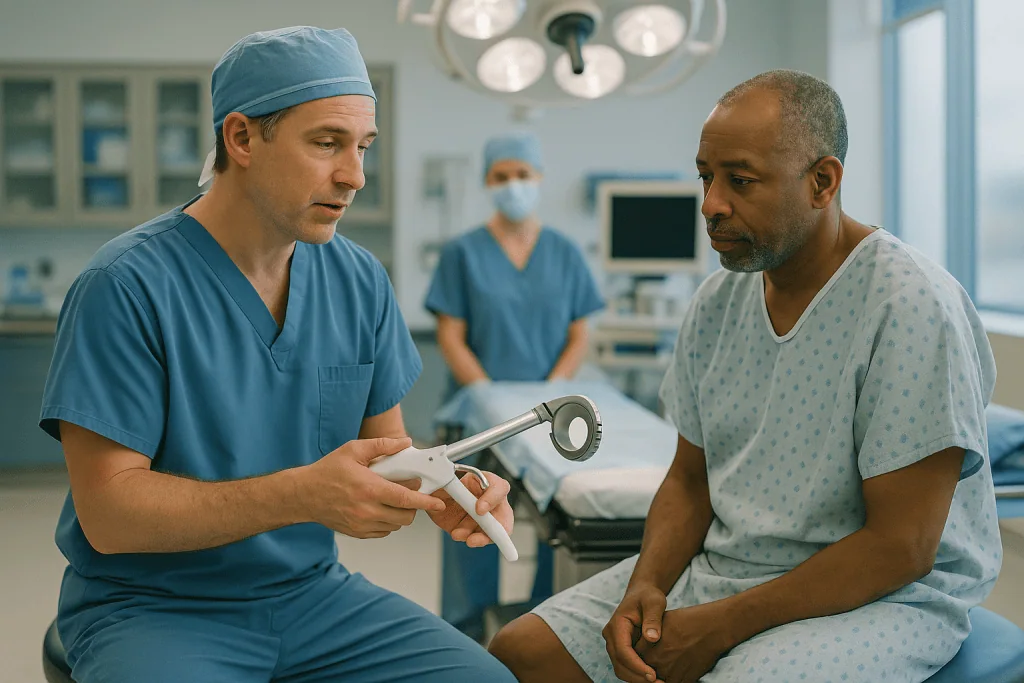
Stapled hemorrhoidopexy leaves the hemorrhoids in place. After a dilator opens the canal, the surgeon places a purse-string stitch in the lining above the dentate line, draws that tissue into the head of a circular stapler, and fires the device. In a few seconds a doughnut of lining is removed and the staple line is sealed. The prolapsed cushions are pulled upward and their blood supply is reduced. The staple ring sits roughly where pain fibers are sparse, so people often describe pressure or an urge to open their bowels rather than sharp wound pain.
Both operations are usually done under general or spinal anesthesia and both can be day-case procedures in many settings, according to MedlinePlus and NHS guidance. Operating time is typically a little shorter for stapling, but the planning, the anesthesia and the time spent in recovery look similar from the patient’s chair.
What differs is where the healing happens. Skin at the anal margin heals slowly and painfully. Mucosa inside the rectum heals quickly and quietly. That is the whole premise of the stapled approach.
How laser hemorrhoidoplasty works, in plain language
Laser hemorrhoidoplasty is the newest of the three techniques and the one with the thinnest evidence base, so it helps to be precise about what it does and does not involve.
The word sounds dramatic, but no tissue is vaporized or cut away. A thin optical fiber is passed through a tiny puncture at the anal margin and threaded into the body of the hemorrhoid. Pulses of laser energy are delivered from the tip of the fiber, heating the vascular tissue from the inside. The heat coagulates the small vessels and causes the connective tissue to contract and scar. Over the following weeks the hemorrhoid shrinks, in much the same way that a laser treatment of a varicose vein causes the vein to collapse. The surgeon repeats the process for each hemorrhoid, usually three positions around the canal.
Because the puncture is small and the dentate-line skin is largely left alone, early pain is generally reported as modest, and some people return to desk work within days. That is the appeal.
The caution is twofold. First, laser hemorrhoidoplasty treats the cushion but does not lift prolapsed lining, so it is mainly used for bleeding internal hemorrhoids of low to moderate grade rather than large, fully prolapsing ones. Second, the published studies are mostly small, single-center and short in follow-up, and the technique has not been through the kind of large multicenter randomized trial that stapling has. The Cochrane and NHS literature that underpins most of this article does not yet rank laser against the alternatives on recurrence, which is the outcome that matters most over years. Any claim that laser is proven superior should be read with that gap in mind.
Hemorrhoidal artery ligation: tying off the blood supply instead of cutting
The third approach treats hemorrhoids as a plumbing problem. Each cushion is fed by branches of the superior rectal artery, and if those branches are tied off the cushion loses pressure and shrinks.

Hemorrhoidal artery ligation, often shortened to HAL, uses a small ultrasound probe mounted in a proctoscope. Doppler ultrasound detects the sound of blood flow, so the surgeon can hear each feeding artery as the probe is rotated around the canal, typically finding six or so. A stitch is placed around each artery through the lining above the dentate line, where sensation is limited, and tied. Nothing is removed. You may also see the method called transanal hemorrhoidal dearterialization, or THD; dearterialization simply means cutting off the arterial supply.
On its own, ligation addresses bleeding more reliably than prolapse. For hemorrhoids that slide out, surgeons usually add a mucopexy: a running stitch that gathers the loose lining and hitches it higher, much like taking in a hem. The combination is sometimes called recto-anal repair.
Recovery is generally gentler than after excision because there is no external wound. A sensation of fullness, some spotting and mild cramping are the common complaints in the first week. Return to ordinary activity is often measured in days rather than weeks, although, as with every timeline in this article, individual healing varies and the treating team’s advice takes precedence.
Where HAL sits on durability is discussed in its own section below, because large UK trial data compared it with office rubber band ligation and found a more complicated picture than early enthusiasm suggested. For now, the headline is that this technique trades a cutting wound for a set of internal stitches, and asks the hemorrhoid to wither rather than be removed.
Who each technique is usually for, and who is usually asked to wait
Surgeons grade internal hemorrhoids by how far they prolapse, and that grade drives most of the decision. Grade I hemorrhoids bleed but never come out. Grade II come out with straining and go back on their own. Grade III come out and need to be pushed back. Grade IV stay out.
Surgery of any kind is rarely the first step. NHS and Mayo Clinic guidance both describe a ladder: fiber, fluids, avoiding straining and limiting toilet time first; then office procedures such as rubber band ligation or sclerotherapy for grade I to II disease; then an operation for grade III to IV disease, for hemorrhoids that keep returning after banding, or for symptoms severe enough to disrupt daily life.
Within the operating room, the techniques tend to sort themselves like this:
- Stapled hemorrhoidopexy suits circumferential grade III prolapse, where several cushions slide together as a ring. It is less suited to a single large pile, to grade IV disease that will not reduce, or to significant external skin tags, which it does not remove.
- Laser hemorrhoidoplasty is typically offered for bleeding grade II to early grade III internal hemorrhoids without major prolapse.
- Artery ligation with mucopexy is used across grade II to III, and is sometimes chosen for people who place a high priority on avoiding a cutting wound.
- Conventional excision remains the usual recommendation for grade IV disease, mixed internal and external hemorrhoids, thrombosed or strangulated piles, and recurrence after a previous stapled or ligation procedure.
Who is asked to wait? People who have not yet tried the simpler measures, anyone with rectal bleeding that has not been fully evaluated (bleeding should never be assumed to be hemorrhoidal without examination), people in pregnancy, where symptoms often settle after delivery, and those with active anal infection, inflammatory bowel disease flares or a bleeding tendency that needs addressing first. Every one of these judgments belongs to the treating team, who can see the anatomy you cannot.
Stapled, laser and artery ligation compared at a glance
The table below pulls together the features discussed so far. It is a summary of typical patterns reported in the sources cited at the end, not a prediction for any individual, and local practice varies.
| Feature | Conventional excision | Stapled hemorrhoidopexy | Laser hemorrhoidoplasty | Artery ligation (HAL/THD) |
|---|---|---|---|---|
| What is done | Hemorrhoids cut out | Ring of lining removed above hemorrhoids; tissue lifted | Hemorrhoids shrunk by heat from inside | Feeding arteries tied; lining hitched up |
| Wound location | Below dentate line (sensitive skin) | Above dentate line | Tiny puncture at margin | Above dentate line |
| Usual grades | III–IV, mixed, thrombosed | Circumferential III | II to early III | II–III |
| Early pain | Highest | Lower in first 3 weeks (eTHoS) | Generally low | Generally low |
| Removes skin tags | Yes | No | No | No |
| Long-term recurrence | Lowest in trials | Higher than excision (Cochrane, eTHoS) | Insufficient long-term data | Higher than expected in UK trial data |
| Evidence quality | Decades of data | Large multicenter RCTs | Small, short studies | Moderate; one large RCT |
Two patterns stand out. The first is that every technique that spares the sensitive skin pays for it, to some degree, in durability. The second is that the quality of the evidence is uneven: the stapled versus conventional comparison has been tested properly, in hundreds of patients followed for years, while the laser literature is still catching up. A technique that lacks long-term data is not necessarily worse; it is simply less known, and that uncertainty is itself information you deserve to have when weighing options.
What the first days and weeks usually look like after each technique
The first bowel movement is the moment most people dread, and it is also the moment that separates these operations most sharply.
After conventional excision, the first week is the hardest. MedlinePlus describes a recovery in which most people are back to ordinary activities in about 2 weeks, with full healing of the wounds taking several weeks longer. Stool softeners, warm sitz baths and regular pain relief prescribed by the surgical team are the mainstays; the point of all three is to prevent a cycle of pain, withholding, hard stool and more pain. Some bleeding with bowel movements is expected for a few weeks as the wounds heal. Difficulty passing urine in the first day is a well-recognized early problem after anal surgery and is one reason some units keep people overnight.
After stapled hemorrhoidopexy, the eTHoS trial found pain scores were lower than after excision across the first 21 days. A feeling of urgency or incomplete emptying is common in the first fortnight and usually fades. Light activity often resumes within days, though heavy lifting and vigorous exercise are generally deferred until the surgeon’s review. Expect a small amount of blood or mucus.
After laser hemorrhoidoplasty or artery ligation, discomfort is typically described as aching or fullness rather than wound pain. Spotting is common. Because the treated tissue shrinks over weeks rather than being removed on the day, the lump may take a month or more to settle, and some people feel a small firm area for a while.
Across all four, two rules recur in NHS and Mayo Clinic advice: keep stools soft with fiber and fluids, and do not sit straining. A short walk several times a day is better than bed rest for both bowel function and clot prevention. Timelines above are typical ranges from the cited sources, not promises, and the surgical team’s instructions override anything written here.
Stapled hemorrhoidopexy vs conventional surgery: what the long-term trials found
This is the comparison with the best evidence, and it is worth reading carefully because the short-term and long-term answers point in opposite directions.
A Cochrane systematic review of randomized trials comparing stapled with conventional surgery concluded that stapling was associated with less pain and a quicker return to normal activity in the early period, but with a significantly higher rate of recurrent hemorrhoids and prolapse at long-term follow-up. The reviewers’ recommendation was blunt: people should be told that the trade for a more comfortable recovery is a greater chance of needing further treatment.
The largest single test came from the UK eTHoS trial, which randomized 777 adults across 29 hospitals to stapled hemorrhoidopexy or traditional excision and followed them for 24 months. Early pain was lower with stapling, as expected. By two years, however, the picture had reversed. Quality-of-life scores favored traditional surgery. Reported symptom recurrence was about 32% in the stapled group compared with about 14% in the excision group, and more people in the stapled group went on to further procedures. The trial’s conclusion, published in The Lancet, was that traditional excision should be considered the preferred option when long-term results are the priority.
Mayo Clinic’s patient guidance echoes the same point in a sentence: stapling involves less pain than hemorrhoidectomy but has been associated with a greater risk of recurrence and rectal prolapse.
So, which is better? It depends on what you are optimizing for. If the next three weeks matter most, stapling has a real and measured advantage. If the next five years matter most, excision has a real and measured advantage. A reasonable surgeon will put both numbers in front of you and ask which future you would rather live in, and the answer is legitimately different for a self-employed parent with no sick leave than for someone who has already had one recurrence.
Laser vs stapler for piles: which is better? What the evidence actually shows
Type this question into a search engine and you will find confident answers in both directions. The honest answer is that the two techniques are not usually competing for the same patient, and where they do overlap, the evidence is not strong enough to declare a winner.
Start with the overlap. Both approaches avoid cutting the sensitive anal skin, so both are expected to produce less early pain than excision. In that sense a person choosing between them is already choosing a gentler recovery. The question is what each does to the underlying problem.
Stapling lifts prolapse. It removes a ring of redundant lining and physically draws the cushions back into the canal, which is why it is reserved for circumferential grade III disease. Laser does not lift anything; it shrinks tissue in place by coagulation. For a bleeding grade II hemorrhoid, shrinking may be exactly what is needed. For a grade III ring that drops out whenever the person stands at the sink, shrinking alone tends to leave the prolapse behind.
Now the evidence. Stapled hemorrhoidopexy has been through the Cochrane process and a 777-patient multicenter trial with two-year follow-up, and its weaknesses on recurrence are documented. Laser hemorrhoidoplasty has, so far, mostly small randomized and observational studies with follow-up measured in months, often comparing it with excision rather than with stapling. Short follow-up flatters any hemorrhoid treatment, because recurrence after stapling and ligation shows up in years two and three. Until laser has been studied over the same horizon, in the same kind of trial, the claim that it is “better” is unproven rather than false.
The practical takeaway is to ask the surgeon a narrower question: for my grade and my symptoms, which technique addresses the problem I actually have, and what is the longest follow-up available for it? That question has an answer. “Which is better in general” does not.
Hemorrhoidal artery ligation recovery and recurrence: the honest picture
Artery ligation arrived with a persuasive story: no cutting, no staples, nothing removed, just the blood supply tied off above the pain line. Recovery data largely support the comfort claim. What the longer studies challenged was the assumption that comfort came free.
In the UK, a large multicenter randomized trial funded by the National Institute for Health Research compared Doppler-guided artery ligation with rubber band ligation, the standard office procedure, for grade II to III hemorrhoids. The headline result was that recurrence after artery ligation at one year was higher than the designers had anticipated, and that much of its apparent advantage over banding disappeared once people who had a repeat banding session were taken into account. Artery ligation was more painful than banding in the first days, as one would expect from an operation under anesthesia compared with a clinic procedure, although still generally less painful than excision.
What does that mean for recovery planning? Most people describe the first week after HAL with mucopexy as uncomfortable rather than agonizing: a sense of rectal fullness, cramping when the bowel moves, some blood and mucus. The mucopexy stitches create internal pleats that take weeks to soften, so a feeling of a lump inside can persist for a month or so even when healing is normal. Sitting is usually tolerable within a few days. The surgical team will advise on when to return to work and lifting.
The recurrence question deserves plain language. Tying an artery reduces inflow, but the anal canal has a rich collateral supply and vessels can reopen or re-route. Prolapse that is hitched up with stitches can gradually slip as scar tissue remodels. Neither outcome is a failure of surgery in the sense of something going wrong; it is the natural behavior of the tissue, and it is the reason excision, which removes the tissue, keeps the lowest recurrence rates in trial after trial.
The main disadvantages of stapled hemorrhoidectomy: what stapled hemorrhoidopexy cannot do, and the rare serious risks
People searching for the disadvantages of stapled hemorrhoidectomy are usually asking two separate questions: what does it leave undone, and what can go badly wrong. They deserve separate answers.
What it leaves undone is fairly predictable. Stapling does not remove external hemorrhoids or skin tags, so anyone bothered by a lump they can feel from outside may still feel it afterward. It does not suit a single large pile, because the stapler works on a full circle of lining. The higher recurrence of prolapse over years, documented in the Cochrane review and the eTHoS trial, is the central disadvantage and has already been covered.
Then there are the complications specific to a circular staple line inside the rectum. Most are uncommon, and the surgical team will discuss them during consent, but they are the reason the technique is confined to trained hands:
- Bleeding from the staple line, occasionally needing a return to theater.
- Persistent pain or a sense of urgency, which in a small number of people lasts months, thought to relate to staples placed too low or to muscle caught in the staple line.
- Narrowing (stricture) at the staple line, which can make stools thin or difficult to pass.
- Injury to the rectal wall or, very rarely, to the vagina in women, if too much tissue is drawn into the device.
- Pelvic infection or sepsis. Mayo Clinic specifically flags rare but serious complications including sepsis, which is why fever after this operation is never something to wait out.
Conventional excision has its own list: more pain, delayed healing, bleeding, urinary retention, anal fissure, narrowing from scar, and a small risk of impaired control of gas if the sphincter is injured. Laser and ligation carry risks of bleeding, thrombosis of the treated pile, and abscess at puncture or stitch sites. No technique is risk-free; the question is which risks you are better placed to accept.
Is piles surgery 100% successful? What "success" means here
No operation in medicine is 100% successful, and hemorrhoid surgery is a particularly good illustration of why the word needs unpacking before it can be answered.
Success can mean at least four different things. It can mean the bleeding stops. It can mean the prolapse stops. It can mean the person is satisfied with the balance of relief and side effects. And it can mean no further treatment is ever needed. A procedure can score well on the first three and poorly on the fourth, and that is precisely the pattern the stapled and ligation trials describe.
Consider the eTHoS numbers again. Two years after surgery, about 14% of people in the excision group and about 32% in the stapled group reported their symptoms had come back. Read one way, excision was successful for roughly six in seven people and stapling for roughly two in three. Read another way, both groups contained many people whose quality of life had improved substantially even if some symptom returned. The trial reported both, which is what good trials do.
Several things shift the odds within any technique. Grade at the time of surgery matters; higher grades recur more. Persistent constipation and straining afterward recreate the pressure that produced the hemorrhoids in the first place, which is why every guideline, including NHS and Mayo Clinic advice, leans so heavily on fiber, fluids and toilet habits after surgery. Body weight, pregnancy, heavy lifting and some chronic coughs add intra-abdominal pressure that pushes cushions back down.
The useful reframing is this: surgery removes or repairs the tissue that has already failed; it does not change the physics that made it fail. A person who has an excellent operation and then returns to twenty minutes on the toilet with a phone has not been let down by the surgeon. The most durable result in every trial combines the right procedure with the unglamorous habits that keep stool soft and time on the seat short.
What people often get wrong about hemorrhoid procedures
Myths in this area tend to survive because the subject is embarrassing and people compare notes in whispers rather than with their clinicians. A few deserve correcting out loud.
“The newer technique is the better technique.” Stapling was once the newer technique, and it took a decade of randomized trials to show that its early advantage came with a late cost. Laser is now in the position stapling once occupied. Novelty tells you nothing about durability.
“Laser means no pain and no risk.” Laser energy coagulates tissue by heat. It is gentler than excision, but thrombosis, bleeding and abscess are all documented, and the fullness as the pile shrinks can last weeks.
“If it hurts less, it must be less effective.” Not for everyone. For a person with circumferential grade III prolapse and a job they cannot step away from, a stapled procedure that works for years is a good outcome. Pain is not a proxy for quality.
“Once operated, hemorrhoids cannot come back.” Hemorrhoidal cushions are normal anatomy. Surgery treats the ones that have enlarged; remaining tissue can enlarge later, especially if constipation and straining continue.
“Bleeding is always just piles.” Rectal bleeding has several causes, some serious. Mayo Clinic and NHS both advise that bleeding be assessed rather than assumed, and surgeons will usually want the bowel examined before any hemorrhoid operation, particularly in people over 45 or with a family history of bowel cancer.
“Surgery is the only real fix.” NHS guidance is clear that most hemorrhoids improve with simple measures and office treatments, and that surgery is reserved for the minority whose symptoms persist. Choosing an operation first, because it sounds definitive, is a common and avoidable mistake.
“A skin tag means the surgery failed.” Stapling, laser and ligation all leave external tags behind by design. A tag is cosmetic unless it causes hygiene problems; it is not recurrence.
Questions to ask your care team
A good consultation about hemorrhoid surgery should leave you able to explain, in your own words, why one technique is being proposed for you and what it will cost you in comfort now versus durability later. These questions help get there. Write the answers down; the details blur quickly.
- What grade are my hemorrhoids, and are they internal, external or mixed? Which of my symptoms is the operation meant to address: bleeding, prolapse, pain or all three?
- Have the simpler steps, including office banding, been tried or ruled out, and why?
- Which technique are you recommending, and what in my anatomy or situation points to it rather than the alternatives?
- What does the longest follow-up data for this technique show about symptoms coming back? How does that compare with conventional excision?
- How many of these procedures do you perform in a typical year? (The answer matters more for stapling than for excision, because the complications are technique-dependent.)
- Will I have any external wound? Will skin tags be removed, and if not, what should I expect to feel afterward?
- What pain relief plan will I be sent home with, and who do I contact if it is not enough?
- When can I expect to sit comfortably, drive, return to my specific job and lift? What would make you tell me to slow down?
- Which symptoms after surgery should prompt a phone call the same day, and which mean I should go to an emergency department?
- If my symptoms return in two or three years, what would the options be then, and does today’s choice narrow them?
- Is there any reason to delay: pregnancy, anticoagulant medicines, a bowel examination that has not been done, or an infection?
Notice that none of these questions asks the surgeon to rank techniques in the abstract. They ask what fits you. That framing tends to produce more honest and more useful answers, and it keeps the decision where it belongs, with you and the team who will be looking after you.
When to call your doctor
Most recovery after hemorrhoid surgery is uncomfortable but uneventful. A minority of problems, though, need to be seen quickly, and after a stapled procedure in particular the serious ones can begin quietly. The surgical team will give written instructions; this list is a general guide drawn from MedlinePlus, Mayo Clinic and NHS advice, not a replacement for it.
Contact the surgical team the same day, or go to an emergency department if you cannot reach them, for any of the following:
- A temperature above 100.4°F (38°C), chills, or feeling suddenly and unusually unwell. After stapling, fever combined with worsening pelvic or lower abdominal pain can signal infection and should never be watched overnight.
- Bleeding that is heavy, that soaks a pad within an hour, that includes clots, or that continues steadily rather than appearing only with bowel movements. Faintness or a racing heart alongside bleeding is an emergency.
- Inability to pass urine for 6 to 8 hours after surgery, or a painful swollen lower abdomen.
- Pain that escalates rather than settling, or that is not controlled by the plan you were sent home with.
- Inability to pass stool or gas for more than a few days despite softeners, or vomiting with abdominal swelling.
- Increasing swelling, redness, warmth or a foul-smelling discharge at the anus.
- New loss of control of gas or stool that does not improve over the first days.
- Calf pain, swelling or sudden breathlessness, which can indicate a blood clot after any operation.
Before surgery, the red flags are different but just as important. Rectal bleeding that is dark, mixed with stool or accompanied by weight loss, a change in bowel habit lasting more than a few weeks, anemia, or a family history of bowel cancer should be evaluated before hemorrhoids are assumed to be the cause. Hemorrhoid treatment of any kind can wait; a missed diagnosis cannot.
If in doubt, call. Surgical teams would far rather hear about a false alarm than meet a real one late.
Frequently asked questions
What is staple hemorrhoid surgery?
Staple hemorrhoid surgery, formally stapled hemorrhoidopexy, uses a circular stapling device to remove a ring of loose rectal lining above the hemorrhoids and close the gap with tiny staples. This lifts prolapsed tissue back into the canal and reduces its blood supply so the hemorrhoids shrink. Because the staple line sits above the sensitive anal skin, early pain is usually less than after excision.
What is the Longo procedure used for?
The Longo procedure is another name for stapled hemorrhoidopexy, after the surgeon who popularized it. It is used mainly for internal hemorrhoids of grade III that prolapse as a ring around the canal. It is less suited to a single large pile, grade IV disease that will not reduce, or external hemorrhoids and skin tags, which it does not remove.
Which is better for treating piles, laser or stapler?
Neither is better in general; they usually treat different problems. Stapling lifts circumferential grade III prolapse and has large trials showing lower early pain but higher long-term recurrence than excision. Laser shrinks bleeding grade II to early III hemorrhoids without lifting prolapse, and its evidence is mostly short-term and small-scale. Ask which addresses your specific grade and symptoms.
Is piles surgery 100% successful?
No hemorrhoid operation is 100% successful, because hemorrhoidal cushions are normal tissue that can enlarge again. In the eTHoS trial, about 14% of people after conventional excision and about 32% after stapling reported recurring symptoms within two years. Results depend on hemorrhoid grade, the technique chosen and whether constipation and straining are controlled afterward.
How does stapled hemorrhoidopexy vs conventional surgery compare on pain?
Randomized trials consistently show less pain after stapling in the early weeks. The eTHoS trial recorded lower pain scores for stapled hemorrhoidopexy across the first 21 days compared with conventional excision. The difference arises because excision leaves wounds in nerve-rich skin at the anal opening, while the staple line sits in the less sensitive rectal lining above it.
What are the main disadvantages of stapled hemorrhoidectomy?
The main disadvantage is a higher rate of recurrent prolapse over years, documented in the Cochrane review and the eTHoS trial. Stapling also leaves external skin tags untouched. Specific complications, though uncommon, include staple-line bleeding, persistent pain or urgency, narrowing at the staple line, rectal wall injury and rare pelvic sepsis, which is why fever afterward needs prompt assessment.
What does hemorrhoidal artery ligation recovery usually involve?
Recovery after hemorrhoidal artery ligation is usually gentler than after excision because there is no external wound. People commonly describe rectal fullness, cramping with bowel movements and some spotting in the first week, with light activity resuming within days. When a mucopexy is added, an internal lump sensation can persist for several weeks as the stitches soften. The surgical team advises on work and lifting.
How long does recovery take after conventional hemorrhoidectomy?
According to MedlinePlus, most people return to ordinary activities in about two weeks after conventional hemorrhoidectomy, with the wounds continuing to heal for several weeks after that. The first week is usually the most uncomfortable, especially around bowel movements. Soft stools, warm sitz baths and the pain plan prescribed by the surgical team are the core of recovery.
Can hemorrhoids come back after any of these operations?
Yes. Hemorrhoidal cushions are part of normal anatomy, so remaining tissue can enlarge again, particularly with ongoing constipation, straining, heavy lifting or pregnancy. Recurrence is lowest after excision, which removes the tissue, and higher after stapling and artery ligation, which leave it in place. Long-term recurrence after laser hemorrhoidoplasty has not yet been studied as thoroughly.
Do I need a bowel examination before hemorrhoid surgery?
Often, yes. Rectal bleeding has several possible causes, and NHS and Mayo Clinic guidance advise that it be assessed rather than attributed to hemorrhoids by assumption. Surgeons commonly arrange an examination of the bowel before operating, especially for people over 45, those with a change in bowel habit, anemia, weight loss or a family history of bowel cancer.
References
- Piles (haemorrhoids) (NHS)
- Hemorrhoid surgery (MedlinePlus Medical Encyclopedia)
- Treatment of Hemorrhoids (NIH, NIDDK)
This article is for general information only and is not a substitute for professional medical advice. Please consult a qualified doctor about your individual situation.

More from the Blog

Do Seeds Cause Appendicitis? Common Myths About the Appendix, Examined by Surgeons
No. Mainstream evidence does not support the idea that seeds cause appendicitis. Appendicitis usually begins when the appendix is blocked by hardened stool, swollen…

How Is Pain Managed After an Appendectomy? Anesthesia Wear-Off, Gas Discomfort and Day One
Pain after appendectomy is usually managed with a layered plan: local anesthetic in the wounds, scheduled non-opioid pain relievers such as acetaminophen or an…

When Achalasia Symptoms Return After Treatment: Repeat Dilation, Redo Myotomy and Next Steps
Achalasia symptoms can return months or years after pneumatic dilation, Heller myotomy or POEM because the treated muscle can tighten again, scar tissue can…

Robotic Colorectal Surgery Recovery: Daily Walks, Small Meals and the Lifting Limit
Robotic colorectal surgery recovery usually means a hospital stay of a few days, then several weeks of gradual healing at home. Most care teams…

What Is Normal After Robotic Hernia Repair and What Signals Infection or Recurrence?
After robotic hernia repair, mild swelling, bruising, a firm ridge under the incisions, shoulder-tip gas pain and tiredness are common for one to two…

Helping a Family Member After Gallbladder Surgery: Meals, Movement and the First Night Home
Helping someone after gallbladder surgery mostly means covering three things for the first few days: small, low-fat meals that are easy to digest, short…