

Supporting Someone Through Testicular Torsion Surgery: The First Night and the Week After

Key Takeaways
- Testicular torsion is a surgical emergency; MedlinePlus notes the chance of saving the testicle is highest when surgery happens within about six hours of pain starting.
- Most surgeons fix both testicles during the same operation because the loose attachment that allows twisting is usually present on both sides.
- Pain typically peaks in the first 24 to 48 hours and then eases, while swelling and bruising can take one to several weeks to settle.
- Spreading bruising that drifts toward the thigh over several days is old blood moving through loose tissue, not a sign of new bleeding.
- Strenuous activity, cycling, contact sport and sexual activity are usually reintroduced over several weeks, on the surgeon's say-so, not on a fixed date.
- Sudden severe testicular pain after orchiopexy, at any point in later life, is treated as a possible new torsion and needs emergency assessment.
Supporting someone after testicular torsion surgery mostly means keeping the first night calm and the week after predictable: help them rest with the scrotum supported, keep the wound dry as instructed, give only the pain relief the surgical team prescribed, watch for fever, spreading redness, heavy bleeding or sudden severe pain, and make sure the follow-up visit happens. Decisions about activity and medicines stay with the treating team.
It is usually a phone call that starts it. A teenager who woke at 2 a.m. doubled over, a partner who went pale in the shower, a son who said “it’s nothing” for an hour too long. Then the emergency department, the ultrasound, the surgeon explaining that the spermatic cord has twisted and the clock is already running. By the time the operation is over, the person holding the discharge sheet is often not the patient at all. It is you.
Testicular torsion support after surgery is a short, intense job. The surgery itself is fast and the hospital stay is often brief, which means the first night and the week after happen in a bedroom, not a ward. This guide is written for the person on the sofa with the ice pack and the printed instructions, who wants to know what is normal, what is not, and how to help without hovering.
What actually happens in testicular torsion surgery
Testicular torsion is a twist of the spermatic cord, the bundle of blood vessels, nerves and the sperm-carrying tube (vas deferens) that suspends each testicle. When the cord rotates, the veins are pinched first, the testicle swells, and then the arterial supply shuts off. Tissue without blood flow starts to die within hours, which is why the Mayo Clinic describes torsion as a surgical emergency rather than a problem to watch overnight.
The operation has two parts. First, the surgeon makes a small incision in the scrotum, finds the cord and untwists it; this is detorsion. Second, if the testicle regains color and blood flow, it is stitched to the inner wall of the scrotum so it cannot rotate again; this is orchiopexy, the technical name for fixing a testicle in place. Most surgeons also fix the opposite testicle during the same operation, because the anatomical quirk that allowed one side to twist, sometimes called a bell clapper deformity, is usually present on both sides (Mayo Clinic).
If the testicle has been without blood for too long and does not recover on the table, the surgeon removes it. That procedure is an orchiectomy. MedlinePlus notes that the chance of saving the testicle is highest when surgery happens within about six hours of the pain starting, and falls steadily after that. Nobody on the ward will have been able to promise an outcome before the incision was made, and the family often learns which operation was done only when the surgeon comes out afterward.
The whole thing is usually done under general anesthesia. Because the incision is small and the scrotum heals well, many patients go home the same day or after a short period of observation (MedlinePlus). That speed is reassuring, but it also means the real recovery starts at home.
Who the surgery is for, and who is usually asked to wait
There is no waiting list for confirmed torsion. Once an examination and, where time allows, a Doppler ultrasound show that blood flow to the testicle has stopped, the patient goes to the operating room as fast as the hospital can arrange it. The Cleveland Clinic puts the condition at roughly 1 in 4,000 males under 25, and the Mayo Clinic notes it is most common between ages 12 and 18, although newborns and adults in their thirties and forties are not exempt.

Where “waiting” comes into the picture is at the edges of the diagnosis. Some people describe episodes of severe testicular pain that resolve on their own within minutes or an hour. That pattern, known as intermittent torsion, means the cord twisted and untwisted by itself. It is not an emergency in the moment, but it is a strong warning sign, and urologists often recommend planned orchiopexy to prevent a complete twist later. The decision about whether and when to operate in that situation rests with the urologist, who weighs the frequency of episodes, the ultrasound appearance and the person’s age.
Occasionally, an emergency clinician will attempt to untwist the cord by hand through the skin, a maneuver called manual detorsion. It can buy time and relieve pain, but it does not replace surgery, because the testicle still needs to be fixed in place to stop a recurrence (Mayo Clinic).
A supporting relative sometimes asks whether the other side really needed stitching if it was never painful. The answer from mainstream guidance is yes: the opposite testicle shares the same loose attachment in most patients, and fixing it during the same anesthetic avoids a second emergency. If that was not done, ask the surgeon why; there may have been a sound reason specific to the case.
The first night home: practical testicular torsion support after surgery
The first night is mostly about position, pain and reassurance. Ask the nurse before discharge exactly which pain medicine was prescribed, when the next dose is due and when the last one was given, and write it on the fridge. A sleepy post-anesthetic patient will not remember, and neither will a worried parent at 3 a.m. Give only what the team prescribed, at the times they wrote down; do not add anything from the bathroom cabinet without checking with the ward or pharmacist first.
Set up a resting spot where the hips are slightly raised and the scrotum is supported. A folded towel under the buttocks or a small pillow between the thighs lifts the scrotum and reduces throbbing. Snug, supportive underwear or the athletic support the hospital provided does the same job when the patient needs to walk to the bathroom (MedlinePlus).
Cold helps swelling. A bag of frozen peas wrapped in a thin cloth, applied over the underwear for short intervals with breaks in between, is the classic approach the Cleveland Clinic and others describe. Never put ice directly on skin, and never on a dressing that must stay dry.
Expect a few things that look alarming but are usually ordinary: a scrotum that is purple-blue and roughly twice its normal size, a small amount of blood staining the dressing, and nausea or lightheadedness from the anesthetic. Encourage small sips of water and bland food rather than a big meal.
What you are really doing on night one is pattern-watching. Pain that is settling, even slowly, is reassuring. Pain that climbs steeply, a fever, or bleeding that soaks through the dressing are not, and the next section on red flags explains what to do.
Pain, swelling and bruising: what is normal in the first 72 hours
The scrotum has a rich blood supply and very loose skin, which is good for healing and bad for appearances. Over the first two to three days, the bruising often spreads downward and sideways, sometimes into the inner thigh or the base of the penis, and changes color from purple to green and yellow. That migration is gravity moving old blood through soft tissue, not a new injury.
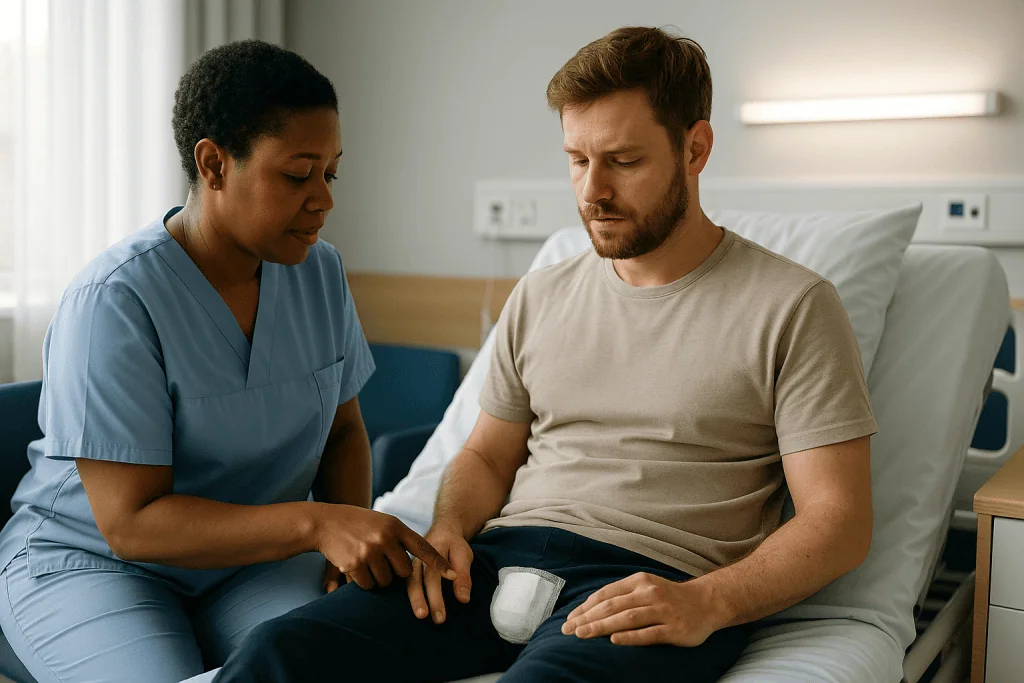
Pain typically peaks in the first 24 to 48 hours and then eases day by day (MedlinePlus). It usually feels like a deep ache with sharper twinges on movement, coughing or standing up. Most surgical teams manage this with non-opioid medicines: acetaminophen (paracetamol in some countries), which acts centrally on pain signaling, and sometimes a nonsteroidal anti-inflammatory such as ibuprofen, which dampens the prostaglandins that drive swelling and soreness. Some patients are also given a short supply of a stronger medicine for breakthrough pain. The choice, the combination and the duration belong to the prescribing clinician, who knows the patient’s kidney function, stomach history and age; the supporter’s role is to keep to the written schedule and to report pain that is not controlled rather than improvise.
Swelling behaves differently from pain. It often increases for the first two days, plateaus, and then takes one to several weeks to settle fully (MedlinePlus). A testicle that was twisted for several hours may stay firm and tender longer than its neighbor.
A simple tracking habit helps the follow-up appointment: once a day, note the pain on a 0 to 10 scale, whether a fever was measured, and whether the swelling looks the same, smaller or larger. Three lines on a phone note give the surgeon more useful information than a vague “it seemed okay.”
Wound care, dressings and showering after torsion surgery
Scrotal incisions are usually closed with dissolving stitches, sometimes covered with skin glue or a small adhesive dressing (MedlinePlus). Dissolving stitches soften and fall out on their own over roughly one to three weeks; finding a short thread in the underwear is normal and not a sign that the wound has opened.
The discharge sheet will say how long to keep the area dry. Follow that number rather than a general rule, because surgeons differ on glue versus dressing. Once showering is allowed, let warm water run over the area without scrubbing, avoid soaking in a bath or pool until the team says otherwise, and pat the skin dry with a clean towel or let it air dry. Baths, hot tubs and swimming soften the healing edges and invite bacteria, which is why they are usually off the list for a couple of weeks.
A little pink or clear fluid on the dressing in the first day or two is common. Bright red bleeding that soaks through, thick yellow or green discharge, a bad smell, or skin around the incision that becomes hotter, redder or more swollen after day two or three are the signs of infection or bleeding that need a call (Cleveland Clinic).
Practical details that reduce friction, literally: loose cotton boxers over a supportive brief, no tight jeans for the first week, and a soft towel folded on the car seat for the ride home and to follow-up. If shaving was done before surgery, the regrowth will itch; discourage scratching near the incision and do not apply creams or powders unless the team recommended one.
Change dressings only if instructed, with clean hands, and keep any product the hospital gave you rather than substituting a different brand or type.
Testicular torsion recovery time: a week-by-week picture
Timelines vary with age, how long the cord was twisted, and whether the testicle was saved or removed. The ranges below are typical patterns described by MedlinePlus and the Mayo Clinic, not promises, and the surgeon’s own instructions override them.
| Period | What usually happens | What support looks like |
|---|---|---|
| Night 1 to day 2 | Peak pain and rising swelling; bruising begins; drowsiness from anesthesia | Scheduled pain relief, elevation, cold packs, small meals, someone within earshot |
| Days 3 to 7 | Pain easing; bruising spreads then fades; short walks comfortable; dressing often removed or glue flaking | Gentle encouragement to move, supportive underwear, watch the wound daily, book follow-up |
| Week 2 | Many return to school or desk work; swelling still visible; stitches dissolving | Plan transport that avoids long sitting on hard seats; keep sport and lifting off the table |
| Weeks 3 to 6 | Strenuous activity, cycling, contact sport and sexual activity usually reintroduced on the surgeon’s say-so (Mayo Clinic) | Check at follow-up before each step up; ask about a protective cup for sport |
A few things slow the curve. Teenagers who go back to gym class early, adults who lift at work before clearance, and anyone who stops supportive underwear on day three because it feels fine tend to see swelling return. On the other side, a testicle that stays enlarged and firm for weeks after being saved is not unusual; the Cleveland Clinic notes that some saved testicles shrink gradually over months as damaged tissue is replaced, which the urologist will track at later visits.
If the week-by-week picture stalls, with pain or swelling that is the same or worse on day five as on day two, that is a reason to call rather than wait for the scheduled appointment.
Orchiopexy recovery tips: moving, sleeping and the small daily things
Rest matters in the first two days, but complete bed rest is not the goal. Short walks around the house, started the first evening if the patient feels steady, keep blood moving in the legs and help the bowels wake up after anesthesia. The rule most teams give is simple: walking yes, lifting, straining, cycling and running no, until told otherwise (MedlinePlus).
Sleep is easier on the back with knees slightly bent over a pillow, which takes tension off the groin. Side sleepers can place a pillow between the thighs so the scrotum is not compressed. A supportive brief worn overnight for the first few nights reduces the tug of gravity that wakes people with a throb at 4 a.m.
Constipation is a quiet troublemaker. Anesthetic drugs, reduced activity and some pain medicines all slow the gut, and straining on the toilet pulls on exactly the muscles the patient is trying to protect. Plenty of fluids, fruit, vegetables and whole grains help; if nothing has moved by day two or three, ask the pharmacist or surgical team whether a stool softener is appropriate rather than choosing one yourself.
Stairs are fine but slow. Getting out of a car is easier if the patient swings both legs out together before standing. Driving is usually discouraged until pain medicine no longer causes drowsiness and the person can brake hard without wincing; check the local rule and the surgeon’s view.
For teenagers, a note for school or college that excuses physical education and allows a cushion on hard chairs removes the awkward conversation. For adults, a return-to-work plan that avoids heavy lifting for the period the surgeon specifies is reasonable to request, and most employers accept a brief medical letter without needing details.
If the testicle could not be saved: supporting someone after orchiectomy
Sometimes the surgeon comes out and says the testicle was already too damaged and had to be removed. The physical recovery after orchiectomy is similar to orchiopexy, with the same wound care, the same swelling and the same timeline. The emotional recovery is different, and it deserves its own attention.
Start with the facts, because they are genuinely reassuring. One healthy testicle produces enough testosterone for normal puberty, libido, muscle and bone health, and enough sperm for fertility in most people (Mayo Clinic). The remaining testicle often grows slightly larger over time to compensate. The urologist will usually check hormone levels and, in adults who want to know, may discuss semen analysis later; those tests are offered, not required.
Appearance can be addressed. A testicular prosthesis, a saline-filled implant placed in the scrotum, can be inserted at a later operation once healing is complete. Some people want it, many do not, and either choice is reasonable. The topic is best raised calmly at a follow-up visit rather than in the raw first week.
What helps emotionally is permission. A teenager may be embarrassed, angry at themselves for not speaking up sooner, or worried about locker rooms and future partners. An adult may feel the same and say even less. The useful message from a supporter is not “it could have been worse” but “this was a medical event, not a failing, and you can talk about it or not, whenever you like.” Grief for a body part is real and does not need to be rushed.
If low mood, withdrawal or sleep problems persist beyond a few weeks, mention it at follow-up; the care team can connect the patient with counseling that understands this specific situation.
Supporting a teenager or young adult through the awkward parts
Torsion lands most often in the exact years when privacy feels sacred. A 14-year-old who had to let a stranger examine him at midnight and now needs help with an ice pack is in an uncomfortable spot, and how the adults around him handle it shapes whether he will report a problem next time.
Offer help without demanding it. Put the supplies in the bathroom, explain once how to check the dressing, and then step back. Knock. Let him manage the support underwear himself. Ask about pain in neutral terms and accept short answers, while still watching for the signs that matter: fever, soaking bleeding, pain that climbs rather than settles.
Decide together what classmates will be told. “Minor surgery, back next week” is enough for most situations, and the patient should control the detail. A letter to the school nurse or physical education teacher can be specific while the public story stays vague.
Be honest about the other side. The surgeon likely fixed the opposite testicle, which means a second torsion is unlikely but not impossible. The Mayo Clinic is clear that any sudden severe testicular pain, at any age, is an emergency until proven otherwise. Teenagers who understand that they will not be judged for a false alarm are far more likely to speak up quickly.
Finally, watch the siblings and friends. Torsion is not inherited in a simple way, but the bell clapper anatomy can run in families, and brothers sometimes develop a sudden fear of their own bodies. A short, matter-of-fact conversation that ends with “if it ever hurts suddenly, you tell someone that minute” is the most protective thing a parent can say.
Fertility, hormones and the other testicle: what the evidence says
This is the question families whisper in the hospital corridor and rarely ask the surgeon directly. The honest answer has two layers.
Layer one is hormonal, and it is reassuring. Testosterone production has a lot of spare capacity. A single testicle, or a saved testicle that is somewhat smaller than before, generally maintains normal hormone levels and normal sexual function (Mayo Clinic). Puberty proceeds on schedule. The urologist may check a blood level at a later visit if there is any clinical reason, but routine lifelong monitoring is not the norm after a straightforward recovery.
Layer two is sperm production, and the evidence is more nuanced. Testicular tissue that was deprived of blood for hours is more vulnerable than hormone-producing tissue, and a saved testicle can show reduced function on later testing even when it looks fine. Some research also suggests that the torsion episode may affect the opposite testicle through immune or vascular mechanisms, although the size of that effect in real-world fertility is uncertain and most people who have had torsion go on to father children (Cleveland Clinic). What the evidence does not support is any claim that torsion routinely causes infertility, or that a supplement or special diet improves outcomes.
The practical path is simple. Adults who are concerned can ask for a semen analysis once healing is complete and the urologist thinks the timing is right. Teenagers do not need testing in the first week, or the first year, unless the specialist advises it. Where fertility later proves difficult, the standard reproductive medicine pathway is open and is not changed by a history of torsion.
Supporters help most by making it clear the question is allowed, then letting the patient decide when to ask it.
What people often get wrong about recovery from torsion surgery
“If the pain is gone, the swelling should be too.” Pain and swelling run on different clocks. Pain fades over days; swelling and firmness can take weeks (MedlinePlus). A testicle that is still enlarged at the two-week visit is not a sign the surgery failed.
“Both testicles were fixed, so torsion can never happen again.” Orchiopexy makes recurrence rare, not impossible. Sudden severe testicular pain after surgery, even years later, is treated as an emergency until a clinician says otherwise (Mayo Clinic).
“The bruise spreading means something is bleeding inside.” Spreading, fading bruising that drifts toward the thigh over several days is old blood moving through loose tissue. New, rapidly expanding, tense swelling with sharp pain is different and needs a call.
“He should stay in bed all week.” Short walks from day one help circulation, bowels and mood. The restriction is on lifting, straining and sport, not on moving around the house.
“Heat will help it heal.” Warmth increases blood flow and swelling in the first days; cold is what most teams recommend early. Heat has no routine role in the first week unless the surgeon specifically suggests it.
“Antibiotics are always needed after scrotal surgery.” Many patients receive none, because the operation is clean and infection is uncommon. If antibiotics were prescribed, the course is finished as written; if they were not, that is not an oversight.
“It happened because of a sports injury or a bike seat.” Torsion can follow minor trauma or activity, but it also happens during sleep. The underlying cause is anatomical, and nobody did anything wrong by playing soccer or cycling that day.
“A saved testicle is as good as new.” Often it recovers well; sometimes it shrinks over months. The urologist tracks this, and it does not change the day-to-day recovery plan.
Ruptured testicle, testicular contusion and vas deferens pain: how they differ from torsion
People searching for recovery advice often mix up several scrotal problems, and knowing the difference matters when a new ache appears during the week after surgery.
A ruptured testicle, also called testicular fracture, is a tear in the tough outer capsule of the testicle, almost always after direct blunt trauma such as a kick, a fastball or a handlebar. It causes immediate severe pain, rapid swelling and often visible bruising, and it is diagnosed by ultrasound. Like torsion, it is usually treated with urgent surgery to repair the capsule and save the testicle (Cleveland Clinic). It is not something that develops quietly after an orchiopexy.
A testicular contusion is a bruise of the testicle or its surrounding tissue without a capsule tear. It also follows a blow, hurts a great deal for a short time and then settles with rest, support and cold. The distinction between contusion and rupture cannot be made at home, which is why any significant scrotal injury, especially in a freshly operated patient, is assessed with an ultrasound rather than watched.
Vas deferens pain is a looser term. The vas deferens is the muscular tube that carries sperm from each testicle toward the urethra, and it runs inside the spermatic cord that was handled during surgery. Soreness along the cord into the groin is common for a week or two after orchiopexy as the handled tissues settle. Persistent or worsening cord pain, pain that radiates with urination, or pain with fever may point to inflammation of the epididymis or vas and should be checked.
The common thread is simple: after torsion surgery, new sudden severe pain, pain after an injury, or pain with fever is a reason to be seen, not a reason to guess which of these it might be.
Questions to ask the care team before and after discharge
Discharge conversations are rushed and the patient is groggy, so the supporter is the one who should carry the list. Write the answers down.
- Was the testicle saved, removed, or is its recovery uncertain? Was the other side fixed as well?
- Which pain medicines are prescribed, when was the last dose given on the ward, and what should we do if the pain is not controlled on the schedule written here?
- Are there any medicines or supplements he already takes that should be paused or continued? Who decides that?
- How long should the dressing stay on, when can he shower, and when is bathing or swimming allowed?
- What is the exact rule on walking, stairs, school or work, lifting, cycling, contact sport and sexual activity, and who gives the go-ahead at each step?
- What does normal swelling and bruising look like for this operation, and what would make you want to see him urgently?
- Which number do we call tonight, and which number tomorrow, if something worries us?
- When is the follow-up appointment, who is it with, and what will be checked?
- Will there be any later tests of hormone levels or fertility, and if so, roughly when?
- If the testicle was removed, when would be the right time to discuss a prosthesis, if he wants one?
- Is there anything about this particular case, such as how long the twist lasted, that changes the usual advice?
Two habits make follow-up more useful. First, take a photo of the scrotum in good light on day one and again on day four or five, with the patient’s consent; a clinician comparing images can judge change far better than a description. Second, bring the daily pain and temperature notes. Surgeons appreciate a supporter who says “pain was 6 on day one, 3 on day four, no fever” far more than one who says “he seemed fine, I think.”
When to call your doctor: red-flag signs after testicular torsion surgery
Most recoveries are uneventful, but the complications that do happen declare themselves early and clearly. Call the surgical team, the hospital number on the discharge sheet, or emergency services if any of the following appears.
Go to the emergency department or call emergency services for sudden severe testicular pain that is clearly worse than the surgical ache, especially if it comes on quickly; this could be a new twist and is treated as an emergency until proven otherwise (Mayo Clinic). Do the same for bleeding that soaks through the dressing and continues, for a scrotum that becomes rapidly larger and tense over an hour or two, or for faintness, chest pain or breathlessness.
Call the surgical team the same day for a measured fever, chills or shivering; for redness, warmth or swelling around the incision that is increasing after the second or third day; for thick yellow or green discharge or a bad smell from the wound; for an incision that has opened; for inability to pass urine; or for pain that is not controlled by the prescribed medicines on the written schedule (Cleveland Clinic, MedlinePlus).
Call during office hours for swelling or firmness that has not started to improve after about a week, for new pain in the groin or along the cord that persists, for a stitch end that is irritating but not infected, or for questions about when to resume a specific activity.
A short word on calf pain, swelling of one leg, or sudden shortness of breath: these are uncommon after a brief scrotal operation, but any surgery and any period of reduced movement slightly raise clot risk, and these symptoms always warrant urgent assessment regardless of the original operation.
When in doubt, call. The team would rather hear about a bruise that turned out to be nothing than meet a complication a day late.
Frequently asked questions
What is the testicular torsion recovery time after surgery?
Most people are up and walking the same day, back to school or desk work within one to two weeks, and cleared for sport and strenuous activity over several weeks, according to MedlinePlus and the Mayo Clinic. Pain usually settles within days; swelling takes longer. These are typical ranges, not guarantees, and the surgeon’s instructions for the individual patient take priority over any general timeline.
What should testicular torsion surgery aftercare include on the first night?
Keep the patient resting with the hips slightly raised and the scrotum supported, give only the prescribed pain relief at the times written by the team, apply a wrapped cold pack in short intervals, offer small sips and bland food, and check the dressing before sleep. Someone should be within earshot overnight. Pain that climbs steeply, soaking bleeding or a fever are reasons to call rather than wait for morning.
What are the symptoms of a ruptured testicle, and can it happen after torsion surgery?
A ruptured testicle follows direct blunt trauma and causes immediate severe pain, rapid swelling and often marked bruising; it is confirmed by ultrasound and usually treated with urgent surgery (Cleveland Clinic). It does not develop on its own after orchiopexy. Any significant blow to the scrotum in the weeks after surgery should be assessed urgently, because rupture and simple bruising cannot be told apart at home.
What is a testicular contusion and how does it happen?
A testicular contusion is a bruise of the testicle or surrounding tissue after a direct blow, without a tear in the testicle’s outer capsule. It causes sharp pain that eases with rest, support and cold over days. Because a contusion and a rupture feel similar at first, clinicians use ultrasound to tell them apart, and a freshly operated patient who takes a knock should be seen rather than watched.
What is the treatment for a swollen testicle that is causing pain after surgery?
Expected post-surgical swelling is managed with supportive underwear, elevation, cold packs and the pain relief the team prescribed; it usually improves over one to several weeks (MedlinePlus). Swelling that increases rapidly, becomes tense, or comes with fever, redness or sudden severe pain is treated differently and needs prompt assessment, because it may indicate bleeding, infection or a new torsion. The treating team decides which applies.
What are the symptoms of vas deferens pain, and is it normal after orchiopexy?
The vas deferens runs inside the spermatic cord that the surgeon handled, so a dull ache along the cord into the groin is common for a week or two afterward. Pain that is worsening rather than easing, pain with fever, or pain that spreads with urination can suggest inflammation of the epididymis or vas and should be checked by the care team rather than assumed to be normal healing.
What are good orchiopexy recovery tips for the first week?
Walk a little from the first evening but avoid lifting, straining and sport; wear supportive underwear day and night early on; sleep on the back with a pillow under the knees; keep the wound dry for exactly as long as instructed; drink enough fluids and eat fiber to avoid constipation; and keep a daily note of pain, temperature and swelling to bring to follow-up. Ask the team before each step up in activity.
What to expect after torsion surgery in terms of bruising?
Expect the scrotum to look purple or blue and roughly twice its normal size for the first few days, with bruising that spreads toward the inner thigh or base of the penis and then fades through green and yellow. That migration is normal. New, rapidly enlarging, tense swelling with sharp pain is not, and should prompt a call to the surgical team the same day.
Will one testicle, or a damaged one, affect fertility and hormones?
A single healthy testicle usually produces normal testosterone and enough sperm for fertility, according to the Mayo Clinic. A testicle that was twisted for hours may show reduced function later, and some evidence suggests the opposite side can be affected, though most people who have had torsion go on to father children. Adults who are concerned can ask the urologist about semen analysis once healing is complete.
Can testicular torsion happen again after both sides have been fixed?
Recurrence after orchiopexy is rare but not impossible, which is why the Mayo Clinic advises treating any sudden severe testicular pain as an emergency even years after surgery. The stitches that anchor the testicle reduce the chance of twisting dramatically. Teaching the patient, and any brothers, to report sudden testicular pain immediately is the most useful long-term protection a family can offer.
References
- MedlinePlus: Testicular torsion
- MedlinePlus: Testicular torsion repair
- Cleveland Clinic: Testicular torsion
This article is for general information only and is not a substitute for professional medical advice. Please consult a qualified doctor about your individual situation.
Add us as a Preferred Source to see more of our trusted health content across Google Search, AI Overviews and Discover.

More from the Blog

Preventing Another Kidney Stone: Fluids, Diet Changes and the Follow-Up Tests That Guide Them
To lower the chance of another kidney stone, most guidelines start with drinking enough fluid to keep urine pale and plentiful through the day,…

How Erectile Dysfunction Is Evaluated: Blood Tests, Hormone Checks and Heart Risk Assessment
Erectile dysfunction is evaluated with a detailed medical and sexual history, often a short questionnaire, a physical examination, and blood tests that commonly include…

How a Urinary Tract Infection Can Reach the Kidneys and How Prompt Care Prevents It
A urinary tract infection usually starts in the bladder, and the bacteria can climb the ureters, the tubes that link bladder and kidneys, to…

Is Swelling After a Vasectomy Normal? Hematoma Signs and When to Call Your Urologist
Mild swelling after vasectomy is expected and usually settles within a few days, along with light bruising and a dull ache. A scrotum that…

How Long Do International Patients Stay in Istanbul After Robotic Prostate Surgery?
Most international patients remain near the surgical center for roughly one to two weeks after robotic prostate surgery, because the urinary catheter is usually…

Can You Travel While on Hemodialysis? Arranging Sessions Abroad and Carrying Records
Yes, most people on hemodialysis can travel, including abroad, provided their condition is stable and sessions are booked in advance at a unit near…