

The Farmer’s Carry: Why Loaded Carries Are the Most Functional Strength Exercise, and How to Do Them Safely
Key Takeaways
- In the PURE study of about 140,000 adults, each 5-kilogram drop in grip strength was associated with roughly 16 percent higher all-cause mortality, but this is observational data showing association, not proof that grip training extends life.
- The WHO and CDC both recommend muscle-strengthening activity on at least two days a week, and adults over 65 should add balance-focused work on three or more days; loaded carries can contribute to both.
- A farmers carry is essentially a moving plank with a grip test attached: electromyography studies show high activation in the forearms, upper back and the lateral trunk muscles that resist side-bending.
- Most injuries during carries happen at the pickup and set-down, not the walk, so use a controlled squat pattern with a long spine to lift and lower the weights.
- Holding your breath under load spikes blood pressure sharply, so breathe steadily behind a gentle abdominal brace, and anyone with a heart condition, hernia or uncontrolled hypertension should set limits with a clinician first.
- The suitcase carry, with one weight in one hand, demands more from the trunk muscles on the opposite side than the two-handed version and reveals left-right strength imbalances that a two-handed carry hides.
A farmers carry is a loaded carry in which you pick up a heavy weight in each hand, stand tall and walk. It trains grip, forearms, shoulders, core and hips together, and it mimics real-life tasks such as carrying groceries or luggage. Strength training of this kind is recommended at least twice a week by the WHO and CDC; anyone with heart, back or joint conditions should check with a clinician first.
Watch a parking lot outside any gym this month and you will see it: someone hauling two kettlebells from one end to the other, jaw set, walking as if late for a train. The clip goes up online with a caption about “the exercise that predicts how long you’ll live,” and the comments fill with people asking how heavy, how far, how often. As of September 2026, the farmers carry has become the fitness internet’s favorite example of “functional” strength, riding a wave of interest in grip strength as a marker of healthy aging.
The odd thing is that the movement itself is about as old as farming. Pick something heavy up. Walk with it. Put it down. What has changed is the science that now sits behind that plain act, and the volume of claims stacked on top of it.
This piece separates the two. It explains what the evidence supports, what it does not, and how to carry a load without hurting your back, your shoulders or your blood pressure along the way.
What changed recently: why the farmers carry is trending
Three threads have braided together to push a workhorse exercise into the spotlight. The first is the long-running research on grip strength. A large international study known as PURE, published in The Lancet in 2015 and indexed on PubMed, followed roughly 140,000 adults in 17 countries and found that each 5-kilogram drop in handgrip strength was associated with about a 16 percent higher risk of death from any cause over the follow-up period. That finding has been quoted, shortened and reshared so many times that “grip strength predicts lifespan” has become a slogan, and the farmers carry is the most photogenic way to train grip.
The second thread is guideline momentum. The World Health Organization’s 2020 physical activity guidelines and the current CDC recommendations for adults both ask for muscle-strengthening activity on at least two days a week, alongside 150 to 300 minutes of moderate aerobic movement. For adults aged 65 and older, WHO adds a specific request for multicomponent activity that emphasizes balance and strength on three or more days a week. Loaded carries tick several of those boxes at once, which makes them attractive to coaches trying to help time-poor people meet the minimum.
The third thread is culture. “Functional fitness” has moved from a niche term to a mainstream marketing word, and the farmers carry is its poster child because the transfer to daily life is obvious. Nobody needs a diagram to see the link between carrying two kettlebells and carrying two suitcases through an airport.
None of this means new trial data specifically on farmers carries has appeared. It has not. What has changed is attention, and attention brings both good information and inflated claims. The rest of this article sorts one from the other.
What is a farmers carry, exactly?
A loaded carry is any exercise in which you hold a weight and walk with it rather than lifting it in place. The farmers carry is the simplest version: one weight in each hand, arms hanging straight at your sides, shoulders pulled back, chest up, eyes forward, and a steady walk for a set distance or time.
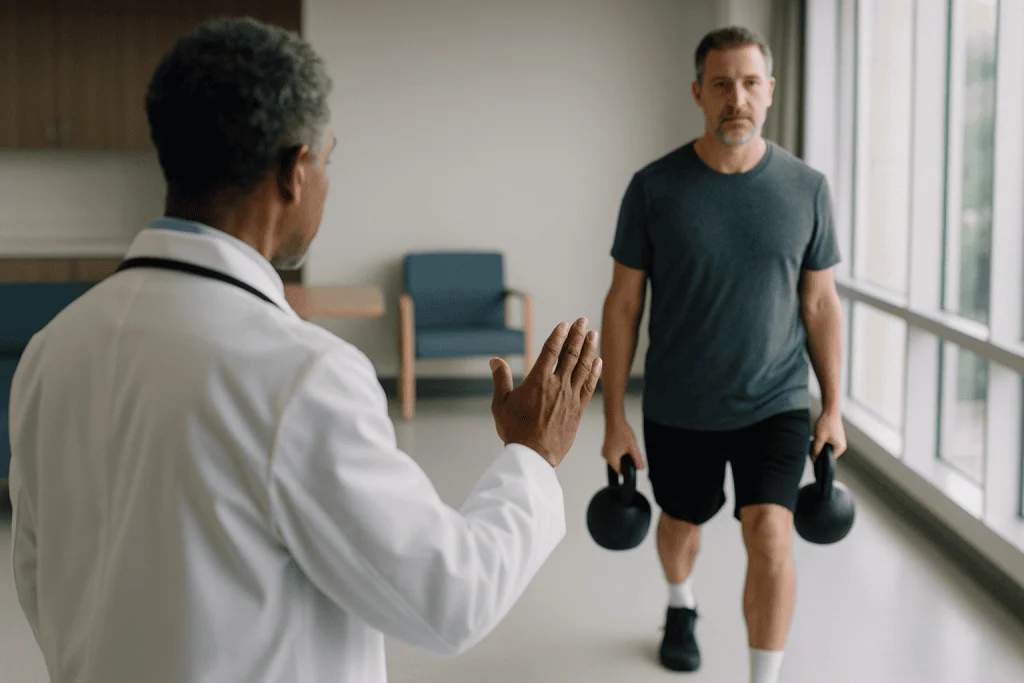
The name comes from the image of a farmer carrying two milk pails, though the movement predates any gym. In strongman competition it appears as a timed event with purpose-built handles; in physical therapy clinics it appears with dumbbells as light as a couple of kilograms for someone rebuilding after an injury. Same pattern, very different loads.
What makes it unusual among strength exercises is that almost nothing moves except your legs. Your spine has to stay long and stable while the weight tries to pull your shoulders down and forward. Your grip has to hold on for the whole walk, not for a single second at the top of a lift. Your hips and trunk have to control the side-to-side sway that comes with every step. The exercise is, in effect, a moving plank with a grip test attached.
Coaches describe this as isometric work for the trunk and shoulders, meaning the muscles contract hard without changing length, combined with dynamic work for the legs. Isometric training is well studied in its own right and is one reason carries feel harder than the numbers on the weights would suggest.
The exercise also asks almost nothing of you technically. Unlike a barbell snatch or a heavy squat, there is no complex sequence to learn and no bar path to perfect. That low skill barrier is a large part of why physical therapists, strength coaches and older-adult fitness instructors all reach for it.
Why loaded carries earn the label "functional" strength
“Functional” is one of the most overused words in fitness, so it deserves a plain definition. A functional exercise is one whose movement pattern and demands closely resemble a task you actually perform outside the gym. Under that definition, few exercises score higher than a carry.
Think about the loads an ordinary week hands you. Grocery bags in each hand from the car to the kitchen. A toddler on one hip and a diaper bag on the other shoulder. A suitcase up a flight of stairs. Bags of soil across a garden. Every one of these is a loaded carry, and every one demands the same combination: a grip that does not quit, shoulders that do not round forward under the pull, a trunk that does not fold sideways, and legs that keep moving under the added weight.
Most gym exercises isolate one of those qualities. A bicep curl trains an elbow. A leg press trains knees and hips while a machine takes care of your balance. The farmers carry refuses to let you outsource anything. Your body has to organize itself as a single unit, which is exactly what happens when you lift something awkward in real life.
There is also a balance dimension that matters more with age. Walking while loaded shifts your center of mass with every step and forces small, rapid corrections through the ankles, hips and trunk. The CDC reports that about one in four adults aged 65 and older falls each year, and strength and balance training are among the interventions with the best evidence for reducing that risk. Carries are not the only way to train balance, but they are one of the few that combine it with meaningful load.
The honest caveat is that “functional” is a description of the movement, not proof of superior results. Whether carries beat other exercises for any given outcome is a question for evidence, not vocabulary, and that is where the next section goes.
What the evidence actually says about farmers carry benefits
The strongest evidence sits at the top of the ladder and gets weaker as the claims get more specific. That shape is worth holding in mind whenever a headline promises a single exercise will change your life.
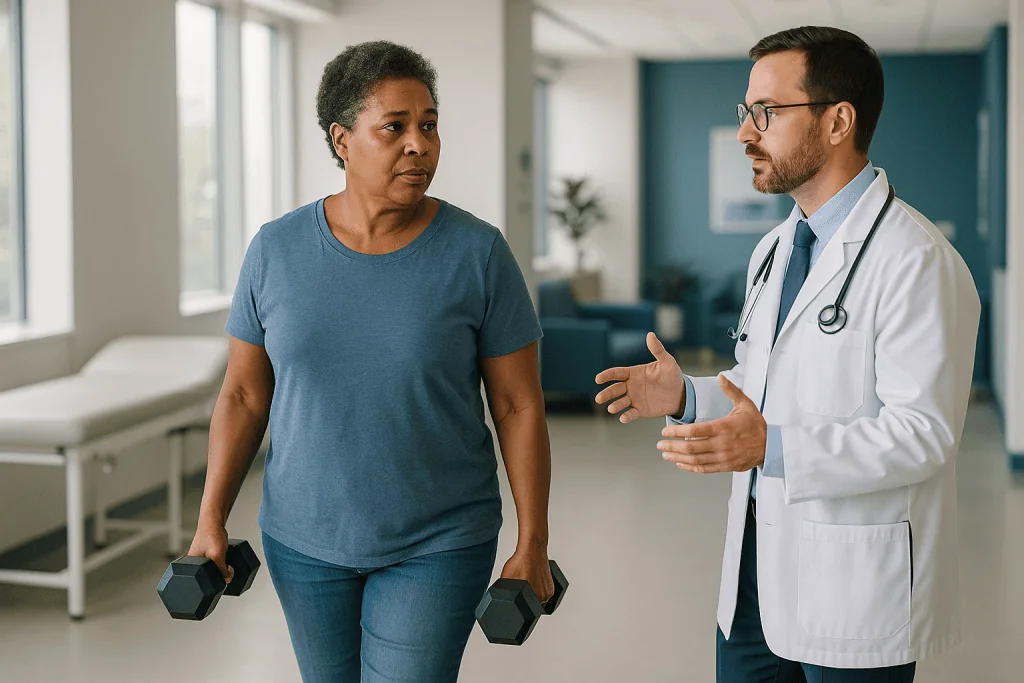
At the top is resistance training in general. Dozens of randomized controlled trials, the type of study that assigns people to an exercise group or a comparison group by chance, show that regular strength training improves muscle mass, strength, bone density, blood sugar control and self-reported function across adult life, including in people in their eighties. A 2023 American Heart Association scientific statement summarized the observational evidence and found that people who do resistance training are roughly 15 percent less likely to die from any cause and about 17 percent less likely to develop cardiovascular disease than those who do none. Those percentages come from cohort studies, so they show association, not proof of cause.
One rung down is grip strength as a marker. The link between weak grip and higher mortality is consistent across many large observational studies, including PURE. But observational data cannot tell you whether making your grip stronger lowers your risk, or whether a strong grip simply reflects a body that is healthier for other reasons. Experts generally read grip strength as a useful window into overall muscle health rather than a lever you pull to extend life.
Lower still is the evidence on farmers carries specifically. It consists mostly of small laboratory studies using electromyography, a method that measures electrical activity in muscles, plus coaching consensus and physical therapy practice. These studies confirm that carries produce high activation in the forearm, upper back and lateral trunk muscles. They do not show that carries beat other exercises for health outcomes, because no one has run that trial.
Put together: the exercise is well grounded in mechanics and sits inside a category with excellent evidence. Claims that it is uniquely life-extending are opinion built on top of that, not findings.
Grip strength and longevity: what the numbers really show
The PURE study deserves a closer look because it is the source of most of the viral claims. Researchers measured handgrip strength with a device called a dynamometer, a handheld gauge you squeeze as hard as you can, in adults aged 35 to 70 from countries at every income level. They then followed participants for a median of about four years.
Each 5-kilogram decrease in grip strength was associated with a 16 percent higher risk of all-cause death, a 17 percent higher risk of cardiovascular death, a 7 percent higher risk of heart attack and a 9 percent higher risk of stroke. Grip strength turned out to be a stronger predictor of death than systolic blood pressure in that dataset, which is the statistic that launched a thousand videos.
Here is what those numbers cannot tell you. They cannot say that raising your grip by 5 kilograms will lower your risk by 16 percent. Grip strength tracks with total muscle mass, nutritional status, chronic inflammation, nerve health and a person’s general activity level. A weak grip may be a signal that something else is going on rather than the problem itself. Researchers call this the difference between a biomarker and a risk factor, and grip strength is firmly in the biomarker category until a trial proves otherwise.
Harvard Health has made the same point in plain language: grip strength is a quick, inexpensive way for clinicians to gauge overall strength and frailty, particularly in older adults, and low readings are a reason to look harder at muscle health and nutrition, not a diagnosis in themselves.
Does that make grip training pointless? No. Stronger forearms and hands make daily tasks easier, help you hold on to a railing, and let you lift heavier in every other exercise. Those are real, immediate benefits. The longevity story is the part that needs a lighter touch than the internet gives it.
Farmers carry muscles worked, from fingertips to feet
Start at the hands. The finger flexors in the forearm do the obvious job of keeping the handle from sliding out. Because you hold for tens of seconds rather than a single repetition, this is endurance grip, and the forearm burn most people notice on their first carry comes from those muscles running out of steam.
Move up to the shoulders. The upper trapezius and levator scapulae, the muscles that run from your neck to the tops of your shoulders, work hard to keep the shoulder blades from being dragged downward. The rotator cuff, the group of four small muscles that center the ball of the shoulder in its socket, stabilizes the joint against the constant downward pull. Beneath them, the rhomboids and middle trapezius hold the shoulder blades back so the chest stays open.
Now the trunk. Every step shifts weight from one leg to the other, and the load in your hands tries to tip you toward the leg in the air. The quadratus lumborum, a deep muscle on each side of the lower spine, and the obliques on the sides of the abdomen fire to resist that side bend. The rectus abdominis and the deep transversus abdominis stiffen the front, while the spinal erectors keep you from hunching. Laboratory studies using electromyography consistently show these lateral trunk muscles working harder during carries than during many traditional abdominal exercises.
Finally, the lower body. Glutes, quadriceps, hamstrings and calves all take on extra load, and the small muscles around the hip and ankle do overtime managing balance with each footfall. The gluteus medius on the side of the hip, which keeps the pelvis level when you stand on one leg, is especially busy.
The result is a single exercise that touches almost every major muscle group. It does not replace squats, hinges or presses, which train those groups through a full range of motion, but few movements ask so much of so many muscles at once.
How to do a farmers carry with proper form
Good form begins before the weights leave the floor, because the pickup is where most backs get into trouble. Place the weights just outside your feet. Squat down by bending the knees and pushing the hips back, keeping the chest up and the spine long rather than rounding over. Grab the handles in the middle so they balance. Stand up by driving through the heels, as if doing a deadlift, letting the legs do the lifting.
Once upright, set your posture before you take a step. Pull the shoulders back and slightly down, as though tucking the shoulder blades into your back pockets. Lift the chest. Look at a point on the wall at eye level, not at the floor. Brace the abdomen gently, the way you would if someone were about to tap your stomach, and breathe steadily behind that brace. Holding your breath raises blood pressure sharply and is not necessary for a carry.
Then walk. Take shorter, quicker steps than you would empty-handed, with the feet landing under your hips. Keep the arms straight and relaxed at the elbows; the grip does the holding, not the biceps. Let the weights hang still rather than swing. If you feel yourself leaning to one side, slow down and shorten your stride.
Finishing matters as much as starting. Stop, reset your feet, and lower the weights with the same squat pattern you used to pick them up. Dropping heavy weights from standing height can damage floors and, more importantly, encourages a rounded-back bailout that teaches your body a bad habit.
Common form faults to watch for include shrugged shoulders creeping toward the ears, a forward head, a lower back that arches excessively, and a stride so long that the torso twists with each step. Filming yourself from the side and the front for one set is one of the fastest ways to spot these.
How much farmers carry weight for beginners, and how far?
The right starting weight is one that lets you walk the full distance with perfect posture and a little grip left in reserve. For many beginners that is somewhere in the range of a quarter to a third of body weight in each hand, but body weight is only a rough guide. A person who works with their hands may start heavier; someone returning from a long break or recovering from illness may start with weights that feel almost trivially light. Both are correct if the posture holds.
Distance is easier to standardize. A common starting point is 20 to 40 meters, roughly the length of a basketball court or two lengths of a typical gym floor, done two to four times with rest between. If space is tight, time works just as well: 20 to 40 seconds of walking, including turns. Turning is itself a skill, so slow down, take small steps around the corner and avoid twisting the trunk while loaded.
Progress one variable at a time. Add a little weight, or a little distance, or an extra set, but not all three in the same week. Grip endurance adapts more slowly than leg strength, so many people find their legs are ready to go heavier before their hands are. That is a signal to be patient, not to switch to straps or hooks, which remove the very quality you are trying to build.
A useful self-check is the last five meters. If your shoulders round, your stride shortens dramatically or your torso starts to sway, the set has gone past the point of useful training. End it there and note the weight for next time.
Whatever numbers you settle on, they are training targets, not medical prescriptions. Anyone with a heart condition, uncontrolled blood pressure, a hernia, osteoporosis or a recent surgery should agree on loading limits with their clinician before starting.
Farmers carry variations: suitcase, rack, overhead and more
The basic two-handed carry is the foundation, but changing where you hold the load changes which muscles have to work hardest. The suitcase carry, a single weight in one hand as if carrying a heavy bag, forces the trunk muscles on the opposite side to fight hard against side-bending, which is why physical therapists often prefer it for people rebuilding lateral core control. It also exposes strength differences between your two sides that a two-handed carry can hide.
The front rack carry holds a kettlebell or dumbbell at chest height with the elbow tucked, shifting demand toward the upper back and deep abdominals and away from the grip. The overhead carry, one arm locked out above the head, is a shoulder stability exercise first and a carry second; it is the most technically demanding and the one where a shoulder history matters most. Mixed carries, one weight overhead and one at the side, combine the two challenges. Bear-hug and sandbag carries hold an awkward load against the chest and mimic carrying a child or a bulky box.
| Variation | Where the load sits | Primary challenge | Who tends to benefit most |
|---|---|---|---|
| Farmers carry | Both hands, arms at sides | Grip endurance, posture, whole-body stability | Most people; the default starting point |
| Suitcase carry | One hand, arm at side | Lateral core control, hip stability | Those with left-right imbalances or back rehab goals |
| Front rack carry | Chest height, elbow tucked | Upper back, abdominal bracing, breathing under load | People with limited grip who still want trunk work |
| Overhead carry | Arm locked out overhead | Shoulder stability and mobility | Experienced lifters with healthy shoulders |
| Bear-hug or sandbag carry | Hugged against chest | Upper body compression strength, breathing | Those who carry children, boxes or awkward objects |
A sensible progression is to master the two-handed carry first, add the suitcase version once posture is reliable, and treat overhead work as an optional advanced step rather than a target everyone should reach. The best variation is the one that matches the task you are trying to get better at.
How often should you do farmers carries, and where in a workout?
Because carries tax the grip and the trunk more than they build the large muscles of the legs and chest, they slot in best as a supporting exercise rather than the centerpiece of a session. Two or three times a week is plenty for most people, which fits neatly inside the WHO and CDC recommendation of muscle-strengthening activity on at least two days.
Placement within a workout depends on your goal. If grip is your weak link, do carries early while your hands are fresh. If you are using them mainly for trunk stability and posture, they work well as a finisher after your main lifts, when fatigue exposes any tendency to slump. What you should avoid is doing heavy carries immediately before an exercise that also relies on grip, such as deadlifts or pull-ups, because a fried grip will limit those lifts and may tempt you into compensations.
Volume can be modest. Three to five carries of 20 to 40 meters, or the time equivalent, is a full dose for most adults. Elite strongman competitors do far more, but they are training for an event, not for health. Recovery for the forearms in particular can lag, and persistently sore or stiff hands in the morning are a sign to reduce the frequency.
Carries also pair well with walking-based routines for people who dislike traditional gym sessions. A brisk walk with a weighted vest is a different exercise, but a short loaded carry at the start or end of a walk delivers some of the same grip and posture benefits without any equipment beyond two heavy objects.
Consistency beats intensity here. The people who report the biggest changes in how carrying groceries or luggage feels are rarely the ones who went heaviest on day one. They are the ones who kept showing up with a manageable load for a few months.
Who should be cautious before adding heavy carries?
The farmers carry is low in skill but not low in demand, and a handful of situations warrant a conversation with a clinician before loading up. The most important involves the cardiovascular system. Holding a heavy weight and, especially, holding your breath while doing so pushes blood pressure up sharply for the duration of the effort. For a healthy adult this is transient and normal. For someone with uncontrolled hypertension, a known aneurysm, recent heart surgery or certain heart rhythm problems, a clinician may set limits on load or advise a lighter, breathing-focused approach.
Abdominal wall and pelvic issues come next. Heavy carries raise pressure inside the abdomen, which can aggravate a hernia or pelvic organ prolapse and is a common reason surgeons ask patients to avoid heavy lifting for a set period after abdominal or pelvic operations. During pregnancy, many people continue lighter carries comfortably, but loading decisions belong with the obstetric team.
Spine and joint history matters too. Carries are frequently used in back rehabilitation precisely because the spine stays neutral, but someone with an acute disc problem, spinal stenosis or unexplained back pain should be assessed before self-prescribing. Osteoporosis is a nuanced case: load-bearing exercise is recommended to help maintain bone, and carries keep the spine upright rather than bent, yet the pickup and set-down need careful technique, and a clinician or physical therapist should guide the starting weight.
Shoulder and hand conditions round out the list. Rotator cuff tears, shoulder instability, carpal tunnel syndrome and arthritis of the hands can all be aggravated by sustained heavy gripping. This does not automatically rule carries out, but it usually means starting lighter and monitoring symptoms closely.
None of these situations is a reason to avoid strength training altogether. In many of them, appropriate strength work is part of standard care. The point is that “appropriate” is defined with a clinician, not by a video.
Common myths about the farmers carry, corrected
Myth: A strong grip adds years to your life. The observational data linking grip strength to mortality is robust and consistent, but it shows association. No trial has demonstrated that strengthening your grip, on its own, lengthens life. Grip is best understood as a readout of overall muscle health. Training it has real practical benefits; life extension is not a proven one.
Myth: Carries are the only core exercise you need. Carries train the trunk brilliantly against side-bending and slumping, but they do little to train it through rotation or through the hip-hinge patterns used in lifting from the floor. A well-rounded program still includes movements such as squats, hinges and rotational work.
Myth: Heavier is always better. The viral videos feature enormous loads because enormous loads get views. For health and function, the useful range is the one where posture holds for the full distance. Once form breaks, the exercise stops training the qualities you want and starts training compensations.
Myth: Straps or lifting hooks are fine for carries. They remove the grip demand, which for most people is a large part of the point. There are exceptions, such as someone with a hand injury who wants the trunk and leg benefits, but as a default they defeat the purpose.
Myth: Carries are dangerous for your back. Carries keep the spine upright and are widely used in back rehabilitation for exactly that reason. The risk sits in the pickup and set-down, not the walk, and is managed by using a controlled squat pattern rather than bending over.
Myth: You need special handles. Strongman implements are convenient but not required. Dumbbells, kettlebells, loaded shopping bags, water jugs or a pair of heavy tool bags all work. The exercise is the pattern, not the equipment.
Each of these myths contains a grain of something true, which is why they spread. The correction in every case is the same: the farmers carry is an excellent exercise, and it does not need exaggeration to earn its place.
Farmers carry for older adults: strength, balance and confidence
If any group stands to gain disproportionately from loaded carries, it is people past 60, and the reasons are both physical and psychological. Physically, the exercise addresses three things that decline together with age and that guidelines single out: muscle strength, balance and the capacity to keep going under load. WHO explicitly recommends multicomponent activity emphasizing functional balance and strength on three or more days a week for older adults, with the goal of improving capacity and preventing falls.
Loss of grip strength is one of the earliest measurable signs of age-related muscle loss, a condition clinicians call sarcopenia. Weak grip makes jars, railings, shopping bags and door handles harder, and each of those small difficulties tends to shrink a person’s world a little. Training grip directly, in a movement that also demands upright posture and steady walking, addresses several of these at once.
Balance benefits come from the constant small corrections a loaded walk demands. Unlike standing on one leg in a controlled way, a carry challenges balance while moving and while distracted by the effort of holding on, which is closer to how falls actually happen in daily life. Trials of strength and balance programs in older adults have shown meaningful reductions in fall rates, and while carries have not been isolated in those trials, they fit the pattern of exercise those programs use.
The psychological side is easy to underrate. Many older adults avoid lifting anything heavy out of fear, and fear of falling is itself a risk factor for falling, because it leads people to move less and lose more strength. Discovering that you can pick up two moderately heavy weights and walk the length of a room, safely, does something for confidence that no lecture can.
Starting points for older beginners are often very light, sometimes a couple of kilograms in each hand, with distances of 10 to 15 meters. Progress is measured in months. Supervision from a physical therapist or qualified instructor for the first sessions is a reasonable investment, particularly for anyone with a history of falls, osteoporosis or dizziness.
Equipment and everyday alternatives: you may already own everything
Strongman-style farmers handles are long bars with a central grip, loaded with plates at each end. They are pleasant to use because the handle is thick and the load hangs low and stable, but they are far from essential. Most people will do all the carrying they ever need with a pair of dumbbells or kettlebells.
Kettlebells have an advantage for beginners: the handle sits above the weight, so the load hangs a little lower and swings less than a dumbbell of the same mass. Dumbbells offer finer increments, which helps when you want to progress in small steps. Either works. Thick-handled implements increase the grip demand at the same weight and are best saved for people whose grip has already caught up with the rest of their body.
Outside a gym, the options multiply. Two loaded shopping bags with sturdy handles are a genuine carry, and the awkward shifting of the contents adds a stability challenge that fixed weights do not. Filled water jugs, a pair of heavy tool bags, two full backpacks held by the top handles, or sandbags from a hardware store all work. The main safety concern with improvised loads is the handle: check that it will not tear, cut into your palm or let the load swing into your knee.
Footwear matters more than most people expect. Flat, stable shoes or bare feet on a clean surface give better ground feel than cushioned running shoes, which can roll under a heavy load. The walking surface should be even and free of obstacles for the full route, including the turn.
Where you carry is a judgment call. Long hallways, garage floors and quiet stretches of sidewalk all work. Stairs are an advanced variation that adds real-world value, since carrying luggage up a staircase is a common task, but they should wait until level-ground carries are secure and should be attempted with a lighter load than you use on the flat.
When to see a doctor about pain or symptoms during loaded carries
Muscle fatigue in the forearms, a burning sensation in the hands and general tiredness after a set are normal and expected. Certain symptoms are not, and they deserve prompt medical attention rather than a lighter weight next time.
Stop immediately and seek urgent care if you experience chest pain, pressure or tightness during or after a carry; pain spreading to the arm, jaw or back; sudden shortness of breath out of proportion to the effort; a racing or irregular heartbeat that does not settle within a minute or two of stopping; fainting or near-fainting; a sudden severe headache; or sudden weakness, numbness or difficulty speaking. These can be signs of a cardiovascular event and are emergencies.
Arrange a non-urgent appointment if you notice a new bulge in the groin or abdomen, particularly one that appears when you strain, which may indicate a hernia. Do the same for numbness or tingling in the fingers that lingers for hours after training, which can point to nerve compression at the wrist, elbow or neck; for a shoulder that clicks painfully, feels unstable or cannot be raised overhead; or for back pain that radiates down a leg, disturbs sleep or comes with changes in bladder or bowel control. That last combination warrants same-day assessment.
Persistent joint pain in the hands or wrists that is worse in the morning and does not ease with rest, or swelling in the finger joints, should also be evaluated, since sustained heavy gripping can unmask inflammatory or degenerative joint conditions.
Anyone with an existing diagnosis, whether that is heart disease, high blood pressure, osteoporosis, a previous hernia repair, pregnancy or a recent operation, should agree on loading limits with the clinician who manages that condition before starting or increasing carries. If you take medicines that affect heart rate, blood pressure, balance or bone density, ask whether they change what is safe for you. The clinician who knows your history is the right person to make that call, and nothing in an exercise article overrides their guidance.
Frequently asked questions
How to do farmers carry correctly as a complete beginner?
Pick the weights up with a squat, not a bend, keeping your chest up and spine long. Stand tall, pull the shoulders back and down, look straight ahead and brace the abdomen gently while breathing normally. Walk with short, quick steps and arms straight, keeping the weights still. Lower them with the same squat pattern. Start with a load that lets you hold perfect posture for 20 to 40 meters.
What are the main farmers carry muscles worked?
The forearm and finger flexors hold the grip; the upper trapezius, rhomboids and rotator cuff keep the shoulders from being dragged forward and down; the obliques, quadratus lumborum, abdominals and spinal erectors stabilize the trunk against side-bending and slumping; and the glutes, quadriceps, hamstrings and calves carry the extra load while walking. The hip stabilizers work hard to keep the pelvis level with each step.
What are the suitcase carry benefits compared with a two-handed carry?
A suitcase carry loads only one side, so the trunk muscles on the opposite side must work much harder to stop you tipping. This makes it a favored exercise in back rehabilitation and for improving lateral core control. It also exposes differences between your left and right sides that a balanced two-handed carry can mask. The trade-off is a smaller total load and a greater balance demand.
How much weight should I use for a farmers carry?
Use a weight that allows perfect posture for the full distance with a little grip in reserve. For many beginners this lands around a quarter to a third of body weight in each hand, but individual starting points vary widely and some people begin far lighter. Increase weight, distance or sets one at a time. Anyone with a medical condition should agree on limits with a clinician.
Does a strong grip really predict how long you will live?
Large observational studies consistently link weaker grip with higher risk of death and cardiovascular disease, and grip strength is a useful clinical marker of overall muscle health. However, this is association, not proven cause. No trial has shown that improving grip alone extends life. Training grip has clear practical benefits for daily function, which is the strongest reason to do it.
Are farmers carries safe if I have back pain?
Carries keep the spine upright and neutral, which is why physical therapists often use them in back rehabilitation. The higher-risk moments are picking up and setting down the weights, which should be done with a controlled squat. Anyone with acute back pain, pain radiating down a leg, or an undiagnosed problem should be assessed by a clinician before starting, and should follow their guidance on loading.
How far and how often should I do farmers carries?
A common structure is three to five carries of 20 to 40 meters, or 20 to 40 seconds, with rest between, done two or three times a week. This fits within guideline recommendations for muscle-strengthening on at least two days weekly. Grip recovers more slowly than the legs, so persistent hand or forearm soreness is a signal to reduce frequency or load.
Can I do farmers carries at home without gym equipment?
Yes. Two loaded shopping bags with strong handles, filled water jugs, heavy tool bags or backpacks held by the top handle all work. Check that handles will not tear or cut into your palms and that the load will not swing into your knees. Use a clear, even route, including space to turn, and wear flat, stable shoes or go barefoot on a clean floor.
Should I hold my breath during a heavy carry?
No. Breath-holding under load drives blood pressure up sharply for the duration of the effort. Instead, brace the abdomen gently, as if expecting a light tap to the stomach, and keep breathing steadily behind that brace. If you cannot maintain a normal breathing rhythm while walking, the load is too heavy for that set. People with heart or blood pressure conditions should discuss safe loading with their clinician.
Are farmers carries good for older adults?
They can be very useful. Carries train grip, posture and balance while moving, which are three qualities that decline with age and that guidelines single out for older adults. Starting loads are often very light and distances short, with progress measured over months. Anyone with a history of falls, osteoporosis, dizziness or heart disease should begin under supervision from a physical therapist or qualified instructor after checking with their clinician.
References
- CDC: Adult Activity: An Overview
- WHO: Physical activity fact sheet
- NHS: Strength and flexibility exercises
This article is for general information only and is not a substitute for professional medical advice. Please consult a qualified doctor about your individual situation.

More from the Blog

Why Antibiotics Cause Thrush and What Helps
Yes. Antibiotics can cause thrush because they kill helpful bacteria that normally keep Candida yeast in check in the mouth, gut, vagina and skin…

The Smallest Bone in the Body: Meet the Stapes
The smallest bone in the human body is the stapes, one of three tiny ossicles in the middle ear. Shaped like a stirrup, it…

Does Coffee Stunt Your Growth? A Century-Old Myth, Measured
No, coffee does not stunt growth. Adult height is determined mostly by genetics, along with childhood nutrition, sleep, and overall health, and no credible…

How Much Blood Is in the Human Body? Liters, Pints and Donations
The average adult carries about 4.5 to 5.7 liters of blood, roughly 9 to 12 pints, or 1.2 to 1.5 gallons, equal to about…

Microplastics in the Body: What Has Been Found in Blood and Tissue, and What Reduces Exposure
Microplastics in the body are real: small studies have detected plastic fragments in human blood, placenta, lung tissue and artery plaque. What that means…

Chickenpox in Adults: Why It Is More Serious, Symptoms and When to Seek Care
Yes, adults can get chickenpox if they have never had the infection or been vaccinated, and the illness tends to be more severe than…