

The First Week After Dental Implant Surgery: Swelling Peaks, Soft Foods and Stitches Explained
Key Takeaways
- Swelling after implant surgery builds for the first few days and then recedes, so a cheek that looks worse on day three than on day one is following the expected curve, not failing.
- Dissolvable stitches typically break down in 7 to 10 days, and a stitch that loosens as swelling settles is normal as long as the gum underneath stays closed.
- The NHS advises no rinsing at all for the first 24 hours after oral surgery, because swishing and spitting can lift the clot that stops bleeding.
- Cold packs help only in roughly the first 48 hours; after that, warmth and an extra pillow at night do more to move fluid out of the tissues.
- Osseointegration, the bone-to-implant bond, takes several months and cannot be felt, so a silent, uneventful first week is the goal rather than a sign something is missing.
- Smoking narrows blood vessels and impairs the immune response, which is why it is the single modifiable factor most strongly linked to slower healing and later implant problems.
In the first week after dental implant surgery, swelling and bruising usually build over the first few days and then ease, light bleeding settles within a day or so, and stitches either dissolve on their own or are removed at around 7 to 10 days. Most people manage with soft foods, gentle cleaning and pain relief as directed, while the implant quietly begins bonding with the jawbone over the following months.
The mirror on the morning of day three is usually where the worry starts. The surgery felt manageable, the numbness wore off, dinner was soup, and then a cheek that looked fine at bedtime is suddenly rounder and faintly yellow at the jawline. Nobody warned you it would look worse before it looked better.
That lag is the defining feature of the first week after dental implant surgery. The body treats a titanium post placed in bone the way it treats any planned injury: it sends fluid, blood cells and repair signals to the site, and that response takes a couple of days to crest. What follows is a fairly predictable sequence of swelling, stiffness, soft meals and, eventually, stitches that loosen or dissolve.
This explainer walks through that sequence day by day, separates ordinary healing from signs that deserve a phone call, and corrects a few myths that make people either panic or get careless. Your surgeon’s written instructions always take priority over anything here.
What actually happens during dental implant surgery
A dental implant is a small screw-shaped post, usually titanium, placed into the jawbone to act as an artificial tooth root. Once bone has grown onto its surface, a connector called an abutment and then a crown are attached on top. Mayo Clinic describes the whole process as a series of steps spread over several months, with most of that time given over to healing rather than treatment.
On the day of surgery, the gum over the site is numbed, a small flap is lifted, and a channel is prepared in the bone with gradually wider drills under cooling irrigation. The implant is threaded into that channel. Depending on the plan, the gum is then either stitched closed over the implant or closed around a small healing cap that pokes through. Some people have a damaged tooth removed in the same visit, and some have bone grafting first or at the same time, which lengthens recovery.
Two things about this sequence matter for the week ahead. First, the bone was cut and the gum was lifted, so the body responds with inflammation: a planned, useful swelling that peaks early and fades. Second, the implant is held in place by mechanical fit at this stage, not by living bone. The biological bond, called osseointegration, forms over the following months as bone cells lay down new tissue directly against the implant surface. Mayo Clinic notes this bonding period can take several months and is the reason the final crown is not fitted straight away in most cases.
Your week-one job, in other words, is not to speed anything up. It is to avoid disturbing a post that is sitting still, waiting for bone to catch up.
What can I expect 7 days after getting a dental implant? A day-by-day map
People searching this question usually want to know whether what they are seeing is normal. The honest answer is that the first week after dental implant surgery follows a pattern that is remarkably consistent across oral surgery, even though the details vary with how many implants were placed and whether bone was grafted. The NHS guidance on recovery from wisdom tooth removal, a comparable procedure in the same tissues, describes pain and swelling that are worst in the first few days and then gradually improve, with full recovery taking up to 2 weeks.

| Timeframe | What is typical | What usually helps |
|---|---|---|
| Day 0 (surgery day) | Numbness for hours, light oozing, a damp pink taste | Firm pressure on gauze, rest, no rinsing or spitting |
| Days 1 to 3 | Swelling and stiffness build, bruising may appear, soreness most noticeable | Cold compresses in short intervals, head raised at night, soft foods, pain relief as prescribed |
| Days 4 to 5 | Swelling plateaus then starts to recede, jaw opens more easily | Warm salt-water rinses as instructed, gentle brushing elsewhere |
| Days 6 to 7 | Most swelling gone, stitches loosen or dissolve, site looks pale pink | Review appointment, gradual return to normal-textured food |
The table describes an uncomplicated case. Two implants on opposite sides, a sinus lift, or a graft can shift every row later by a day or more, and a person who smokes or has diabetes may heal more slowly. None of that is a sign of failure; it is a sign that more tissue was asked to recover.
Read the rest of this article as commentary on that table: why each stage happens, what to do about it, and where the boundary sits between ordinary and concerning.
Dental implant swelling timeline: why day two or three looks worse than day one
Swelling after oral surgery is not fluid leaking from a wound. It is the result of blood vessels near the site becoming deliberately more permeable so that plasma, white blood cells and clotting proteins can reach injured tissue. That process ramps up over hours, not minutes, which is why the cheek in the mirror on day one looks almost normal and the cheek on day three does not.
The NHS describes swelling of the mouth and cheeks after oral surgery as worse in the first few days before gradually improving. Clinically, the crest tends to sit around the second or third day, with a clear downward trend by the end of the first week. Lower jaw implants, particularly toward the back, often swell more visibly than upper front ones because the tissues there are looser and gravity pulls fluid toward the jawline.
Cold helps most in the first 48 hours, when it narrows those leaky vessels and slows fluid movement. A wrapped cold pack held against the cheek in short intervals, with breaks in between, is the standard advice; skin should never be iced continuously. After the first two days, cold does little, and many surgeons switch people to gentle warmth to encourage fluid to drain away. Sleeping with the head propped on an extra pillow, as the NHS suggests, uses gravity in your favor overnight.
The swelling itself is usually not painful. What people feel is pressure, tightness when opening the jaw, and a dull ache that responds to the pain relief plan. Swelling that keeps growing after day four, feels hot and tense, or spreads toward the eye or down the neck is a different pattern and is covered in the red-flag section later.
Bleeding and bruising: what is normal in the first week after dental implant surgery
A small amount of blood mixed with saliva looks like a lot of blood. That is the single most useful thing to remember on surgery night. Pink-tinged spit for the first evening and faint oozing into the next morning are expected after any procedure that lifts gum and cuts bone, and Mayo Clinic lists minor bleeding alongside swelling and bruising as the usual after-effects of implant placement.
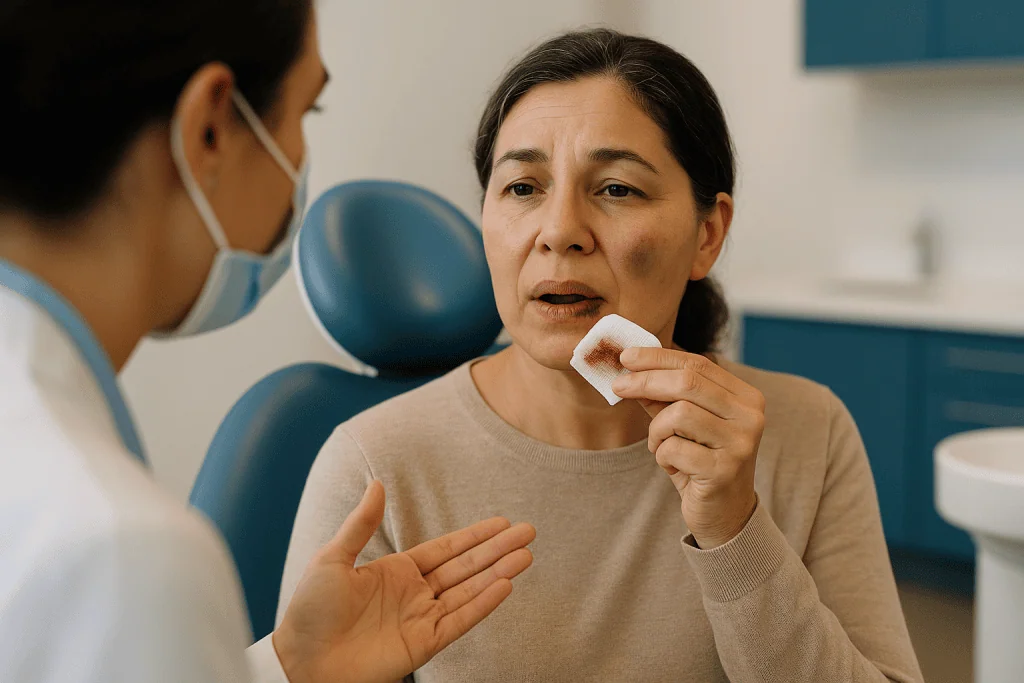
Bleeding is controlled by pressure and stillness. Biting firmly on folded gauze for the time your surgeon specifies compresses the vessels and lets a clot form. Rinsing, spitting, sucking through a straw and poking the area with the tongue all do the opposite: they create suction or shear that lifts the fresh clot off the site. The NHS advises against rinsing the mouth at all for the first 24 hours after oral surgery for exactly this reason.
Bruising arrives a day or two later than swelling and often appears lower than you expect, along the jaw or even on the upper neck, because blood that leaked into tissue tracks downward with gravity. It shifts through the familiar yellow and green shades as the body breaks down hemoglobin, usually fading within the first week to ten days. Older adults, people taking anticoagulant or antiplatelet medicines, and people who bruise easily in general can expect more color.
What is not typical: bright red bleeding that fills the mouth, bleeding that restarts hard after it had stopped, or oozing that is still steady on day two despite pressure. If you take a blood-thinning medicine, your surgeon should already know and will have planned around it; do not alter that medicine yourself in either direction. Any change to anticoagulation is a decision for the prescribing clinician.
Dental implant stitches: dissolving versus removed, and what to do if one comes loose
Stitches, or sutures, hold the lifted gum back in position so it can knit over or around the implant. Surgeons use two broad types. Dissolvable sutures are made of materials the body gradually breaks down; the NHS notes these typically dissolve in 7 to 10 days, though some take longer. Non-dissolving sutures are stronger and smoother and are removed at a review visit, usually within a similar window.
In the first week, stitches change. They start out tight, with small knots you can feel with your tongue. By day four or five, the gum has shrunk back toward normal as swelling recedes, so the sutures feel looser and the knots may stick out more. Dissolvable types soften, fray and sometimes fall out in pieces, which can be alarming at breakfast but is entirely ordinary.
A single stitch coming out early is rarely a problem if the gum edges beneath it are already stuck together, which they usually are by day three or four. What matters is what the site looks like afterward. Gum that stays closed and pale pink needs nothing. Gum that gapes open, exposing a gray or white surface underneath, or a visible metal cap that was supposed to be covered, deserves a call and probably a quick look.
Resist the urge to trim, pull or tuck a loose stitch yourself. Tugging can open the wound edge you cannot see, and scissors in a half-numb mouth are a poor idea. Food debris catching around sutures is common; gentle salt-water rinses after meals, once past the first 24 hours, keep the area clean without disturbing it. At your review visit the surgeon will remove whatever remains and check the implant cover.
What to eat after dental implant surgery: a realistic week of soft foods
Food advice after implant surgery has three purposes: avoid putting chewing force on the implant, avoid sharp or hot things that damage healing gum, and keep eating enough that the body has the protein and calories to repair tissue. Mayo Clinic advises soft foods while the surgical site heals, and the NHS makes the same recommendation for oral surgery generally, adding that very hot food and drink should be avoided early on because numb tissue cannot judge temperature.
A practical progression looks like this:
- Days 0 to 2: cool or lukewarm, no chewing. Smoothies eaten with a spoon, yogurt, applesauce, blended soups, mashed potato, custard, protein shakes, scrambled eggs cooled down.
- Days 3 to 5: soft and fork-tender. Oatmeal, well-cooked pasta, flaky fish, soft tofu, cottage cheese, bananas, avocado, refried beans, mashed vegetables.
- Days 6 to 7: gradually firmer, chewed on the opposite side. Pancakes, soft bread without crust, tender chicken cut small, steamed vegetables, soft rice.
A few things to leave out all week: seeds, nuts, popcorn and granola, which lodge in the site; crusty bread, chips and crackers, which have sharp edges; very spicy or acidic food, which stings exposed tissue; and anything through a straw, because suction can dislodge the clot. Alcohol is best avoided for at least the first 24 hours according to NHS guidance and ideally longer if pain medicines are being taken, since it interacts with several of them.
Protein deserves a specific mention. Tissue repair needs amino acids, and people recovering from oral surgery often undereat simply because chewing is tiresome. Greek yogurt, eggs, lentil soup, milk-based drinks and soft fish are easy ways to cover that without effort. Hydration matters too; cool water throughout the day is fine from the first evening.
How to keep the surgical site clean without disturbing it
The mouth is the one surgical field that cannot be covered with a sterile dressing and left alone. Food passes over the site several times a day, and the mouth normally hosts hundreds of bacterial species. Cleanliness therefore matters more after implant surgery than after a skin incision, yet the usual tools, a stiff toothbrush and vigorous rinsing, can lift the clot and open the wound. The balance is gentleness in the right place at the right time.
For the first 24 hours, the NHS advises no rinsing at all. Brush the teeth away from the site normally; the molars on the other side and the front teeth do not need a holiday. From day two, a warm salt-water rinse held gently in the mouth and allowed to fall out rather than spat forcefully, repeated after meals, reduces debris and bacterial load around the sutures. Your surgeon may also prescribe an antiseptic mouthwash; chlorhexidine is the most common generic example, and it works by binding to oral surfaces and disrupting bacterial membranes. It can temporarily stain teeth and alter taste, which is expected and reversible.
Near the implant itself, a very soft brush or a cotton swab can clean the neighboring teeth from around day three onward, keeping bristles off the suture line. Flossing adjacent teeth usually waits until the review visit. Avoid electric brushes against the site in week one; the vibration is harmless to bone but unkind to a fresh gum edge.
One habit worth adopting from day one: drink water after every meal and snack. It clears food without any mechanical force at all. The goal across the week is a site that stays free of visible debris and smells neutral, which is both the best defense against infection and the clearest sign that nothing needs attention.
Pain relief in week one: how the usual medicine classes work and what the timeline typically looks like
Discomfort after implant surgery is usually described as a deep ache rather than sharp pain, strongest on the first two or three days and tailing off in step with the swelling. Mayo Clinic lists pain at the site among the normal after-effects and notes that surgeons generally advise pain relief medicine for it. Which medicine, how much, and for how long is a decision for the prescribing clinician, who knows your kidney function, stomach history, other medicines and allergies. What follows is mechanism only.
Two classes do most of the work. Non-steroidal anti-inflammatory drugs, ibuprofen being the most familiar generic, block the enzymes that make prostaglandins, the signaling molecules that drive both pain and swelling at an injury. Acetaminophen, known as paracetamol in many countries, acts mainly in the central nervous system on pain perception and does little for inflammation. Clinicians often combine or alternate the two because they act on different pathways. For a minority of people with more extensive surgery, a short course of a stronger prescription analgesic may be added for the first day or two; these carry side effects such as drowsiness and constipation, and are not meant to run for the whole week.
Antibiotics are a separate question. Some surgeons prescribe a short course, particularly after grafting or in people with specific risk factors, while others do not; the evidence for routine use is mixed and practice varies. If you are given one, the entire course is usually intended to be completed unless you are told otherwise.
The pattern to watch is direction, not intensity. Pain that is gradually easing from day three onward, even if it is still present on day seven, is on track. Pain that was settling and then returns worse, or that is not touched by the medicines you were given, is the pattern that warrants a call.
What are the signs that a dental implant is healing well?
Healing well is quieter than people expect. There is no sensation of bone growing, no click of the implant becoming firm, nothing to feel at all from the post itself. The signs are all indirect, and they are mostly about trajectory: things getting steadily less rather than more.
By the end of the first week, an uncomplicated site typically shows a gum that has closed over or around the implant, color that has shifted from angry red to pale pink, swelling that has visibly reduced from its peak, and bruising that is yellowing and fading. Chewing on the opposite side feels close to normal. Any discharge is absent, and the breath, which can be unpleasant for a few days from the clot and sutures, has returned to normal with rinsing.
Pain should be following the swelling down. Mild tenderness when brushing nearby, or a dull awareness of the site at the end of a long day, is consistent with tissue still knitting. Needing less pain relief each day is a better indicator than any single pain score.
What you will not see in week one is the implant itself becoming integrated. Mayo Clinic describes osseointegration as taking several months, and the only reliable assessment of that is clinical: the surgeon checking stability at follow-up and, where appropriate, imaging. The absence of problems in week one is encouraging and is associated with a smoother course, but it is not proof of success, and nobody can honestly promise an outcome at day seven.
If you want a single rule of thumb, use this: every day should be a little better than the day before from around day three onward. Flat is acceptable for a day. Backward is the signal to pick up the phone.
Who is usually offered an implant, and who is usually asked to wait
Dental implants are generally offered to adults who are missing one or more teeth, whose jaw growth is complete, and who have enough healthy bone at the site, or who can have bone built up with a graft. Mayo Clinic lists these criteria along with healthy gum tissue, the absence of conditions that would seriously impair bone healing, and a willingness to commit to several months of the process. Cleveland Clinic adds that a thorough dental and medical evaluation, usually with three-dimensional imaging, comes first.
Being asked to wait is common and is usually about timing rather than suitability. Typical reasons include:
- Active gum disease, which raises the risk of infection around the implant and is treated first.
- A recent extraction where the socket has not yet filled with bone, unless immediate placement was planned.
- Uncontrolled diabetes, because high blood glucose impairs healing; the implant waits until control improves.
- Heavy smoking, since nicotine narrows blood vessels and the CDC notes that smoking weakens the body’s defenses against infection and makes gum disease more likely. Many surgeons ask for a smoke-free period before and after surgery.
- Certain medicines that affect bone turnover, particularly intravenous bisphosphonates and some cancer treatments, which require specialist assessment.
- Recent radiotherapy to the jaw, which reduces blood supply to bone.
Adolescents are usually asked to wait until jaw growth is complete, because an implant does not move with the growing jaw and can end up sitting at the wrong height.
Alternatives exist at every stage: a fixed bridge supported by neighboring teeth, a removable partial denture, or simply leaving a gap where it causes no functional problem. Each has trade-offs in longevity, cost of care, and effect on adjacent teeth, and the right choice depends on the mouth in front of the clinician. The decision belongs to you and your treating team together, after that evaluation.
What helps dental implants heal faster? An honest answer
Nothing on the market speeds up osseointegration. Bone cells lay down new tissue against the implant at a biological rate that no rinse, supplement, laser, or diet shortens in any way that mainstream evidence supports. Mayo Clinic frames the healing period as several months, and the honest framing is that the goal is not to accelerate it but to avoid the things that slow it down or interrupt it.
The interrupters are well established. Smoking is the clearest. Nicotine constricts blood vessels, carbon monoxide reduces oxygen delivery, and the CDC describes smoking as impairing the immune response and increasing gum disease risk; the NHS advises against smoking after oral surgery, at minimum for the first 24 hours and preferably much longer. Vaping delivers nicotine with the same vascular effect and involves suction. Alcohol in the first days dilates vessels, interacts with pain medicines and dehydrates tissue.
Mechanical disturbance is next. Chewing on the implant, probing it with the tongue, or wearing a denture that presses on the site loads a post that has no biological anchor yet. Strenuous exercise in the first few days raises blood pressure and can restart bleeding, which is why the NHS suggests avoiding it early on.
Then there are the slower influences: poorly controlled blood glucose, inadequate protein intake, and poor oral hygiene around the site. Each can be managed, and your care team can advise on all three.
What about vitamin D, calcium or collagen supplements? Deficiency in vitamin D or calcium is linked to poorer bone health in general, and the NIH Office of Dietary Supplements describes both as essential for bone. Correcting a genuine deficiency is sensible. Taking extra when levels are adequate has not been shown to speed implant healing, and large doses of some supplements carry their own risks. Ask your physician before adding anything, and treat any product that promises faster integration with skepticism.
What the following weeks usually look like: from stitches to osseointegration
Week one ends with a review visit, where remaining stitches are removed, the site is checked and cleaned, and you are given the green light to widen your diet and resume normal brushing near the implant. From here, the visible drama is over and the invisible work begins.
Across weeks two to four, the gum finishes maturing. Residual tenderness fades, and the slight pit or ridge where the sutures sat flattens out. The NHS places full recovery from comparable oral surgery at up to 2 weeks, and most people are eating normally by then, still favoring the other side on firmer foods. Any bone graft placed at surgery continues to consolidate for considerably longer.
Months two to six are osseointegration proper. Bone cells migrate onto the roughened implant surface and deposit new mineralized tissue directly against it, gradually replacing mechanical hold with biological lock. Mayo Clinic describes this as taking several months, and the figure varies with bone density, implant site, grafting and general health. There is nothing to feel during this period; the implant is either covered by gum or sits under a small healing cap, and a temporary tooth or denture may be worn over it.
Once the surgeon is satisfied with stability, a second, much smaller procedure may expose the implant and attach the abutment, after which the gum is allowed to shape around it for a couple of weeks. Impressions are then taken for the final crown. Some plans use a one-stage approach, where the abutment is placed at the original surgery, and a few use immediate temporary crowns on carefully selected cases.
Long term, implants need what natural teeth need: daily cleaning around the gum line, regular dental checkups, and attention to gum health. Inflammation around an implant, called peri-implantitis, is the main long-term risk and is strongly associated with smoking and plaque, both of which are modifiable.
What people often get wrong about the first week
Most week-one mistakes come from a reasonable instinct applied at the wrong moment. A few patterns come up again and again.
Rinsing hard to keep it clean. Vigorous swishing on the first day lifts the clot and can start bleeding again. The NHS advises no rinsing at all for 24 hours; after that, gentle salt-water rinses, not forceful ones.
Treating day-three swelling as an emergency. Swelling that peaks on the second or third day is the normal inflammatory curve. Swelling that keeps climbing after day four is a different pattern. The timing is the diagnostic clue.
Assuming a lost stitch means the implant has failed. Sutures loosen as swelling recedes and dissolvable ones fray by design. The implant sits in bone, not in the stitch. What matters is whether the gum is still closed.
Expecting to feel the implant fuse. Osseointegration is silent and takes months. The absence of sensation at day seven is normal, not a bad sign.
Stopping antibiotics early because the mouth feels fine. If a course was prescribed, the prescribing clinician intended its full length. Stopping or extending it is their call.
Using a straw to avoid touching the site. Suction is precisely the force that dislodges a clot. Sip from a cup instead.
Relying on the ice pack all week. Cold helps for roughly the first 48 hours. After that, warmth helps fluid drain.
Pushing through pain to eat normally by day five. Chewing force on a post that has no bone bond can shift it. Soft food is not caution for its own sake; it protects the mechanical fit that everything else depends on.
The thread running through all of these is the same. The first week after dental implant surgery is about leaving the site alone and watching direction, not about doing more.
Questions to ask your care team before and after surgery
The best time to ask most of these is at the planning visit, when you are not numb and nobody is watching the clock. The second best time is at the week-one review.
Before surgery:
- Will the implant be covered by gum or left with a healing cap showing, and what should the site look like each day?
- Are my stitches dissolvable or will they be removed, and when?
- What pain relief plan do you recommend for me, given my other medicines and health conditions?
- Will I be prescribed antibiotics or an antiseptic rinse, and if so, for how long?
- Am I having a bone graft or sinus lift as well, and how does that change the recovery?
- Should I stop or continue any of my regular medicines, including blood thinners, and who makes that decision?
- Will I have a temporary tooth, and can I wear my existing denture over the site?
- How long should I stay off work, and when can I exercise again?
After surgery:
- What number do I call out of hours, and what counts as urgent?
- When can I start rinsing, and what should I use?
- When is it safe to brush right up to the implant?
- What does the next appointment involve, and when will integration be checked?
- If a stitch comes out early, do you want to see me?
Write the answers down or ask for them in writing. People leave surgery with local anesthetic in the jaw and a short memory for instructions, and most post-operative confusion comes from half-remembered advice rather than bad advice. If something you read online, including here, contradicts what your surgeon said, your surgeon knows your mouth and the article does not.
When to call your doctor: red-flag signs in the first week after dental implant surgery
Most first weeks pass without a phone call. The signs below are the exceptions that should prompt one, and some of them warrant same-day or emergency care rather than waiting for the review visit.
Call the surgical team the same day if you notice any of the following:
- Bleeding that soaks gauze repeatedly, fills the mouth, or restarts hard after it had stopped, despite firm pressure.
- Swelling that is still increasing after day four, feels hot and tense, or spreads toward the eye, under the tongue, or down the neck.
- Pain that was settling and returns worse, or pain not controlled by the medicines you were given. Mayo Clinic notes that severe pain developing a few days after extraction-type surgery can signal a disturbed clot or infection.
- A fever, chills, or feeling generally unwell.
- Pus, a foul taste or persistent bad odor that rinsing does not clear.
- Gum that has opened to expose the implant or bone, or a healing cap that has fallen out.
- Numbness or tingling of the lip, chin or tongue that persists beyond the first day, which can indicate nerve irritation.
- Nosebleeds, air escaping into the mouth when you blow your nose, or sinus pain after an upper jaw implant.
- An implant that feels loose or has shifted.
Seek emergency care without waiting for a callback if swelling makes it hard to swallow, breathe or open the mouth, if the floor of the mouth is rising, or if you develop a rash, lip swelling or wheezing after taking a new medicine. These are rare, but they are not situations for a next-day appointment.
When in doubt, call. Surgical teams would far rather look at a site that turns out to be healing normally than hear about a problem a week late. Every decision about what to do next, including whether to adjust medicines, intervene or simply reassure, sits with the clinician who placed the implant.
Frequently asked questions
What can I expect 7 days after getting a dental implant?
By day seven, most people have little or no visible swelling, bruising that is yellowing, a site that looks pale pink, and stitches that have dissolved or are about to be removed. Mild tenderness when brushing nearby is common. Chewing on the other side feels close to normal, and pain relief needs are usually tapering off. A review appointment around this time lets the surgeon check the gum and confirm that the implant cover is intact.
What are the signs a dental implant is healing well in the first week?
The clearest sign is direction: swelling, pain and bruising all decreasing from around day three onward, a gum that has closed over or around the implant, no discharge or foul taste, and no fever. The implant itself cannot be felt bonding to bone; that process takes months and is assessed by the surgeon at follow-up. A quiet, steadily improving week is the best indicator available at this stage.
What can I eat 1 week after dental implant surgery?
By the end of the first week, most people are moving from very soft foods to fork-tender ones chewed on the opposite side: pancakes, soft bread without crust, flaky fish, well-cooked pasta, tender chicken cut small, and steamed vegetables. Seeds, nuts, popcorn, chips and crusty bread are still best avoided because they lodge in or scrape the site. Follow your surgeon’s timeline, which may be longer after a bone graft.
What is the dental implant swelling timeline?
Swelling usually starts within hours of surgery, peaks around the second or third day, plateaus briefly, and then recedes through the rest of the first week. The NHS describes post-operative swelling as worst in the first few days before gradually improving. Cold compresses help during the first two days; after that, gentle warmth and sleeping with the head raised help fluid drain. Swelling that keeps increasing after day four needs a call.
What happens if a dental implant stitch comes out early?
Usually nothing serious. Stitches loosen as swelling recedes, and dissolvable sutures fray by design within about 7 to 10 days. If the gum edges beneath are already sealed, which is common by day three or four, the site needs no action. Call your surgeon if the gum has opened to show gray or white tissue, a healing cap or the implant itself. Do not trim or pull a loose stitch yourself.
What helps dental implants heal faster?
No product or supplement has been shown to speed up osseointegration, which takes several months at a fixed biological pace. What genuinely helps is removing obstacles: not smoking or vaping, avoiding alcohol in the early days, eating enough protein, keeping blood glucose well controlled, and not chewing on or probing the implant. Gentle salt-water rinses after the first 24 hours keep the site clean. Correcting a real vitamin D or calcium deficiency is reasonable; extra beyond that is not supported.
Can I brush my teeth after dental implant surgery?
Yes, away from the surgical site from the first day, using a soft brush and avoiding the implant area. The NHS advises no rinsing for the first 24 hours; after that, gentle salt-water rinses after meals help clear debris. From around day three, a very soft brush or cotton swab can clean neighboring teeth, keeping bristles off the suture line. Brushing right up to the implant and flossing adjacent teeth usually wait until the surgeon says so.
How long does the pain last after dental implant surgery?
Discomfort is usually strongest in the first two or three days and tails off with the swelling, so that by day seven most people feel only mild tenderness. Mayo Clinic lists pain at the site as a normal after-effect for which surgeons generally advise pain relief medicine. The specific medicine and duration are decided by the prescribing clinician. Pain that returns worse after settling, or that the prescribed medicines do not touch, warrants a call.
When can I return to work and exercise after dental implant surgery?
Many people return to desk work within a day or two, while jobs involving heavy lifting or heat may need longer. The NHS suggests avoiding strenuous exercise in the early days after oral surgery because raised blood pressure can restart bleeding and worsen swelling. Light walking is fine from the first day. Your surgeon will give a specific timeline based on the extent of your surgery, including any grafting.
Is it normal to have bad breath or a strange taste after dental implant surgery?
Yes, for a few days. The clot, healing tissue and sutures can produce an unpleasant taste and odor, and prescribed antiseptic rinses can alter taste on their own. This usually improves once gentle salt-water rinsing begins after the first 24 hours and clears by the end of the first week. A persistent foul taste that rinsing does not clear, especially with pus, increasing pain or fever, can indicate infection and should be reported to your surgeon.
References
- Cleveland Clinic: Dental Implants
- NHS: Wisdom tooth removal, Recovery
- CDC: Smoking, Gum Disease, and Tooth Loss
This article is for general information only and is not a substitute for professional medical advice. Please consult a qualified doctor about your individual situation.

Planning This Treatment in Turkey
Our full guide for international patients: techniques, hospital stay, recovery and cost.
More from the Blog
Intraoral Scanning vs Traditional Impressions: What Digital Dentistry Changes for the Patient
An intraoral scanner captures a digital 3D map of the teeth with a wand-shaped camera, while a traditional impression records their shape in a…

All On 4 for International Patients: How Long to Stay, the Healing Gap and the Second Trip
All on 4 international patients usually need two separate trips. The first covers surgery and a fixed temporary bridge, with most surgeons asking patients…

Who Is a Candidate for Zygomatic Implants? Severe Upper Jaw Bone Loss and the Alternatives
A candidate for zygomatic implants is usually an adult who has lost most or all upper teeth and whose upper jaw has too little…
How to Clean All On 6 Teeth: Water Flossers, Superfloss and Professional Maintenance Visits
To clean All-on-6 teeth, brush the bridge and the gum line twice a day with a soft brush and fluoride toothpaste, then clean beneath…
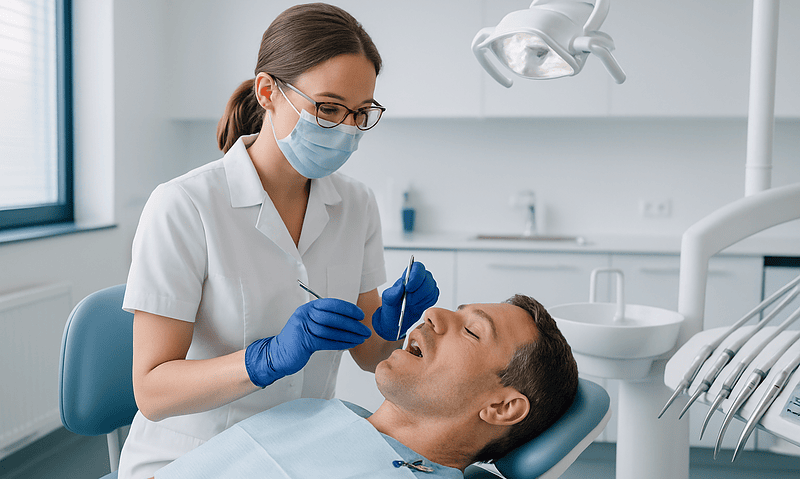
The Dental Implant Process: Every Stage From First Scan to Final Crown
The dental implant process typically unfolds over three to nine months. It begins with a 3D scan and treatment planning, followed by any needed…
Why an ENT Check May Come Before a Sinus Lift When You Have Chronic Sinusitis or Allergies
An ENT (ear, nose and throat) check often comes before a sinus lift because the graft is placed directly beneath the maxillary sinus lining,…