

The Men’s Health Check: What to Test at 30, 40, 50 and 60

Key Takeaways
- Heart disease causes roughly one in four male deaths in the United States, which is why blood pressure and cholesterol checks never leave the schedule from age 20 onward.
- Colorectal cancer screening starts at 45 for average-risk men, and regular screening is associated with about a 50 percent reduction in colorectal cancer deaths in large observational studies.
- For every 1,000 men aged 55 to 69 screened with PSA for about 13 years, one to two fewer die of prostate cancer while around 240 have a false-positive result, which is why it is a shared decision.
- A one-time abdominal aortic aneurysm ultrasound in men aged 65 to 75 who ever smoked cut aneurysm-related deaths by about 40 percent in randomized trials.
- Since October 2024 the CDC recommends pneumococcal vaccination for all adults from age 50, the same age the recombinant shingles vaccine series begins.
- Testosterone falls about 1 percent a year after 30, and guidelines call for a morning sample repeated on a second day before any diagnosis of deficiency, never a routine screen.
A men's health check is a scheduled set of screenings that changes with age. At 30 it centers on blood pressure, cholesterol, weight, mental health and sexually transmitted infections. At 40, blood sugar and a heart-risk estimate are added. From 45 to 50, colorectal cancer screening begins and prostate screening becomes a shared decision. At 60, lung and aortic screening apply to men who smoked. Frequency depends on personal risk.
Every June, around Men’s Health Month, searches for ‘men’s health check’ climb, and this year the curve is steeper than usual. As of June 2026, three dated changes have given men a genuine reason to re-read the list: in October 2024 the CDC lowered routine pneumococcal vaccination to age 50; in August 2025 the American Heart Association and American College of Cardiology issued a new high blood pressure guideline that leans harder on home readings; and colorectal screening at 45, not 50, has now been standard long enough that the first wave of men who started early are returning for their follow-ups.
Layered on top is a noisier trend: social feeds promoting full-body scans, mail-order testosterone panels and ‘optimization’ bloodwork as if more tests automatically meant more health.
The evidence tells a calmer story. A handful of screenings, timed to the right decade, prevent a measurable share of the heart attacks, strokes and cancers that shorten men’s lives. The rest is noise. This is the decade-by-decade guide, with the strength of the evidence stated plainly.
What changed recently in the men's health check
Guidelines move slowly, which is why a cluster of changes in a short window deserves attention. Four are worth knowing about.
The first is vaccination. In October 2024 the CDC lowered the age for routine pneumococcal vaccination from 65 to 50 for all adults, citing the rising rate of pneumococcal pneumonia in people in their fifties, particularly those with diabetes, heart or lung disease. The current CDC adult schedule reflects that change, and it also lists RSV vaccination for everyone 75 and older, plus adults from age 50 who have conditions that raise their risk.
The second is blood pressure. The 2025 AHA/ACC guideline kept the thresholds introduced in 2017, so a reading of 130/80 mmHg or higher still counts as stage 1 hypertension, but it added a newer risk calculator (called PREVENT) that folds in kidney function and metabolic health, and it placed more weight on confirming office readings with a validated home cuff before any diagnosis is made.
The third is colorectal screening. The US Preventive Services Task Force moved the start age to 45 in 2021, and in July 2024 the FDA approved the first blood-based screening test for average-risk adults. That blood test has not been added to the Task Force recommendation, and the CDC still lists stool tests and colonoscopy as the established options.
The fourth is quieter: since 2020 the CDC has recommended a one-time hepatitis C test for every adult, and that test is now routinely folded into a first-decade men’s health check. Put together, these are not dramatic shifts. They are the kind of small adjustments that only matter if a man actually turns up for the visit.
What does a men's health check include, and what are the top 3 health issues facing men?
Strip away the marketing and a men’s health check has four layers. The first is measurement: blood pressure, height, weight and waist circumference, which together estimate cardiovascular risk better than any single number. The second is bloodwork chosen for age and risk, mainly a lipid panel (the test that measures cholesterol and triglycerides) and, from the mid-thirties, a blood sugar test. The third is cancer screening with an age trigger, chiefly colorectal, and for some men prostate, lung or skin. The fourth is the conversation: mood, sleep, alcohol, tobacco, sexual function and vaccinations.

Why these four? Because they map onto what actually kills and disables men. CDC mortality data list the top three causes of death for US men as heart disease, cancer and unintentional injuries, with heart disease responsible for roughly one in four male deaths. Behind those headline causes sit the conditions a check-up can find early: high blood pressure, high LDL cholesterol, type 2 diabetes and depression, which raises injury and suicide risk.
The CDC also notes that American men live about five years less than American women on average, a gap that observational data link partly to higher rates of smoking, heavy drinking and delayed care. That last point is the one clinicians repeat most. Survey data from the CDC show men are markedly less likely than women to have seen a health professional in the past year.
So ‘men’s health’ is not a specialty confined to the prostate or testosterone. It is ordinary preventive medicine applied to a group that, on average, shows up late. The age-by-age schedule that follows is simply the evidence-backed way to show up on time.
The men's health check at 30: baselines that compound
A 30-year-old man rarely feels like a patient, which is exactly why this visit matters. Nothing found at 30 is likely to be urgent. Almost everything found at 30 is cheaper to fix than the same problem found at 50.
Blood pressure comes first. MedlinePlus guidance for men aged 18 to 39 calls for a check at least every two years if the reading is below 120/80 mmHg, and yearly if the top number is 120 to 129. Roughly a third of US adults with hypertension do not know they have it, and the damage to arteries and kidneys begins long before symptoms.
Cholesterol follows. A fasting or non-fasting lipid panel is recommended from age 20 and repeated about every five years if normal, sooner if there is diabetes, a family history of early heart disease or a high reading. Familial hypercholesterolemia, an inherited condition that pushes LDL very high from birth, is usually caught only because someone ordered this test.
Weight and waist are recorded, not judged. Body mass index (BMI, a weight-to-height ratio) above 25 is the threshold at which blood sugar screening starts earlier, at 35 rather than later.
Infection screening belongs here too. The CDC recommends a one-time HIV test for everyone aged 15 to 65 and a one-time hepatitis C test for all adults, with sexually transmitted infection tests based on risk.
Finally, the conversation. The Task Force recommends depression screening for all adults, and anxiety screening for adults under 65. Men in their thirties have high rates of untreated depression and the highest rates of risky drinking. A clinician who asks the question at 30 is often the first person who has.
The check at 40: what blood tests are recommended for a 40-year-old male?
Forty is where the men’s health check stops being a formality. The arteries have had two decades of exposure to whatever the cholesterol and blood pressure numbers were, and the body’s handling of sugar starts to drift in a measurable share of men.
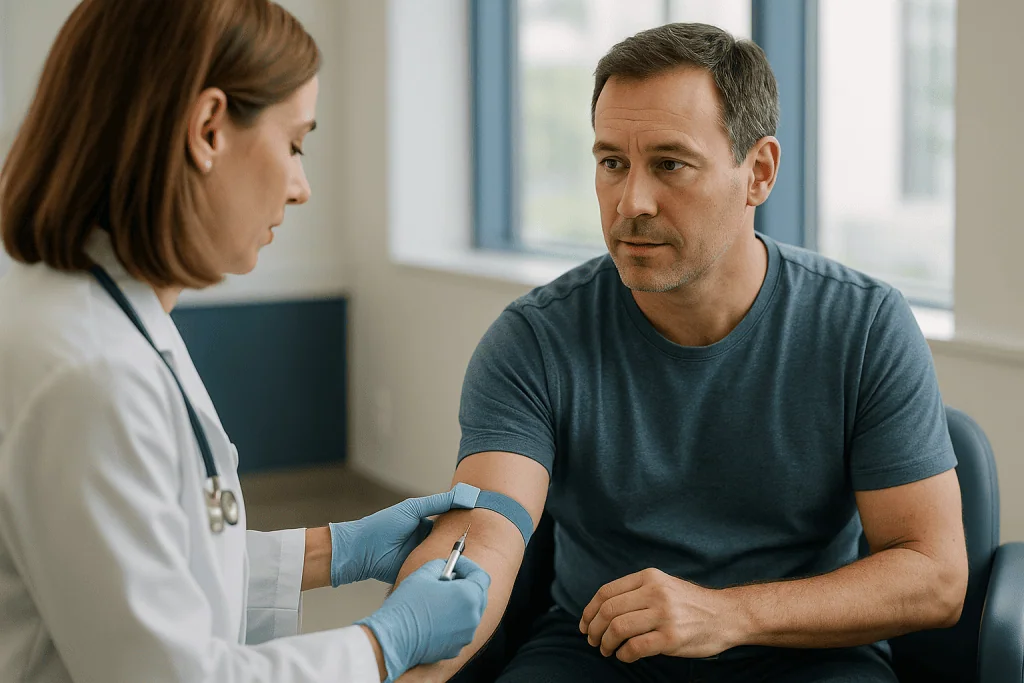
The core bloodwork for a 40-year-old at average risk is short. A lipid panel, now repeated every four to six years, or every one to two years once risk factors appear, remains the anchor. A blood sugar test joins it: either fasting glucose or hemoglobin A1C, which reflects average blood sugar over the previous two to three months. The Task Force recommends this from age 35 to 70 for adults who are overweight or obese, repeated roughly every three years if normal. Many clinicians also order it for men of normal weight who have a family history of diabetes or South Asian, Hispanic, Black or Native American ancestry, because risk in those groups rises at lower BMI.
Beyond those two, the list depends on the man. Kidney function and liver enzymes are often added when blood pressure is elevated or alcohol intake is high. A hepatitis C test is done if it was never done before. Routine testosterone, thyroid, vitamin D or ‘full panel’ testing is not recommended for men without symptoms; the evidence for finding useful disease that way is weak, and the false-positive trail is long.
The numbers then feed a calculation. Using age, sex, cholesterol, blood pressure, smoking and diabetes status, a 10-year cardiovascular risk estimate tells the clinician and the patient whether lifestyle alone is enough or whether a medication discussion belongs on the table. That estimate, not any single lab value, is the real output of the 40-year-old visit, and the decision that follows rests with the treating clinician.
The check at 50: the decade screening gets serious
Fifty is the decade with the most to gain, because it is when the cancers that screening can genuinely intercept begin to appear in meaningful numbers.
Colorectal screening should already be under way. The Task Force recommends it for all adults aged 45 to 75, and a 50-year-old who has never been screened is five years behind. Three options have the strongest evidence: colonoscopy every 10 years; a fecal immunochemical test (FIT, a stool test that detects hidden blood) every year; or a multi-target stool DNA test every one to three years. Observational data from large US health systems show that regular screening is linked to a fall in colorectal cancer deaths of roughly half, and the colonoscopy approach also removes precancerous polyps before they turn.
Prostate screening enters at 50 as a conversation, not an automatic order. The Task Force advises that men aged 55 to 69 decide individually, after discussing benefits and harms, whether to have a prostate-specific antigen (PSA) blood test. Many professional bodies suggest starting that discussion at 50, or at 45 for Black men and men with a father or brother diagnosed young. The next section covers the trade-offs in detail.
Lung screening becomes relevant for smokers. Annual low-dose CT (a chest scan using a fraction of standard radiation) is recommended from 50 to 80 for adults with a 20 pack-year history who still smoke or quit within the past 15 years. A pack-year means one pack a day for one year, so 10 cigarettes a day for 40 years also qualifies.
Vaccines shift too: the recombinant shingles vaccine series from 50, and since 2024 pneumococcal vaccination from 50. Blood pressure, lipids and A1C continue, now typically on a one-to-two-year rhythm.
The check at 60 and beyond: screening with judgment
The sixties invert the earlier logic. Through 50, the question was which tests to start. From 60, it increasingly becomes which tests still help, because a screening only pays off if a man is likely to live long enough to benefit from finding something early.
Two screenings are specific to this decade. The first is a one-time ultrasound for abdominal aortic aneurysm (AAA, a bulge in the main artery below the heart that can rupture) in men aged 65 to 75 who have ever smoked. Randomized trials, including the large UK Multicentre Aneurysm Screening Study, showed this single scan cut aneurysm-related deaths by about 40 percent in that group. The second is a fall and bone check. Osteoporosis screening in men is not a universal recommendation, but MedlinePlus guidance suggests a bone density scan for men over 70, or earlier with risk factors such as long-term steroid use or a fracture after a minor fall.
Colorectal screening continues to 75 and then becomes an individual decision to 85, weighed against health and prior results. PSA testing is not recommended at 70 and older because the harms of finding slow-growing cancer outweigh the benefits in trial data. Lung screening continues to 80 for eligible smokers.
The everyday checks grow in importance rather than fading. Blood pressure is now checked yearly. Hearing, vision and dental assessments catch problems that quietly erode independence. Cognitive concerns raised by the man or his family warrant evaluation, though routine dementia screening in people without symptoms is not recommended, because the evidence that it improves outcomes is insufficient.
The CDC schedule adds RSV vaccination for all adults 75 and older, and from 60 for those at increased risk. Annual flu and current COVID-19 vaccination continue.
Men's health screening by age: the summary table
A decade-by-decade table is the quickest way to see how the list grows, then narrows. It assumes a man at average risk; family history, smoking, diabetes and ethnicity can pull any start age earlier, and the final schedule is set with a clinician.
| Screening or check | 30s | 40s | 50s | 60s and older |
|---|---|---|---|---|
| Blood pressure | Every 1–2 years | Every 1–2 years | Yearly | Yearly |
| Lipid panel (cholesterol) | Every 5 years | Every 4–6 years | Every 1–2 years | Every 1–2 years |
| Blood sugar (glucose or A1C) | From 35 if BMI 25 or higher | Every 3 years | Every 3 years | Every 3 years |
| Colorectal cancer | Only with strong family history | Start at 45 | Continue | To 75, then individual to 85 |
| Prostate (PSA) | No | Discuss from 45 if higher risk | Shared decision 55–69 | Not recommended at 70+ |
| Lung (low-dose CT) | No | No | Yearly from 50 if 20 pack-years | Continue to 80 if eligible |
| Abdominal aortic aneurysm | No | No | No | Once at 65–75 if ever smoked |
| HIV and hepatitis C | Once each | If not yet done | If not yet done | HIV to 65; hep C if not done |
| Depression and anxiety | Each visit | Each visit | Each visit | Depression each visit |
Two things stand out. Blood pressure and depression screening never leave the table, which reflects how much of men’s excess mortality is cardiovascular and behavioral rather than oncological. And the cancer rows have both a start and a stop, because screening is a balance of benefit and harm that shifts with age, not a lifetime subscription.
Vaccinations, dental and eye checks sit outside the table because their timing depends more on history than on decade; the vaccine section below lists the age triggers.
What the evidence actually says about each test
Not every line on the schedule rests on the same foundation. Grading them honestly is the difference between a men’s health check and a wish list.
Strongest: randomized trial evidence of fewer deaths. Blood pressure treatment has decades of trials showing fewer strokes and heart attacks. Colorectal screening with stool blood tests reduced colorectal cancer mortality in several randomized trials, and flexible sigmoidoscopy trials showed the same; colonoscopy’s benefit is supported by those trials plus large observational studies. Low-dose CT for heavy smokers reduced lung cancer deaths by about 20 percent in the US National Lung Screening Trial. AAA ultrasound in older men who smoked has randomized evidence of fewer aneurysm deaths.
Strong but conditional: trials show benefit, with real harms. PSA screening reduced prostate cancer deaths modestly in the European ERSPC trial and showed no benefit in the US PLCO trial, which was contaminated by widespread testing in the control group. The net is a small benefit at the cost of overdiagnosis, which is why the recommendation is a shared decision rather than a yes.
Moderate: observational and mechanistic evidence, no mortality trial. Cholesterol testing is a case in point. The trials prove that lowering LDL prevents events; the act of measuring it is justified because it identifies who benefits. Blood sugar screening is similar: trials of early diabetes treatment show fewer complications, and screening is the gateway.
Weak or absent: expert opinion only. Routine testosterone, vitamin D, thyroid and comprehensive metabolic panels in symptom-free men, testicular self-examination, whole-body imaging and ‘executive’ physicals have no trial evidence of improved outcomes. A Cochrane review of general health checks found no reduction in overall mortality, a result that argues for targeted screening rather than against seeing a doctor. The useful visit is the one that orders the first two tiers and resists the fourth.
Prostate cancer screening: a shared decision, not a default
No test on the men’s health check generates more confusion than PSA, and the confusion is understandable. Prostate cancer is the second most common cancer in US men, yet most men diagnosed with it die of something else. The test cannot tell those two groups apart on its own.
PSA stands for prostate-specific antigen, a protein made by the prostate that rises with cancer, but also with age, infection, benign enlargement and recent ejaculation or cycling. A raised result therefore starts a chain: repeat testing, often an MRI, sometimes a biopsy. Each link has its own false positives and complications.
The Task Force summarizes the trade-off with numbers worth sitting with. If 1,000 men aged 55 to 69 are screened every one to four years for about 13 years, roughly one to two fewer will die of prostate cancer and about three fewer will develop cancer that has spread. In the same 1,000 men, around 240 will have a positive PSA result leading to further testing, about 100 will be diagnosed, and a substantial number of those will be treated for a cancer that would never have harmed them, with surgery and radiation carrying meaningful rates of erectile dysfunction and urinary leakage.
That is why the CDC and the Task Force frame screening from 55 to 69 as an individual choice made after a conversation, and recommend against it at 70 and older. Risk changes the calculus: Black men and men whose father or brother had prostate cancer before 65 face roughly double the lifetime risk, and many urology bodies suggest their conversation starts at 40 to 45.
Active surveillance, meaning monitoring a low-risk cancer rather than treating it immediately, has reduced one harm of screening over the past decade. It has not eliminated the need for the conversation, and that conversation belongs with the man and his clinician.
Is a testosterone test part of a men's annual physical checklist?
Scroll any men’s health feed and the answer appears to be yes, with ‘low T’ blamed for everything from a slow afternoon to a soft midsection. The guideline answer is more specific: a testosterone test belongs on the checklist only when there are consistent symptoms, and never as a routine screen.
The reasoning is physiological. Testosterone falls slowly with age, by about 1 percent a year after 30 according to Mayo Clinic summaries of population data, and that gradual drift is normal. Levels also swing by time of day, with sleep, illness, obesity and some medicines, which is why endocrinology guidance insists on a morning sample, repeated on a separate day, before any diagnosis of hypogonadism (the medical term for the testes producing too little testosterone). A single mail-order result taken at 4 p.m. after a bad night’s sleep is close to meaningless.
What the evidence does support is testing men who have the specific pattern: low libido, erectile difficulty, loss of early-morning erections, reduced body hair or shrinking testes, especially alongside conditions such as type 2 diabetes, pituitary disease or prior chemotherapy. Fatigue or low mood alone, without those features, are far more often sleep apnea, depression or alcohol, and a clinician will usually look there first.
Treatment questions sit entirely with the prescribing clinician. Randomized trial data published in 2023 (the TRAVERSE trial) were reassuring on heart attack risk in men with confirmed deficiency, but testosterone products still carry warnings, can suppress fertility, and are not recommended for men with normal levels. Products sold online without a confirmed diagnosis, including compounded or ‘research’ preparations, fall outside regulated use and are not for self-treatment.
The honest line for the checklist is this: ask about symptoms every visit, test when the symptoms fit, and treat only confirmed deficiency.
Which vaccines belong on the schedule at 30, 40, 50 and 60?
Vaccination is the one part of a men’s health check with no false positives, which makes it strange that it is so often skipped at the adult visit. The CDC adult immunization schedule sets the ages, and they are easier to remember than most men expect.
Every decade carries three constants. A tetanus-diphtheria booster is due every 10 years, with at least one dose as Tdap (the version that also covers whooping cough). Influenza vaccination is recommended every season for all adults. COVID-19 vaccination follows the current CDC recommendation for the season, which has varied by year and risk group.
In the thirties, two catch-up items matter. HPV vaccination is routinely recommended through age 26, and adults 27 to 45 who were never vaccinated can discuss it with a clinician, since benefit depends on prior exposure. Hepatitis B vaccination is now recommended by the CDC for all adults through 59 who were not vaccinated as children, and for those 60 and older with risk factors.
At 50, two new recommendations switch on. The recombinant shingles vaccine series is recommended for all adults 50 and older; it reduced shingles by more than 90 percent in randomized trials, and shingles risk climbs steeply after this age. And since the October 2024 CDC update, pneumococcal vaccination is recommended for everyone 50 and older, not just those with chronic conditions.
From 60, RSV joins the list for adults at increased risk, and at 75 it is recommended for everyone. Observational data from the first two seasons suggest it substantially cuts RSV-related hospitalization in older adults.
Eligibility details, intervals and product choices change, so the clinician checks the current schedule at each visit. The man’s job is simpler: bring the record, or ask for it to be pulled from the state registry.
Mental health: the part of the check most men skip
Ask a man in a waiting room what he is there for and he will mention his blood pressure before his mood, if he mentions his mood at all. The numbers suggest the order should sometimes be reversed.
CDC data show that men in the United States die by suicide at nearly four times the rate of women, and that men aged 75 and older have the highest rate of any group. Men are also less likely to be diagnosed with depression, partly because the condition in men more often shows up as irritability, anger, risk-taking, heavier drinking or physical complaints than as sadness. A screening questionnaire asked without fuss catches a share of these men that symptom-led care misses.
The evidence for screening is solid at the guideline level. The Task Force recommends depression screening for all adults, and anxiety screening for adults under 65, provided there is a system to confirm the diagnosis and offer treatment. Randomized trials of collaborative care, where a primary care team tracks and treats depression systematically, show meaningful improvement in symptoms. Screening on its own, with no follow-up, has weaker evidence, which is why the questionnaire is paired with a conversation.
Alcohol belongs in the same breath. The Task Force recommends screening all adults for unhealthy alcohol use and offering brief counseling, which trials show reduces drinking by a modest but real amount. Men are roughly twice as likely as women to meet criteria for heavy drinking.
Sleep is the third pillar. Loud snoring with daytime sleepiness points toward obstructive sleep apnea, which is more common in men, raises blood pressure and is frequently the real cause behind a request for testosterone testing. It is diagnosed with a sleep study, not a blood test.
None of this requires a separate appointment. It requires an honest answer to a question that is finally being asked.
Common myths about men's health checks
The current trend has revived several durable myths. Each has an evidence-based correction.
‘A full-body MRI is the ultimate men’s health check.’ No professional body recommends whole-body imaging for people without symptoms. Observational series show these scans find incidental abnormalities in a large majority of healthy adults, most of which are harmless but trigger further tests, anxiety and occasionally invasive procedures. No trial has shown they extend life.
‘If I feel fine, I don’t need testing.’ High blood pressure, high cholesterol, early type 2 diabetes and colorectal polyps are all symptom-free for years. Feeling fine is the normal state of a man with a condition worth treating.
‘Every man over 40 should have a PSA test.’ The trial evidence supports an individual decision between 55 and 69, earlier for higher-risk men, and recommends against testing at 70 and older. A PSA test is a risk marker, not a cancer diagnosis.
‘Low testosterone explains tiredness and belly fat in most middle-aged men.’ Sleep apnea, depression, alcohol and simple weight gain are far more common causes. Testosterone testing is for consistent symptoms, confirmed on a morning sample twice.
‘Annual physicals don’t work, so skip the doctor.’ The Cochrane finding that general check-ups do not reduce mortality is often quoted out of context. The same evidence base shows that specific screenings, blood pressure, colorectal, lung for smokers and AAA, do reduce deaths. The lesson is to make the visit targeted, not to avoid it.
‘A clean colonoscopy means I’m done.’ A normal result buys 10 years, not a lifetime, and new bleeding or bowel changes should be assessed regardless of when the last test was.
When to see a doctor: red flags between check-ups
Screening schedules cover the quiet years. They do not replace the judgment to act when something changes, and some changes should not wait for the next planned men’s health check.
Call emergency services, do not drive yourself, for chest pressure or pain lasting more than a few minutes, especially with sweating, breathlessness or pain spreading to the arm, jaw or back; for sudden weakness or numbness on one side, a drooping face, slurred speech or sudden loss of vision, which are stroke signs where every minute counts; for a home blood pressure reading of 180/120 mmHg or higher with headache, chest pain or confusion; and for thoughts of harming yourself, where the 988 Suicide and Crisis Lifeline is available around the clock in the United States.
Arrange a prompt appointment, within days rather than months, for blood in the stool or urine, unexplained weight loss, a new lump in a testicle, a mole that is changing shape or color, persistent low mood for more than two weeks, or new erectile dysfunction, which observational studies link to cardiovascular disease appearing several years later and which warrants a heart-risk review rather than a search for a quick fix.
Bring unexplained numbers too: a home blood pressure cuff consistently reading 130/80 or above, a workplace cholesterol result that came back high, or a family member newly diagnosed with colorectal or prostate cancer before 60, which may move your own screening start date earlier.
Finally, if any screening result is abnormal, the follow-up plan is set by the clinician who ordered it, and no medicine on the list, from blood pressure tablets to statins to testosterone, should be started, stopped or adjusted on the strength of an article. The schedule in this piece is the map. The clinician is the one reading it with you.
Frequently asked questions
What is a doctor who specializes in men called?
A urologist is the specialist most associated with men’s health, covering the prostate, testes, bladder, kidneys and erectile function. An andrologist is a urologist or endocrinologist focused on male hormones and fertility. In practice, most of the men’s health check, including blood pressure, cholesterol, diabetes, colorectal screening and mood, is run by a primary care physician, who refers to a specialist when a result or symptom needs one.
What blood tests are recommended for a 40-year-old male, and which blood tests for men over 40 are optional?
The recommended core is a lipid panel for cholesterol and a blood sugar test, either fasting glucose or hemoglobin A1C, plus one-time HIV and hepatitis C tests if never done. Kidney and liver tests are added when blood pressure or alcohol intake is high. Testosterone, thyroid, vitamin D and broad ‘wellness’ panels are optional at best and are not recommended for men without symptoms, because they rarely find treatable disease.
What are the top 3 health issues facing men?
CDC data rank heart disease, cancer and unintentional injuries as the three leading causes of death for US men. Heart disease alone accounts for about one in four male deaths. Beneath those headlines sit the preventable drivers a check-up targets: high blood pressure, high cholesterol, type 2 diabetes, smoking and depression, with men dying by suicide at nearly four times the rate of women.
What does men's health include beyond prostate and testosterone?
Men’s health includes cardiovascular risk, metabolic health, cancer screening, infection screening, mental health, sleep, sexual function and vaccination. The prostate and testosterone are a small part of it. Most of the preventable years of life men lose come from heart disease, stroke, lung and colorectal cancer, injuries and suicide, which is why blood pressure, cholesterol, blood sugar and mood screening form the backbone of every decade’s check.
How often should a man have a men's health check?
For a healthy man at average risk, every one to three years in his twenties and thirties, then yearly from around 40 to 50 onward. The interval is really set by the individual tests: blood pressure every one to two years when normal, cholesterol every four to six years, blood sugar every three years, and cancer screenings on their own cycles. Risk factors, abnormal results or chronic conditions shorten the gap, and the clinician sets the schedule.
Do I need a PSA test at 50?
Not automatically. Guidelines frame PSA testing as an individual decision for men aged 55 to 69, made after discussing a small reduction in prostate cancer deaths against a meaningful risk of false positives and overtreatment. Many urology bodies suggest opening that conversation at 50, and at 40 to 45 for Black men or men with a father or brother diagnosed young. Testing is not recommended at 70 and older.
Should I ask for a testosterone test at my physical?
Only if you have the specific symptoms: low libido, erectile difficulty, loss of morning erections, shrinking testes or reduced body hair. Tiredness and weight gain alone are more often sleep apnea, depression or alcohol. If testing is warranted, guidelines require a morning sample repeated on a separate day before diagnosing deficiency. Treatment decisions belong to the prescribing clinician, and products bought online without a confirmed diagnosis are not for self-use.
Is a full-body MRI scan a good men's health check?
No professional body recommends whole-body imaging for people without symptoms. Studies of these scans show incidental findings in a large majority of healthy adults, most of them harmless but many leading to further tests, biopsies and anxiety. No randomized trial has shown they extend life. The screenings with proven mortality benefit, such as blood pressure, colorectal, lung for smokers and aortic ultrasound, are targeted and age-specific.
What does a men's annual physical checklist look like at 50?
At 50 the checklist includes blood pressure, weight and waist, a lipid panel, a blood sugar test, colorectal screening if not already current, a prostate screening conversation, lung screening if you have a 20 pack-year smoking history, depression and alcohol screening, and a vaccine review covering shingles, pneumococcal, tetanus, flu and COVID-19. Hearing, vision and dental checks are added as needed. A clinician adjusts it to your history.
At what age should men start colon cancer screening?
Average-risk men should start at 45 and continue to 75, with screening from 76 to 85 decided individually. Options include colonoscopy every 10 years, a fecal immunochemical test every year or a stool DNA test every one to three years. Men with a parent or sibling diagnosed with colorectal cancer, or with inflammatory bowel disease, often start earlier, typically at 40 or 10 years before the relative’s diagnosis, as advised by their clinician.
References
- MedlinePlus: Health screenings for men ages 40 to 64
- MedlinePlus: Health screenings for men ages 18 to 39
- CDC: Screening for Prostate Cancer
- CDC: Screening for Colorectal Cancer
This article is for general information only and is not a substitute for professional medical advice. Please consult a qualified doctor about your individual situation.

More from the Blog

The Prostate: Where It Is and What It Does
The prostate is a walnut-sized gland that sits just below the bladder and in front of the rectum, wrapped around the tube that carries…

TRT and Hair Loss: Who Sheds, Why It Happens and What Can Be Done
Testosterone replacement therapy (TRT) does not cause hair loss on its own, but it can accelerate male pattern baldness in men who are genetically…

Testosterone and Sleep: How Short Nights Lower Levels and What a Full Night Restores
Sleep and testosterone are closely linked. Testosterone rises during sleep and peaks in the early morning, so cutting sleep short shrinks the production window.…

TRT and Fertility: Why Testosterone Therapy Can Shut Down Sperm Production
Testosterone replacement therapy (TRT) usually lowers sperm production sharply, and in many men it stops it altogether, because added testosterone switches off the pituitary…

Prostate Health Foods: What Diet Research Says About Tomatoes, Fat and the Prostate
No single food has been proven to prevent prostate cancer or shrink an enlarged prostate. The strongest evidence supports an overall pattern: plenty of…

Testosterone Gel Side Effects: Transfer Risk, Skin Reactions and Monitoring
Testosterone gel side effects fall into three groups: effects on the person using it, such as acne, oily skin, fluid retention, breast tenderness, a…