

The Scar After Surgical Tattoo Removal: Sun Protection, Scar Care and How It Fades

Key Takeaways
- Surgical excision removes tattoo ink completely because it removes the skin containing it, which is why a scar is certain rather than merely possible.
- A normal excision scar is usually at its reddest and most raised around two to three months, then flattens and pales over up to two years according to NHS guidance.
- Scar tissue contains no hair follicles or sweat glands and often has altered sensation, so the skin does not return to its original state even when the scar becomes hard to see.
- The NHS advises protecting a scar from sun with high-factor sunscreen or clothing for at least the first year, mainly to prevent permanent darkening.
- Silicone gel or sheets and gentle massage after wound closure are the scar-care measures with the most consistent evidence; vitamin E has none and irritates some skin.
- Keloids, which grow beyond the wound edge and do not regress, are more common in darker skin and on the chest, shoulders, upper back and earlobes, and a known history should be raised with the surgeon before excision.
A scar after surgical tattoo removal is permanent, but it usually changes a great deal over its first one to two years, typically shifting from raised and pink or darker to flatter and paler. Consistent sun protection, keeping the wound clean while it closes, and following your surgeon's scar-care plan give it the best chance of settling. Decisions about any further treatment belong with your treating team.
The night before surgery, a man in his forties sits on the edge of the bath and traces the name on his forearm one last time. He has lived with it for nineteen years and with the divorce for eleven. The surgeon has explained the trade plainly: the ink goes, a line stays. What he cannot picture yet is the line itself.
That gap between expectation and reality is where most worry about a scar after surgical tattoo removal lives. People imagine either an invisible seam or an angry welt, and the truth sits somewhere in between, moving slowly over many months.
This explainer walks through what excision actually does to skin, why a fresh scar looks the way it does, how sun and scar care change its course, and what the evidence genuinely supports. It also tells you when a scar is behaving normally and when it deserves a phone call.
What actually happens to the skin during surgical tattoo removal
Tattoo ink does not sit on the surface. A tattoo needle deposits pigment into the dermis, the thicker middle layer of skin beneath the outer epidermis, where the particles are too large for the body to clear. Laser treatment works by shattering those particles so immune cells can carry them away. Surgery takes a blunter route: the surgeon removes the entire block of tattooed skin, ink and all, then brings the edges together.
Excision, the clinical name for that cutting-out, is usually done under local anesthetic, meaning only the area itself is numbed. The surgeon marks an ellipse around the tattoo rather than a circle, because a lens shape closes flat while a round hole puckers at the ends. The cost of that geometry is length: the resulting line is longer than the tattoo was wide.
The wound is closed in layers. Deeper stitches, often the kind that dissolve, hold the tissue together and take tension off the surface. Fine surface stitches or adhesive strips align the skin edges. How neatly those edges meet, and how little pull sits across them, shapes the eventual scar more than almost anything you do afterward.
For larger tattoos, a single ellipse would not close. Surgeons then consider serial excision, removing the tattoo in stages several months apart as the surrounding skin stretches, or a skin graft, in which a thin layer of skin from elsewhere covers the defect. Both approaches leave more visible marks than a simple line. Mayo Clinic describes surgical removal as an option mainly for small tattoos, precisely because the scar is a given and grows with the size of the tattoo.
Does tattoo removal leave scars? Surgery versus everything else
Every method of tattoo removal carries some risk of scarring; surgery is the one method where a scar is not a risk but a certainty. That distinction is worth holding onto, because it reframes the question. You are not hoping to avoid a scar. You are choosing a predictable line over an unpredictable patch.
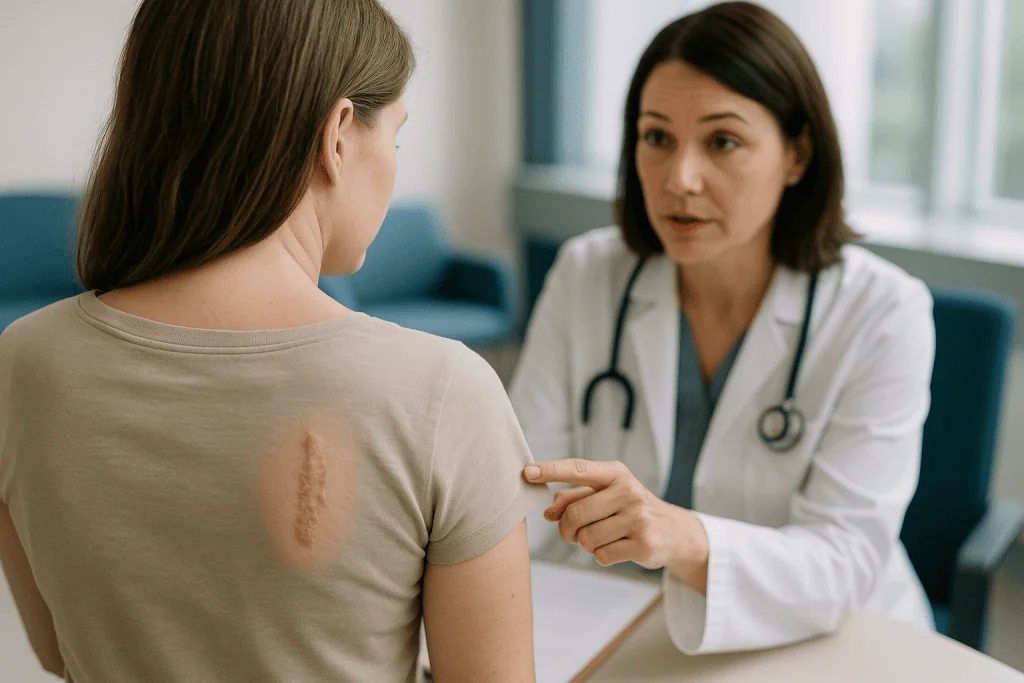
A scar is simply the body’s repair material. When skin is cut through the dermis, fibroblasts, the cells that build connective tissue, lay down collagen quickly and in a less organized pattern than the original weave. The result is stronger than a fresh wound but never identical to untouched skin. The NHS notes that scar tissue lacks the hair follicles and sweat glands of normal skin, which is why a mature scar looks smooth and slightly shiny.
Laser removal can also scar, particularly when energy settings are too high, when the skin blisters and the blister is picked, or when a treated area gets infected or sunburned. Mayo Clinic lists scarring and permanent changes in skin color among the recognized risks of laser treatment. The difference is that many people finish a laser course with textural change so subtle it goes unnoticed, while excision always produces a line you can point to.
There is a third scenario people rarely anticipate: laser first, then surgery. Some tattoos fade unevenly under laser, leaving ghosted patches of green or yellow, and a surgeon may later excise the remnant. In that case the skin being cut has already been through repeated inflammation, and the final scar sits inside an area that may already be lighter or darker than its surroundings.
Who surgical excision is usually for, and who is usually asked to wait
Excision tends to be discussed when a tattoo is small enough to close in one line, when someone wants the ink gone in a single procedure rather than across many months of laser sessions, or when a tattoo has resisted laser. Mayo Clinic points out that certain ink colors respond poorly to laser, and a stubborn remnant is a common reason people arrive at a surgeon’s door.
Location matters as much as size. Skin on the inner arm or abdomen is loose and forgiving. Skin over the shoulder, upper back, chest and shin is tight, and a wound there sits under constant tension every time you move. Surgeons weigh that tension carefully, because a scar under strain is more likely to widen or thicken.
Several situations usually prompt a pause rather than a refusal. A team may ask you to wait if there is an active skin infection or inflamed rash near the tattoo, if blood sugar is poorly controlled, if you smoke, or if you are pregnant, since none of these is ideal for wound healing. Some prescription medicines that affect skin healing, and some that thin the blood, need review before elective surgery; the prescribing clinician makes that call, never the patient alone.
A personal or family history of keloids, the overgrown scars described later in this article, changes the conversation most. MedlinePlus notes keloids are more common in people with darker skin and tend to form on the chest, shoulders, upper back and earlobes. A surgeon may recommend against excision in those sites, suggest a test excision of a small area first, or plan preventive scar treatment from the start.
Scar after surgical tattoo removal vs laser: a side-by-side view
People often frame the choice as scar or no scar. The honest comparison is between two different kinds of change to the skin, arriving on two different timelines. The table below summarizes what mainstream sources such as Mayo Clinic and the NHS describe for each approach.

| Feature | Surgical excision | Laser removal |
|---|---|---|
| Number of treatments | Usually one for a small tattoo; staged for larger ones | Multiple sessions, spaced weeks apart |
| What happens to the ink | Removed with the skin | Broken into fragments the body clears over time |
| Scar | Certain: a linear scar longer than the tattoo’s width | Possible, not certain; risk rises with blistering, infection or aggressive settings |
| Color change | Scar line may be paler or darker than surrounding skin | Patchy lightening or darkening across the treated area is a recognized risk |
| Ink colors | Irrelevant; all colors go | Some colors respond less well |
| Wound care period | Stitched wound needing dressings for roughly two weeks | Superficial healing after each session |
| Reversibility | None; a scar cannot be un-made | Incomplete fading may leave a faint shadow |
Two points deserve emphasis. First, laser rarely removes every trace; Mayo Clinic is explicit that complete removal without any residual is not guaranteed, and a faint outline or color shift is common. Second, excision trades that uncertainty for a certainty that is visible from day one and fades gradually. Neither is the right answer for everyone. A small dark tattoo on the inner forearm and a palm-sized colorful piece across the shoulder blade are different problems, and your team will frame the choice around your skin, your site and your priorities rather than a general rule.
Surgical tattoo removal healing time: what the first two weeks usually look like
The first fortnight is about the wound, not the scar. The scar comes later; right now the job is helping the skin edges knit without infection or strain.
Expect a dressing over the line for the first day or two, then either a lighter dressing or exposure to air, depending on your surgeon’s preference. Mild swelling, bruising and a tight, pulling sensation are normal. Some clear or slightly blood-tinged fluid on the dressing in the first 24 to 48 hours is also normal; a steady ooze or a spreading red halo is not, and the final section of this article covers those signs.
Stitches on the surface are typically removed at a follow-up visit, with timing set by the surgeon based on the site; skin under more tension is generally left stitched longer. Dissolving stitches under the surface do their work quietly and disappear over the following weeks. Adhesive strips, if used, are left until they peel away on their own.
Movement is the variable people underestimate. A wound on the forearm barely notices typing but complains at the gym. A wound on the shoulder stretches every time you reach overhead. Surgeons usually ask patients to avoid heavy lifting, vigorous exercise and any activity that pulls across the line until the wound has gained strength, and to keep the area dry until they say showering is fine. The NHS wound-care guidance is consistent: keep it clean, keep it covered as advised, and resist the urge to pick at scabs or peel strips early.
By the end of two weeks, most simple excision wounds are closed, the surface stitches are out, and the line looks raised, pink or reddish, and slightly firm. That is the starting point of the scar’s long journey, not a verdict on how it will end.
How the scar changes over the following months and how long fading takes
Scar healing runs in overlapping phases, and knowing them stops a lot of unnecessary alarm. The inflammatory phase, when the wound is swollen and tender, lasts days. The proliferative phase follows, when fibroblasts pour out collagen and tiny new blood vessels flood the area; this is why a young scar is red, raised and sometimes itchy. The remodeling phase, the longest by far, is when that rushed collagen is slowly broken down and rebuilt in a more orderly pattern while the excess blood vessels retreat.
The NHS describes scars as taking up to two years to fade, with most of the visible change happening in the first year. In practical terms, a scar that looks worst around the two-to-three-month mark, redder and more prominent than it did at the stitch removal visit, is usually behaving normally. That peak is the proliferative phase doing its work. Many people judge their scar at exactly this stage and conclude it has gone wrong.
From roughly six months onward, the color typically begins to soften from red toward pink, then toward a shade closer to the surrounding skin. The line flattens and becomes more pliable. Itch fades. Numbness or altered sensation along the line, common because small nerve endings are cut during excision, often improves but may not fully return.
Where the scar ends up depends on genetics, skin tone, body site, wound tension, age and whether the wound healed without complication. Younger skin, which heals more vigorously, can paradoxically produce thicker scars; older skin often produces flatter, paler ones. None of these factors is under your control after the fact, which is exactly why the two things that are, sun protection and scar care, deserve real attention.
Why sun protection matters so much for a healing scar
A young scar is a poor defender against ultraviolet light. Its surface layer is thin, its pigment cells are disorganized and reactive, and its blood supply is exaggerated. Sunlight hitting that tissue does two unwelcome things: it provokes melanocytes, the cells that make pigment, into overproducing melanin, leaving a scar permanently darker than the skin around it; and it prolongs the inflammation that keeps a scar red.
The NHS advises protecting scars from the sun and using a high-factor sunscreen for at least the first year, while the scar is still remodeling. The CDC’s general sun-safety guidance is a sound framework: a broad-spectrum sunscreen of at least SPF 15, applied generously and reapplied at least every two hours and after swimming or sweating, plus shade during the middle of the day and clothing that covers the area. For a scar, most clinicians lean toward the higher end of that SPF range, and clothing is often the simpler answer for a line on the arm or shoulder.
Timing matters. Sunscreen should not go on an open wound; wait until the surface has fully closed and your surgeon has confirmed it is safe. Until then, the dressing or clothing is the sun protection.
Hyperpigmentation, the medical term for that permanent darkening, is a particular concern for people with medium to deep skin tones, whose melanocytes respond more strongly to injury and light. Hypopigmentation, a scar turning paler than its surroundings, is the more common outcome in lighter skin and is harder to influence. Sun protection helps most with the first and does little for the second, which is a good example of why honest expectations beat blanket promises.
Scar care after tattoo removal: what the evidence actually supports
Walk into any pharmacy and the scar-care shelf will tell you a dozen stories. The evidence supports a much shorter list.
Silicone, in gel or sheet form, has the most consistent support. The NHS lists silicone gel or sheets among the measures that can soften and flatten scars and reduce redness, and Cleveland Clinic and Johns Hopkins describe them in similar terms. The proposed mechanism is hydration of the scar surface and a mild reduction in the signaling that drives excess collagen. Silicone is typically started once the wound has fully closed and worn for many hours a day over several months; your surgeon will tell you when and for how long, and whether it suits your site.
Massage is the second measure with reasonable backing. Once the wound is closed and the surgeon agrees, firm circular pressure along the line for a few minutes daily may help soften the scar and improve its pliability, and it appears to reduce itch and sensitivity for many people. The evidence here is weaker than for silicone but the intervention is low-risk.
Keeping the scar moisturized with a plain, fragrance-free emollient is sensible and helps with itch, though it does not change the scar’s structure.
What the evidence does not support is longer. Vitamin E applied to scars has not been shown to improve appearance and causes contact irritation in a meaningful minority of users. Onion-extract creams have mixed, largely unconvincing results in controlled studies. Cocoa butter, essential oils and most branded miracle balms have no controlled evidence at all. None of these are dangerous on a closed scar, but none earn their shelf space, and any product that stings or causes redness should stop.
Hypertrophic scars and keloids: when a scar overgrows
Two kinds of scar step outside the normal script, and telling them apart matters because they behave differently.
A hypertrophic scar is thick, raised and often red, but it stays within the boundaries of the original wound. It tends to appear in the first weeks to months, frequently in areas of skin tension, and it often improves on its own over a year or two. The NHS notes that hypertrophic scars can settle with time and that silicone, pressure and steroid injections are among the treatments used when they do not.
A keloid is different in kind. It grows beyond the edges of the wound into surrounding skin, may keep growing for months or years, and does not regress on its own. MedlinePlus describes keloids as more common in people with darker skin, most frequent between the ages of roughly 10 and 30, and prone to appearing on the chest, shoulders, upper back, earlobes and jawline. They can be itchy, tender or painful, and they can arise months after the original wound seemed to have healed normally.
Treatment of an established keloid is a specialist conversation. Cleveland Clinic and MedlinePlus list corticosteroid injections into the scar, silicone, pressure dressings, cryotherapy, laser and surgical removal as options, usually in combination, because keloids removed surgically on their own tend to return, sometimes larger. Corticosteroids work by dampening the inflammatory signals that drive fibroblasts to overproduce collagen; how often they are given and for how long is decided by the treating clinician.
If you know you form keloids, tell your surgeon before excision, not after. That single sentence can change the site, the technique, the closure and the aftercare plan, and it is one of the few genuinely preventable scar outcomes.
Does the skin go back to normal after tattoo removal?
No, and it is kinder to say so plainly than to let the hope linger. Skin that has been cut through the dermis is repaired, not regenerated. The repaired tissue works well as a barrier and gains strength over months, but it is not the skin you were born with.
The differences are specific. Scar tissue does not grow hair, so a line across a hairy forearm will show as a smooth, hairless strip. It does not contain sweat glands, so the strip stays dry when the surrounding skin perspires. Its collagen is laid down in parallel bundles rather than the original basket-weave, which is why a mature scar looks slightly glossy and feels firmer. The tiny nerve endings that were cut regrow imperfectly, so patches of numbness, tingling or heightened sensitivity along the line are common and may be permanent.
Color is the other honest caveat. Mayo Clinic notes that tattoo removal, by any method, is likely to leave some change in skin color. After excision that usually means a line that is paler than its surroundings in lighter skin, or darker in deeper skin tones, especially if it saw sun during the first year.
What does normalize, in most people, is how much the scar draws the eye. A mature scar from a well-closed, well-cared-for excision is a fine, flat, pale line that most observers never notice and that you stop noticing yourself. Whether that counts as normal is a matter of expectation rather than biology. People who go in expecting invisibility are often disappointed at three months and relieved at eighteen. People who go in expecting a line are usually content much sooner.
Options if the tattoo excision scar still bothers you later
Timing comes first. The NHS describes scars as continuing to change for up to two years, and most surgeons will not consider revising a scar until it has matured, usually at least a year after surgery, because a scar treated too early may have improved on its own anyway, and because operating on tissue that is still remodeling carries a higher chance of a worse result.
Once a scar is mature, several approaches exist, each suited to a different problem. Corticosteroid injections address scars that are thick and raised. Laser treatment, including vascular lasers for persistent redness and fractional lasers for texture, can refine a scar’s appearance. Dermabrasion or microneedling smooths surface irregularity. Surgical scar revision, in which the old scar is excised and closed with a different orientation or technique, is considered when a scar has widened, sits in a poor line or is tethered to the tissue beneath.
Skin camouflage is an underused, entirely non-invasive option. The NHS notes that specialist cover creams and powders can conceal scars for daily wear, and for a line that is flat but pale, camouflage often achieves what no procedure can.
A cover-up tattoo over the scar is something people ask about frequently. Tattooing over mature scar tissue is technically possible, but scar tissue takes ink unevenly, may be more sensitive, and can react unpredictably. It should never be attempted over an immature scar, and anyone with a keloid history should discuss it with a clinician first.
No option is guaranteed to improve a scar, and each carries its own small risk of making it worse. That is why the decision belongs in a conversation with your treating team, weighing what specifically bothers you against what each approach can realistically shift.
What people often get wrong about tattoo removal scars
Myths cluster around scars because they heal slowly and privately, and slow private processes invite folklore. A few corrections are worth making.
Judging the scar at two months is the most common error. That is roughly when a normal scar is at its reddest and most raised, and it is exactly when people search for pictures of bad scars and decide theirs matches. The remodeling phase has barely begun.
Believing that a scar must dry out and scab to heal well is the second. Modern wound care favors a moist, covered environment; the NHS guidance on wound care is clear that picking scabs and leaving wounds to dry out slows healing and worsens scarring.
Assuming laser leaves no mark while surgery leaves a terrible one misreads both. Laser scars are less certain but not rare, and patchy color change after laser is common. A clean surgical line, protected from sun and tension, frequently ends up less conspicuous than an unevenly faded laser patch.
Treating vitamin E as a proven scar remedy is durable folklore with no support in controlled trials and a real rate of skin irritation.
Expecting a tattoo to be one hundred percent gone by any method deserves a direct answer: surgery removes the ink completely because it removes the skin, at the cost of a scar; laser often leaves a faint residue or color shift. Neither returns the skin to its untouched state.
Stopping sun protection once the scar looks fine is the final mistake. A scar that appears settled at six months is still remodeling, and a single strong sun exposure in that window can fix darkening in place. The NHS guidance of at least a year is a floor, not a ceiling.
Questions to ask your care team before and after excision
Good questions do two things: they surface information you would not otherwise get, and they signal to your surgeon what you care about most. Take the list below, cross out what does not apply, and add your own.
Before surgery:
- Roughly how long will the scar be, and in which direction will it run?
- Can the tattoo be removed in one stage, or will it need serial excision or a graft?
- How much tension will sit across this wound, and what does that mean for the scar?
- Given my skin tone and family history, what is my risk of a keloid or dark scar here?
- What would make you advise against excision at this site?
- Are there medicines or habits I should discuss with my prescriber before surgery?
After surgery:
- When can I shower, and when can the wound be uncovered?
- When will the surface stitches come out, and what should I do if one loosens early?
- What movements or activities should I avoid, and for how long?
- When can I start sunscreen, silicone or massage, and how will I know the wound is ready?
- What does a normal scar look like at one month, three months and a year, so I can recognize a problem?
- Which signs should prompt a call to the clinic, and which should send me to urgent care?
Bring a phone and take a photograph at each visit. Scars change so gradually that memory flattens the progress; a monthly photo in the same light tells a truer story than the mirror, and it gives your team a record if anything does need attention.
When to call your doctor: red-flag signs after surgical tattoo removal
Most excision wounds heal without drama. A short list of signs separates normal healing from something that needs a clinician’s eyes, and none of them should be waited out.
Contact your surgical team the same day if you notice:
- Redness that spreads outward from the wound edge rather than fading, or skin that feels hot to the touch
- Increasing pain after the first two or three days, when pain should be easing
- Thick, cloudy or foul-smelling discharge, or a wound that keeps oozing beyond the first two days
- Swelling that worsens rather than settles, or a firm, tender lump under the line that could be a collection of blood
- Wound edges that gape or separate, or stitches that break early
- Fever, chills or feeling generally unwell in the days after surgery
- Bleeding that does not stop with ten minutes of steady pressure
In the months that follow, call if the scar keeps thickening or growing beyond the original line after the third month, becomes persistently painful or intensely itchy, or develops a new open area, blister or sore. A scar that changes in the second year, or a sore on a mature scar that will not heal, also warrants review; scars are not immune to skin conditions, and any non-healing lesion should be examined.
Seek urgent care rather than waiting for a callback if you develop a high fever with a rapidly spreading red area, if the wound begins bleeding heavily, or if you notice signs of an allergic reaction to a dressing or medicine such as widespread rash, facial swelling or difficulty breathing.
Every decision about treating an infection, revising a scar or managing an overgrowth belongs with the clinicians who can examine the skin in person. This article can tell you what normal looks like; only they can tell you what yours is doing.
Frequently asked questions
Can a tattoo be 100% removed?
Surgical excision removes all the ink because it removes the tattooed skin itself, so in that narrow sense yes, at the cost of a permanent scar. Laser removal breaks ink into fragments the body clears over several sessions, and Mayo Clinic notes that a faint residue or change in skin color often remains. No method returns the skin to its untouched original state.
Do tattoo scars go away after removal?
A scar from surgical tattoo removal never disappears entirely, but it usually becomes far less noticeable. The NHS describes scars as fading over up to two years, moving from raised and red toward flat and pale. How faint it ends up depends on skin tone, body site, wound tension, genetics and how well it was protected from sun and strain during healing.
Does tattoo removal leave scars with laser as well as surgery?
Laser removal can leave scars, though it does not always. Scarring after laser is more likely if the skin blisters and is picked, if the area becomes infected or sunburned, or if settings are aggressive. Patchy lightening or darkening of the treated skin is a more common outcome than a true scar. Surgery, by contrast, always leaves a linear scar.
What does a tattoo excision scar look like at first?
In the first two weeks it is a stitched or taped line that looks pink or red, slightly raised and firm, with some swelling and bruising around it. Over the next two to three months it often becomes redder and more prominent as collagen builds, which is normal. Flattening and fading follow gradually over the months after that.
How long is surgical tattoo removal healing time before I can exercise?
Surgeons generally ask people to avoid heavy lifting, vigorous exercise and any movement that pulls across the wound until it has closed and gained strength, which for a simple excision is usually a matter of a few weeks, longer for sites under tension such as the shoulder or shin. Your own surgeon sets the timeline based on where the wound is and how it is healing.
When should I start scar care after tattoo removal?
Scar care such as silicone gel or sheets, gentle massage and sunscreen begins only once the wound has fully closed and your surgeon confirms the surface is intact, typically after the stitches or strips are out. Applying products to an open wound risks irritation and infection. Until then, care means keeping the wound clean, dry as advised and covered.
Why is sun protection so important for a new scar?
Ultraviolet light stimulates the disorganized pigment cells in a young scar to overproduce melanin, which can leave the scar permanently darker than the surrounding skin, and it prolongs the inflammation that keeps a scar red. The NHS advises high-factor sunscreen or covering for at least the first year; the CDC recommends broad-spectrum SPF 15 or higher, reapplied at least every two hours.
Does the skin go back to normal after tattoo removal?
Not fully. Scar tissue lacks hair follicles and sweat glands, has collagen arranged differently from normal skin, and often carries patches of numbness or altered sensation where small nerves were cut. Color may also differ from the surrounding skin. What usually does happen is that the scar becomes flat, pale and easy to overlook once it has matured.
What is the difference between a hypertrophic scar and a keloid?
A hypertrophic scar is thick and raised but stays within the original wound boundary and often improves over a year or two. A keloid grows beyond the wound edges, can keep enlarging for months or years, and does not regress on its own. MedlinePlus notes keloids are more common in darker skin and on the chest, shoulders, upper back and earlobes.
Can I get a new tattoo over the scar from surgical removal?
Tattooing over scar tissue is possible once the scar has fully matured, generally after at least a year, but scar tissue takes ink unevenly and can be more sensitive or reactive. It should never be done over an immature scar, and anyone with a history of keloids or thick scarring should discuss the idea with a clinician before proceeding.
References
This article is for general information only and is not a substitute for professional medical advice. Please consult a qualified doctor about your individual situation.

More from the Blog

Before Eye Laser Treatment: Corneal Thickness, Eye Pressure and Stopping Contact Lenses
An eye exam before laser treatment measures far more than your glasses prescription. Clinicians map the cornea's shape, measure its thickness in micrometers, check…

What the Microscope Changes in Microsurgery: Repairing Vessels and Nerves Thinner Than a Hair
Microsurgery magnification lets a surgeon see and stitch structures roughly one millimeter across or smaller, such as facial nerve branches and the arteries that…

Can Xanthelasma Return After Surgical Removal? Recurrence and the Next Options
Yes. Xanthelasma can come back after surgical removal, and published case series report recurrence often enough that surgeons discuss it before treating. The plaques…
Is Surgical Tattoo Removal an Option for You? Size, Location and Skin Elasticity Explained
Yes, tattoos can be surgically removed, but excision suits a narrow group: small to medium tattoos on areas with loose, elastic skin, in people…

How Masseter Botox Is Injected: Locating the Chewing Muscle and What the Session Involves
In a masseter botox procedure, a clinician first asks you to clench your teeth so the masseter, the thick chewing muscle at the back…

Fibroblast Plasma Skin Tightening Results: What Changes, How Gradually and How Long It Lasts
Fibroblast plasma treatment results tend to be modest and gradual rather than dramatic. Small dark crusts usually lift within one to two weeks, pinkness…