

The Thyroid Biopsy: What Fine-Needle Aspiration Involves, Honestly
Key Takeaways
- The FNA needle is thinner than a standard blood-draw needle, and it's inside the nodule for only a few seconds per pass, usually two to six passes total.
- Roughly 60 to 70 percent of thyroid biopsies come back benign, and only about 5 to 10 percent land in the malignant or suspicious categories.
- Pathologists report results using the six-tier Bethesda System, and each category maps to an approximate cancer risk and a standard next step.
- A 'nondiagnostic' result means the sample lacked enough cells, often because the nodule was fluid-filled, not that something suspicious was found.
- For indeterminate (Bethesda III/IV) results, molecular testing of the same sample can often rule out cancer confidently enough to avoid diagnostic surgery.
- No single red flag defines thyroid cancer; the concerning cluster is rapid nodule growth, persistent hoarseness, a hard fixed lump, and swollen neck lymph nodes.
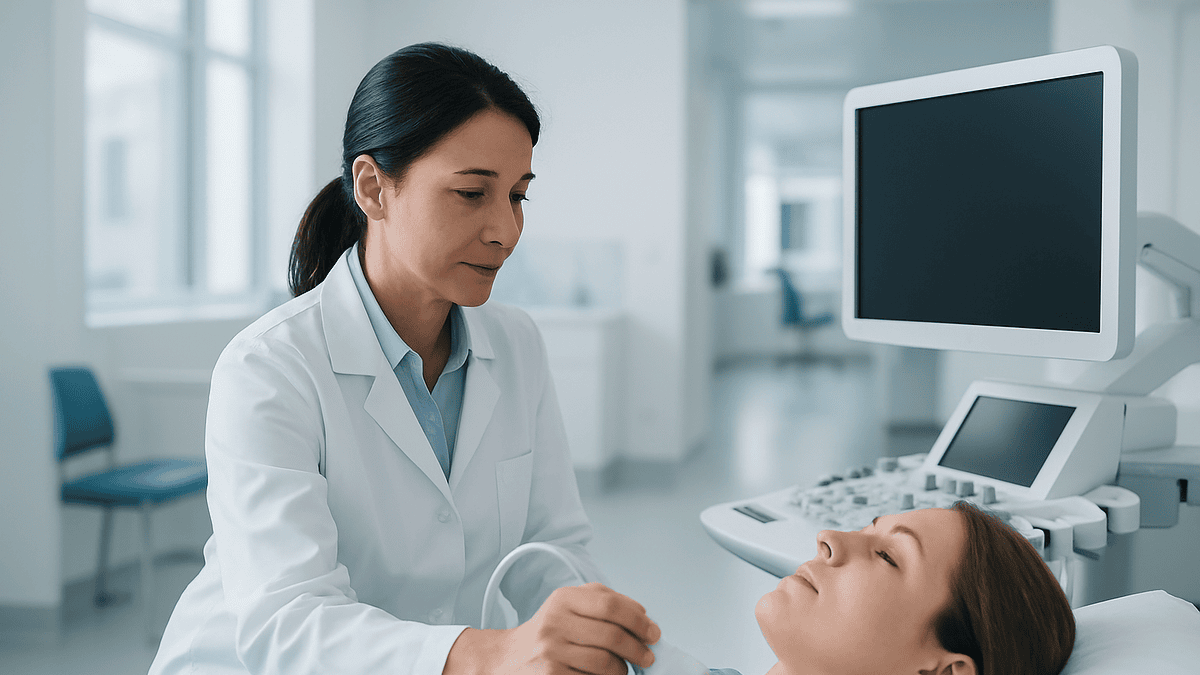
A thyroid biopsy, usually performed as fine-needle aspiration, uses a needle thinner than a standard blood-draw needle to sample cells from a thyroid nodule under ultrasound guidance. The outpatient procedure typically takes 20 to 30 minutes, needs no stitches, and carries a low complication risk. Most results come back benign; roughly 5 to 10 percent of biopsied nodules turn out to be cancerous.
It usually starts with something else entirely. A CT scan after a car accident. An ultrasound of the carotid arteries. A physical where a clinician’s fingers pause at your throat for one beat too long. Then the phrase arrives: incidental thyroid nodule, followed a few weeks later by a word that lands harder than it should, biopsy.
Here’s what that word tends to do: it turns a small, silent lump into two weeks of 2 a.m. searching. And most of what turns up online is either clinical boilerplate or vague reassurance, neither of which answers the questions people actually type, how bad does it hurt, what are the odds, what happens if it’s positive.
So this is the honest version. The needle, the numbers, the pathology report with its odd six-tier grading system, and the gray-zone results nobody warns you about. Spoiler worth stating up front: the waiting is almost always worse than the needle.
Why did I even need a thyroid biopsy? Nodules are astonishingly common
Run a high-resolution ultrasound over the necks of 100 adults and, by some estimates cited by the Mayo Clinic, you’ll find thyroid nodules in as many as 68 of them. Most of those people will never know. Nodules become more common with age, are found more often in women, and the overwhelming majority never cause a single symptom.
That’s the first honest point: being sent for a biopsy does not mean your doctor thinks you have cancer. It means a nodule crossed a threshold, usually a combination of size (often around one centimeter or larger) and how it looks on ultrasound. Radiologists grade nodules on features like solid composition, irregular margins, tiny calcifications, and a taller-than-wide shape, often using a scoring system called TI-RADS. A large, smooth, fluid-filled nodule may need no biopsy at all; a smaller one with suspicious features might.
The math favors you before the needle ever comes out. Fewer than one in ten thyroid nodules turns out to be malignant, and biopsy exists precisely because ultrasound alone can’t reliably sort the harmless majority from the small minority that needs attention. Fine-needle aspiration answers the question with actual cells instead of educated guessing, which, given the alternative used decades ago (surgery to remove the nodule just to find out what it was), represents genuine progress.
How serious is a thyroid biopsy? Less than the word 'biopsy' suggests
The word conjures operating rooms. The reality is closer to an elaborate blood draw. Fine-needle aspiration uses a needle in the 25-to-27-gauge range, thinner than the needle used to draw blood at a routine lab visit. There is no incision, no stitch, no general anesthesia, and no hospital stay. You walk in, you walk out, and most people drive themselves home.
According to Cleveland Clinic and MedlinePlus, complications are uncommon and usually minor. The most frequent are:
- Soreness or a bruised feeling at the site for a day or two
- A small amount of bleeding under the skin, which resolves on its own
- Brief lightheadedness during the procedure, more from nerves than needles
Serious problems, significant bleeding into the neck or infection, are rare, partly because the needle is so fine and partly because the whole thing happens under live ultrasound, so the operator can see exactly where the tip is at every moment. The thyroid sits just under the skin, which makes it one of the more accessible targets in the body.
One risk worth naming plainly, because it isn’t physical: the anxiety of the waiting period. Results commonly take several days to two weeks. Building that timeline into your expectations, and asking your care team exactly when and how results will arrive, does more for most people’s wellbeing than anything involving the needle itself.
What actually happens during fine-needle aspiration, step by step
Expect the appointment to run 20 to 30 minutes, with the needle involved for only a fraction of that. Here’s the typical sequence.
You lie on your back, often with a pillow under your shoulders so your neck arches gently backward: the least glamorous part for many people, since it feels oddly exposed. The skin is cleaned, and the clinician locates the nodule with an ultrasound probe. Most centers inject a small amount of numbing medicine under the skin first; some rely on the fineness of the needle alone.
Then come the passes. The needle enters the nodule for a few seconds, usually two to six separate passes in total, while the operator moves it slightly to gather cells. You’ll be asked not to swallow, talk, or cough during each pass, because the thyroid rides up and down with your larynx every time you swallow. Ten seconds of stillness at a time is genuinely all that’s asked.
In some clinics, a cytotechnologist checks the slides on the spot to confirm enough cells were captured; if not, another pass happens right then rather than at a repeat appointment. Afterward, a gauze pad and light pressure for a few minutes, a small bandage, and you’re done. No recovery room. Per MedlinePlus, most people return to normal activities the same day.
Does a thyroid biopsy hurt? An honest answer
Most people describe pressure more than pain. The initial numbing injection stings briefly, comparable to any small shot, and after that, the dominant sensation is a strange, firm pushing feeling in the throat rather than sharpness. Several studies and patient-reported experiences summarized by major medical centers put the discomfort in the same neighborhood as a blood draw, sometimes less.
What surprises people isn’t pain but the weirdness: feeling movement in a part of the neck you’ve never consciously felt before, plus the psychological effort of lying still with a needle near your throat. Naming that in advance helps. So does slow breathing through the nose between passes.
Afterward, plan on:
- A dull ache or bruised sensation at the site for one to two days
- Mild awareness when swallowing, occasionally a scratchy feeling
- A small bruise in some cases, which fades like any other
An ice pack in short intervals and an ordinary over-the-counter approach recommended by your own care team usually cover it, most people need nothing at all. Pain that worsens after the first day, visible swelling that grows, difficulty breathing or swallowing, or fever are not part of normal recovery and warrant a call, which we’ll cover in the warning-signs section below. But for the typical patient, tomorrow’s soreness is a footnote, forgotten by the weekend.
How to prepare, and what to tell your care team beforehand
Preparation is refreshingly minimal, but a few details matter more than the paperwork suggests.
Tell the scheduling team about every medicine and supplement you take, especially anything that affects bleeding or clotting, whether prescribed or bought off a shelf. Some centers ask patients to pause certain products for a few days beforehand; others proceed without changes because the needle is so fine. That call belongs to your clinician, not to a blog, which is exactly why full disclosure matters. Mention any bleeding disorders and any previous fainting episodes with needles, so the team can plan around them.
Practical points for the day itself:
- Eat normally unless told otherwise, fasting is usually not required for FNA
- Wear a top with an open neckline; you likely won’t need a gown
- Leave necklaces at home
- Most people can drive themselves home, since no sedation is involved
- Skip heavy lifting and strenuous workouts for the rest of the day, per common post-procedure guidance
One underrated preparation: write down two or three questions and ask them before the procedure starts, while everyone’s attention is on you. “How many passes do you expect?” “Will someone check sample adequacy today?” “When exactly will I get results, and who calls me?” That last question is the one people most regret not asking, because unanswered timelines are what turn a two-week wait into a two-week spiral.
Afterward: recovery, side effects, and what counts as normal
The recovery arc is short. Pressure and a bandage at the site, then home. Cleveland Clinic’s guidance and standard post-FNA instructions run roughly like this: keep the bandage on for a few hours, use a cold pack briefly if the area aches, and resume normal eating, talking, and light activity right away. Strenuous exercise waits until the next day at many centers.
Normal over the following 48 hours:
- Tenderness when you press on the spot or turn your head
- A faint bruise
- Mild awareness when swallowing
Not normal, and worth a same-day call to your care team:
- Swelling in the neck that is visibly growing
- Difficulty breathing or swallowing
- Bleeding that doesn’t stop with gentle pressure
- Fever, or spreading redness and warmth at the site
These complications are rare: the neck’s anatomy is well mapped, the ultrasound shows the needle in real time, and the puncture is smaller than most paper cuts, but rare is not zero, and knowing the short list beats vague reassurance.
Then comes the real recovery task: the wait. Cytology results typically arrive within a few days to two weeks, depending on the lab and whether additional testing is added. Ask whether results will come by portal, phone, or appointment. Seeing a pathology report land in a patient portal at 9 p.m. on a Friday, full of unfamiliar terms, is an experience worth planning around, which is what the next sections are for.
How pathologists read your cells: the Bethesda System explained
Your report will almost certainly use the Bethesda System for Reporting Thyroid Cytopathology: a standardized six-category framework that tells your doctor not just what the pathologist saw, but roughly how likely cancer is and what usually happens next. Understanding it transforms a cryptic report into an actual roadmap.
| Bethesda category | What it means in plain terms | Approximate cancer risk | Typical next step |
|---|---|---|---|
| I – Nondiagnostic | Not enough usable cells to judge | ~5–20% | Repeat biopsy, often after ~3 months |
| II – Benign | Cells look normal or show benign patterns | ~0–3% | Monitoring with ultrasound |
| III – Atypia of undetermined significance | Mildly unusual cells; genuinely unclear | ~10–30% | Repeat biopsy, molecular testing, or surveillance |
| IV – Follicular neoplasm | Growth pattern that cytology alone can’t classify | ~25–40% | Molecular testing or diagnostic surgery |
| V – Suspicious for malignancy | Features strongly suggest cancer | ~50–75% | Usually surgery |
| VI – Malignant | Cells diagnostic of cancer | ~97–99% | Treatment planning |
The risk figures are approximate ranges drawn from the published Bethesda framework, and individual labs report slightly different numbers. Two things deserve emphasis. First, a Bethesda II result is genuinely reassuring: the false-negative rate is low. Second, categories III and IV are not diagnoses of cancer; they are honest admissions that a needle sample of cells sometimes cannot answer the question alone. What happens in that gray zone is where modern thyroid care has changed most, as we’ll see shortly.
What percent of thyroid biopsies are cancerous?
The numbers are more comforting than the anxiety suggests. Across large series, roughly 60 to 70 percent of thyroid FNAs come back benign (Bethesda II). Only about 5 to 10 percent land in the malignant or suspicious-for-malignancy categories. The remainder split between nondiagnostic samples and the indeterminate gray zone.
It helps to see the funnel. Nodules are found in a huge share of adults, up to two-thirds on sensitive ultrasound. Most never meet criteria for biopsy at all. Of nodules that do get biopsied, already a preselected, more suspicious-looking group, the clear majority are still benign. And of the minority that prove malignant, the most common type by far is papillary thyroid cancer, which tends to grow slowly and, per NHS and U.S. cancer registry data, carries survival statistics among the most favorable of any cancer.
One honest caveat: those percentages describe populations, not individuals. If your nodule had high-risk ultrasound features, your pre-test odds were higher than average; if it was biopsied mainly because of size, they were lower. Your report doesn’t exist in a vacuum: the radiologist’s ultrasound assessment and the pathologist’s cytology reading are designed to be interpreted together, which is why the same Bethesda III result might prompt watchful waiting in one patient and molecular testing in another. If you want your personal probability rather than the textbook one, that’s a fair and answerable question to bring to your follow-up visit.
'Nondiagnostic' doesn't mean suspicious: it means try again
Few results generate more unnecessary dread than Bethesda I: nondiagnostic or unsatisfactory. Patients often read it as “they found something they couldn’t identify.” The truth is more mundane: the sample didn’t contain enough thyroid follicular cells for the pathologist to render any opinion at all.
This happens in a meaningful share of first biopsies, commonly cited figures run from around 5 to 15 percent, depending on the center and the nodule. The usual culprits:
- Cystic nodules. A needle aspirating a fluid-filled nodule pulls back mostly fluid and debris, not the cells needed for diagnosis.
- Bloody samples. The thyroid is richly supplied with blood vessels, and blood can dilute the cellular material on the slide.
- Tough or calcified tissue that yields few cells per pass.
The standard response is a repeat FNA, often scheduled about three months out: a delay that exists to let post-biopsy changes in the tissue settle, not because anyone is stalling. Repeat biopsies succeed in producing a diagnostic sample most of the time, especially when on-site adequacy checking is used the second time around.
Worth knowing: a nodule that repeatedly refuses to yield a diagnostic sample despite good technique isn’t automatically ignored. Depending on its ultrasound appearance and growth over time, your clinician may recommend continued imaging surveillance or, occasionally, surgical removal to settle the question. But the result itself carries no hidden message. It’s a logistics problem, not a verdict.
The gray zone: what an 'indeterminate' result really means
Somewhere between 15 and 30 percent of thyroid biopsies land in Bethesda III or IV: the indeterminate categories. This is the result nobody prepares you for, and arguably the one that most needs honest explanation, because it isn’t a soft way of saying “probably cancer.” It’s a structural limitation of the test itself.
Here’s the mechanism. Fine-needle aspiration collects loose cells, not an intact piece of tissue. For some thyroid tumors, follicular ones in particular, the difference between benign and malignant isn’t visible in individual cells at all. It depends on whether the growth has invaded its own capsule or nearby blood vessels, and that architecture simply cannot travel through a fine needle. The pathologist isn’t hedging; the information genuinely isn’t on the slide.
Historically, the default answer was diagnostic surgery: remove half the thyroid, examine the whole nodule, and find out. Since most indeterminate nodules ultimately proved benign, that meant a majority of those operations were, in hindsight, unnecessary, with real costs in recovery time, scarring, and sometimes lifelong thyroid hormone replacement.
Today the options are broader. Depending on your specific result, ultrasound features, and preferences, your clinician may suggest a repeat biopsy, molecular testing of the sample (next section), a period of structured ultrasound surveillance, or surgery. An indeterminate result is an invitation to a genuinely shared decision, one of the few places in medicine where “it depends” is the scientifically correct answer.
Molecular testing: how gray-zone nodules increasingly avoid surgery
The most meaningful advance in thyroid nodule care over the past decade isn’t a new needle: it’s what labs can now do with the cells the needle collects. Molecular tests analyze the genetic activity and mutations in an indeterminate sample to estimate, far more precisely than cytology alone, whether a Bethesda III or IV nodule is likely benign.
The logic is straightforward. Thyroid cancers tend to carry characteristic genetic alterations and gene-expression patterns. By profiling dozens to hundreds of these markers, modern classifiers can flag a gray-zone nodule as low risk with high confidence. NIH-supported research has shown that when these tests return a benign-pattern result, the chance of cancer drops low enough that many patients can safely choose ultrasound monitoring instead of diagnostic surgery.
The practical impact, as reported in studies indexed on PubMed, is substantial: at centers using molecular testing, a large fraction of diagnostic thyroid surgeries for indeterminate nodules, operations that would previously have been done just to obtain a diagnosis, are avoided.
Honest caveats apply. These tests are strongest at ruling out cancer; a suspicious molecular result raises the probability but doesn’t equal a diagnosis. Availability and insurance coverage vary. And the test can only run if enough material was collected, which is why some centers set aside a dedicated needle pass for it during the original biopsy. If your result comes back indeterminate, asking “Is molecular testing an option for my sample?” is one of the highest-value questions you can pose.
What if a thyroid biopsy is positive?
First, breathe. A malignant result (Bethesda VI) or suspicious result (Bethesda V) starts a planning process, not an emergency. Thyroid cancer is, in the large majority of cases, a slow-moving disease, and the days or weeks spent staging and deciding do not squander your outcome.
What typically happens next:
- More detailed imaging, usually a comprehensive neck ultrasound to map the thyroid and check nearby lymph nodes, since that changes the surgical plan.
- A conversation about the specific type. Papillary thyroid cancer accounts for the large majority of cases and behaves very differently from rarer, more aggressive types: the name on your report matters enormously.
- Treatment planning, most often surgery to remove part or all of the thyroid, with additional therapies considered case by case.
- For selected very small, low-risk papillary cancers, some specialists now discuss active surveillance, structured monitoring instead of immediate surgery, an approach supported by ongoing research.
On outlook, the honest framing is statistical, not promissory: U.S. registry data show five-year relative survival for localized thyroid cancer approaching 100 percent, and the NHS describes most thyroid cancers as highly treatable. Those are population figures, and your own clinicians will place your case within them.
Two practical suggestions. Ask whether your surgeon performs thyroid operations regularly, experience volume is a legitimate, evidence-supported question. And bring someone to the results appointment; a second set of ears catches what adrenaline erases.
What is the red flag for thyroid cancer? (There isn't just one)
People search for the red flag, singular. The evidence doesn’t cooperate, most thyroid cancers cause no symptoms at all in their early stages, which is exactly why so many are found incidentally on scans done for other reasons. What exists instead is a cluster of features that, especially in combination, raise concern and deserve prompt evaluation:
- A nodule that grows quickly over weeks to months, rather than the indolent stability typical of benign nodules
- Persistent hoarseness or voice change without another explanation, which can signal pressure on the nerve controlling the vocal cords
- A lump that feels hard and fixedanchored in place rather than moving when you swallow
- Swollen lymph nodes in the neck that persist
- Difficulty swallowing or breathing related to pressure in the neck
Background risk factors shift the odds too: radiation exposure to the head or neck in childhood, a family history of thyroid cancer or certain inherited syndromes, and age under 30 or over 60 at nodule discovery all factor into how aggressively clinicians investigate, per Mayo Clinic guidance.
Equally important is what is not a red flag. A nodule that has sat unchanged for years, a soft and mobile lump, or ordinary fatigue on its own, none of these carries the same weight. And feeling fine proves nothing in either direction, which is why the ultrasound-plus-biopsy pathway exists: it replaces symptom-based guessing with cell-level evidence.
When to see a doctor
Two separate situations call for medical attention here, before any biopsy, and after one.
See a doctor promptly if you notice, on your own:
- A new lump or swelling in the front of your neck, even if painless, most are benign, but they warrant evaluation
- Hoarseness or a voice change lasting more than three weeks, a threshold the NHS specifically flags
- Growing difficulty swallowing or breathing
- Persistent swollen glands in the neck
- A known nodule that seems to be enlarging
After a thyroid biopsy, contact your care team the same day if you develop:
- Neck swelling that is visibly increasing
- Trouble breathing or swallowing
- Bleeding that continued pressure doesn’t stop
- Fever, or spreading redness and warmth at the puncture site
Difficulty breathing from rapid neck swelling, though rare, is an emergency, seek immediate care rather than waiting for a callback.
There’s a quieter third scenario worth naming: results limbo. If two weeks have passed and no one has contacted you, call. Reports occasionally sit unread in queues, and no news is not reliable news. Likewise, if you received a result through a patient portal that you don’t understand, you’re entitled to an explanation in plain language: a follow-up visit or phone consultation to walk through the Bethesda category, the recommended next step, and the reasoning behind it. That conversation is part of the test, not an optional extra.
Questions worth asking at your results appointment
The results conversation moves fast, and the vocabulary is unfamiliar. Walking in with specific questions changes it from a lecture into a dialogue. Consider bringing these, adapted to your result:
- “Which Bethesda category is my result, and what cancer risk does that carry at this lab?” Local numbers can differ from textbook ranges, and good labs know their own.
- “How do my ultrasound findings and my cytology fit together?” The two are meant to be read as a pair; a mismatch between them sometimes changes the plan.
- “If this is indeterminate, is molecular testing possible on my existing sample, or would I need another biopsy?”
- “If we choose monitoring, what exactly does surveillance look like, how often, what scan, and what change would trigger action?” Vague “we’ll keep an eye on it” plans breed anxiety; concrete intervals dissolve it.
- “If surgery is recommended, how much of the thyroid, and what would that mean for hormone replacement afterward?”
- “What would make you re-biopsy a benign result?” Even Bethesda II nodules get rechecked if they grow substantially or change on ultrasound.
And one meta-question that patients rarely ask but clinicians respect: “If this were your neck, what would you do, and why?” You may or may not follow the answer, but the reasoning it surfaces is often the most useful thing said in the room. Take notes, or ask permission to record the conversation. Memory under stress is a poor stenographer.
Frequently asked questions
How serious is a thyroid biopsy?
It is a minor outpatient procedure, not surgery. Fine-needle aspiration uses a needle thinner than a blood-draw needle, requires no stitches or sedation, and takes about 20 to 30 minutes. The most common side effects are a day or two of soreness and a small bruise. Serious complications such as significant bleeding or infection are rare, and most people drive themselves home and resume normal activities the same day.
What percent of thyroid biopsies are cancerous?
Roughly 5 to 10 percent of biopsied thyroid nodules turn out to be malignant or suspicious for malignancy. About 60 to 70 percent of results are clearly benign, with the remainder falling into nondiagnostic or indeterminate categories that require follow-up. Because nodules chosen for biopsy are already a preselected, more suspicious-looking group, the cancer rate among all thyroid nodules in the general population is even lower.
What if a thyroid biopsy is positive?
A positive result starts a planning process, not an emergency. Next steps typically include detailed neck ultrasound to map lymph nodes, identifying the specific cancer type, and discussing treatment, most often surgery, with active surveillance considered for some very small, low-risk papillary cancers. The most common type, papillary thyroid cancer, is slow-growing, and U.S. registry data show five-year relative survival for localized thyroid cancer approaching 100 percent.
What is the red flag for thyroid cancer?
There is no single red flag, most early thyroid cancers cause no symptoms. The concerning cluster is a nodule that grows rapidly, persistent hoarseness or voice change, a lump that feels hard and fixed rather than mobile, swollen neck lymph nodes, and difficulty swallowing or breathing. Childhood radiation exposure to the neck and a family history of thyroid cancer also raise concern. Any of these warrants prompt medical evaluation.
How painful is a thyroid biopsy?
Most people describe pressure rather than pain, comparable to or milder than a blood draw. A brief sting from the numbing injection is typically the sharpest moment. During the passes, the main sensation is an odd pushing feeling in the throat while you hold still and avoid swallowing. Afterward, expect a bruised, achy feeling at the site for one to two days, usually managed with a cold pack or nothing at all.
How long do thyroid biopsy results take?
Most cytology results arrive within a few days to two weeks, depending on the laboratory. If molecular testing is added to an indeterminate sample, that analysis can take an additional one to several weeks. Ask before you leave the appointment exactly when results are expected and whether they will come by phone, portal, or follow-up visit, and call your care team if the promised window passes without word.
Can a thyroid biopsy be wrong?
It can, though clearly benign results are highly reliable, with false-negative rates generally reported in the low single digits. The bigger limitation is the indeterminate zone: 15 to 30 percent of samples cannot be classified from cells alone, because some tumors are defined by architecture a needle cannot capture. That’s why benign nodules are still monitored with periodic ultrasound and re-biopsied if they grow or change significantly.
Do I need to fast or stop medications before a thyroid biopsy?
Fasting is usually not required, and most people eat normally beforehand. Medication instructions vary: tell your care team about everything you take, especially anything affecting bleeding or clotting, including over-the-counter products and supplements. Some centers pause certain products for a few days; others proceed without changes because the needle is so fine. Follow your own clinician’s instructions rather than a general rule, and wear a top with an open neckline.
What does an indeterminate thyroid biopsy result mean?
It means the cells looked mildly abnormal but not clearly benign or malignant: a known limitation of sampling loose cells, since some tumors can only be classified by their overall architecture. Cancer risk in these Bethesda III and IV categories runs roughly 10 to 40 percent. Options include repeating the biopsy, molecular testing of the sample to refine the risk, structured ultrasound surveillance, or diagnostic surgery, decided together with your clinician.
Will I need my thyroid biopsy repeated?
Possibly. A repeat is standard after a nondiagnostic sample, usually scheduled about three months later, and is one option after an indeterminate result. Even a benign result can lead to re-biopsy years later if the nodule grows substantially or develops suspicious ultrasound features. Repeat FNAs succeed at producing a diagnostic answer most of the time, especially when the lab checks sample adequacy on-site during the procedure.
References
This article is for general information only and is not a substitute for professional medical advice. Please consult a qualified doctor about your individual situation.

More from the Blog

Low Platelets: The Common Causes and How Low Is Dangerous
A low platelet count (thrombocytopenia) means your blood has fewer than about 150,000 platelets per microliter, the cells that plug small leaks in blood…

How Long Biopsy Results Take (and Why Bad Results Are Not Faster)
Most biopsy results are ready within a few days to about two weeks, depending on the tissue type and the tests required. Routine skin…

Ferritin Levels: The Iron-Storage Number Behind Unexplained Fatigue
Ferritin is a blood protein that stores iron, and a ferritin test estimates the body's iron reserves. Many labs consider roughly 24–336 ng/mL normal…

How to Read a Blood Test: A Guided Tour of Your Results
To read a blood test, start with the reference range printed beside each result, which shows the values found in roughly 95 percent of…

How Long to Fast Before Blood Work, and What Breaks a Fast
Most blood tests that require fasting call for 8 to 12 hours without food or calorie-containing drinks; plain water is fine and usually encouraged.…
Thyroid Antibody Tests: TPO, Thyroglobulin and What Positivity Means to Discuss
Positive thyroid antibodies, most often against thyroid peroxidase (TPO) or thyroglobulin, mean the immune system is reacting to thyroid tissue. That raises the likelihood…