

Tirzepatide for Sleep Apnea: What the Approval Covers and Who Still Needs CPAP
Key Takeaways
- The FDA approved Zepbound (tirzepatide) for moderate-to-severe obstructive sleep apnea on December 20, 2024, but only in adults who also have obesity by BMI.
- In two 52-week randomized trials, tirzepatide reduced the apnea-hypopnea index by about 25 to 29 events per hour compared with roughly 5 on placebo, tracking weight loss of 18 to 20 percent.
- About 43 to 52 percent of trial participants reached remission or mild, non-symptomatic OSA, which means roughly half still had clinically significant apnea after a year.
- Participants in the second trial kept using CPAP throughout, so no trial has shown that the medicine can safely replace the machine.
- Ozempic and Wegovy (semaglutide) are not approved for sleep apnea and have not been tested in a dedicated OSA trial; any such use is off-label and a clinician's decision.
- Because the benefit rides on weight, apnea is expected to return if the medicine is stopped and weight regained, making this an ongoing treatment rather than a course.
Zepbound (tirzepatide) is FDA-approved to treat moderate-to-severe obstructive sleep apnea in adults who also have obesity, alongside a reduced-calorie diet and more physical activity. In two 52-week randomized trials it cut breathing interruptions by roughly 25 to 29 events per hour, mainly through weight loss. It is not approved for people without obesity, and it does not automatically replace CPAP; that decision belongs to the treating clinician.
The first sign, for many people, is a spouse who has quietly moved to the guest room. The second is a sleep study report full of numbers nobody explained. And then, sometime in the past several months, a third thing arrived: a friend saying, over coffee, that a weight-loss shot now treats sleep apnea and maybe you can throw out the CPAP machine.
That conversation is why zepbound sleep apnea has become one of the most-searched sleep phrases in the country. On December 20, 2024, the FDA approved Zepbound (tirzepatide) for moderate-to-severe obstructive sleep apnea in adults with obesity, the first medicine ever cleared for the condition. As of spring 2025, insurers, sleep clinics, and a great many bedrooms are still working out what that means in practice.
The honest answer sits somewhere between the headline and the friend at coffee. The approval is real and the trial data are strong. The part about the machine is where the story gets more careful, and more interesting.
What changed recently: the December 2024 approval, explained
For decades, the treatment menu for obstructive sleep apnea, or OSA, the condition in which the throat repeatedly collapses during sleep and briefly cuts off airflow, had no pills or injections on it at all. Machines, mouthpieces, surgery, positional tricks, weight loss advice. Then, in late December 2024, the FDA added a medicine.
The specific action: Zepbound, the brand of tirzepatide sold for chronic weight management, received a second indication for moderate-to-severe OSA in adults who have obesity, to be used together with a reduced-calorie diet and increased physical activity. The wording matters. Both conditions must be present. The label does not cover people with OSA at a lower body weight, and it does not cover mild OSA.
The approval rested on two phase 3 trials published together in the New England Journal of Medicine in June 2024 under the name SURMOUNT-OSA. One enrolled people who were not using positive airway pressure, the family of machines that includes CPAP; the other enrolled people who were already using it and continued to do so. Between them, 469 adults took part for one year.
Two other developments explain the search spike. In the same month as the approval, the FDA reaffirmed that the national shortage of tirzepatide had ended, which changed the legal footing of compounded copies. And because OSA is a diagnosed medical condition rather than weight itself, the new indication reopened coverage conversations that had been closed for years in many health plans.
What has not changed is the underlying anatomy of OSA, the diagnostic pathway through a sleep study, or the role of positive airway pressure as the most established therapy. A medicine joined the list. It did not erase it.
What exactly did the FDA approve tirzepatide for?
Read the approval like a lawyer for a moment, because the boundaries are the whole point.

Approved: adults with moderate-to-severe obstructive sleep apnea who also have obesity. Severity is measured by the apnea-hypopnea index, or AHI, which is simply the number of times per hour of sleep that breathing fully stops (apnea) or becomes dangerously shallow (hypopnea). By convention, 5 to 14 events an hour is mild, 15 to 29 is moderate, and 30 or more is severe. The trials enrolled people averaging around 50 events an hour, which is deeply severe territory.
Obesity, in the trial and label sense, is defined by body mass index, or BMI, a height-to-weight ratio in which 30 or above counts as obesity. Trial participants averaged a BMI near 39.
Not approved: OSA without obesity, mild OSA, central sleep apnea (a different disorder in which the brain fails to send the signal to breathe), children, and use during pregnancy. Also not part of the approval: any statement that the medicine replaces CPAP. The second trial specifically kept people on their machines.
The distinction between a weight-loss indication and a sleep apnea indication may sound bureaucratic, but it shapes real decisions. A clinician prescribing for OSA is expected to have a documented diagnosis, usually from an overnight sleep study called polysomnography or a validated home sleep test. Prescribing for OSA also means the sleep condition, not the scale, becomes the outcome being followed over time, which is a healthier way to frame the goal.
One more boundary: Zepbound and Mounjaro contain the same molecule, tirzepatide, but Mounjaro is approved for type 2 diabetes, not OSA. Same drug, different label, different conversation with the prescriber.
How does a weight-loss medicine treat obstructive sleep apnea?
Picture the upper airway as a soft-walled tube held open by muscle tone while you are awake. Fall asleep and that tone slackens. If the tube is already narrowed by fat deposits in the tongue, the side walls of the throat, and the neck, or squeezed from below by abdominal weight that reduces lung volume, it collapses. Oxygen drops, the brain jolts you partly awake, muscles fire, the airway reopens, and the cycle restarts, sometimes 50 times an hour.
Tirzepatide does not touch the airway directly. It mimics two gut hormones, GLP-1 and GIP, which are released after eating and signal fullness to the brain while slowing stomach emptying. People eat less, and body fat falls, including the fat that matters most here. Imaging studies of weight loss in general have shown shrinking tongue fat tracks closely with falling AHI, which is why sleep physicians have long recommended weight reduction. The medicine simply makes substantial, sustained weight loss achievable for far more people than diet alone.
Is weight the whole story? Mostly, yes, and that is a strength rather than a weakness of the evidence. In SURMOUNT-OSA, participants lost roughly 18 to 20 percent of body weight over a year, and the AHI improvement was proportionate. Researchers have speculated about additional effects, such as reduced inflammation or changes in fluid balance around the neck, but those remain hypotheses rather than demonstrated mechanisms.
The corollary is important for anyone weighing the treatment. Because the benefit rides on weight, it is expected to persist only as long as the weight loss persists. Older observational research found that gaining about 10 percent of body weight raised AHI by roughly a third. The airway does not remember that it was once clear.
What the evidence actually says: grading the SURMOUNT-OSA trials
Not all medical evidence is created equal, so it helps to place these trials on the ladder. At the top sit randomized controlled trials, in which participants are assigned by chance to a treatment or a placebo, so that differences at the end can be attributed to the medicine. Below that sit observational studies, which watch what happens to people who chose a treatment themselves, and expert opinion sits lower still.
SURMOUNT-OSA belongs to the top rung. Two separate, double-blind, placebo-controlled trials, meaning neither participants nor investigators knew who received the active drug, each ran for 52 weeks and used sleep-lab measurement of AHI as the primary outcome rather than a symptom questionnaire. Results were consistent across both, which strengthens confidence considerably.
The headline findings: in the trial without positive airway pressure, AHI fell by about 25 events per hour with tirzepatide versus about 5 with placebo. In the trial where everyone used their machines, the drop was about 29 versus about 5. Roughly 43 percent of participants in the first trial and 52 percent in the second reached the study’s definition of remission or mild, non-symptomatic OSA, compared with about 14 percent on placebo. Blood pressure and a marker of inflammation also improved.
Now the honest caveats. One year is long for a drug trial and short for a lifelong condition; we do not yet know what happens over five or ten years, or after stopping. The trials measured breathing events, not heart attacks, strokes, or car crashes, which are the outcomes patients ultimately care about. Participants were heavier and had more severe apnea than many people now asking about the medicine, so results may not transfer neatly to someone with moderate OSA and a BMI of 31. And the trials were funded by the manufacturer, which is standard for approval studies but worth knowing.
Verdict: high-quality, short-to-medium-term evidence that tirzepatide substantially reduces apnea severity in adults with obesity. Strong for what it measured. Silent on what it did not.
Zepbound sleep apnea results by the numbers
Numbers from a trial can feel abstract until they are lined up side by side. The table below summarizes what the two SURMOUNT-OSA trials reported after 52 weeks, rounded for readability. Values are averages across participants; individual results varied widely.
| Measure at 52 weeks | Trial 1 (no CPAP) | Trial 2 (using CPAP) |
|---|---|---|
| Participants | 234 | 235 |
| Starting AHI (events/hour) | About 51 | About 50 |
| AHI change, tirzepatide | About -25 | About -29 |
| AHI change, placebo | About -5 | About -6 |
| Body weight change, tirzepatide | About -18% | About -20% |
| Body weight change, placebo | About -2% | About -2% |
| Reached remission or mild, non-symptomatic OSA | About 43% vs 14% placebo | About 52% vs 14% placebo |
A few readings of that table. First, the placebo groups improved a little too, partly because everyone received diet and activity counseling and partly because AHI naturally wobbles from night to night. The gap between the columns, not the raw drop, is the drug effect.
Second, the machine did not cancel out the medicine. People already on CPAP still saw a large fall in their untreated AHI, measured on a study night without the device. That tells you the airway itself became more stable, which is exactly what you would want before any conversation about reducing reliance on a machine.
Third, look at what remission does not mean. Roughly half of participants did not reach that threshold. Starting at 50 events an hour and dropping by 25 leaves a person at 25, which is still moderate OSA and still, by every guideline, a reason for treatment. A big improvement and a residual problem can coexist in the same patient, and in these trials they often did.
How long does Zepbound take to work for sleep apnea?
Slower than the internet suggests, and for a reason that is built into the drug itself.
Tirzepatide is started at a low level and stepped up gradually by the prescriber over a period of months to limit stomach upset. Weight loss follows that curve rather than racing ahead of it. In the weight-management trials that preceded the OSA studies, most of the total loss accrued over the first nine months to a year, with the steepest part in the middle of that window. Since the apnea benefit depends on the weight coming off, the breathing improvement follows the same slow arc.
SURMOUNT-OSA measured AHI at 20 weeks and 52 weeks. Meaningful improvement was already visible at the earlier check, but the full effect reported in the headlines is the one-year figure. Anyone expecting a quieter bedroom within a fortnight will be disappointed, and, more importantly, anyone who eases off their CPAP in month two because the shot has started is acting well ahead of the evidence.
What might someone notice first? Often the changes are indirect. Less snoring reported by a partner. Fewer trips to the bathroom at night, since untreated apnea drives nighttime urination. A little less morning headache or daytime fog. These are encouraging but subjective, and the only reliable way to know how much the airway has actually improved is a repeat sleep study, which sleep specialists typically consider after substantial weight change has stabilized.
Timelines also vary by person. Someone who loses 25 percent of body weight may see a near-normal AHI; someone who loses 8 percent may see a modest shift. Age, sex, neck anatomy, and how much of the apnea was driven by weight in the first place all shape the response. The medicine sets the stage; the individual body writes the script.
Who still needs CPAP after starting tirzepatide?
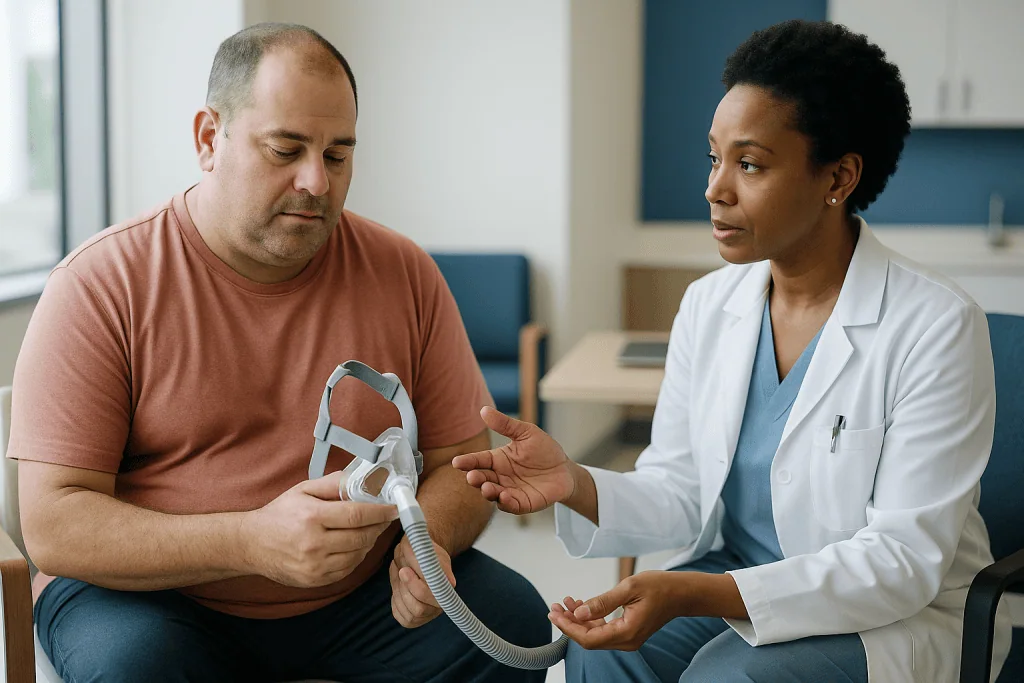
Here is the sentence most coverage skips: every participant in the second SURMOUNT-OSA trial kept using positive airway pressure for the entire year. The trial was never designed to test whether the medicine could replace the machine, and no trial has yet done so.
CPAP, continuous positive airway pressure, works by blowing a gentle stream of air through a mask to hold the throat open like a pneumatic splint. Its effect is immediate and almost total on the nights it is worn. Its weakness has always been adherence; many people abandon it within a year. A medicine that improves the airway itself is attractive precisely because it works on the nights the mask stays in the drawer. That does not make the two interchangeable.
Who is likely to keep needing CPAP, at least for now?
- Anyone whose repeat sleep study still shows moderate or severe OSA after weight loss has plateaued, which in the trials was roughly half of participants.
- People with heart failure, atrial fibrillation, pulmonary hypertension, or a history of stroke, where untreated apnea carries the highest stakes and specialists tend to be conservative.
- Commercial drivers and others in safety-sensitive jobs, where documented, verified treatment often matters legally as well as medically.
- People whose apnea has a strong anatomical component, such as a recessed jaw, large tonsils, or nasal obstruction, that weight loss cannot fix.
- Anyone in the first months of therapy, before weight change is substantial and before it has been re-measured.
The reasonable middle path, and the one sleep physicians increasingly describe, is treating the medicine as a way to make CPAP less necessary over time rather than unnecessary overnight. Some people will eventually qualify to try lower pressure settings or stop; some will find a mouthpiece suffices; some will stay on the machine and simply breathe better on the nights they forget it. Any change to CPAP use is a decision for the prescribing clinician, ideally after objective testing, not a personal experiment.
What happens to sleep apnea if you stop tirzepatide?
Nobody has yet run a study that withdraws tirzepatide from people with OSA and re-measures their breathing, so the direct answer is that we do not know with certainty. The indirect evidence, though, points in one direction.
When tirzepatide was stopped in a weight-management trial extension, participants regained a large share of the weight they had lost over the following year. The appetite signals the drug had been quieting return to their baseline; the body’s set point had not moved. Given that the apnea benefit in SURMOUNT-OSA tracked weight so tightly, it is reasonable to expect AHI to climb back as weight returns. The airway is a mechanical structure, and mechanics do not hold a grudge or a memory.
This is not a criticism of the medicine so much as a description of the condition. OSA in the setting of obesity behaves like high blood pressure: manageable, often dramatically, but chronic. Both the FDA label and the trial design treat tirzepatide as ongoing therapy rather than a course.
Why might someone stop? Side effects that do not settle, a planned pregnancy, a change in insurance, surgery that requires pausing, or simply a preference to try maintaining weight through other means. Each is legitimate. What matters is that stopping is planned with the prescriber rather than done quietly, and that sleep apnea follow-up is built into the plan. Someone who has stepped down from CPAP on the strength of the medicine should expect that decision to be revisited if the medicine is withdrawn.
A practical note that often surprises people: gastrointestinal side effects sometimes flare when a dose changes, and a rough week is not, by itself, a reason to stop. Report it, do not self-adjust, and let the clinician decide whether to hold, slow down, or continue. Never change or stop a prescribed medicine on your own.
Ozempic for sleep apnea: is semaglutide approved too?
No. As of spring 2025, tirzepatide is the only medicine with an FDA indication for obstructive sleep apnea. Ozempic and Wegovy, both brands of semaglutide, share the GLP-1 mechanism but not the label. Ozempic is approved for type 2 diabetes and cardiovascular risk reduction in that population; Wegovy is approved for weight management and for reducing cardiovascular events in adults with obesity and heart disease. Neither has been studied in a dedicated OSA trial of the kind that led to the tirzepatide approval.
That gap is why the phrase ozempic sleep apnea keeps appearing in search: people already taking semaglutide wonder whether their breathing will improve, and people who cannot access tirzepatide wonder whether the older drug will do.
What can honestly be said. Semaglutide produces substantial weight loss, typically somewhat less than tirzepatide in head-to-head comparison, and weight loss by any means tends to lower AHI. Observational reports and small analyses have described improved apnea measures in people taking GLP-1 medicines generally. That is plausible, consistent with mechanism, and a rung or two below randomized-trial evidence. It would be surprising if semaglutide had no effect on apnea; it is unproven exactly how much, in whom, and whether it matches the tirzepatide results.
Using semaglutide with the specific goal of treating OSA would be off-label, meaning outside the approved indication. Off-label prescribing is legal and common, but it shifts the weight of the decision onto the clinician’s judgment rather than a regulator’s review. If you already take semaglutide for diabetes or weight and also have OSA, the useful conversation is about monitoring: when to repeat a sleep study, what symptoms to track, and whether current apnea treatment should change. Whether to prescribe either medicine for apnea, and which one, belongs to the treating clinician who knows your full history.
What are the side effects of tirzepatide when used for sleep apnea?
The side-effect profile does not change because the reason for the prescription did. The same molecule, at the same strengths, was studied in SURMOUNT-OSA as in the weight trials, and the findings lined up.
Most common by far are digestive: nausea, diarrhea, constipation, vomiting, indigestion, and abdominal discomfort. In the OSA trials these affected a meaningful minority of participants, were usually mild to moderate, clustered around dose increases, and tended to fade. They are the price of a slowed stomach and reduced appetite, which is also how the drug works. Hair thinning, fatigue, and injection-site reactions were reported less often.
Less common but more serious concerns appear on the label and deserve plain description. Pancreatitis, inflammation of the pancreas, presents as severe, persistent abdominal pain that may spread to the back. Gallbladder disease, including gallstones, becomes more likely with rapid weight loss from any cause. Kidney injury has occurred, usually when vomiting or diarrhea led to dehydration. Blood sugar can drop too low when tirzepatide is combined with insulin or certain diabetes pills, an interaction the prescriber manages. Slowed stomach emptying has raised concern about food remaining in the stomach during anesthesia, so surgical teams now ask about these medicines before procedures.
Tirzepatide carries a boxed warning, the FDA’s strongest, about thyroid C-cell tumors seen in rodent studies. Whether this applies to humans is unknown; as a precaution, people with a personal or family history of medullary thyroid cancer or a rare inherited syndrome called MEN 2 should not take it. Depression and suicidal thoughts are monitored with all weight-management medicines, though a clear causal link has not been established.
One OSA-specific consideration: sleepiness and mood should be tracked as apnea improves, because better sleep can change how other medicines feel, and a prescriber may want to reassess sedatives or stimulants. Report what you notice; adjusting is their job.
Common myths about Zepbound and sleep apnea
Viral claims travel faster than trial reports. Five of the most common, corrected.
Myth: Zepbound makes sleep apnea worse. There is no signal for this in the randomized data; both trials showed large improvements against placebo. The confusion likely stems from two sources. Some people feel more tired during the first weeks of treatment because of nausea and reduced intake, and tiredness gets blamed on apnea. Others report vivid dreams or fragmented sleep during dose changes. Neither is the same as more breathing interruptions, which only a sleep study can measure.
Myth: The approval means you can stop CPAP. The approval says nothing of the kind, and the trial kept participants on their machines. Roughly half did not reach remission.
Myth: It cures sleep apnea. The trials measured one year, and the benefit is expected to reverse if weight returns. Chronic condition, ongoing treatment.
Myth: Ozempic does the same thing. Semaglutide plausibly helps through weight loss, but it has not been tested in an OSA trial and holds no approval for it.
Myth: It works for anyone who snores. The indication requires moderate-to-severe OSA confirmed by testing plus obesity by BMI. Snoring alone is not apnea, mild apnea is not covered, and apnea in a person of normal weight was not studied. Central sleep apnea is a different condition altogether.
Myth: Weight loss from the drug is somehow different from other weight loss. The airway does not know how the weight came off. What is different is the magnitude and durability most people can reach, which is why the trial results outpace what diet-only studies have shown. Bariatric surgery produces comparable or larger apnea improvements through the same route.
A pattern runs through all six: the claim takes a true finding and stretches it past the edge of what was measured. Staying inside the data is less exciting and more useful.
Will insurance cover Zepbound for sleep apnea?
Coverage is the question underneath most of the others, and it does not have a single answer. It has a set of moving parts.
Historically, many US health plans, including Medicare’s prescription benefit, excluded medicines prescribed for weight loss as a category, regardless of how strong the medical case. That exclusion is why the OSA indication drew so much attention: a medicine prescribed for a diagnosed sleep disorder is not, on its face, a weight-loss prescription. Following the December 2024 approval, some plans began treating tirzepatide for OSA as a covered medical therapy where they had not covered it for weight, subject to their own criteria.
Those criteria commonly include documentation of moderate-to-severe OSA from a sleep study, a BMI in the obesity range, evidence of participation in lifestyle measures, and sometimes prior use of or intolerance to CPAP. Prior authorization, a process in which the prescriber submits records for the plan to review before approving, is typical. Step therapy, requiring another treatment first, appears in some plans.
Coverage also differs by plan type. Employer plans set their own formularies. State Medicaid programs vary. Medicare drug plans have had specific rules that are still evolving in response to new indications, and what is true one calendar year may not be the next.
The practical path runs through two offices. The prescribing clinician’s team knows what documentation plans in your area typically request. Your plan’s member services line can tell you whether the medicine is on the formulary for the OSA indication and what the authorization requires. Asking both, before the first appointment, saves weeks.
What this article will not do is quote figures or point to sources of supply. Costs shift by plan, region, and month, and any number printed here would be wrong for most readers by the time they finished the sentence. The coverage decision, like the clinical one, is individual.
Who is not a candidate for tirzepatide sleep apnea treatment?
The approval draws a fairly tight circle, and a good number of people with sleep apnea fall outside it.
People with OSA at a normal or overweight-but-not-obese BMI were not enrolled in the trials and are not covered by the label. This is not a small group. Sleep clinics regularly see lean patients whose apnea comes from a narrow jaw, a large tongue relative to the mouth, enlarged tonsils, nasal blockage, or age-related loss of throat muscle tone. Weight loss cannot fix an airway that was never crowded by fat, and there is no evidence that tirzepatide would help them breathe.
People with central sleep apnea, in which the problem is the brain’s breathing drive rather than a collapsing throat, have a different disorder with different treatments, often related to heart failure or certain medicines. A sleep study distinguishes the two.
Pregnancy is a contraindication; the medicine should be stopped before trying to conceive, on a timeline the prescriber sets. Personal or family history of medullary thyroid cancer or MEN 2 rules it out. A history of pancreatitis, severe gastrointestinal disease such as gastroparesis, or significant kidney impairment calls for individual judgment, and some clinicians will decline. People with a history of eating disorders need careful assessment, since appetite suppression can interact badly with restrictive patterns.
Children and adolescents were not studied for OSA. Pediatric sleep apnea is usually driven by tonsils and adenoids and is treated very differently.
Then there is a softer category: people for whom the medicine is technically permitted but not obviously wise. Someone with mild OSA controlled by a mouthpiece who wants a shot mainly to avoid the device. Someone unwilling to continue any monitoring. Someone who expects to take it for a few months and stop. In each case a frank conversation with the sleep physician or prescriber about goals, and about what the evidence does and does not promise, tends to be more valuable than the prescription itself.
Compounded tirzepatide and sleep apnea: what is the regulatory status?
Some of the current search traffic comes from people who have encountered tirzepatide in forms other than the approved product. It is worth being exact about what those are.
Compounded medicines are prepared by mixing or altering ingredients for an individual patient, typically when a commercial product is unavailable or unsuitable. During the tirzepatide shortage that ran through 2023 and much of 2024, federal rules allowed compounded versions to fill the gap. In October 2024 the FDA determined the shortage had resolved, and in December 2024, the same month as the OSA approval, it confirmed that finding after review. With the shortage over, the allowance that permitted routine compounded copies narrowed sharply.
Compounded tirzepatide has never been FDA-approved. It is not reviewed for safety, effectiveness, or manufacturing quality the way the approved product is, and the agency has reported adverse events and dosing errors associated with compounded GLP-1-class products. The SURMOUNT-OSA trials used the approved medicine exclusively; none of their findings can be assumed to apply to a compounded version.
Products sold online as research peptides, sometimes labeled not for human use, sit even further outside the system. They are unapproved, unregulated for human administration, and not for self-use under any circumstances. This magazine will not describe how or where they are obtained, and anyone currently using such a product should tell their clinician so that care can be planned around it.
The straightforward position: the approval for sleep apnea applies to the approved product, prescribed by a licensed clinician, after diagnosis. Anything else is a different substance with a different, and largely unknown, risk profile.
If access is the barrier, the more productive conversation is about coverage criteria and about the non-drug treatments that remain fully available, several of which have decades of evidence behind them.
What else helps sleep apnea alongside a GLP-1 medicine?
Even the strongest trial in this field left half its participants with residual apnea. The rest of the toolkit has not gone anywhere.
Positional therapy. Many people’s apnea is worse on the back, when gravity pulls the tongue rearward. Side sleeping, sometimes trained with a small wearable that vibrates when you roll, cuts AHI meaningfully in position-dependent OSA. Evidence is moderate and the intervention is nearly free of harm.
Which brings up mattresses. The question is asked constantly and the honest answer is that no mattress treats sleep apnea. There is no trial showing a firmness, material, or brand changes AHI. What has modest supporting evidence is head-of-bed elevation, a slight incline of the upper body, which can reduce airway collapse in some people. An adjustable base achieves this; a wedge under the mattress does too. Comfort that keeps you asleep on your side matters more than the marketing.
Oral appliances. A dentist-fitted device holds the lower jaw slightly forward, widening the airway. Randomized trials show it is less powerful than CPAP for severe OSA but often well tolerated, and it can be a bridge or a landing point as weight falls.
Alcohol and sedatives. Both relax throat muscles. Avoiding alcohol in the hours before bed reduces event frequency in many people, an effect large enough to show up on a sleep study.
Nasal treatment. Clearing allergic or structural obstruction helps people tolerate CPAP and slightly improves breathing on its own.
Surgery and nerve stimulation. Procedures on the palate, tongue, or jaw, and an implanted device that stimulates the hypoglossal nerve to tense the tongue during sleep, are options for selected people who cannot use CPAP. Bariatric surgery, for those who qualify, produces apnea improvements at least as large as those seen with tirzepatide.
The best plan is usually plural. A medicine to shrink the problem, a position or device to manage what remains, and a repeat study to check the math.
When to see a doctor about sleep apnea or tirzepatide side effects
Two sets of warning signs matter here: those of untreated or worsening sleep apnea, and those of a serious reaction to the medicine. Both deserve prompt attention rather than a wait-and-see approach.
See a clinician soon if you have not been evaluated and notice:
- Loud, persistent snoring with pauses in breathing or gasping that a partner has observed.
- Waking unrefreshed most mornings despite adequate time in bed, or falling asleep unintentionally during the day.
- Morning headaches, dry mouth, or frequent nighttime urination without another explanation.
- High blood pressure that is difficult to control, or a new diagnosis of atrial fibrillation.
Seek urgent or emergency care while taking tirzepatide for:
- Severe, persistent abdominal pain, especially radiating to the back, with or without vomiting, which can signal pancreatitis.
- Pain in the upper right abdomen, fever, yellowing of the skin or eyes, or clay-colored stools, which can indicate gallbladder problems.
- Vomiting or diarrhea severe enough that you cannot keep fluids down, or very little urine, since dehydration can injure the kidneys.
- A lump or swelling in the neck, hoarseness, or trouble swallowing that persists.
- Symptoms of low blood sugar such as shakiness, sweating, confusion, or fainting, particularly if you also take insulin or diabetes pills.
- Signs of a serious allergic reaction: swelling of the face, lips, or throat, difficulty breathing, or a widespread rash.
- New or worsening depression, or any thoughts of harming yourself.
Talk to your prescriber before, not after, if you are considering: changing how often you use CPAP, pausing the medicine for surgery, planning a pregnancy, or stopping because of side effects that have not settled. Do not adjust doses or timing on your own.
Finally, a repeat sleep study is the only reliable way to learn what tirzepatide has actually done for your airway. Ask when it makes sense to schedule one. Every treatment decision described in this article, from starting to stopping to stepping down from a machine, belongs to the clinician who knows your history and can see your data.
Frequently asked questions
How long does Zepbound take to work for sleep apnea?
Improvement builds over months, not weeks, because it follows weight loss and the dose is increased gradually by the prescriber. In the approval trials, meaningful reductions in breathing events were measurable at 20 weeks, and the full effect reported in headlines was measured at 52 weeks. Early signs such as reduced snoring or fewer nighttime bathroom trips may appear sooner, but only a repeat sleep study can confirm how much the airway has actually changed.
Does Zepbound make sleep apnea worse?
No evidence suggests it does. Both randomized trials showed large improvements in apnea severity compared with placebo. Some people feel more tired or sleep restlessly during the first weeks, usually from nausea, reduced food intake, or dose changes, and this can be mistaken for worse apnea. Fatigue and breathing interruptions are different things; if daytime sleepiness worsens or persists, tell your prescriber so the cause can be sorted out properly.
Will insurance cover Zepbound for sleep apnea?
It depends on the plan. Many insurers historically excluded medicines prescribed for weight loss, but the sleep apnea indication is a diagnosed medical condition, and some plans now cover tirzepatide for OSA under their own criteria. Those commonly include a sleep study confirming moderate-to-severe apnea, a BMI in the obesity range, and prior authorization. Your prescriber’s office and your plan’s member services line can tell you exactly what is required.
Can Ozempic treat sleep apnea?
Ozempic (semaglutide) is not approved for sleep apnea and has not been studied in a dedicated OSA trial. Because it produces significant weight loss, it plausibly lowers apnea severity, and observational reports support that, but the evidence is weaker than the randomized data behind tirzepatide. Using it specifically for apnea would be off-label, a decision that rests with the treating clinician after weighing your full history.
Can I stop using CPAP once I start Zepbound?
Not on your own, and not early. The trial that included CPAP users kept them on their machines for the full year, and about half of all participants still had moderate or severe apnea at the end. Some people may eventually qualify to reduce or stop CPAP after substantial weight loss confirmed by a repeat sleep study, but that decision belongs to the sleep physician or prescriber, not to a good night’s sleep in month two.
Does Zepbound work for sleep apnea if you are not overweight?
It has not been studied for that purpose and is not approved for it. The indication requires obesity by BMI, and the mechanism depends on losing fat around the airway and abdomen. People with apnea at a normal weight usually have anatomical causes such as a narrow jaw, large tonsils, or nasal obstruction, which weight loss cannot address. CPAP, oral appliances, surgery, or nerve stimulation remain the evidence-based options for them.
What is the best mattress for sleep apnea?
No mattress treats sleep apnea, and no study shows that a particular firmness or material changes breathing events. What has modest supporting evidence is sleeping on your side rather than your back and slightly elevating the head of the bed, both of which reduce airway collapse in some people. Choose whatever keeps you comfortably on your side through the night; an adjustable base or wedge can provide the incline.
Is tirzepatide a cure for sleep apnea?
No. The trials ran for one year and measured breathing events, not long-term outcomes, and the benefit is tied to weight loss that tends to reverse when the medicine is stopped. Obstructive sleep apnea in the setting of obesity behaves like a chronic condition such as high blood pressure: it can be controlled, sometimes dramatically, but it requires ongoing treatment and periodic re-testing rather than a one-time fix.
Is compounded tirzepatide approved for sleep apnea?
No. Compounded tirzepatide has never been FDA-approved for any use, is not reviewed for quality or effectiveness, and was not used in the trials that led to the sleep apnea approval. The FDA declared the tirzepatide shortage resolved in late 2024, which narrowed the circumstances under which compounded copies are permitted. Products sold as research peptides are unapproved and not for human use. Anyone using such products should tell their clinician.
What side effects of Zepbound should make me call a doctor right away?
Severe persistent abdominal pain, especially spreading to the back; pain in the upper right abdomen with fever or yellowing skin; vomiting or diarrhea so severe you cannot keep fluids down; a neck lump, hoarseness, or trouble swallowing; shakiness, sweating, or confusion suggesting low blood sugar; facial or throat swelling; and new or worsening depression or thoughts of self-harm. These are red flags for pancreatitis, gallbladder disease, dehydration, thyroid concerns, or allergic reaction and need prompt evaluation.
References
- Tirzepatide for the Treatment of Obstructive Sleep Apnea and Obesity (SURMOUNT-OSA), NEJM 2024: PubMed
- Tirzepatide Injection: MedlinePlus Drug Information
- Sleep Apnea: Cleveland Clinic
- Sleep Apnoea: NHS
This article is for general information only and is not a substitute for professional medical advice. Please consult a qualified doctor about your individual situation.

More from the Blog
The Military Sleep Method and 4-7-8 Breathing: Do the Viral Fall-Asleep Techniques Work?
The military sleep method and 4-7-8 breathing are relaxation routines that combine muscle release, slow breathing and calming imagery. They are low-risk and can…
The Best Temperature for Sleep: Why a Cooler Room Deepens Sleep
For most healthy adults the best temperature for sleep is roughly 60 to 67°F (about 15.5 to 19.5°C), with some guidance settling around 64…
How to Sleep Better: The 12 Evidence-Backed Habits, Ranked by How Much They Actually Help
To sleep better, keep the same wake time every day, get outdoor light within an hour of waking, use the bed only for sleep,…

Caffeine Half-Life: Why a 3 pm Coffee Is Still in Your Blood at Midnight
Caffeine half life is the time your body needs to clear half of a dose, about five hours in a typical healthy adult, with…
Sleep Score: What the Number Means and How Seriously to Take It
A sleep score is a proprietary estimate, usually on a 0-to-100 scale, that blends how long you slept, how restless you were, and sleep…
Sleep Cycles Explained: The 90-Minute Rhythm, the Stages and Why Waking Time Matters
A sleep cycle is one pass through the light, deep and REM stages of sleep, lasting roughly 90 to 120 minutes in adults, with…