

Sleep Apnea Mouth Guards: When an Oral Appliance Works Instead of CPAP
Key Takeaways
- In randomized crossover trials, custom mandibular advancement devices cut the apnea-hypopnea index by about half on average, while CPAP brings it close to normal, yet sleepiness and blood pressure improved similarly because the appliance was worn one to two hours longer per night.
- The 2015 American Academy of Sleep Medicine and American Academy of Dental Sleep Medicine guideline recommends oral appliances for adults who cannot tolerate CPAP or prefer an alternative, and specifies custom, adjustable devices over store-bought ones.
- The '3% rule' is a sleep-lab scoring convention: a partial blockage counts as a hypopnea if oxygen falls 3 percent or an arousal occurs, so the same night can yield a higher AHI than under the older 4 percent rule.
- The viral 'Japanese trick' usually refers to mouth taping, which has almost no rigorous evidence and a nasal-blockage safety concern, or to tongue exercises, which small randomized trials show can reduce AHI by roughly half after about three months of daily practice.
- Over years of nightly use, most oral appliance users develop a millimeter or two of tooth movement that reduces overjet and overbite, which is why yearly dental review is part of treatment rather than an optional extra.
- The American Heart Association's 2021 statement estimates obstructive sleep apnea affects about 34 percent of middle-aged men and 17 percent of middle-aged women and is present in 40 to 80 percent of people with hypertension, heart failure, coronary disease, atrial fibrillation or stroke.
A sleep apnea mouth guard, properly called a mandibular advancement device, holds the lower jaw slightly forward during sleep to keep the throat open. Randomized trials show custom-fitted, dentist-adjusted devices roughly halve breathing pauses in most people with mild to moderate obstructive sleep apnea, and can be a recognized alternative when CPAP is not tolerated. Store-bought versions are less predictable, and a sleep physician should confirm the result with a follow-up test.
A reader wrote to us in late 2025 with a photo of her bedside table: a CPAP mask coiled like a garden hose, unused for six months, and next to it a plastic mouthpiece she had bought after watching a video about a “Japanese trick” for snoring. Her question was blunt. Which one should she actually be wearing?
She is not alone. Searches for the sleep apnea mouth guard have climbed sharply this year, pushed along by short-form videos promising a mask-free fix, by a widely shared newspaper feature on jaw-advancing devices, and by the first prescription medicine approved for obstructive sleep apnea in adults with obesity, which has nudged the whole condition back into conversation. As of late 2025, the American guideline position has not changed, but the marketing around it has.
So this is the honest version: what these devices do, for whom the evidence is solid, where it thins out, and how to tell a medical appliance from a novelty.
What changed recently: guidelines, approvals and viral videos
Three things collided to make an old device feel new. The first is the guideline that still governs practice. In 2015 the American Academy of Sleep Medicine and the American Academy of Dental Sleep Medicine jointly recommended that sleep physicians consider prescribing oral appliances for adults with obstructive sleep apnea who cannot tolerate CPAP or who prefer an alternative, and that when a device is prescribed it should be a custom, adjustable one made by a qualified dentist rather than a one-size-fits-all product. That guidance, published in the Journal of Clinical Sleep Medicine, has not been superseded.
The second is a shift in how seriously cardiologists take the condition. In June 2021 the American Heart Association issued a scientific statement estimating that obstructive sleep apnea affects roughly 34 percent of middle-aged men and 17 percent of middle-aged women, and that it is present in 40 to 80 percent of people with high blood pressure, heart failure, coronary disease, atrial fibrillation or stroke. The statement urged screening in cardiac patients. More screening means more diagnoses, and more people asking about alternatives to a mask.
The third is the internet. Since 2024, videos about the “3% rule,” mouth taping and tongue exercises have racked up tens of millions of views, often ending with a link to a boil-and-bite mouthpiece. In December 2024, US regulators also approved tirzepatide (sold as Zepbound) as the first medicine for moderate to severe obstructive sleep apnea in adults with obesity, which put the diagnosis in headlines again even though it has nothing to do with mouth guards.
The net effect is a lot of people arriving at the dentist or sleep clinic having already bought something. The rest of this article is meant to help you judge whether what you bought, or are about to buy, has evidence behind it.
What is a sleep apnea mouth guard and how does it keep the airway open?
Obstructive sleep apnea, usually shortened to OSA, is a condition in which the soft tissues of the throat collapse during sleep and block airflow for ten seconds or longer, over and over, through the night. Each blockage ends with a brief arousal and often a drop in blood oxygen. People rarely remember these events; their partners remember the snoring and the silences.
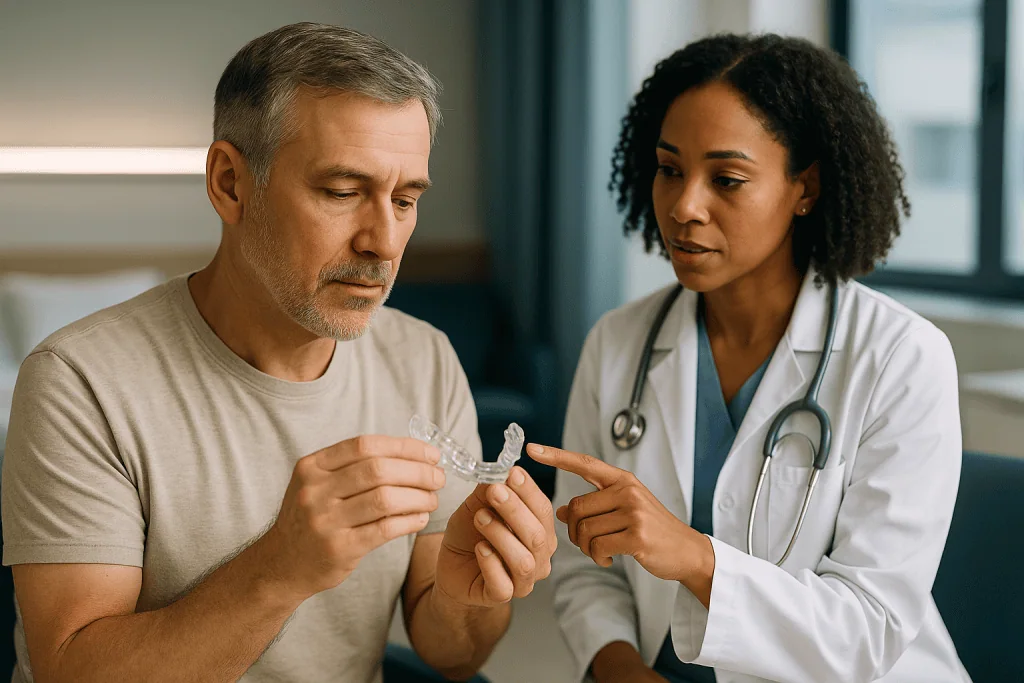
A sleep apnea mouth guard is not the rubbery shield an athlete wears. The medical version is a mandibular advancement device, or MAD: two custom trays that fit over the upper and lower teeth and are linked so that the lower jaw sits a few millimeters forward of its resting position. Because the tongue is anchored to the lower jaw, pulling the jaw forward pulls the base of the tongue away from the back of the throat and tightens the soft tissue at the sides of the airway. Imaging studies show the airway cross-section widens most in the side-to-side direction, which is exactly where it tends to collapse.
A second, less common design is the tongue-retaining device, a soft bulb that holds the tip of the tongue forward by gentle suction. It does not depend on teeth, which makes it an option for people with dentures, but it is harder to tolerate and less studied.
Compare this with CPAP, continuous positive airway pressure, which blows a steady stream of air through a mask to splint the airway open from the inside. CPAP works on the airway pneumatically; a MAD works mechanically. That difference explains almost everything that follows: CPAP is more powerful at any severity, while a MAD is quieter, portable and, for many people, simply worn more often.
Does a mouthguard work for sleep apnea? What the evidence actually says
The short answer is yes, for the right person, with important qualifiers, and the evidence can be graded fairly cleanly.
The strongest data come from randomized trials, including crossover studies in which the same patients used CPAP for a period and a custom mandibular advancement device for another. The consistent finding is that CPAP lowers the apnea-hypopnea index (AHI, the number of breathing pauses and partial blockages per hour of sleep) further than a MAD does. A typical pattern: CPAP brings the AHI close to normal, under 5, in most users, while a well-adjusted MAD cuts it by about half on average and brings it under 5 in roughly a third to two fifths of users. On the measure sleep labs care about most, CPAP wins.
Here is the twist that randomized trials also captured. Participants wore the oral appliance more hours per night than the mask. When researchers looked at outcomes that matter to patients, such as daytime sleepiness scores, quality of life and driving-simulator performance, the two treatments came out close to equal. A meta-analysis of randomized trials found blood pressure reductions of similar size with either treatment. A less complete treatment used all night appears to deliver as much real-world benefit as a more complete treatment used for four hours.
What we do not have is long-term randomized evidence that oral appliances reduce heart attacks, strokes or deaths. Those hard-outcome trials are largely missing for CPAP too, so this is a gap for the whole field, not a strike against one device.
Observational data suggest that the people who respond best tend to have mild to moderate OSA, apnea that is worse when lying on the back, a lower body mass index and a smaller neck. Expert opinion, not trial data, guides most of the fine details of fitting. Grade it this way: moderate-to-strong evidence for symptom relief in mild to moderate OSA; moderate evidence for blood pressure; low evidence for hard cardiovascular outcomes.
Who is a good candidate for oral appliance therapy for sleep apnea instead of CPAP?
The guideline answer is specific. Oral appliance therapy is recommended for adults with obstructive sleep apnea who are intolerant of CPAP or who prefer an alternative, and for adults with primary snoring without apnea who want treatment. It is not recommended as a first choice over CPAP for severe OSA, where the pressure device remains the standard because the mechanical pull of a jaw device may not be enough to hold a heavily collapsing airway open.
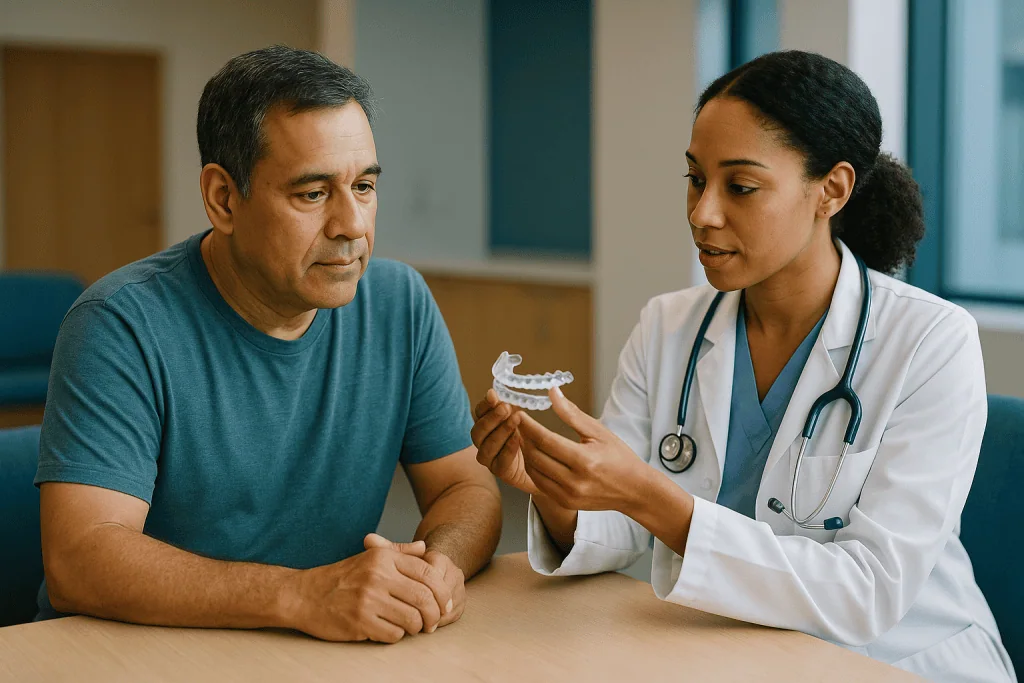
In practice, sleep physicians weigh several things before writing the prescription.
- Severity on the sleep study. Mild (AHI 5 to 14) and moderate (AHI 15 to 29) OSA are the sweet spot. Some people with severe OSA do respond, but they are usually offered a MAD only after CPAP has failed and with a mandatory follow-up study.
- Dental health. A MAD needs enough sound teeth, generally at least eight to ten per arch, to anchor to. Active gum disease, loose teeth or extensive untreated decay need to be addressed first.
- Jaw joint. People with an existing temporomandibular joint disorder, the painful clicking or locking of the jaw hinge, may find the forward posture aggravates it, though some tolerate it well under supervision.
- Type of apnea. Central sleep apnea, in which the brain briefly stops sending the signal to breathe, is a different disorder and does not respond to jaw positioning.
- Body position and weight. Apnea that is markedly worse on the back and a lower body mass index both predict a better response.
CPAP intolerance is common enough that this pathway matters. Studies of CPAP adherence repeatedly find that a third to a half of people prescribed a mask are not using it adequately a year later, whether from claustrophobia, dry nose, leaks, noise or a partner’s objection. For these patients an oral appliance is not a compromise; it is often the first treatment they actually receive.
Mandibular advancement device vs CPAP: a side-by-side comparison
Numbers help here more than adjectives. The table below summarizes what randomized and observational studies have reported for the main options. Percentages are typical ranges across studies rather than guarantees for any individual.
| Feature | CPAP | Custom mandibular advancement device | Over-the-counter boil-and-bite | Tongue-retaining device |
|---|---|---|---|---|
| How it works | Air pressure splints airway | Holds lower jaw forward | Holds jaw forward, fixed or crude adjustment | Suction holds tongue forward |
| Typical AHI reduction | Near normal in most users | About 50 percent on average; under 5 in roughly 35 to 40 percent | Smaller and less predictable | Similar to MAD in small studies |
| Best-studied severity | All, including severe | Mild to moderate | Snoring; mild OSA at most | Mild to moderate |
| Nightly use in trials | Often 4 to 5 hours | Often 6 hours or more | Highly variable | Lower tolerance |
| Needs teeth | No | Yes | Yes | No |
| Main side effects | Dry nose, mask marks, bloating, leaks | Jaw soreness, drooling, gradual bite change | Same as MAD, plus poorer fit and gagging | Tongue soreness, drooling |
| Follow-up sleep test advised | Usually built in via machine data | Yes, to confirm response | Rarely done | Yes |
Two rows deserve emphasis. The nightly-use row explains why a less powerful device can produce comparable symptom relief. The follow-up row explains why a store-bought mouthpiece is risky even when it quiets the snoring: silence is not the same as breathing. A device can stop the noise while leaving many partial blockages and oxygen dips untouched, and the only way to know is to measure.
Notice also what the table does not contain. It has no row for cure. None of these devices changes the anatomy of the throat permanently; each works only on the nights it is worn.
Custom vs over the counter mouth guard for sleep apnea: does the difference matter?
Walk down a pharmacy aisle or scroll a marketplace and you will find mouthpieces that promise to stop snoring for the price of a nice dinner. Most are boil-and-bite: you soften the thermoplastic in hot water, bite down, and the tray molds to your teeth. Some have a screw or ratchet that lets you nudge the lower tray forward.
The 2015 guideline is unusually direct on this point. It recommends that when an oral appliance is prescribed, it should be a custom, titratable one rather than a non-custom device. Titratable simply means the amount of forward jaw movement can be adjusted in small steps over weeks until breathing pauses are minimized while the jaw stays comfortable.
Why does the distinction matter? A custom device is built on impressions or a digital scan of your teeth by a dentist trained in sleep medicine, so it grips evenly, distributes force across many teeth and holds its position through the night. Head-to-head studies comparing custom devices with boil-and-bite versions in the same patients have found the custom device reduced the AHI substantially more and was more likely to be worn; a meaningful share of participants abandoned the boil-and-bite device for poor fit, gagging or the sense that it fell out during the night.
Over-the-counter devices are not worthless. For simple snoring without apnea in a person who has already had a sleep study, they may be a reasonable trial, and some dentists use them as a short test of whether jaw advancement helps at all before committing to a custom build. The danger lies in the untested case: someone who snores, buys a device, hears the snoring stop, and never learns that their oxygen still dips forty times an hour.
One more practical point. A poorly fitting tray that anchors on only a few teeth concentrates force on those teeth, which is the most likely route to loosening or shifting them. Fit is a safety feature, not a luxury.
What is the 3% rule for sleep apnea?
This phrase has been circulating in videos as if it were a secret. It is actually a scoring convention used by sleep labs, and understanding it explains why two people with identical nights can receive different diagnoses.
When a technician scores a sleep study, an apnea is straightforward: airflow drops by at least 90 percent for ten seconds or more. A hypopnea, a partial blockage, is trickier. Airflow falls by at least 30 percent, but a reduction alone is not enough; the event has to have consequences. Under the American Academy of Sleep Medicine’s recommended rule, a hypopnea counts if it comes with a drop in blood oxygen of 3 percent or more, or with an arousal from sleep visible on the brain-wave tracing. Under an older alternative rule still used by some insurers, only events with a 4 percent oxygen drop count, and arousals do not qualify.
The consequence is arithmetic. The 3 percent rule counts more events, so the same recording produces a higher AHI. Studies have found that a noticeable fraction of people classified as normal or mild under the 4 percent rule move into mild or moderate OSA under the 3 percent rule. That is the entire “secret”: the threshold you are scored against changes your number and sometimes your treatment eligibility.
For mouth guard decisions, this matters in two ways. First, ask which rule your lab used; a report scored at 3 percent with an AHI of 12 reflects a different physiology than a 4 percent report with the same number. Second, when a follow-up study is done with the device in place, it should be scored the same way as the original so the comparison is fair.
None of this is something to act on yourself. It is a question for the sleep physician interpreting your study, and a good one to ask.
What is the Japanese trick for sleep apnea?
Videos using this label do not agree on what the trick is, which is the first clue about its evidence base. Three claims travel under the name.
The most common is mouth taping: a strip of porous tape over the lips to force nasal breathing. The theory is that nasal breathing keeps the tongue forward and the airway more stable. The evidence is thin. A handful of very small studies in people with mild OSA who breathe through the mouth showed modest reductions in snoring and AHI, but these were short, unblinded and involved fewer than a few dozen participants. Sleep physicians raise a safety concern that is not theoretical: if the nose becomes blocked during the night from congestion, a deviated septum or a cold, taping the mouth removes the backup route for air. People with moderate or severe OSA, nasal obstruction or reflux are generally advised against it. This is expert opinion grounded in physiology, not randomized data, and it argues for caution rather than a blanket ban.
The second version is a set of tongue and throat exercises, sometimes credited to Japan, sometimes to Brazil where the best-known trial was run. This is oropharyngeal myofunctional therapy, a program of repeated tongue, palate and cheek movements meant to tone the muscles that keep the airway open. Here the evidence is more respectable: several small randomized trials and a meta-analysis found roughly a 50 percent reduction in AHI and less snoring in people with mild to moderate OSA who did the exercises daily for about three months. Adherence is the weakness; the exercises are tedious and benefits fade when they stop.
The third version is side-sleeping with a particular pillow arrangement. Positional therapy has genuine support for people whose apnea is mainly on the back, and it can be combined with a mouth guard.
The honest summary: exercises, plausible and modestly supported; positional sleep, well supported for the right subgroup; mouth tape, unproven and worth discussing with a clinician before trying.
What is the best sleep apnea mouth device?
People want a brand name, and the evidence does not provide one. No randomized trial has established that a particular manufacturer’s device outperforms another’s. What the literature does show is which design features predict success, and those are worth knowing more than any logo.
Custom fabrication comes first, for the reasons covered above. Adjustability comes second: a device whose forward position can be changed in small increments consistently outperforms fixed devices because the effective position varies widely between people and cannot be predicted from a single measurement. Two-piece designs, with separate upper and lower trays connected by hinges, bars or elastic straps, generally allow some jaw opening and side-to-side movement, which many people find more comfortable and which may reduce joint strain compared with a rigid single block. Materials matter for durability; hard acrylic lasts longer, soft linings feel gentler on the teeth at first.
Beyond the device itself, the best predictor of a good result is the team around it. The guideline recommends that the appliance be made and adjusted by a qualified dentist working with a sleep physician, and that the physician confirm the response with a follow-up sleep study rather than relying on how the patient feels. A brilliant device that no one checks is a coin toss.
Some devices now include a small temperature sensor that logs when the appliance is in the mouth, giving an objective record of nightly use similar to the data a CPAP machine collects. Early studies suggest people overestimate their own use by about an hour a night, which is another argument for measurement over recollection.
If you are handed a list of options, the questions to ask are not “which is best” but “is it custom, is it adjustable, who adjusts it, and when do we retest.” The device that scores yes on all four is the best one for you.
What to expect from fitting, adjustment and the follow-up sleep test
The process is slower than buying something online, and the slowness is where the safety lives.
It starts with a diagnosis. A sleep physician orders either an in-lab polysomnogram, the full overnight study with brain-wave, oxygen, airflow and effort sensors, or a home sleep apnea test, a simplified kit that measures breathing and oxygen. The result gives the AHI and severity, rules out central apnea, and lets the physician decide whether an oral appliance is appropriate. If it is, a referral goes to a dentist with training in dental sleep medicine.
The dentist examines the teeth, gums and jaw joint, records how far the jaw can comfortably move forward, and takes impressions or a digital scan. Custom fabrication typically takes a few weeks. At delivery the device is usually set at a modest starting position, often around half of the maximum comfortable advancement, because starting gently reduces jaw soreness and dropout.
Then comes the adjustment phase, sometimes called titration. Over several weeks the dentist or the patient, following the dentist’s instructions, advances the lower tray a small step at a time. The endpoint is a balance: enough advancement to quiet the snoring and relieve symptoms, not so much that the jaw aches in the morning. Some clinics speed this up with a home oxygen monitor or a single-night adjustable study in the lab.
Once a stable position is reached, the sleep physician orders a follow-up sleep test with the device in place. This is the step most often skipped by people who buy over the counter, and it is the only way to know whether the device is treating the apnea or just the noise. Long-term, the guideline advises periodic dental review to catch bite changes early, and a repeat sleep evaluation if weight, symptoms or snoring change.
Side effects of a sleep apnea mouth guard: jaw, teeth and bite changes
Every effective medical device has trade-offs, and a jaw-advancing appliance has a predictable set. Most are mild and fade; one is slow and permanent, and deserves plain language.
In the first weeks, the common complaints are excess saliva or, paradoxically, a dry mouth; tooth tenderness on waking; a sense that the teeth do not fit together for a few minutes in the morning; and soreness in the jaw muscles or in front of the ears where the joint sits. In studies these early effects affect a majority of users to some degree and settle for most within a month or two as tissues adapt and the dentist fine-tunes the fit. Gagging and difficulty sleeping with a foreign object in the mouth lead a minority to give up early, more often with poorly fitting devices.
The long-term issue is dental movement. Holding the jaw forward for seven hours a night applies a steady backward force on the upper front teeth and a forward force on the lower ones. Over years, this tends to reduce the overjet, the horizontal distance the upper teeth sit in front of the lower, and to reduce the overbite, the vertical overlap. Studies following patients for five to ten years find measurable changes in most users, typically a millimeter or two, and a small fraction develop a noticeable shift in how their back teeth meet. Most people do not perceive it; dentists do, on comparison photographs and models.
Is this a reason to avoid the device? Sleep physicians generally regard modest tooth movement as an acceptable exchange for treated apnea, since untreated OSA carries its own risks. It is, however, a reason to insist on yearly dental review, to report any change in chewing, and to use the morning jaw exercises many dentists recommend to reseat the bite.
Joint problems are the other watch point. Persistent jaw pain, clicking that was not there before, or locking should prompt a pause and a call to the dentist rather than pushing through.
Common myths about sleep apnea mouth guards, corrected
Viral claims tend to contain a grain of truth stretched past what the studies support. Here are the ones that come up most.
“If the snoring stops, the apnea is gone.” Snoring is the sound of vibrating tissue; apnea is the airway closing. A device can quiet one without fixing the other, which is why the guideline calls for a follow-up sleep test rather than a partner’s report.
“Mouth guards only work for mild cases.” They work best in mild to moderate OSA, but studies include people with severe OSA who responded well, particularly those with position-dependent apnea. The point is not that severe cases cannot respond; it is that the response is less predictable, so CPAP remains first-line and any oral appliance in severe OSA needs confirmation.
“A sports mouth guard or night guard for grinding does the same job.” A grinding guard covers one arch and does nothing to the jaw position. Some can even let the jaw fall back, worsening the airway. Only a device that advances the lower jaw or holds the tongue treats obstruction.
“The Japanese trick cured my apnea in a week.” Myofunctional exercises have modest trial support over about three months of daily practice; a week is too short for muscle change, and no study shows a cure. Mouth taping has almost no rigorous evidence.
“Once you find the right device, you are done.” Weight change, aging, new dental work and tooth movement all alter how a device performs. Periodic review is part of the treatment.
“CPAP is always better, so a mouth guard is settling.” In randomized crossover trials, sleepiness, quality of life and blood pressure improved similarly with either treatment, largely because the appliance was worn longer. A treatment used every night is not settling.
“Online custom devices are the same as a dentist’s.” Mail-in impressions skip the examination of gums, joint and existing dental disease, and skip the adjustment relationship. The material may be similar; the safety net is not.
Why treating obstructive sleep apnea matters for heart and brain
The urgency behind all of this is not the snoring. It is what repeated oxygen dips and arousals do to the body over years, and the numbers here are large enough that a treatment used imperfectly beats a treatment abandoned.
Each obstructive event triggers a surge of the stress hormones that raise heart rate and constrict blood vessels. Do that thirty times an hour and blood pressure stays elevated into the day. Observational cohorts consistently link moderate to severe OSA with roughly a doubling of the risk of developing high blood pressure, and OSA is a leading identifiable cause of hypertension that resists standard treatment. Randomized trials of CPAP and of oral appliances both lower blood pressure by a few points on average, more in people with resistant hypertension, and that reduction is in the range known to cut stroke risk at a population level.
The American Heart Association’s 2021 statement summarized the broader picture: OSA is present in a large fraction of people with atrial fibrillation, heart failure and coronary disease, and untreated OSA is associated with recurrence of atrial fibrillation after procedures to correct it. Whether treating OSA prevents these outcomes is less settled; the large randomized trials of CPAP in cardiac patients did not show fewer heart attacks or strokes, though average mask use in those trials was low, which is exactly the adherence problem an oral appliance is meant to address. The evidence for hard outcomes therefore sits at the observational level for both treatments.
The brain is affected too. Fragmented sleep impairs attention and reaction time; people with untreated OSA have a two- to threefold higher rate of motor vehicle crashes in observational studies, and treatment brings that rate back toward baseline. Mood, memory and insulin sensitivity all worsen with untreated apnea and improve with treatment.
Put plainly, the goal of choosing between a mask and a mouthpiece is to find the one you will actually wear, because the alternative that does the most harm is neither.
When to see a doctor about sleep apnea or a mouth guard
Two sets of warning signs matter here: the ones that should send you for a sleep evaluation in the first place, and the ones that mean a device you are using needs review. Either way, the decision about diagnosis and treatment belongs to a sleep physician working with a dentist, not to a video or a product page.
Seek a medical evaluation, and do not start with a store-bought device, if you notice any of the following:
- A partner reports that you stop breathing, gasp or choke during sleep.
- You fall asleep unintentionally while driving, in meetings or mid-conversation, or you feel unrefreshed no matter how long you sleep.
- You wake with headaches most mornings, or with a racing or irregular heartbeat.
- Your blood pressure stays high despite treatment, or you have been diagnosed with atrial fibrillation, heart failure or stroke.
- You have loud nightly snoring with a neck size over about 17 inches for men or 16 for women, or a body mass index in the obese range.
Call the dentist or sleep physician promptly if you are already using an oral appliance and you experience jaw pain that lasts beyond the first few weeks or worsens, new clicking or locking of the jaw, a tooth that feels loose, a bite that no longer feels normal by mid-morning, sores or bleeding in the gums, or a return of snoring, daytime sleepiness or witnessed pauses despite wearing the device.
Go to an emergency department or call emergency services for chest pain, sudden severe shortness of breath, fainting, or signs of stroke such as facial drooping, arm weakness or slurred speech. These are not mouth guard problems; they are medical emergencies that sometimes coexist with untreated apnea.
Never stop CPAP or another prescribed treatment to try an oral appliance without discussing it with the prescribing clinician. The transition is common and reasonable, and it goes best when it is planned, monitored and confirmed with a follow-up test.
Frequently asked questions
Does a mouthguard work for sleep apnea?
Yes, for many people with mild to moderate obstructive sleep apnea, a custom mandibular advancement device works well enough to be a recognized alternative to CPAP. Randomized trials show it reduces breathing pauses by about half on average and improves daytime sleepiness and blood pressure to a similar degree as CPAP, largely because it is worn longer. It is less reliable in severe apnea, and a follow-up sleep study is needed to confirm it is working.
What is the 3% rule for sleep apnea?
The 3% rule is the American Academy of Sleep Medicine’s scoring criterion for a hypopnea, a partial blockage of breathing. Airflow must drop by at least 30 percent for ten seconds and be accompanied by a 3 percent fall in blood oxygen or an arousal from sleep. An older rule requires a 4 percent drop and ignores arousals, so it counts fewer events. The rule your lab uses affects your apnea-hypopnea index and sometimes your diagnosis.
What is the Japanese trick for sleep apnea?
Videos using this name usually mean mouth taping, tongue and throat exercises, or side-sleeping with a specific pillow setup. Mouth taping has very little rigorous evidence and can be unsafe if the nose blocks during the night. Tongue exercises, known as myofunctional therapy, have modest support from small randomized trials after roughly three months of daily practice. Side-sleeping genuinely helps people whose apnea is worse on their back. None of these is a cure.
What is the best sleep apnea mouth device?
No brand has been shown superior in randomized trials. The features that predict success are custom fabrication from impressions or a scan of your teeth, adjustability so the jaw position can be fine-tuned in small steps, and a two-piece design that allows some jaw movement. Just as important is the team: a trained dentist to fit and adjust it and a sleep physician to confirm the result with a follow-up sleep test.
Is a mandibular advancement device as good as CPAP?
It is less powerful but often equally useful. CPAP lowers the apnea-hypopnea index further, bringing it near normal in most users, while a mandibular advancement device typically halves it. In crossover trials where the same patients tried both, symptom relief, quality of life and blood pressure improved by similar amounts because people wore the appliance more hours per night. For severe apnea, CPAP remains the first choice and an appliance needs confirmation by testing.
Can I use a mouth guard for snoring without a sleep study?
It is not recommended. Loud snoring is the most common symptom of obstructive sleep apnea, and a mouth guard for snoring can quiet the noise while leaving oxygen dips untreated, which hides a condition linked to high blood pressure, atrial fibrillation and stroke. A sleep study, in a lab or at home, tells you whether you have simple snoring or apnea, and rules out central apnea, which jaw devices do not treat.
Will a sleep apnea mouth guard move my teeth?
Over years of nightly use, some tooth movement is common. Studies following users for five to ten years find most develop a millimeter or two of change in how far the upper teeth sit in front of the lower and how much they overlap. Most people do not notice, but a small number develop a shift in how their back teeth meet. Yearly dental review and morning jaw exercises help catch and limit this.
How long does it take for a sleep apnea mouth guard to work?
Snoring often improves within the first nights, but the full effect on breathing pauses usually takes several weeks of gradual adjustment. Dentists typically start the device at a comfortable partial advancement and move the lower jaw forward a small step at a time to balance effectiveness against jaw soreness. Once a stable position is reached, a follow-up sleep test with the device in place confirms whether the apnea is adequately controlled.
Who should not use an oral appliance for sleep apnea?
People with too few sound teeth to anchor the device, active gum disease, loose teeth or extensive untreated decay need dental treatment first. A significant existing jaw joint disorder may be aggravated by the forward posture. Central sleep apnea, where the brain briefly stops signaling to breathe, does not respond to jaw positioning. Severe obstructive sleep apnea is usually treated with CPAP first, with an appliance considered only if CPAP fails and with a confirmatory sleep study.
Can I stop CPAP and switch to a mouth guard on my own?
No. Switching is a common and reasonable step, but it should be planned with the sleep physician who prescribed CPAP. Stopping treatment abruptly returns the apnea, along with its effects on blood pressure and alertness, and an untested mouth guard may not control it. The safe path is a referral to a dentist trained in sleep medicine, a period of fitting and adjustment, and a follow-up sleep study before CPAP is set aside.
References
This article is for general information only and is not a substitute for professional medical advice. Please consult a qualified doctor about your individual situation.

More from the Blog
Is 7 Hours of Sleep Enough? What the Research Says About the Minimum That Protects Health
For most healthy adults, yes: seven hours of actual sleep a night is the minimum that major sleep medicine and public health bodies recommend,…
What Causes Lack of Sleep? The Medical, Hormonal and Lifestyle Reasons, Sorted
Lack of sleep usually has more than one cause. Doctors sort them into medical conditions (pain, reflux, sleep apnea, restless legs, thyroid disease), mental…
How Much REM Sleep Do You Need? What the Numbers on Your Tracker Mean
Most healthy adults spend about 20 to 25 percent of the night in REM sleep, which works out to roughly 90 to 120 minutes…
Weighted Blankets: What Trials Show for Sleep and Anxiety-Related Restlessness
A weighted blanket applies gentle, evenly spread pressure across the body, and the best available evidence suggests it can modestly ease insomnia symptoms and…
Sleep Inertia: Why You Wake Up Groggy and How to Shorten It
Sleep inertia is the temporary grogginess, slowed thinking, and disorientation many people feel right after waking. It typically fades within 15 to 60 minutes,…
Why Can’t I Sleep? A Checklist for Racing-Mind Nights
Most sleepless nights trace back to an overactive stress response, a state researchers call hyperarousal, often layered on top of practical triggers like late…