

Traveling With CPAP: What International Patients Ask About Flights and Device Settings
Key Takeaways
- A CPAP machine is classified as an assistive medical device on most airlines and travels in the cabin without counting toward your carry-on allowance.
- Aircraft cabins are pressurized to the equivalent of roughly 6,000 to 8,000 feet, which can lower the pressure a fixed-speed machine delivers unless the device compensates automatically.
- The humidifier chamber must be empty and dry before security, because water inside it is treated as a carry-on liquid.
- Travel lasting more than four hours raises the risk of deep vein thrombosis, and recent surgery, heart disease and extra weight all increase it further.
- Distilled water is recommended in the humidifier to prevent mineral scale and microbial growth, with bottled water an acceptable short-term substitute and unsafe tap water never appropriate.
- Sleep apnea returns the very first night without CPAP, so the machine matters most on the morning you drive an unfamiliar rental car.
A CPAP machine can travel with you on most commercial flights. Aviation and security authorities in the US and many other countries treat it as an assistive medical device, so it normally rides in the cabin and does not count toward your carry-on allowance. Empty the humidifier before screening, carry your prescription and a copy of your settings, and ask your care team before changing any pressure for altitude.
It is late, the suitcase is half zipped, and the gray box that has sat on the same nightstand for three years is suddenly a problem. Does it go in the case or on your shoulder? Will the security officer want it out? Will the hotel outlet even fit the plug? Anyone traveling with a CPAP machine for the first time recognizes this small, specific dread. It is not about the trip. It is about the machine.
The questions arrive in a cluster, and they arrive from everywhere: people flying abroad for work, families visiting relatives, and patients heading home after treatment in another country who now have a prescription, a device, and a twelve-hour flight ahead of them.
Most of the answers are reassuring. A few are not, and those deserve honesty rather than a cheerful checklist. This explainer walks through what actually happens at the airport, in the cabin, and in a foreign hotel room, and where the decisions belong with your treating team.
How a CPAP machine works, and why a few nights without it matter
CPAP stands for continuous positive airway pressure. A quiet pump draws in room air, adds gentle pressure, and delivers it through a hose and mask so that the soft tissues of the throat stay open while you sleep. Think of it as an air splint rather than a breathing machine: it does not breathe for you, it simply keeps the passage from collapsing.
That collapse is the problem it treats. In obstructive sleep apnea (OSA), the muscles of the throat relax so far during sleep that airflow stops or shrinks, oxygen dips, and the brain briefly rouses you to reopen the airway. This can repeat dozens of times an hour without your knowing. The result is fragmented sleep, morning headaches, and daytime sleepiness that many people have simply learned to live with.
CPAP controls OSA only on the nights you use it. Skip the machine and the apnea returns that same night, not weeks later. This is the honest reason the device deserves a place in your carry-on: the first morning in a new city is often the morning you pick up a rental car, cross unfamiliar roads, and make decisions while more tired than you realize.
The long game matters too. Untreated sleep apnea is associated with high blood pressure, stroke, heart disease, type 2 diabetes and depression, according to the NHS. A holiday will not undo years of treatment, but people who travel frequently and leave the machine at home each time are effectively untreated for a meaningful share of the year.
Two features come up repeatedly when traveling. The heated humidifier, a small water chamber that moistens the airflow, is the part that causes most airport confusion. Auto-adjusting machines, sometimes called APAP, change pressure breath by breath within a range your clinician sets, which becomes relevant at altitude.
Can you bring a CPAP on a plane? Yes, and it belongs in the cabin
Yes. In the US and in many other countries, a CPAP machine is classified as an assistive medical device rather than luggage. In practice that means it travels in the cabin with you and, on most airlines, does not count against your carry-on bag limit. Airline policies differ in the details, so confirm with the carrier before departure, particularly on international itineraries where several airlines may operate different legs of the same journey.
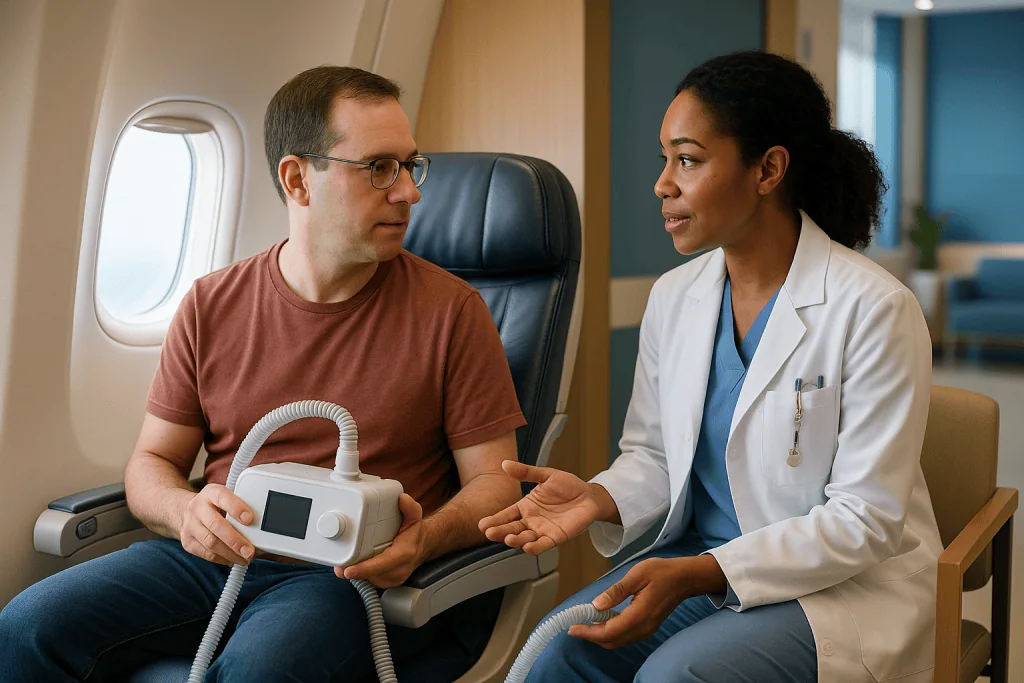
Do not check it. Baggage holds are cold, bags are thrown, and delayed luggage is common. A checked CPAP that arrives two days after you do is a CPAP you did not use for two nights. Keep it in its own case with the hose, mask, power cord and any battery packed together so that nothing critical ends up in a different bag.
Carrying the device on board is different from using it on board. Most airlines allow the first with no advance notice. The second often requires notification, sometimes a form, and sometimes a check that the specific model is approved for in-flight use. If you think you might switch it on during an overnight flight, contact the airline well ahead of travel rather than at the gate.
A letter from your prescribing clinician is rarely required by law, but it smooths conversations at check-in and at foreign customs desks. A copy of your prescription with your pressure settings serves a second purpose: if the machine fails abroad, a local sleep service can read exactly what you need without guessing.
Patients flying home after treatment in another country face the same rules as any other traveler. The only extra step is making sure the prescription and settings summary are written in a language your home care team can read.
Traveling with a CPAP machine through airport security
Airport screening is where the machine draws attention, and knowing the routine takes the sting out of it. In most countries you will be asked to remove the CPAP from its case and place it in a bin for X-ray, the same way laptops are handled. Officers may also swab the device for explosive trace residue. This is routine and takes a minute or two.
Hygiene is the reasonable worry. Bins are shared by hundreds of shoes and bags a day. Place the machine in a clear plastic bag before it goes into the bin, or ask the officer to lay down a clean liner. In many security programs you may also request that the officer put on fresh gloves and use a new swab before touching a medical device. Keep the mask and hose inside a sealed bag; they do not need to be exposed for screening.
The humidifier chamber is the part that triggers delays. Water in the chamber is a liquid, and liquids are restricted in carry-on luggage almost everywhere. Empty the chamber completely and let it dry before you pack. In the US, medically necessary liquids can be declared for separate screening, but rules elsewhere are stricter and less predictable, so carrying a large bottle of distilled water through security is not a reliable plan.
Some airports offer assistance programs for travelers with medical devices, which you can request in advance or at the checkpoint. If you use a battery, keep it in your carry-on; lithium batteries are generally not permitted in checked luggage, and airlines set watt-hour limits that vary by carrier and country.
Give yourself a few extra minutes. Screening a CPAP is quick when the chamber is dry and the device is easy to lift out, and slow when it is buried under a week of clothing.
Using CPAP on an airplane: is it actually worth it?
Here is the honest answer most guides avoid: on a daytime flight of a few hours, most people do not use their CPAP, and for someone with stable, well-controlled OSA that is usually a reasonable choice to discuss with their team. Sleeping upright in a seat produces lighter, shorter sleep, and many travelers barely doze. The calculation changes on an overnight long-haul, where you may sleep several hours in a row and arrive expected to function.
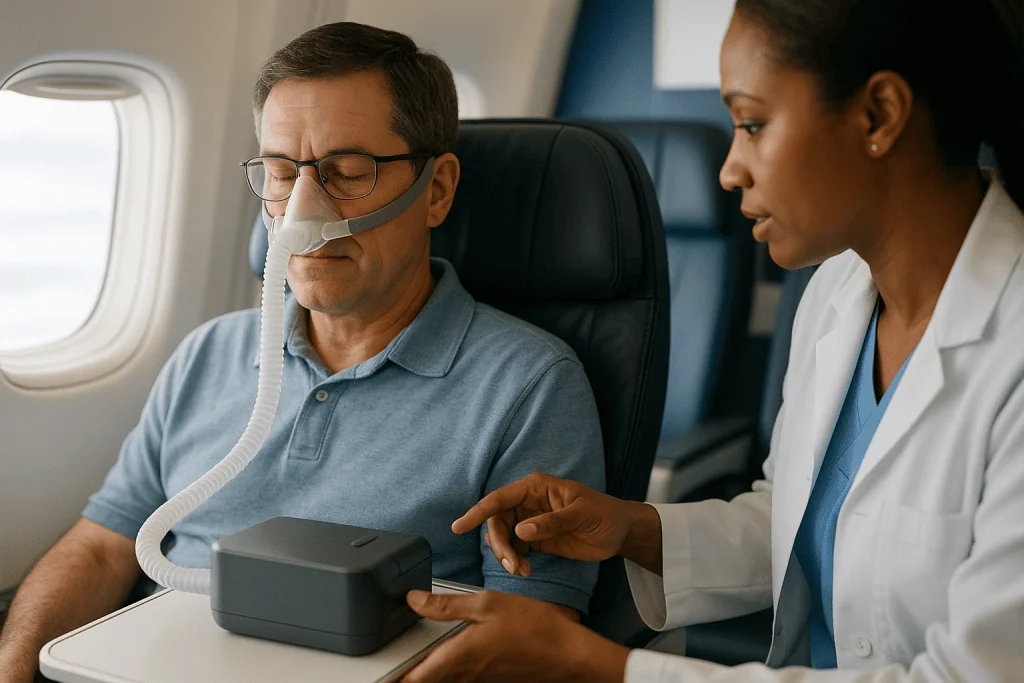
Using the device in the air involves practical hurdles. Seat power is not guaranteed on every aircraft, and outlets can switch off when the cabin power load is high, so a charged battery is the only dependable supply. Most airlines prohibit water in the humidifier during flight because of spill risk, which means dry air passing through a machine in an already dry cabin. The mask is visible, the hose needs a place to rest, and your seat neighbor will notice the soft exhale of air.
None of these are reasons not to do it. They are reasons to prepare. People who use CPAP in flight often report waking clearer than they would have otherwise, though that is individual experience rather than trial evidence.
If you choose not to use it, the fallback strategies are the same ones that help any night without the machine. Avoid alcohol before and during the flight, since it relaxes the throat muscles that collapse in OSA. Sleep with the head supported so the chin does not drop to the chest. A neck pillow that keeps the head upright rather than tilted forward helps some people.
Nasal dryness is common in cabin air whether or not the machine is running. The Mayo Clinic notes that a heated humidifier or a saline nasal spray can ease dryness; the first is unavailable in flight, the second is easy to carry.
Do CPAP settings need changing at altitude or abroad?
This is the question that worries international patients most, and it has a clear principle behind it: never change your prescribed pressure yourself. The physics are real, but the adjustment is a clinical decision.
Aircraft cabins are pressurized, but not to sea level. The CDC notes that cabin pressure on commercial flights is typically equivalent to an altitude of about 6,000 to 8,000 feet. Air at that altitude is thinner, so a CPAP blower spinning at a fixed speed pushes slightly less pressure than it would at home. The same applies to mountain destinations on the ground.
Many modern machines compensate for this automatically, measuring delivered pressure and adjusting the motor to hold the prescribed number. Auto-adjusting machines add a second layer, changing pressure breath by breath within the range your clinician set. Older fixed-pressure units sometimes have a manual altitude setting in a menu. Your device manual will state whether compensation is automatic and up to what altitude; if it is not clear, this is a question for the clinic or the equipment supplier’s technical support, not for guesswork at a hotel desk.
Travel does not change your underlying prescription. A pressure that works in one country works in another; the throat does not know where it is. What may change is the mask fit, because heat, humidity and a different pillow all affect how the seal sits on your face. The Mayo Clinic describes mask leaks and skin irritation as among the most common CPAP problems, and both worsen when the routine is disrupted.
People who use supplemental oxygen bled into their CPAP have a separate set of aviation rules to navigate. Oxygen concentrators require airline approval, and the oxygen itself must be arranged in advance. Anyone in this situation should start the conversation with their care team and the airline well before booking rather than after.
Power, plugs and batteries: keeping a CPAP running away from home
The most commonly forgotten item is the power cord. Machines have their own case; cords wander into laptop bags. Pack the cord in the CPAP case before anything else.
Voltage is the second question. Look at the label on the power supply, usually a small brick on the cord. If it lists an input range that spans both 110-volt and 220-volt systems, the device will work on power grids in most countries and you need only a plug adapter, the small block that changes the shape of the prongs. A voltage converter, which is heavier and changes the electricity itself, is unnecessary in that case and can cause problems. If the label lists a single voltage, you need to check compatibility with your destination before you go.
Plug shapes vary by region and sometimes within a country. Hotel outlets also have a habit of sitting behind the headboard or across the room. A short extension cord solves more nights of CPAP use than any other accessory.
Batteries earn their place on long-haul flights, in sleeper trains, on camping trips and anywhere the power supply is unreliable. Lithium batteries must travel in the cabin, and airlines impose limits on capacity; some sizes require prior approval and some are simply not allowed. Check the airline’s rules against the battery’s rated capacity, which is printed on it. Running the heated humidifier drains a battery quickly, so many people switch humidification off when on battery power.
Cruise ships and long-distance trains usually offer standard cabin outlets, but the location and number of outlets vary. Asking in advance about an outlet near the bed and about distilled water avoids improvising on the first night.
Distilled water for CPAP travel: what to do about the humidifier
Manufacturers, the Mayo Clinic and the Cleveland Clinic all recommend distilled water in the humidifier chamber. The reasons are practical rather than mysterious. Tap water leaves mineral scale that builds up on the heating plate and shortens the life of the chamber, and water that is not clean can introduce microbes into a warm, moist environment you breathe from all night.
Distilled water is easy to find in some countries and puzzling to find in others. Pharmacies and supermarkets often stock it, sometimes labeled for irons or car batteries; the product is the same. Learn the phrase in the local language before you land. If you truly cannot find it, bottled drinking water is a reasonable short-term substitute for a few nights, with the chamber emptied each morning and cleaned more thoroughly than usual when you return home. Tap water is the last resort, and only where the water is safe to drink; in places where it is not, do not put it in a device you inhale from.
For short trips, some people leave the humidifier empty or remove the chamber entirely. Many manage well. Others develop a dry mouth, sore nose or nosebleeds within a night or two. The Mayo Clinic lists a dry, stuffy nose among common CPAP complaints and suggests humidification or saline spray as the usual remedies, so the trade-off is comfort rather than safety for most users. Anyone with a history of nosebleeds or sinus problems should ask their team before going without.
Waterless humidification inserts exist. They trap moisture from your exhaled breath and return some of it on the next inhale, the same principle used in some hospital breathing circuits. They avoid the water problem entirely, though how much moisture they provide compared with a heated chamber varies, and whether one suits you is a question for your care team.
Whatever water you use, empty the chamber before every flight. A leaking chamber inside a case can damage the machine’s electronics and, at security, becomes a liquid you did not declare.
Who usually travels comfortably with CPAP, and who should talk to their team first
Most people with stable, well-controlled OSA who have used CPAP for months travel without incident. The device is portable, the rules are known, and the main risks are forgetting a cord or losing a night’s sleep to a hotel outlet in the wrong place. If that describes you, a brief message to your clinic before a long trip is courteous but rarely essential.
Several groups are usually asked to have a conversation before booking rather than after. People who started CPAP recently are still adjusting to mask fit and pressure, and the Mayo Clinic describes this adjustment period as one where problems commonly appear. A first trip during those early weeks can undo hard-won habits, so some clinicians prefer travelers to be settled first.
Anyone whose pressure was recently changed, or who is waiting for a follow-up sleep study, should ask whether the team wants data from the machine before they leave. People who use bilevel devices, which deliver a higher pressure on inhale and a lower one on exhale, or who bleed oxygen into the circuit, face extra airline arrangements and should not assume CPAP rules apply.
Recent surgery changes the picture. Operations on the nose, throat or jaw may make mask use uncomfortable or temporarily inadvisable, and surgery of any kind raises the risk of blood clots on long flights, which the CDC notes is already elevated after several hours of travel. Patients who have had a procedure abroad and are planning the flight home should ask the surgical team both when it is reasonable to fly and how CPAP fits around any healing wounds.
People with heart failure, chronic lung disease or poorly controlled blood pressure alongside OSA are usually asked to check in before long-haul travel because thin cabin air and lost sleep affect them more. Children who use CPAP have their own considerations around mask sizing, supervision and routine, best planned with the pediatric team.
None of this is a list of who may not travel. It is a list of who benefits from a ten-minute conversation before they do.
Traveling with a CPAP machine: scenario by scenario
Different trips stress different parts of the system. A short domestic hop and a two-week mountain trek share a machine but almost nothing else. The table below summarizes what tends to matter most in each situation and which questions belong with your care team or the carrier.
| Scenario | What usually matters most | Ask before you go |
|---|---|---|
| Short daytime flight, hotel stay | Carrying the device in the cabin, empty humidifier, plug adapter | Airline carry-on policy for medical devices |
| Overnight long-haul | Battery power, airline approval for in-flight use, clot prevention | Whether the team recommends using CPAP in flight; battery capacity limits |
| Mountain destination | Altitude compensation, mask fit in dry air | Whether your device compensates automatically and to what altitude |
| Cruise or sleeper train | Outlet near the bed, distilled water supply | Cabin power and water availability with the operator |
| Camping or unreliable power | Battery capacity, humidifier off to conserve charge | How many nights the team is comfortable with reduced humidification |
| Flying home after treatment abroad | Written prescription and settings, timing of flight after surgery, follow-up booked | When it is reasonable to fly; who reviews the machine data at home |
Two patterns cut across every row. The first is documentation: a copy of the prescription and settings turns a lost or broken machine from a crisis into an inconvenience anywhere with a sleep service. The second is the humidifier, which is the source of most airport delays and most hotel-room frustration. Solve those two and the rest is packing.
Notice what is absent from the table: any need to travel to a particular place for care. CPAP is prescribed and adjusted by sleep teams across the world using the same principles, and the right team is the one that knows your history.
The first days after arrival: time zones, jet lag and your sleep apnea
Jet lag is your body clock disagreeing with the local clock. Sleep arrives at the wrong hour, appetite follows a different schedule, and concentration sags in the afternoon. Layer OSA on top and the effects compound: the jet-lagged brain wants to sleep at odd times, and each of those sleeps, if taken without the machine, is an untreated one.
The single most useful habit in the first days is to use the CPAP for every sleep, including afternoon naps and the early-evening collapse onto the hotel bed. Setting the machine up on arrival, before unpacking anything else, makes this far more likely than intending to do it later.
Expect the mask to behave differently. Hotel pillows are often thicker or softer than yours, the air conditioning dries the room, and a new sleeping position can break the seal. The Mayo Clinic points out that mask leaks, skin marks and pressure sores are among the most frequent CPAP problems and that small adjustments to strap tension or a different pillow shape usually resolve them. Bring a spare mask cushion if you have one; they are light and they fail at inconvenient moments.
Alcohol deserves a specific mention because holidays invite it. It relaxes the throat muscles and deepens the first part of sleep, which is exactly when apnea worsens. The machine still works, but you may need a higher effective pressure than usual, and a fixed-pressure device cannot supply it.
Adjustment to a new time zone takes several days for most people, with the eastward direction typically harder than westward, according to CDC travel guidance. During that window, be conservative about driving when drowsy and about important decisions late in the day.
For patients heading home after treatment elsewhere, the first weeks are also when follow-up matters. Most modern machines store usage and leak data on a card or transmit it to a clinic; ask your home team how they want to receive it and book the appointment before you fly rather than after you land.
Long flights, sitting still and blood clots: the basics
Sleep apnea and blood clots are not the same problem, but they often share the same passenger. OSA is more common in people who carry extra weight, are older, or have heart disease, and each of those also raises the risk of a clot forming in a leg vein during long periods of sitting. The CDC advises that travel lasting more than four hours increases that risk, and that the risk rises further with recent surgery, hormone-containing medicines, pregnancy, cancer treatment, or a personal or family history of clots.
A clot in the leg, called deep vein thrombosis, can break loose and travel to the lungs, where it becomes a pulmonary embolism. This is the serious, occasionally fatal, complication that the precautions exist to prevent.
The basics are simple and evidence-based. Walk the aisle every couple of hours when the seatbelt sign allows. When seated, flex and point the feet and tighten the calf muscles for a minute at a time. Drink water rather than alcohol, which dehydrates and also worsens apnea. Avoid clothing that pinches behind the knees. Choose an aisle seat if you can, because people in aisle seats move more.
Compression stockings below the knee are recommended by the CDC for travelers at increased risk, but the fit and pressure grade matter, so ask your team which kind suits you rather than buying the first pair at the airport. Some people at high risk are prescribed a short course of blood-thinning medicine around a long flight. That is a decision for the prescribing clinician, weighing bleeding risk against clot risk; it is never something to start, stop or borrow on your own.
Patients who have recently had surgery abroad and are planning the flight home sit squarely in the higher-risk category. The surgical team, not the airline and not this article, is the right source for how long to wait before flying and what precautions to take on board.
What people often get wrong about traveling with CPAP
The most damaging myth is also the most common: that a few nights off do not matter. They do, immediately. The airway collapses the first night the machine stays home, and the daytime consequences arrive the next morning. A week without CPAP is a week of untreated sleep apnea, and the NHS lists drowsy driving among its practical hazards.
A second misconception is that the machine counts as a carry-on bag and must be crammed into the one allowed. On most airlines it does not; it is a medical device carried in addition to your normal allowance. Travelers who do not know this sometimes check it to make room, which is the one thing not to do.
Many people believe that altitude means turning the pressure up. The physics behind that instinct is partly right, but the response is wrong. Modern devices frequently compensate on their own, and any manual change belongs with the clinician who prescribed the setting. Adjusting pressure by feel in a hotel room can leave you over- or under-treated with no way to tell which.
Tap water for a week is fine, the thinking goes, if the water is drinkable. The mineral scale it leaves is real, and in countries where tap water is not safe to drink it is a genuine risk to breathe. Bottled water for a few nights, with extra cleaning afterward, is the reasonable compromise.
Smaller travel-sized machines are sometimes assumed to be identical to a home unit in a lighter shell. Some lack a heated humidifier, some sound different, and some use different masks. Whether one suits your prescription is a question for your team, not a marketing claim.
Airplane seat power will run the machine all night, people assume. It may not. Outlets are absent on some aircraft and switch off on others when load is high. A battery is the only dependable in-flight source.
Finally, some travelers who lose weight or sleep better on holiday conclude they can stop CPAP. Any change in treatment, including stopping, is a decision for the sleep team, usually after a repeat assessment.
Questions to ask your care team before you go
A short conversation with the clinic before a long trip covers ground that no general article can, because the answers depend on your pressure, your mask, your other conditions and your itinerary. Book it a few weeks ahead so that any setting change or equipment swap has time to settle before you leave.
- Does my machine compensate automatically for altitude, and up to what height? If not, is a setting change needed for my destination, and who makes it?
- Do you recommend I use the CPAP on an overnight flight, or is it reasonable to sleep without it for those hours given my history?
- Can I have a written copy of my prescription and current settings, ideally with a brief clinical letter, in a language useful at my destination and at home?
- For short trips, is it acceptable for me to travel without the humidifier, and what should I watch for if my nose or throat becomes sore?
- Given my other conditions, do I need any specific precautions against blood clots on a long flight, such as compression stockings?
- If my machine fails abroad, how do I reach you, and what should a local sleep service know about my case?
- How do you want to receive the machine’s usage and leak data after I return, and should I book a follow-up now?
- If I have recently had surgery, when is it reasonable for me to fly, and does the CPAP mask need to be adjusted around any healing area?
- Are there any medicines I take that interact with lost sleep, alcohol or altitude in a way I should know about?
Bring the device or its model number to the appointment. Teams can check the manual for altitude range, battery compatibility and available mask options far more quickly with the specifics in hand. Write the answers down; the information is most useful at a check-in desk or a hotel reception, not in your memory.
When to call your doctor
Most CPAP travel problems are inconveniences: a dry nose, a leaking mask, a night without the machine. A few are not, and knowing the difference matters more when you are far from your usual care.
Seek emergency care immediately, wherever you are, for signs of a blood clot after a long flight: swelling, pain or warmth in one calf or thigh; sudden shortness of breath; chest pain that worsens with breathing; coughing up blood; or a rapid heartbeat with lightheadedness. The CDC describes these as warning signs of deep vein thrombosis and pulmonary embolism, and they are not conditions to sleep on.
Also seek urgent help for severe breathlessness at rest, fainting, confusion, or lips or fingertips turning blue, particularly if you use oxygen alongside CPAP or have heart or lung disease.
Contact your care team promptly, even while traveling, if you find yourself falling asleep while driving or in conversation despite using the machine every night; if you wake repeatedly gasping or choking with the mask on; if morning headaches return; if the machine reports persistent high leak or shows an error you cannot clear; or if the mask is causing skin breakdown, eye pain or new facial numbness. A fever with a productive cough or sinus pain after several nights on an improvised water supply also warrants a call, because humidifier chambers can harbor microbes when cleaning slips.
Once home, ask for a review if your sleep or daytime energy has not returned to baseline within the first week or two, or if the trip involved any change to your settings, mask or routine. Bring the machine’s data. Every decision about pressure, equipment or whether to continue treatment rests with the team that knows your history, and the value of that history is precisely why it should not be replaced by advice from a stranger, a forum or a hotel concierge.
Frequently asked questions
Can you bring a CPAP on a plane as an extra bag?
Yes. On most airlines a CPAP machine is treated as an assistive medical device and does not count toward your carry-on limit, so it travels in addition to your usual bag. Policies vary by carrier and country, particularly on multi-airline international itineraries, so confirm before departure. Keep the device, hose, mask and cord together in its own case, and never check it into the hold.
Do I need a doctor's letter to travel with a CPAP machine?
A letter is rarely a legal requirement, but it is worth carrying. A brief note from your prescribing clinician, plus a copy of your prescription with current pressure settings, smooths conversations at check-in, security and customs. It also becomes essential if the machine fails abroad, because a local sleep service can read exactly what you need. Ask for it in a language useful at your destination.
What should be on a CPAP travel checklist?
The machine, power cord, hose, mask with headgear, a spare mask cushion, plug adapter for the destination, a short extension cord, a battery if you plan in-flight or off-grid use, a copy of your prescription and settings, and a clear plastic bag for security bins. Empty and dry the humidifier chamber before packing. The power cord is the item most often left behind.
Is using CPAP on an airplane allowed?
Usually, with conditions. Most airlines permit approved CPAP models to be used in flight but ask for advance notice, sometimes a form, and generally prohibit water in the humidifier. Seat power is not guaranteed, so a battery within the airline’s capacity limits is the only reliable supply. Whether using it on a given flight is worthwhile depends on flight length and your history, which your care team can help you weigh.
Do CPAP settings need to change at high altitude?
Do not change them yourself. Thinner air at altitude means a fixed-speed blower delivers slightly less pressure, and cabins are pressurized only to the equivalent of about 6,000 to 8,000 feet. Many modern machines compensate automatically within a range stated in the manual, and auto-adjusting devices adapt breath by breath. If your device needs a manual altitude setting, the change belongs with your clinician or the equipment supplier.
Can I use bottled water in my CPAP while traveling?
For a few nights, bottled drinking water is a reasonable substitute when distilled water is unavailable. Distilled water remains the recommendation because tap and mineral water leave scale on the heating plate and can carry microbes. Empty the chamber every morning, clean it more thoroughly than usual when you return home, and never use tap water in places where it is not safe to drink.
What happens if I skip CPAP for a week on vacation?
Your sleep apnea returns the first night, not gradually. Expect fragmented sleep, possible morning headaches and daytime sleepiness that raises driving risk, which the NHS highlights as a practical hazard of untreated OSA. A single week will not undo years of treatment, but frequent travelers who routinely leave the machine behind spend a meaningful share of the year untreated. Discuss any planned break with your care team.
How do I get a CPAP through airport security quickly?
Empty and dry the humidifier chamber, pack the machine where it is easy to lift out, and place it in a clear plastic bag before it goes into the screening bin. Officers may X-ray and swab it; you can ask for fresh gloves and a new swab. Keep the mask and hose sealed in a separate bag. Allow a few extra minutes and carry your prescription in case questions arise.
Should I worry about blood clots on a long flight if I have sleep apnea?
The CDC notes that travel over four hours increases clot risk, and factors that often accompany sleep apnea, such as extra weight, heart disease and older age, increase it further. Walk the aisle every couple of hours, exercise your calves while seated, drink water rather than alcohol and avoid tight clothing at the knees. Ask your team whether compression stockings or other measures are appropriate for you.
I was treated abroad and am flying home with a new CPAP. What should I arrange?
Before you fly, obtain a written prescription and settings summary in a language your home team can read, ask the treating team when it is reasonable to fly, especially after any surgery, and book a follow-up at home. Find out how your home clinic wants to receive the machine’s usage data. Airline and security rules for the device are the same as for any other traveler.
References
This article is for general information only and is not a substitute for professional medical advice. Please consult a qualified doctor about your individual situation.

More from the Blog
Septoplasty vs Turbinate Reduction: Which Blockage Each Operation Fixes
Septoplasty and turbinate reduction treat two different causes of a blocked nose. Septoplasty straightens a deviated septum, the wall of cartilage and bone between…

Voice Rest After Vocal Cord Polyp or Nodule Surgery: How Speaking Returns Step by Step
Voice rest after vocal cord surgery usually means a short period of complete silence, often around three to seven days depending on the surgeon's…

What Is Normal After Stapedectomy Surgery, and Which Symptoms Call for a Prompt Check?
After a stapedectomy, a blocked or muffled ear, mild ache, a metallic taste, brief unsteadiness when moving the head and faint blood-tinged discharge are…

Why Do Surgeons Ask for Voice Therapy Before Glottoplasty (Pitch-Raising Surgery)?
Surgeons ask for voice therapy before glottoplasty because surgery changes only one feature of a voice, its pitch, while listeners judge gender from resonance,…
What Results Can You Expect From Sleep Apnea Treatment? Sleep Quality, Energy and Snoring
Effective sleep apnea treatment usually reduces breathing pauses during sleep to a normal range, which in turn tends to improve sleep continuity, daytime alertness…

Nasal Sprays vs Saline Rinses for Sinusitis: Does Your Treatment Plan Need Both?
Saline rinses and nasal sprays treat sinusitis in different ways, so many care plans use both. A saline rinse physically flushes mucus and irritants…