

Traveling With Pulmonary Hypertension: Altitude, Oxygen and Planning Follow-Up Abroad

Key Takeaways
- Aircraft cabins are pressurized to the equivalent of roughly 6,000–8,000 feet, so a long flight is a mild altitude exposure even before you reach a mountain destination.
- Low oxygen constricts the lung's arteries, which is why cabin air and high elevation raise pulmonary pressure and load the right heart more in pulmonary hypertension than in most other conditions.
- A hypoxic challenge test breathes a reduced-oxygen mixture under monitoring to show whether you need supplemental oxygen in flight, replacing guesswork with a measured response.
- CDC guidance places the threshold for altitude illness in healthy people at about 2,500 meters, and advises people with pulmonary hypertension to approach high elevation only after specialist review.
- Travel longer than about four hours is a recognized trigger for deep vein thrombosis, and a clot reaching narrowed pulmonary arteries carries more risk, so movement, hydration and your team's clot-prevention advice matter.
- A dated clinician letter listing diagnosis, generic medicine names, oxygen needs and specialist contacts is the document that unlocks airline approval, airport security and emergency care abroad.
Many people with stable pulmonary hypertension can travel, including by air, after a review with their specialist team. Aircraft cabins and high-altitude destinations lower oxygen levels, which can narrow the lung's blood vessels and strain the right heart, so some travelers need supplemental oxygen and most benefit from a written plan, medicine supplies in hand luggage, clot-prevention habits and a named clinician to contact abroad.
The wedding invitation sits on the kitchen table for a week before she picks it up again. Her niece is getting married in a town that sits a mile above sea level, two flights and a long drive away. Three years ago that would have been a simple yes. Now, with pulmonary hypertension on her problem list and a pulse oximeter in her handbag, the question is not whether she wants to go but whether her lungs and heart will tolerate the trip.
That hesitation is common, and it is reasonable. Traveling with pulmonary hypertension asks more of the body than a routine journey does: thinner air in the cabin, thinner air again at a mountain destination, hours of sitting, disrupted medicine routines and a healthcare system that does not know your history.
None of that makes travel impossible. It makes travel something to plan with your team rather than improvise, and the evidence on what to plan is clearer than many people assume.
What traveling with pulmonary hypertension actually does to your body
Pulmonary hypertension means the blood pressure inside the arteries that carry blood from the heart to the lungs is abnormally high. It is a different condition from ordinary high blood pressure, which is measured in the arm and reflects the pressure in the body’s main circulation. In pulmonary hypertension the right side of the heart has to push against resistance that should not be there, and over time that chamber can thicken, enlarge and weaken.
Travel matters because of one piece of lung physiology. When oxygen in the air falls, the small arteries in the lungs constrict. In healthy lungs this is a useful reflex that steers blood toward the best-ventilated areas. In lungs where pressure is already high, the same reflex raises resistance further and the right heart has to work harder at exactly the moment it has less oxygen to work with.
Lower oxygen is built into both halves of a typical trip. Commercial aircraft cabins are pressurized to the equivalent of roughly 6,000 to 8,000 feet, not to sea level, which is why the CDC’s travel guidance treats a long flight as a mild altitude exposure in its own right. A destination in the mountains adds a second, longer exposure once you land.
The practical consequence is that the same journey a companion barely notices can leave someone with pulmonary hypertension more breathless, more tired and, in some cases, at risk of fluid building up or the right heart struggling. How much that matters depends on how severe and how stable the condition is, which is why the assessment always starts with your own specialist rather than a general rule.
Pulmonary hypertension and altitude: why thinner air hits harder
Air at altitude contains the same proportion of oxygen as air at sea level, about 21 percent. What changes is the total pressure. With less pressure pushing oxygen across the lung membrane into the blood, saturation falls, and it falls faster in anyone whose lungs or pulmonary circulation are already compromised.

The CDC’s altitude guidance uses a few thresholds that are worth knowing. Altitude illness in otherwise healthy people becomes a real possibility above roughly 2,500 meters (about 8,200 feet), and the risk rises with the speed of ascent and the height at which you sleep. For people with pulmonary hypertension the same guidance is more cautious: because low oxygen directly raises pulmonary artery pressure, travel to high elevation is generally discouraged or approached only after specialist review, and some teams advise against it altogether depending on severity.
Two altitude conditions deserve a plain definition. High-altitude pulmonary edema is fluid leaking into the lungs because of hypoxic constriction of the pulmonary vessels; it can occur in healthy climbers and the mechanism overlaps directly with the physiology of pulmonary hypertension. Acute mountain sickness is the milder, headache-and-nausea syndrome of rapid ascent.
Neither is a reason to panic about a moderate destination. A city at 1,500 meters is a different proposition from a trekking lodge at 4,000. The questions your team will weigh are the elevation where you will sleep, how quickly you will get there, whether you can descend easily, and what your own oxygen saturation does at rest and on exertion at sea level. Those answers, not the destination’s reputation, decide the plan.
Who usually travels safely, and who is usually asked to wait
Specialist teams tend to sort travel questions into three broad groups, and the sorting is based on stability rather than on the diagnosis itself.
People most often cleared to travel have symptoms that are stable on an established treatment plan, no recent hospital admissions, resting oxygen saturation that is normal or only mildly reduced, and no sign that the right heart is failing. For this group the conversation is usually about practicalities: oxygen, medicine supplies, mobility and who to call abroad.
People commonly asked to postpone include those whose treatment has changed within the last few weeks, those recently discharged after a decompensation (a worsening episode in which the heart could not keep up), those with new or increasing leg swelling, and those whose saturation already drops significantly on walking. A trip planned for a period of adjustment to a new therapy removes the safety net of frequent review at exactly the time it is most useful.
A third group needs a specific assessment rather than a yes or no. That includes anyone on a continuous infusion pump, anyone with a history of fainting, anyone with a lung condition alongside pulmonary hypertension, and anyone headed somewhere high or remote. Pregnancy with pulmonary hypertension is a separate, high-risk situation that specialist teams manage individually.
The CDC’s guidance for travelers with chronic illnesses makes a point that applies here: the goal of a pre-travel review is not to find reasons to say no but to identify what would need to go wrong, and to make sure the traveler knows how to recognize it and where to go. Your treating team makes that call; a general article cannot.
Flying with pulmonary hypertension: what actually happens at cruising altitude
At cruising height the air outside is unbreathable, so the cabin is pressurized, but only partly. Regulations allow a cabin altitude of up to about 8,000 feet, and many flights cruise close to that figure. A healthy passenger’s oxygen saturation typically slips a few points and nobody notices. Someone whose lungs already deliver oxygen inefficiently can slide much further.
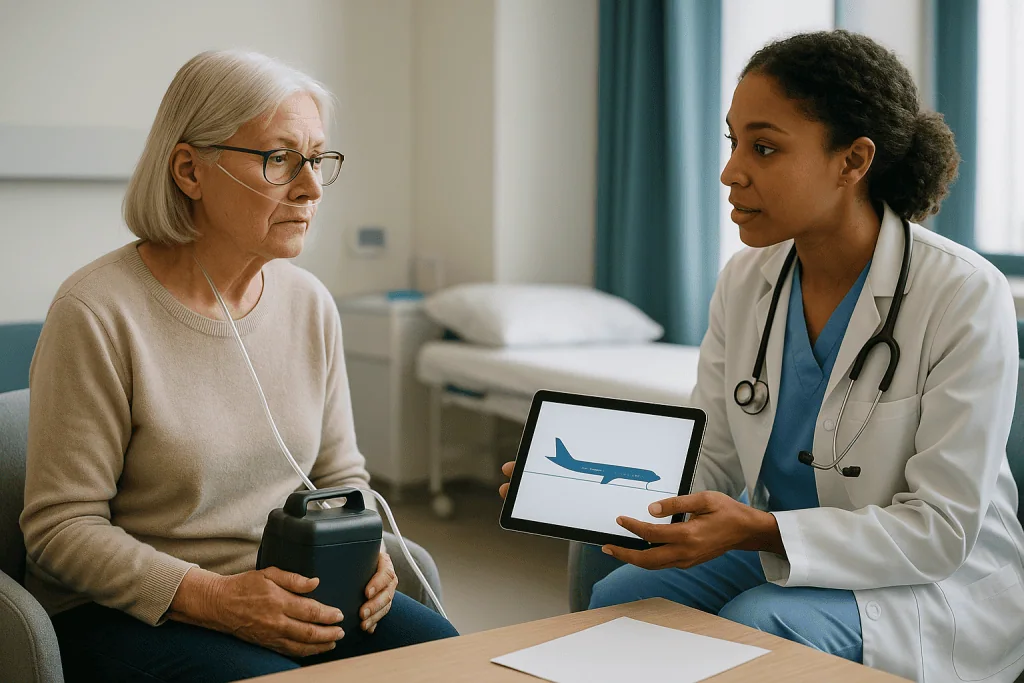
For pulmonary hypertension the two effects are the drop in oxygen itself and the reflex it triggers in the lung’s arteries. Pulmonary pressure rises during the flight and the right heart carries a heavier load for the duration. Short flights expose you for an hour or two; long-haul flights for ten or more, often while dehydrated and immobile.
Breathlessness, a faster heart rate, light-headedness, chest tightness and unusual fatigue are the symptoms people report. The NHS lists these among the warning signs of worsening pulmonary hypertension in general, and a flight can bring them forward in someone who is borderline at sea level.
Three variables shape the risk. Flight duration matters because exposure is cumulative. Your baseline saturation matters because it sets how much reserve you have before oxygen delivery becomes critical. Right-heart function matters because a chamber already working near its limit has little capacity to absorb an extra load.
This is the reason specialists ask about the flight, not just the destination. A two-hour hop with a good baseline may need nothing more than a letter and a plan. A fourteen-hour overnight sector for someone with reduced saturation is a different proposition, and that is where the question of supplemental oxygen comes in.
Do I need in-flight oxygen with pulmonary hypertension?
Not everyone does, and the answer is not guesswork. Specialist respiratory and pulmonary hypertension teams have a structured way of deciding, and it starts with your oxygen saturation at rest.
If your saturation is normal and your condition is stable, many teams judge the cabin tolerable without extra oxygen. If it is reduced, or if you already use oxygen at home, the usual assumption is that you will need it in the air, often at a higher flow than usual because the cabin removes a further margin.
For the uncertain middle ground there is a test. A hypoxic challenge test, sometimes called a fitness-to-fly test, has you breathe a gas mixture with reduced oxygen for a short period in a clinic while your saturation and symptoms are monitored. It simulates cabin conditions and lets the team see how your body responds rather than predict it. A walk test, which measures how far you can walk in a fixed time and what your saturation does on the way, often supports the decision.
Deciding on oxygen is only half the job. The other half is working out the mechanism:
- Portable oxygen concentrators draw in cabin air and concentrate the oxygen; airlines generally require an approved model and enough battery life for the flight plus a margin.
- Airline-supplied oxygen exists on some carriers and must be requested in advance, usually with a medical form completed by your clinician.
- Compressed oxygen cylinders are typically not permitted as carry-on items.
Whichever route applies, the request, the form and the prescription for flow rate come from your team. Airlines will not assess your need; they will check that someone qualified has.
How far ahead to arrange oxygen, forms and airline approval
The single most common reason oxygen plans fall apart is time. Airlines, concentrator suppliers and clinics each need days to weeks, and the steps happen in sequence rather than in parallel.
A sensible order looks like this. First, the pre-travel review with your specialist, ideally well before booking so the itinerary can still change. Second, any testing the team wants, such as the hypoxic challenge, which is booked through the clinic and may have its own waiting time. Third, the airline’s medical clearance form, which your clinician completes and the carrier’s medical department reviews; many airlines ask for this at least a couple of days before departure and some ask for considerably longer. Fourth, confirmation in writing from the airline that your equipment or their supply is approved for every sector, including connections on partner carriers, which may apply different rules.
Battery planning deserves its own line. Carriers commonly require portable concentrator batteries sufficient for the scheduled flight time plus a buffer, often expressed as a percentage of flight duration, and they will ask you to prove it at check-in. Delays on the ground and at the gate count against that total.
Carry a short, dated medical letter in plain language that states your diagnosis, your medicines by generic name, your oxygen requirement, any implanted device or pump, and your specialist’s contact details. Keep one paper copy and one digital copy. At security and at the gate it answers most questions before they are asked, and in an emergency abroad it is the document a stranger will read first.
None of this is complicated. It is just slow, and the calendar is the enemy of a good plan more often than the diagnosis is.
Cabin altitude, destination altitude and your oxygen: a comparison
Numbers help here because the words “high” and “moderate” mean different things to a hiker and to a cardiologist. The table uses approximate figures from the CDC’s altitude guidance to show how oxygen availability and the typical specialist stance change with elevation. Your own thresholds come from your team.
| Setting | Approximate elevation | Oxygen available versus sea level | General stance for stable pulmonary hypertension |
|---|---|---|---|
| Sea-level city | 0–500 m | About 100% | Usual baseline; standard travel planning |
| Aircraft cabin at cruise | Up to about 2,400 m equivalent | Roughly 75–80% | Review needed; oxygen for some, especially on long sectors |
| Moderate-altitude city | 1,500–2,500 m | Roughly 75–85% | Specialist review; slow arrival, rest days, oxygen for some |
| High altitude | 2,500–3,500 m | Roughly 65–75% | Often discouraged; individual assessment only |
| Very high altitude | Above 3,500 m | Below about 65% | Generally advised against |
Two things stand out. A long flight is physiologically close to a day at a moderate-altitude resort, which surprises people who have flown without trouble but worry about a mountain town. The second is that oxygen availability does not fall in a straight line with elevation; the drop steepens as you climb, so the difference between 2,000 and 3,000 meters is larger than it looks on a map.
Use the table to frame questions, not to self-clear. Your saturation at rest, your response on exertion and your right-heart function are the inputs that convert these generic figures into a decision for you.
Clots, cabin pressure and swollen ankles: the mobility basics that matter
Long periods of sitting slow the blood flow in the legs, and slow-moving blood is more likely to clot. The NHS lists travel lasting longer than about four hours as a recognized trigger for deep vein thrombosis, the clot that forms in a deep leg vein. For most travelers that is an occasional-risk footnote. For someone with pulmonary hypertension it carries extra weight, because a clot that breaks off travels to the lungs, and lungs with already narrowed arteries have less capacity to absorb a blockage. In one form of the disease, chronic thromboembolic pulmonary hypertension, old clots are the cause of the condition itself.
The protective habits are unglamorous and well supported. Stand and walk the aisle when the seatbelt sign allows, and flex the ankles and calves regularly in the seat. Choose an aisle seat if it makes moving easier. Drink water steadily and treat alcohol and sedatives with caution, since both reduce movement and the cabin is already dry. Avoid crossing the legs for long stretches.
Compression stockings are often suggested for longer flights; whether they suit you, and what grade, is a question for your team, because leg swelling in pulmonary hypertension can also reflect right-heart strain rather than simple pooling.
Anyone already prescribed an anticoagulant (a blood-thinning medicine) should not change it for a trip without specific advice, and should carry it in hand luggage with the generic name on the label. If your team feels extra clot protection is needed for a particular journey, that is a prescribing decision they will make with you.
Leg swelling that is new, one-sided, painful or warm after a journey is a reason to seek care promptly rather than wait for it to settle.
Carrying medicines across time zones and borders
Pulmonary hypertension treatments work by relaxing or remodeling the lung’s arteries through several pathways, and most need to be taken at consistent intervals to keep pressure controlled. A missed or delayed dose does not usually cause an instant crisis, but gaps add up, and some therapies, particularly continuous infusions of prostacyclin-type medicines through a pump, have a short duration of action and must not be interrupted.
Hand luggage is the only place for medicines. Checked bags are delayed, lost and exposed to temperature extremes. Pack more than the trip requires, split between two bags if traveling with a companion, and keep everything in original pharmacy packaging with your name on the label. A copy of the prescription and the clinician’s letter travels alongside.
Time zones trip people up. The simplest approach, which many specialist teams suggest, is to work out with your team before departure whether to keep the home schedule by the clock or shift gradually, and to write the plan down in both local and home time. Phone alarms set to the new zone take the guesswork out of it.
Some medicines used in pulmonary hypertension have handling needs. Certain injectable or infused therapies require refrigeration or protection from heat; some pump cassettes must be mixed within a set time. Suppliers and specialist nurses can advise on travel cases, spare pump parts and what to do if a device fails abroad. That contingency plan should exist on paper before you leave.
Import rules differ between countries, and a few medicines that are routine at home are controlled elsewhere. Check the destination’s requirements through official channels and carry documentation. All of this is logistics, not a reason to alter what you take; that decision stays with your prescriber.
Planning follow-up abroad when traveling with pulmonary hypertension
The most useful thing you can pack is not a device but a route to care. Pulmonary hypertension is uncommon enough that a general emergency department may not have managed it recently, and your usual team cannot see you from several thousand miles away. Planning follow-up abroad means closing that gap before you need it.
Start by asking your specialist whether they know of a pulmonary hypertension service near your destination, or how to find one. Many countries have specialist centers and patient organizations that keep lists. Having the name and number of a center written down, even if you never call it, changes a frightening situation into a manageable one.
Assemble a concise medical summary: diagnosis and its type, the most recent echocardiogram or right-heart catheterization findings in a sentence or two, current medicines by generic name, oxygen requirements, any pump or device details, allergies, and your home team’s contact information. Ask your team to review it. Keep it on paper and on your phone.
If the trip is long, discuss whether any monitoring should happen while you are away. For some people that is nothing more than checking saturation and weight; for others, especially those on infused therapies or newer treatments, the team may want a blood test or a check-in call at a set point.
Travel insurance is a practical rather than a medical matter, but a policy that excludes pre-existing conditions leaves you exposed abroad. Declare the diagnosis fully; a claim denied for non-disclosure helps nobody.
Book a follow-up with your own team for soon after you return. Travel is a stress test, and the first weeks home are when its effects show.
What the days before and after a trip usually look like
A well-planned journey has a shape to it, and knowing the shape takes much of the anxiety out of the trip.
In the weeks before departure, the focus is the specialist review, any fitness-to-fly testing, airline paperwork and medicine supplies. This is also when teams tend to check that nothing has shifted: a quick look at weight, swelling, saturation and symptoms against the last clinic visit. If anything has drifted, postponing is far easier now than from a departure lounge.
In the last few days, pack the medicine bag, charge concentrator batteries and spares, print the letters, confirm oxygen approval for each flight, and set the medicine alarms to destination time. Rest matters more than it seems; arriving already tired narrows your reserve.
On travel day, move early through the airport, use assistance if offered, keep water within reach and keep the oxygen on if it has been prescribed for the flight, including taxi and climb, which are often the phases people skip.
The first day or two after arrival, particularly at any elevation, is when the body is adjusting. The CDC’s altitude guidance notes that most altitude illness appears within hours of arrival, often on the first night, so a gentle schedule for the first forty-eight hours is wise, with no strenuous activity until you know how you feel.
After returning home, expect a few days of fatigue even from a smooth trip. Keep a note of anything that felt different: breathlessness, swelling, how far you could walk. That log, brought to the post-travel appointment, tells your team more than a vague “it was fine.”
What people often get wrong about travel and pulmonary hypertension
Several ideas circulate that are either half right or simply wrong, and each can lead to a poor decision.
“Pulmonary hypertension is just high blood pressure, so if my blood pressure is controlled I can fly.” The two conditions involve different circulations. Arm blood pressure says nothing about the pressure in the lung’s arteries, and a person with normal arm readings can have severe pulmonary hypertension. The question of whether a high blood pressure patient can fly is a separate one, and for most people with controlled systemic hypertension the answer is generally yes; it does not transfer.
“If I felt fine on my last flight I will be fine on this one.” Flights differ in length and cabin altitude, and the condition changes over time. A pre-travel check is about today’s reserve, not last year’s.
“Oxygen on the plane means I am getting worse.” Supplemental oxygen in the cabin compensates for an environment that is harder on everyone. Needing it in the air says nothing about needing it on the ground.
“You can fully recover from pulmonary hypertension if you take the trip easy.” The honest evidence, as summarized by the NHS and Mayo Clinic, is that pulmonary hypertension is a long-term condition. Some causes can be treated at source, surgery helps selected people with the clot-related form, and modern therapy can control symptoms and slow progression, but it is managed rather than reversed.
“COVID gives you pulmonary hypertension.” Severe lung infections, including COVID-19, can leave lung damage or clots that raise pulmonary pressure in some people, and the research is still developing. That is a risk factor in a minority, not a routine consequence.
“I can fly with pulmonary edema if I rest.” Fluid in the lungs is an acute, unstable state. It is a reason not to fly until treated and reviewed.
Questions to ask your care team before you book
A good pre-travel appointment is shaped by the questions you bring. These are the ones that specialist nurses and physicians say they most want asked, phrased so you can use them as they are.
- Given my recent results, is this trip reasonable right now, or would a different time be safer?
- What is my resting oxygen saturation, and do you expect it to fall in the cabin or at my destination’s elevation?
- Do I need a hypoxic challenge or walk test before flying?
- Will I need supplemental oxygen on the flight, and if so, how is it arranged and at what flow?
- Is the destination’s altitude acceptable, and is there an elevation above which you would advise me not to sleep?
- How should I handle my medicine timing across the time-zone change?
- What is the plan if my pump, concentrator or supply fails while I am away?
- Do I need anything extra to reduce clot risk on long flights?
- Is there a pulmonary hypertension center near where I am going, and how would I contact it?
- Which symptoms should make me seek care immediately rather than wait to come home?
- What written documents will you provide, and can I have them in time for the airline’s deadline?
- When should I be seen after I return?
Write the answers down during the appointment or ask for them in a letter. Decisions made in a fifteen-minute consultation have a way of blurring by the time the suitcase comes out, and the written version is also what you will hand to a clinician abroad if you need one.
If anything about the plan feels unclear, say so before you leave. Teams would much rather field a question now than a phone call from a hotel room at 3 a.m.
When to call your doctor: red-flag signs during or after travel
Most trips with pulmonary hypertension go as planned. The point of knowing the warning signs is not to expect trouble but to recognize it early, because early contact with a clinician is what turns a serious problem into a managed one.
Seek emergency care, wherever you are, for any of the following:
- Severe or rapidly worsening breathlessness, especially at rest or lying flat.
- Chest pain or pressure that is new, persistent or spreading.
- Fainting, near-fainting or sudden dizziness on standing or exertion.
- Coughing up blood or frothy pink sputum.
- Blue or gray lips or fingertips, or oxygen saturation well below your usual level despite supplemental oxygen.
- A fast, pounding or irregular heartbeat that does not settle with rest.
- Sudden pain, swelling or warmth in one leg, or breathlessness that began abruptly, which together can signal a clot.
- Confusion or extreme drowsiness.
Contact your specialist team the same day, or the nearest pulmonary hypertension service if abroad, for:
- Steadily increasing leg or abdominal swelling or rapid weight gain over a few days.
- Breathlessness that is worse than your usual baseline but not severe.
- Pump alarms, line problems or any interruption to an infused medicine.
- Running low on medicine or oxygen supplies.
- Symptoms of altitude illness such as headache, nausea and poor sleep that do not improve with rest, and particularly if a cough or breathlessness develops at elevation.
If you are at altitude and symptoms are worsening, descending to lower elevation is the standard first response in CDC guidance while you seek care. If a clinician abroad is unsure how to manage you, your home team’s contact details on the letter you carry are there precisely for that call. Every treatment decision, including whether to continue, pause or change a medicine, belongs to the clinicians caring for you.
Can you fly with pulmonary edema, and other acute situations
Pulmonary edema is fluid in the air spaces of the lungs. It can follow heart failure, severe infection, a reaction at altitude or a worsening of pulmonary hypertension itself, and it is an acute condition rather than a stable one. The question of flying with it has a short answer: not until it has been treated and a clinician has confirmed you are stable. The cabin’s reduced oxygen would act on exactly the physiology that produced the fluid, and the aircraft is the worst place to find out that it is still present.
The same logic applies to other acute situations that people sometimes hope to fly through. A recent hospital admission for worsening right-heart strain, a new clot in the leg or lung, a chest infection that has not resolved, or a change in therapy within the last few weeks are each reasons specialist teams usually ask people to delay. The interval varies and is a clinical judgment, not a fixed number; airline medical departments typically defer to the treating team on this point rather than apply their own rule.
Returning home after an acute illness abroad is a special case. If you have been admitted while traveling, the discharging hospital and your home team need to agree that you are fit to fly, and the airline will usually require a fresh medical form. Sometimes that means a few extra days in the destination with monitoring, and occasionally it means a medical escort or supplemental oxygen for the flight home.
None of these scenarios is a reason to avoid travel in the first place. They are reasons to build the plan around stability, keep a margin of medicines and documents, and know that postponing a flight is always an acceptable outcome. Your team would rather you arrive late than arrive unwell.
Frequently asked questions
Can a high blood pressure patient travel in a flight?
Most people with ordinary high blood pressure that is controlled can fly without special arrangements. That condition affects the body’s main circulation and is different from pulmonary hypertension, which affects the lung’s arteries and is far more sensitive to cabin oxygen levels. Anyone with either diagnosis who has had recent changes in treatment, symptoms or hospital care should check with their clinician before booking.
Can you fully recover from pulmonary hypertension?
Pulmonary hypertension is generally a long-term condition that is managed rather than reversed. Some underlying causes, such as certain heart or lung problems, can be treated at source, and surgery helps selected people whose disease is caused by old clots. Modern therapies can control symptoms and slow progression for many people, but the condition usually requires ongoing specialist follow-up.
Can you get pulmonary hypertension from COVID?
Severe COVID-19 can leave lung scarring or blood clots in the lungs, and in some people this raises pulmonary artery pressure. Research on how common and how lasting this is remains ongoing. Pulmonary hypertension is not a routine consequence of infection; it is an uncommon complication seen mainly after severe illness, and persistent breathlessness after COVID should be assessed by a clinician.
Can you fly with pulmonary edema?
Flying with pulmonary edema, meaning fluid in the air spaces of the lungs, is not advised until it has been treated and a clinician confirms you are stable. Cabin air contains less oxygen than air at sea level, which worsens the physiology that causes the fluid. Airlines typically require medical clearance after any recent acute lung or heart problem.
Is flying with pulmonary hypertension safe?
Many people with stable pulmonary hypertension fly without problems after a specialist review. Risk rises with longer flights, lower baseline oxygen saturation and weaker right-heart function. Your team may test how you respond to reduced oxygen and may prescribe supplemental oxygen for the flight. A recent worsening or treatment change is usually a reason to delay.
How high can I go with pulmonary hypertension and altitude?
There is no single safe number. CDC guidance treats about 2,500 meters as the level where altitude illness becomes likely even in healthy people, and advises caution or avoidance at high elevation for anyone with pulmonary hypertension. Your specialist will set a personal limit based on your resting saturation, exertion response and heart function, often focusing on sleeping altitude.
Do I need in-flight oxygen for pulmonary hypertension?
It depends on your oxygen saturation and stability. People with normal resting saturation and stable disease often do not need it on shorter flights; those with reduced saturation or home oxygen usually do. A hypoxic challenge test can settle uncertain cases by simulating cabin conditions. The prescription and airline paperwork come from your clinician, not the airline.
How do I arrange oxygen on a plane?
Ask your specialist for the airline’s medical clearance form and a prescription for the flow rate. Check the carrier’s rules on approved portable concentrators and battery duration, and request airline-supplied oxygen where offered. Confirm approval in writing for every sector, including partner airlines. Start several weeks ahead, as clinics and airlines each need time.
What should I pack for traveling with pulmonary hypertension?
Keep all medicines in hand luggage, in original packaging, with more than the trip requires. Carry a dated clinician letter listing your diagnosis, generic medicine names, oxygen needs, any pump details and specialist contacts, plus a copy of prescriptions. Add spare concentrator batteries, a pulse oximeter if you use one, and contact details for a pulmonary hypertension center near your destination.
Can pulmonary hypertension patients travel long distances by car or train?
Ground travel avoids cabin altitude but still involves hours of sitting, which raises clot risk, and mountain routes can climb to significant elevation. Plan regular stops to walk, stay hydrated, check the maximum altitude of the route and keep medicines and documents within reach. A specialist review before a long overland journey is sensible, especially if your condition has changed recently.
References
This article is for general information only and is not a substitute for professional medical advice. Please consult a qualified doctor about your individual situation.
Add us as a Preferred Source to see more of our trusted health content across Google Search, AI Overviews and Discover.

More from the Blog

Heart Rate in AFib: What Counts as Too Fast and When It Needs Urgent Care
There is no single number that makes an AFib heart rate dangerous, but a resting rate that stays above 110 beats per minute, and…

Valve Repair vs Replacement, Mechanical vs Biological: How Heart Valve Surgery Is Chosen
Surgeons generally prefer to repair a leaking or narrowed heart valve when a durable repair is technically possible, especially for the mitral valve, and…

What Is Normal on Pulmonary Embolism Treatment and When Bleeding Means Calling Your Team
On pulmonary embolism treatment, anticoagulants (blood thinners) make small bruises, slightly longer bleeding from cuts, and occasional minor gum or nose bleeding more common,…

When Does a Cardiologist Order an Echocardiogram? Murmurs, Breathlessness and Follow-Up
A cardiologist usually orders an echocardiogram when something suggests the heart's structure or pumping may be affected: a new or changed heart murmur, unexplained…
How Echocardiography and Cardiac Imaging Locate a Clot Before Cardiac Thrombosis Treatment
Echocardiography uses sound waves to build moving pictures of the heart, and a clot usually appears as a distinct mass inside a chamber or…

Sternum Pain: Where the Breastbone Sits, Costochondritis and Other Causes and When to Seek Care
Sternum pain most often comes from the chest wall itself: costochondritis, an inflammation of the cartilage that joins the ribs to the breastbone, or…