

Ultrasonic (Piezo) Rhinoplasty: What the Instrument Changes About Bone Work and Bruising

Key Takeaways
- The piezo tip vibrates at ultrasonic frequency and abrades bone while largely sparing elastic soft tissue, which is why its claimed benefit is confined to the bony upper third of the nose.
- Small randomized trials report less bruising and swelling around the eyes in the first week than chisel-and-mallet osteotomies, but no demonstrated difference in long-term appearance.
- Most ultrasonic bone work needs an open approach, so a technique marketed as gentler may add a small columellar incision that a closed conventional rhinoplasty would avoid.
- Operating time is generally longer with the device, and wider lifting of the periosteum can add to early swelling over the bridge even as eye bruising falls.
- Splint removal at about a week, return to desk work at around two weeks and no strenuous exercise for four to six weeks apply to both techniques (NHS).
- Tip swelling can take up to a year to fully settle (Mayo Clinic) because it depends on lymphatic regrowth, which no bone instrument alters.
Ultrasonic rhinoplasty, also called piezo rhinoplasty, reshapes the nasal bones with a fine tip that vibrates at ultrasonic frequency instead of a chisel and mallet. The vibrating tip cuts bone while largely sparing soft tissue, and small trials suggest somewhat less bruising and swelling in the first week. It changes how bone is cut, not what cartilage, breathing or tip work involve, and long-term results appear similar.
The consultation is nearly over when the surgeon mentions, almost in passing, that the bone work will be done with the ultrasonic device. The patient nods. Ten minutes later, in the parking lot, she is typing ultrasonic rhinoplasty into her phone and finding a wall of city names and glossy promises about gentler surgery and half the bruising.
She is asking the right question, just in the wrong place. Whether a piezoelectric tip or a steel osteotome cuts the nasal bones is a real technical choice with real consequences for the first week after surgery. It is also a much smaller decision than the marketing implies, because the bones are only the upper third of the nose, and the rest of the operation is unchanged.
This explainer separates the two. It describes what the instrument physically does, what the trials have actually measured, where the trade-offs sit, and how to read your own healing without mistaking a normal week three for a problem.
What is ultrasonic rhinoplasty, in plain terms?
Strip away the branding and ultrasonic rhinoplasty is a nose reshaping operation in which the bony part of the nose is cut and smoothed with a piezoelectric instrument rather than with hand tools. A piezoelectric instrument is a handpiece whose tip vibrates tens of thousands of times a second, driven by crystals that flex when electricity passes through them. The word piezo is Greek for pressure; it has nothing to do with lasers, and no beam of anything touches the face.
Everything else about the operation is ordinary rhinoplasty. The surgeon still works under general anesthesia or sedation, still lifts the skin and soft tissue off the underlying framework, still shapes cartilage with scissors and sutures, and still closes with the stitches and splint that MedlinePlus and the NHS describe for any nose reshaping. The ultrasonic tip appears for one specific job: the bone.
That job is smaller than the marketing suggests but larger than skeptics allow. The upper third of the nose is bone; the lower two-thirds are cartilage. Humps, width at the bridge and crookedness of the upper nose all involve bone, so how the bone is handled shapes both the result and the first week of healing. Cartilage is not cut with the ultrasonic tip in routine use, which is why the device changes bone work and bruising, not the whole procedure.
Because the tip has to rest directly on bone, most surgeons use it through an open approach, meaning a small incision across the columella, the strip of skin between the nostrils, joined to incisions inside the nose. That detail matters when people ask whether the technique is less invasive, and we return to it below.
How does the piezo instrument actually cut bone?
Picture the difference between tapping a chisel through a board and running a fine saw along a pencil line. A conventional osteotome, the surgical chisel used to cut nasal bone, is advanced with light taps of a mallet, and the bone gives way along a path the surgeon guides but cannot fully see. The energy travels through the bone, which is why small unplanned cracks radiating from the cut line are a recognized hazard.
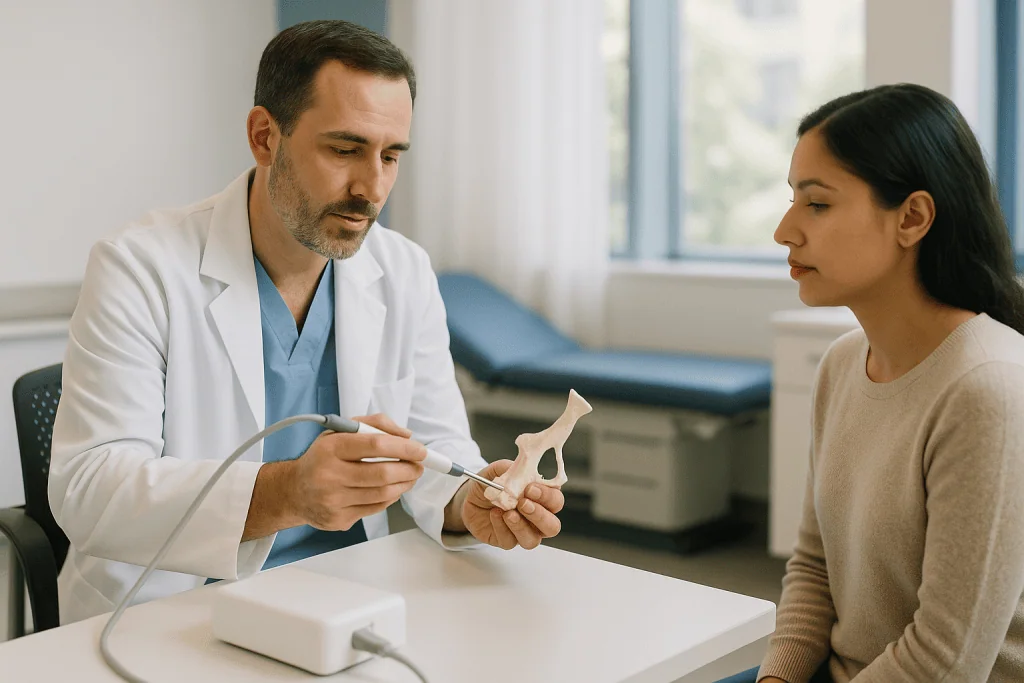
The ultrasonic tip works differently. Its vibration is tuned so that stiff, mineralized bone fractures into fine dust under the tip, while softer, more elastic tissues such as skin, the nasal lining and blood vessel walls tend to move with the vibration rather than tear. The selectivity is not absolute. A tip held firmly against soft tissue long enough will still injure it, and heat becomes a concern if the cooling irrigation fails. Under normal use, though, the surgeon can rest the tip on bone beside a vessel with a margin a chisel does not offer.
Two families of tips exist. Saw-shaped inserts make straight cuts, the osteotomies that let bones move inward to close a gap or straighten a deviation. Rasp-shaped inserts grind bone gradually, shaving a hump down in fractions of a millimeter, so the surgeon can pause, feel the profile through the skin, and continue. Saline runs constantly over the tip to carry heat away and wash out dust.
The practical consequence is control rather than speed. Bone is removed in small, visible increments, and cuts stop where the tip stops. That mechanism sits behind every claim about smoother bridges and less bruising, and it is the mechanism worth judging.
Why the bone work matters: humps, open roofs and osteotomies
When a bridge hump is removed, the surgeon takes off the top of a roof. Beneath it the two nasal bones met at a peak; once the peak is gone, they stand apart like the walls of a house with the ridge lifted off. Surgeons call this an open roof, and a nose left this way looks flat and wide from the front. Closing it means cutting each bone near where it meets the cheek and moving the two walls inward until they touch again. Those cuts are lateral osteotomies, and they are the most bruise-prone step in rhinoplasty because the line runs close to small vessels that feed the side of the nose and the lower eyelid.
With hand tools, the surgeon feels the chisel through the skin and taps it along a planned path. Experienced hands do this well, and the technique has a century of results behind it. Yet bone can crack beyond the intended line, and the mallet drives force into soft tissue, which bleeds into the loose skin under the eyes.
An ultrasonic saw makes the same cut as a slot rather than a fracture. Bone on either side of the slot is undisturbed, and the vessels alongside are more likely to be nudged aside than sheared. The bones can then be moved inward by hand with less risk of an uncontrolled break.
The hump itself changes too. A rasp tip grinds the profile flat in stages instead of slicing it off in one pass, lowering the chance of a step or spur visible under thin skin. Cleveland Clinic lists an uneven-looking nose among the recognized risks of rhinoplasty, and this incremental approach is where surgeons who favor the device say it earns its place.
Where rhinoplasty bruising actually comes from
Bruising after a nose operation is not a mystery. Blood escapes from small vessels cut or torn during surgery, pools in the loosest tissue nearby, and the eyelids happen to be the loosest tissue on the face. Gravity and the shared drainage between nose and eye sockets do the rest, which is why someone who had nothing done to their eyes wakes up looking as though they did.

Three steps account for most of it. Lifting the skin and soft tissue off the nasal framework opens a broad plane where blood can collect. Cutting bone injures the vessels that run in and along it. Moving bone stretches the periosteum, the thin membrane wrapped around bone that carries much of its blood supply. Each adds to the swelling that peaks in the first two to three days after surgery (Mayo Clinic).
An ultrasonic device addresses the second and third steps. Its cut is narrower and more selective, and moving bones through a clean slot stretches the periosteum less than levering them across a jagged fracture. It does nothing for the first step. In fact, because the tip must see bone directly, the surgeon often lifts periosteum more widely than a hand-tool technique requires, and wide elevation is itself a source of swelling. Whether reduced vessel injury outweighs the extra dissection is exactly the trade-off the clinical trials have tried to measure.
Bruising that has already formed follows its own biology. Broken-down red cells shift from purple to green to yellow over roughly two weeks regardless of instrument, and the NHS notes that bruising and swelling around the eyes typically settle within about three weeks after rhinoplasty. Nothing about the device speeds that chemistry.
Is ultrasonic rhinoplasty better? What the evidence really shows
Better is the wrong word until you specify better at what. Several small randomized trials and pooled analyses, searchable on PubMed under piezoelectric osteotomy in rhinoplasty, compare the device with conventional osteotomes. The most consistent finding is reduced periorbital ecchymosis and edema, the medical terms for bruising and swelling around the eyes, in the first days after surgery, most clearly at the first postoperative check. Several studies also report fewer irregular or unplanned bone cracks when the bone is inspected or imaged.
The evidence has clear limits. Most trials enroll a few dozen patients per group, follow them for weeks rather than years, and grade bruising with scoring systems that depend on the observer. Many are single-surgeon series, so what is measured includes that surgeon’s comfort with the tool. Operating time is usually longer with the device. When studies look at long-term appearance, patient-reported satisfaction or revision rates, differences between the techniques tend to shrink to statistical noise.
Read plainly: the device seems to make the first week gentler for many patients and gives the surgeon a more controlled way to cut bone. It has not been shown to make noses look better a year later, and no guideline body recommends it over hand instruments as a standard of care. Mayo Clinic frames rhinoplasty outcomes in terms of surgeon experience and realistic goals rather than any single tool, and that framing survives scrutiny.
So the honest answer to whether ultrasonic rhinoplasty is better runs like this: modestly, for early bruising and bone precision, on limited data; unproven, for the result you will live with. A surgeon comfortable with both approaches is best placed to say which suits your particular bones.
Piezo rhinoplasty vs traditional osteotomes: a side-by-side view
The table below summarizes what generally differs and what does not. Treat it as orientation rather than a scorecard; many surgeons combine elements of both, and the right column for you depends on your anatomy and their training.
| Aspect | Conventional osteotomes and rasps | Ultrasonic (piezo) instrument |
|---|---|---|
| How bone is cut | Chisel advanced by mallet taps; controlled fracture | Vibrating saw or rasp tip; slot cut or gradual grinding |
| Adjacent soft tissue | Force transmitted; vessels can be sheared | Relative sparing of elastic tissue; still needs care and cooling |
| Unplanned bone cracks | Recognized risk, especially in thin bone | Reported less often in comparative studies |
| Early bruising and swelling | Typical; peaks at two to three days | Often reduced in the first week in small trials; peaks at the same time |
| Surgical approach | Open or closed (incisions inside the nose only) | Usually open, with wider exposure of bone |
| Operating time | Shorter for the bone steps | Generally longer |
| Cartilage and tip work | Standard techniques | Unchanged; the tip is not used on cartilage |
| Long-term appearance | Depends on surgeon and healing | No demonstrated difference |
Two rows deserve emphasis. The approach row explains why a technique advertised as gentler can involve a small external incision that a closed conventional rhinoplasty would avoid; whether that trade is worthwhile is a conversation, not a given. The long-term row is the one brochures skip. The NHS reminds patients that the final shape of a reshaped nose takes around six months to settle, and by then the instrument used on the bone has left no signature anyone can see.
Who ultrasonic rhinoplasty is usually for, and who is asked to wait
The device earns its keep where bone is the problem. A prominent hump that will leave an open roof, a bridge that is wide or asymmetric, a nose bent after an old fracture, or a revision in which earlier cuts left the bone thin or irregular: these are the situations in which surgeons most often reach for it. Thick bone that resists hand rasping and brittle bone that shatters under a chisel are both, for different reasons, candidates.
It offers little to the person whose concern is a drooping or bulbous tip, a hanging columella or nostril shape, because those are cartilage and soft tissue matters the tip does not touch. Someone set on a purely closed operation with no external incision may also be steered elsewhere, since most surgeons need open exposure to see the bone they are cutting.
Who is asked to wait follows general rhinoplasty rules rather than anything specific to ultrasound. Mayo Clinic and the NHS describe waiting until facial growth is complete, usually in the mid to late teens, and surgeons routinely ask people to stop smoking well before surgery because nicotine narrows the small vessels the skin depends on to heal. Uncontrolled high blood pressure, bleeding disorders, medicines that affect clotting and active nasal infection are reasons to postpone. Those decisions belong to the surgical and anesthetic team, never to a blog.
A quieter group is also asked to wait: people whose expectations the surgeon cannot meet. Mayo Clinic is explicit that rhinoplasty aims to improve features realistically rather than produce a perfect nose, and a request framed around a photograph of someone else’s face often opens a longer conversation about goals, and sometimes about body image support, before any date is set.
What are the disadvantages of ultrasonic rhinoplasty?
Every instrument buys something at a price, and honest surgeons list the price beside the benefit. The first disadvantage is exposure. To rest the tip on bone, the surgeon usually lifts the periosteum more widely than hand tools require. Wide lifting can mean more swelling over the bridge in the weeks after early bruising fades, and some studies showing less eye bruising also show no reduction, or a slight increase, in swelling over the nose itself.
The second is time. Grinding bone in fractions of a millimeter takes longer than removing it in a pass or two, and comparative studies typically record longer operating times. A longer operation means longer anesthesia, and while modern anesthesia is safe for healthy adults, duration is one of the variables anesthetists weigh.
The third is the approach. Most ultrasonic work is done through an open rhinoplasty, adding a small scar across the columella. It usually heals inconspicuously, but a person whose nose could have been reshaped through a closed operation is accepting an incision they might otherwise have skipped.
Heat is a fourth, technical concern. A vibrating tip generates warmth, and if irrigation falls short the bone edge can be damaged, which may slow healing at the cut. Good technique manages this, yet it is a failure mode chisels do not have.
Then comes the learning curve. Surgeons trained for years with osteotomes develop a tactile sense of bone through skin; the ultrasonic tip demands a different feel, and early cases may not match later ones. Finally, the device does nothing for cartilage, so anyone told it will transform tip refinement or breathing has been handed a promise the technology cannot keep.
Piezo rhinoplasty recovery time: the first days and weeks
Recovery after a piezo operation follows the same arc as any rhinoplasty; the device may soften the first chapter, but it does not rewrite the book. Here is the typical shape of it, drawn from NHS and Mayo Clinic patient guidance, with the reminder that your surgeon’s instructions override anything general.
The first night is usually spent at home or, occasionally, in hospital, with the head raised on pillows and a rigid splint taped over the bridge. Nasal breathing is difficult because the lining is swollen, and a small amount of blood-tinged drainage is expected in the first days (Mayo Clinic). Discomfort is generally described as pressure or a dull headache rather than sharp pain; the surgical team prescribes and adjusts whatever is needed.
Swelling and bruising peak around the second or third day. This is where trials suggest the ultrasonic group may look somewhat better, though the range between individuals is wide, and someone with thin, fair skin may bruise more with either technique than someone with thicker skin.
The splint and any external stitches typically come off at about a week (NHS, Mayo Clinic). Most people feel ready for desk work and social life at around two weeks, when bruising has largely yellowed and faded (NHS). Strenuous exercise, swimming and anything risking a knock to the nose are usually restricted for four to six weeks (NHS), because the bones, moved inward through those ultrasonic slots, are still knitting in their new position.
Glasses are often kept off the bridge for a similar period, and vigorous nose blowing is discouraged until the surgeon clears it. Swelling at the tip lingers longest and can take up to a year to fully resolve (Mayo Clinic).
Swelling and bruising run on different clocks
People merge the two, and the confusion produces a lot of needless anxiety around week three. Bruising is blood outside vessels. It is loudest early, changes color as the body breaks the blood down, and is gone or nearly so within about three weeks (NHS). This is the variable the ultrasonic device most plausibly improves, because it is the variable most directly tied to how vessels beside bone are handled.
Swelling is fluid, not blood. It accumulates because surgery inflames tissue and because the lymphatic channels that normally drain the nose have been cut and must regrow. Swelling over the bony bridge tends to settle within weeks, but swelling at the tip, where skin is thickest and lymphatics slowest to recover, can take months; Mayo Clinic advises that up to a year may pass before the final contour shows.
The ultrasonic tip has no effect on lymphatic regrowth, and the wider exposure it often requires may add slightly to early bridge swelling. So a person may find their eyes clear faster than a friend who had conventional surgery while their nose looks equally puffy at six weeks. Neither is a sign that something went wrong.
A practical way to hold this: judge bruising in days, bridge swelling in weeks and tip swelling in months. Photographs taken every couple of weeks in the same light are more reliable than the mirror, which magnifies day-to-day fluctuation from salt, sleep position and hormones. Surgeons sometimes see residual firm swelling they may choose to treat in clinic, and that judgment, along with any medicine involved, sits with them rather than with a schedule you read online.
What the instrument does not change
It is tempting to imagine that a modern device modernizes the whole operation. It does not. Anesthesia is the same, whether general or sedation with local, and carries the same small risks MedlinePlus lists for any surgery: reaction to medication, breathing problems and bleeding. The incisions are the same or, as noted, slightly more extensive. The splint, any internal supports, the stitches and the follow-up schedule are unchanged.
Cartilage work is unchanged. The tip, the septum that divides the airway, and the spreader or strut grafts a surgeon may place to keep the airway open after a hump is removed are all trimmed and sutured with conventional instruments. Since most of the artistry in rhinoplasty happens in cartilage, most of what determines whether you like your nose is untouched by ultrasound.
Breathing is unchanged. A deviated septum, enlarged turbinates or collapsing nasal valves are treated with septoplasty, turbinate reduction or grafting, and those steps are performed the same way alongside either bone technique. Anyone told that ultrasonic rhinoplasty will improve airflow should ask which specific step will do that, because the answer is not the ultrasonic tip.
The general risk profile is unchanged too. Cleveland Clinic and Mayo Clinic describe infection, poor wound healing, persistent numbness of the nasal skin, asymmetry, a hole in the septum and the possibility of revision. Trials of the device have not shown these risks to fall.
What changes, then, is narrow and real: how bone is cut, how cleanly it moves, and how the first week around the eyes tends to look. That is a legitimate reason to feel reassured by a surgeon who uses it. It is not a reason to choose a surgeon because they use it.
What people often get wrong about ultrasonic rhinoplasty
The first misunderstanding is that ultrasonic means non-surgical or scarless. It is a full operation under anesthesia, most often through an open approach with an external incision, and nothing about the vibration reaches the skin from outside.
The second is that it is a laser. Lasers use light and heat to vaporize tissue; the piezo tip is a mechanical vibrator that abrades bone. The two share nothing except a marketing tendency toward the futuristic.
The third is that no bones are broken. Ultrasonic osteotomies cut bone. The cut is a clean slot rather than a fracture, and the bones are then repositioned. Whether that counts as breaking is a matter of words; the anatomy is that bone is divided and moved in both techniques.
The fourth is that recovery is dramatically faster. Trials point to less bruising in the first week. The splint still comes off at about a week, exercise is still restricted for four to six weeks, and the final shape still takes around six months to a year (NHS, Mayo Clinic). Planning a wedding around a promise of half the downtime means planning around a claim the evidence does not support.
The fifth is that it guarantees a smoother result. Incremental rasping reduces the chance of a step under thin skin, but final smoothness depends on how cartilage meets bone, how skin redrapes and how the individual heals. A perfectly ground bone under an unevenly healed soft tissue envelope still looks uneven.
The last is the belief that a surgeon who does not use the device is behind the times. Many excellent rhinoplasty surgeons prefer hand instruments, and the outcomes literature does not separate the two camps on long-term results. Ask not which tool a surgeon owns but how many noses like yours they have reshaped, by any method.
Questions to ask your care team
A good consultation is a conversation about your bones, not a demonstration of equipment. These questions keep it there, and none of them has a right answer that applies to everyone.
- Which parts of my nose are bone and which are cartilage, and which parts will the ultrasonic tip actually be used on?
- Would you recommend an open or closed approach for my nose if you were using hand instruments instead, and does the device change that choice?
- How many rhinoplasties like mine have you done with each technique, and what made you choose one over the other in cases similar to mine?
- What do you expect my bruising and swelling to look like at day three, at one week and at one month, and what would make you concerned?
- If my breathing is part of the plan, which specific steps address it, and how are they separate from the bone work?
- How long do you expect the operation to take, and how does that affect anesthesia planning?
- What are the most common reasons your patients need a revision, and how does the device affect or not affect those?
- What should I stop, start or avoid before surgery, and who on the team decides that for medicines I already take?
Notice that several of these questions invite the surgeon to argue against the device for your particular case. That is deliberate. A clinician willing to say the ultrasonic tip adds little for a nose that is mostly a cartilage problem is giving you more useful information than one who describes it as universally superior. Write the answers down; the details about your own anatomy will matter more than anything general you read here.
When to call your doctor
Most of what happens in the first two weeks after rhinoplasty is uncomfortable rather than dangerous: a blocked nose, a tight splint, eyes that look as though they belong to someone else. Your surgical team will give written instructions, and those come first. Some signs, though, should never be waited out.
Call the surgeon or the number you were given without delay for bleeding that soaks through dressings or runs steadily down the throat and does not slow with gentle pressure and sitting upright; a fever, spreading redness, warmth or foul-smelling discharge that could signal infection; sudden new pain or swelling on one side of the nose after the first few days, which can indicate a collection of blood or fluid under the skin; a splint that has shifted after a knock, or any impact to the nose; clear, watery fluid dripping from the nose, especially with a headache, which is rare but needs prompt assessment; or vision changes, severe eye pain or bulging of an eye, which are emergencies.
Seek emergency care for chest pain, shortness of breath, or pain and swelling in one calf, since any operation carries a small risk of blood clots. Difficulty breathing that is not simply a stuffy nose, a rash with facial swelling, or confusion after taking prescribed medicine also warrant immediate help.
Beyond emergencies, keep every scheduled follow-up even when things feel fine. The one-week visit is when the splint comes off and the bones are checked; the later visits are where slow tip swelling and any small irregularities are assessed, and where decisions about further treatment, if any, are made by the team who knows your nose.
Frequently asked questions
Is ultrasonic rhinoplasty better than traditional rhinoplasty?
Not overall, on current evidence. Small randomized trials suggest less bruising and swelling around the eyes in the first week and fewer unplanned bone cracks, but studies of long-term appearance, satisfaction and revision show no consistent difference. The device changes only the bone steps, so surgeon experience and the cartilage work still determine most of the result. Ask your surgeon which technique suits your specific anatomy.
How much does ultrasonic rhinoplasty cost?
We do not publish price figures, because they vary with the facility, the anesthetic, the complexity of the operation and whether functional airway work is included, and quoting one number would mislead. Ask the care team for a written, itemized estimate covering surgery, anesthesia, facility fees, follow-up visits and how a revision would be handled, then compare like with like rather than headline figures.
How long does it take to recover from ultrasonic rhinoplasty?
About the same as any rhinoplasty. Bruising and swelling peak at two to three days, the splint and stitches come off at around a week, most people return to desk work at about two weeks, and strenuous exercise is restricted for four to six weeks (NHS, Mayo Clinic). The ultrasonic technique may ease the first week, but the final shape still takes six months to a year to settle.
What are the main ultrasonic rhinoplasty disadvantages?
Longer operating time, the need for an open approach with wider exposure of bone, possible extra swelling over the bridge from that exposure, heat risk if irrigation is inadequate, and a learning curve for surgeons trained with hand tools. It does nothing for cartilage, the tip or breathing. None of these is a reason to avoid it; they are reasons to ask how they apply to your nose.
Does ultrasonic rhinoplasty hurt less?
Trials measure bruising and swelling more often than pain, and pain findings are mixed. Rhinoplasty discomfort is usually described as pressure, congestion and a dull headache rather than sharp pain, and that experience is broadly similar with either bone technique. Pain management is planned by your surgical and anesthetic team, who will adjust it to how you actually feel after surgery.
Can ultrasonic rhinoplasty be done as a closed procedure without an outside scar?
Usually not. The vibrating tip must sit directly on exposed bone under direct vision, so most surgeons use an open approach with a small incision across the columella joined to incisions inside the nose. Some experienced surgeons use limited ultrasonic tips through closed approaches in selected cases, but that is the exception. If avoiding an external incision matters to you, say so early.
Does the ultrasonic device help breathing or a deviated septum?
No. Breathing problems come from the septum, turbinates or nasal valves, all cartilage and soft tissue structures treated with septoplasty, turbinate reduction or grafting using conventional instruments. Those steps can be combined with either bone technique. If airflow is part of your goal, ask the surgeon to name the specific step that addresses it rather than crediting the ultrasonic tip.
Does piezo rhinoplasty really cause less bruising?
Often, in the first week, according to several small randomized trials that compared it with chisel-and-mallet osteotomies. The likely mechanism is a cleaner bone cut that spares nearby vessels. The effect is modest and variable; skin thickness, blood pressure control, head elevation and individual healing all influence bruising, and by about three weeks (NHS) bruising has largely faded with either technique.
Is ultrasonic rhinoplasty suitable for revision surgery?
It is commonly considered for revisions, because bone left thin, irregular or scarred by a previous operation can be difficult to cut predictably with a chisel and may shatter. The controlled slot cut and gradual rasping suit that situation. Whether it is appropriate depends on what actually needs correcting, since many revision problems involve cartilage or soft tissue, which the device does not treat.
Will the result look different from a traditional rhinoplasty?
Once healed, no visible signature distinguishes the two. Surgeons who favor the device report smoother bridges with fewer steps under thin skin, but the final contour depends on how cartilage meets bone, how skin redrapes and how you heal over six to twelve months (NHS, Mayo Clinic). Choose a surgeon for experience with noses like yours rather than for the instrument they use.
References
- NHS: Nose reshaping (rhinoplasty)
- Cleveland Clinic: Rhinoplasty (nose job)
- MedlinePlus Medical Encyclopedia: Rhinoplasty
- PubMed, piezoelectric osteotomy in rhinoplasty (literature search)
This article is for general information only and is not a substitute for professional medical advice. Please consult a qualified doctor about your individual situation.

More from the Blog

Are Lip Lift Results Long-Lasting? How the Upper Lip Ages After Surgery
A lip lift removes a narrow strip of skin beneath the nose, and because removed skin does not grow back, the shorter distance between…

Cheek Augmentation Risks: Implant Shifting, Asymmetry and Numbness Explained Honestly
Cheek augmentation risks include implant shifting or malposition, visible asymmetry, numbness or altered sensation in the cheek and upper lip, infection, bleeding, fluid collection,…

What Happens During Rhinoplasty? Anesthesia, Incisions and the Steps Inside the Operating Room
During rhinoplasty, you are given general anesthesia or intravenous sedation with local anesthetic, the surgeon makes incisions inside the nostrils (closed approach) or adds…

Why Is a Night Headband Worn After Prominent Ear Surgery? Duration, Sleep and Sports
After otoplasty, the surgery that sets prominent ears closer to the head, a soft headband is usually worn at night so that rolling over…

Which Noses Are Candidates for Revision Rhinoplasty? Breathing, Shape and What Is Assessed
A revision rhinoplasty candidate is usually someone whose nose has fully healed from a previous operation, typically around a year later, and who has…

What Scar Revision Surgery Can and Cannot Do: Realistic Results and the Year-Long Maturation
Scar revision surgery can make a scar narrower, flatter, better aligned with skin creases, or less tight, but it cannot erase a scar; it…