

Upper Endoscopy: What to Expect Before, During and After
Key Takeaways
- The endoscope is about the width of a little finger, and the exam itself usually lasts just 15 to 30 minutes, though plan on two to three hours at the facility.
- Fasting for roughly six to eight hours isn't ritual: an empty stomach both sharpens the camera's view and lowers the risk of stomach contents reaching the lungs under sedation.
- Biopsies are painless because the gut lining doesn't register cutting the way skin does, and taking them is routine practice, not evidence the doctor saw something alarming.
- Sedation impairs reaction time and judgment for up to 24 hours even when you feel sharp, so driving, alcohol, and important decisions all wait until the next day.
- A scratchy throat and gas-related bloating are the two most common aftereffects, and both typically fade within 24 to 48 hours.
- Black tarry stools, vomiting blood or coffee-ground material, fever of 100.4°F or higher, or worsening chest or abdominal pain after the procedure warrant an urgent call to your care team.
An upper endoscopy is a short procedure, usually 15 to 30 minutes, in which a doctor passes a thin, flexible camera through your mouth to examine the esophagus, stomach, and the first part of the small intestine. You typically fast for six to eight hours beforehand, most people receive sedation, and you need a ride home. A mild sore throat and bloating for a day or so are common.
The word that trips people up is never “endoscopy.” It’s “scope.” Somewhere between the scheduling call and the night before, the mind conjures something industrial: a garden hose, a plumber’s snake. Then patients wake up in recovery, ask when things will start, and learn it ended twenty minutes ago.
That gap between expectation and reality is worth closing, because upper endoscopy is one of the most common procedures in modern medicine. Gastroenterologists use it to investigate stubborn heartburn, unexplained anemia, trouble swallowing, and pain that antacids never touch, and to take painless tissue samples while they’re in there.
What follows is the whole arc, hour by hour: the fasting rules and why they exist, what sedation actually feels like, what the doctor can see and even fix on the spot, and which aftereffects are ordinary versus the short list that should send you back to a clinician.
What exactly happens during an upper endoscopy?
Formally, the procedure is called esophagogastroduodenoscopy, EGD for short, and the name is a map of the route. The endoscope travels down the esophagus, into the stomach, and through to the duodenum, the first stretch of the small intestine. That’s the entire journey, roughly two feet of upper digestive tract.
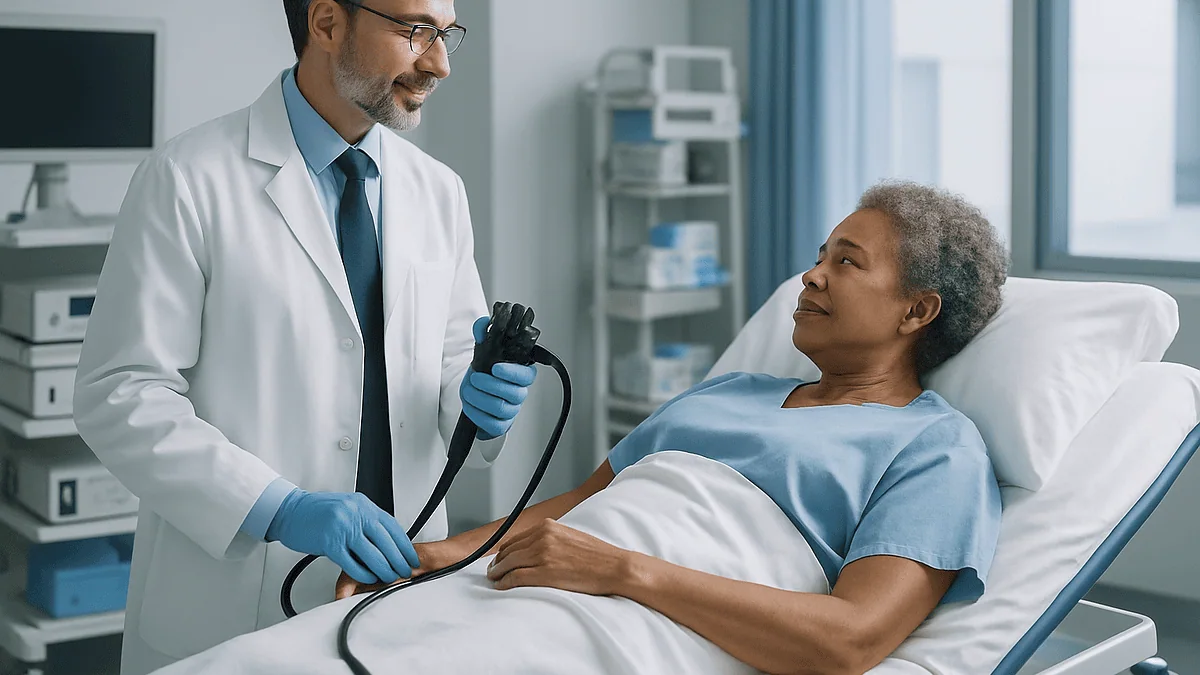
The instrument itself is far less dramatic than most people picture: a flexible tube about the width of a little finger, tipped with a light and a tiny high-definition camera that streams video to a monitor. A narrow channel inside the tube lets the doctor pass miniature tools, forceps for tissue samples, snares, clips, without a single incision.
To see the walls of the stomach clearly, the endoscopist gently inflates it with air or carbon dioxide, the way you’d open a collapsed paper bag before looking inside. That puff of gas is why bloating and burping are the most predictable aftereffects, and it’s also why the images are so detailed. The camera can pick up inflammation, ulcers, abnormal tissue, and sources of bleeding that no blood test or X-ray would reveal.
Two things the procedure is not: it is not surgery, and it does not interfere with breathing. The scope travels down the esophagus, the food pipe, not the windpipe. You breathe normally, on your own, the entire time, which is a fact worth repeating to yourself the night before if swallowing anxieties start to circle.
Why would a doctor order an upper endoscopy?
Usually because symptoms have outlasted the simple explanations. According to the National Institute of Diabetes and Digestive and Kidney Diseases, common reasons include:
- Persistent heartburn or reflux that doesn’t respond to lifestyle changes and standard treatment
- Difficulty or pain with swallowing, or food that feels stuck
- Upper abdominal pain, nausea, or vomiting without a clear cause
- Unexplained anemia or signs of bleeding, such as black stools or vomited blood
- Unintentional weight loss
- Abnormal findings on an imaging test that need a direct look
Endoscopy also plays a surveillance role. People with Barrett’s esophagusa change in the esophageal lining linked to long-standing reflux, return at intervals so doctors can watch for early cell changes. Those with celiac disease may need duodenal biopsies to confirm the diagnosis, since blood tests alone can’t always settle it. Testing stomach tissue for H. pylori, the bacterium behind many ulcers, is another everyday use.
Here’s the part worth internalizing: an order for endoscopy is not a coded message that your doctor suspects something dire. Most upper endoscopies find either nothing alarming or a very treatable problem, inflammation, a small ulcer, a hiatal hernia. The procedure exists precisely because symptoms in the upper gut overlap so much; heartburn, an ulcer, and a motility problem can all feel nearly identical from the inside. Looking directly is how doctors stop guessing.
How is it different from a colonoscopy?
Same family of technology, opposite ends of the digestive tract, and a very different preparation experience, which is the news most patients are happiest to hear.
A colonoscopy examines the large intestine and requires a full bowel cleanse: a day of clear liquids and a laxative preparation that most people rank as the worst part of the whole affair. Upper endoscopy asks only that you show up with an empty stomach, which fasting alone accomplishes. No laxatives, no marathon bathroom evening, no special diet in the days before unless your care team says otherwise.
The procedures also differ in purpose. Colonoscopy doubles as a routine screening test for colorectal cancer in people with no symptoms at all, on a schedule that typically starts at age 45 in the United States. Upper endoscopy, by contrast, is usually a diagnostic tool, ordered because something specific needs investigating, rather than a screening test the general population receives on a calendar. The exception is targeted surveillance for conditions like Barrett’s esophagus.
Timewise, upper endoscopy is the quicker of the two, often finished in under half an hour of scope time. Some patients with symptoms at both ends of the digestive tract have the two procedures done back-to-back under one round of sedation, which spares them a second day of fasting and a second escort home. If that applies to you, ask; combining them is common practice.
How should I prepare in the week before?
The single most consequential conversation happens days ahead, not the morning of: the medication review. Tell your care team about everything you take, prescriptions, over-the-counter products, and supplements. Two categories matter most.
Blood thinners and other medicines that affect clotting may need adjusting before the procedure, because biopsies and any therapeutic work carry a small bleeding risk. Whether to pause, bridge, or continue is an individualized medical decision that weighs your bleeding risk against the reason you take the medicine in the first place. Never stop a blood thinner on your own; the risks of an unplanned pause can outweigh the procedural risk it was meant to prevent.
Diabetes medicines are the second category, since fasting changes how your body handles them. Your team will tell you what to adjust and when.
Beyond medications, mention any history of heart or lung conditions, sleep apnea, swallowing problems, pregnancy, or prior reactions to sedation or anesthesia, all of it shapes the sedation plan. If you use an inhaler, ask whether to bring it.
Then handle logistics. Arrange a responsible adult to drive you home and, ideally, stay with you for a few hours; most centers will not perform sedated procedures without a confirmed escort, and rideshare apps alone usually don’t qualify. Plan to skip work for the rest of the day. None of this is bureaucratic fussiness: it’s the recognition that sedation lingers long after you feel fine.
When do I have to stop eating and drinking?
Fasting is the one preparation you truly cannot fudge, for two reasons. An empty stomach gives the camera an unobstructed view, food debris can hide an ulcer as effectively as fog hides a road sign. More importantly, sedation dulls the reflexes that normally keep stomach contents out of your lungs, so arriving with food on board raises the risk of aspiration. If you eat when you shouldn’t have, say so; rescheduling is a nuisance, but it’s the safe call, and centers handle it all the time.
Exact instructions vary by facility and sedation plan, so your written instructions always override any general guide. A typical countdown looks like this:
| Time before procedure | Typical instruction |
|---|---|
| 6–8 hours | Last solid food and non-clear drinks such as milk or coffee with cream |
| 2–4 hours (if allowed) | Last clear liquids, water, clear juice without pulp, only if your center permits them |
| Morning of | Approved essential medicines with a small sip of water, only as directed |
| At arrival | Nothing by mouth; ride home confirmed; valuables left at home |
A few smaller courtesies to your future self: skip alcohol the day before, wear loose comfortable clothing, and leave jewelry at home. If you wear dentures or a dental appliance, you’ll remove them before the scope goes in, so bring a case. Smokers are usually asked not to smoke on the day of the procedure, since smoking stimulates stomach secretions.
What happens when I check in?
Expect the rhythm of any outpatient procedure: paperwork, a wristband, and more people asking your name and date of birth than seems strictly necessary. That repetition is a safety system, not disorganization.
A nurse will review your health history and medications one more time, check your blood pressure, pulse, and oxygen level, and place a small intravenous line in your hand or arm, usually the only needle of the day. You’ll change into a gown, remove glasses or dentures, and meet the endoscopist and the sedation clinician, who will walk through the plan and answer questions before you sign consent.
Use that conversation. Good questions that take thirty seconds to ask: What level of sedation am I getting? Will you take biopsies routinely or only if something looks abnormal? When and how do I get results? Who calls whom? Patients who ask these up front are consistently the ones least frustrated a week later.
In the procedure room, you’ll lie on your left side on a padded table: the standard position, because it follows the natural curve of the stomach and helps any saliva drain safely out of your mouth rather than pooling. Monitors track your heart rate, blood pressure, and oxygen throughout, and a soft clip on your finger measures oxygen continuously. Many centers spray or gargle a numbing medicine in the throat to quiet the gag reflex; it tastes medicinal and makes swallowing feel oddly distant for an hour or so. Then a plastic mouth guard goes between your teeth to protect both you and the scope, and the sedation begins.
Will I be awake? Sedation, explained honestly
There are three broad approaches, and which one you get depends on the center, your health history, and sometimes your preference, so this is a conversation to have in advance, not a surprise to absorb on the table.
No sedation, numbing spray only. Some centers, and some patients, opt for throat anesthetic alone, occasionally with an ultra-thin scope passed through the nose. You’re fully awake, the exam is uncomfortable but brief, and you can drive yourself home and return to work. This is more common in the UK and parts of Europe than in the US.
Moderate sedation. Medicine through the IV makes you relaxed, drowsy, and largely indifferent to what’s happening. You may drift in and out, and most people remember little or nothing afterward: a memory-blunting effect of the medicines used, not deep unconsciousness.
Deep sedation. Increasingly the US default, this leaves you effectively asleep and unaware, though still breathing on your own. It is lighter than the general anesthesia used for major surgery.
Two reassurances backed by routine monitoring data: your breathing, heart rate, and oxygen are tracked continuously, with a clinician whose only job is watching them; and the near-universal patient report afterward is some version of “that was it?” The most commonly cited unpleasantness isn’t pain but the pre-procedure hunger and the numbing spray’s bitter taste. If you’ve had trouble with sedation before, or you have sleep apnea, flag it: the plan adjusts.
What does the procedure actually feel like?
For the sedated majority, the honest answer is: like nothing, followed by waking up. But since fear of the experience keeps some people from a genuinely useful test, here’s what the awake minority, and the moments before sedation takes hold, actually involve.
The first swallow is the hardest part. As the scope tip reaches the back of the throat, the doctor asks you to swallow, and the tube slips into the esophagus. There can be a brief gagging sensation; the numbing spray blunts most of it, and it passes within seconds. After that, the dominant sensations are pressure and fullness rather than pain. The esophagus and stomach simply don’t have the kind of nerve endings that make skin so touchy: they register stretch, not contact.
When the stomach is inflated for viewing, you feel bloated, the way you might after drinking a carbonated beverage too fast. Burping around the scope is normal, expected, and, endoscopy staff will assure you, utterly unremarkable to them. Saliva is allowed to drain onto a towel rather than swallowed, which feels undignified in prospect and turns out to be a non-event.
What you will not feel: the camera moving through the stomach, biopsies being taken, or most therapeutic work. And a point worth engraving: the scope never enters your airway. Patients who fear choking are describing a sensation, not an anatomical reality. Your breathing passage stays open and unobstructed from the first second to the last.
How long does an upper endoscopy take?
The scope itself is typically in place for 15 to 30 minutes, often toward the shorter end for a straightforward diagnostic look, longer if biopsies, dilation, or treatment of a bleeding site are on the agenda. Mayo Clinic and the NIH both describe the exam in this range, and experienced endoscopists routinely finish uncomplicated cases in under twenty minutes.
The whole visit is another matter, and this is where day-of planning goes wrong for people who budget an hour. A realistic timeline:
- Check-in and pre-procedure prep: 30 to 60 minutes for paperwork, the nursing assessment, IV placement, and consent
- The procedure: 15 to 30 minutes
- Recovery: 30 to 60 minutes while sedation wears off enough for discharge
Add it up and most people are at the facility for two to three hours door to door. Then comes the part that surprises the type-A planners: the rest of the day belongs to the sedation, not to you. Even if you feel sharp by early afternoon, and many people do, reaction time, judgment, and coordination remain measurably impaired for up to 24 hours. That’s the basis for the standard instructions: no driving, no operating machinery, no alcohol, and no signing contracts or making significant decisions until the next day.
The practical upshot: schedule morning procedures if you can, clear your calendar completely, and treat the afternoon as a legitimate excuse for a couch, a mild diet, and a nap. Your body just did quiet work; let it.
What can the scope find, and fix, on the spot?
Diagnostically, the camera sees what indirect tests can only infer. Common findings include esophagitis and gastritis (inflammation of the esophagus or stomach lining), peptic ulcers, hiatal hernias, narrowed segments called strictures, abnormal-looking tissue such as Barrett’s esophagus, polyps, and active or recent bleeding sites. Sometimes the finding is the most valuable one of all: a completely normal upper tract, which redirects the diagnostic search and rules out a long list of worries in one pass.
The biopsy deserves its own paragraph, because the word alarms people out of proportion to the act. Through the scope’s working channel, tiny forceps pinch off a tissue sample smaller than a grain of rice. You cannot feel it, the gut lining lacks the pain receptors that make a skin cut hurt, and there’s no wound to heal in any meaningful sense. Crucially, taking biopsies is routine, not a signal that the doctor saw something ominous. Samples are how labs check for H. pylori, confirm celiac disease, grade inflammation, and characterize any tissue that looks even slightly atypical.
Therapeutically, upper endoscopy often solves the problem in the same session that diagnoses it. Endoscopists can stretch a narrowed esophagus with a dilating balloon, remove polyps or swallowed objects, stop active bleeding with clips or heat, and treat enlarged veins in the esophagus. For patients, this two-in-one quality is the procedure’s quiet superpower: what began as a look around ends as a repair, with no incision and, typically, no memory of either.
What happens right after, in the recovery room?
You’ll surface in a recovery bay, usually 30 to 60 minutes after the procedure ends, with a nurse checking your vital signs at intervals. Waking from procedural sedation tends to be gentle, more like emerging from a heavy nap than from surgery, though grogginess, mild confusion about time, and a scratchy throat are standard issue.
A few recovery-room realities worth knowing in advance:
- You may ask the same question twice. The sedation medicines blunt short-term memory for a while. Staff are used to it; your escort should take notes.
- The doctor’s debrief may not stick. Many endoscopists share visual findings before you leave, but studies of sedated patients show recall of these conversations is poor. Ask for the written summary, most centers provide one automatically, and have your companion listen in.
- Burping is progress. The gas used to inflate your stomach works its way out, and releasing it is the fastest route to comfort. Some centers use carbon dioxide, which the body absorbs faster than air, shortening the bloated phase.
- The first sips come after the numbness fades. Staff will wait until your gag reflex returns, usually within an hour, before offering water, so that swallowing is safe.
Discharge criteria are simple: stable vital signs, ability to drink, manageable comfort, and a confirmed adult to accompany you. You’ll leave with written aftercare instructions and, if biopsies were taken, an expected timeline for results. Then home, where the day’s remaining obligations should be exactly none.
What's normal for the rest of the day, and the day after?
Three complaints account for nearly all post-endoscopy discomfort, and all three are benign.
Sore throat. The scope’s passage leaves the throat scratchy or hoarse in a sizable share of patients. It typically peaks the first evening and fades within 24 to 48 hours. Cool drinks, soft foods, and throat lozenges (once the numbness is fully gone) help; the sensation resembles the tail end of a mild cold more than an injury.
Bloating and gas. Leftover insufflation gas causes fullness, burping, and sometimes cramping for a few hours. Walking around the house genuinely speeds its exit, gentle movement helps the gut move gas along.
Grogginess. Sedation’s fog lifts unevenly. You may feel clear-headed at 2 p.m. and unexpectedly wiped out by 5. Both are normal; neither means anything went wrong.
Eating can usually resume once your throat’s numbness has worn off and you feel up to it, start with something light and bland rather than a celebratory feast, and let your stomach cast the deciding vote. Most people eat a normal dinner the same evening. If biopsies were taken or treatment was performed, you may get specific dietary instructions; those override the general rule.
By the next morning, the typical patient feels entirely themselves: back to work, back behind the wheel, back to coffee. Lingering mild throat awareness for another day is within normal limits. Anything escalating rather than fading belongs in the next section.
How safe is upper endoscopy? The real risks, in numbers
Very safe, by the standards of any medical procedure, and the numbers back the reassurance rather than just decorating it. The NIH’s digestive disease institute and Mayo Clinic both classify complications of diagnostic upper endoscopy as rare, with serious events occurring in a small fraction of one percent of procedures. Millions of EGDs are performed in the United States each year, the overwhelming majority without incident.
The recognized risks, in descending order of likelihood:
- Reaction to sedation. The most common category, usually manifesting as temporary drops in blood pressure or breathing that the monitoring team catches and corrects on the spot. This is precisely why continuous monitoring is standard.
- Bleeding. More likely when biopsies are taken or treatment is performed, and even then usually minor and self-limiting. Significant bleeding requiring intervention is uncommon.
- Perforation. A tear in the lining of the esophagus, stomach, or duodenum is the most serious complication and also among the rarest for diagnostic exams, on the order of a fraction of one in a thousand procedures, higher when dilation or other therapy is involved. It’s treatable, but it’s the reason the warning-signs list below exists.
- Aspiration. Stomach contents entering the lungs, which fasting is specifically designed to prevent.
Context matters here. The risks of not looking: a missed ulcer quietly bleeding, an untreated stricture, precancerous tissue evolving unobserved, routinely outweigh procedural risk for people with genuine indications. That risk-benefit arithmetic is the evidence-based case for saying yes when a doctor with a good reason recommends the test.
When should I call a doctor after an upper endoscopy?
Most aftereffects fade on their own within a day or two. A short list of symptoms does not belong in the wait-and-see category, because they can signal the rare complications, bleeding, perforation, or infection, that need prompt attention. Contact your care team, or seek emergency care, if you develop any of the following in the hours or days after the procedure:
- Chest pain, or pain in the neck or upper abdomen that is severe or steadily worsening rather than easing
- Fever of 100.4°F (38°C) or higher, or shaking chills
- Vomiting blood, or vomit that looks like coffee grounds, digested blood takes on that dark, granular appearance
- Black, tarry stools, another signature of bleeding higher in the digestive tract
- Trouble breathing or swallowing that appears or worsens after you’ve left the facility
- A hard, distended, or intensely tender abdomen
- Persistent vomiting, or an inability to keep liquids down
The distinction that matters is trajectory. A scratchy throat that’s a little better each hour is recovery; pain that intensifies overnight is a phone call. Bloating that eases as you burp is gas; a belly that grows harder and more tender is not. When in doubt, call, endoscopy centers field these calls daily, expect them, and would far rather reassure ten worried patients than miss the eleventh. Keep the after-hours number from your discharge paperwork somewhere your companion can find it too, since sedation can blur your own memory of the instructions.
When and how will I get my results?
Results arrive in two waves, and knowing that in advance prevents a week of unnecessary refresh-clicking on the patient portal.
Wave one: what the camera saw. Visual findings are available immediately. Before discharge, the endoscopist or a team member typically summarizes what the exam showed, often with printed images from the scope, which patients find unexpectedly fascinating. Because sedation sabotages memory, the written report matters more than the conversation; ask for it, and let your escort hear the verbal version too.
Wave two: what the lab found. If biopsies were taken, tissue goes to a pathology lab, and those results generally take from a few days up to about two weeks, depending on the tests ordered. Checking a sample for H. pylori is faster than detailed analysis of atypical cells. A longer wait is usually a scheduling reality, not a coded message about severity, labs don’t slow-walk bad news or fast-track good news.
Before you leave, nail down three logistics: who will contact you (or whether results post to a portal), roughly when, and what the follow-up plan is for each plausible outcome. If the plan is a follow-up appointment, book it before the sedation haze makes you agreeable to “we’ll call you.”
And if the endoscopy comes back entirely normal? That’s information, not failure. A clean upper tract rules out structural causes and points the diagnostic conversation toward function, motility, or causes outside the gut: a narrower, smarter search than the one you started with.
Frequently asked questions
Does an upper endoscopy hurt?
For most people, no, sedation means they feel and remember essentially nothing. Without sedation, the exam is uncomfortable rather than painful: a brief gag as the scope passes the throat, then pressure and bloating as the stomach is inflated for viewing. The esophagus and stomach sense stretch, not contact, so the camera’s movement and any biopsies are not felt. A mild sore throat afterward is the most common complaint.
Will I be awake during the procedure?
It depends on the sedation plan, which you should discuss in advance. In the United States, most patients receive moderate or deep sedation through an IV and are drowsy, unaware, or fully asleep, with little or no memory afterward. Some centers offer the exam with only a numbing throat spray, leaving you awake: an option that lets you skip the escort and drive yourself home.
Can I drive myself home afterward?
Not if you received sedation, and most centers will not start the procedure without a confirmed adult escort. Sedation medicines impair reaction time, coordination, and judgment for up to 24 hours, even once you feel normal. Plan for no driving, machinery, alcohol, or major decisions until the next day. If you have the unsedated, numbing-spray-only version, driving yourself home is generally permitted.
How long does the sore throat last?
Usually 24 to 48 hours, peaking the first evening and fading steadily. It’s caused by the scope’s passage and the mouth guard, not by any injury, and it typically feels like the tail end of a mild cold. Cool liquids, soft foods, and lozenges, once the numbing spray has fully worn off, help. A throat that grows more painful over time rather than better is a reason to call your care team.
When can I eat after an upper endoscopy?
Generally once your throat’s numbness has completely worn off, usually within about an hour, and staff will confirm you can swallow safely before discharge. Start with something light and bland; most people eat a normal dinner the same evening. If biopsies were taken or a treatment such as dilation was performed, you may receive specific dietary instructions, and those override the general rule.
Does having biopsies taken mean my doctor suspects cancer?
No. Biopsies are a routine part of upper endoscopy, used to test for the ulcer-causing bacterium H. pylori, confirm celiac disease, measure inflammation, and characterize tissue that looks even mildly atypical. The samples are tiny, smaller than a grain of rice, and painless. Most biopsy results identify common, treatable conditions or come back normal. A longer lab turnaround usually reflects scheduling, not severity.
Should I stop my blood thinner before the procedure?
Never on your own. Whether to pause, adjust, or continue a blood thinner is an individualized decision your prescribing doctor and endoscopy team make together, weighing your bleeding risk during the procedure against the condition the medicine protects you from. Report all blood thinners, including over-the-counter products and supplements that affect clotting, when you schedule, days in advance, not the morning of the exam.
How soon can I go back to work?
Most people return the next day. The procedure itself requires no physical recovery, but sedation impairs thinking and reflexes for up to 24 hours, so working the same day isn’t advised even for desk jobs, and it’s prohibited for driving or safety-sensitive work. If you have the unsedated version with numbing spray only, returning to work the same day is generally fine.
What's the difference between an upper endoscopy and a colonoscopy?
They examine opposite ends of the digestive tract. Upper endoscopy enters through the mouth to view the esophagus, stomach, and upper small intestine, and requires only fasting. Colonoscopy examines the large intestine and requires a full laxative bowel preparation. Colonoscopy is also a routine cancer screening test; upper endoscopy is usually ordered to investigate specific symptoms. Some patients have both done in one sedated session.
How safe is upper endoscopy, really?
Very safe. Major medical sources classify complications of diagnostic upper endoscopy as rare, with serious events occurring in a small fraction of one percent of procedures. The main risks are sedation reactions caught by continuous monitoring, minor bleeding after biopsies, and, most rarely, a perforation of the digestive tract lining. For people with genuine symptoms, the risk of leaving the cause uninvestigated typically outweighs the procedural risk.
References
This article is for general information only and is not a substitute for professional medical advice. Please consult a qualified doctor about your individual situation.

More from the Blog

Whole Genome Sequencing and Polygenic Risk Scores: What Consumer Genomics Can Predict
Whole genome sequencing reads nearly all 3 billion letters of a person's DNA and can reliably identify rare single-gene variants linked to conditions such…
Protein in Urine: What a Urinalysis Finding Means for Your Kidneys
Protein in urine, called proteinuria, means the kidneys' filters are letting protein such as albumin leak through. A single positive result on a urinalysis…
Lynch Syndrome: The Inherited Cancer Risk Worth Knowing About
Lynch syndrome is an inherited condition, caused by a change in one of the DNA mismatch repair genes, that raises lifetime risk of colorectal,…
Genetic Testing: What It Can Detect and How Long Results Take
Genetic testing can detect single-gene conditions such as cystic fibrosis, sickle cell disease and Huntington disease, chromosome differences such as Down syndrome, inherited cancer…
Pap Smear vs HPV Test: What Each Detects and the New Screening Intervals
A Pap smear examines cervical cells under a microscope for abnormal changes, while an HPV test looks for the genetic material of high-risk human…
A Short History of DNA Testing, and How Long a Test Takes Today
Modern DNA testing began in September 1984, when British geneticist Alec Jeffreys developed DNA fingerprinting at the University of Leicester; the first criminal conviction…