

Vagus Nerve Stimulation (VNS) Surgery Step by Step: Neck Incision, Lead and Generator

Key Takeaways
- The implant uses the left vagus nerve because the right one sends more fibers to the heart's pacemaker node, raising the risk of a slowed heart rate during stimulation.
- The operation involves two incisions, one in a neck crease and one below the collarbone, and typically lasts one to two hours under general anesthesia according to the Mayo Clinic.
- Voice wavering timed to the stimulation cycle is the expected signature of a working device, while constant hoarseness or trouble swallowing is a reason to call the team.
- Benefit builds slowly: the Mayo Clinic notes that a reduction in seizures can take months and in some people up to two years to become apparent.
- VNS is an add-on to continued anti-seizure medicines, and any later change to those medicines belongs to the prescribing neurologist.
- Battery life depends on settings, and the Cleveland Clinic describes a range of roughly five to ten years before a generator replacement that reopens only the chest incision.
Vagus nerve stimulation surgery procedure involves two small incisions under general anesthesia: one on the left side of the neck, where a thin lead is coiled around the vagus nerve, and one below the collarbone, where a pulse generator is placed under the skin. The operation typically takes one to two hours, and the device delivers scheduled mild electrical pulses to help reduce seizure frequency in drug-resistant epilepsy.
The folder on the kitchen table has a diagram in it: a nerve drawn as a thick yellow cable running down the neck, a small coil wrapped around it, a disc the size of a pocket watch sitting under the collarbone. Someone has circled the word “generator” in pen and written a question mark beside it. That is usually how the vagus nerve stimulation surgery procedure first arrives in a household, as a sketch and a shortlist of worries.
The worries tend to be practical ones. Will there be a scar on my neck? Does the lead actually touch the nerve? What happens if the battery dies? And the question that sits underneath all of them: what does the surgeon actually do once I am asleep?
This explainer walks through the operation in the order it happens, from the first incision to the first programming visit, with the evidence stated as plainly as the uncertainties. It is written for the person holding that folder, and for the family member reading over their shoulder.
What is the vagus nerve stimulation surgery procedure, in plain language?
The vagus nerve is the longest of the twelve cranial nerves, a two-way cable running from the brainstem down through the neck and chest to the abdomen. It carries signals about heart rate, breathing, digestion and swallowing, and it also carries information upward into the brain. Vagus nerve stimulation, usually shortened to VNS, uses that upward traffic. A small implanted device sends mild, regular electrical pulses into the nerve in the neck, and those pulses travel into brain regions involved in seizure activity and mood regulation.
No one is entirely certain why this reduces seizures. The leading explanation, described by the Mayo Clinic, is that the stimulation alters patterns of electrical activity and neurotransmitter release in parts of the brain that help trigger or sustain seizures. What is clear from the clinical evidence is that the effect is gradual: benefit, when it comes, tends to build over months rather than appearing on the first day.
The hardware has three parts. The pulse generator is a flat, battery-powered unit, roughly the size of a large coin or small watch face, placed under the skin of the upper chest. The lead is an insulated wire ending in small helical coils, which the surgeon wraps gently around the nerve in the neck. The third part lives outside the body: a programming wand or tablet that the clinic uses to adjust the device through the skin, and a handheld magnet the patient can use to trigger an extra pulse or pause stimulation.
The operation itself is not brain surgery. The skull is never opened, which is one reason VNS is often considered when the seizure focus cannot be safely removed. The surgeon works entirely in the neck and chest, under general anesthesia, over roughly one to two hours according to the Mayo Clinic.
Who is VNS usually for, and who is usually asked to wait?
The longest track record is in drug-resistant epilepsy, meaning seizures that continue despite adequate trials of at least two appropriately chosen anti-seizure medicines. UK guidance from NICE and advice on the NHS epilepsy pages position VNS as an add-on treatment for people in this situation who are not suitable for, or who have not been helped by, surgery to remove the seizure focus. It is used in adults and in children, and the device is typically combined with continued medication rather than replacing it.

Outside epilepsy, the Mayo Clinic notes that implanted VNS has regulatory approval in the United States for treatment-resistant depression that has not responded to several other approaches, and for rehabilitation of arm and hand function after ischemic stroke, where stimulation is paired with therapy exercises. Research continues in conditions such as inflammatory disease, chronic headache and heart failure, but those remain investigational, and no implanted device should be described as an established treatment for them.
Several groups are usually asked to wait or to consider other routes first. Someone whose seizures could be eliminated by removing a well-defined focus is generally offered that evaluation first, because resective surgery has the better chance of stopping seizures altogether. People who have not yet had a proper medication review may benefit from that before any implant. A history of certain heart rhythm problems, prior surgery or radiation to the left neck, a lung condition that makes breathing marginal, or an active infection all prompt extra assessment, because the vagus nerve influences heart rate and airway muscles.
The decision belongs to the epilepsy or neuromodulation team working with the patient. They weigh seizure type, frequency, previous treatments, imaging, and what the patient and family hope to gain, and they are the right people to say whether now is the moment or whether something else should come first.
Why the left vagus nerve, and what is "the best point to stimulate"?
People searching for the best spot to stimulate the vagus nerve are usually mixing two very different things: an implanted surgical device and the handheld or ear-clip gadgets sold for wellness. They are not interchangeable.
For the implant, the target is the left cervical vagus nerve, the portion running down the left side of the neck beside the carotid artery and jugular vein. Surgeons choose the left side for an anatomical reason: the right vagus sends a greater share of its fibers to the sinoatrial node, the heart’s natural pacemaker, so stimulating it carries a higher chance of slowing the heart. The left nerve still sends some fibers to the heart, which is why the surgical team tests the device before closing, but it is the safer side. The Cleveland Clinic and Mayo Clinic both describe this left-sided approach as standard.
Within the neck, the lead is placed on a mid-cervical segment of the nerve, below the point where branches to the larynx leave the trunk. That positioning is deliberate. Placing the coil too high would increase effects on the voice box; placing it too low, near the chest, would complicate the exposure and increase the risk of injuring nearby structures.
The auricular branch of the vagus nerve, which supplies a small patch of skin in the outer ear, is the target of non-invasive ear devices. Some external devices applied to the neck are cleared for certain headache disorders. The evidence for these non-invasive approaches in epilepsy is far thinner than for the implant, and they are not substitutes for it. If a wellness product claims to reach the same result as surgery with a clip on the ear, the honest answer is that the research does not support that claim.
Before the day: evaluation and preparation
By the time VNS is on the table, most people have already been through a long diagnostic road: EEG monitoring, MRI of the brain, medication records stretching back years. The epilepsy team uses that history to confirm the seizures are genuinely drug-resistant and to decide whether a resective operation would be the better choice. Only then does a neurosurgeon see the patient to talk about the implant itself.
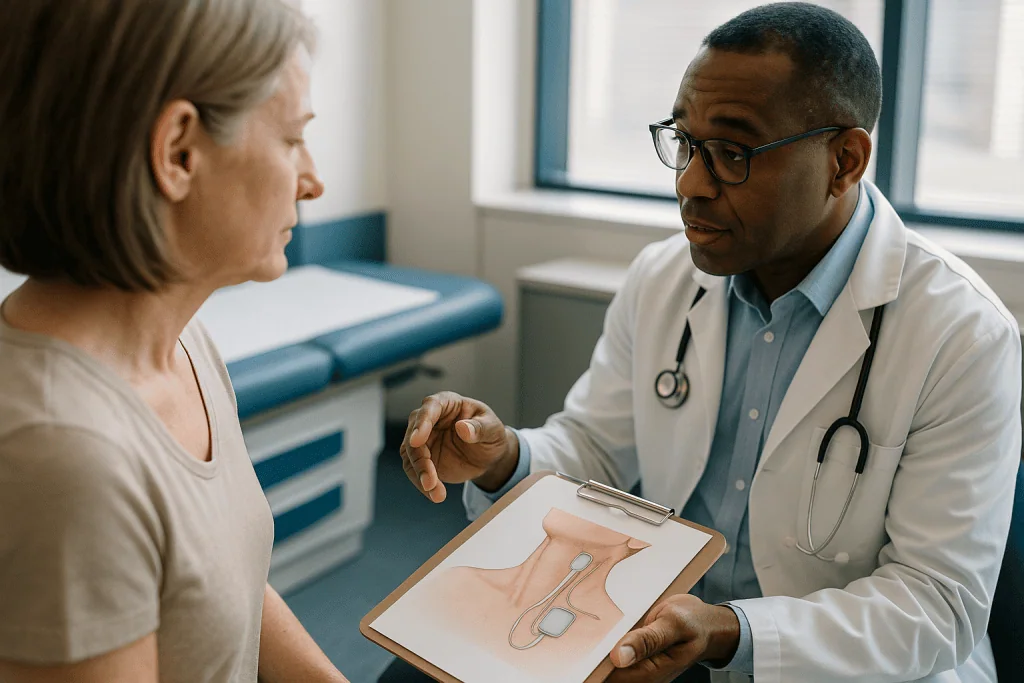
The pre-operative visit covers things that matter directly to the operation. The surgeon examines the neck for scars, lumps or previous procedures. Heart rhythm is checked with an electrocardiogram, since the vagus nerve influences heart rate. Anyone taking blood-thinning medicines is asked about them well ahead of time, because the generator pocket and the neck dissection both bleed if clotting is impaired; whether and when to pause such a medicine is a decision for the prescribing clinician and the anesthetist together, never for the patient alone.
Practical instructions usually include fasting from a set time before surgery, washing with an antiseptic wash if the hospital uses one, and leaving jewelry at home. Anti-seizure medicines are generally continued, often with a small sip of water, because stopping them around an operation raises seizure risk. The exact plan comes from the treating team.
It helps to arrive with a short list of personal priorities. For a parent, that might be how the child will cope with the dressing. For an adult who sings or teaches, it might be the effect on the voice. These conversations shape where the surgeon places the generator pocket and how they counsel about side effects. The Mayo Clinic suggests bringing someone along to help remember what was said, a small piece of advice that pays off on a day when nerves run high.
How is a vagus nerve stimulator inserted? Step one: the neck incision
The patient is asleep under general anesthesia, lying on their back with the head turned slightly to the right and a small roll under the shoulders to open up the left side of the neck. The skin is cleaned and draped. Some teams give a single dose of antibiotic through the drip before the first cut, a routine measure for any implant surgery.
The first incision is on the left side of the neck, usually placed in a natural skin crease roughly level with the voice box so that the scar sits in a line the eye already expects. It is short, often a few centimeters. Beneath the skin lies a thin sheet of muscle called the platysma, which the surgeon divides, and then the edge of the sternocleidomastoid, the large strap muscle that runs from behind the ear to the collarbone.
The surgeon gently retracts that muscle outward and opens the carotid sheath, a tube of connective tissue that bundles three structures together: the common carotid artery, the internal jugular vein and, lying between and slightly behind them, the vagus nerve. Under magnification, the nerve appears as a pale, slightly glistening cord a few millimeters wide.
A length of about three to four centimeters of nerve is freed from the surrounding tissue, enough to seat the coils. This is the most delicate part of the operation. The surgeon avoids stretching or grasping the nerve directly, because traction injury is a cause of later voice problems, and takes care not to disturb small branches heading toward the larynx. Neither the artery nor the vein needs to be cut; they are simply moved aside and protected.
At this stage nothing has been implanted. The surgeon has created a clean, well-lit window onto the nerve, and the next step is attaching the lead.
Step two: attaching the lead to the nerve
The lead is a thin, flexible wire with silicone insulation. At its tip are small helical coils, typically three in the most widely used design: two electrodes that deliver the current and a third anchoring coil that holds the lead steady. Each coil looks a little like a tiny spring that has been cut open along one side.
The surgeon unrolls each coil just enough to slip it around the nerve, then lets it close back to its resting diameter so that it rests snugly without squeezing. Think of fitting a loose ring onto a finger rather than tying a knot. The spacing between the electrodes is fixed by the manufacturer, which is why the length of nerve freed earlier matters.
Once the coils are seated, a short stretch of the lead is laid in a gentle loop beside the nerve and secured to nearby connective tissue with fine stitches. That slack loop is a strain-relief measure: when the neck turns or the head tilts, the loop absorbs the movement so that the coils are not tugged off the nerve. Over time, the body forms a thin layer of scar around the coils, which further stabilizes them.
An electrical check is often done at this point. The team connects the lead to a test device and measures impedance, a reading that confirms the electrodes are in good contact with the nerve and that the wire is intact. A poor reading means the coils are adjusted before the surgeon moves on.
The remaining length of lead is then passed under the skin toward the chest, a process called tunneling, which is where the second incision comes in. From this point on, the nerve itself is not touched again.
Step three: tunneling the lead and placing the generator
The second incision is usually made below the left collarbone, in the upper chest, though some surgeons place it in the armpit crease so the scar is hidden when the arm is down. The choice depends on body shape, clothing preferences, and whether the patient is a child whose chest wall is still growing. In small children, the pocket may be placed more centrally or on the chest wall side to keep it away from the delicate skin fold.
Beneath this incision, the surgeon creates a pocket just under the skin and fat, or in some cases beneath the chest muscle. The pocket is sized to fit the generator snugly; too loose and the device can flip or migrate, too tight and the skin over it can thin.
A long, blunt tunneling tool is then passed under the skin from the chest incision up to the neck incision. It travels just beneath the surface, above the muscle layer, without entering the chest cavity. The free end of the lead is drawn down through this tunnel to the pocket. The route is the reason some people feel a line of tightness between neck and chest in the first weeks.
The lead plug is inserted into the generator header and locked in place with a small set screw. The surgeon checks the connection, then tucks the generator into its pocket and secures it to the underlying tissue with a stitch so it cannot rotate. A rotated generator can coil the lead around itself, a known cause of lead fracture.
With both incisions open and the system connected, the team runs a full function test before closing, described in the next section.
Testing, closing, and what the first hours look like
Before the wounds are closed, the generator is interrogated through the skin with the programming wand. The team confirms the device is communicating, checks lead impedance again, and runs a brief test stimulation. The anesthetist watches the heart monitor closely during this test. In a very small number of cases, the first pulses have produced a marked slowing of the heart or a brief pause, which is why the test is done while the patient is monitored and why the left nerve is chosen. The Mayo Clinic lists this intra-operative response among the uncommon surgical risks.
Both incisions are then closed in layers with absorbable stitches under the skin and either skin glue, tape strips or a fine surface suture. Dressings are applied. The whole operation, from the first incision to the final dressing, typically takes one to two hours, as the Mayo Clinic notes.
Most adults wake in the recovery area with a sore neck, sometimes a scratchy throat from the breathing tube, and a dull ache over the generator pocket. Swallowing may feel awkward for a day or two. Depending on local practice, the person goes home the same day or after one night; outpatient surgery is common, according to the Mayo Clinic, although children and people with other medical conditions are more often kept overnight.
Whether the device is switched on straight away or left off until the first clinic visit varies between centers. Many teams prefer to leave it off for about two weeks so the wounds settle before the nerve receives its first regular stimulation. Either approach is standard; the treating team decides based on their own protocol and the patient’s situation.
Vagus nerve stimulator implant compared with other options
VNS sits within a wider menu of treatments for seizures that medicines alone have not controlled. Seeing them side by side helps explain why a team might steer one person toward the implant and another toward a different route.
| Option | What it involves | Where it fits | Main trade-offs |
|---|---|---|---|
| Further medicine adjustment | Changing or combining anti-seizure medicines under neurology supervision | First step for everyone; continues alongside any device | Diminishing returns after two well-chosen medicines have failed |
| Resective surgery | Removing the brain region where seizures start | When a single, safely removable focus is found | Highest chance of stopping seizures; requires opening the skull and a suitable target |
| Vagus nerve stimulation | Lead on the left vagus nerve, generator in the chest | Drug-resistant seizures when resection is not possible or has not worked | Reduces seizure frequency for many; rarely eliminates seizures; voice and throat side effects |
| Other neuromodulation (responsive or deep brain stimulation) | Electrodes placed in or on the brain | Selected adults with focal or generalized epilepsy at specialist centers | Intracranial surgery; narrower eligibility |
| Dietary therapy | Ketogenic or modified diets under dietitian supervision | Often considered for children; some adults | Demanding to maintain; needs close monitoring |
The table is a map, not a ranking. Resective surgery offers the only realistic path to seizure freedom, which is why a thorough search for a removable focus comes first. VNS earns its place by being reversible, by avoiding the skull entirely, and by being available to people whose seizures arise from several places or from areas that cannot be removed safely. The NHS describes it as a treatment that can help control seizures without being expected to stop them completely, which is a fair summary of where the evidence sits.
VNS surgery recovery time: the following days and weeks
Recovery from the operation is quicker than most people expect, because the wounds are superficial and the body cavities are never entered. Recovery from the condition is a separate, slower story told in the programming section.
The first three or four days are about comfort. The neck feels stiff, turning the head is awkward, and lying on the left side is uncomfortable. Swallowing is usually a little sore. Simple pain relief as advised by the surgical team, cool packs wrapped in a cloth, and sleeping slightly propped up tend to help. Keeping the dressings dry until the team says otherwise reduces infection risk.
By the end of the first week, most adults are moving normally around the house and many return to desk work. Driving is a matter for local law and the epilepsy team: in most places the seizure history, not the operation, decides when someone may drive. Lifting with the left arm is usually limited for a few weeks so the lead is not pulled before scar tissue has anchored it; the surgeon gives a specific limit.
Around two weeks, a wound check and the first programming session typically take place. The Mayo Clinic describes this early follow-up as the point where stimulation is switched on at a low level and the patient learns how the handheld magnet works. Some centers allow showering before this; bathing or swimming generally waits until both incisions are fully sealed.
Scars mature over several months. The neck scar fades along its skin crease; the chest scar sits over a faint bulge where the generator lies. Children’s families often notice the outline more as the child grows, and the surgical team will have placed it with that in mind.
Programming: how the settings are built up over months
Once the wounds have healed, the device is switched on and programmed through the skin. There is no second operation for this; the clinician holds a wand over the generator, and software on a tablet adjusts the output. The parameters are current strength, pulse width, frequency, and the on-off cycle, the pattern of stimulation bursts separated by rest periods that runs continuously, day and night, without the patient doing anything.
The first setting is deliberately gentle. Over a series of visits, often spaced a few weeks apart, the team raises the output in small steps, watching for throat tingling, hoarseness or cough. The goal is the highest level that the person tolerates comfortably, because the evidence suggests therapeutic effect depends on reaching an adequate output. Each visit is short, and nothing about it needs to be done at home.
Expectations deserve honest framing. The Mayo Clinic states plainly that VNS is not expected to stop seizures altogether and that it can take months, in some people up to two years, before a reduction in seizures becomes apparent. The reduction, when it arrives, is measured in frequency and sometimes severity rather than in complete freedom. A good proportion of people also report shorter seizures or faster recovery afterward, but these are observations from clinical follow-up, not promises.
Two features are often introduced in programming visits. The magnet mode allows a patient or carer to swipe the handheld magnet across the generator at the start of a seizure aura to deliver an extra burst. Some newer generators also carry a heart-rate detection mode that triggers a burst automatically when the pulse rises sharply, as it often does at seizure onset. Whether these modes are activated is a clinical decision made for each person.
What are the downsides of vagus nerve stimulation? Side effects and risks
Every honest conversation about VNS covers two different kinds of downside: things that happen during or shortly after the operation, and things that come with living alongside an active device.
Surgical risks, as listed by the Mayo Clinic and Cleveland Clinic, include infection at either incision, bleeding or bruising in the neck, pain, and injury to the nerve or its laryngeal branches. The latter can leave one vocal cord weak, producing a breathy or hoarse voice that sometimes recovers and sometimes does not. A small number of people experience a slowed heart rate during the initial test, which is the reason for close monitoring in the operating room. Lead fracture, lead or generator migration, and skin erosion over the generator are hardware problems that may need a further operation.
Stimulation side effects are more common and are the ones people notice daily. The most frequent, according to the Mayo Clinic, are voice changes or hoarseness, throat pain or tingling, cough, headache, shortness of breath, difficulty swallowing, and tingling or prickling of the skin. Because the pulses arrive on a fixed cycle, many people hear their own voice waver every few minutes while the device is on. These effects usually soften as the nerve adapts and as programming is refined, and they can be eased by lowering settings or, in some cases, by holding the magnet over the device to pause stimulation temporarily.
Less common concerns include worsening of sleep-related breathing problems, since vagal stimulation can affect upper airway muscle tone during sleep. Anyone with known or suspected sleep apnea should raise it before surgery.
Set against these, the device is adjustable and removable. If stimulation does not help after a fair trial, it can be switched off, and the generator can be taken out, although surgeons often leave the coils on the nerve because removing them carries its own risk of nerve injury.
Living with the device: MRI, magnets, scanners and battery changes
A vagus nerve stimulator is a lifelong companion, and a few practical rules follow it.
MRI needs planning. The implanted lead and generator interact with the strong magnetic fields of a scanner, and the risk is heating of the lead where it meets the nerve. Modern systems can be scanned under defined conditions, typically with the device switched off, with specific scanner settings, and with restrictions on which body regions can be imaged. The patient carries a device identification card, and any clinic booking an MRI needs to see it and check the manufacturer’s conditions. A head MRI is often possible; scans of the chest or neck may not be. This is one area where the patient should never assume and should always ask.
Everyday magnets and electronics rarely cause trouble. The Mayo Clinic advises that household appliances, mobile phones and microwaves do not interfere, but that strong magnets held close to the generator, such as those in some speakers or magnetic clasps, can switch it temporarily into magnet mode. Airport security arches are generally safe to walk through; showing the device card avoids confusion if the alarm sounds.
Battery life depends on the output settings and the on-off cycle. The Cleveland Clinic describes a range of several years, roughly five to ten depending on programming, before the generator needs replacing. Replacement is a shorter operation than the original implant, reopening only the chest incision to swap the unit while the neck lead stays in place. The clinic monitors battery status at each programming visit, so a flat battery should never arrive as a surprise.
Diathermy, a form of deep-heat physical therapy, is contraindicated with any implanted stimulator, and any surgeon or dentist planning a procedure should know the device is there.
What people often get wrong about VNS surgery
A handful of myths follow this procedure around, and correcting them early spares disappointment later.
“It’s brain surgery.” It is not. The skull is never opened. The surgeon works on the neck and upper chest, and the stimulation reaches the brain through the nerve, not through any electrode placed inside the head.
“The device replaces my medicines.” VNS is an add-on treatment. The NHS and Mayo Clinic both describe it being used alongside continued anti-seizure medication. Some people are later able to simplify their regimen under supervision, but that is a decision for the prescribing neurologist based on how seizures respond, never something to try alone.
“If it works, it works straight away.” The effect builds over months. The Mayo Clinic notes that noticeable benefit can take up to two years in some people. Judging the device by the first few weeks, when it is still at a low setting, is the commonest reason for early discouragement.
“An ear clip does the same thing.” Non-invasive devices stimulate a small skin branch of the nerve. The evidence base for them in epilepsy is limited and preliminary, and they are not a substitute for an implanted lead on the cervical nerve.
“A sacral nerve stimulator is the same kind of operation.” It is a different device for bladder and bowel control, placed in the lower back. The two get confused in search results, but the anatomy, the surgery and the recovery are unrelated.
“Hoarseness means something has gone wrong.” Voice change timed to the stimulation cycle is the expected signature of a working device. A hoarse voice that is constant, worsening, or accompanied by difficulty breathing is a different matter and belongs in the red-flag section below.
Questions to ask your care team before VNS surgery
The pre-operative consultation goes better when the questions are written down beforehand. These are the ones that tend to matter most, grouped by the stage they relate to.
About suitability: Has a removable seizure focus been fully excluded, and if so, how? What specifically makes VNS a reasonable next step for my seizure type? What does the team realistically hope the device will change for me, and over what timescale?
About the operation: Where will the two incisions sit, and can the chest pocket be placed to suit my clothing or sport? Will the device be switched on in the operating room or at follow-up? How does this team monitor heart rate during the initial test?
About recovery and programming: How long should I avoid lifting with the left arm? When is the first programming visit, and how many visits are usually needed before settings are stable? Who do I contact if voice or throat symptoms become hard to tolerate between appointments?
About living with the device: Which MRI scans will remain possible, and what paperwork do I need to carry? How is battery life monitored, and what does a generator replacement involve? If the device does not help, what happens to the lead on the nerve?
About medicines: Which of my current medicines continue unchanged through surgery, and who decides any later adjustments? The answer should always be the prescribing clinician, and it is worth hearing that said aloud.
A good team will welcome these questions and will give plain answers, including “we don’t know yet” where that is the truth. The purpose is not to test them but to make sure the plan reflects what matters to the person who will carry the device.
When to call your doctor after vagus nerve stimulation surgery
Most recovery questions can wait for the scheduled wound check, but a short list of signs warrants a same-day call to the surgical or epilepsy team, and a few need emergency services.
Call the team promptly if either incision becomes increasingly red, warm, swollen or painful, if it leaks cloudy fluid or pus, or if a fever develops in the first weeks. Infection around an implant can spread along the lead, and early treatment makes a real difference to whether the device can be kept. A rapidly enlarging, tense swelling in the neck in the first day or two may indicate bleeding and should be assessed urgently.
Call if the voice becomes persistently hoarse or weak between stimulation bursts rather than only during them, if swallowing becomes difficult enough to affect eating or drinking, or if there is choking or coughing on liquids. These can point to a problem with the laryngeal branches of the nerve or with lead position.
Call if the device appears to have shifted, if the skin over the generator thins, discolors or opens, or if stimulation suddenly stops being felt. Also report any new or noticeably worse snoring, pauses in breathing during sleep, or daytime sleepiness, because vagal stimulation can affect breathing during sleep.
Treat the following as emergencies: difficulty breathing or noisy breathing, a seizure that lasts longer than five minutes or repeated seizures without recovery in between, fainting or a sustained very slow pulse, or chest pain. The Mayo Clinic and NHS both advise calling emergency services for a prolonged seizure, device or no device.
None of these signs means the decision to have the implant was wrong. They are the cues the care team needs in order to act, and every decision about what to do next sits with them.
Frequently asked questions
How is a vagus nerve stimulator inserted?
A surgeon makes a small incision in a crease on the left side of the neck, exposes the vagus nerve beside the carotid artery, and wraps thin helical coils around it. The lead is tunneled under the skin to a second incision below the collarbone, where it connects to a battery-powered generator placed in a pocket under the skin. The system is tested, then both incisions are closed, all under general anesthesia.
What are the downsides of vagus nerve stimulation?
The most common downsides are stimulation-related: hoarseness or voice change, throat tingling, cough, headache, shortness of breath and swallowing discomfort, which usually ease as settings are refined. Surgical risks include infection, bleeding, vocal cord weakness from nerve injury, and rare heart-rate slowing during testing. Hardware can fracture or migrate, and MRI scanning needs special conditions. The device rarely stops seizures completely, and benefit can take months to appear.
How long is VNS surgery recovery time?
Wound recovery is usually short because the operation stays under the skin of the neck and chest. Most adults are moving comfortably within a few days and back to light activities within a week or two, with lifting on the left side restricted for a few weeks so the lead settles. The first programming visit often takes place around two weeks. Benefit from stimulation itself takes much longer, typically months, as the Mayo Clinic notes.
What is the best point to stimulate the vagus nerve?
For the implanted device, the target is the mid-cervical portion of the left vagus nerve in the neck, chosen because it lies below the branches to the voice box and carries fewer heart-slowing fibers than the right side. Non-invasive ear or neck devices stimulate small surface branches instead. Their evidence base in epilepsy is limited and preliminary, so they are not a substitute for the implanted lead.
How long does it take to recover from a sacral nerve stimulator implant?
A sacral nerve stimulator is a different device, placed in the lower back to treat bladder or bowel control problems, and it is often confused with vagus nerve stimulation in search results. The surgery, anatomy and recovery are unrelated. Anyone considering a sacral implant should ask their urology or colorectal team for the specific recovery timeline for that procedure rather than relying on information about VNS.
What vagus nerve stimulation side effects are most common?
Voice changes are the most frequent, typically a hoarse or wavering quality that appears each time the device delivers a burst. Throat tingling, cough, headache and a sense of shortness of breath during stimulation are also common, according to the Mayo Clinic. These effects usually lessen over months as the nerve adapts and as the care team adjusts the settings, and they can often be reduced by lowering the output.
Is a vagus nerve stimulator implant a form of brain surgery?
No. The skull is never opened. The surgeon works only in the neck and upper chest, placing a lead on the nerve and a generator under the skin. The stimulation travels up the nerve into the brain, which is why VNS is often considered when the seizure focus cannot be removed safely or when seizures arise from more than one region.
Will I still need my seizure medicines after VNS?
Usually yes. Guidance from NICE and advice from the NHS describe VNS as an add-on treatment used alongside continued anti-seizure medicines rather than a replacement for them. Over time, some people are able to simplify their regimen under supervision if seizures respond, but any change is a decision for the prescribing neurologist and should never be attempted independently.
Can I have an MRI with a vagus nerve stimulator?
Often, but only under defined conditions. The lead can heat in a scanner, so modern systems are scanned with the device switched off, with specific scanner settings, and with limits on which body regions can be imaged. Head scans are frequently possible; chest and neck scans may not be. Always show the device card and ask the implanting team before any scan is booked.
How long does the VNS battery last and how is it replaced?
Battery life depends on the programmed output and on-off cycle. The Cleveland Clinic describes a range of several years, roughly five to ten, before replacement is needed. Replacement is a shorter operation that reopens only the chest incision to swap the generator while the lead on the nerve stays in place. The clinic checks battery status at each programming visit, so the timing is planned rather than sudden.
References
- Cleveland Clinic: Vagus Nerve Stimulation (VNS)
- NHS: Epilepsy treatment
- NIH NINDS: Epilepsy and Seizures
This article is for general information only and is not a substitute for professional medical advice. Please consult a qualified doctor about your individual situation.
Add us as a Preferred Source to see more of our trusted health content across Google Search, AI Overviews and Discover.

More from the Blog

Numb Big Toe: Nerve Pressure, Footwear, Circulation and Other Causes
A numb big toe most often comes from pressure on a small nerve: tight or stiff shoes, a bunion, or a position that squashes…

Narcolepsy Treatment: How Medication, Scheduled Naps and Sleep Planning Work Together
Narcolepsy is treated with three things that work together: wake-promoting or stimulant medicines for daytime sleepiness, separate medicines such as sodium oxybate or certain…

Concussion Symptoms: How Soon They Start After a Blow and Whether a Head Impact Is Needed
Concussion symptoms usually begin within minutes to a few hours of a blow, and most appear within the first 24 to 48 hours, though…

What Can Families Do When a Neurodegenerative Disease Is Diagnosed? Support and Planning Ahead
After a neurodegenerative disease diagnosis, families can help most by learning what the specific condition does, agreeing early on who coordinates care, setting up…
Which Tests Confirm Motor Neuron Disease? EMG, MRI and Blood Work in the Diagnostic Path
No single test confirms motor neuron disease. Neurologists combine a detailed examination with electromyography (EMG) and nerve conduction studies to show nerve damage in…

Headache with Dizziness: Common Causes, from Migraine to Dehydration, and the Warning Signs
Headache with dizziness is most often caused by migraine, dehydration, skipped meals, poor sleep, a drop in blood pressure on standing, or an inner-ear…