

Vitiligo Treatment After You Fly Home: Planning Phototherapy and Follow-Up Across Borders

Key Takeaways
- Narrowband UVB for vitiligo typically runs two to three times a week, with visible change taking one to three months and full effect six months or longer, so a treatment started away from home must be continued at home.
- A new clinic cannot safely guess a phototherapy dose; without the written dose record it usually restarts lower, costing weeks of build-up.
- Standardized photographs and Wood's lamp images are the only reliable way to judge progress, because repigmentation begins as tiny dots that memory cannot track.
- Uncontrolled sun on depigmented skin burns easily and can trigger new patches at the injury site, so SPF 30 or higher on patches is standard advice even during light treatment.
- Vitiligo does not shorten life expectancy, but it is linked with autoimmune thyroid disease, which is why clinicians sometimes check thyroid function during follow-up.
- Regained pigment can be lost if the disease reactivates, which is why follow-up plans include review dates and reporting of any new patches.
Vitiligo treatment usually continues for months, so anyone who starts phototherapy or topical treatment while away from home needs a written plan before flying. Ask the treating team for a treatment summary, dated photographs, the phototherapy dose record and a named local prescriber to continue care. Narrowband UVB typically needs two to three sessions a week, and gaps slow progress, so arrange follow-up before you board.
The last session is done. The nurse hands over a folded sheet of paper, the suitcase is half packed, and somewhere between the hotel and the airport a quiet question arrives: who looks at my skin next week?
Vitiligo does not fit neatly into a trip. Phototherapy works in weeks and months, not days, and the people who do best are usually the ones whose care simply carries on, in the same rhythm, wherever they happen to be living. That is why vitiligo treatment follow up abroad is less about where treatment started and more about how well the handover is written down.
This explainer walks through what a good handover contains, what the first weeks at home tend to look like, how to continue light sessions without a gap, and which signs mean a prompt call rather than a patient wait.
Why vitiligo treatment follow up abroad is really a handover problem
Vitiligo is a long-term condition in which the skin loses pigment-producing cells called melanocytes, leaving pale patches that can appear anywhere on the body. The NHS estimates it affects around 1 in 100 people, and it tends to behave in cycles: quiet for months, then active again. A treatment started on one side of a border therefore needs someone on the other side to pick it up, adjust it and watch for side effects.
The medical facts do not change at passport control. What changes is the information. A dermatologist at home cannot see what the previous clinic saw unless the records travel with you. Phototherapy in particular depends on a precise dose record, because narrowband UVB (a specific wavelength of ultraviolet B light delivered in a cabinet or by handheld device) is increased step by step and a new clinic cannot safely guess where to restart.
Three things make the handover work. First, a written summary that states the type of vitiligo, the body areas treated, every medicine used and the reason each was chosen. Second, standardized photographs, ideally taken in the same light and position so change can be measured rather than remembered. Third, an appointment that already exists at home before the plane leaves. Mayo Clinic notes that visible change on light therapy can take one to three months, with the full effect often needing six months or longer, so a gap of several weeks while someone hunts for a new clinic is a real setback rather than a minor delay.
None of this requires special technology. It requires asking for the paperwork while the people who wrote it are still in the room.
How vitiligo phototherapy and topical treatments actually work
Vitiligo is usually described as autoimmune, meaning the body’s own immune system attacks melanocytes. Treatments therefore do one of two jobs: they calm the immune attack, or they coax surviving melanocytes to multiply and migrate back into pale skin. Many plans do both at once.
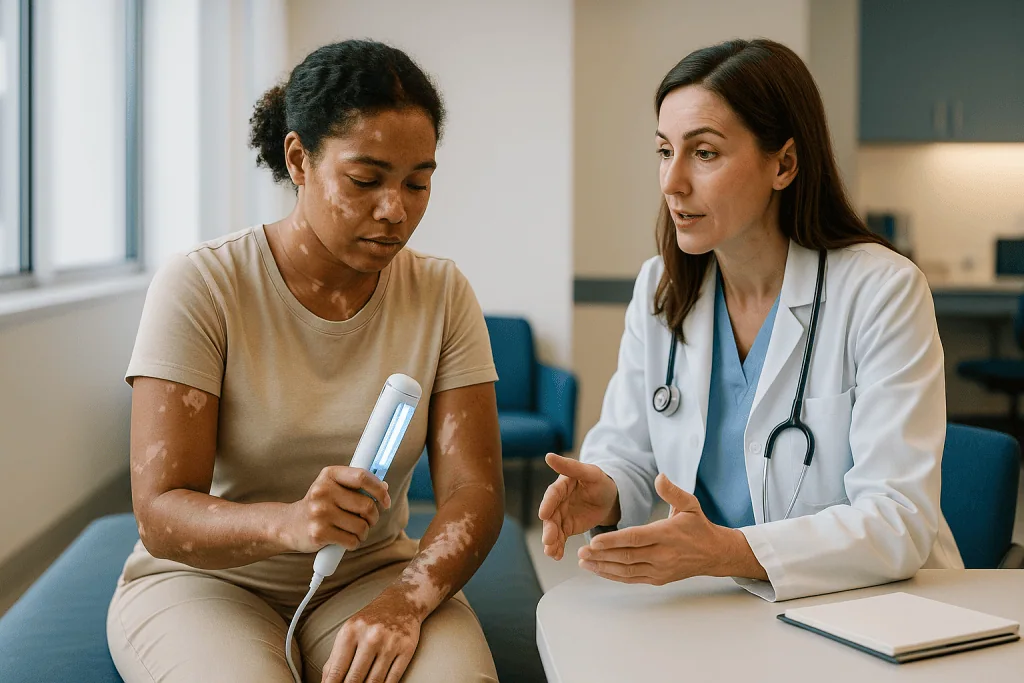
Narrowband UVB sits at the center of most phototherapy. It delivers a narrow band of ultraviolet light that dampens local immune activity and stimulates melanocytes that sit dormant in hair follicles. Repigmentation often starts as tiny dots around hairs, which slowly join up. An excimer laser or lamp uses a similar wavelength aimed only at small patches, which is why it is used for limited areas such as the face.
Topical corticosteroids reduce inflammation in the skin and are commonly used for small areas in short courses, with the prescriber monitoring for thinning of the skin. Topical calcineurin inhibitors (creams such as tacrolimus that quiet a specific immune signal) are often chosen for the face and skin folds where steroid side effects matter most. A newer class, topical JAK inhibitors (a cream such as ruxolitinib that blocks the chemical messengers driving the attack), has been approved in some countries for nonsegmental vitiligo, according to NIAMS. Which option suits a given patient is a prescriber’s decision that depends on site, extent, age and skin type.
Surgical techniques, which transplant pigment cells from unaffected skin, are reserved for stable disease that has not responded to other methods. Depigmentation, which removes remaining color so skin becomes uniformly pale, is considered only for widespread disease and is permanent.
Every one of these approaches needs months to show its effect, which is the single most important fact for planning follow-up.
Who is usually offered phototherapy, and who is usually asked to wait
Phototherapy is typically considered when vitiligo affects a larger area than creams can reasonably cover, when it is spreading, or when the face and hands are involved and the person wants active treatment. Mayo Clinic and the NHS both describe narrowband UVB as a standard option for widespread or stubborn disease, often combined with topical treatment.
Some people are usually asked to wait or to choose a different route:
- Those whose vitiligo is segmental (confined to one side or one body segment, often stable after an early burst) may be steered toward topical or surgical options, since segmental disease responds differently to light.
- Children are treated with care over timing and supervision, and the care team weighs the long commitment of thrice-weekly sessions against the child’s routine.
- People with a history of skin cancer, certain light-sensitive conditions, or who take medicines that increase sun sensitivity need a specific risk discussion first.
- Anyone whose vitiligo is very limited may be better served by topical treatment alone, keeping light therapy in reserve.
Stability also matters. Surgical grafting is generally offered only when no new patches have appeared for a sustained period, because transplanted cells can be attacked just like the originals. Cleveland Clinic describes this as the reason surgery sits late in the sequence.
For the traveling patient, the practical point is that the assessment made at the start of treatment should be written into the summary. A home dermatologist who knows why phototherapy was chosen, and what was ruled out, can continue the plan rather than start the reasoning again. If you were asked to wait on any option, note the reason, because it may change over time and is worth revisiting.
Before you fly: the records that make vitiligo treatment after travel possible
A good handover file is short, specific and portable. Ask for it before the final appointment rather than after, because clinics are better at writing summaries while the case is live.

The core of the file is a phototherapy record. Narrowband UVB is delivered in a dose measured in energy per area of skin, raised gradually from a starting point set for your skin type. The record should show each session’s date, dose, body areas and any reaction such as redness or blistering. A home clinic uses this to restart safely; without it, the usual approach is to drop back to a lower level and build up again, which costs weeks.
Photographs are the second essential. Standardized images taken under the same lighting, at the same distance and with the same body position are the only reliable way to tell whether pigment is returning. Many clinics also use a Wood’s lamp (a handheld ultraviolet light that makes depigmented skin glow chalk-white) to map the true extent, which is useful when patches are hard to see on lighter skin.
Include a medication list by generic name, with start dates and the areas each is applied to, plus the reason for any that were stopped. Add blood test results if thyroid function or other autoimmune screening was done, since vitiligo is linked with thyroid disease and the NIAMS recommends awareness of that association.
Finally, request a contact route: an email address or secure portal for the treating team to answer a home clinician’s question. Ask whether the summary can be written in the language your home dermatologist reads, or in plain English with standard medical terms, which most clinicians can follow. Keep a digital copy and a paper copy; borders and batteries are both unpredictable.
On the plane: skin, sun and clot basics for the journey home
Flying does not harm vitiligo, but two ordinary travel issues deserve attention: ultraviolet light and long periods of sitting.
Skin that has lost pigment burns easily, and skin that has recently had phototherapy or topical treatment can be more reactive still. Cabin windows filter most UVB but let through some UVA, and the real exposure usually comes at the airport, on transfers and at the destination. The NHS advises a sunscreen of SPF 30 or higher with good UVA protection on exposed vitiligo patches, together with clothing and shade. Apply before leaving the hotel, not on arrival, and pack it in hand luggage within liquid limits so it is accessible.
Do not schedule a phototherapy session on the morning of a flight. Most clinics advise avoiding additional sun on treatment days, and a sunburn layered on a treatment dose is the most common avoidable setback.
The clot question applies to everyone on a long flight, not specifically to vitiligo, but it is worth stating. Public health guidance from the CDC recommends standing and walking at intervals on flights longer than about four hours, flexing the calves while seated, staying hydrated and avoiding sedatives that prevent movement. Anyone with a personal history of clots, recent surgery, pregnancy or other known risk factors should ask their own clinician about additional measures before booking rather than at the gate.
If you had a surgical grafting procedure rather than light treatment, the timing of the return flight is a separate conversation with the surgical team, because grafted sites need to stay undisturbed and dressings need checking. Ask for a written aftercare sheet and a named contact for the first fortnight.
Continuing narrowband UVB vitiligo sessions once you are back
Phototherapy is not a course with a fixed end, like antibiotics. Mayo Clinic describes a typical rhythm of two to three sessions a week, with noticeable change taking one to three months and the full benefit often needing six months or longer. The practical task after flying home is to keep that rhythm going with the smallest possible gap.
Start by finding out where narrowband UVB is delivered near home. In many health systems it is offered through hospital dermatology departments and some larger practices, usually on referral from a primary care doctor or dermatologist. Waiting lists exist, which is exactly why the referral should be requested before departure rather than after arrival. A home dermatologist can review the travel file, confirm the plan and book the next session with the dose record in hand.
Home phototherapy units exist and are sometimes used under supervision for people who cannot attend a clinic several times a week. They are prescribed and monitored by a dermatologist, who sets the starting dose, teaches eye protection and schedules reviews. A home unit is not a self-treatment device; the same dose-escalation principles apply, and the same skin checks are needed.
If a gap is unavoidable, tell the new clinic how long it was. After a pause of more than a couple of weeks, clinics commonly restart at a reduced dose, since skin loses its adaptation quickly. That is normal and does not mean the earlier sessions were wasted; the melanocyte activity they stimulated does not vanish overnight.
Keep eye protection, keep the treatment diary, and keep the same body-area list. Consistency, not intensity, is what makes narrowband UVB work.
What the first weeks after flying home usually look like
The weeks after returning tend to feel quiet, and that quiet can be unsettling. Patients often expect the home visit to bring visible proof that treatment worked. Usually it brings a careful comparison of photographs and a decision to continue.
In the first week, the priority is simply getting a home appointment on the calendar and checking the skin for any lingering reaction from the last sessions: pinkness that fades within a day or two is expected, while persistent soreness or blistering is not and should be reported.
By the second to fourth week, most people are either back in a phototherapy chair or using topical treatment as directed while waiting for sessions to begin. This is when the standardized photographs matter most. The home clinician compares them with the travel set and looks for the earliest signs of repigmentation: faint freckle-like dots around hair follicles, or a slight darkening at the edge of a patch.
Across months two and three, the Mayo Clinic timeline suggests change may begin to be visible if it is going to happen. Not every patch responds equally. Face and neck generally repigment more readily than hands, feet and bony areas, where hair follicles are scarce and the reservoir of melanocytes is small.
Throughout, the plan should include a review date rather than an open-ended continuation. Dermatologists commonly reassess after a set number of sessions and decide whether to continue, combine with a topical agent, or pause. New patches appearing during this period are a sign of active disease and should be mentioned promptly, because they may change the strategy.
Expect slow. Plan for slow. The surprise, for most people, is how undramatic good progress looks week to week.
Comparing vitiligo follow-up options after you return
Choosing how to continue depends on what is available locally, how extensive the vitiligo is, and how much travel to a clinic is realistic. The table below summarizes the main routes in neutral terms; the right choice is made with the home care team.
| Option | Typical use | Practical demands | Points to raise with your team |
|---|---|---|---|
| Clinic narrowband UVB | Widespread or spreading nonsegmental vitiligo | Two to three visits a week for months | Referral timing, dose record transfer, waiting list |
| Excimer laser or lamp | Small, limited patches, often on the face | Clinic visits; fewer body areas per session | Whether patches are small enough; availability locally |
| Supervised home phototherapy unit | People unable to attend clinic frequently | Dermatologist prescription, training, regular reviews | Eye protection, dose escalation plan, review dates |
| Topical treatment alone | Limited disease; bridging while awaiting sessions | Daily application; monitoring for skin thinning with steroids | Which class suits which body site; course length |
| Surgical grafting | Stable disease unresponsive to other methods | Procedure plus wound care; stability required first | Evidence of stability; donor site care; follow-up |
| Watchful waiting with sun protection | Very limited or inactive disease; personal preference | Sunscreen, photographs, periodic review | What would prompt a change of plan |
Combination is common. Many clinicians pair light treatment with a topical calcineurin inhibitor or corticosteroid, because the two mechanisms act on different parts of the problem. What the table cannot show is how an individual responds, which is why the review date matters more than the initial choice.
Carrying topical treatments across borders: what matters medically
Creams and ointments are the part of vitiligo treatment most likely to travel in a suitcase, and the questions patients ask are mostly about continuity and safety rather than logistics.
The first point is identification. Keep every topical in its original packaging with the pharmacy label showing your name and the generic name of the medicine. Customs officers, and later your home pharmacist, read generic names; brand names change from country to country and can cause confusion. Carry the prescription or a letter from the prescriber listing each item.
The second point is that topical medicines are prescribed for specific body sites. Topical corticosteroids are chosen by potency for particular areas and used in courses with breaks because long use can thin the skin, cause stretch marks or visible blood vessels. The NHS describes this balance and the need for regular review. Topical calcineurin inhibitors are generally preferred for the face, eyelids and skin folds. A topical JAK inhibitor, where available and approved, is used for nonsegmental vitiligo under specialist supervision and has its own monitoring. A home clinician needs to know which product went where, and for how long, to continue safely.
Third, ask the original prescriber what to do if the supply runs out before the home appointment. The answer will depend on the medicine; some can be paused without harm, others are best continued. That instruction belongs in the handover letter. Do not substitute a similar-sounding product bought without prescription, and do not increase application to make up for missed days.
Finally, storage. Heat degrades some preparations. A cabin bag is cooler than a checked hold in summer, and a car’s glovebox is cooler than nowhere at all.
Vitiligo and sun exposure: why the advice has shifted
For decades, people with vitiligo were told one thing: stay out of the sun entirely. The reasoning was sound as far as it went. Depigmented skin has no melanin shield, burns fast, and a burn can trigger new patches through the Koebner phenomenon (the tendency for vitiligo to appear at sites of skin injury). Sunburn also increases long-term skin cancer risk.
What has changed is recognition that ultraviolet light, carefully controlled, is itself the most established treatment. Narrowband UVB works precisely because a narrow slice of the same spectrum stimulates melanocytes. Mayo Clinic lists light therapy as a central option, and the apparent contradiction dissolves once dose is understood: a measured, gradually escalated dose in a clinic is treatment, whereas an unmeasured afternoon on a beach is injury.
The current position is therefore nuanced. Protect patches from uncontrolled sun with SPF 30 or higher, clothing and shade, as the NHS advises. Do not seek a tan to even out color; tanning darkens surrounding skin and makes patches more visible while adding burn risk. Treat phototherapy as the controlled version of sunlight and keep the two from stacking on the same day.
Vitamin D deserves a word. Strict sun avoidance can lower vitamin D levels, and some clinicians check this, particularly in people with widespread disease or who cover up fully. Whether supplementation is needed is an individual decision for the care team, and the NIH Office of Dietary Supplements provides general guidance on vitamin D without any vitiligo-specific claims.
So the reversal is not from avoid to embrace. It is from blanket avoidance to measured use, with protection against everything unmeasured.
How progress is measured at vitiligo follow up appointments
Vitiligo progress is slow and patchy, and human memory is a poor instrument for it. Follow-up visits therefore lean on objective records.
Photography is the backbone. Clinics typically take images of each affected region under consistent lighting, with the same background, distance and position each time. Some use a Wood’s lamp to sharpen the outline of patches, because under its ultraviolet light depigmented skin fluoresces brightly and borders become unambiguous. If your travel file contains Wood’s lamp images, the home clinic can reproduce them.
Many dermatologists also use scoring systems that estimate the percentage of body surface affected, or that rate change in defined regions. The scores are not something a patient needs to calculate, but it helps to know they exist, because a change in score is often what justifies continuing or adjusting treatment.
What the clinician looks for on the skin itself is instructive. Early repigmentation usually appears as small dots around hair follicles or as a thin rim of color creeping in from the edge of a patch. Patches with white hair growing from them tend to respond poorly, because the follicle reservoir is depleted. Hands, feet, lips and nipples are often the slowest areas.
Disease activity is tracked separately from repigmentation. New patches, patches with faint or blurred borders, or small confetti-like spots suggest active disease and may prompt a change of plan even if treated areas are improving. Note any new patch with a date and photograph before the appointment.
Keep your own simple record between visits: one photo of each area per month, same window, same time of day. It is not a substitute for clinic images, but it stops the slow-progress feeling from turning into discouragement.
What people often get wrong about vitiligo treatment follow up abroad
Several misunderstandings surface repeatedly, and each can cost months.
The treatment is finished when the trip is. It is not. Phototherapy and topical treatment are months-long processes, and a stretch of sessions followed by nothing often leads to fading of early gains. The follow-up is the treatment.
Any clinic can pick up where another left off. Only if the dose record travels. Without it, a responsible clinic restarts at a lower dose, and the build-up takes weeks.
More sun will speed things up. Uncontrolled sun burns depigmented skin, can trigger new patches at the injury site, and does not substitute for measured narrowband UVB. The NHS advises SPF 30 or higher on patches.
Repigmentation is permanent. Regained color can be lost again if the disease reactivates. Many clinicians plan maintenance strategies for that reason, and the decision is theirs to make with you.
Vitiligo is contagious or caused by poor hygiene. It is neither. MedlinePlus and NIAMS describe it as an autoimmune condition with genetic and environmental contributors, not an infection.
Diet or a supplement will clear it. No diet has been shown to reverse vitiligo. Some supplements are studied as add-ons to phototherapy, but the evidence is limited and inconsistent, and they should never replace prescribed treatment. Say exactly what you take to your clinician.
A newer medicine means older ones are obsolete. Topical JAK inhibitors are a genuine advance for some patients, but corticosteroids, calcineurin inhibitors and narrowband UVB remain standard, and which is right depends on site, extent and the individual. Choice sits with the prescriber.
The only thing that matters is the skin. Vitiligo affects mood, confidence and social life. Follow-up that ignores this is incomplete.
Life expectancy, thyroid checks and mood: the wider picture
One of the most searched questions is whether vitiligo shortens life. The answer, from every mainstream source, is that it does not. MedlinePlus and Mayo Clinic describe vitiligo as a non-life-threatening condition that affects skin color and does not damage internal organs. Life expectancy for people with vitiligo is the same as for the general population.
That reassurance comes with a practical footnote. Vitiligo is associated with other autoimmune conditions, most commonly autoimmune thyroid disease, and NIAMS and Cleveland Clinic both note the link. Clinicians therefore sometimes check thyroid function at diagnosis or at intervals, particularly if symptoms such as unexplained tiredness, weight change or feeling unusually cold or hot appear. If this was done before you traveled, the results belong in the handover file; if it was not, raise it at the first home appointment.
Eyes and ears contain pigment cells too, and a minority of people with vitiligo have changes there. These rarely cause problems, but any new visual or hearing symptom should be mentioned rather than attributed to travel fatigue.
The psychological weight of vitiligo is real and well documented. Visible patches, especially on the face and hands, can affect self-image and social confidence, and the NHS lists emotional support as part of care. A good follow-up plan includes a frank conversation about how you are coping, and referral to counseling or support groups where helpful. Camouflage creams and skin-tone products are legitimate tools, not a sign of giving up on treatment, and can be used alongside it.
Vitiligo is a long relationship with your skin and your care team. The aim of follow-up is to make that relationship steady, not to chase a finish line.
Questions to ask your care team before and after you fly
The best handovers happen because the patient asked the right questions at both ends. Take this list to the final appointment before departure and to the first appointment at home.
Before you fly, ask the treating team:
- What type of vitiligo do I have, and is it currently active or stable?
- Can I have a written summary with the phototherapy dose record, body areas treated and every medicine by generic name?
- Can I have copies of the standardized photographs and any Wood’s lamp images?
- If my topical treatment runs out before my home appointment, should I pause or continue, and for how long?
- How soon after the last session should the next one happen, and what happens if there is a gap?
- Were thyroid or other blood tests done, and what did they show?
- Is there a contact route for my home clinician to reach you with questions?
At home, ask the receiving clinician:
- Have you reviewed the travel file, and does the plan make sense to you?
- Where will narrowband UVB sessions take place, and when can the first one be booked?
- Will you restart at the previous dose or a lower one, and why?
- When is the first formal review, and what result would make you continue, change or pause?
- Which body sites should each cream go on, and for how long before a break?
- What signs of active disease or side effects should I report between visits?
- Is emotional support available if I want it?
Write the answers down. The value of these questions is not the asking but the record they leave, which becomes the next handover if you ever move again.
When to call your doctor
Vitiligo itself is not an emergency, but treatment reactions and the conditions that travel with it can need prompt attention. Call your doctor or the treating team without waiting for the scheduled review if any of the following appears.
- Blistering, open sores or severe pain after a phototherapy session, rather than the mild pinkness that fades within a day or two.
- A burn on treated skin, since sunburn can trigger new patches and increases skin cancer risk.
- Rapid spread of pale patches over days to weeks, or many small new spots appearing together, which may signal active disease needing a change of plan.
- Skin thinning, stretch marks, visible small blood vessels or persistent irritation at a site where a topical corticosteroid has been applied.
- Any new mole, a changing mole, or a sore that does not heal, on treated or untreated skin.
- Symptoms suggesting thyroid trouble: marked tiredness, unexplained weight change, feeling unusually hot or cold, palpitations or a swelling at the front of the neck.
- New changes in vision or hearing.
- Low mood, anxiety or withdrawal that is affecting daily life.
Seek urgent medical care, not a routine call, for signs that are unrelated to vitiligo but relevant to recent long-haul travel: a swollen, painful or warm calf, sudden breathlessness, chest pain or coughing blood, which can indicate a blood clot.
If you have had a surgical grafting procedure, contact the surgical team about increasing redness, discharge, fever or a dressing that has lifted, in line with the aftercare sheet they provided.
When in doubt, call. A short message with a photograph is usually welcomed and often resolves the question. Every decision about continuing, changing or pausing treatment rests with your treating team, who know your record and can weigh the risks and benefits for your skin.
Frequently asked questions
Can phototherapy be used to treat vitiligo?
Yes. Narrowband UVB phototherapy is a standard treatment for widespread or spreading nonsegmental vitiligo, often combined with topical creams. It works by calming the local immune attack and stimulating dormant pigment cells in hair follicles. Mayo Clinic describes typical use at two to three sessions a week, with change taking one to three months and full effect often six months or more.
Can vitiligo be permanently reversed?
No treatment currently reverses vitiligo permanently. Treatments can restore color to many patches and slow spread, but the underlying autoimmune tendency remains and pigment can be lost again if the disease reactivates. For that reason dermatologists plan long-term follow-up and maintenance, and research into newer immune-targeted treatments is ongoing. Decisions on continuing or pausing treatment belong to your care team.
What is the life expectancy of people with vitiligo?
Life expectancy is normal. Vitiligo affects skin color and does not damage internal organs, according to MedlinePlus and Mayo Clinic. It is associated with other autoimmune conditions, especially thyroid disease, so clinicians may check thyroid function, but the condition itself is not life-threatening. The main burdens are sun sensitivity and the emotional impact of visible patches.
How do I continue vitiligo phototherapy at home after treatment abroad?
Ask the treating clinic for a written dose record and standardized photographs, then arrange a referral to a home dermatology service before you leave. Narrowband UVB is delivered in hospital dermatology departments and some practices, and a supervised home unit may be an option for those who cannot attend frequently. The home dermatologist decides whether to restart at the previous dose or a lower one.
What should vitiligo treatment after travel include in the handover letter?
The letter should state the type of vitiligo, whether it is active or stable, the body areas treated, the full phototherapy dose record, every topical medicine by generic name with sites and start dates, any blood test results such as thyroid function, and a contact route for questions. Standardized photographs, ideally with Wood’s lamp images, should accompany it.
How many narrowband UVB vitiligo sessions are needed before I see change?
There is no fixed number. Mayo Clinic notes that at two to three sessions a week, visible change can take one to three months, with the full effect often needing six months or longer. Response varies by body site: face and neck tend to repigment more readily than hands, feet and areas with few hair follicles. Your dermatologist sets a review point to decide whether to continue.
Is it safe to fly straight after a phototherapy session?
Flying itself does not affect phototherapy, but most clinics advise avoiding additional sun on treatment days, and airport transfers and destinations can add real exposure. It is sensible not to schedule a session on the morning of a flight, to apply SPF 30 or higher to patches, and to follow general long-haul advice on moving regularly and staying hydrated.
What happens if there is a gap in my vitiligo follow up appointments?
A gap of a few weeks does not erase progress, but skin loses its adaptation to UV quickly, so clinics commonly restart at a reduced dose and build up again. Tell the new clinic exactly how long the pause was. If topical treatment was also paused, follow the prescriber’s written instruction on whether to resume, rather than applying extra to catch up.
Does sun exposure help or harm vitiligo?
Both, depending on control. Measured narrowband UVB in a clinic treats vitiligo; uncontrolled sun burns depigmented skin, can trigger new patches at the injury site, and raises skin cancer risk. The NHS advises SPF 30 or higher with UVA protection, clothing and shade for patches. Tanning to blend color is not recommended because it increases contrast and burn risk.
Can my home doctor change the creams a clinic abroad prescribed?
Yes, and that is normal. Topical corticosteroids, calcineurin inhibitors and, where approved, topical JAK inhibitors are chosen by body site, extent, age and skin type, and availability differs between countries. Your home prescriber reviews the travel record and may continue, swap or pause products. Keep original packaging with generic names so the review is accurate, and never substitute products yourself.
References
This article is for general information only and is not a substitute for professional medical advice. Please consult a qualified doctor about your individual situation.

More from the Blog

Dandruff Myths Corrected: Hygiene, Dryness and Why Washing Less Often Rarely Helps
Dandruff is not caused by poor hygiene or a dry scalp. It is a mild form of seborrheic dermatitis, driven by scalp oil, a…
What Happens During Molluscum Lesion Removal: Numbing, the Procedure and Aftercare
A molluscum removal procedure is a short outpatient visit in which a clinician either scrapes the bumps off with a small spoon-shaped tool (curettage),…

How Is Chronic Urticaria Treated When Antihistamines Are Not Enough? The Next Steps Explained
When antihistamines are not enough for chronic urticaria, international guidelines describe a stepwise pathway: the prescriber first reviews the antihistamine choice and timing, then…
Before Your First Acne Appointment: Products to Pause and What Your Dermatologist Will Ask
Before a first acne appointment, most dermatologists prefer to see your skin as it usually looks, so avoid starting new products, skip harsh scrubs…

Rosacea That Affects the Eyes: Gritty, Red or Watery Eyes That Need Medical Attention
Ocular rosacea is rosacea affecting the eyes and eyelids. Typical eye symptoms include a gritty or burning sensation, redness of the eyes and lid…

How to Stop and Prevent Dandruff for Good: Causes, Treatments and Daily Habits
Dandruff is usually controlled, not cured, by washing regularly with a medicated anti-dandruff shampoo, leaving it on the scalp for a few minutes before…