

What a Scalp Injection Session for Alopecia Areata Involves: Comfort, Timing and Repeat Visits
Key Takeaways
- Alopecia areata scalp injections deliver a corticosteroid directly into the bald patch to suppress the immune cells attacking hair follicles, which are dormant rather than destroyed.
- Each patch is treated individually with a series of shallow, fine-needle injections, so the number of injections depends on patch size, and extensive loss is usually managed with other approaches.
- The injections sting briefly; numbing cream, cold and vibration devices reduce discomfort, and most people leave immediately and resume normal activities.
- Sessions are commonly repeated at intervals of roughly every 4–6 weeks according to Mayo Clinic, with the clinician reassessing after several rounds rather than continuing indefinitely.
- The first regrowth is often fine and white before pigment returns, and the earliest sign is usually texture felt by fingertip rather than visible hair.
- Skin dimpling and lightening at injection sites are the main local side effects, which is why steroid is spread across the patch, kept modest and spaced weeks apart.
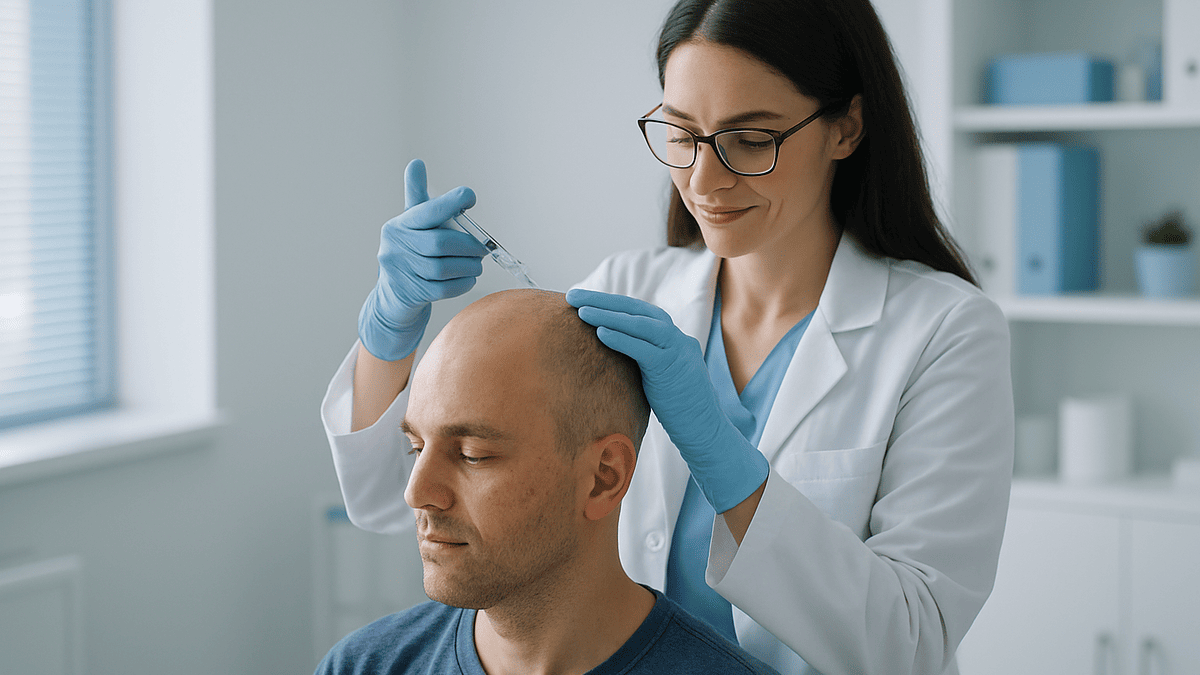
Alopecia areata scalp injections are corticosteroid shots placed just under the skin of a bald patch to calm the immune attack on hair follicles. A session usually involves a series of small, quick injections, feels like brief stings, and is often repeated every few weeks while the dermatologist checks for regrowth. Whether to start, continue or stop is decided with the treating clinician, based on how the patches respond.
The first appointment usually starts with a hand mirror. Someone angles it toward the back of their head, finds the smooth coin-sized patch a hairdresser noticed last month, and asks the question that brought them in: can anything be done, and will it hurt? For many people with patchy hair loss, the answer their dermatologist offers is a course of alopecia areata scalp injections.
The phrase sounds more dramatic than the experience tends to be. Picture a nurse cleaning a small area of skin, a clinician working methodically across the patch with a very fine needle, and the whole thing finished before the parking meter needs feeding. What takes longer is everything around it: understanding why an immune system turned on its own hair, learning what the weeks between visits look like, and deciding how many rounds are worth it.
This explainer walks through that whole arc, from the biology to the follow-up chair, with the evidence stated plainly and the decisions left where they belong, with you and your care team.
Is there any injection for alopecia areata?
Yes, and it has been part of dermatology for decades. The injection most often used is a corticosteroid, a synthetic version of the cortisol your adrenal glands make, delivered directly into the skin of the affected patch. Doctors call this an intralesional injection: intralesional simply means placed inside the lesion, which here is the bald area itself.
Alopecia areata is an autoimmune condition, meaning the body’s own defense cells mistakenly attack a normal tissue. In this case the target is the hair follicle, the tiny pocket in the skin that grows each strand. The follicle is not destroyed; it is pushed into a resting state and stops producing hair. That distinction matters enormously, because a follicle that is asleep rather than gone can wake up. The NIH’s National Institute of Arthritis and Musculoskeletal and Skin Diseases notes that in many people hair regrows on its own, sometimes without any treatment at all.
Injections are one way to nudge that process along. A steroid placed where the immune cells are crowding around follicles suppresses the local inflammation without exposing the whole body to the effects of steroid tablets. The NHS lists steroid injections as a commonly used option for smaller patches of alopecia areata, alongside steroid creams, and Mayo Clinic describes them in the same role.
Two other kinds of scalp injection appear in online searches and deserve a brief word. Platelet-rich plasma, where a person’s own concentrated blood platelets are injected, and botulinum toxin have both been studied for hair loss, but neither is an established, guideline-supported treatment for alopecia areata. Small studies exist; robust evidence does not. If someone offers these for alopecia areata, it is reasonable to ask what evidence they are relying on.
How alopecia areata scalp injections actually work
To understand why a steroid helps, it helps to picture the crime scene. Under the microscope, an active patch of alopecia areata shows a swarm of immune cells, mostly T lymphocytes, clustered around the lower part of the hair follicle like bees around a hive. Dermatologists sometimes describe this as a loss of immune privilege: healthy follicles normally hide from the immune system, and in alopecia areata that camouflage fails.
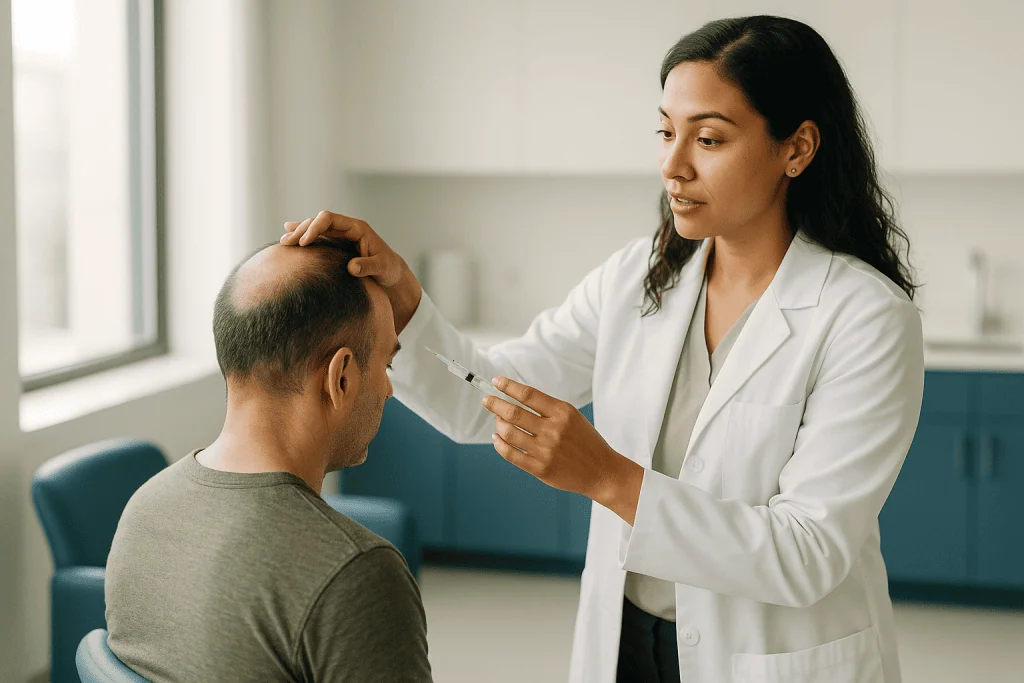
Corticosteroids are broad anti-inflammatory hormones. When a small amount is deposited in the mid-layer of the skin, the dermis, it diffuses into the surrounding tissue and dampens the signaling that keeps those immune cells activated. With the attack quieted, the follicle can shift from its forced resting phase back into the growth phase and produce a new hair shaft.
This explains three things patients notice. First, the medicine only works where it is placed, so each patch has to be treated individually and injections are spaced across the whole bald area. Second, results are not instant: a follicle that restarts growth still has to build a hair that then has to lengthen enough to see. Mayo Clinic describes new growth as something that may become apparent over a period of weeks rather than days. Third, an injection does not change the underlying tendency of the immune system, so new patches can appear elsewhere even while a treated one fills in.
The first hairs to return are often fine and pale, sometimes white, before pigment returns. That is normal biology, not a sign the treatment has gone wrong. The Cleveland Clinic and the NHS both note that regrown hair may initially lack color.
What the injection cannot do is predict the future. Alopecia areata is unpredictable, and a good clinician will say so plainly rather than promise a timeline.
Who is usually offered scalp injections, and who is asked to wait
The typical candidate has a limited number of patches on the scalp, eyebrows or beard, has had them for a while, and wants an active option. Guidance from the NHS frames steroid injections as most useful for smaller areas of hair loss, and Mayo Clinic describes them as an approach for patchy alopecia areata. The logic is practical: each patch needs its own injections, so a scalp with three patches is manageable in a session, while a scalp that has lost most of its hair would need more injections than is sensible or safe.
People with extensive loss, including alopecia totalis (loss of all scalp hair) and alopecia universalis (loss of all body hair), are generally steered toward other strategies, discussed later in this article. Children are often treated more conservatively; many dermatologists prefer creams or watchful waiting in younger patients, both because injections are uncomfortable and because spontaneous regrowth is common.
Being asked to wait is not a brush-off. Because a large share of patchy alopecia areata regrows without treatment, some clinicians suggest observing a new patch for a period before intervening, particularly if it is small or already showing fine regrowth. MedlinePlus and the NIH both describe spontaneous recovery as a real and frequent outcome.
Several situations prompt caution before injecting: an active skin infection at the site, a history of poor reaction to steroids, uncontrolled diabetes (local steroid can nudge blood sugar), pregnancy or breastfeeding (usually a shared decision), or very thin skin in the area from previous treatments. None of these is an absolute barrier in every case; they are reasons for a conversation.
Ultimately the question is not only whether injections could be used, but whether they are the right fit for this person, this patch and this moment. That judgment sits with the dermatologist and the patient together.
What happens during an alopecia areata scalp injection session, step by step
The appointment usually opens with a look, not a needle. The clinician examines the patches, may photograph them for comparison at later visits, and sometimes uses a handheld magnifier called a dermatoscope to check for signs of active disease, such as short broken hairs that taper toward the scalp. If there is any doubt about the diagnosis, a small skin sample (biopsy) may be discussed, though most cases are diagnosed by appearance alone.
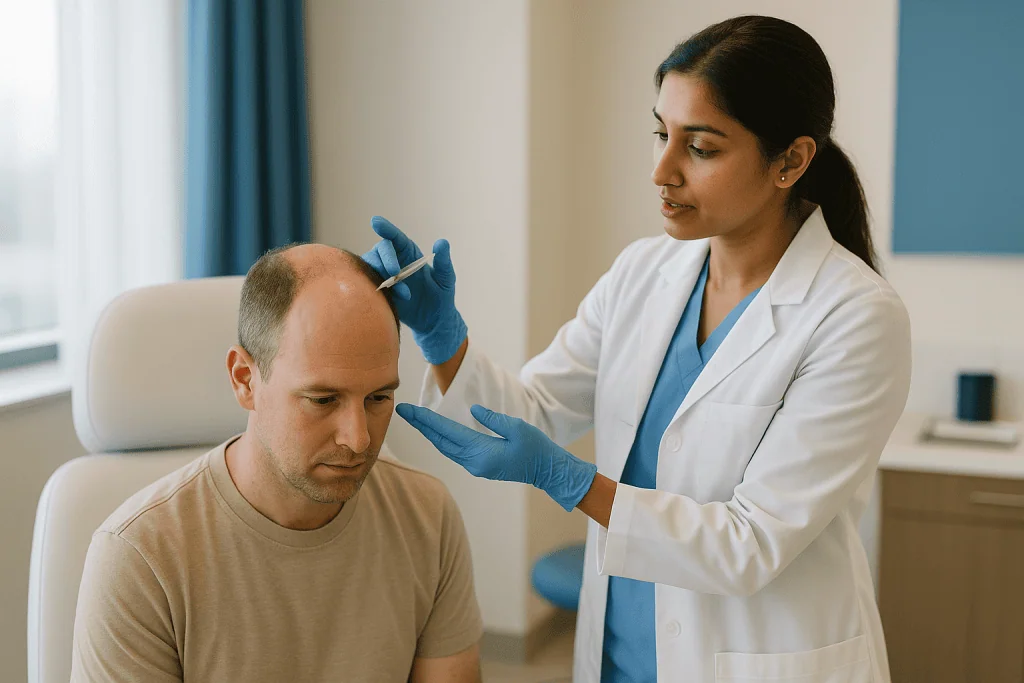
Preparation is minimal. There is no need to fast, shave or wash the area in a special way, though arriving with clean, product-free hair makes the clinician’s job easier. Some clinics apply a numbing cream and let it sit before starting; others rely on cooling sprays, ice packs or a vibrating device held nearby to distract the nerves. Ask ahead of time what your clinic offers so you know what to expect.
The skin is cleaned with an antiseptic swab. The clinician then works across the patch with a very fine needle, placing small deposits of steroid into the dermis at intervals, commonly a short distance apart so that the medicine reaches the whole area. Each injection is shallow and quick. A patch the size of a large coin might take a handful of injections; a larger area takes more. The clinician decides the pattern and amount based on the patch and on how the skin has tolerated previous rounds.
You may feel each pinprick and a brief pressure or burning as the fluid goes in, then it fades. Small raised bumps or a faint whitening of the skin at each site are expected and settle quickly.
Afterward there is no bandage and no recovery room. Most people walk out, drive themselves home and carry on with their day. A follow-up is booked before leaving, which is where the real work of tracking progress happens.
How painful are alopecia injections? Do alopecia injections hurt?
Honest answer: they sting, and the sting is brief. Most people describe each injection as a sharp pinch followed by a few seconds of burning as the liquid spreads under the skin. The scalp is well supplied with nerves, so it is more sensitive than, say, the upper arm, but the needle used is very thin and the depth is shallow.
Discomfort is not uniform across the head. The crown and the area just above the neck tend to be more tender than the sides. Eyebrow injections, when used, are often felt more sharply because the skin there is thin and close to bone. Beard injections sit somewhere in between.
Several factors affect how a session feels. A numbing cream applied in advance blunts the initial pinch, though it does little for the spreading sensation. Cold, from an ice pack or a cooling spray, both numbs and reduces the small bruises that sometimes follow. Vibration devices held against the scalp near the injection site work through a well-described mechanism: the nerves carrying vibration signals compete with those carrying pain, and the brain registers less of the latter. Slow, steady breathing genuinely helps, as does not watching the needle.
Pain tends to lessen over repeated sessions for two reasons: people know what to expect, and once hair begins to regrow, the number of sites needing injection often falls.
A small ache in the treated area can linger for the rest of the day. A simple over-the-counter pain reliever, if you normally tolerate one, is usually enough; ask your clinician which they would suggest, especially if you take blood thinners or have kidney concerns.
People vary. Some find the procedure barely worth mentioning; others find it unpleasant enough to weigh against the benefit. Both reactions are legitimate, and a clinician should take either seriously when planning whether to continue.
How long does a session take and how many injections are given?
Set aside far less time than you might think. The injecting itself is usually a matter of minutes for a small number of patches. What stretches an appointment is the surrounding care: check-in, examination, photographs, numbing cream if used, and the conversation about progress. Many people are in and out within a routine clinic slot.
The number of injections depends on the size of the area, not on a fixed formula. Clinicians distribute small amounts of steroid across the patch so that every part receives some, which means a patch twice as wide needs roughly twice as many sites. There is also a practical ceiling: dermatologists limit the total steroid delivered in one visit to reduce the chance of side effects, both local and, in larger amounts, systemic. That ceiling is why extensive hair loss is not usually treated this way. The exact numbers are set by the clinician for the individual and are not something a general article can or should specify.
New patches found at a visit can usually be added to the same session. Patches that have fully regrown are typically left alone; injecting skin that no longer needs it only adds risk.
Timing within the year is flexible. There is no season when injections work better, though some people prefer to schedule around events where they would rather not have small bruises or bumps visible for a day or two.
One question worth asking at the first visit is who will do the injecting at future appointments. In some clinics a dermatologist performs every session; in others a trained nurse or physician associate does so under supervision. Both are appropriate. Knowing the setup helps you know whom to direct questions to when you return.
How often are alopecia injections repeated, and for how long?
Repeat visits are the core of this treatment, not an afterthought. A single round rarely finishes the job because follicles restart growth gradually and the immune process can flare again. Mayo Clinic describes corticosteroid injections for patchy hair loss as being repeated at intervals of roughly every 4–6 weeks, and the NHS similarly describes the injections as given every few weeks. Those intervals are typical ranges, not a schedule; your clinician will set the timing.
Why not more often? Steroids linger in the skin for weeks, so injecting sooner adds little benefit while raising the chance of thinning the skin. Why not less often? Longer gaps allow inflammation to rebuild between doses, which can stall the regrowth that was starting.
At each return visit the clinician compares the patch with earlier photographs and looks for fine new hairs. Three outcomes are possible. If the patch is filling in, injections may be repeated at the remaining bare areas or paused to see whether growth continues unaided. If nothing has changed after several rounds, the clinician will usually suggest a rethink rather than continuing indefinitely; a common working rule is to reassess after a small number of sessions, since a follicle that has not responded by then is unlikely to respond to more of the same. If the patch has grown or new ones have appeared, a different or additional approach may be raised.
Courses, then, are open-ended in design but not endless in practice. Some people need a handful of visits; others attend intermittently over a longer stretch as new patches come and go. Nobody can promise where on that spectrum you will land, and any clinician who does is overstepping the evidence.
Keeping a simple log of dates, sites treated and how you felt afterward turns each visit into a better conversation.
The days and weeks after alopecia areata scalp injections
The first evening is the least glamorous part. Expect tenderness at the injection sites, occasional small bruises, and perhaps a few pinpoint marks where the needle went in. Some people notice a dull headache, usually more from the tension of the appointment than the medicine. Washing your hair the same or next day is generally fine; ask your clinic if they prefer you wait, and avoid vigorous rubbing over the sites for a day.
Days two to seven are usually quiet. The bumps flatten, the bruises fade, and the patch looks exactly as it did before. This is the stretch where people start checking the mirror too often. Nothing visible is supposed to happen yet.
Somewhere in the following weeks, in patches that are going to respond, the first change is texture before it is hair: a faint fuzz you feel with a fingertip before you see it. New hairs tend to be fine, short and often pale or white. Mayo Clinic notes that regrowth after injections may become apparent over a few weeks; the exact timing varies between people and between patches on the same head.
Before the next appointment, two things are worth doing. Photograph the area in the same light and angle as your clinic did, because memory is a poor judge of slow change. Note anything unusual: a dip in the skin, lightening of skin color, increased shedding elsewhere or new smooth areas. These are the details that shape what happens at the next visit.
Emotionally, this in-between period can be harder than the injections. Alopecia areata is visible, unpredictable and often misunderstood by others. Many people find it useful to plan how they will cover or style patches during the waiting weeks, whether with a parting, a headscarf, a hat or a cosmetic scalp product, so that the mirror checks become less charged.
Alopecia injections side effects: what the evidence describes
Because the steroid is placed locally, the most common side effects are local too. The one clinicians watch for most closely is skin atrophy, which means thinning of the skin at the injection site that shows up as a shallow dimple or dent. It happens when steroid concentrates in one spot or is placed too superficially, and it is the main reason doses are spread out, kept modest and spaced weeks apart. Mild atrophy usually recovers over months once injections stop; deeper dents can persist longer.
Skin lightening at the site, called hypopigmentation, is the second recognizable effect and is more noticeable in people with darker skin. It, too, generally fades with time but can be slow. Fine visible blood vessels, bruising and temporary bumps are minor and short-lived.
Rarer effects deserve mention. Enough steroid absorbed into the bloodstream can nudge blood sugar upward for a day or two, which matters mostly for people with diabetes. Repeated injections near the eyebrows carry a small theoretical risk of raising pressure inside the eye, so eyebrow treatment is often approached more conservatively and people with glaucoma should mention it. Infection at an injection site is uncommon when standard skin cleaning is used. Allergy to the steroid itself is very rare.
What injections do not do, at the amounts used for patchy alopecia areata, is cause the weight gain, mood change or bone effects associated with long courses of steroid tablets. That whole-body exposure is precisely what the local approach is designed to avoid.
None of these risks is a reason to refuse treatment outright, and none should be dismissed. They are the reason your clinician examines the skin before injecting again, and the reason you should mention any dent or color change you notice, even a small one.
Steroid injections for alopecia areata compared with other approaches
Injections are one tool on a short shelf. Knowing what else sits there helps you understand why your clinician suggested one route over another, and what a change of plan might involve. The table summarizes options described by the NHS, Mayo Clinic, the Cleveland Clinic and the NIH.
| Approach | How it works | Typically used for | What it involves |
|---|---|---|---|
| Intralesional corticosteroid | Local anti-inflammatory placed in the patch | Limited patches on scalp, eyebrows, beard | Repeat clinic visits, brief stinging injections |
| Topical corticosteroid | Same principle, applied to skin surface | Small patches, children, people avoiding needles | Daily home application, weaker effect than injection |
| Topical immunotherapy | A sensitizing chemical applied weekly to provoke a mild allergic reaction that distracts the immune system | Extensive or long-standing loss | Specialist clinic visits, expected itching and redness |
| Minoxidil (topical) | Prolongs the growth phase of follicles | Adjunct alongside other treatments | Daily application; not a stand-alone treatment for alopecia areata |
| JAK inhibitors (oral) | Block signaling proteins the immune attack depends on | Severe alopecia areata, under specialist care | Daily tablets, blood test monitoring, prescriber-led decisions |
| Watchful waiting | Allows spontaneous regrowth | Recent, small patches | Review visits, no procedure |
A few clarifications. JAK inhibitors, or Janus kinase inhibitors, are a newer class of medicine that interrupts the chemical messages immune cells use to coordinate the attack; generic names in this class include baricitinib and ritlecitinib. They are reserved for severe disease, need monitoring, and whether they suit a given person is entirely a prescriber’s judgment. Topical immunotherapy uses a substance most people search under its generic name, diphencyprone, and is delivered in specialist clinics.
Approaches are often combined, and a plan that starts with injections can shift. The point of the comparison is not to rank them but to show that each addresses a different situation.
What is stage 4 alopecia, and does it apply to alopecia areata?
People searching this phrase are usually mixing two different systems, and it is worth untangling them because the confusion can cause real worry.
Numbered stages belong mostly to pattern hair loss, the common hormonal and genetic thinning also called androgenetic alopecia. Men’s pattern loss is graded on the Norwood scale, which runs from stage 1 (no visible loss) to stage 7 (a narrow band of hair around the sides and back). Stage 4 on that scale describes a receded hairline with a thinning crown, separated by a bridge of hair. Women’s pattern loss uses the Ludwig scale, with three grades of widening central thinning. Neither scale has anything to do with alopecia areata, which is a different disease with a different cause.
Alopecia areata is not staged by number in everyday clinical language. Instead, doctors describe its pattern and extent. Patchy alopecia areata means one or more discrete smooth patches. Ophiasis means a band of loss along the back and sides of the scalp, a pattern that tends to be more stubborn. Alopecia totalis is loss of all scalp hair; alopecia universalis is loss of all scalp and body hair.
For research and for decisions about newer treatments, dermatologists also use the Severity of Alopecia Tool, or SALT score. It estimates the percentage of the scalp without hair, from 0 (full coverage) to 100 (complete loss). A clinician might describe someone as having a SALT score in the severe range rather than as stage anything.
So if you have been told you have stage 4 alopecia, the useful follow-up question is: stage 4 on which scale, and for which condition? Pattern hair loss and alopecia areata can coexist, and they are treated differently. Getting the diagnosis clear comes before any conversation about injections.
What people often get wrong about alopecia areata scalp injections
The first misunderstanding is that injections fix the immune system. They do not. They quiet the inflammation in the patch they reach and give that patch a chance to regrow. The underlying tendency remains, which is why a treated area can fill in while a new one appears an inch away. That is not treatment failure; it is the nature of the condition, as the NIH and NHS both describe.
The second is that steroid injections are the same as steroid tablets or the steroids athletes misuse. Corticosteroids are anti-inflammatory hormones, unrelated to anabolic steroids, and the local amounts used in the scalp do not produce the body-wide effects of long oral courses.
Third, many people believe that white regrowth means the treatment has damaged the hair. Pale first hairs are the expected early sign of returning growth; pigment usually follows as the follicle recovers.
Fourth, stress is often blamed as the sole cause. Stress may contribute to flares in some people, but alopecia areata is a genetically influenced autoimmune process, and no amount of relaxation will substitute for treatment when treatment is needed. Blaming yourself for a patch is both unkind and inaccurate.
Fifth, an online search will suggest that platelet-rich plasma, botulinum toxin, laser caps and a long list of supplements are proven alternatives. For alopecia areata specifically, none of these has the evidence base of corticosteroids or the newer JAK inhibitors, and some carry costs and risks of their own. The NIH Office of Dietary Supplements notes that biotin supplementation helps hair only in people with an actual biotin deficiency, which is rare.
Finally, there is the belief that if injections do not work, nothing will. The comparison table above shows otherwise. A patch that does not respond to one approach still has options, and a good clinician will walk through them rather than closing the door.
Questions to ask your care team before starting alopecia areata scalp injections
Coming to the appointment with a list changes the dynamic. You stop being a passenger. These are questions that experienced dermatologists are happy to answer and that many patients wish they had asked earlier.
- Are you confident this is alopecia areata rather than another form of hair loss, and would a biopsy change anything?
- Given the size and number of my patches, why do you think injections are the right first step rather than a cream or waiting?
- What comfort measures does this clinic offer, and can I use a numbing cream beforehand?
- How many sessions would you normally try before reassessing, and what would you look for to decide whether to continue?
- What side effects should I watch for at home, and which would you want to hear about before the next visit?
- Do I have any conditions, such as diabetes or glaucoma, that change how you would approach this?
- If new patches appear between visits, should I call, or wait for the scheduled appointment?
- What would the next option be if injections do not help, and would that involve a different specialist?
- Is it safe to color, relax or heat-style my hair between sessions?
- Are there any activities, hair products or medicines I should avoid on the day of treatment?
Two habits make the answers more useful. Write them down during the visit or immediately after, because the specifics blur quickly. And ask who to contact between appointments, whether a nurse line, a patient portal or the clinic reception, so a worry does not have to wait weeks for an answer.
You are allowed to ask for time to think. Alopecia areata is not an emergency, and a clinician who is comfortable with their recommendation will not mind you taking a few days to decide.
When to call your doctor
Most people never need to make this call. The injections are low-risk, the aftermath is mild, and follow-up is already scheduled. Even so, there are signs that should prompt contact with your clinic or, in a few cases, urgent care.
Contact your dermatology team promptly if you notice a growing, painful, red or hot area at an injection site, especially with pus or a fever, since these can indicate infection. Call if a dent or noticeable thinning develops in the skin where you were injected, or if the skin lightens markedly, so the plan can be adjusted before the next round. Report any sudden, widespread shedding, rapid enlargement of patches or new loss of eyebrows, eyelashes or body hair, because a change in pattern may change the treatment discussion. If you have diabetes and your readings run unusually high in the days after treatment, let both your dermatologist and the clinician who manages your diabetes know.
Seek urgent medical care if you develop signs of a serious allergic reaction within hours of an injection: swelling of the face, lips or tongue, difficulty breathing, widespread hives or feeling faint. This is very rare with intralesional corticosteroids but is treated as an emergency wherever it occurs. Sudden eye pain, blurred vision or halos around lights after injections near the eyebrows also need same-day assessment.
Beyond the physical, low mood, anxiety or withdrawal from social life because of hair loss are reasons to speak up, too. Alopecia areata carries a real psychological weight, and clinicians who treat it regularly are used to helping people find support, whether through counseling, patient organizations or simply a frank conversation.
The general rule is simple. If something feels different from what your team told you to expect, that is reason enough to ask. Every decision about continuing, pausing or changing treatment rests with you and your treating clinicians, and they can only make good decisions with the information you give them.
Frequently asked questions
Is there any injection for alopecia areata?
Yes. The standard injection is a corticosteroid placed directly into the skin of the bald patch, a technique dermatologists call intralesional injection. It calms the local immune attack so dormant follicles can restart growth. The NHS and Mayo Clinic describe it as a common option for limited patches. Other injectables marketed for hair loss, such as platelet-rich plasma, lack strong evidence for alopecia areata specifically.
How painful are alopecia injections?
They cause a brief sharp pinch followed by a few seconds of burning as the fluid spreads under the skin, then the feeling fades. The scalp is nerve-rich, so it is more sensitive than an arm, but the needle is very fine and the injection shallow. Numbing cream, cooling and vibration devices reduce the sting. Most people find the discomfort tolerable, and it often lessens with later sessions.
Do alopecia injections hurt more on some parts of the head?
Usually, yes. The crown and the area near the nape tend to be more tender than the sides, and eyebrow injections are often felt more sharply because the skin there is thin and sits over bone. Beard injections fall somewhere in between. Telling your clinician which areas bother you most lets them adjust the pace and comfort measures.
How much do alopecia areata injections cost?
This article does not give cost figures, because charges depend on where you live, how many patches are treated, how many sessions you need and what your insurance covers. The most reliable answer comes from your clinic’s billing office and your insurer before the first appointment. Ask whether follow-up visits and any photography or numbing are billed separately.
How often are alopecia injections repeated?
Mayo Clinic describes corticosteroid injections for patchy alopecia areata as typically repeated at intervals of roughly every 4–6 weeks, and the NHS describes them as given every few weeks. These are typical ranges rather than a fixed schedule. Your dermatologist sets the timing based on how the patch is responding, how the skin is tolerating treatment and whether new patches have appeared.
What are the side effects of steroid injections for alopecia areata?
The most recognized local side effects are skin thinning that appears as a shallow dent, and lightening of skin color at the injection site. Both usually improve over months once injections stop, though slowly. Bruising and small bumps are short-lived. Rarer concerns include a temporary rise in blood sugar and, with injections near the eyebrows, a small risk to eye pressure. Infection and allergy are uncommon.
What is stage 4 alopecia?
Stage 4 is a term from the Norwood scale for male pattern hair loss, describing a receded hairline plus a thinning crown. It does not apply to alopecia areata, which is an autoimmune condition described by pattern and extent, such as patchy, totalis or universalis, or by the SALT score estimating the percentage of scalp affected. If you were told stage 4, ask which scale and which condition.
How long until hair grows back after alopecia areata scalp injections?
There is no guaranteed timeline. Mayo Clinic notes that regrowth after injections may become apparent over a period of weeks, and the earliest sign is usually fine, pale fuzz you feel before you see. Some patches respond after one or two sessions, others after several, and some do not respond to this approach at all. Your clinician compares photographs at each visit to judge progress.
Can I wash, color or style my hair after scalp injections?
Gentle washing the same or next day is generally fine, but avoid vigorous scrubbing over the injection sites for a day. Most clinicians prefer you postpone chemical coloring, relaxing or heat styling directly over treated areas for a short period to avoid irritating the skin. Ask your own clinic for their specific advice, since practices vary.
What happens if steroid injections for alopecia areata do not work?
A patch that has not responded after several sessions is usually reassessed rather than injected indefinitely. Options described by the NHS and NIH include topical corticosteroids, topical immunotherapy for extensive loss, and, for severe disease under specialist care, the JAK inhibitor class of oral medicines. Spontaneous regrowth also remains possible. The decision about what comes next rests with you and your treating team.
References
- NIH National Institute of Arthritis and Musculoskeletal and Skin Diseases: Alopecia Areata
- Cleveland Clinic: Alopecia Areata
- MedlinePlus Medical Encyclopedia: Alopecia areata
This article is for general information only and is not a substitute for professional medical advice. Please consult a qualified doctor about your individual situation.

More from the Blog
Hyperpigmentation: Types, Causes and the Treatment Ladder Dermatologists Use
Hyperpigmentation is a patch or spot of skin that has become darker than the surrounding skin because pigment cells have produced or deposited extra…
What Regrowth After Alopecia Areata Treatment Usually Looks Like: Fine, Pale Hairs First
Regrowth after alopecia areata treatment usually begins as a soft fuzz of fine, short hairs that are pale or white, appearing inside the patch…
Does Laser Hair Removal Hurt? Honest Answers Before a First Session
Yes, laser hair removal usually causes brief, tolerable discomfort, most people compare each pulse to a rubber band snapping against warm skin. Pain varies…

Face Taping and Face Yoga: Do the Viral Wrinkle Hacks Work?
Face yoga has weak but real evidence: one small 2018 study with no control group found slightly fuller cheeks and a modest drop in…

Back Acne and Body Acne: Why They Differ From Facial Acne and How They Are Treated
Back acne is the same disease as facial acne, driven by oil, clogged follicles, bacteria and inflammation, but it behaves differently because back skin…
Skin Barrier Repair: What a Damaged Barrier Looks Like and the Ingredients That Rebuild It
Skin barrier repair means restoring the outermost skin layer so it holds water in and keeps irritants out. A damaged barrier typically feels tight,…