

What an Oral Health Therapy Visit Involves: Cleaning, Gum Checks and a Personal Plan

Key Takeaways
- Healthy gum pockets measure about 1 to 3 millimeters, and readings of 4 millimeters or more may indicate periodontitis, which is why the probing chart is the most useful part of the visit.
- The World Health Organization estimates severe periodontal disease affects roughly 19 percent of adults worldwide, more than 1 billion people, most of whom have no pain.
- Bleeding gums are a sign of plaque-driven inflammation, not of brushing too hard, and the fix is gentle but thorough cleaning of the exact spot that bleeds.
- The six-month rule is tradition; the NHS sets recall by individual risk, anywhere from every 3 months to every 2 years.
- Routine cleaning treats gingivitis above and just below the gumline, while scaling and root planing works deep in the pocket for periodontitis and often needs numbing and more than one visit.
- Gum disease is associated with heart disease, but the American Heart Association states causation has not been proven, so treat your gums for your teeth's sake and be skeptical of bigger promises.
An oral health therapy appointment is a preventive dental visit led by a hygienist or oral health therapist. It usually includes a review of your medical history, a gum check that measures the pockets around each tooth, removal of plaque and hardened tartar above and below the gumline, polishing, fluoride where indicated, and a written personal plan for home care and follow-up. Findings that need a dentist are referred on.
The reminder text arrives while you are making coffee: your hygiene visit is next week. You run your tongue along the back of your lower front teeth and feel that faint ridge that toothbrushes never quite shift. You also remember the pink tinge in the sink last month, the one you decided was nothing. Most people book an oral health therapy appointment with a mix of good intentions and mild dread, and very little idea of what will actually happen once they sit down.
That gap matters. A hygiene visit is not a scolding with a suction tube. It is one of the few medical appointments where a clinician can see the problem forming, measure it in millimeters, remove the cause on the spot and hand you a plan that changes the result next time. The evidence behind each step is stronger than the folklore around it.
Here is what the hour is for, who does what, what the numbers mean, and which parts of the popular story are simply wrong.
What does oral health therapy mean?
Oral health therapy is the branch of dentistry focused on preventing disease rather than repairing its damage. The core of it is the professional management of plaque, the sticky film of bacteria that forms on teeth within hours of brushing, and of the gum inflammation that plaque triggers when it is left alone. An oral health therapist is a clinician trained in both dental hygiene and dental therapy; in many countries that means cleaning, gum assessment, preventive treatments such as fluoride and sealants, and, depending on local regulation, a defined range of simple fillings and children’s dentistry. A dental hygienist covers the preventive and periodontal side of that same scope.
Why does a whole profession exist around something that sounds like a good brush? Because gum disease is common, largely silent, and driven by a cause you cannot fully remove at home. The World Health Organization estimates that oral diseases affect close to 3.5 billion people worldwide and that severe periodontal disease, the advanced form of gum disease that destroys the bone holding teeth in place, affects roughly 19 percent of the global adult population, more than 1 billion people. Those figures come from the WHO’s oral health fact sheet, and they describe a condition that rarely hurts until late.
The therapy part of the name is deliberate. Removing plaque and tartar is a treatment for an infection, not a cosmetic buff. The personal plan you leave with is the part that decides whether the infection comes back. That is why guideline bodies such as the NHS describe hygiene care as ongoing management: the visit interrupts the disease, and what happens between visits controls it.
What actually happens at an oral health therapy appointment, step by step
The visit tends to follow a predictable arc, though the length of each stage depends on what the clinician finds.

It opens with questions, not instruments. You will be asked about changes in your health, new medicines, smoking or vaping, pregnancy, diabetes, and anything that has bothered you, such as bleeding, bad taste or a tooth that catches floss. This is not paperwork for its own sake: several conditions and medicines dry the mouth or change how gums respond to bacteria, and the clinician adjusts the plan accordingly.
Next comes the look. Using a mirror and light, the clinician checks the soft tissues of the mouth, including the tongue, cheeks and palate, then examines the gums for redness, swelling and recession, the pulling back of gum from the tooth. If it is due, a periodontal chart follows: a thin, blunt probe with millimeter markings is slid gently between tooth and gum at six points around each tooth, and the depth is recorded. Bleeding on probing is noted too, because it is one of the earliest signs of active inflammation.
Then the cleaning. Tartar, which is plaque that has hardened with minerals from saliva, cannot be brushed off, so it is removed with an ultrasonic instrument that vibrates it loose under a water spray, with hand instruments called scalers to finish. Polishing with a mild paste or an air-powder jet lifts stain and remaining soft plaque. Fluoride varnish may be painted on if you are at higher risk of decay.
The last ten minutes are the ones people most often undervalue: the clinician shows you where plaque is being missed, adjusts your technique, and sets the interval to the next visit. Anything that needs a dentist, such as a suspected cavity or a cracked filling, is referred on. The visit ends with a plan, not just a cleaner mouth.
What is an oral hygiene appointment, and how is it different from a dental check-up?
People use the terms interchangeably, and in many practices they happen in the same hour, but they answer different questions.
A dental check-up, sometimes called an examination, is the dentist’s assessment of the whole mouth: teeth, bite, existing fillings and crowns, jaw joints, and the soft tissues, with X-rays when they are clinically justified. Its job is to find disease that needs repair or referral. The NHS explains that the interval between check-ups is set according to individual risk and can range from every 3 months to every 2 years, rather than a fixed six-month rule.
An oral hygiene appointment is the preventive and periodontal half of care. Its job is to measure gum health, remove the deposits driving inflammation, and coach you on home care. It is often delivered by a hygienist or oral health therapist working alongside the dentist, who may not see you at all on a hygiene-only day.
The overlap causes two common misunderstandings. The first is assuming a clean mouth after a hygiene visit means the teeth have been examined for decay. They may not have been, unless the practice combines the visits or the therapist’s scope includes that assessment. The second is assuming a dentist’s check-up included a proper gum chart. A brief look at the gums is not the same as six-point probing on every tooth.
The practical fix is to ask, once, how your practice structures care: who charts the gums, who checks for decay, who takes X-rays, and how the two records are shared. When the answer is clear, the two appointments stop feeling like duplicates and start working as a pair, one finding problems and the other removing the cause.
Oral health therapist vs dentist: who does what in your care
The division of labor varies by country and state, so treat this as a general map rather than a rulebook.
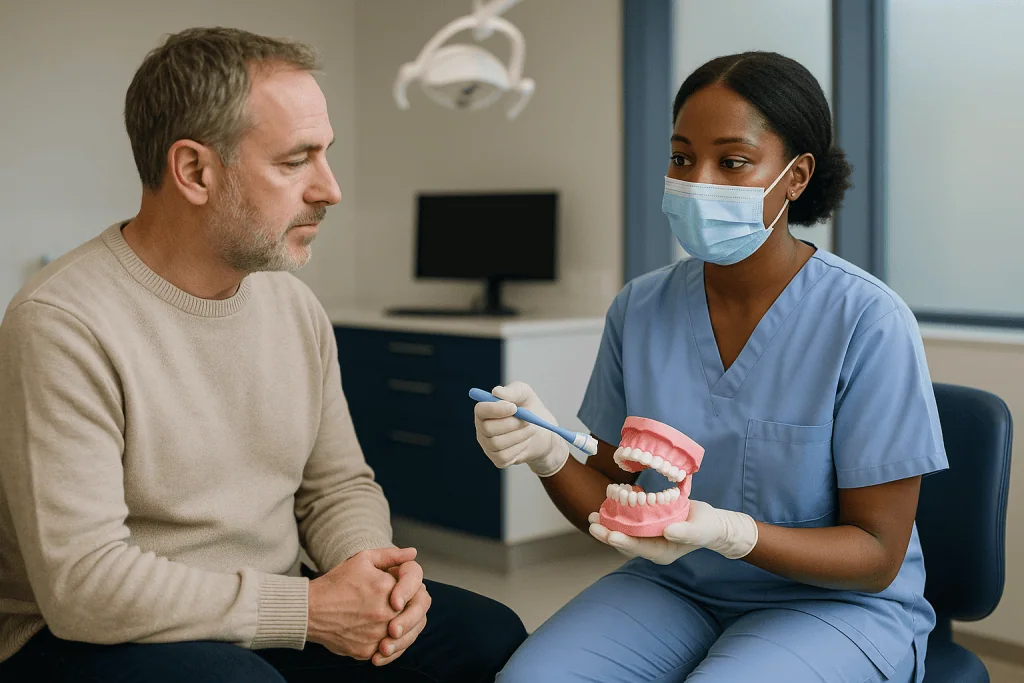
A dentist holds the broadest scope: diagnosis of all oral disease, complex fillings, crowns, root canal treatment, extractions, and prescribing. In most systems the dentist also carries overall responsibility for your treatment plan.
A dental hygienist is a licensed clinician whose core work is periodontal assessment, scaling and root planing, preventive treatments and education. In many jurisdictions hygienists can administer local anesthetic, the injected numbing medicine used for deeper cleaning, and place sealants and fluoride.
An oral health therapist, or dental therapist, is trained in hygiene plus a defined set of restorative procedures. Depending on regulation that may include simple fillings, certain extractions of baby teeth, and preventive care for children and adults. In some places therapists work independently; in others they work to a prescription from a dentist, meaning the dentist has examined you and set out what the therapist may do.
Why does the arrangement exist? Partly access: the WHO notes that oral disease burden falls hardest on people with the least access to care, and a wider team can see more patients. Partly effectiveness: preventive work benefits from time, and a clinician whose whole session is dedicated to gum health and coaching can give it.
What this means for you is simple. Ask who is doing your gum charting and cleaning, what their scope is where you live, and how findings reach the dentist. A good team makes those handoffs invisible, but you are entitled to know who owns which decision. The decision to fill, extract, refer to a periodontist (a gum specialist) or change a prescribed medicine always rests with the treating dentist or physician.
Gum checks explained: what the probing numbers actually mean
If you have heard a clinician call out a string of numbers while working around your mouth, you have heard a periodontal chart being made. It is the single most informative measurement in the visit, and almost nobody is told what it means.
Healthy gum attaches to the tooth a short distance below the visible edge, leaving a shallow groove. Mayo Clinic describes healthy pocket depths as typically 1 to 3 millimeters. When plaque bacteria inflame the gum and begin to destroy the fibers and bone beneath, that groove deepens into a pocket. Mayo notes that depths of 4 millimeters or more may indicate periodontitis, the stage where supporting bone is being lost, and that pockets deeper than 5 millimeters cannot be cleaned well at home. The deeper the pocket, the more bacteria live in an oxygen-poor space where your toothbrush cannot reach.
Two other readings sit alongside depth. Bleeding on probing shows the tissue is actively inflamed right now; a healthy gum does not bleed when touched with a blunt probe. Recession, recorded separately, shows how much gum has pulled back from where it started. Together these give the clinician a picture not just of where you are but of the direction you are moving.
The chart is repeated at intervals so changes can be tracked tooth by tooth. A 4 millimeter reading that becomes 3 after treatment and better brushing is a good outcome; a 3 that becomes 5 is a warning. Ask to see your chart, or a copy of it. Numbers you understand are far more motivating than a general instruction to floss more, and they turn each future visit into a progress report rather than a repeat of the same lecture.
Scale and polish: what to expect from the cleaning itself
The phrase scale and polish describes the two physical parts of the cleaning, and each has a job.
Scaling is the removal of tartar and plaque from the tooth surface, including just below the gumline. Most clinicians start with an ultrasonic scaler, a thin metal tip that vibrates thousands of times a second and is cooled by a fine water spray. The vibration shatters hardened deposits and the water flushes them away; the mist and the high-pitched sound are the parts people remember. Hand scalers, small curved blades, then remove what the ultrasonic leaves, particularly in tight spaces between teeth and along the back of the lower incisors, where saliva ducts open and tartar builds fastest.
Polishing follows. A soft rubber cup spinning with gritty paste, or an air-powder jet in some practices, lifts surface stain from coffee, tea, red wine and tobacco and leaves the enamel smooth. Smoothness matters beyond appearance: plaque attaches less readily to a polished surface, which buys you time between brushings.
Fluoride may be applied at the end. Fluoride strengthens enamel by helping it re-harden after acid attack, and a varnish sets on the teeth within moments. Whether you receive it depends on your decay risk, which the clinician judges from your history and what they see.
What you will feel is pressure, vibration, cold water, and occasionally a sharp twinge where a tooth root is exposed or gums are inflamed. Cleveland Clinic notes that teeth and gums may feel sensitive for a few days afterward, particularly to cold. If a spot hurts during the visit, say so; the clinician can change angle, pressure or instrument, or offer numbing for deeper work, and the visit goes better when you are not bracing.
Who an oral health therapy appointment is usually for, and who is asked to wait
Nearly every adult and child with teeth benefits from preventive hygiene care, but the intensity and timing are individual, and a few situations call for a pause or a different sequence.
The people who gain most are those at highest risk of gum disease and decay. Mayo Clinic and the NHS list smoking as one of the strongest risk factors, alongside diabetes, which impairs the body’s response to infection; a dry mouth from medicines or medical conditions; pregnancy, when hormonal changes make gums more reactive to plaque; a family history of periodontitis; and any earlier diagnosis of gum disease. Children benefit from early visits that focus on fluoride, sealants and habit-building rather than scaling.
Who is typically asked to wait, or to see a dentist or physician first?
- Someone in acute pain or with facial swelling. That needs diagnosis and treatment of the cause before a routine cleaning.
- Someone with an active oral infection or open sores, where instrumentation could spread infection or be very uncomfortable.
- Someone whose medical situation has changed, such as a new blood-thinning medicine, recent heart surgery or a new joint replacement. Bleeding during scaling is normal, so the clinician may liaise with your physician about timing and precautions. Never stop or change a prescribed medicine on your own for a dental visit.
- Someone who is unwell with a contagious illness, for their sake and the team’s.
Being asked to wait is not a refusal of care. It is the team ordering the steps so the cleaning is safe and does not mask a problem that needs a different treatment first. If you are unsure whether your situation belongs on this list, phone the practice before the visit and let them decide.
Routine cleaning vs deep cleaning: how the two visits compare
Not every hygiene visit is the same procedure. The gum chart decides which one you need, and the two differ enough that the comparison is worth laying out.
| Feature | Routine cleaning (prophylaxis) | Deep cleaning (scaling and root planing) |
|---|---|---|
| Who it is for | Healthy gums or gingivitis, the reversible early stage with inflammation but no bone loss | Periodontitis, where pockets have deepened and bone support is being lost |
| Where it works | Tooth surfaces above and just below the gumline | Deep into the pocket, cleaning and smoothing the root surface |
| Numbing | Usually not needed | Local anesthetic is commonly offered |
| Visits | Typically completed in one | Cleveland Clinic notes it may be spread over two or more visits, often by quadrant |
| Afterward | Mild sensitivity for a few days at most | Sensitivity, tenderness and some gum shrinkage as inflammation settles; a re-evaluation visit follows |
| Goal | Prevent disease from starting | Halt active bone loss and shrink pockets |
Root planing, the second half of the deep-cleaning name, means smoothing the root surface after tartar is removed so the gum can reattach and bacteria find fewer footholds. Cleveland Clinic describes this as the standard first-line, non-surgical treatment for periodontitis, and notes that a follow-up appointment a few weeks later re-measures the pockets to judge the response.
The important point is that the two are not interchangeable. A routine polish on a mouth with 6 millimeter pockets leaves the disease untouched below the gumline, which is why a proper chart comes first. If your clinician recommends deep cleaning, ask which teeth, why, and what the re-evaluation will measure.
Is a dental hygiene appointment painful?
The honest answer is: usually not, sometimes a little, and almost always less than people expect once they know what drives the discomfort.
Three things cause most of it. Inflamed gums are tender; the more bleeding and swelling you have, the more a probe or scaler tip will sting. Exposed root surfaces, where gum has receded, lack enamel and react sharply to cold water and vibration. And heavy tartar takes longer to remove, so instruments stay in one place for longer. Notice what those have in common: they are all signs of the disease the visit is treating. A first cleaning after years away tends to be the uncomfortable one; the next, on calmer gums, is usually noticeably easier.
You have real options during the visit. Tell the clinician before starting where you are sensitive and whether you would like to signal a pause with a raised hand. Ask about a desensitizing paste applied beforehand, a gentler ultrasonic setting, or hand instruments in the tender spots. For deep cleaning, local anesthetic is routinely available and turns a difficult session into a numb, pressure-only one. Some practices offer a topical numbing gel for the gums even for routine work.
Afterward, Cleveland Clinic advises that sensitivity to hot and cold is common for a few days and settles as the gum tightens. Warm salt-water rinsing and a soft-bristled brush help; do not skip brushing the area, because leaving plaque on a healing gum prolongs the soreness. Persistent or worsening pain is not expected and should be reported.
The people who fear the visit most are often those who most need it, and avoidance makes the next one harder. Saying that you are anxious is a clinical detail the team wants to know, not a confession.
Your personal plan: what a good one contains
The plan is the part of the visit that works after you leave, and it should be specific to you rather than a printed leaflet. A useful one covers five things.
Where you are missing. The clinician has just seen your plaque pattern and can name the sites: the tongue side of the lower molars, the gumline of the upper canines, the back of the last tooth. Ask them to show you in a mirror. Generic advice to brush better rarely changes behavior; a photograph or a chart with three circled spots often does.
How to clean between teeth. The NHS advises cleaning between teeth daily with floss or interdental brushes, because a toothbrush cannot reach those surfaces where gum disease typically begins. The right size interdental brush for each gap is a fitting exercise, not a guess, and the plan should record the sizes.
Brushing basics, confirmed rather than assumed. The NHS recommends brushing for about 2 minutes twice a day with a fluoride toothpaste, last thing at night and at one other time, and spitting rather than rinsing so fluoride stays on the teeth. A manual or powered brush both work when used well; the plan should say which technique suits your hands and your gums.
Risk factors you can change. Smoking cessation is the largest, and the clinician can refer you to support. Diet advice focuses on how often sugar hits the teeth, not just how much. If a medicine dries your mouth, the plan notes it and suggests speaking to the prescriber about options; the therapist will not alter your prescription.
The next date. Recall is set by risk: the NHS describes intervals from every 3 months to every 2 years. A plan that names the interval and what will be re-measured turns the next appointment into a check on progress.
The days and weeks after: what usually happens next
The first evening, your teeth often feel unfamiliar. Tongues notice smoothness and small gaps where tartar used to fill the space between teeth; those gaps were always there, hidden. Cleveland Clinic notes that mild sensitivity to temperature is common for a few days after a cleaning and is more marked after scaling and root planing. Gums that were swollen begin to shrink as the inflammation subsides, which can make teeth look slightly longer and feel exposed at the neck. That is the tissue returning toward health rather than something being lost.
Bleeding when you brush should reduce over the following one to two weeks if plaque is being removed daily, because bleeding is a sign of active inflammation and inflammation resolves when its cause is gone. If you were told your gums bled at 30 sites on the chart and they still bleed everywhere at home after two weeks of careful cleaning, that is worth mentioning at the re-evaluation rather than waiting.
For people who had deep cleaning, the timeline stretches. Tenderness may last several days, and Cleveland Clinic describes a follow-up visit a few weeks later to re-probe the pockets and decide whether the response is sufficient, whether specific sites need further treatment, or whether referral to a periodontist is appropriate. If an antiseptic mouth rinse or an antibiotic was prescribed, it works by lowering the bacterial load while the gum heals; how long to use it and whether to continue is the prescriber’s decision, and questions about it belong with them.
Over months, the meaningful markers are simple: fewer bleeding sites on the next chart, shallower pockets, and less tartar to remove. None of those is guaranteed by the cleaning alone. They depend on the plan being followed, which is why the last ten minutes of the appointment matter as much as the first fifty.
What people often get wrong about hygiene visits
Several durable beliefs make hygiene care less effective than it could be. Each has a straightforward correction.
Bleeding gums mean you brushed too hard. Usually the opposite. Healthy gums do not bleed under normal brushing; bleeding is the first sign of inflammation from plaque left behind, as Mayo Clinic describes for gingivitis. Softening your brushing and avoiding the area lets the plaque stay and the bleeding continue. Brush gently, but do brush the spot.
Scaling damages enamel or loosens teeth. Ultrasonic and hand scalers remove deposits, not tooth structure, when used correctly. Teeth that feel looser after a deep clean were already loose; tartar packed around them was masking the mobility, and swollen gum was splinting them. The disease loosened the teeth, not the treatment.
Everyone needs a visit every six months. The six-month habit is a tradition rather than an evidence-based rule. The NHS sets recall by risk, from 3 months to 2 years. Some people need more frequent care; others, less.
Gum disease is only about the mouth. Harvard Health reviews a consistent association between periodontal disease and cardiovascular disease, and the American Heart Association’s position is that the two are linked but that a causal relationship has not been proven. Shared risk factors such as smoking and diabetes explain part of the link. Treating gum disease is worthwhile in its own right; do not expect it to be sold as heart protection, and be wary of anyone who does.
Whitening toothpaste or mouthwash can replace a cleaning. Neither removes tartar. Rinses can reduce bacteria on surfaces they reach, but they do not reach the base of a 5 millimeter pocket.
Cleaning is cosmetic. It is treatment for a bacterial infection that, untreated, is a leading cause of tooth loss in adults according to Mayo Clinic. The shine is a side effect.
Questions to ask your care team
Ten minutes of the right questions can change how much you get from the visit. Take these in, on paper or on your phone, and do not be shy about the first one.
- Did you chart my gums today, and may I see the numbers? Which teeth have pockets of 4 millimeters or more, and how have they changed since last time?
- Where exactly am I missing plaque? Can you show me in the mirror or on the chart?
- Which interdental brush sizes fit my gaps, and where does each one go?
- Do I need a routine cleaning or scaling and root planing, and if the latter, which areas and why?
- Was I checked for decay and were X-rays considered today, or is that a separate visit with the dentist?
- How does what you found reach the dentist, and do I need a separate appointment?
- What is my recall interval and what will you re-measure to know whether the plan is working?
- Are any of my medicines or health conditions affecting my gums, and should I mention this to my physician?
- If numbing is available for the deeper areas, may I have it, and what should I expect afterward?
- Would I benefit from a referral to a periodontist, and what would prompt that decision?
- Can I have a written plan and a written outline of any proposed treatment before I book it?
A team that welcomes these questions is doing something right. The answers should be specific to your chart rather than general reassurance, and any recommendation for further treatment should come with the reason, the alternatives including watchful waiting, and the risks of each. The decision about what happens next remains yours, made with the treating dentist and, where relevant, your physician.
When to call your doctor or dentist: red-flag signs
Most of what follows a hygiene visit is mild and settles within days. A few signs mean you should not wait for the next scheduled appointment.
Contact your dentist or physician promptly if you notice any of the following, whether or not you have recently had a cleaning:
- Swelling of the face, jaw or neck, or difficulty swallowing or breathing. This can indicate a spreading infection and is an emergency; seek urgent care.
- Fever with mouth or jaw pain.
- A tooth that has become loose over days or weeks, or teeth that have shifted position.
- Pain that is worsening rather than easing several days after treatment, or pain that wakes you at night.
- Bleeding that does not stop with gentle pressure, particularly if you take a blood-thinning medicine.
- Pus at the gumline, a persistent bad taste, or a gum boil.
- A sore, ulcer, white or red patch, or lump anywhere in the mouth that has not healed within three weeks, as the NHS advises; this needs examination.
- Gums that bleed heavily or spontaneously without brushing.
People with diabetes, a weakened immune system, a heart valve condition or a recent joint replacement should also let their physician know about any mouth infection, since the treating team may want to coordinate care. If you are unsure whether a symptom is urgent, phone the practice and describe it; they would rather hear from you early than see you late.
None of these signs should be self-managed with over-the-counter remedies alone. Mouth infections can progress quickly, and the right response depends on a clinical examination. Any decision about antibiotics, further treatment or changes to your existing medicines belongs with the dentist or physician who examines you, not with a search result or this article.
Frequently asked questions
What does oral health therapy mean?
Oral health therapy is preventive dental care focused on controlling plaque and gum inflammation before they damage teeth and bone. An oral health therapist is trained in dental hygiene and, depending on local regulation, a defined range of simple restorative work. The visit typically includes a gum assessment, removal of plaque and tartar, preventive treatments such as fluoride, and a tailored home-care plan, with anything needing a dentist referred on.
What is an oral hygiene appointment?
An oral hygiene appointment is the preventive half of dental care, usually delivered by a hygienist or oral health therapist. It involves reviewing your health history, measuring the gum pockets around each tooth, removing plaque and hardened tartar, polishing, applying fluoride where indicated, and coaching on cleaning technique. It differs from a dental check-up, which is the dentist’s examination for decay, failing fillings and other disease.
Is a dental hygiene appointment painful?
Usually not, though inflamed gums and exposed roots can make some areas sting, and heavy tartar takes longer to remove. Discomfort tends to be greatest at a first visit after a long gap and less at follow-ups on healthier gums. You can ask for a gentler setting, hand instruments in tender spots, a desensitizing paste or local anesthetic for deep cleaning. Cleveland Clinic notes mild sensitivity for a few days afterward is common.
How much should I pay for a hygienist appointment?
There is no single answer, because fees depend on your country, region, whether you are receiving a routine cleaning or scaling and root planing, how many visits are needed, and what your insurance or public system covers. This magazine does not publish prices. The practical step is to ask the practice for a written outline of the proposed treatment and its codes before you book, and to check coverage with your insurer or health service.
Oral health therapist vs dentist: who should I see for bleeding gums?
Either can start the process, and in many practices they work as a team. A hygienist or oral health therapist will chart your gums, remove the plaque and tartar causing the bleeding and set a home-care plan. If the chart shows deep pockets, bone loss or another problem, the dentist becomes involved, and referral to a periodontist, a gum specialist, may be discussed. Sudden heavy or spontaneous bleeding should be assessed promptly.
What does scale and polish involve, and does it damage teeth?
Scaling removes tartar and plaque with an ultrasonic tip and hand instruments; polishing lifts stain and smooths enamel so plaque attaches less readily. Used correctly, these remove deposits rather than tooth structure. Teeth that feel looser or more exposed afterward were already affected by gum disease; tartar and swollen gum were hiding it. Cleveland Clinic notes short-lived sensitivity is common, but lasting damage from proper scaling is not expected.
How often should I have an oral health therapy appointment?
It depends on your risk rather than a fixed schedule. The NHS explains that dental recall intervals are set individually and can range from every 3 months to every 2 years. People who smoke, have diabetes, a dry mouth or a history of periodontitis are usually seen more often; people with consistently healthy charts less often. Your clinician should name the interval in your plan and explain what will be re-measured.
What is the difference between gingivitis and periodontitis?
Gingivitis is the early, reversible stage of gum disease: gums are red, swollen and bleed easily, but the bone holding the teeth is intact. Periodontitis is the advanced stage in which inflammation has destroyed some of the fibers and bone supporting the teeth, forming deeper pockets. Mayo Clinic describes periodontitis as a common cause of tooth loss in adults. Gingivitis responds to cleaning and better home care; periodontitis needs scaling and root planing and ongoing management.
Can I have a hygiene visit if I take blood thinners or have a heart condition?
Often yes, but tell the team beforehand. Scaling causes some gum bleeding, so the clinician may take precautions or liaise with your physician about timing. Never stop or adjust a prescribed medicine for a dental visit on your own; that decision belongs to the prescriber. People with certain heart valve conditions, recent heart surgery or a recent joint replacement should also mention it, as their physician may want to coordinate care.
Does treating gum disease protect my heart?
The evidence shows an association, not proven cause and effect. Harvard Health summarizes consistent links between periodontal disease and cardiovascular disease, and the American Heart Association’s position is that a causal relationship has not been established; shared risk factors such as smoking and diabetes explain part of the overlap. Treating gum disease is worthwhile for your teeth and comfort. Claims that a cleaning prevents heart attacks go beyond what the evidence supports.
References
This article is for general information only and is not a substitute for professional medical advice. Please consult a qualified doctor about your individual situation.

More from the Blog

Root Canal vs Extraction and Implant: What Keeping the Natural Tooth Changes Long Term
A root canal removes infected pulp and keeps your natural tooth, root and surrounding ligament in place; extraction and implant replace the whole tooth…

What Periodontal Measurements Reveal About Gum Recession: Pocket Depths and Bone Support
Periodontal measurements translate gum recession into numbers a dental team can track. A probe measures pocket depth, the gap between gum and tooth, and…

When Do Children Get Removable Appliances? How Jaw Growth Shapes the Timing
Removable appliances for children are usually fitted during the mixed dentition years, when baby and adult teeth share the mouth and the jaws are…
Why a Cleaning Comes Before Teeth Whitening: Checking Enamel, Gums and Old Fillings
A professional cleaning usually comes before teeth whitening because whitening gel works on clean enamel, not on plaque and tartar, and because the dentist…

How Fiber Application Works in One Visit: Bonding the Fiber Into Composite Resin
A fiber reinforced composite procedure adds a ribbon of glass or polyethylene fiber inside tooth-colored composite resin so the restoration resists bending and cracking.…

How Digital Planning Maps Tooth Movement Before Clear Aligners Are Made
Clear aligner digital planning starts with a 3D scan of the teeth, often alongside X-rays, from which software separates each tooth and lets the…