

What Does a Sleep Study for Narcolepsy Involve? The Overnight Test and Daytime Nap Test
Key Takeaways
- A full sleep study for narcolepsy pairs an overnight polysomnogram with a next-day multiple sleep latency test of five nap trials spaced about two hours apart.
- The diagnostic signal is not just falling asleep fast (a mean latency of eight minutes or less) but entering REM sleep within 15 minutes on at least two trials.
- Healthy adults typically reach REM about 60 to 90 minutes after falling asleep, which is why early REM during a daytime nap carries so much diagnostic weight.
- Sleep diaries, actigraphy and pausing certain medicines beforehand are safeguards against false results, since chronic short sleep and some drugs mimic or mask the narcolepsy pattern.
- Narcolepsy type 1 is defined by cataplexy or very low spinal fluid hypocretin; type 2 shows the same nap-test findings without either.
- A negative or borderline result does not end the search: specialists may repeat the study, test hypocretin, treat an apnea found overnight, or consider idiopathic hypersomnia.
A sleep study for narcolepsy usually combines two tests over roughly 24 hours: an overnight polysomnogram that records brain waves, breathing, heart rate and muscle activity while you sleep, then a next-day multiple sleep latency test with five scheduled nap chances at two-hour intervals. Together they measure how fast you fall asleep and whether dream (REM) sleep begins unusually early; a sleep specialist interprets the results alongside your symptoms.
The referral letter uses two abbreviations, PSG and MSLT, and a sentence that stops most people cold: “Please arrive at 7 p.m. and plan to stay until approximately 5 p.m. the following day.” Twenty-two hours in a room with wires on your scalp. For someone who has spent years being told they are simply lazy, or not getting enough sleep, or should try going to bed earlier, the idea of a formal sleep study for narcolepsy lands as both relief and dread. Relief, because someone finally wants to measure the thing. Dread, because what if the test cannot see what you feel every afternoon at 2 o’clock?
Sleep laboratories are quieter than people imagine. The technologist has done this hundreds of times. The bed is ordinary. And the science behind the two tests is elegant once you understand what each one is actually looking for.
This guide walks through both nights and the day in between: what gets measured, why the numbers matter, how to prepare so the results are trustworthy, and what happens once the report lands on your specialist’s desk.
Why a sleep study for narcolepsy is really two tests, not one
Narcolepsy is a long-term brain disorder in which the system that keeps you awake and the system that produces sleep, especially dream sleep, no longer stay in their proper lanes. The National Institute of Neurological Disorders and Stroke (NINDS) describes the core problem as an inability to regulate sleep-wake cycles normally, with elements of REM sleep (the rapid-eye-movement stage in which most vivid dreaming happens) intruding into wakefulness.
That definition explains the two-part design. An overnight test alone cannot confirm narcolepsy, because many people with the condition sleep reasonably well at night. A daytime nap test alone cannot be trusted either, because a person who barely slept the night before will nod off quickly for entirely ordinary reasons. The sleep laboratory therefore pairs them: the overnight polysomnogram proves you had a fair night’s sleep and rules out other causes of sleepiness, and the multiple sleep latency test the next morning measures how your brain behaves when it is given permission to nap after that fair night.
One number from each test carries the weight. Overnight, technologists want to see enough total sleep, commonly at least six hours, so the following day’s sleepiness cannot be blamed on a short night. During the day, they watch for two things: how many minutes it takes you to fall asleep on average, and whether REM sleep appears within minutes rather than after the hour or more that healthy adults typically need. NINDS notes that most people enter REM sleep roughly 60 to 90 minutes after falling asleep, while people with narcolepsy often reach it within 15 minutes.
Knowing this in advance changes how the day feels. Every wire and every scheduled nap is collecting one of those two numbers.
What to expect from the overnight polysomnography
Polysomnography, usually shortened to PSG, is a recording of several body signals at once while you sleep. You arrive in the early evening, typically with your own pajamas, toiletries and anything that normally helps you settle, such as a book or a pillow from home. The technologist attaches small sensors with a water-soluble paste: electrodes on the scalp to record brain waves, beside the eyes to track eye movement, on the chin and legs to measure muscle tone, and on the chest for heart rhythm. Soft elastic belts around the chest and abdomen register breathing effort, a small clip on a finger measures blood oxygen, and a thin tube under the nose senses airflow.
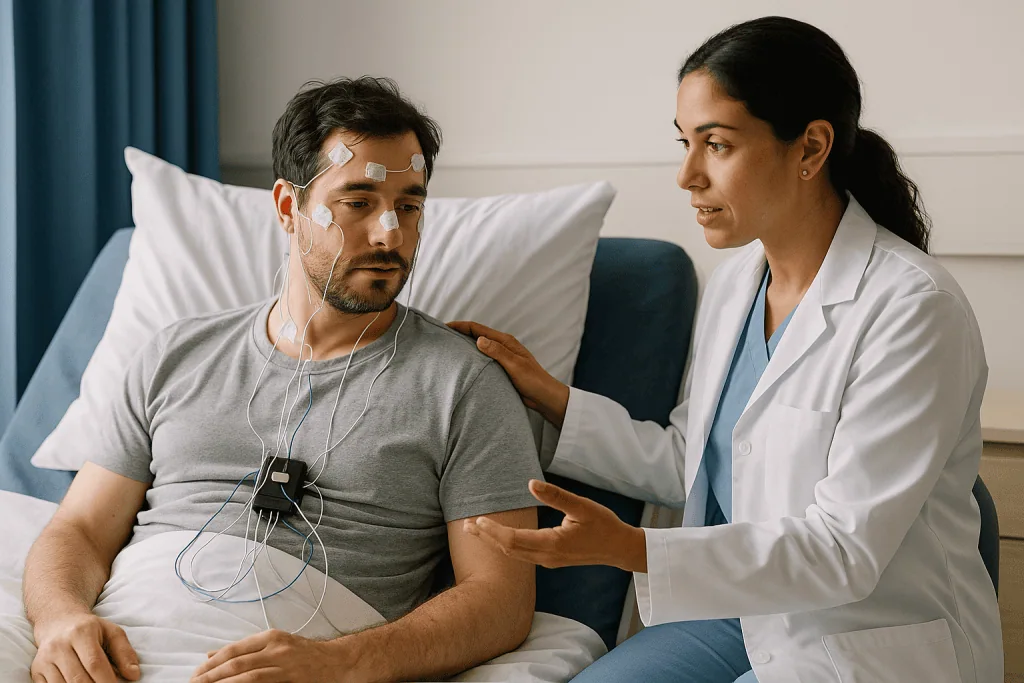
It sounds like a lot. In practice the wires gather into a single bundle behind your head and most people find they can turn over without trouble. A low-light camera and a microphone let the technologist watch from an adjoining room, and you can call out if you need the bathroom; the bundle unplugs from the wall box in seconds.
The most common worry is “I will never sleep like this.” Sleep clinics hear it every evening, and the Cleveland Clinic points out that the test does not require a perfect night, only enough sleep to score. People routinely sleep less than they would at home and still produce a fully usable recording.
Beyond preparing for the next day, the overnight recording does independent detective work. It can reveal obstructive sleep apnea (repeated pauses in breathing), periodic limb movements, or other disorders that produce daytime sleepiness and would need to be treated before, or instead of, considering narcolepsy. The NHS lists these alternative explanations as part of why the overnight test is required even when narcolepsy is strongly suspected.
How the multiple sleep latency test works the next day
The multiple sleep latency test, or MSLT, measures how quickly you fall asleep when lying down in a dark, quiet room during the daytime, and what kind of sleep you fall into. The word “latency” simply means the delay between lights-out and the first recorded sleep.
Most sensors stay on from the night before, minus the breathing equipment. According to the Cleveland Clinic, the first nap opportunity begins about one and a half to three hours after you wake, and there are five nap trials spaced roughly two hours apart. Each follows the same script. The technologist asks you to lie comfortably, turns the lights off, and instructs you to try to fall asleep. If you do, the recording continues for a set period so scorers can see whether REM appears. If you do not fall asleep within about 20 minutes, the trial ends and is scored as no sleep.
Between naps you must stay awake, out of bed, and out of dim light. The technologist will usually ask you to avoid caffeine and vigorous exercise; a short walk in the corridor and a light meal are fine. Some centers ask for a urine sample to check for substances that could distort the findings.
People are frequently surprised by two things. First, they cannot always tell whether they slept. Brief sleep of a minute or two often feels like a lull in thinking rather than a nap, yet it is unmistakable on the trace. Second, the day drags. Two-hour gaps with nothing to do but stay awake are hard for anyone and harder for someone with pathological sleepiness. Bring something absorbing, and expect to be tired rather than refreshed by the finish.
What the numbers mean: sleep latency and early REM
When the report arrives, two figures from the nap test will be highlighted. The first is mean sleep latency, the average number of minutes it took you to fall asleep across the five trials. The second is the count of SOREMPs, short for sleep-onset REM periods, meaning trials in which you reached REM sleep within 15 minutes of falling asleep.

The Cleveland Clinic offers a plain interpretation of latency ranges for the MSLT, which the table below summarizes alongside the REM timing that NINDS describes. Note that the categories are guides for the specialist, not verdicts on their own.
| Measurement | Typical finding in healthy adults | Finding that raises concern for narcolepsy |
|---|---|---|
| Mean sleep latency (MSLT) | Often 10 to 20 minutes | 8 minutes or less on average |
| Time from sleep onset to first REM | About 60 to 90 minutes at night | Within 15 minutes, on two or more nap trials (one may be counted from the overnight study) |
| Overnight total sleep | Enough to make daytime results interpretable, commonly six hours or more | If short, the nap test may be postponed or interpreted with caution |
Why does early REM matter so much? Healthy sleep proceeds through lighter and deeper non-REM stages before the first dreaming period arrives. Falling directly into REM during a daytime nap is exactly the loss of stage order that defines the condition, and it is the closest thing the test has to a fingerprint. Speed alone is less specific. Anyone sleep-deprived, or taking a sedating medicine, can fall asleep in five minutes; far fewer people slide straight into dream sleep while doing so.
Even so, the specialist reads both numbers next to your history, your sleep diary and the overnight findings, not in isolation.
Narcolepsy diagnosis criteria: the three requirements explained
People searching “what are the three requirements for narcolepsy” usually mean the checklist a specialist uses before applying the label. The international classification that sleep physicians follow, summarized in patient terms by the Mayo Clinic and NINDS, rests on three pillars.
The first is a history of excessive daytime sleepiness lasting at least three months. Sleepiness in this sense means an irresistible need to sleep or lapses into sleep, not simple tiredness after a long week. The three-month threshold exists to separate a persistent disorder from a rough patch after a new baby, night shifts or a viral illness.
The second pillar is objective evidence from the sleep study: a mean sleep latency of eight minutes or less on the MSLT together with two or more sleep-onset REM periods. A REM period that appears within 15 minutes of falling asleep on the previous night’s polysomnogram is allowed to count as one of the two, which is another reason the overnight recording is not optional.
The third pillar concerns type. If cataplexy is present (a sudden, brief loss of muscle tone while fully conscious, often triggered by laughter or strong emotion), or if a spinal fluid test shows very low levels of the brain chemical hypocretin, the diagnosis is narcolepsy type 1. If sleepiness and the MSLT findings are present without cataplexy and without proven hypocretin loss, it is narcolepsy type 2.
A different “three” also circulates online: the classic symptom group of sleepiness, cataplexy and disrupted night sleep, sometimes expanded to include sleep paralysis and vivid dream-like hallucinations at the edges of sleep. NINDS notes that only a minority of people experience all of these. Symptoms raise suspicion; the study and the criteria above are what settle it.
How to prepare in the two weeks before the study
A nap test is only as trustworthy as the fortnight that precedes it, and this is where patients have real influence over the quality of their own result.
Most sleep centers ask for a sleep diary covering one to two weeks, recording bedtimes, wake times, naps and caffeine. Many also lend an actigraph, a wristwatch-sized motion sensor that estimates sleep and wake periods, so the diary can be checked against objective data. The purpose is to confirm that you were getting a reasonable and regular amount of sleep, because chronic short sleep produces a fast latency and can even provoke early REM, mimicking narcolepsy in someone who does not have it.
Medicines are the second preparation issue, and the most delicate. Stimulants, many antidepressants and some allergy or sleep aids alter how quickly REM appears or how alert you feel. The Cleveland Clinic explains that the ordering clinician may ask you to pause certain medicines for a period before the test, often around two weeks, so the recording reflects your untreated brain. This instruction must come from the prescribing clinician, never from a leaflet or a forum, because stopping some medicines abruptly can be unsafe. Ask exactly which medicines are affected, and tell the laboratory about everything you take, including over-the-counter products and supplements.
Smaller practical steps matter too. Keep your usual sleep schedule in the days before rather than trying to bank extra sleep. On study day, arrive with clean, dry hair free of product so electrodes stick, skip caffeine from the morning of the overnight test unless told otherwise, and pack layers, since laboratory rooms run cool. Eat a normal dinner. Shift workers should tell the center, because the nap schedule may need to be timed to their usual day.
Who is usually referred for a sleep study for narcolepsy, and who is asked to wait
Referral generally follows a pattern. A primary care clinician hears about sleepiness that persists despite adequate time in bed, sometimes with cataplexy, sleep paralysis or dream-like hallucinations at sleep onset. A screening questionnaire such as the Epworth Sleepiness Scale, which the NHS describes as a series of everyday situations rated for the likelihood of dozing, may point toward pathological sleepiness. Blood tests are often ordered first to look for thyroid problems, anemia or other medical explanations. If nothing accounts for the symptoms, a sleep specialist takes over and orders the PSG and MSLT.
Some people are asked to wait, and it helps to understand why. Someone whose diary shows five hours of sleep a night will usually be asked to extend sleep for several weeks and then be reassessed, because their test would almost certainly be positive for reasons that have nothing to do with narcolepsy. A person with untreated obstructive sleep apnea found on the overnight study may be treated for that first, then re-evaluated, since apnea itself causes daytime sleep attacks. Those who cannot safely stop a REM-suppressing medicine may have the timing adjusted or, in type 1 with clear cataplexy, may be offered the spinal fluid hypocretin test as an alternative route to diagnosis.
Children are tested too, with modifications. NINDS notes that symptoms often begin between the ages of 7 and 25, and pediatric sleep laboratories use age-adjusted norms because healthy children fall asleep faster than adults. A parent usually stays overnight.
The condition is uncommon but not rare: NINDS estimates that between 135,000 and 200,000 people in the United States have narcolepsy, with many undiagnosed for years. The sleep study exists to shorten that wait.
Type 1, type 2 and the hypocretin test: what else the specialist may order
Two people can produce identical nap-test results and still receive different diagnoses. The difference lies in cataplexy and in a chemical called hypocretin, also known as orexin.
Hypocretin is a signaling molecule made by a small cluster of cells in the hypothalamus, a brain region that governs basic drives including wakefulness. NINDS explains that in narcolepsy type 1, most of these cells have been lost, probably through an autoimmune process in which the body’s defenses mistakenly target them. Without hypocretin, the brain struggles to hold wakefulness steady and to keep REM sleep confined to its normal slot. In type 2, hypocretin levels are usually normal and the underlying cause is less clear.
Measuring hypocretin requires a lumbar puncture, in which a thin needle draws a small sample of cerebrospinal fluid from the lower back. The Mayo Clinic notes that this is occasionally offered when the MSLT is unavailable, inconclusive or cannot be performed reliably, for instance when a medicine cannot be paused. Very low hypocretin is considered strong evidence for type 1, whether or not cataplexy has yet appeared.
Genetic testing sometimes comes up in conversation. A specific immune-system gene variant is found in most people with type 1, but NINDS cautions that it is also carried by many people who will never develop narcolepsy, so the blood test cannot diagnose the condition on its own. It may help a specialist decide how strongly to weigh a borderline MSLT.
Which pathway you follow is a clinical judgment made by the treating team, weighing symptoms, test practicality and your own preferences. The overnight-plus-nap study remains the standard route for most adults precisely because it is non-invasive and captures the behavior of sleep itself.
Why the nap test is not perfect: false results and repeat studies
Patients deserve honesty about the limits of the MSLT, because a normal result after a long-awaited study can feel like being disbelieved.
The test can miss narcolepsy. Anxiety about being observed, an unfamiliar bed, an unusually alert day, or the lingering effect of a medicine that suppresses REM can all lengthen latency or prevent early REM on the day of testing. NINDS describes narcolepsy type 2 in particular as harder to pin down, and specialists sometimes repeat the study months later if symptoms persist. A single negative MSLT does not close the door.
The test can also point toward narcolepsy in someone who does not have it. Chronic sleep restriction, irregular schedules such as rotating shifts, withdrawal from REM-suppressing medicines, and untreated sleep apnea all shorten latency and can produce sleep-onset REM periods. This is why the sleep diary, actigraphy and overnight polysomnogram are not paperwork but safeguards; each removes a rival explanation before the nap results are trusted.
Results near the cut-offs are common. A mean latency of nine minutes with one SOREMP does not meet the formal criteria, yet it may sit alongside convincing cataplexy. In that situation a specialist may repeat the MSLT, request hypocretin testing, or diagnose idiopathic hypersomnia, a related condition of excessive sleepiness without the REM signature.
A practical consequence follows from all this. If you know your night in the laboratory was far worse than usual, or you accidentally drank coffee, or you were unable to pause a medicine as requested, say so before you leave. The technologist records these notes, and they change how the report is read.
What the following days and weeks usually look like
The study ends mid-afternoon. Paste comes off with warm water and a towel; a shower at home finishes the job. Most people feel drained rather than rested and should arrange a ride if drowsy driving is a concern, which after a night of monitored sleep and five naps it often is.
Scoring takes time. A trained technologist reviews the overnight recording in 30-second segments, labeling each as wake or a sleep stage, then does the same for every nap trial. A sleep physician then interprets the scored data, and the Cleveland Clinic notes that results are typically discussed at a follow-up appointment rather than at the laboratory door. Waiting periods vary between centers, so ask before you leave when to expect the report and how it will be delivered.
The follow-up visit is where the two numbers meet your story. Expect the specialist to revisit your sleep diary, ask again about cataplexy and hallucinations at sleep onset, and explain whether the findings meet the criteria, fall short, or point to something else. If they meet the criteria, the conversation turns to management. The Mayo Clinic describes a combination of behavioral strategies, such as consistent sleep schedules and brief planned naps, alongside medicines that promote wakefulness or, for cataplexy, medicines that suppress REM intrusion. Which options fit, and in what sequence, is decided with your prescribing clinician over subsequent visits; effects are usually judged over weeks rather than days.
If the results are inconclusive, the plan may involve treating an apnea found overnight, extending sleep and repeating the diary, or scheduling a second study. None of these outcomes means the effort was wasted. Each rules something in or out, and narrows the search.
What people often get wrong about the narcolepsy sleep test
Misunderstandings about this test are remarkably consistent, and several can distort results.
The first is that you should stay up late beforehand so you are “sure to fall asleep.” The opposite is true. Deliberate sleep deprivation makes the nap test uninterpretable and may lead to a diagnosis you do not have. Sleep normally, and let the study measure your normal.
The second is that falling asleep quickly is what the test is looking for. Speed matters, but the specialist is watching mainly for early REM. Plenty of exhausted people fall asleep fast; far fewer dream within a few minutes, and that pattern is the one with diagnostic weight.
The third is that a home sleep apnea kit can do the same job. Home devices track breathing and oxygen but do not record brain waves, so they cannot identify sleep stages or REM timing. The MSLT has to be done in a laboratory with electrodes on the scalp.
The fourth is that narcolepsy always involves dramatic collapses. NINDS notes that cataplexy affects only some people, and when present it is often subtle: a drooping jaw during laughter, a sagging head, knees that briefly buckle. Many people with type 2 never experience it at all. Not collapsing does not mean the test is unnecessary.
The fifth is that the test can be failed. It cannot. It is a measurement, and an unexpected result is information, not a judgment on your honesty or effort.
The last is that a diagnosis is a life sentence of sleeping. The Johns Hopkins overview describes narcolepsy as a lifelong condition that is managed, with symptoms that can be reduced substantially through a mix of scheduled sleep, lifestyle adjustment and prescribed treatment, and with many people continuing to work, study and drive under appropriate medical guidance.
Life after the result: why naps help, memory worries and a good life
Three questions arrive almost immediately after diagnosis, and each has a reasonably clear evidence-based answer.
Why do naps help narcolepsy? In healthy brains, wakefulness builds a steady sleep pressure that is discharged overnight. In narcolepsy the wake-promoting system is unstable, so pressure tips over into sleep at unpredictable moments. A brief planned nap discharges some of that pressure on your own terms. The Mayo Clinic lists scheduled naps of around 20 minutes at regular points in the day as a core behavioral strategy, noting that many people feel refreshed for a period afterward. Naps do not fix the underlying mechanism, but they let you choose when sleep happens rather than having it choose for you.
Can narcolepsy cause memory loss? People often describe forgetting conversations, losing the thread of a task, or finding a completed chore they do not remember doing. NINDS describes this last phenomenon as automatic behavior: continuing an activity during a brief lapse into sleep without awareness, then having no memory of it. The problem is attention and consolidation, not damage to memory itself; information that never registered cannot be recalled. Treating sleepiness typically improves these lapses, and the pattern is quite different from the progressive memory decline of dementia. If memory problems continue despite well-managed sleepiness, mention them, since other causes deserve their own evaluation.
Can you live a good life with narcolepsy? The condition does not shorten life expectancy, and NINDS emphasizes that symptoms can be managed to allow work, relationships and independence. Practical adjustments matter: honest conversations with employers or schools about nap breaks, caution around driving and other safety-critical tasks until sleepiness is controlled, and attention to mood, since living with an invisible condition can be isolating. Support groups and a consistent specialist relationship help many people build a routine that works.
Questions to ask your care team before and after the study
A sleep study appointment is long on wires and short on conversation, so the most useful questions are best asked at the ordering visit and again at follow-up. Bring a written list; sleepiness makes remembering questions in the moment genuinely hard.
Before the study, it helps to ask:
- Which of my current medicines, including over-the-counter products, could affect the results, and exactly how and when do you want me to adjust them?
- How many nights of sleep diary or actigraphy do you need, and what counts as “enough” sleep in the week before the test?
- What should I do if I sleep very badly on the overnight portion? Will the nap test still go ahead?
- Is the laboratory able to adapt the schedule to my shift pattern?
- Will you also be looking for sleep apnea or limb movements, and what happens if you find them?
After the study, useful questions include:
- What was my mean sleep latency, how many sleep-onset REM periods were recorded, and how many hours did I sleep overnight?
- Do these findings meet the formal criteria, and if not, what is the alternative explanation you are considering?
- Is this type 1 or type 2, and would a hypocretin test change your thinking?
- If the result is borderline, would you recommend repeating the study, and after how long?
- What does this mean for driving, my job and any safety-critical tasks, and who decides when sleepiness is adequately controlled?
- Who do I contact between appointments if symptoms change or a new one appears?
You are entitled to a copy of the full report, including the scored sleep stages. Reading it with your specialist is more useful than reading it alone, but having it lets a future clinician pick up where the last one left off.
When to call your doctor
Most of the time, the process around a sleep study for narcolepsy is unhurried, and results can wait for the scheduled follow-up. A few situations should not wait.
Call your doctor or the ordering clinic promptly if you are asked to pause a medicine and develop worsening mood, unusual agitation, severe anxiety or a marked change in how you feel; medicine adjustments for the test are meant to be safe, and the prescribing clinician needs to know if they are not. Contact them too if you become so sleepy during the wash-out period that you cannot function safely, especially if you drive or operate machinery for work.
Seek urgent medical attention, without waiting for the study, if you experience a sudden episode of muscle weakness on one side of the body, facial drooping, slurred speech, confusion, or a severe headache unlike any before; these are not features of narcolepsy and can signal a stroke or other neurological emergency. Similarly, a first-ever episode of collapse with loss of consciousness, rather than the preserved awareness that characterizes cataplexy, deserves same-day assessment, as do falls resulting in injury.
After the study, arrange an earlier appointment if new symptoms emerge, such as episodes that look like cataplexy when you have never had them, frequent sleep paralysis, or sleepiness that has clearly worsened. Mention low mood or thoughts of self-harm directly; living with unexplained sleepiness is exhausting, and support is part of good care.
Above all, if you have nodded off at the wheel or narrowly avoided doing so, tell your clinician now rather than at the next routine visit. Driving safety guidance depends on your own local regulations and your treating team’s judgment, and no test result should be waited on before that conversation happens.
Frequently asked questions
How is narcolepsy diagnosed?
Narcolepsy is diagnosed by combining a detailed symptom history with an overnight polysomnogram and a next-day multiple sleep latency test. The history must show excessive daytime sleepiness for at least three months; the nap test must show a mean sleep latency of eight minutes or less with two or more sleep-onset REM periods. Cataplexy or a spinal fluid hypocretin measurement distinguishes type 1 from type 2. Blood tests and a sleep diary help exclude other causes first.
What are the three requirements for narcolepsy?
The three formal requirements are daily excessive sleepiness lasting at least three months, objective nap-test evidence (a mean sleep latency of eight minutes or less plus at least two sleep-onset REM periods), and a determination of type based on cataplexy or low hypocretin. Online lists sometimes describe a different “three” made up of symptoms: sleepiness, cataplexy and disturbed night sleep. Symptoms prompt testing, but the sleep study findings are what confirm the diagnosis.
Why do naps help narcolepsy?
Short planned naps help because they discharge accumulated sleep pressure at a time you choose, rather than letting an unstable wake system tip you into sleep unexpectedly. The Mayo Clinic lists scheduled naps of around 20 minutes as a core behavioral strategy, and many people feel more alert for a period afterward. Naps do not change the underlying loss of hypocretin signaling in type 1, so they are usually used alongside other measures agreed with the treating team.
Can narcolepsy cause memory loss?
Narcolepsy commonly causes memory complaints, but through lapses in attention rather than damage to memory itself. During brief involuntary sleep episodes a person may continue an activity automatically and later have no recollection of it, a pattern NINDS calls automatic behavior. Information that never registered cannot be recalled. These lapses generally improve when sleepiness is better controlled and differ from the progressive decline seen in dementia. Persistent memory problems despite good management deserve separate evaluation.
Can you live a good life with narcolepsy?
Yes. Narcolepsy is a lifelong condition, but it does not shorten life expectancy, and NINDS notes that symptoms can be managed well enough for most people to work, study, maintain relationships and, with medical guidance, drive. A combination of regular sleep schedules, planned naps, prescribed treatment and honest conversations with employers or schools forms the usual foundation. Attention to mood and connection with others who have the condition also matter, since invisible illnesses can feel isolating.
What is a multiple sleep latency test like from the patient's side?
It is a long, quiet day. After the overnight study, most sensors stay attached and you are given five chances to nap in a dark room, each about 20 minutes, spaced roughly two hours apart. Between naps you must stay awake and out of bed. Many people cannot tell whether they slept, and the waiting between trials is often the hardest part. Bring something absorbing, and expect to leave tired rather than refreshed.
What should I expect during the polysomnography portion of the study?
Expect an early-evening arrival, roughly an hour of sensor placement using water-soluble paste, then an ordinary night in a private room while brain waves, eye movements, muscle tone, breathing, heart rhythm and oxygen are recorded. A technologist monitors from another room and can unplug the wire bundle if you need the bathroom. You do not need a perfect night; enough sleep to score, commonly six hours or more, is what makes the next day’s nap test interpretable.
Do I have to stop my medicines before a narcolepsy sleep study?
Often some medicines are paused, but only on the instruction of the prescribing clinician. Stimulants and many antidepressants change how quickly you fall asleep or how soon REM appears, so the Cleveland Clinic notes centers may ask for a wash-out period of around two weeks. Stopping certain medicines abruptly can be unsafe, so never do this on your own. Tell the laboratory about every product you take, including over-the-counter remedies and supplements.
Can a home sleep test diagnose narcolepsy?
No. Home sleep tests are designed for sleep apnea and record breathing, oxygen and heart rate, but not brain waves. Without scalp electrodes they cannot identify sleep stages or detect the early REM sleep that defines narcolepsy. Diagnosis requires an in-laboratory polysomnogram followed by a multiple sleep latency test, or in selected cases a spinal fluid hypocretin measurement ordered by a sleep specialist.
What happens if my nap test is normal but I still feel exhausted?
A normal result does not mean your sleepiness is imaginary. The test can miss narcolepsy, especially type 2, if you had an unusually alert day or a medicine effect lingered. Your specialist may repeat the study after several months, review the overnight recording for apnea or limb movements, extend your sleep diary, or consider related conditions such as idiopathic hypersomnia. Report anything unusual about the test day so it can be factored into the interpretation.
References
- Narcolepsy – National Institute of Neurological Disorders and Stroke (NIH)
- Narcolepsy – Diagnosis – NHS
This article is for general information only and is not a substitute for professional medical advice. Please consult a qualified doctor about your individual situation.

More from the Blog

Who May Be a Candidate for Peripheral Nerve Surgery? Injury, Compression and Tumor Cases
Peripheral nerve surgery is considered for three groups: people with a nerve that has been cut, torn or crushed and shows no sign of…

Can You Keep Working With Multiple Sclerosis? Fatigue, Heat and Pacing Strategies Explained
Many people with multiple sclerosis continue working, often for years, though the path varies with symptoms, job demands and disease course. Fatigue and heat…

Can Home and Work Routines Be Adapted in Motor Neuron Disease? Mobility Aids, Meals and Rest
Yes. Most people with motor neuron disease can adapt home and work routines for a considerable time by pacing activity, changing how meals are…

Questions to Ask Before Agreeing to a Cerebrovascular Disease Treatment Plan
Before agreeing to a cerebrovascular disease treatment plan, ask what the imaging showed (clot, bleed, narrowing or small vessel damage), why this option was…

What to Track Before a Tourette Syndrome Evaluation: Tic Diaries, Triggers and School Reports
Before a Tourette syndrome evaluation, keep a simple tic diary for several weeks noting each tic's type, time of day, setting and rough frequency;…

Genetic Counseling in Huntington’s Disease: Questions Families Ask Around Testing
Huntington's genetic counseling is a series of conversations with a trained genetics professional before and after any decision about testing for the HTT gene…