

What Does Lung Infection Recovery Look Like? The First Two Weeks of Treatment

Key Takeaways
- The NHS expects fever from pneumonia to be gone after about a week, chest pain and mucus to ease by 4 weeks, and cough and breathlessness by around 6 weeks.
- A mild chest infection such as acute bronchitis usually clears in 7 to 10 days, though the cough can persist for up to 3 weeks, and antibiotics are not usually offered because most are viral.
- Antibiotics kill bacteria but do not drain the fluid and debris from the air sacs; that clearance is done by your own immune cells over several weeks, which is why the cough outlasts the prescription.
- The CDC defines a fever as 100.4°F (38°C) or higher, and a temperature that stays above that line 48 to 72 hours into treatment, or returns after settling, is a reason to be reassessed.
- Sputum color is not a reliable way to tell a bacterial infection from a viral one, because the green and yellow pigments come from white-cell enzymes that respond to both.
- Tiredness is the last symptom to leave, and the NHS notes that while most pneumonia symptoms resolve by 3 months, many people do not feel fully back to normal for around 6 months.
Lung infection recovery time is measured in weeks, not days. With appropriate treatment, fever from pneumonia usually settles within about a week, chest pain and mucus ease over roughly four weeks, and cough and breathlessness improve by around six weeks, according to NHS guidance. Tiredness can linger for months. Milder chest infections often clear in 7 to 10 days. Anyone who is getting worse rather than better should contact their doctor.
Day three. The antibiotics are lined up on the nightstand, the thermometer has finally dipped below the number that worried everyone, and yet the stairs still feel like a hill. That is the moment most people start searching for lung infection recovery time, half expecting a tidy answer and half suspecting there isn’t one.
There isn’t a single answer, but there is a pattern. Pneumonia and other chest infections heal in a recognizable order: fever first, then breathlessness and chest pain, then the cough, and finally, stubbornly, the energy. The medicine does its part in days. The lungs take weeks to clear the debris left behind.
This explainer walks through the first two weeks of treatment the way a clinician would describe them across a desk: what should be improving, what is normal to still feel, and which changes mean you should pick up the phone. Every timeframe here is a typical range from published guidance, never a promise.
Why lung infection recovery time is a range, not a date
“Lung infection” is an umbrella term, and the umbrella covers two quite different things. Bronchitis is infection of the bronchi, the branching tubes that carry air into the lungs. Pneumonia is infection of the alveoli, the millions of tiny air sacs at the ends of those tubes where oxygen actually crosses into the blood. Both cause coughing and both can make you feel dreadful, but they sit at different depths, and depth changes the timeline.
The NHS puts the difference plainly. A chest infection such as acute bronchitis usually improves on its own in about 7 to 10 days, though the cough and mucus can hang around for up to 3 weeks. Pneumonia runs on a longer clock: the high temperature should have gone after about a week, chest pain and mucus should be much reduced by 4 weeks, and cough and breathlessness by around 6 weeks. Most symptoms have resolved at 3 months, with many people still tired, and it can be 6 months before someone feels fully back to normal.
Layered on top of that are the variables your care team weighs. Bacteria and viruses behave differently, and antibiotics only work against the former. Age matters at both ends of life. Heart disease, diabetes, asthma, emphysema and any condition that weakens the immune system slow the process. Smoking damages the tiny hairs that sweep mucus out of the airways, so smokers clear infections more slowly. And the sooner appropriate treatment starts, the less ground the infection gains before the tide turns.
So when someone asks how long a lung infection takes to recover from, the honest reply begins with three questions: which infection, which germ, and which body.
What is actually happening inside your lungs
Picture an alveolus as a soap bubble wrapped in a net of hair-thin blood vessels. Healthy, it is filled with air, and oxygen slips across a wall thinner than a sheet of tissue paper. When bacteria or a virus reach that bubble and start multiplying, the immune system floods the area with white blood cells, fluid and inflammatory chemicals. The bubble fills. On a chest X-ray this shows up as a white patch, which radiologists call consolidation: air replaced by fluid and cells.
Every symptom follows from that picture. Fewer air-filled bubbles means less surface for oxygen exchange, so you feel short of breath and your oxygen level can drop. Fever is the immune system deliberately turning up the thermostat, which makes many microbes reproduce more slowly. The cough is a reflex trying to move the fluid, now called sputum, up and out. Chest pain that sharpens when you breathe in often comes from inflammation of the pleura, the smooth lining between the lung and the ribcage.
Antibiotics enter this scene with a narrow job description. They kill bacteria or stop them from dividing. They do not drain the bubbles. Once the bacteria are gone, the body still has to send in macrophages, the cleanup cells that swallow dead cells and debris, and that clearance takes weeks. The Mayo Clinic notes that a chest X-ray can still look abnormal for a while after someone feels well, which is the same story told in pictures.
This is the single most useful mechanism to hold onto during recovery. The medicine’s work finishes early. The lungs’ work finishes late. A cough that outlasts the prescription is usually not a sign the treatment failed; it is the sound of housekeeping.
How serious is a lung infection?
Seriousness runs the full spectrum. Most previously healthy adults with a chest infection recover at home without ever seeing the inside of a hospital, and the NHS describes mild pneumonia as something usually treated at home with rest, fluids and antibiotics where indicated. At the other end, pneumonia remains a leading infectious cause of death worldwide. The World Health Organization reports that it accounted for 14% of all deaths in children under five globally in 2019, and it is consistently among the most common reasons older adults in the United States are admitted to hospital for infection, according to the CDC.
What separates the two ends is mostly who gets sick, not how dramatic the cough sounds. Risk climbs in infants and toddlers, in adults over 65, in anyone with chronic heart or lung disease, in people whose immune systems are suppressed by illness or medication, and in smokers. A young, otherwise well adult with pneumonia may feel worse than they have ever felt and still be at low risk of complications. An 80-year-old may show little more than confusion and a slightly faster breathing rate and be in real danger.
The complications clinicians watch for have names worth knowing in plain language. Bacteremia means bacteria have entered the bloodstream; sepsis is the body’s dangerous, whole-system reaction to an infection. A pleural effusion is fluid collecting in the space between lung and ribcage; if that fluid becomes infected it is called empyema and may need draining. A lung abscess is a pocket of pus inside the lung tissue itself. Respiratory failure means the lungs can no longer keep oxygen in the blood at a safe level without support.
None of these is the expected path. They are the reason your care team asks you to report worsening rather than wait it out.
Who is treated at home, who is admitted, and who is asked to wait on antibiotics
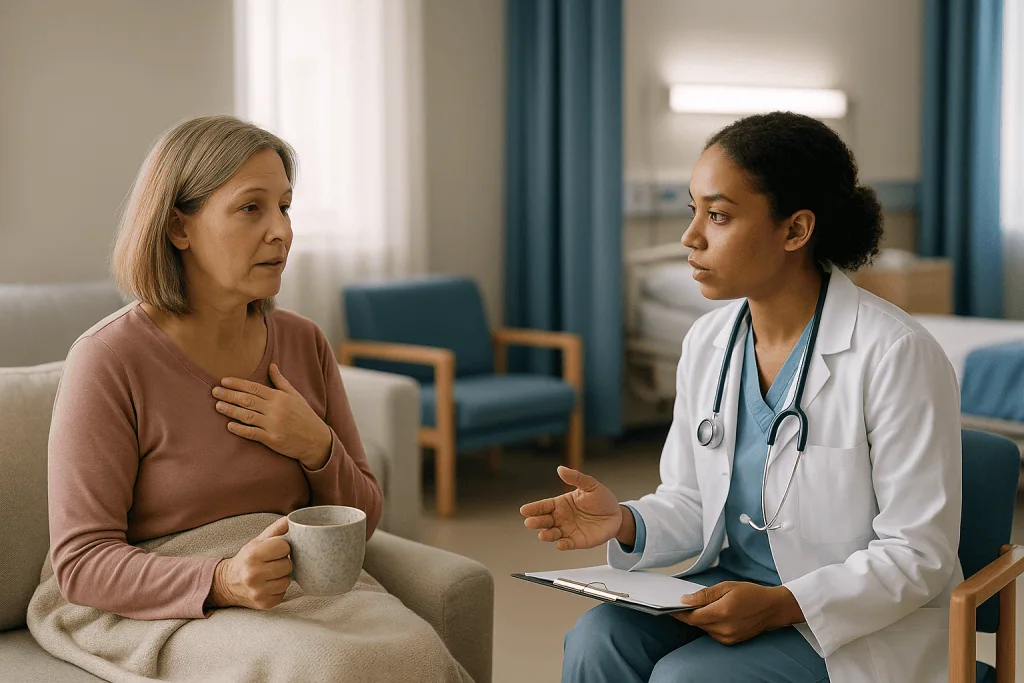
The first decision your clinician makes is not which medicine but where you should be. For pneumonia, that judgment rests on a handful of measurable things rather than on how ill you say you feel: your breathing rate, blood pressure, whether you are newly confused, your age, and your oxygen saturation, which is the percentage of hemoglobin in the blood carrying oxygen, read by a small clip on the fingertip called a pulse oximeter. Blood tests and a chest X-ray add detail. Someone who scores low on these markers and can eat, drink and take medicine reliably is usually cared for at home, with a plan for what to do if things change.
Hospital admission is more likely when oxygen levels are low, when someone cannot keep fluids down, when there is another serious condition in the background, or when the person lives alone and cannot safely monitor themselves. In hospital, treatment may include oxygen, intravenous antibiotics or fluids, and closer observation. The Mayo Clinic describes intensive care as the route when breathing needs mechanical support.
A third group is asked, sometimes to their frustration, to wait. Most acute bronchitis is viral, and antibiotics do nothing against viruses. The NHS is explicit that antibiotics are not usually offered for chest infections unless there are signs of pneumonia or the person is at higher risk of complications. Prescribing them anyway trades no benefit for the risk of side effects and antibiotic resistance. Being told to rest, drink fluids and come back if things worsen is not being dismissed; it is being treated according to the evidence.
Where you fall among these groups can shift. A home plan can become an admission after a phone call, and that flexibility is the point. The decision sits with the treating team, revisited as often as your condition demands.
Days 1 to 3: what the first 72 hours of treatment usually look like
The first three days are the hardest to interpret, because the body often feels no different for a while after treatment begins. If antibiotics have been prescribed for a bacterial infection, they start acting on the bacteria within hours, but the inflammation those bacteria triggered does not switch off with them. The Cleveland Clinic and the Mayo Clinic both describe people typically beginning to feel better within a few days of starting treatment, which in practice means somewhere in the 24-to-72-hour window rather than by the next morning.
What you can usefully do in this stretch is small and unglamorous. Sleep as much as your body asks for. Drink enough that your urine stays pale, because fluid thins mucus and makes the cough more productive. Sleep propped on pillows if lying flat makes breathing harder. Take every prescribed medicine exactly as your prescriber directed, at the times directed, and raise any side effect with them rather than adjusting on your own. Many clinicians advise against suppressing the cough entirely because, as the Mayo Clinic notes, coughing helps loosen and move fluid out of the lungs; ask your team before using any cough product.
It also helps to measure rather than guess. Note your temperature at the same times each day. Count your breaths for a full minute while resting. Notice how far you can walk before stopping. These three numbers give your clinician far more to work with than “still rough” when you speak on the phone.
The CDC defines a fever as 100.4°F (38°C) or higher. A temperature that stays above that line, or breathing that gets faster rather than slower over these first days, is exactly the kind of change that warrants a call rather than another day of waiting.
How long does it take to clear a lung infection with antibiotics?
This question hides two different ones. How long until the bacteria are gone, and how long until you feel well? The first is shorter than most people expect; the second is longer.
Antibiotic courses for uncomplicated pneumonia have grown shorter over the past two decades as trials showed that longer courses did not improve outcomes for most people. Today a course for lower-severity pneumonia treated at home often runs about a week or less, though the exact length, the choice of drug and any extension are entirely the prescriber’s call and depend on the likely organism, your other conditions and how you respond. Some infections, including those caused by certain atypical bacteria or acquired in hospital, are treated for longer. If a viral cause is identified, antibiotics may not be used at all, and any antiviral decision again rests with the team.
The mechanism explains why finishing the course does not mean finishing recovery. Antibiotics work either by breaking down the bacterial cell wall or by jamming the machinery bacteria use to build proteins and copy themselves. Both actions stop the infection from spreading. Neither clears the fluid and cellular debris already sitting in the alveoli. That clearance is done by your own immune cells over the following weeks, which is why the NHS timeline runs to 6 weeks for cough and breathlessness even though the medicine bottle is empty long before.
Two practical points follow. First, feeling better on day four is not a reason to stop early; finish the course as prescribed unless your prescriber tells you otherwise, because surviving bacteria are the ones most able to resist the drug. Second, still coughing on day ten is not, by itself, evidence the antibiotic failed. Failure looks like fever that never settles or symptoms that worsen, and that is a clinical judgment for your care team, not a calendar calculation.
Days 4 to 7: the fever should be gone by the end of week one
Somewhere in the second half of the first week, most people notice the turn. Appetite comes back before energy does. The night sweats stop. The cough often changes character, sounding wetter and producing more mucus, which alarms people but usually signals the lungs are moving fluid up and out rather than sitting on it.
The NHS marks the end of week one as the point by which a high temperature should have gone. That is the milestone your clinician is most likely to ask about, and it is worth taking literally. A fever that has settled and then returns, or one that never dropped below 100.4°F (38°C) despite treatment, is a signal to be reassessed. The reasons range from an antibiotic that does not match the organism, to a viral infection that antibiotics were never going to touch, to a complication such as fluid collecting around the lung. None of these can be sorted out at home.
Energy in this phase arrives in short bursts and departs without warning. A shower can feel like a workout. This is not weakness of character; it is the metabolic bill for a week of fever and inflammation, and for muscles that have done little. The sensible pattern is short, frequent movement around the house rather than either bed rest or a heroic walk.
Many people ask about work and school. The NHS advice is to return when you feel well enough, and for most people with a mild chest infection that falls within the 7-to-10-day window. Pneumonia usually takes longer, and jobs involving physical exertion take longer still. Until the fever has been gone for a full day, you may also still be contagious with the virus or bacterium that started this, so covering coughs and washing hands protects the people around you.
Days 8 to 14: the second week of the pneumonia recovery timeline
Week two is when recovery stops looking like illness and starts looking like convalescence, a word that has fallen out of fashion but describes exactly what is happening. The antibiotics may be finished. You are probably up and dressed. And there is a widening gap between how you feel sitting on the sofa, which is fine, and how you feel after climbing a flight of stairs, which is not.
That gap is the central experience of this fortnight and the source of most worry. Breathlessness on exertion persists because some alveoli are still clearing; deconditioning adds to it, since even a week of reduced activity measurably weakens muscle. The National Heart, Lung, and Blood Institute, part of the NIH, describes the spread candidly: some people feel better and return to their normal routine within a week, while for others it takes a month or more, with tiredness the most common lingering complaint.
Your care team may arrange a review at or around this point. For some people, particularly smokers and adults over about 50, the Mayo Clinic notes a clinician may recommend a follow-up chest X-ray several weeks after treatment to confirm the lungs have cleared. This is not a sign of concern; it is a check that the white patch has gone, and it can occasionally pick up something that was hidden behind the infection.
What you can do in week two is expand your radius gradually. Walk a little further each day than the day before, stopping while you can still talk in full sentences. Keep drinking. Keep sleeping more than usual. If you smoke, this is the moment when quitting has the most direct and immediate effect on your lungs’ ability to clear, and your team can point you to support for that.
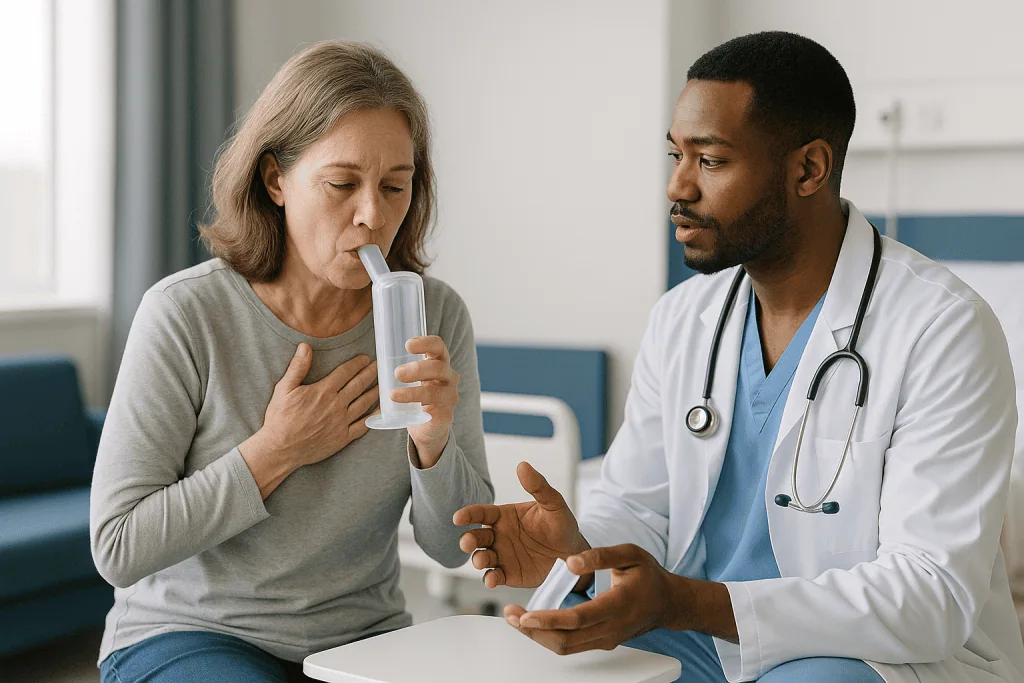
Deep breathing exercises are often suggested. Ask your clinician which technique suits you; some involve a small handheld device, others just a slow, counted breath.
Lung infection recovery time at a glance
The table below sets the two common infections side by side using the milestones published by the NHS. Read the pneumonia column as “most people, most of the time”; older adults and people with other conditions often sit at the later edge of each range, and anyone who was admitted to hospital should expect a slower arc.
| Point in time | Acute bronchitis (chest infection) | Pneumonia |
|---|---|---|
| First 3 days | Symptoms at their worst; antibiotics usually not needed | Treatment begins; people typically start to feel better within a few days |
| About 1 week | Most symptoms improving | High temperature should have gone |
| 7 to 10 days | Symptoms usually cleared | Appetite and sleep returning; exertion still hard |
| Up to 3 weeks | Cough and mucus may persist | Cough, mucus and tiredness continue |
| 4 weeks | Usually resolved | Chest pain and mucus substantially reduced |
| 6 weeks | Cough and breathlessness substantially reduced | |
| 3 months | Most symptoms resolved; tiredness may remain | |
| 6 months | Most people feel back to normal |
Two cautions on reading this. A cough lasting beyond 3 weeks after a chest infection, or a fever that returns after settling, falls outside the expected pattern and should prompt a call. And these ranges describe symptoms, not the microbes; someone may be free of infection long before they feel free of its aftermath.
Use the table as a shared reference with your care team rather than a scorecard. Where you sit on it depends on which infection you had, which organism caused it and what your lungs were like before it arrived.
How long does pneumonia last once the antibiotics are finished?
Longer than the prescription, and often longer than patience. The NHS timeline is the clearest published guide: chest pain and mucus production much reduced by 4 weeks, cough and breathlessness by 6 weeks, most symptoms gone by 3 months, and a return to feeling fully normal by around 6 months for many people. Those last two figures surprise people who assumed pneumonia was a two-week illness.
The lingering cough has its own physiology. After infection, the airway lining is raw and the nerves within it are hypersensitive, so cold air, talking or lying down can trigger coughing long after there is anything left to clear. Clinicians call this a post-infectious cough. It fades as the lining heals, and it does not usually mean the infection has come back, though a cough that is getting worse, producing blood or accompanied by a new fever should always be checked.
Fatigue is the other slow mover, and it has several sources at once. Inflammatory signaling molecules that circulated during the infection take time to settle. Muscle lost during days in bed has to be rebuilt. Sleep was disrupted by coughing for weeks. Appetite was poor, so nutrition dipped. Older adults, whose recovery reserves are smaller, feel this most, and the NHLBI singles out tiredness as the symptom most likely to persist even when everything else has cleared.
What is not normal in the post-antibiotic weeks: fever returning, breathlessness worsening rather than plateauing, new chest pain, coughing up blood, or ankle swelling and breathlessness together. Each of those needs a clinician’s eyes, because the list of causes includes complications of the pneumonia and, occasionally, a separate problem the infection unmasked.
What is the fastest way to recover from a lung infection?
The honest answer is that there is no proven accelerator. No supplement, tea, breathing gadget or diet has been shown in good-quality trials to shorten how long pneumonia lasts. What the evidence does support is removing the things that slow recovery down, which in practice can make a real difference to how the weeks feel.
Start with the medicine plan. Taking prescribed treatment exactly as directed, at the times directed, and finishing it unless your prescriber says otherwise, is the single intervention with the strongest evidence behind it. Then sleep. Immune function and tissue repair are both concentrated during sleep, and the Mayo Clinic lists rest among its core self-care advice. Fluids come next: staying hydrated keeps mucus thin enough to cough out rather than sit in the airways.
Smoking is the largest modifiable brake. Tobacco smoke paralyzes the cilia, the microscopic hairs that sweep mucus upward, and it is a direct irritant to an already inflamed airway. Not smoking, and avoiding other people’s smoke, gives the lungs their best chance to clear. Ask your care team about support to quit if that applies to you.
Movement matters more than most people expect. Complete bed rest beyond the feverish days weakens breathing muscles and encourages mucus to pool. Gentle, frequent walking around the home, then outside, then a little further, rebuilds capacity without overloading a healing chest. Stop when you can no longer speak comfortably, and try again later rather than pushing through.
What about vitamin C, zinc, honey, steam or herbal products? Evidence for any of them shortening a lung infection is weak or absent. Honey can soothe a cough in adults and children over one year, according to NHS advice, but that is comfort, not treatment. Anything you are considering adding should be run past your clinician, especially if you take other medicines.
What is the last stage of lung infection?
People searching this phrase usually want one of two things: reassurance about where they are in the process, or a fear checked. Both deserve a straight answer.
Medically, an ordinary lung infection is not staged the way cancers or chronic diseases are. “End-stage” is a term used for conditions such as advanced emphysema, not for pneumonia in someone who was well beforehand. A bout of pneumonia is an event with a beginning, a peak and a resolution, and for most people it ends with the lungs returning to normal.
There is, however, an older description from pathology that answers the question in a different way. When a lobe of the lung is infected by bacteria, it passes through a recognizable sequence. First, congestion: blood vessels swell and fluid leaks into the alveoli. Then the air sacs fill with red and white blood cells and clotting protein, becoming firm; textbooks called this hepatization because the tissue looked like liver. As red cells break down and white cells dominate, the color shifts to gray. The final stage is resolution: enzymes dissolve the debris, macrophages carry it away, and the alveoli refill with air.
That last stage, resolution, is what you are living through when the fever has gone but the cough persists. It is not a plateau or a setback; it is the phase in which the lungs are literally emptying themselves. In the timeline used by the NHS it corresponds roughly to weeks two through six.
Where the fear comes from is the confusion between this natural resolution and complications. A worsening course, with fluid around the lung, an abscess or sepsis, is not a stage of normal infection but a departure from it. Those are the situations the red-flag section later in this article is written for, and they are exactly why clinicians ask to hear from you if you stop improving.
What people often get wrong about recovering from a lung infection
Some of these misunderstandings are harmless. A few can prolong illness or send someone back to hospital, so they are worth naming.
“I feel better, so the infection is gone and I can stop the antibiotics.” Feeling better tracks the inflammation settling, not the last bacterium dying. Finish the course as prescribed unless your prescriber tells you otherwise; partial courses leave the hardiest bacteria behind.
“Green or yellow mucus means bacteria, so I need antibiotics.” The NHS is clear that sputum color is not a reliable guide to whether an infection is bacterial or viral. The color comes mainly from enzymes released by white blood cells, which respond to both.
“Antibiotics will speed up my chest infection.” Most acute bronchitis is viral. For those infections antibiotics offer no benefit and carry real risks, which is why clinicians decline to prescribe them.
“I should stay in bed until I am fully better.” Rest during the feverish days, yes. Weeks of bed rest afterward weaken breathing muscles and let mucus pool. Gentle, progressive movement is part of recovery, not a threat to it.
“A cough at week three means the treatment failed.” The NHS expects cough to persist for up to 6 weeks after pneumonia. Failure looks like fever returning, breathlessness worsening or new chest pain, not a cough that is slowly fading.
“Pneumonia only affects the very old.” Risk is highest in older adults and young children, but healthy adults of any age get it, particularly after influenza or other viral infections.
“I have had pneumonia once, so I am immune.” Dozens of organisms cause pneumonia. Recovering from one confers no protection against the others, which is why vaccination against pneumococcus, influenza and other respiratory viruses is recommended by the CDC for people at higher risk.
Correcting these is not pedantry. Each one changes a decision someone makes at home.
Questions to ask your care team about your recovery
Consultations are short and the days afterward are long. Writing a few questions down before an appointment, or before a follow-up phone call, turns a vague sense of “is this normal?” into answers you can act on. These are the ones clinicians most often wish patients had asked.
- Do you think this is bacterial or viral, and how does that change what I should expect over the next two weeks?
- By what day should my fever be gone, and what should I do if it is still there or comes back?
- What specific changes in breathing, chest pain or alertness would you want a call about, and which number do I use out of hours?
- How long should I expect the cough and tiredness to last after I finish the medicine?
- Are there any of my regular medicines I should discuss with you while I am taking this treatment?
- Should I avoid cough products or other over-the-counter remedies while I recover?
- When is it reasonable for me to return to work, school, driving or exercise, and how should I build activity back up?
- Will I need a follow-up appointment or a repeat chest X-ray, and when?
- Am I still contagious, and for how long should I take precautions around older or vulnerable family members?
- Given my age and health, are there vaccinations you would recommend once I have recovered?
- Are there breathing exercises or a rehabilitation program that would suit me?
- Is there anything about this episode that changes how you think about my longer-term lung or heart health?
Bring your three home measurements with you: temperature readings, resting breathing rate and how far you can walk before stopping. They make your clinician’s job easier and your reassurance more specific. If a family member is helping with your care, having them hear the answers first-hand often prevents a second round of worried questions later.
When to call your doctor: red-flag signs during lung infection recovery
Recovery is supposed to move in one direction, unevenly but forward. The signs below mean it has stopped doing that, and each one warrants contacting your care team the same day. Several warrant emergency services.
Call emergency services (911 in the US) or go to the emergency department if you or the person you are caring for:
- is struggling to breathe, gasping, or breathless while sitting still
- has lips, face or fingernails that look blue, gray or unusually pale
- is newly confused, very drowsy or difficult to rouse, which in older adults may be the only sign of serious deterioration
- has chest pain that is severe, crushing or spreading to the arm, jaw or back
- is coughing up blood or blood-streaked sputum in more than small flecks
- has cold, clammy or mottled skin, a very fast heartbeat, or has not passed urine in a day, all of which can point to sepsis
Contact your doctor or urgent care the same day if:
- fever above 100.4°F (38°C) persists beyond 48 to 72 hours of starting treatment, or returns after it had settled
- breathlessness is getting worse rather than better over several days
- chest pain is new, sharper or worsening when breathing in
- you cannot keep fluids or prescribed medicine down
- a home pulse oximeter reading falls below the level your clinician told you to act on
- a cough is still worsening, rather than slowly improving, three weeks after a chest infection
- a rash, severe diarrhea or swelling of the face or mouth develops after starting a new medicine
For infants and young children, add fast or grunting breathing, the skin sucking in between the ribs with each breath, feeding much less than usual, or being unusually floppy or hard to console. The CDC and Mayo Clinic both flag these as reasons for prompt assessment.
When in doubt, call. Clinicians would far rather hear about a change that turns out to be nothing than learn afterward that someone waited. Every decision about what happens next, from adjusting treatment to arranging admission, belongs with the team who knows your case.
Frequently asked questions
How long does pneumonia last in total?
For most adults treated at home, pneumonia symptoms follow a six-week arc with a longer tail. The NHS expects fever to settle within about a week, chest pain and mucus to ease by 4 weeks, and cough and breathlessness by 6 weeks, with most symptoms gone at 3 months. Tiredness can linger for up to 6 months, longer in older adults or those who needed hospital care.
What is the fastest way to recover from a lung infection?
There is no proven shortcut, but you can remove what slows recovery. Take prescribed treatment exactly as directed and finish it unless your prescriber says otherwise, sleep more than usual, drink enough to keep mucus thin, avoid tobacco smoke completely, and build activity back gradually rather than resting in bed for weeks. Supplements and herbal products have not been shown to shorten lung infections.
What is the last stage of lung infection?
Ordinary lung infections are not staged like chronic diseases. In pathology terms, bacterial pneumonia passes through congestion, filling of the air sacs, and finally resolution, when enzymes and immune cells clear the debris and the alveoli refill with air. That resolution phase is what you experience as the weeks of lingering cough after the fever has gone. Complications such as fluid around the lung are departures from this pattern, not stages of it.
How serious is a lung infection?
It ranges from a mild illness that clears at home to a life-threatening one. Most healthy adults recover fully. Risk of complications such as sepsis, fluid around the lung or respiratory failure rises in infants, adults over 65, smokers, and people with chronic heart or lung disease or weakened immunity. The WHO reports pneumonia caused 14% of deaths in children under five worldwide in 2019, which is why prompt assessment matters in higher-risk groups.
How long does it take to clear a lung infection with antibiotics?
Antibiotics start acting within hours, and people typically begin to feel better within a few days, according to the Mayo Clinic and Cleveland Clinic. Courses for uncomplicated pneumonia are usually about a week or less, decided by the prescriber. Clearing the bacteria is not the same as clearing the symptoms: cough and tiredness commonly continue for weeks afterward while the lungs remove fluid and debris.
What are the best chest infection recovery tips for the first week?
Rest during the feverish days, drink enough that your urine stays pale, sleep propped up if lying flat worsens breathing, and avoid smoke entirely. Measure your temperature and resting breathing rate daily so you can report changes precisely. Do not suppress a productive cough without asking your clinician, since coughing helps clear the lungs. Return to activity in short, frequent walks once the fever has gone.
Is it normal to still be coughing two weeks after finishing antibiotics?
Yes, usually. The NHS expects cough to persist for up to 6 weeks after pneumonia and up to 3 weeks after a chest infection, because the airway lining stays irritated and hypersensitive after the infection has gone. A cough that is slowly fading is expected. One that is worsening, producing blood, or accompanied by a returning fever or new chest pain should be assessed by your doctor.
Why am I so tired weeks after a lung infection?
Fatigue is the slowest symptom to resolve and the one the NHLBI singles out as most likely to linger. Inflammatory chemicals released during the infection take time to settle, muscle weakens quickly during days in bed, sleep was disrupted by coughing, and appetite was poor. Older adults feel this most. Gradual, daily increases in activity rebuild capacity; if tiredness is worsening rather than plateauing, tell your care team.
Can I go back to work while recovering from pneumonia?
The NHS advises returning when you feel well enough, which for a mild chest infection is often within 7 to 10 days and for pneumonia usually longer. Physically demanding jobs take longer still. Until fever has been gone for a full day you may remain contagious, so cover coughs and wash hands. Ask your clinician for a timeframe specific to your job and your recovery.
Do I need a follow-up chest X-ray after pneumonia?
Not everyone does. The Mayo Clinic notes that clinicians may recommend a repeat X-ray several weeks after treatment, particularly for smokers and adults over about 50, to confirm the lungs have cleared and to check nothing was hidden behind the infection. Your care team will decide based on your age, risk factors and how you have recovered. Ask at your follow-up whether one is planned.
References
- NHS: Pneumonia
- NHS: Chest infection
- NIH National Heart, Lung, and Blood Institute: Pneumonia: Recovery
- Cleveland Clinic: Pneumonia
This article is for general information only and is not a substitute for professional medical advice. Please consult a qualified doctor about your individual situation.

More from the Blog

Preparing for Robotic Lung Surgery: Breathing Tests, Heart Checks and Stopping Smoking Early
Preparing for robotic lung surgery usually means several weeks of assessment and conditioning before the operation. Breathing tests such as spirometry and a gas…

Why Is Lung Infection Treatment Planned Differently for Older Adults?
Lung infection treatment is planned differently for older adults because aging changes how infections present, how the body clears them, and how medicines behave.…

When Does a Lung Infection Need Hospital Care? Oxygen Levels and Other Signals Doctors Use
A lung infection usually needs hospital care when the body can no longer keep up on its own: a blood oxygen reading that stays…

What Can a Bronchoscopy Find That a Chest CT Cannot? Washings, Brushings and Biopsies
A bronchoscopy detects things a chest CT can only suggest: it shows the inside surface of the airways directly and collects samples. Washings and…

Who Is a Candidate for Robotic Lung Surgery? Tumor Size, Lung Function and Heart Health
Robotic lung surgery candidates are usually people with an early-stage lung tumor that has not spread beyond nearby lymph nodes, enough breathing reserve on…

What Is an Asthma Action Plan and How Does Your Doctor Build One With You?
An asthma action plan is a written, personalized set of instructions that you and your clinician create together during a visit. It uses color-coded…