

What Does the Surgeon Actually See in Robotic Urology? The View the Patient Never Notices
Key Takeaways
- The robotic surgeon watches a magnified, three-dimensional image from a two-lens camera inside the body, with the rest of the operating room shut out of view.
- Every instrument movement is made by the surgeon in real time; the system filters hand tremor and bends instrument tips further than a human wrist, but has no autonomy.
- Port incisions are typically around 1 to 2 centimeters, yet the internal operation is as major as the open version and fatigue for weeks is expected.
- A Cochrane review of prostatectomy found keyhole and robotic approaches shortened hospital stay by roughly 1.7 days and reduced transfusions, without clear differences in cancer control or urinary and sexual function.
- Pain is slightly lower on the first day after robotic prostatectomy than after open surgery, but similar by one week, and gas-related shoulder ache is unique to keyhole approaches.
- The surgeon loses the sense of touch at the console, which is why a trained bedside assistant and honest questions about case volume matter more than any equipment model.
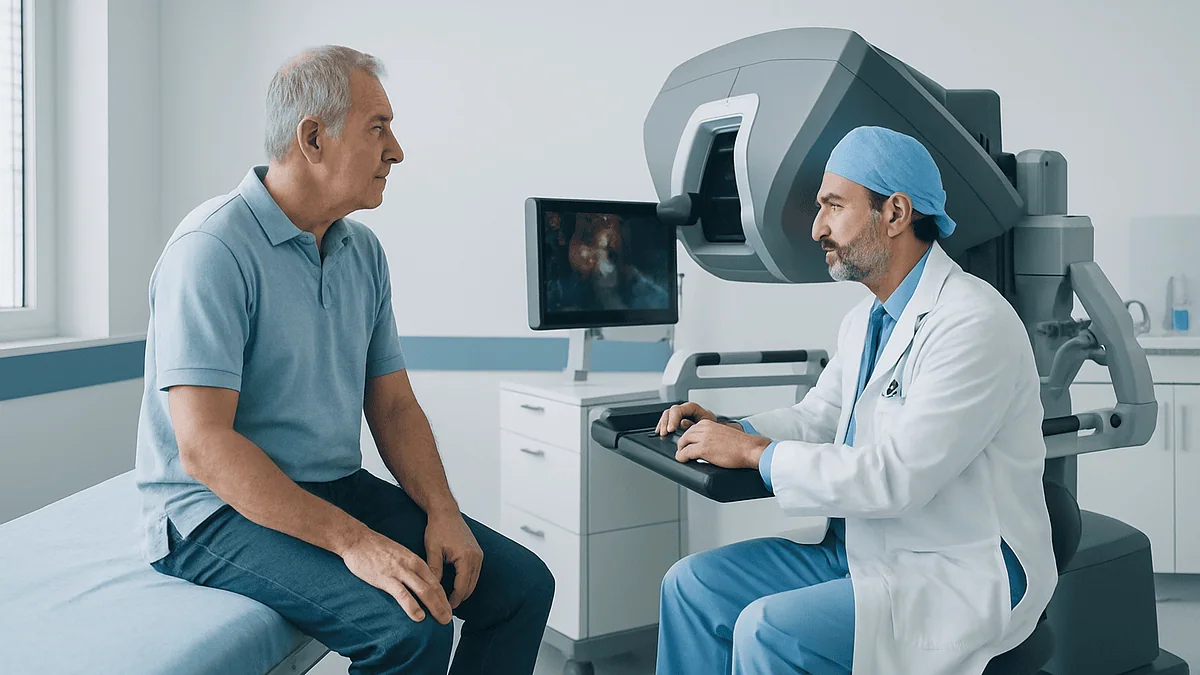
In robotic urology, the surgeon sits at a console a few feet from the patient and looks into a magnified, high-definition, three-dimensional view sent from a camera inside the body. That view shows blood vessels, nerves and tissue planes at a scale the naked eye cannot match, while the surgeon's hand movements are translated, with tremor filtered out, to wristed instruments inside small incisions.
The pre-op nurse has just left, and the man on the trolley is staring at the ceiling tiles, doing arithmetic he does not want to do. His prostate operation is in forty minutes. He has met the surgeon twice. What he cannot picture, and what nobody has really described, is that for the next few hours the person he trusted with this will not be standing over him at all. She will be seated, head lowered into a hooded viewer, hands resting in two controllers, watching his insides in three dimensions.
That gap between what the patient imagines and what actually happens is worth closing. Most explanations of what the surgeon sees in robotic surgery stop at “a magnified camera.” The honest version is stranger and more reassuring than that, and it also explains what robotics can and cannot change about an operation.
This article walks through the view from the console, the anatomy it reveals, what the evidence says about pain and recovery, and the questions worth asking before you sign the consent form.
What does the surgeon actually see in robotic surgery?
Picture a stereo endoscope: a slim tube, roughly the width of a finger, carrying two side-by-side camera lenses and its own light source. It passes through a small port in the abdomen and feeds two slightly offset images to the console. When the surgeon looks into the viewer, each eye receives one image, and the brain fuses them into depth, the same trick that lets you judge the distance to a coffee cup. The result is a three-dimensional, high-definition picture that fills the surgeon’s entire field of vision, with the operating room, the anesthesia monitors and the rest of the team shut out of view (Mayo Clinic; MedlinePlus).
What appears on that screen is not a sanitized diagram. It is living tissue, moving with each breath the ventilator delivers. Arteries pulse. Fat glistens yellow. The pale, fibrous capsule around a kidney looks quite different from the darker, softer kidney itself, and those differences in color and texture are the surgeon’s map. The camera can be driven closer to a structure until a vessel the width of a pencil lead fills half the screen, then pulled back to survey the whole pelvis.
The image is also steady in a way the human head is not. In older keyhole surgery, an assistant held the camera, and every slight tremor or sway showed up on the monitor. In the robotic setup the camera arm holds position until the surgeon moves it, so the picture stays fixed on the exact spot of interest (Cleveland Clinic).
The surgeon does not see everything, though. The view is a cone of light inside a body cavity inflated with carbon dioxide gas. Anything outside that cone, including the patient’s face, is invisible from the console. That is why a second surgeon or trained assistant always stands at the bedside, watching the whole patient and the instruments from the outside.
How does robotic urology surgery actually work, step by step?
The word “robot” misleads people. Nothing in the room acts on its own. Robotic surgery is more accurately called robot-assisted laparoscopic surgery: keyhole surgery in which the surgeon controls the instruments through a computer interface rather than holding them directly (MedlinePlus).
The sequence is predictable. After general anesthesia, the team positions the patient, often tilted head-down for pelvic operations or on one side for kidney work, so gravity moves the bowel out of the way. The abdomen is inflated with carbon dioxide to create working space. Several small incisions, typically around 1 to 2 centimeters each, are made, and hollow ports are placed through them (MedlinePlus). The camera and the instruments enter through these ports, and the robotic cart is docked so its arms hold each instrument.
The surgeon then moves to the console and scrubs out, in the sense that their gloved hands are no longer inside the sterile field. Their fingers rest in two controllers. Every movement of the surgeon’s hands is read by the system, scaled down, filtered for tremor and reproduced by the instrument tips inside the body (Mayo Clinic). Foot pedals switch between instruments, adjust the camera and control the energy used to seal small vessels.
At the bedside, an assistant changes instruments, passes sutures through a port, applies suction and keeps the outside of the operation safe. The anesthesiologist manages breathing, blood pressure and the effects of the tilted position and the gas. When the reconstruction is finished, the instruments are withdrawn, the gas is released, and the small incisions are closed.
If at any point the surgeon judges the robotic approach unsafe, for example because of heavy bleeding or dense scar tissue, the team can convert to a conventional open incision. This is a planned safety option, not a failure, and it is discussed during consent (Mayo Clinic).
Why is the console view sharper than a surgeon's own eyes?
Three things separate the robotic view from what a surgeon sees in open surgery: magnification, depth and stillness.
Magnification first. In an open operation, the surgeon looks down into a wound from perhaps 40 centimeters away, sometimes with loupes that magnify a few times. The robotic camera sits centimeters from the tissue and displays it on a screen filling the viewer, so structures appear enlarged many times over, commonly described as roughly tenfold (Cleveland Clinic). At that scale, the tiny vessels that feed a nerve bundle become visible as individual threads rather than a vague pink haze.
Depth second. Standard laparoscopy uses a single lens and a flat monitor, so the surgeon relies on shadows and instrument contact to judge distance. The stereo camera restores true depth perception, which matters most when placing a needle through a ureter only a few millimeters wide or when deciding exactly where a tumor ends and healthy kidney begins (Mayo Clinic).
Stillness third. Human hands shake slightly, more so at the end of a long operation. The system removes that tremor before it reaches the instrument tip (MedlinePlus). The instruments themselves have a wrist near the tip that bends and rotates through a wider range than a human wrist can, so the surgeon can sew around a corner without moving the whole arm (Mayo Clinic).
None of this is magic, and it is worth being honest about the trade-off. The surgeon loses the sense of touch. In open surgery, fingers can feel a hard lymph node or the firmness of a tumor. At the console, the surgeon must infer tissue stiffness from how it moves and deforms on screen. Experienced robotic surgeons describe learning to “see” texture, but it is a learned substitute, not the real thing.
What the patient never notices: the anatomy that decides the operation
Every urologic operation has a few square centimeters that matter more than everything else, and the console view is designed to make those areas legible.
In a radical prostatectomy, the operation to remove the whole prostate for cancer, the critical zone is the pair of neurovascular bundles. These are delicate cords of nerves and small vessels running along either side of the prostate that help control erections, and the sphincter muscle below the prostate that helps control urine (MedlinePlus). Whether the surgeon can peel the prostate away from those nerves depends partly on where the cancer sits, which is decided before surgery by imaging and biopsy, and partly on being able to see the thin layer of tissue between the two. Magnification shows that layer; it does not guarantee the nerves can be spared if the cancer has grown into them.
In a partial nephrectomy, removing a kidney tumor while leaving the rest of the kidney in place, the surgeon must first find and temporarily clamp the renal artery, then cut around the tumor while a clock runs, because the kidney tolerates only a limited period without blood flow. The view has to show the exact edge of the tumor and the individual branches of the artery.
In a pyeloplasty, a repair of the narrow junction where the kidney drains into the ureter, the whole operation happens on a tube a few millimeters across, and the surgeon spends much of it sewing tiny stitches.
The patient wakes with a few small dressings and no sense of any of this. Yet those moments at the console, choosing where to place a cut a millimeter to one side or the other, shape continence, kidney function and cancer control for years. Ask your surgeon which structure they are most focused on protecting in your specific operation; it is a fair question with a concrete answer.
Who is a robotic surgeon, and do neurosurgeons do robotic surgery?
There is no such thing as a robotic surgeon in the sense of a separate specialty. A “robotic surgeon” is a fully trained surgeon in an established specialty, urology in this case, who has completed additional training to operate through the console (Mayo Clinic). Urologists finish medical school, several years of surgical residency and often a fellowship before adding robotic credentialing, which typically involves simulator hours, observed cases and proctored operations under hospital rules. The robot is a tool in the hands of someone who could also do the operation open or laparoscopically.
That framing matters when you meet your surgeon. The relevant questions are about their training and experience with your particular operation, not about the machine. A surgeon who has done many robotic prostatectomies has seen many variations of pelvic anatomy on that screen and knows what unusual tissue looks like.
As for neurosurgery: yes, robotic assistance exists in brain and spine surgery, but it looks very different from the urology setup. Spinal robots mostly guide the placement of screws along a pre-planned path using imaging, and some brain procedures use robotic arms to position needles or electrodes precisely. The surgeon still works directly at the patient. The immersive, console-based, wristed-instrument system described in this article is used mainly in the abdomen, pelvis and chest, where there is room to inflate a cavity and move instruments freely (Johns Hopkins Medicine).
Other specialties using console systems include gynecology, colorectal and general surgery, thoracic surgery and some head and neck operations (Cleveland Clinic). Urology was an early adopter because the prostate sits deep in a narrow bony pelvis, exactly the kind of space where a steady, magnified, three-dimensional view and bendable instrument tips earn their keep.
Who is robotic urology surgery usually for, and who is asked to wait?
Robotic assistance is an approach, not a treatment. The first question is always whether surgery is the right option at all, and that decision belongs to the treating team, often a multidisciplinary group of urologists, oncologists and radiologists reviewing scans and biopsy results together.
Operations commonly performed robotically in urology include removal of the prostate for localized cancer, removal of all or part of a kidney for tumors, removal of the bladder with reconstruction of a new urine pathway, repair of blockages where the kidney meets the ureter, and some reconstructive procedures on the ureter and bladder (Mayo Clinic; NHS). Not every patient with these conditions is a candidate for surgery; for low-risk prostate cancer, for example, guidelines describe active surveillance, watchful waiting and radiotherapy as alternatives that many people choose instead (NHS).
Who is usually asked to wait, or offered a different approach? Several situations make the team cautious:
- Extensive scar tissue from previous abdominal operations, which can make safe port placement and dissection difficult.
- Severe heart or lung disease, because the steep head-down tilt and the gas used to inflate the abdomen raise pressure on the chest and affect circulation.
- Very large tumors or cancers that have spread to surrounding structures, where an open incision may give better access.
- Active infection, poorly controlled diabetes or recent blood clots, which are usually addressed first.
- Uncontrolled bleeding tendency or blood-thinning medicines that cannot yet be safely paused; any adjustment is decided by the prescribing clinician, never by the patient alone.
Body size is discussed honestly rather than as a barrier. Higher body weight can lengthen the operation and change port placement, but surgeons routinely operate robotically across a wide range of body types (Cleveland Clinic). If your team suggests waiting, ask what specifically they want to change and how they will know it is time.
Robotic surgery vs laparoscopic vs open: what the evidence actually shows
People often assume the sharper view must translate into dramatically better results. The evidence is more measured, and it is worth seeing side by side.
| Feature | Open surgery | Standard laparoscopic | Robot-assisted laparoscopic |
|---|---|---|---|
| Incision | One larger cut | Several small ports | Several small ports |
| Surgeon’s view | Direct, with loupes | Two-dimensional monitor | Magnified three-dimensional viewer |
| Instrument movement | Full hand and wrist | Rigid, limited angles | Wristed tips, tremor filtered |
| Sense of touch | Yes | Partial, through instruments | Largely absent |
| Blood loss and transfusion | Higher | Lower | Lower |
| Hospital stay | Longer | Shorter | Shorter |
| Cancer control and long-term function | No clear difference shown in randomized comparisons for prostatectomy |
The clearest data come from prostate surgery. A Cochrane systematic review comparing laparoscopic and robot-assisted radical prostatectomy with open surgery found little or no difference in cancer-related outcomes, urinary function or sexual function, but did find a shorter hospital stay, by roughly 1.7 days on average, and fewer blood transfusions with the keyhole approaches (Ilic et al., Cochrane Database of Systematic Reviews, PubMed). The certainty of that evidence was rated low to moderate.
In plain terms: the view helps the surgeon operate through smaller incisions with less bleeding and get you home sooner. It has not been shown, in the best available trials, to change whether the cancer is fully removed or whether continence and erections return. Those outcomes depend far more on the stage of disease, your baseline health and the surgeon’s experience than on which approach is chosen (NHS).
Is robotic surgery less painful, and does the view explain it?
This is one of the most searched questions, and the honest answer is: somewhat, and mostly early on.
Pain after abdominal surgery comes from several sources: the skin and muscle that were cut, the stretching of the abdominal wall by the gas, irritation of the diaphragm that is felt as shoulder-tip pain, and the internal work itself. Small port incisions hurt less than a long muscle-splitting incision, so the first source is reduced. The gas-related pain, however, is specific to keyhole surgery and does not exist after open surgery, which is why some people are surprised by aching shoulders on day one.
The Cochrane review of prostatectomy found that laparoscopic and robot-assisted surgery may result in slightly less pain on the first day compared with open surgery, but found little or no difference in pain at one week or at twelve weeks (Ilic et al., PubMed). In other words, the advantage is real but front-loaded.
Does the magnified view contribute? Indirectly. A steadier, clearer picture lets the surgeon handle tissue more gently and seal small vessels precisely, which may reduce bruising and inflammation, but this is a plausible mechanism rather than a measured effect. Pain also depends heavily on the anesthetic plan, on regional nerve blocks and local anesthetic placed in the incisions, and on getting out of bed early.
Pain management after surgery is individualized. Teams commonly combine several classes of medicine so that no single one carries the load, and they aim to move people off the strongest options within days. Any question about which medicines you will receive, and for how long, belongs with your anesthesiologist and surgical team; the plan is written for your kidneys, your other prescriptions and your history, not for a general reader.
Robotic prostatectomy recovery time: what the first days and weeks usually look like
Recovery has a rhythm, and knowing it in advance takes some of the fear out of the small setbacks.
The first night is usually spent in hospital. You wake with several small dressings, a urinary catheter, sometimes a thin drain and, after prostate surgery, a feeling of pressure in the pelvis. Shoulder ache from the gas is common and fades over a day or two. Nurses will want you sitting out of bed within hours and walking the corridor the same day or the next; early movement lowers the risk of blood clots and helps the bowel wake up (MedlinePlus).
Many people go home after one or two nights, though this varies with the operation and your general health (NHS). At home, the first week is about small walks, fluids, gentle food and managing the catheter, which after prostatectomy is usually kept in for around one to two weeks until the join between the bladder and urethra has healed (NHS). Removing it is a quick outpatient visit.
Weeks two to six bring the parts nobody enjoys. After prostate surgery, urine leakage when the catheter comes out is expected, not a complication, and pelvic floor exercises taught before surgery are the main tool for improving it; the pace of improvement varies widely between individuals (NHS). After kidney surgery, fatigue is often the dominant complaint, and blood tests track how the remaining kidney tissue is functioning.
Most teams advise avoiding heavy lifting for several weeks and returning to desk work when you feel ready, often sooner than after open surgery (MedlinePlus). Driving resumes when you can brake sharply without pain and are no longer taking sedating medicines; your team will give you their own rule. Full return of energy can take longer than the incisions suggest, because the internal work was substantial even though the outside looks minor.
What risks is the surgeon watching for on the screen?
Every advantage of the console view has a shadow, and good surgeons will describe both.
Bleeding is the first concern. The magnified view makes small vessels visible and easy to seal, but a torn large vein can fill the screen with blood in seconds and obscure everything. Suction, pressure and, if needed, conversion to open surgery are the responses. The lower transfusion rates seen with keyhole prostatectomy reflect how often this goes well, not a guarantee that it will (Ilic et al., PubMed).
Injury to neighboring structures is the second. The bowel, the ureters, major vessels and, in pelvic surgery, the rectum all sit close to the target. Because the surgeon sees only what is in the camera’s cone of light, an instrument tip outside the view can touch something unseen. Systems are designed so instruments cannot move unless the surgeon is looking into the viewer, and the bedside assistant watches for anything the camera misses (Mayo Clinic).
Positioning injuries are specific to this kind of surgery. Hours of steep head-down tilt can cause swelling of the face and eyes, pressure on nerves in the shoulders and, rarely, muscle damage in the legs. Anesthesia teams pad pressure points and limit operating time partly for this reason.
General surgical risks apply as well: infection, blood clots in the legs or lungs, hernias at port sites, reactions to anesthesia and, after prostate or bladder surgery, longer-term urinary leakage and erectile changes (MedlinePlus). Equipment problems are uncommon but possible, and a plan to complete the operation by another route always exists.
Alternatives should be laid out in the same neutral way: open or standard laparoscopic surgery, radiotherapy, active surveillance for suitable prostate cancers, or ablation for some small kidney tumors (NHS). Which is right depends on your disease and your priorities, and that conversation belongs with your treating team.
Who is the best robotic surgeon in the world? Why that question has no honest answer
Type this into a search engine and you will find plenty of people volunteering for the title. Medicine does not work that way, and understanding why will make you a sharper patient.
Surgical outcomes are shaped by the patient’s disease stage, age, other illnesses and anatomy as much as by the surgeon. A surgeon who operates only on healthy people with small tumors will post better numbers than one who takes on difficult cases, even if the second surgeon is more skilled. Published results are rarely adjusted for this, and marketing never is. Rankings, awards and social media follower counts measure visibility, not the steadiness of a hand inside a pelvis.
What the evidence does support is that experience with a specific operation matters. Surgeons and hospitals that perform a procedure frequently tend to have fewer complications than those performing it rarely, a pattern seen across many types of complex surgery (Johns Hopkins Medicine). Volume is not everything, but it is something you can ask about directly.
Better questions than “who is the best” include: How many of this exact operation do you do each year? How often do you convert to open surgery, and why? What are your own complication rates, and how do you track them? Who will be at the bedside while you are at the console? What happens if there is a problem overnight?
Notice that none of those questions requires you to travel anywhere or compare cities. A surgeon who answers them calmly, with numbers and without defensiveness, is telling you something more useful than any ranking. So is a surgeon who says, “I don’t think you need this operation yet,” because the best decision in urology is sometimes not to operate at all.
What people often get wrong about what the surgeon sees in robotic surgery
A handful of misunderstandings come up in almost every consultation, and each has a clear correction.
The robot operates on its own. It does not. Every movement of every instrument is made by the surgeon in real time; the system has no autonomy and cannot take a single action without a hand in the controller (MedlinePlus). If the surgeon lets go, the instruments freeze.
The surgeon is in another room or another city. In practice the console sits in the same operating room, a few steps from the table. Remote operation over long distances has been demonstrated experimentally but is not how routine urology surgery is done.
Robotic surgery means the cancer is more likely to be fully removed. The best randomized evidence for prostate surgery shows no clear difference in cancer control between robotic, laparoscopic and open approaches (Ilic et al., PubMed). Cancer control depends on disease stage and surgical judgment, not the platform.
Smaller incisions mean a minor operation. The outside is minor. Inside, a prostatectomy or partial nephrectomy is exactly as major as the open version, and the body knows it. Fatigue lasting weeks is normal and does not mean something went wrong.
The surgeon can see everything. The camera shows a cone of light inside one body cavity. Anything outside that cone, and anything requiring the sense of touch, is either supplied by the bedside team or simply not available.
Newer machine, better surgeon. The training and case experience of the person at the console matter far more than the model number of the equipment. Ask about the person.
Robotic surgery is painless. Pain is lower in the first day compared with open surgery, then similar by one week (Ilic et al., PubMed). Gas-related shoulder pain is a real and expected part of the early recovery.
Questions to ask your care team before robotic urology surgery
Bring this list, or your own version of it, to the consent conversation. Writing the answers down is worth more than trying to remember them afterward.
- Is surgery the right option for me now, and what are the alternatives, including waiting and monitoring?
- Why are you recommending the robotic approach rather than open or standard laparoscopic surgery for my case?
- How many of this exact operation do you perform in a typical year, and how many has the team done together?
- What structure are you most focused on protecting during my operation, and what could make that difficult?
- How often do you convert to an open incision, and what would prompt that decision?
- Who will be at the bedside while you are at the console, and who covers if there is a problem overnight?
- What is your plan for my pain, and who do I contact if it is not controlled at home?
- How long should I expect the catheter or drain to stay in, and who removes it?
- Which of my regular medicines should I continue, and which need to be paused, and who makes that decision?
- What symptoms after discharge should make me call, and what number do I call?
- When can I expect to hear the pathology results, and how will they be explained to me?
- What does recovery look like at two weeks, six weeks and three months for someone like me?
Ask, too, whether you can be taught pelvic floor exercises before surgery if you are having prostate or bladder surgery; starting early is commonly advised (NHS). If any answer feels rushed or vague, it is reasonable to ask for a second appointment or a second opinion. Good surgical teams expect these questions and are not offended by them.
When to call your doctor after robotic surgery
Most recoveries are uneventful, and most of the odd sensations in the first two weeks, including bloating, shoulder ache, mild bruising around port sites and light blood-tinged urine, are expected. A short list of signs is different, and each deserves a same-day call to your surgical team or, where noted, emergency care.
Call your team the same day if you notice a fever, spreading redness or pus at any incision, urine that becomes heavily blood-stained or contains clots, a catheter that stops draining despite drinking normally, worsening rather than easing abdominal pain, persistent vomiting, or new swelling and pain in one calf (MedlinePlus).
Seek emergency care immediately, by ambulance if needed, for sudden shortness of breath or chest pain, which can signal a clot in the lungs; heavy bleeding from a wound or the catheter; fainting or a racing heartbeat with lightheadedness; a rigid, severely painful abdomen; confusion; or an inability to pass urine at all after the catheter has been removed. Do not wait to see whether these settle overnight.
Bring your discharge paperwork to any emergency visit, because a clinician who did not do your operation needs to know which structures were operated on and what was reconstructed. If you were sent home with instructions to pause or restart any regular medicine, follow the plan given by the prescribing clinician, and if you are unsure, call rather than guess.
Finally, contact your team about anything that simply worries you. Surgical nurses field calls about drains, dressings and dribbles all day, and a five-minute conversation often prevents a much longer one later. Every decision about your care, from the first scan to the last follow-up, sits with the people who know your case; this article is a map of the territory, not a substitute for their judgment.
Frequently asked questions
What does the surgeon actually see on the screen during robotic urology surgery?
The surgeon sees a magnified, high-definition, three-dimensional image of the inside of the body, produced by a two-lens camera inserted through a small port. Tissue appears many times larger than life, with true depth, so small vessels, nerve bundles and the edges of a tumor can be identified. The view is a cone of light within one cavity, so a bedside assistant watches everything outside it.
Who is a robotic surgeon?
A robotic surgeon is a fully trained specialist, such as a urologist, who has completed additional training and hospital credentialing to operate through a console. It is not a separate specialty. The same surgeon could perform the operation open or laparoscopically, so the meaningful questions are about their training and how many of your specific operation they perform, not about the machine itself.
Do neurosurgeons do robotic surgery?
Yes, but in a different form. Robotic systems in spine and brain surgery mostly guide the precise placement of screws, needles or electrodes along a pre-planned path from imaging, while the surgeon works directly at the patient. The immersive console with wristed instruments used in urology is designed for the abdomen, pelvis and chest, where a cavity can be inflated and instruments moved freely.
Is robotic surgery less painful than open surgery?
Slightly, and mainly early. A Cochrane review of prostatectomy found robotic and laparoscopic surgery may cause slightly less pain on the first day than open surgery, with little or no difference at one week or twelve weeks. Small incisions hurt less than a large one, but the gas used to inflate the abdomen can cause shoulder-tip pain for a day or two that open surgery does not cause.
How does robotic surgery vs laparoscopic surgery differ from the surgeon's side?
Both use small ports and a camera, but standard laparoscopy gives a flat two-dimensional picture and rigid instruments held directly in the surgeon’s hands. The robotic console adds three-dimensional depth, higher magnification, tremor filtering and instrument tips that bend like a wrist. Neither approach has been shown in randomized trials to improve cancer control over open surgery; both reduce blood loss and hospital stay.
What is a typical robotic prostatectomy recovery time?
Many people spend one or two nights in hospital and keep a urinary catheter for around one to two weeks, according to NHS guidance, then spend several weeks avoiding heavy lifting while energy returns. Urine leakage after catheter removal is expected and usually improves with pelvic floor exercises over a variable period. Your team gives ranges for your situation; none of these figures is a promise.
Does the robot ever move on its own?
No. The system has no independent function; every movement of every instrument is produced by the surgeon’s hands in the controllers, in real time. If the surgeon looks away from the viewer or releases the controls, the instruments stop. The term robot-assisted surgery is more accurate than robotic surgery, because the machine is a precise tool, not a decision-maker.
Who is the best robotic surgeon in the world?
There is no evidence-based answer, because outcomes depend heavily on disease stage, patient health and case selection, and rankings measure visibility rather than skill. What research does support is that surgeons and teams performing a specific operation frequently tend to have fewer complications. Asking your surgeon for their annual case numbers and conversion and complication rates is far more useful than any list.
Can the surgeon feel tissue during robotic surgery?
Largely no. Current console systems transmit little or no sense of touch, so the surgeon cannot feel whether a lymph node is hard or a tumor is firm the way an open surgeon can. Experienced robotic surgeons learn to judge texture visually from how tissue moves and deforms under the instruments, but this is a learned substitute, and it is one reason case experience matters.
What happens if something goes wrong at the console?
The team converts to another approach. If heavy bleeding, dense scar tissue or an equipment problem makes the robotic route unsafe, the surgeon can switch to standard laparoscopy or make a conventional open incision to finish the operation. This possibility is discussed during consent and is a planned safety step. A trained assistant is always at the bedside, and the anesthesia team monitors the whole patient throughout.
References
- Robotic surgery – MedlinePlus Medical Encyclopedia
- Radical prostatectomy – MedlinePlus Medical Encyclopedia
- Prostate cancer – Treatment – NHS
- Robotic Surgery – Cleveland Clinic
This article is for general information only and is not a substitute for professional medical advice. Please consult a qualified doctor about your individual situation.

More from the Blog

Renal Pharmacotherapy Explained: How Medicines Are Adjusted When Kidneys Filter Less
Medication management in kidney disease means adjusting medicines because the kidneys clear many drugs from the blood, and when filtration falls those drugs can…

Ureteral Stent or Nephrostomy Tube: Which Drainage Route Suits Your Hydronephrosis?
A ureteral stent and a nephrostomy tube both relieve hydronephrosis by letting trapped urine escape, but by different routes. A stent is an internal…

After an Enlarged Prostate Procedure: Catheter Care, Fluids and the First Weeks of Recovery
After an enlarged prostate procedure such as TURP, a urinary catheter is usually left in for about one to three days to drain the…

Easing Epididymitis Pain Safely: Scrotal Support, Cold Packs and Rest Your Urologist Recommends
Epididymitis pain relief rests on three measures that urology guidelines consistently list: supporting and elevating the scrotum with snug underwear or a jockstrap, applying…

How Kidney Function Tests Guide Renal Pharmacotherapy and Why They Are Repeated
Kidney function tests before medication measure how well the kidneys filter blood, usually through serum creatinine, an estimated glomerular filtration rate (eGFR), and a…

After Peyronie’s Injection Treatment: Bruising, Discomfort and the Follow-Up Schedule
After a Peyronie's injection, bruising, swelling and tenderness of the penis are expected and usually fade over about one to two weeks, while the…