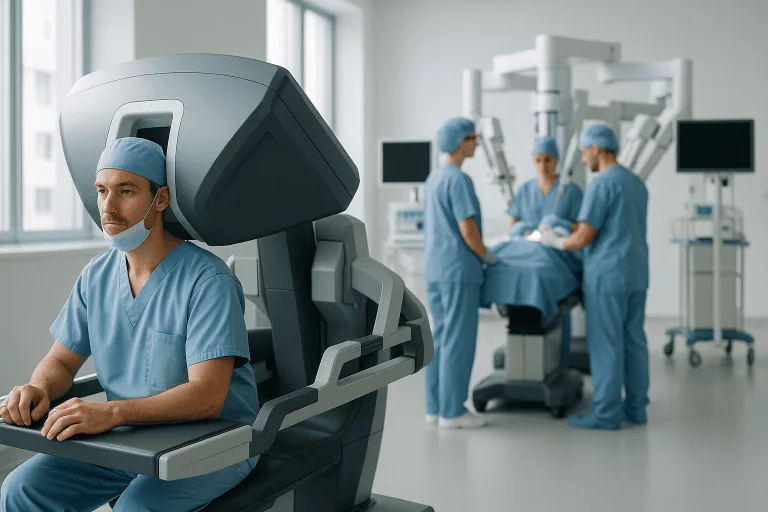
Robotic Urology
Robotic urology uses da Vinci robotic systems to perform minimally invasive procedures for prostate, kidney, bladder and other urinary conditions with enhanced precision and smaller incisions.

Quick answer
Robotic urology uses a robotic-assisted surgical system to operate on the prostate, kidney, bladder and ureter through small incisions. The surgeon controls every instrument movement from a console with magnified 3D vision. It is most widely used for prostate cancer surgery (robotic prostatectomy), kidney tumour removal and urinary tract reconstruction, and typically involves general anaesthesia, a short hospital stay and a staged recovery.
Robotic Urology and Prostate Cancer Surgery: What You Need to Know
Robotic urology is the use of a robotic-assisted surgical system to perform operations on the prostate, kidneys, bladder, ureters and adrenal glands through several small incisions. Its best-known application is prostate cancer surgery: the removal of a cancerous prostate gland using fine instruments controlled entirely by a urologic surgeon seated at a console. It is a form of minimally invasive surgery, and it suits some patients and some conditions better than others.
Being told you may need a urologic operation is unsettling, and it helps to name why. The urinary system is tied to daily comfort, kidney function, continence, sexual health and quality of life. For men facing prostate cancer surgery, the questions are usually specific: Will I stay dry? Will erections recover? Will the cancer be fully removed? For anyone facing kidney, bladder or ureter surgery, the concerns tend to centre on pain, scarring, recovery time and the possibility of long-term change. This page addresses those questions plainly, without promising outcomes no surgeon can promise.
One point deserves stating at the outset. The robot does not perform surgery. It is a surgical instrument, and every movement it makes is directed in real time by a trained urologic surgeon. The technology extends the surgeon’s vision and dexterity; it does not replace the surgeon’s judgement, experience or ability to plan around your particular anatomy. Those human factors remain central to the result, which is why the choice of team matters as much as the choice of technique.
At Acibadem, robotic urology sits inside a broader diagnostic and treatment pathway rather than standing alone. Patients are assessed carefully before any operation is proposed, and when cancer is involved, planning may include multidisciplinary review by urologists, radiologists, pathologists, medical oncologists, radiation oncologists and other specialists. This matters particularly for international patients, who often arrive with prior imaging, biopsy results or conflicting medical opinions and need a clear, evidence-based recommendation before committing to treatment abroad.
What Is Robotic Urology?
Robotic urology refers to urologic operations performed with a robotic-assisted surgical system rather than through a single large incision or conventional laparoscopy. Through several small access points, the surgeon inserts a high-definition camera and delicate instruments that bend and rotate in ways that exceed the movement of the human wrist. Sitting at a surgical console near the patient, the surgeon views the operative field in magnified three-dimensional detail and controls each instrument movement moment by moment. A bedside team assists throughout, exchanging instruments, managing suction and removing tissue.
What is robotic surgery in urology?
In urology specifically, robotic surgery means using this console-and-instrument system for operations on the prostate, kidney, bladder, ureter, adrenal gland and selected reconstructive work in the urinary tract. Urology adopted robotic assistance earlier and more widely than most surgical fields for a practical anatomical reason: many urologic operations take place in confined spaces, the deep male pelvis, the area around the kidney, where important nerves, blood vessels and urinary structures sit close together. In prostate surgery, robotic assistance helps the surgeon separate the gland from surrounding tissue with close attention to the urinary sphincter and, where oncologically appropriate, the erectile nerves. In kidney surgery, it supports removing a tumour while preserving as much healthy kidney tissue as the disease allows.
How do robots improve urology surgeries?
Robotic systems improve urologic operations in three concrete ways: better vision, finer movement and steadier control. The camera provides a magnified three-dimensional view, so structures a few millimetres across, nerve bundles, small vessels, the ureter, are easier to identify and protect. The instruments articulate through a greater range of motion than a human wrist and filter out natural hand tremor, which makes precise dissection and suturing in narrow spaces more controlled. And because access is through small incisions rather than one long cut, tissue trauma is generally lower than in open surgery, which for many patients translates into less blood loss, a shorter hospital stay and an earlier return to ordinary activity. None of this is automatic; the advantages depend on appropriate patient selection and an experienced team.
What robotic surgery is not
Robotic surgery is not suitable for every patient or every condition, and an honest programme says so. Some patients are better served by open surgery, conventional laparoscopy, endoscopic treatment, radiation therapy, medication or active surveillance, depending on the diagnosis, prior operations and general health. Extensive scar tissue from previous abdominal surgery, certain tumour characteristics or medical conditions that make prolonged general anaesthesia risky can all shift the balance. A responsible robotic urology assessment therefore begins with two prior questions: Is surgery needed at all? And if so, is the robotic approach the right one for this patient? Only after those are answered does the technique itself become relevant.
Who May Need Robotic Urologic Surgery
Patients are usually considered for robotic urologic surgery after symptoms, screening results or imaging suggest a condition that may need operative treatment. Some people have no symptoms at all and are diagnosed through routine testing: an elevated prostate-specific antigen (PSA) result, or a scan performed for an unrelated reason that happens to show a kidney mass. Others come to medical attention because of pain, bleeding, urinary difficulty or repeated infections.
Symptoms that commonly lead to urologic evaluation include blood in the urine, difficulty starting urination, a weak urinary stream, frequent urination, pain in the side or back, recurrent urinary tract infections, pelvic discomfort, urinary leakage and changes in sexual function. In cancer-related conditions, symptoms may be absent in the early stages. That is precisely why imaging, laboratory testing and biopsy results, rather than how a person feels, often drive the decision-making.
Diagnosis typically begins with a detailed medical history, a physical examination and a review of prior records. Depending on the concern, the workup may include blood tests, urine tests, ultrasound, computed tomography, magnetic resonance imaging, cystoscopy, prostate biopsy, kidney function testing or nuclear medicine studies. International patients commonly share scans, pathology slides and reports before travelling, so the clinical team can judge whether the existing workup is sufficient or whether further testing is needed on arrival. This preparatory review often changes the plan, and occasionally removes the need for surgery altogether.
Robotic surgery becomes a genuine option when the condition is treatable operatively and a minimally invasive approach is expected to offer meaningful advantages. The decision also weighs age, general health, prior abdominal or pelvic surgery, body build, kidney function, cancer stage, tumour location and your own priorities. For many patients, the most useful conversation is not whether robotic surgery is technically possible, it usually is, but whether it is the safest and most effective path given the full clinical picture. That conversation belongs with a urologist who performs both robotic and non-robotic operations and has no reason to favour one over the other.
Conditions Robotic Urology Can Treat
Robotic techniques are used for both cancerous and non-cancerous conditions across the urinary tract. The four main areas are described below, roughly in order of how commonly they are performed.
Robotic Prostatectomy for Localised Prostate Cancer
Robotic prostatectomy is the removal of the prostate gland and seminal vesicles, and sometimes nearby lymph nodes, for cancer that appears confined to the prostate or its immediate surroundings. It is the most common robotic urologic operation worldwide. Where the cancer’s position and grade allow, the surgeon aims to preserve the urinary control structures and the nerve bundles responsible for erections; this is called nerve-sparing surgery, and whether it is possible depends on where the tumour sits, not on the surgeon’s preference. Before recommending surgery, prostate cancer is staged using MRI, biopsy pathology and sometimes advanced imaging, because the right treatment differs sharply between low-risk disease that may only need monitoring and higher-risk disease that may need combined treatment. You can read more about the operation itself on our robotic prostatectomy page, and about the disease and its treatment options on the prostate cancer page.
Robotic Kidney Surgery: Partial and Radical Nephrectomy
For kidney tumours, robotic partial nephrectomy removes the tumour together with a narrow margin of surrounding tissue while leaving the rest of the kidney in place. Kidney-sparing surgery matters most for patients with small or awkwardly located tumours, reduced kidney function, a single kidney, or risk factors for future kidney disease such as diabetes or hypertension. During the operation, blood flow to the kidney may be temporarily controlled while the tumour is removed and the kidney repaired with sutures, delicate work for which the robotic platform is well suited. Where the tumour is large, centrally placed or otherwise unsuitable for kidney-sparing removal, robotic radical nephrectomy, removal of the entire kidney, may be the safer choice. Which operation is right is an oncological judgement made from imaging and kidney function testing, and it should be explained to you before surgery, not after.
Robotic Bladder Surgery
Robotic surgery is also used for selected bladder cancer operations, including removal of the bladder (cystectomy) in appropriately staged disease. Depending on the patient and the cancer, urinary reconstruction is performed at the same time to create a new route for urine drainage, either through an opening on the abdominal wall or, in selected patients, an internal reservoir made from bowel. These are major operations with a significant recovery and long-term adjustment, and they demand thorough preoperative counselling. Robotic access can reduce the trauma of the abdominal part of the surgery, but it does not make cystectomy a small operation, and no honest team will present it as one.
Reconstructive and Other Urology Procedures
Robotic systems support a range of reconstructive urology procedures beyond cancer surgery. These include repair of ureteropelvic junction obstruction, where urine flow from the kidney into the ureter is blocked; ureteral reconstruction after injury or narrowing; removal of adrenal tumours in selected cases; treatment of complex kidney cysts; and correction of certain urinary tract abnormalities. The unifying feature across all of these is anatomical: robotic assistance lets the surgeon perform detailed dissection and fine suturing through small incisions in places that are difficult to reach and unforgiving of error. Acibadem’s urology department assesses each of these conditions individually, because for several of them non-surgical or endoscopic alternatives exist and may be preferable.
How Robotic Urologic Surgery Is Performed
Preparation Before Surgery
Preparation begins with confirming the diagnosis and matching the surgical plan to your medical condition. Your surgeon reviews imaging, pathology, blood tests, current medicines and prior surgical history. If cancer is involved, the team assesses whether the disease appears localised or whether further staging is needed, for prostate cancer this may mean prostate MRI, biopsy review and, in higher-risk cases, additional imaging; for kidney or bladder tumours, cross-sectional imaging and kidney function assessment are usually central.
Anaesthesia specialists then evaluate your heart, lung and general health. Some patients need cardiology, pulmonology or internal medicine review first, particularly those with diabetes, heart disease or chronic conditions. You will be told when to stop eating and drinking before the operation, and whether bowel preparation or preventive antibiotics apply to your procedure. Decisions about any of your regular medicines, including blood thinners, are made by your treating doctors as part of this assessment, based on your individual risk. Practical steps within your own control also help: stopping smoking, keeping blood sugar well controlled and improving general fitness before surgery all support healing and reduce complications.
International patients are guided through the practical side as well: translation of medical records, coordination of appointments, scheduling of any remaining diagnostic tests after arrival, interpreter support, and realistic planning of the hospital stay and the follow-up period before flying home. When travel is involved, this groundwork matters more, because the team must be confident both that surgery is appropriate and that you can recover safely before returning.
During the Procedure
Robotic urologic surgery is performed under general anaesthesia. Once you are asleep, the team positions your body to give safe access to the operating area, for pelvic operations this typically means a head-down tilt, while protecting pressure points, nerves and circulation. The sequence of the operation itself follows these broad steps:
- Several small incisions are made and ports placed for the camera and instruments.
- The abdomen is gently expanded with carbon dioxide gas to create working space.
- The surgeon moves to the console and views the anatomy through the magnified three-dimensional camera; from here, every hand movement translates into precise instrument motion inside the body.
- The planned dissection, removal and reconstruction are carried out, with the bedside team assisting with instrument exchange, suction and tissue handling.
- The specimen is removed, the working space is checked for bleeding, and the small incisions are closed.
The detail of step four depends entirely on the operation. In robotic prostate surgery, the prostate is separated from the bladder and urethra, the surrounding blood vessels are controlled, and the urinary tract is reconstructed by joining the bladder directly to the urethra; where appropriate, lymph nodes are removed for staging. In robotic partial nephrectomy, the tumour is identified, kidney blood flow may be briefly controlled, the tumour is excised and the kidney repaired with sutures to limit bleeding and preserve function. In reconstructive operations, narrowed or blocked tissue is removed and the urinary tract reconnected to restore drainage.
Modern robotic programmes use supportive technology throughout: high-resolution imaging to map tumours and anatomy before surgery, intraoperative imaging in selected procedures to locate lesions and vessels, advanced energy devices to control bleeding, and digital operating room systems that integrate imaging with the surgical view. The purpose of all of it is the same, to give the surgeon better information and better control, not to substitute for skill.
How Long Does the Operation Take?
Duration varies widely with the procedure. A straightforward prostate or kidney operation may take several hours; major bladder removal with urinary reconstruction takes longer. Time in the operating room also includes anaesthesia, positioning and preparation, so the interval your family waits is always longer than the surgery itself. Your team will give you a realistic estimate for your specific operation beforehand.
Immediately After Surgery and Your Hospital Stay
After surgery you are monitored in a recovery area while the anaesthesia wears off. Pain is managed with a combination of medicines, and most patients are encouraged to begin walking early, often the same day or the next morning. Early movement reduces the risk of blood clots, wakes up bowel function and helps the lungs expand. Acibadem’s approach to analgesia after operations of this kind is described in detail in our guide to how we control pain after surgery and invasive procedures.
Depending on the procedure, you may wake with a urinary catheter, a drain or a temporary internal stent. After prostatectomy, a catheter routinely stays in place for a period while the new join between bladder and urethra heals: this is a normal part of the operation, not a complication. After kidney or reconstructive surgery, drain output and sometimes imaging are reviewed before discharge. Nurses and physicians teach you how to care for the catheter and incision sites, and explain what to watch for during healing.
Length of stay depends on the procedure and how your recovery progresses. Many robotic urologic operations involve a shorter hospitalisation than the equivalent open surgery, but complex cancer operations, or patients with other medical conditions, may need longer. Discharge planning covers pain control, activity guidance, medication instructions from your treating team, wound care, follow-up appointments and, for international patients, sensible timing of the journey home.
Recovery After Robotic Urologic Surgery
Recovery varies by procedure, diagnosis and personal health, but the following timeline describes what many patients can generally expect. Treat it as a map, not a schedule; your own team’s instructions take precedence.
| Time Period | What Patients Can Expect |
|---|---|
| Day 1 | Monitoring after anaesthesia, pain control, fluids as allowed, and usually first steps of walking with assistance. A catheter, drain or stent may be present depending on the surgery. |
| First Week | Fatigue, mild abdominal discomfort, bloating and incision tenderness are common. Most patients walk daily, avoid heavy lifting and follow catheter or wound-care instructions. |
| First Month | Daily activity increases gradually. Desk work often resumes earlier than physically demanding work. Follow-up visits review the pathology report, healing and next steps. |
| Longer Term | Functional recovery continues. After prostate surgery, urinary control and sexual function may improve over months. After kidney surgery, kidney function is monitored. Cancer surveillance may include blood tests and imaging. |
What is the recovery time for prostate cancer surgery?
Most men are up and walking within a day of robotic prostate cancer surgery, home within days, and back to light daily activity within a few weeks; physically demanding work and strenuous exercise take longer and are resumed on the surgeon’s advice. The catheter is removed at a follow-up visit once the reconstruction has healed. Functional recovery is slower than physical recovery: urinary control typically improves progressively over weeks to months, often supported by pelvic floor exercises, and where nerve-sparing surgery was performed, erectile function can continue to recover over a longer horizon. Recovery time also depends on age, fitness, the extent of the operation and whether lymph nodes were removed, which is why two men who had “the same operation” can have quite different first months.
How painful is prostate cancer surgery?
The operation itself is performed under general anaesthesia, so you feel nothing during it. Afterwards, most men describe discomfort rather than severe pain: soreness at the small incision sites, abdominal bloating from the gas used to create working space, occasionally shoulder-tip ache from the same cause, and catheter-related irritation. This is generally managed well with a planned combination of medicines and tends to ease significantly within the first days. Pain after minimally invasive prostate cancer surgery is usually less than after the equivalent open operation, because there is no long incision through the abdominal wall, but every patient’s experience differs, and your team will adjust pain relief to yours rather than assume a standard course.
What happens to a man after his prostate is removed?
Removing the prostate changes several things permanently and predictably, and you should hear them before surgery, not after. Because the prostate and seminal vesicles produce most of the fluid in semen, ejaculation of fluid no longer occurs after prostatectomy; orgasm remains possible, but it is dry, and natural fertility ends, men who wish to father children later can discuss sperm banking beforehand. Urinary control commonly needs time to return, since the operation works directly around the sphincter mechanism; leakage in the early weeks is expected and usually improves with healing and pelvic floor training. Erectile function depends heavily on whether nerve-sparing was possible, on function before surgery and on age; recovery, where it occurs, is gradual. Finally, PSA blood testing continues after surgery as the standard means of monitoring for any sign of recurrence.
What is the life expectancy after prostate cancer removal?
No honest page can give you a single figure, because life expectancy after prostate cancer removal depends on the stage and grade of the cancer, the pathology findings after surgery, your age and your overall health. What can be said honestly is this: surgery for localised prostate cancer is performed with the intent of removing all detectable disease, many men treated at this stage go on to live long lives, and the final pathology report, reviewed with your team after the operation, is what turns general reassurance into a prognosis that actually applies to you. Ongoing PSA monitoring exists precisely so that, in the minority of cases where further treatment is needed, it can be considered early.
Why Acting Early Matters
Urologic conditions can progress silently. Prostate, kidney and bladder cancers are generally more treatable when found and managed before they spread or compromise organ function. A kidney tumour that is small today may become harder to remove while preserving kidney tissue if it grows into critical structures. A bladder tumour that appears superficial can become invasive without timely evaluation. Obstruction in the urinary tract can quietly damage kidney function well before symptoms become severe.
Delay can also narrow your options. In some prostate cancer cases, careful monitoring is entirely appropriate; in others, waiting too long may reduce the possibility of nerve-sparing surgery or of treatment aimed at complete removal of the disease. For urinary obstruction, repeated infections or worsening hydronephrosis can make eventual reconstruction more complex. For recurrent bleeding or suspected bladder cancer, postponing cystoscopy simply postpones the diagnosis, not the disease.
Acting early does not mean rushing to the operating theatre. It means completing the diagnosis, understanding your level of risk and choosing the right treatment at the right time. A timely second opinion is particularly worthwhile when recommendations differ between doctors, when you are weighing treatment abroad, or when the diagnosis is cancer and several credible treatment paths exist.
Benefits of Robotic Urology
For carefully selected patients, robotic urology offers practical and clinical advantages over more invasive approaches. The table summarises them; the paragraph after it states the limits.
| Benefit | What It Means for You |
|---|---|
| Smaller incisions | Robotic procedures are performed through small access points, which may reduce visible scarring and lessen tissue trauma compared with open surgery. |
| Enhanced surgical visualisation | Magnified three-dimensional views help the surgeon identify delicate nerves, blood vessels and urinary structures during complex steps. |
| Precise instrument movement | Robotic instruments allow fine dissection and suturing in narrow spaces such as the pelvis or deep around the kidney. |
| Potential for less blood loss | Minimally invasive access and careful control of vessels may reduce bleeding in many procedures, although individual risk varies. |
| Faster functional recovery for many patients | Many people return to walking, eating and basic daily activities earlier than they might after open surgery, depending on the operation and overall health. |
| Organ and function preservation in selected cases | In appropriate patients, robotic techniques may support nerve-sparing prostate surgery or kidney-sparing tumour removal when medically safe. |
The limits deserve equal weight. Robotic access does not change what must be removed: an operation for cancer is defined by the cancer, and a surgeon will always prioritise complete, safe removal over incision size. Robotic surgery still carries the general risks of major surgery under anaesthesia, bleeding, infection, injury to nearby structures, blood clots, and its specific advantages depend on the operation, the disease and the team. Men researching prostate robotic surgery in particular should be wary of any source that presents the technology itself as the outcome; the technology is the means.
Factors That Influence Outcomes
The outcome of robotic urologic surgery depends on several factors, and the most important is the underlying disease. A small localised kidney tumour, a low-volume prostate cancer and a complex invasive bladder cancer each require different planning and carry different expectations. Cancer stage, grade, tumour location and biological behaviour shape long-term results more than any surgical technique does.
Your health matters too. Age alone is not the deciding factor, but heart and lung function, diabetes, obesity, kidney function, smoking history and medication use all affect surgical risk and recovery. Prior abdominal or pelvic surgery may have left scar tissue that makes minimally invasive access more challenging. For prostate surgery, your baseline urinary control and erectile function set the ceiling for functional recovery afterwards. For kidney surgery, pre-existing kidney disease and the amount of healthy tissue that can be preserved are central considerations.
Surgeon and team experience are the third pillar. Robotic urology demands more than familiarity with the platform: it requires deep knowledge of urologic anatomy, cancer surgery principles, reconstruction and the management of complications when they arise. A good result is built before the first incision, through careful patient selection, imaging review, operative planning and frank conversation about goals. During surgery, judgement decides when to preserve tissue, when to remove more for safety, and when to change the plan based on what is found.
Finally, postoperative care shapes recovery. Early walking, breathing exercises, well-managed pain relief, infection prevention, nutrition and respect for activity restrictions all contribute to healing. For cancer patients, the final pathology report determines whether surveillance alone is sufficient or whether additional therapy should be discussed. Long-term follow-up is not an optional extra; it is part of the treatment, particularly where the original condition carries any risk of recurrence.
Robotic Urology at Acibadem
Acibadem’s robotic urology practice is organised around three things patients consistently need: sound medical assessment, clear communication and careful coordination. It operates within the group’s wider robotic surgery programme and its urology departments, supported by advanced imaging, pathology, anaesthesia, intensive care and rehabilitation services.
Those supporting services matter because urologic surgery is rarely just an operation. A patient with prostate cancer may need expert radiology and pathology review before choosing between surgery, radiation therapy and surveillance. A patient with a kidney tumour needs an assessment of renal function and a plan for preserving kidney tissue where feasible. A patient with bladder cancer may need multidisciplinary discussion covering surgery, chemotherapy, urinary reconstruction and long-term follow-up. Where appropriate, urologists work alongside medical oncologists, radiation oncologists, radiologists, nuclear medicine specialists and pathologists so that the plan aligns with evidence-based protocols, including, sometimes, the conclusion that robotic surgery is not the best option for a given patient.
For international patients, practical support is part of safe care. Acibadem International provides coordination in more than 20 languages, covering appointments, interpretation, hospital admission, discharge planning and communication with the medical team. This does not replace the doctor-patient relationship; it strengthens it, by removing avoidable confusion and making it easier to ask the questions that matter. Medical records can be reviewed before travel, so that patients arrive knowing what tests, consultations and procedures are likely to be involved.
Treatment planning is personal by design. Two patients with the same diagnosis may not need the same operation. A younger man with localised prostate cancer and strong baseline function may weigh nerve-sparing possibilities heavily. An older patient with other health conditions may prioritise minimising risk and preserving independence. One patient with a kidney mass may be a candidate for kidney-sparing surgery; another may be safer with complete removal. The team’s role is to explain the options, the trade-offs and the expected recovery in language you can actually use to decide.
Technology in this setting serves a defined purpose: better visualisation, precise dissection, careful suturing and effective planning. Robotic platforms, detailed imaging, modern anaesthesia monitoring and digital surgical support all contribute to a more controlled surgical environment. The emphasis, though, stays where it belongs, on choosing the right treatment, performing it with discipline and supporting you through recovery.
Deciding Whether Robotic Surgery Is Right for You
If you have been diagnosed with prostate cancer, a kidney tumour, bladder cancer, urinary obstruction or another condition that may require operative treatment, it is reasonable to ask whether robotic surgery is appropriate in your case. The answer depends on your diagnosis, imaging, pathology, general health and personal goals, not on the technology’s reputation. A second opinion is a normal and sensible part of this process, particularly when recommendations differ or when several credible treatment paths exist.
Whichever team you consult, certain questions separate a considered recommendation from a reflexive one. Useful ones to raise include:
- Is surgery necessary now, or is monitoring a reasonable alternative for my condition?
- Why is the robotic approach preferred over open or laparoscopic surgery in my specific case?
- If this is cancer surgery, is nerve-sparing or organ-sparing technique feasible for me, and what determines that during the operation?
- What will my first week, first month and longer-term recovery realistically look like?
- What does follow-up involve after this operation, and for how long?
- What are the alternatives if the operation cannot proceed as planned?
Robotic urology is an important option for complex urinary and reproductive conditions, and for many patients it is the least invasive way to treat serious disease effectively. But the best care does not begin with a robot. It begins with an accurate diagnosis, an honest discussion of the alternatives and a treatment plan built around you, with the technique chosen last, once the goal is clear.
Preparation
- Before robotic urology, patients usually have blood tests, urine tests, imaging and anesthesia assessment. Your urologist will review medications, especially blood thinners, and explain fasting instructions. The surgical plan depends on the condition and the organ involved.
Aftercare
- After surgery, patients are monitored for pain control, urination, wound healing and early mobility. A catheter or drain may be used temporarily depending on the procedure. Follow-up visits assess recovery, pathology results if relevant, and return to daily activities.
Frequently Asked Questions
What affects the cost of robotic urology?
The final cost depends on the exact diagnosis, procedure type, robotic system use, surgeon and hospital factors, anaesthesia, tests, pathology, hospital stay and follow-up needs. Travel and interpreter services may also affect the overall budget.
How can I get a personalised quote?
You can request a free consultation by sharing medical reports, imaging, biopsy or pathology results and current medications. A specialist team can review your case and prepare a personalised treatment plan and quote.
Is robotic urology always the best option?
Not always. Robotic surgery may be suitable for many prostate, kidney, bladder and reconstructive procedures, but the best option depends on your diagnosis, anatomy, disease stage and general health. A urology specialist decides suitability.
What is usually included in an international patient package?
Packages may include specialist consultation, preoperative tests, surgery, anaesthesia, hospital stay, standard medications during admission, interpreter support and follow-up coordination. Inclusions should always be confirmed in writing.
Why do quotes vary between countries and hospitals?
Quotes vary because hospital billing systems, surgeon fees, technology costs, room category, diagnostic requirements, insurance rules and package inclusions differ. The same procedure name may also involve different clinical complexity.
Medically reviewed by the Acıbadem International Medical Board September 13, 2026
See our medical review board →
Update history
- PublishedJune 8, 2026
- Medical review approvedSeptember 13, 2026
- Last content updateSeptember 12, 2026
References1
- Robotic Surgery my.clevelandclinic.org
Trusted care for international patients
From the Acibadem Blog

Robotic vs Laparoscopic Urology for Kidney Surgery: How Surgeons Choose Between the Two
Robotic and laparoscopic kidney surgery are both keyhole techniques that use small incisions rather than one large cut. In laparoscopic surgery the surgeon holds…