

Robotic vs Laparoscopic Urology for Kidney Surgery: How Surgeons Choose Between the Two

Key Takeaways
- Robotic and laparoscopic kidney surgery are both keyhole operations under general anesthesia; the robot is controlled entirely by the surgeon and makes no decisions of its own.
- The largest proven gains in pain, scarring and recovery come from choosing any keyhole approach over open surgery, not from choosing robotic over laparoscopic.
- Robotic assistance tends to matter most in partial nephrectomy, where wristed instruments and 3D vision help the surgeon sew the kidney back together quickly after tumor removal.
- For removing a whole kidney, studies generally find little difference in complications or hospital stay between robotic and laparoscopic techniques.
- MedlinePlus puts typical hospital stays after kidney removal at about 1–7 days, and Mayo Clinic describes full recovery as taking several weeks, with no consistent difference between the two keyhole approaches.
- Surgeon experience with the chosen technique influences outcomes more than the technique itself, so asking how often a surgeon performs your exact operation is the most useful question you can bring.
Robotic and laparoscopic kidney surgery are both keyhole techniques that use small incisions rather than one large cut. In laparoscopic surgery the surgeon holds long instruments directly; in robotic surgery the surgeon controls the same kind of instruments from a console with wristed tips and a 3D view. Surgeons usually choose based on tumor complexity, the need to preserve kidney tissue, prior surgery, equipment availability and their own training.
The scan is up on the screen, the urologist is drawing with a fingertip on the shadow of a kidney, and the person in the chair is trying to hold two thoughts at once: there is something growing in there, and which of these two operations should I want? The surgeon has said both robotic and laparoscopic approaches are possible. Both are keyhole. Both are done through incisions shorter than a house key. So what is the difference, and why would a surgeon pick one over the other?
The honest answer to the robotic vs laparoscopic kidney surgery question is less about a machine and more about geometry, tissue and hands. A surgeon is weighing where the tumor sits, how much healthy kidney can be saved, what the belly has been through before, and which tools they personally trust when a blood vessel starts to bleed.
This explainer walks through what each approach involves, what the evidence does and does not show, and the questions worth asking before anyone signs a consent form.
What does robotic vs laparoscopic kidney surgery actually mean?
Start with the word that sits underneath both: minimally invasive, which simply means operating through several small incisions instead of one long one. Laparoscopic surgery is minimally invasive surgery performed with a thin camera and long, rigid instruments that the surgeon holds and moves by hand. Robotic surgery is minimally invasive surgery in which those instruments are attached to mechanical arms and steered by the surgeon from a nearby console.
The word robot misleads a lot of people. Nothing in the operating room makes its own decisions. Mayo Clinic describes robotic systems as tools that translate the surgeon’s hand movements into smaller, steadier movements of the instrument tips inside the body. Every cut, stitch and clip is initiated by a human.
The kidney itself is a fist-sized organ tucked high in the back of the abdomen, behind the bowel and beneath the ribs, with a large artery and vein running into its center. Any approach, open or keyhole, has to reach that space, control those vessels, and then remove or repair part of the organ. The keyhole techniques differ in how the surgeon sees and how the surgeon moves, not in the anatomy they must respect.
Both approaches usually inflate the abdomen with carbon dioxide gas to create working room, and both rely on a camera image projected on a screen rather than the surgeon looking directly at the organ. A radical nephrectomy removes the whole kidney; a partial nephrectomy removes only the tumor and a rim of healthy tissue, leaving the rest of the kidney in place. Both can be done laparoscopically or robotically, and the choice between the two is what the rest of this article unpacks.
How laparoscopic kidney surgery works, step by step
Picture the surgeon standing at the operating table, eyes on a monitor, hands on instruments that look like long chopsticks with tiny working tips. That is laparoscopic kidney surgery, and it has been the workhorse of keyhole urology for decades.

Under general anesthesia the patient is positioned on their side so the kidney falls away from the bowel. MedlinePlus notes that a laparoscopic nephrectomy is usually performed through three or four small cuts in the abdomen and flank, each often no longer than about an inch. Through one of these passes a laparoscope, a slim tube containing a light and a high-definition camera. The others admit graspers, scissors, a suction tube and a device that seals blood vessels with heat or clips.
The surgeon frees the kidney from the fatty tissue around it, identifies the renal artery and vein, and controls them with clips or staples before removing tissue. For a whole-kidney removal, the organ is placed in a bag and drawn out through one incision that is enlarged just enough to fit it. For a partial removal, the surgeon temporarily clamps the blood supply, cuts out the tumor, and sews the kidney back together while it is not bleeding.
Two things make this technically demanding. The instruments are straight and pivot at the abdominal wall, so the surgeon’s hand movements are reversed and amplified, a bit like drawing while looking in a mirror. The image is flat, so depth has to be judged from shadow and experience. Experienced laparoscopic urologists become remarkably good at both, which is why the technique remains a sound option in many centers.
How robotic kidney surgery works: the surgeon is still operating
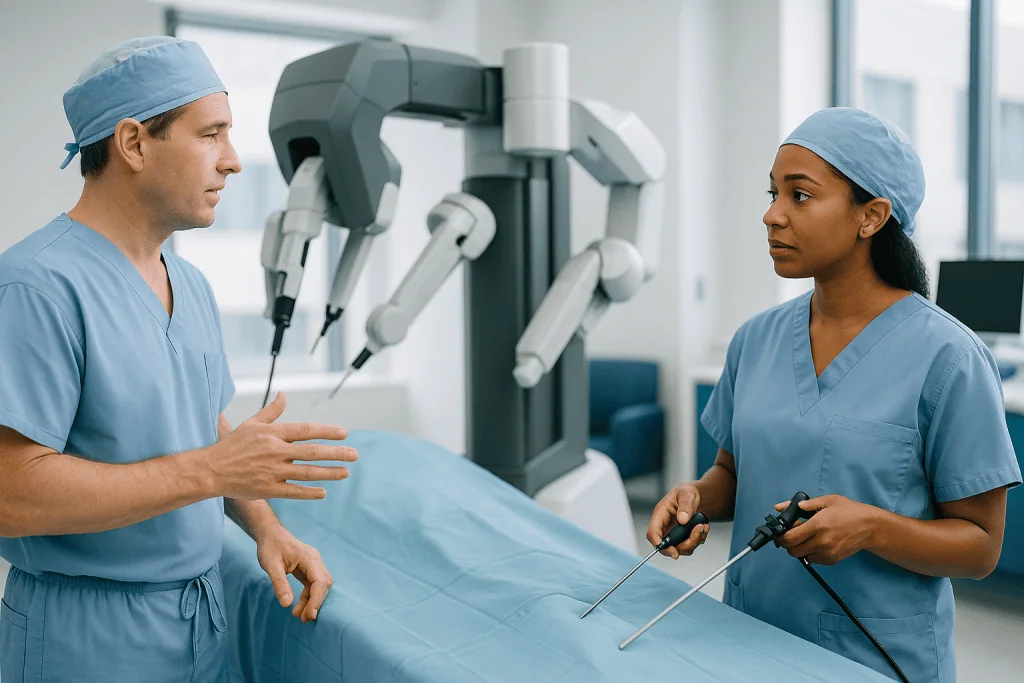
Now move the surgeon a few feet away, seated at a console with their forehead resting against a viewer and their fingers looped into controls. On the table, a cart with several jointed arms holds the camera and instruments through ports very similar in size to those used in laparoscopy. This is robotic kidney surgery.
Three features distinguish it in practice. First, the camera delivers a magnified, three-dimensional image, so depth is seen rather than inferred. Second, the instrument tips are wristed, meaning they bend and rotate at the end like a human wrist, which allows a curved needle to be driven around a blood vessel from angles a straight instrument cannot reach. Third, the system filters hand tremor and can scale movement, so a large motion of the surgeon’s hand becomes a small, precise motion inside the body.
The sequence of the operation mirrors the laparoscopic version: gas inflation, freeing the kidney, controlling the artery and vein, removing or repairing tissue, closing. A bedside assistant, usually a trained surgeon or nurse, changes instruments, passes sutures and manages suction. The console surgeon can hear and speak to the team throughout, and can step back to the table at any moment.
What the system cannot do is feel. There is little or no tactile feedback, so the surgeon judges how hard tissue is being pulled by watching it stretch and blanch rather than by sensing resistance. Mayo Clinic frames robotic surgery as a set of tools that may offer greater precision and flexibility in confined spaces, while stressing that the surgeon’s skill and experience remain the decisive factor. That caveat matters more than any brochure image of gleaming arms.
Robotic vs laparoscopic kidney surgery: side-by-side comparison
People often ask for the two approaches laid out plainly. The table below summarizes what generally differs and, just as usefully, what does not. Where a claim is uncertain, the wording says so.
| Feature | Laparoscopic | Robotic |
|---|---|---|
| Incisions | Several small cuts (MedlinePlus: typically 3 or 4) | Several small cuts, similar in number and size |
| Who operates | Surgeon at the table, holding instruments | Surgeon at a console, controlling instruments |
| View | Two-dimensional, high definition | Three-dimensional, magnified |
| Instrument movement | Straight, pivoting at the abdominal wall | Wristed tips that bend and rotate |
| Sense of touch | Some tactile feedback through the instruments | Little or none; visual cues instead |
| Suturing deep inside the body | Possible, technically demanding | Generally easier for complex reconstruction |
| Anesthesia and gas inflation | General anesthesia, CO2 insufflation | Same |
| Typical hospital stay | MedlinePlus: about 1–7 days for kidney removal depending on approach and recovery | Same range; no consistent proven difference |
| Conversion to open surgery | Possible if bleeding or scarring prevents safe progress | Possible for the same reasons |
| Equipment needed | Widely available | Requires a robotic system and a trained team |
Notice how many rows read “same.” Both are general-anesthesia operations on the same organ with the same goals and largely the same risks. The genuine differences cluster around vision and wrist movement, and those matter most when the surgeon has to sew a kidney back together quickly and accurately after removing a tumor. For a straightforward removal of a whole kidney, the practical gap narrows considerably, which is why many surgeons still favor laparoscopy for that operation.
Which kidney operations are done robotically or laparoscopically?
The kidney comes to the operating room for more reasons than cancer, and the approach question arises across all of them.
Radical nephrectomy removes the entire kidney, usually for a larger tumor or one positioned where partial removal is not sensible. Cleveland Clinic and Mayo Clinic both describe this as commonly performed laparoscopically, with robotic assistance used in some centers, particularly when the tumor involves the vein or nearby structures.
Partial nephrectomy takes out the tumor with a margin of normal tissue and preserves the remaining kidney. This is where the robotic approach has become especially popular, because the reconstruction step benefits from wristed instruments and a 3D view.
Pyeloplasty repairs a narrowing where the kidney drains into the ureter, the tube carrying urine to the bladder. It is largely a sewing operation, and both approaches are used, including in children.
Nephroureterectomy removes the kidney together with its ureter, typically for cancers of the urine-collecting lining.
Living-donor nephrectomy removes a healthy kidney from a donor for transplant. Laparoscopic donor surgery is well established; robotic donor surgery is offered in some programs.
Stone surgery sits slightly apart. Most kidney stones are treated through the urinary tract with flexible scopes or through a small tube into the kidney, so the laparoscopic-versus-robotic question rarely applies unless a stone is unusually large or the anatomy is abnormal.
Across all of these, the sensible framing is: first decide what the kidney needs (removal, partial removal, repair), and only then ask which keyhole technique best delivers it in a given surgeon’s hands.
Who is usually offered keyhole kidney surgery, and who is asked to wait or consider open surgery
Most people facing a planned kidney operation today are candidates for a minimally invasive approach of one kind or another, and the question is often which one rather than whether. Still, there are patterns worth understanding.
Keyhole surgery, robotic or laparoscopic, is commonly suited to people with localized tumors, benign masses, drainage problems or a healthy kidney being donated. The NHS notes that smaller kidney cancers, generally those under about 4 cm, are often treated by removing only part of the kidney, and these are exactly the cases where the precision arguments for robotic assistance are most often made.
Open surgery through a single larger incision has not disappeared. Surgeons may prefer it when a tumor is very large, when it has grown into the main vein or nearby organs, when extensive scarring from previous operations makes the keyhole route hazardous, or when a person cannot safely tolerate the inflated abdomen and steep positioning that keyhole surgery requires. Certain heart and lung conditions fall into that last category, and the anesthesia team weighs in heavily.
Some people are asked to wait rather than choose. A small, slow-growing mass in an older adult or someone with significant other illnesses may be monitored with periodic scans, an approach called active surveillance, because the risks of any operation may outweigh the benefit of removing something that may never cause harm. Pregnancy, an active infection, uncontrolled blood pressure or a recent heart event are common reasons to postpone elective kidney surgery until the situation is safer.
None of this is a checklist a patient can apply alone. It is the treating team’s job to weigh tumor, body and life circumstances together and to say plainly which options are reasonable and which are not.
How surgeons choose between the two: the factors that really drive the decision
Ask a urologist privately how they choose, and the answer rarely begins with the machine. It begins with the scan.
Tumor complexity. A small tumor bulging from the outer edge of the kidney is a different operation from one buried near the center next to the collecting system. Deep, central or multiple tumors demand more cutting and more sewing under time pressure, and many surgeons feel the wristed instruments and 3D view of robotic assistance make that reconstruction more controllable.
Whole kidney or part of it. When the entire organ is coming out, the reconstruction advantage largely evaporates. Plenty of surgeons perform radical nephrectomy laparoscopically and see no reason to change.
Previous surgery and body shape. Old scars inside the abdomen, prior infections or a very high body mass can make either keyhole route harder. Some surgeons find the longer instruments and stable camera of a robotic system helpful in a deep abdomen; others rely on laparoscopic experience.
Surgeon training and volume. This is the quiet giant. Mayo Clinic explicitly notes that outcomes with robotic surgery depend on the surgeon’s experience with the system. A surgeon who has performed hundreds of laparoscopic partial nephrectomies may achieve results a newly trained robotic surgeon cannot yet match, and vice versa.
Availability and scheduling. Robotic systems are not present in every hospital, and where they exist they are shared across specialties. A safe, timely laparoscopic operation is often preferable to a delayed robotic one.
The best question a patient can ask is therefore not “Do you have a robot?” but “Which approach do you do most often for a tumor like mine, and why?”
Is robotic kidney surgery safer than laparoscopic? What the evidence shows
People searching “is robotic kidney surgery safer” want a yes or a no, and the responsible answer is: for kidney surgery, neither approach has been proven safer across the board.
Both are keyhole techniques, and both share the well-documented advantages of keyhole surgery over open surgery. MedlinePlus states that recovery after laparoscopic kidney removal is most often faster than after open surgery, with less pain and smaller scars. Mayo Clinic lists similar potential benefits for robotic surgery, including less blood loss and quicker return to normal activity, while noting these are possibilities rather than guarantees and that risks similar to those of conventional surgery remain.
When robotic and laparoscopic approaches are compared directly with each other, the picture is more nuanced. For partial nephrectomy, studies often report that the robotic approach shortens the time the kidney’s blood supply is clamped and lowers the chance of the surgeon needing to convert to an open operation or to a full kidney removal. Those are meaningful surrogate outcomes, because less clamp time may protect kidney function. Whether they translate into fewer serious complications or better long-term kidney function overall remains debated, and results vary widely with surgeon experience.
For radical nephrectomy, comparisons generally find little difference in complications, blood loss or length of stay between the two keyhole methods.
What patients should take from this: the biggest safety leap was from open to keyhole surgery, and both keyhole approaches deliver it. Between the two, the surgeon’s familiarity with the chosen technique is likely to influence your outcome more than the technique itself. Anyone promising that one approach is simply safer is speaking beyond what the evidence supports.
Partial vs radical nephrectomy: why saving kidney tissue matters more than the tool
If there is one decision in kidney surgery that deserves more attention than the robot question, it is this one: how much kidney is coming out.
Kidneys filter blood, balance fluids and salts, help regulate blood pressure and produce hormones involved in red blood cell production. Losing an entire kidney means the remaining one takes over. The NIDDK explains that most people live healthy lives with a single kidney, but also notes that the remaining kidney can become slightly larger and may be more vulnerable to high blood pressure and protein leakage over time, so periodic checks are advised.
That is why guidelines from the NHS and others favor partial nephrectomy for smaller localized tumors when it is technically feasible. Preserving working tissue tends to protect long-term kidney function, which in turn is linked to cardiovascular health and overall survival in large population studies. The trade-off is that partial removal is technically harder, carries a somewhat higher chance of bleeding or urine leak from the cut surface, and requires the surgeon to work quickly while the blood supply is clamped.
This is precisely where the robotic-versus-laparoscopic debate becomes relevant. If a surgeon feels more confident completing a difficult partial nephrectomy robotically, the robot may indirectly help the patient keep more kidney. If a surgeon is equally skilled laparoscopically, the patient gets the same benefit without the robot.
So the sharper question for a consultation is not “robot or not” but “can my kidney be saved, and which approach gives you the best chance of saving it safely?” A surgeon who reframes the discussion that way is doing you a service.
Robotic partial nephrectomy recovery time and the first days after either approach
Whichever approach is used, the hours and days immediately after kidney surgery follow a recognizable pattern, and knowing it in advance takes some of the fear out.
You wake in a recovery area with a drip in your arm and, commonly, a catheter draining the bladder so the team can measure urine output closely. Some people also have a thin drain tube exiting near one incision to collect fluid. Shoulder-tip pain is common after keyhole surgery because leftover carbon dioxide gas irritates the diaphragm; it usually eases over a day or two as the gas is absorbed.
Pain control is planned before the operation and adjusted afterward by the anesthesia and surgical teams. The specifics of medicines and their timing belong to the prescribing clinician, but the goal is consistent: comfortable enough to breathe deeply, cough and walk.
Walking is not optional. Nurses typically encourage getting out of bed the same day or the next morning, because movement lowers the risk of blood clots in the legs and lungs, helps the bowel wake up and clears the chest. Compression stockings or inflatable leg sleeves are often used for the same reason.
MedlinePlus puts the typical hospital stay after kidney removal at roughly 1–7 days, with keyhole approaches tending toward the shorter end. Mayo Clinic describes a full recovery from nephrectomy as taking several weeks. The evidence does not show a consistent difference in stay between robotic and laparoscopic operations once surgeon experience is accounted for, so a promise that the robot will get you home faster should be treated with caution.
Before discharge you will be told how to care for incisions, what to eat, how much to drink, and how to recognize trouble.
The weeks that follow: healing, activity and getting back to normal
The second week home is often when people feel deceived by how well they looked on day three. Energy dips, appetite is inconsistent, and the incisions ache when you twist. This is ordinary healing after abdominal surgery, not a sign that something has gone wrong.
Mayo Clinic advises that recovery from nephrectomy generally takes several weeks and that you should avoid strenuous activity and heavy lifting during that period so the incisions and, in partial nephrectomy, the sutured kidney can heal. Walking daily, gradually increasing distance, is the recommended activity for most people. Driving usually waits until you can brake hard without pain and are no longer taking medicines that impair alertness; your surgical team gives the specific go-ahead.
Bowel habits often take a week or more to settle after the anesthesia and any pain medicines. Drinking enough fluid, eating fiber and moving help. Sleep may be disturbed by discomfort when lying on the operated side.
Follow-up typically includes a wound check within a couple of weeks and blood tests to see how the remaining kidney tissue is functioning. If tissue was removed for suspected cancer, the pathology report arrives in this window and shapes what monitoring comes next. The NHS explains that follow-up after kidney cancer surgery usually involves periodic scans and blood tests over several years.
The robotic-versus-laparoscopic distinction fades almost entirely at this stage. Scars are similar in size and number, activity restrictions are the same, and the trajectory back to work and exercise depends far more on how much kidney was removed, your general health before surgery and whether any complication occurred than on which console or handle the surgeon used.
Risks and complications shared by both approaches
Every operation carries risk, and honest consent means naming it. The list below is not designed to alarm; it is the same conversation a surgeon should have with you, and it applies to robotic and laparoscopic kidney surgery alike.
- Bleeding. The kidney receives a large share of the body’s blood flow. Bleeding during or after surgery can require transfusion and, rarely, a return to the operating room or a procedure to block a bleeding vessel from inside.
- Infection. At an incision, in the urine or, less commonly, deep in the abdomen.
- Urine leak. After partial nephrectomy, urine can escape from the cut surface of the kidney. Most leaks settle with drainage and time.
- Injury to neighboring organs. The bowel, spleen, liver, pancreas and pleura (the lining of the lung) all sit near the kidney.
- Blood clots. In leg veins or lungs, which is why early walking and clot-prevention measures are routine.
- Conversion to open surgery. If safe progress is impossible through keyholes, the surgeon makes a larger incision. Cleveland Clinic and Mayo Clinic both describe this as a recognized possibility rather than a failure.
- Reduced kidney function. More likely after whole-kidney removal, especially if the other kidney is already impaired.
- Anesthesia-related problems. Nausea, breathing issues and, rarely, heart or stroke events, more common in people with existing heart or lung disease.
- Hernia at an incision. A late complication that may need repair.
Robotic surgery adds a few technology-specific considerations: instrument malfunction, which is uncommon but real, and the possibility of nerve or pressure injuries from the steep positioning and longer setup that some robotic cases involve. Laparoscopy carries a somewhat higher chance of conversion in complex partial nephrectomy. Neither list is dramatic; both deserve a plain conversation with your surgeon about how often these events happen in their practice.
Alternatives to surgery for a small kidney mass
A conversation about robotic versus laparoscopic surgery quietly assumes surgery is the right path. Sometimes it is not, and a good urologist will say so.
Active surveillance. Many small kidney masses grow slowly, and a proportion are not cancer at all. The NHS and Mayo Clinic both describe monitoring with periodic imaging as a reasonable option for small tumors, especially in older adults or people whose other health problems make surgery risky. Treatment can be reconsidered if the mass grows or changes.
Ablation. Thermal ablation destroys a tumor with extreme heat (radiofrequency or microwave) or cold (cryoablation) delivered through a needle guided by imaging, without removing tissue. Mayo Clinic notes this is generally reserved for small tumors and for people who are not good surgical candidates. It is less invasive than any operation but does not provide a full tissue specimen, and the chance that a tumor persists or returns may be higher than with surgical removal, so imaging follow-up is closer.
Open surgery. Still the right choice for some very large or invasive tumors, and worth naming as an alternative rather than treating it as a failure of keyhole techniques.
Systemic treatment. For kidney cancer that has spread beyond the kidney, medicines such as immunotherapy and targeted therapies, which work by helping the immune system recognize cancer cells or by blocking growth signals, may be the primary treatment, sometimes alongside surgery. Choices about these medicines sit entirely with the oncology team.
For a benign drainage problem, a temporary stent or a less invasive endoscopic repair may be offered before any keyhole reconstruction. The point is simple: the tool debate only matters once the team has agreed that an operation is the best next step.
What people often get wrong about robotic vs laparoscopic kidney surgery
Myths gather around new technology like iron filings around a magnet. A few are worth clearing away.
“The robot does the surgery.” It does not. Every movement inside your body is made by a surgeon whose hands are on the controls. If the surgeon steps away, the instruments stop.
“Robotic is always better.” For some complex partial nephrectomies, the robotic approach offers real technical advantages. For a straightforward whole-kidney removal, evidence shows little difference from laparoscopy. Better depends on the operation and the operator.
“Robotic surgery leaves no scars.” Both approaches leave several small scars, and both require one incision to be enlarged if a whole kidney is being removed.
“Keyhole surgery means the tumor was small or not serious.” Approach and tumor stage are separate questions. Sizable cancers are sometimes removed through keyholes; small ones are sometimes removed open because of location or scarring.
“Recovery is dramatically faster with the robot.” Compared with open surgery, both keyhole approaches shorten recovery, as MedlinePlus and Mayo Clinic describe. Compared with each other, the difference is small and inconsistent.
“A hospital without a robot cannot offer good kidney surgery.” Laparoscopic nephrectomy is a mature, well-studied operation. A skilled laparoscopic surgeon is a strong option.
“Losing a kidney means dialysis.” The NIDDK explains that most people with one healthy kidney live normal lives with routine monitoring. Dialysis becomes a concern mainly when the remaining kidney is already diseased.
“You can feel which approach was used afterward.” Pain, gas discomfort and fatigue are essentially the same. Patients rarely could tell in blinded comparisons.
Discarding these ideas frees the conversation to focus on what changes outcomes: how much kidney can be saved, and how experienced your surgeon is with the technique they propose.
Questions to ask your care team before robotic or laparoscopic kidney surgery
A consultation goes better with a short written list. These questions are designed to surface the reasoning behind a recommendation, not to second-guess it.
- Can my kidney be partially preserved, or does the whole kidney need to come out? What makes you lean that way?
- Which approach, robotic, laparoscopic or open, do you recommend for me, and what specifically about my scan or history drives that choice?
- How often do you perform this exact operation with this approach? Is it the approach you use most for cases like mine?
- How often, in your practice, does this operation need to be converted to open surgery, and what would happen if it did?
- What are the most common complications you see, and how are they managed?
- How will you protect the function of my remaining kidney tissue during and after surgery?
- What will my hospital stay and the first two weeks at home realistically look like?
- Are active surveillance or ablation reasonable alternatives for me? If not, why?
- Who do I contact after hours if I develop a fever, heavy bleeding or severe pain?
- What follow-up scans or blood tests will I need, and for how long?
- Should any of my regular medicines be paused before surgery, and who will tell me exactly when? (Decisions about stopping or restarting medicines belong to your prescribing clinicians; ask them to coordinate.)
Notice that only one question is about the robot. That proportion is deliberate. If the answers reveal a surgeon who is comfortable, experienced and candid about their own numbers, the equipment matters less than you might have feared walking in. If the answers are vague, or lean heavily on the technology rather than on your anatomy, it is reasonable to ask for time or a second opinion. Requesting one is normal and is not an insult to the first team.
When to call your doctor after kidney surgery
Most recoveries are uneventful, and most worries turn out to be ordinary healing. Still, certain signs need a same-day call to your surgical team or, if severe, emergency care. This applies whether your operation was robotic or laparoscopic.
Seek emergency care immediately for chest pain, sudden shortness of breath, coughing up blood, or a sudden swollen, painful calf, all of which can signal a blood clot; for heavy bleeding from an incision or large amounts of blood in the urine; for fainting or feeling you might pass out; or for confusion or difficulty staying awake.
Call your surgical team the same day if you have a fever with chills, if pain is worsening rather than gradually easing, if the abdomen becomes swollen, hard or increasingly tender, if you cannot pass urine or notice a marked drop in how much you produce, if there is spreading redness, warmth, pus or a foul smell at an incision, if vomiting prevents you keeping fluids down for more than a few hours, or if a drain, if you have one, suddenly increases its output or turns bloody.
Cleveland Clinic and MedlinePlus both list fever, wound changes, bleeding and breathing difficulty among the signs that warrant prompt contact after nephrectomy. Reduced urine output deserves special attention when you have had a whole kidney removed, because the remaining kidney is now doing all the work.
Bring your discharge paperwork to any unscheduled visit and tell whoever sees you exactly which operation you had and when. Never adjust prescribed medicines on your own in response to symptoms; describe what is happening and let the prescribing clinician decide. When in doubt, call. Surgical teams would far rather hear about a false alarm than miss a real one.
Frequently asked questions
What is the difference between laparoscopic nephrectomy vs robotic nephrectomy?
Both remove all or part of a kidney through several small incisions. In laparoscopic nephrectomy the surgeon holds long, straight instruments directly at the table and views a two-dimensional image. In robotic nephrectomy the surgeon sits at a console and controls wristed instruments through mechanical arms with a magnified three-dimensional view. The steps of the operation, the anesthesia and most risks are the same.
Is robotic kidney surgery safer than laparoscopic surgery?
Neither has been shown to be safer across all kidney operations. Both are keyhole approaches that share the established advantages over open surgery. For complex partial nephrectomy, robotic assistance may shorten clamp time and reduce conversions to open surgery, but overall complication rates depend heavily on the surgeon’s experience. For whole-kidney removal, direct comparisons usually find little difference.
What is the typical robotic partial nephrectomy recovery time?
Recovery follows the same pattern as other keyhole kidney operations. MedlinePlus gives a hospital stay of roughly 1–7 days after kidney surgery depending on approach, and Mayo Clinic describes a full recovery from nephrectomy as several weeks, with heavy lifting avoided during that time. Your own timeline depends on how much kidney was removed, your general health and any complications, and your surgical team will set specific limits.
Does the robot perform the surgery on its own?
No. The surgeon controls every movement from the console in real time, and the instruments stop if the surgeon’s hands leave the controls. The system translates hand movements into smaller, steadier motions inside the body and filters tremor, but it has no independent function. A trained bedside assistant and the full operating team are present throughout, and the surgeon can return to the table at any moment.
Why would a surgeon choose laparoscopic over robotic kidney surgery?
Common reasons include a straightforward whole-kidney removal where robotic advantages add little, extensive personal experience with laparoscopy, immediate availability of an operating room without waiting for a shared robotic system, and cases where tactile feedback from hand-held instruments is valued. Mayo Clinic notes that surgeon familiarity with a technique is a key determinant of outcome, so a surgeon’s own track record legitimately drives the choice.
Is keyhole kidney surgery an option for large tumors?
Sometimes. Approach and tumor size are separate questions. Sizable tumors are removed through keyholes in many centers, while surgeons may prefer open surgery when a tumor has grown into the main vein or neighboring organs, when heavy scarring from previous operations exists, or when a person cannot safely tolerate the inflated abdomen and positioning. The treating team weighs imaging, anatomy and overall health together.
How many incisions are made in robotic or laparoscopic kidney surgery?
MedlinePlus describes laparoscopic kidney removal as typically using three or four small cuts, each often no longer than about an inch. Robotic operations use a similar number of small ports, sometimes one more for the extra arm or the bedside assistant. If a whole kidney is being removed, one incision is enlarged just enough to lift the organ out in a protective bag.
Can I live normally with one kidney after a radical nephrectomy?
The NIDDK explains that most people with one healthy kidney live full, normal lives. The remaining kidney may enlarge slightly to take on the extra work. Because a solitary kidney can be more vulnerable to high blood pressure and protein leakage over time, periodic checks of blood pressure, blood tests and urine are advised, and your care team may recommend protecting the kidney from injury during contact sports.
Will I need to stop my regular medicines before kidney surgery?
Possibly, particularly blood thinners, some diabetes medicines and certain supplements, but this decision belongs entirely to your surgical, anesthesia and prescribing teams. Do not stop or change any medicine on your own. Bring a complete list to your pre-operative appointment, ask who will give you exact instructions and when, and confirm the plan for restarting medicines after the operation.
What are the alternatives to surgery for a small kidney mass?
Options may include active surveillance with periodic scans, since many small masses grow slowly or are not cancer, and thermal ablation, which destroys a tumor with heat or cold delivered through a needle without removing tissue. The NHS and Mayo Clinic describe both as reasonable for selected people, particularly older adults or those with health problems that raise surgical risk. Suitability is a decision for the treating team.
References
This article is for general information only and is not a substitute for professional medical advice. Please consult a qualified doctor about your individual situation.

More from the Blog

How Do You Read a Urodynamic Report? Capacity, Pressure-Flow Curves and Leak Points Explained
A urodynamic report is read in order: the header and patient details, then the flow curve and the volume left after voiding, then the…

When Can You Lift, Drive and Exercise Again After Robotic Prostate Surgery?
Most people walk the day of robotic prostate surgery, drive again once the catheter is out and they are no longer taking opioid painkillers,…

How Peritoneal Dialysis Exchanges Work: Fill, Dwell and Drain Explained in Plain Words
A peritoneal dialysis exchange uses the lining of your own abdomen as a filter. Cleansing fluid flows through a soft catheter into the belly…

Reading a Bladder Disease Treatment Plan: Questions to Ask Your Urologist Before You Decide
Before agreeing to a bladder disease treatment plan, ask your urologist which specific condition is being treated, what test results support that diagnosis, why…

Is Tiredness After Hemodialysis Normal? Cramps, Low Blood Pressure and What to Report
Yes, feeling tired after hemodialysis is common and expected for many people, because a session removes fluid and waste quickly and shifts salts and…

Shockwave Therapy or Endoscopic Removal: Which Kidney Stone Treatment Fits Your Stone?
Shock wave lithotripsy breaks a kidney stone from outside the body using focused sound waves, while ureteroscopy passes a thin scope up the urinary…