

Recovery After Minimally Invasive Urology: Same-Day Discharge, Catheters and Lifting Limits

Key Takeaways
- Ureteroscopy and shock wave lithotripsy are usually day-case procedures, while PCNL and TURP more often involve a stay of one to three days (NHS, Mayo Clinic).
- Ureteral stents are temporary and must be removed on schedule; a forgotten stent can become encrusted with mineral deposits over months and is then hard to take out.
- Lifting limits protect internal tissue, not skin: Mayo Clinic cites about two to four weeks after PCNL and the NHS about three to four weeks after TURP, with longer for laparoscopic kidney or prostate surgery.
- Pink or red urine is expected for days after scope procedures and for weeks after TURP, and a brief second bleed as scabs shed around two to four weeks is a recognized phase (NHS).
- A catheter after TURP usually comes out within days, whereas after prostatectomy it typically stays one to two weeks to protect the bladder-urethra join.
- Fever, an unproductive or blocked catheter, steadily darkening urine, severe flank pain with vomiting, or a swollen painful calf are same-day-call signs after any urology procedure.
Recovery after minimally invasive urology is usually measured in days to a few weeks, not months. Many scope procedures allow same-day discharge, catheters and ureteral stents are typically temporary, and surgeons commonly ask patients to avoid heavy lifting for roughly two to six weeks depending on the operation. Exact timelines vary by procedure and health, so your treating team sets the plan.
The discharge nurse hands over a folder, a plastic bag with a leg strap in it, and a sentence that sounds simple until you get home: “Take it easy and don’t lift anything heavy.” Standing in the kitchen that evening with a full kettle in one hand and a stent card in your pocket, you realize nobody defined “heavy.” Or “easy.” Or how many days “a few” is.
That gap between the operating room and the kitchen is where most questions about minimally invasive urology recovery actually live. The surgery itself, whether a ureteroscope threaded up to a kidney stone or a laparoscopic camera through a keyhole in the abdomen, is over quickly. What follows is a stretch of small decisions: when to trust a catheter, when to worry about pink urine, when the grocery bags are fine to carry.
This explainer walks through that stretch honestly, using what mainstream guidance actually says rather than what a hospital brochure hopes.
What is minimally invasive urology?
Minimally invasive urology is a family of operations on the kidneys, ureters, bladder and prostate that reach the problem through natural openings or through small incisions rather than one long cut. The idea is not new. Urologists were passing telescopes up the urethra long before “keyhole” became a household word, because the urinary tract is essentially a set of connected tubes that a thin instrument can travel along.
Three broad approaches sit under the umbrella. Endoscopic procedures use a scope passed through the urethra: ureteroscopy for stones in the ureter or kidney, and transurethral resection of the prostate (TURP), where tissue is trimmed from inside an enlarged prostate. Laparoscopic and robot-assisted procedures use a camera and slender instruments through several small abdominal incisions, typically for kidney removal, pyeloplasty (repair of a narrowed kidney drainage junction) or prostatectomy. Percutaneous procedures make a single small opening in the back to reach the kidney directly, most often percutaneous nephrolithotomy (PCNL) for large stones.
What unites them is the trade-off. Smaller wounds usually mean less tissue disruption, less pain and a faster return to ordinary life, which is exactly why same-day discharge has become common for scope procedures (NHS). Smaller does not mean trivial, though. The kidney has been worked on, the ureter may be swollen, or the bladder lining may be raw. The body still needs time to heal internally even when the outside looks almost untouched.
That mismatch, a nearly invisible scar over a very real internal wound, explains most of the rules you are given about catheters, stents and lifting. Understanding it makes the rules easier to follow.
How minimally invasive urology recovery actually works inside the body
Picture the urinary tract as plumbing lined with a delicate membrane. Every procedure in this category irritates that membrane somewhere, and recovery is mostly the story of that irritation settling.
After ureteroscopy, the ureter (the narrow tube carrying urine from kidney to bladder) has been stretched by the scope and possibly by a laser. It responds the way any tube does when handled: it swells. Swelling can slow drainage from the kidney for a few days, which is why a temporary stent is often left in place to keep urine flowing while the wall calms down (NHS). Drainage recovers as swelling fades.
After TURP, the inside of the prostate is a raw surface roughly the size of a walnut’s interior. It weeps blood and sheds small scabs into the urine for weeks. A catheter drains the bladder while the first layer heals, and bleeding fades gradually as new lining grows over the surface (NHS).
After laparoscopic or robotic surgery, the wounds you can see are small, but inside, tissues were separated, a kidney may have been removed or repaired, and the abdominal wall was punctured in several places. Those deep fascial layers, the tough sheets that hold the abdominal contents in, knit slowly. Straining raises pressure against them before they have full strength, which is the whole basis of lifting limits (NHS).
Pain follows a fairly predictable arc: worst in the first two or three days, then improving daily. Fatigue lasts longer than pain and surprises people most. Anesthesia, disrupted sleep and the body’s inflammatory response to healing all cost energy. Feeling tired at day ten after a “small” operation is not a sign anything has gone wrong.
Same-day discharge after urology surgery: who usually goes home
Same-day discharge means leaving the hospital a few hours after the procedure without an overnight stay. It has become routine for many scope procedures because the risk of an early problem that needs a hospital bed is low and because home sleep, home food and ordinary movement genuinely help recovery.
Procedures that are commonly done as day cases include ureteroscopy for stones, cystoscopy (a look inside the bladder), some bladder tumor resections, and shock wave lithotripsy, which breaks stones from outside the body using focused sound waves (NHS). Some centers also send selected patients home the same day after laparoscopic kidney operations or robotic prostatectomy, but this varies widely and depends on the individual.
Before you leave, the team is checking several things. You should be able to pass urine, or have a working catheter with a plan for it. Pain should be controlled with what you will take at home. You should be steady on your feet, eating or drinking without vomiting, and you should have a responsible adult to take you home and stay the first night, because anesthetic drugs impair judgment for many hours.
Overnight stays are more usual after TURP, where the catheter is monitored for bleeding and typically comes out before discharge over one to three days (NHS), and after PCNL, where the kidney was punctured and a stay of a day or two is typical (Mayo Clinic). Larger laparoscopic operations often mean a couple of nights.
Going home early is not a downgrade in care. It reflects that the team expects you to do well. Staying is not a bad sign either; it usually reflects the type of procedure, not a complication.
Who is usually asked to wait, or to plan a longer stay
Not everyone is a candidate for the fast track, and surgeons are cautious with good reason. Several situations commonly lead to a delayed operation or a longer planned recovery.

Active urinary infection is the most frequent reason to postpone. Operating on an infected urinary tract can push bacteria into the bloodstream, so a positive urine test before a stone procedure usually means antibiotics first and surgery later (NHS). People taking blood thinners are often asked to pause or adjust them under their prescribing clinician’s direction, because the prostate and kidney bleed readily. That decision belongs with the doctor who prescribed the medicine, never with the patient alone.
People with significant heart or lung disease, poorly controlled diabetes, or sleep apnea are more likely to be scheduled as inpatients so that breathing and circulation can be watched overnight. Living alone, living far from emergency care, or having no one to help for the first night also tips the balance toward a planned stay. These are practical, not medical, judgments, and they matter as much.
Children having procedures such as ureterocele repair are usually kept until they are drinking, passing urine and comfortable, though many simple endoscopic repairs are day cases.
A few groups are advised toward one procedure over another rather than toward waiting. Someone with a very large or hard stone may be steered to PCNL rather than repeated ureteroscopy. A person with a small stone that is likely to pass on its own may be advised to wait with monitoring and fluids, since many small stones pass without any procedure at all (NHS).
The pattern is consistent: the safest recovery is one that starts from the right baseline. If your team asks you to wait, it is usually because they want the recovery to be as uneventful as the brochure implies.
Kidney stone ureteroscopy recovery time: what to expect
Ureteroscopy is the most common minimally invasive stone operation. A thin scope is passed through the urethra and bladder into the ureter or kidney, the stone is broken with a laser or retrieved in a small basket, and often a stent is left behind (NHS). There are no incisions.
Most people go home the same day. The first 24 to 48 hours bring burning when passing urine, urgency, mild flank ache and pink-tinged urine. These come from the scope’s passage and from the stent, not from a problem. Drinking enough to keep urine pale helps flush small fragments and dilutes blood.
Many people return to desk work within a few days, though those with physically demanding jobs are often advised to wait longer, particularly while a stent is in place. Stent-related symptoms can make sitting for long periods uncomfortable, so a first week of shorter days is reasonable.
If a stent was placed, the timeline is anchored to its removal. Stents are usually temporary and are taken out in clinic, either by pulling an attached string or through a brief cystoscopy (NHS). Bladder symptoms often improve markedly within a day or two after removal. Some people notice a brief return of flank ache in the hours after the stent comes out; this is common and usually settles.
Full recovery, meaning no residual bladder irritation and unrestricted activity, generally falls within a couple of weeks for uncomplicated cases. Larger stone burdens, multiple procedures or a preexisting infection can stretch that. Your follow-up imaging, usually an ultrasound or X-ray some weeks later, confirms that the kidney is draining and no fragments remain.
The honest summary: ureteroscopy is quick, but the stent often shapes how the recovery feels far more than the operation does.
Is kidney stone removal without a stent possible?
Yes, and it is done regularly, but the decision is made during the operation rather than in advance.
A ureteral stent is a soft, thin tube with a curl at each end that sits from kidney to bladder, holding the ureter open so urine drains even if the wall swells. Surgeons place one after ureteroscopy when they judge that swelling, bleeding or leftover fragments could block drainage (NHS). They may skip it when the procedure was short, the ureter was not stretched or injured, the stone was small and fully cleared, and the kidney was healthy.
The appeal of a stentless procedure is obvious to anyone who has lived with one: no urgency, no bladder spasms, no flank twinge when urinating, no second appointment for removal. The trade-off is a somewhat higher chance of a painful blockage in the first days as the ureter swells, occasionally needing an unplanned return to place a stent after all.
Several factors make surgeons more likely to leave a stent: a stone that was stuck in one spot and inflamed the wall, use of an access sheath to widen the path, a solitary kidney, prior infection, or a plan for a second-stage procedure. Patients can and should ask before surgery whether a stent is likely, and whether an attached string could be used so removal can happen at home or in a quick visit rather than a cystoscopy.
Shock wave lithotripsy does not usually involve a stent, though one is sometimes placed beforehand for larger stones (NHS). PCNL may end with a stent, a temporary tube through the back, or neither, depending on the surgeon’s assessment.
The candid position: stents are placed to prevent a worse outcome, not for convenience. If yours was left in, there was probably a specific reason. Asking what it was is a fair question.
Living with a ureteral stent for a few days or weeks
A stent is the part of stone surgery that patients rate as most bothersome, and expectations shape how bothersome it feels. Knowing what is normal turns a frightening sensation into a tolerable one.
Common stent effects include a need to pass urine more often, a feeling of urgency even with a nearly empty bladder, mild pain in the side when the bladder empties (urine briefly refluxes up the stent toward the kidney), and blood in the urine that comes and goes. Physical activity tends to make the bleeding more visible; a walk that turns urine rosé-colored the same evening is typical and usually clears with fluids.
Practical measures that help: keep fluid intake steady so the bladder is never bone dry, since concentrated urine irritates more; avoid holding urine for long stretches; and plan sitting and travel around access to a toilet. Caffeine and alcohol irritate the bladder lining in many people and may worsen urgency, so cutting back for the duration is reasonable. Medications that relax the bladder or ureter are sometimes prescribed to ease spasm; whether they suit you is a decision for the prescribing clinician.
Sexual activity is generally permitted with a stent unless your team says otherwise, though a string dangling from the urethra makes many people prefer to wait until removal.
The single most important fact about stents is that they must come out. A stent forgotten for many months can become encrusted with mineral deposits and is then difficult to remove. If you are given a stent card or a removal date, treat it as an appointment that cannot be skipped. If you lose the date, call the urology office rather than assume they will chase you.
Stent discomfort ends abruptly on removal for most people. That is often the day recovery from stone surgery truly feels complete.
Catheter after prostate surgery and other urology procedures: how long and how to manage
A urinary catheter is a flexible tube passed into the bladder to drain urine into a bag, held in place by a small water-filled balloon (MedlinePlus). After urology surgery it does two jobs: it rests the bladder so the raw surface can heal, and it lets the team watch the color of the urine for bleeding.
How long it stays depends on the operation. After TURP, the catheter is typically removed within a few days, often before discharge (NHS). After robotic or laparoscopic prostatectomy, where the bladder has been reconnected to the urethra, the catheter usually stays for one to two weeks to protect the join while it seals; the surgeon confirms timing, sometimes with an X-ray. After bladder or kidney procedures the range is anywhere from a few hours to a week or more.
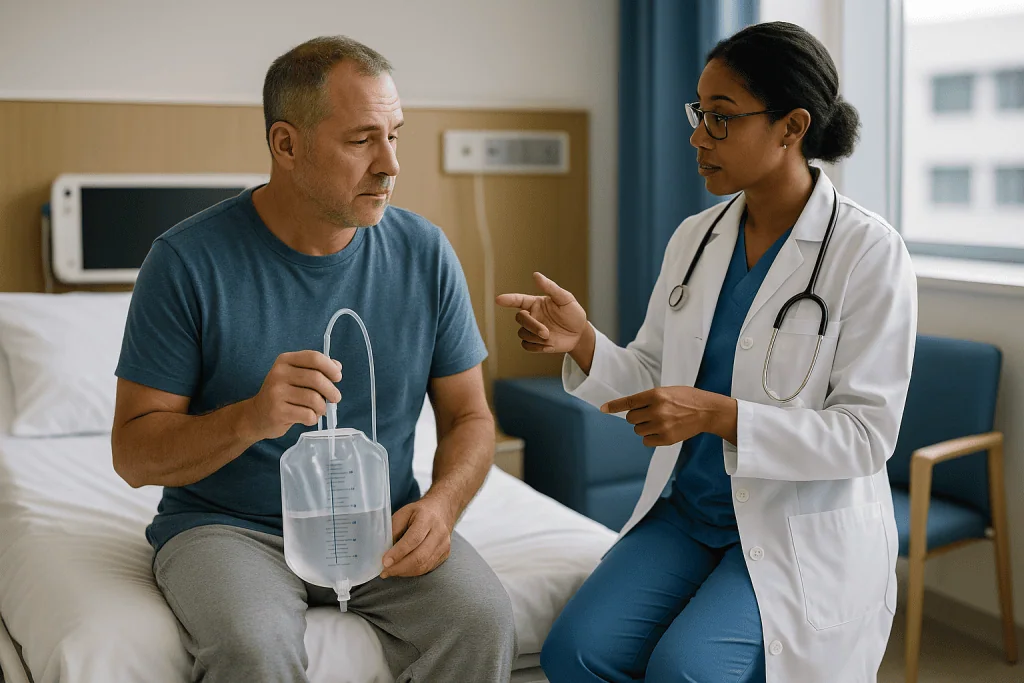
If you go home with a catheter, the routine is simple but matters. Wash your hands before and after touching it. Keep the bag below bladder level so urine flows downhill and cannot run back. Use a smaller leg bag by day and a larger bag at night, connected without disconnecting the catheter itself more than necessary. Clean the skin where the tube enters daily with soap and water, and keep the tube secured to the thigh so it does not tug (NHS).
Drink enough to keep urine flowing freely; a catheter that stops draining despite fluids may be blocked by a clot or debris. Bladder spasms, a sudden cramping urge with a small leak around the tube, are common and usually settle.
Once the catheter is removed, some leakage is normal for days to weeks, especially after prostate surgery, while the muscles relearn control. Pelvic floor exercises, taught by the team, are the standard first step (NHS). The catheter’s departure is a milestone, but continence recovery is its own timeline.
Lifting restrictions after laparoscopic surgery and other urology procedures: why and for how long
“Don’t lift anything heavy” is the instruction people most often ignore, and the reason is usually that nobody explained the mechanism.
The purpose is pressure control. When you lift, push or strain, the abdominal muscles brace and pressure inside the abdomen spikes. After laparoscopic or robotic surgery, that pressure presses on incisions in the fascia, the tough connective layer under the skin that was punctured to admit the instruments. Fascia heals slowly; it regains much of its strength over weeks, not days. Straining before then raises the chance that a gap opens and abdominal contents push through, creating an incisional hernia. Larger port sites and the extraction incision used to remove a kidney are the vulnerable spots.
After scope procedures without incisions, the concern shifts. Straining after TURP or ureteroscopy raises pressure in the bladder and pelvis and can restart bleeding from a raw surface. After PCNL, the kidney itself was punctured; vigorous activity can provoke bleeding from the tract.
Typical guidance follows these mechanisms. Mayo Clinic advises avoiding lifting, pushing or pulling for about two to four weeks after PCNL. The NHS suggests avoiding heavy lifting and strenuous exercise for around three to four weeks after TURP. For laparoscopic abdominal surgery generally, the NHS describes a return to normal activity over one to two weeks for minor procedures and longer for major ones, with heavy lifting delayed until the surgeon clears it. Robotic prostatectomy and nephrectomy commonly carry limits of four to six weeks.
What counts as heavy? Many surgeons use a full kettle, a grocery bag or a toddler as the ceiling; anything that makes you hold your breath is too much. Walking is encouraged from day one. Stairs are fine. Driving is usually allowed once you can brake sharply without pain and are off sedating medicines. These limits are typical ranges, not rules for your body; your surgeon’s number overrides anything you read here.
Typical recovery timelines by procedure: a comparison table
Ranges below are drawn from mainstream guidance and describe uncomplicated cases. Individual plans differ, and your team’s instructions take precedence.
| Procedure | Typical hospital stay | Catheter or stent | Heavy lifting usually paused | Source |
|---|---|---|---|---|
| Ureteroscopy for stones | Same day for most | Stent often left temporarily, removed in clinic | Days to about 1–2 weeks, longer if stented | NHS |
| Shock wave lithotripsy | Same day | Usually none | A few days | NHS |
| Percutaneous nephrolithotomy (PCNL) | About 1–2 days | Possible back tube or stent short term | About 2–4 weeks | Mayo Clinic |
| TURP | About 1–3 days | Catheter typically removed within days | About 3–4 weeks | NHS |
| Laparoscopic minor procedure | Same day to 1 night | Often none or brief | About 1–2 weeks | NHS |
| Laparoscopic or robotic kidney or prostate surgery | 1–3 nights commonly | Catheter 1–2 weeks after prostatectomy | Commonly 4–6 weeks | NHS (laparoscopy general guidance) |
Two patterns stand out. First, the time in hospital and the time until full activity are not proportional. Ureteroscopy involves no overnight stay but can carry a fortnight of stent symptoms; PCNL means a night or two yet often a faster symptom recovery once the tube is out. Second, the lifting limit tracks the depth of the wound rather than its visible size. A robotic prostatectomy leaves a handful of small marks and yet earns the longest restriction, because the reconnection inside needs protection.
Use the table as a map, not a contract. Bleeding, infection or a kidney that drains slowly can extend any row. A smooth course can shorten it. The point of knowing the typical range is to notice when your own experience falls outside it and to ask why.
What the first days and weeks usually look like
Day zero is mostly grogginess. Anesthesia lingers, the throat may be sore from the breathing tube, and the first urination after a scope procedure stings. Eat lightly, drink steadily, and walk to the bathroom and back rather than lying flat all evening; movement helps the bowel restart and lowers clot risk.
Days one to three are the peak of discomfort. Bladder urgency from a stent or catheter, flank ache, and shoulder-tip pain after laparoscopy (from gas used to inflate the abdomen, irritating the diaphragm) are all typical. Pink urine is expected. Constipation is common because of anesthesia and pain medicines, and straining on the toilet is exactly the pressure surge you are trying to avoid; fluids, fiber and gentle walking are the first response, and your team may suggest a stool softener.
By the end of week one, most people after scope procedures are moving normally, sleeping better and back to light work. Laparoscopic patients are usually off stronger pain relief and walking outside. Wound dressings often come off around now, and small incisions may look bruised or slightly puckered; both are normal.
Weeks two to four bring the milestones: stent removal, a first follow-up call or visit, and for TURP patients a phase where old scabs slough off and urine turns bloody again for a day or two (NHS). This second bleed alarms people, yet it is expected and usually short.
Beyond week four, activity limits lift for most, imaging confirms drainage after stone surgery, and continence continues to improve after prostate surgery. Fatigue is the last symptom to leave. Planning for a slower month rather than a slower week is realistic, even when the operation was small.
Pain, bleeding and bladder symptoms: what is expected and what is not
Recovery hinges on interpreting three sensations correctly.
Pain after minimally invasive urology should improve day by day. Flank ache after ureteroscopy or PCNL, a dull pressure behind the pubic bone after TURP, and soreness at port sites after laparoscopy all fit the pattern. Pain that spikes suddenly after improving, or severe one-sided flank pain with vomiting, can signal a blocked kidney or an obstructing clot, and warrants a same-day call. Pain relief plans vary; the team explains what is prescribed, and any change to it goes through them.
Bleeding is the symptom that causes the most anxiety and the most unnecessary worry. A small amount of blood tints a large volume of urine dramatically; rosé or cranberry-colored urine is common for days after scope procedures and for weeks after TURP (NHS). What matters is trend and consistency. Urine that gets progressively darker, urine that looks like undiluted blood, or clots that stop the flow altogether are different from intermittent pinkness. Bleeding that soaks a wound dressing repeatedly after laparoscopy is likewise not expected.
Bladder symptoms, meaning urgency, frequency and stinging, are nearly universal with a stent or after a catheter comes out. They settle as the lining heals. Symptoms that escalate rather than fade, accompanied by cloudy or foul-smelling urine, fever or shaking chills, suggest infection rather than irritation.
Two rules of thumb hold across procedures. A symptom that is present from the start and slowly improving is almost always part of healing. A symptom that is new, worsening, or paired with fever is the one to report. Keeping brief notes on urine color, temperature and pain level for the first week makes the phone conversation with your team far more useful.
How long does it take to recover from ureterocele surgery?
A ureterocele is a balloon-like swelling at the lower end of a ureter where it enters the bladder, present from birth and most often found in infants and children, sometimes in adults during imaging for another reason. It can trap urine and encourage infection or stones.
The most common minimally invasive treatment is endoscopic incision or puncture: a small cystoscope is passed into the bladder and a tiny opening is made in the ureterocele so it drains. There are no external cuts. This is usually a day-case procedure, and children typically go home once they have passed urine and are drinking. Discomfort is mild and short-lived; a day or two of irritation with urination is typical, and normal play resumes within days. Some children need a temporary catheter for a very brief period.
Recovery in the medical sense is longer than recovery in the everyday sense. Follow-up ultrasound over the following weeks and months checks that the ureterocele has decompressed and that the kidney above it is draining well. A proportion of children later need a second, larger reconstructive operation, most often because urine flows backward from the bladder toward the kidney after the puncture (a condition called vesicoureteral reflux). That decision is made by the pediatric urology team based on imaging and infection history, not on a fixed schedule.
When open or laparoscopic reconstruction is needed, hospital stay and restrictions follow the pattern of other abdominal surgery in children: a stay of a night or more, avoidance of rough play and contact sports for several weeks, and wound checks.
For adults with a ureterocele, the same endoscopic approach applies and recovery mirrors that of ureteroscopy: same-day discharge is common, with bladder irritation and pink urine for a few days. Parents and adult patients alike should ask specifically how many follow-up scans are planned and what finding would prompt further treatment.
What people often get wrong about minimally invasive urology recovery
“Small scars mean small surgery.” The outside heals in a week; the inside does not. A kidney that was punctured, a prostate that was hollowed out, or a bladder that was reconnected needs weeks regardless of how the skin looks. Lifting limits exist for the inside.
“Any blood in the urine is an emergency.” Pink or red urine is expected for days to weeks after most urology procedures, and a teaspoon of blood colors a whole bladder (NHS). The warning signs are steady darkening, clots that block flow, or bleeding paired with fever or faintness.
“A stent is optional, so I can ignore the removal date.” Stents are placed for a clinical reason and become dangerous if forgotten. Encrustation after months can turn a five-minute clinic visit into a complex operation. The removal date is not negotiable.
“Bed rest speeds healing.” Lying still raises the risk of blood clots in the legs and slows the bowel. Guidance consistently favors walking from the first day and building up gradually (NHS, Mayo Clinic). Rest means avoiding strain, not avoiding movement.
“If I feel fine at day five, the limits no longer apply.” Feeling well and being healed are different states. Fascia and internal joins do not send pain signals as they strengthen; the lifting window is a calendar, not a sensation.
“Drinking more always helps.” Good hydration keeps urine dilute and helps fragments pass, but people with heart or kidney conditions may have fluid limits, and no volume of water flushes an obstructed kidney. Pale urine is a reasonable target unless your team says otherwise.
“Same-day discharge means low risk of problems.” It means low risk of problems that need a hospital bed. Infection, blockage and bleeding can still appear at home in the first week, which is why the red-flag list matters more for day-case patients, not less.
Questions to ask your care team before you go home
The most useful discharge conversation is specific. Generic instructions produce the kitchen-doorway confusion this article opened with; concrete answers prevent it. Consider asking:
- Was a stent placed, and if so, exactly when and how will it come out? Is there a string, and who removes it?
- Was a catheter left? What date is removal, what should I do if it stops draining, and who do I call after hours?
- What weight can I lift, for how many weeks, and what is the first date I can resume exercise, cycling, or my specific job tasks?
- When can I drive, shower, bathe, swim and have sex?
- What color should I expect my urine to be this week, and what change would you want to hear about the same day?
- Which of my regular medicines, especially any blood thinner, should I restart, and when? Who makes that call?
- What is the plan for pain relief, and what is the plan for constipation?
- What follow-up imaging or tests are scheduled, and what are they checking?
- Were all the stone fragments cleared, and are there any I should expect to pass at home?
- What is the exact phone number for the urology team, and what should send me to an emergency department rather than to a phone?
Write the answers down or ask a companion to. Anesthesia impairs memory for hours after you feel alert, and a surprising amount of discharge advice evaporates on the drive home. If a written summary is offered, keep it beside the stent card and the catheter supplies where you will actually see it.
None of these questions second-guess the team. They simply convert a plan the surgeon holds in their head into one you can follow at your own kitchen counter.
When to call your doctor: red-flag signs after minimally invasive urology
Most recoveries are uneventful, and most calls to a urology office end with reassurance. The signs below are the ones that should prompt a call the same day, or an emergency visit if severe, because they can indicate infection, obstruction, bleeding or a clot that needs prompt attention (NHS, Mayo Clinic, MedlinePlus).
- Fever, shaking chills or feeling suddenly very unwell, particularly with a stent or catheter in place; infection of an obstructed urinary tract can progress quickly.
- Inability to pass urine for several hours despite drinking, or a catheter that stops draining and cannot be restarted by checking for kinks.
- Urine that becomes steadily darker, looks like undiluted blood, or contains clots that block the flow.
- Severe or rapidly worsening pain in the side or back, especially with nausea or vomiting, which can signal a blocked kidney.
- A wound that becomes red, hot, swollen, leaks pus, or opens; or a firm bulge under an incision.
- A swollen, painful or warm calf, or sudden breathlessness or chest pain, which can indicate a blood clot in the leg or lung.
- Persistent vomiting, dizziness, fainting or a racing heartbeat, which can accompany bleeding or dehydration.
- A stent removal date that has passed, or a stent string that has fallen out or been pulled accidentally.
Call sooner rather than later. Urology teams would far rather hear about a symptom that turns out to be nothing than learn about a blocked kidney two days on. If you cannot reach the team and any of the first four signs is present, an emergency department is the right place.
Every judgment about your recovery, from when the catheter comes out to when the kettle is safe to lift, rests with the team that performed the procedure and knows what they found inside. This article describes typical ranges; they hold your specifics.
Frequently asked questions
What is minimally invasive urology?
Minimally invasive urology covers procedures on the kidneys, ureters, bladder and prostate performed through natural openings or small incisions rather than one large cut. It includes scope procedures such as ureteroscopy and TURP, laparoscopic and robot-assisted operations through keyhole incisions, and percutaneous procedures through a small opening in the back. Smaller wounds usually mean less pain and faster return to daily life, though internal healing still takes weeks.
How long is kidney stone ureteroscopy recovery time?
Most people go home the same day and return to light activity within a few days. Burning, urgency and pink urine are common for the first day or two. If a stent was placed, bladder symptoms often persist until it is removed in clinic, typically within a couple of weeks (NHS). Full recovery for uncomplicated cases usually falls within about two weeks; larger stones or infection can extend that.
Is kidney stone removal without a stent possible?
Yes. Surgeons often skip a stent when the procedure was brief, the ureter was not injured or stretched, and the stone was fully cleared. A stent is more likely after a stuck, inflamed stone, use of an access sheath, a solitary kidney or planned second-stage treatment. The decision is made during surgery based on what the surgeon sees, and it is reasonable to ask beforehand how likely a stent is.
How long does a catheter after prostate surgery stay in?
It depends on the operation. After TURP, the catheter is typically removed within a few days, often before discharge (NHS). After robotic or laparoscopic prostatectomy, where the bladder is reconnected to the urethra, it usually remains one to two weeks so the join can seal. Some leakage after removal is common while pelvic muscles recover, and pelvic floor exercises are the standard first step.
What are typical lifting restrictions after laparoscopic surgery?
Limits exist to protect the fascia, the tough layer punctured by instruments, from pressure spikes that could cause a hernia. The NHS describes a return to normal activity in about one to two weeks after minor laparoscopy and longer after major procedures, with heavy lifting delayed until the surgeon clears it. Robotic kidney or prostate surgery commonly carries four to six weeks. Your surgeon’s specific instruction overrides general ranges.
How long does it take to recover from ureterocele surgery?
Endoscopic puncture of a ureterocele is usually a day-case procedure with mild irritation for a day or two and a return to normal play within days. Medical follow-up is longer: ultrasounds over weeks to months check drainage, and some children later need a reconstructive operation if urine flows backward toward the kidney. Open or laparoscopic reconstruction involves a hospital stay and several weeks without rough play.
Is blood in the urine normal after urology surgery?
Pink or red urine is expected for days after scope procedures and for weeks after TURP, because a small amount of blood colors a large volume of urine (NHS). Bleeding often increases briefly with activity and clears with fluids. Report urine that steadily darkens, looks like pure blood, contains clots that block flow, or is accompanied by fever, dizziness or an inability to pass urine.
Can I drive after same-day discharge from urology surgery?
Not on the day of the procedure. Anesthetic drugs impair judgment and reaction time for many hours, so someone else must drive you home and stay the first night. Afterward, most teams allow driving once you are off sedating pain medicines and can brake sharply without pain, which is often within days for scope procedures and longer after laparoscopic surgery. Confirm timing with your team.
Why do I feel so tired weeks after a small urology procedure?
Fatigue routinely outlasts pain after any operation, including minimally invasive ones. Anesthesia, disrupted sleep from urgency or a catheter, blood loss, and the body’s inflammatory work of healing all consume energy. Feeling tired at two or three weeks is common and not a sign of a problem. Fatigue paired with fever, breathlessness, dizziness or worsening pain should be reported, since those can indicate infection or bleeding.
What happens if a ureteral stent is left in too long?
A stent left for many months can become coated in mineral deposits, a process called encrustation, and may then be difficult to remove, occasionally needing surgery to break up the deposits first. Long-term stents also raise infection and blockage risk. Stents are meant to be temporary, so keep the removal date as a firm appointment and call the urology office if the date passes or you have lost track of it.
References
- NHS: Kidney stones, treatment
- NHS: Transurethral resection of the prostate (TURP), recovery
- NHS: Urinary catheters
- NHS: Laparoscopy (keyhole surgery)
This article is for general information only and is not a substitute for professional medical advice. Please consult a qualified doctor about your individual situation.

More from the Blog

How Do You Read a Urodynamic Report? Capacity, Pressure-Flow Curves and Leak Points Explained
A urodynamic report is read in order: the header and patient details, then the flow curve and the volume left after voiding, then the…

When Can You Lift, Drive and Exercise Again After Robotic Prostate Surgery?
Most people walk the day of robotic prostate surgery, drive again once the catheter is out and they are no longer taking opioid painkillers,…

How Peritoneal Dialysis Exchanges Work: Fill, Dwell and Drain Explained in Plain Words
A peritoneal dialysis exchange uses the lining of your own abdomen as a filter. Cleansing fluid flows through a soft catheter into the belly…

Reading a Bladder Disease Treatment Plan: Questions to Ask Your Urologist Before You Decide
Before agreeing to a bladder disease treatment plan, ask your urologist which specific condition is being treated, what test results support that diagnosis, why…

Is Tiredness After Hemodialysis Normal? Cramps, Low Blood Pressure and What to Report
Yes, feeling tired after hemodialysis is common and expected for many people, because a session removes fluid and waste quickly and shifts salts and…

Shockwave Therapy or Endoscopic Removal: Which Kidney Stone Treatment Fits Your Stone?
Shock wave lithotripsy breaks a kidney stone from outside the body using focused sound waves, while ureteroscopy passes a thin scope up the urinary…