

What Follow-Up Comes After Prostate HIFU Focal Therapy? PSA Checks, Imaging and Repeat Review

Key Takeaways
- After focal HIFU most of the prostate remains and keeps producing PSA, so the level never falls to near zero and clinicians track the trend from a new post-treatment baseline instead.
- Multiparametric MRI after HIFU shows the treated zone as a dark, scarred area, and early scans can be clouded by inflammation, which is why the first meaningful scan is not rushed.
- Biopsy is the only test that can confirm or exclude living cancer in the treated area, and many programs schedule one by protocol even when PSA and MRI look reassuring.
- The NHS describes HIFU as available in specialist centers, often within trials, and states that its long-term effectiveness has not been fully assessed.
- Cancer can persist at the edge of or within the treated zone or appear in untreated tissue, and options such as repeat HIFU, surgery or radiotherapy usually remain open if it is found early.
- Inability to pass urine, fever with chills, heavy bleeding, or any bleeding or urine leakage from the rectum after HIFU are red flags that need same-day contact with the care team.
Follow-up after prostate HIFU focal therapy usually combines regular PSA blood tests, periodic MRI scans of the prostate, and in many programs a planned repeat biopsy of the treated area, alongside reviews of urinary, sexual and bowel function. Because part of the prostate remains, PSA rarely falls to zero, so teams watch its trend rather than a single number. The exact schedule is set by the treating team.
The catheter is out, the bruised feeling has faded, and a man who spent months deciding whether to treat a small area of prostate cancer with focused ultrasound now finds himself in a quieter, stranger place. Nothing hurts much. Nobody has said the words he wanted to hear. Instead, the nurse hands him a card with a blood-test date and says, gently, that this is where the real work starts.
That moment captures what many people are not told clearly enough: follow up after prostate HIFU is not a formality tacked onto the end of a procedure. It is the procedure’s second half. Focal therapy deliberately leaves most of the gland in place, which means the usual reassurance of a near-zero PSA never arrives, and the team has to look for trouble in more than one way.
This article walks through what that looking actually involves: which tests, roughly when, what the results can and cannot say, and which decisions stay firmly with the people treating you.
Why follow up after prostate HIFU is a program, not a single appointment
Surgery to remove the whole prostate gives clinicians a blunt but useful yardstick afterward: with the gland gone, prostate-specific antigen (PSA) should fall to almost nothing, and any climb is a signal. High-intensity focused ultrasound (HIFU) delivered as focal therapy works on a different principle. It treats only the part of the prostate where imaging and biopsy found significant cancer, leaving the rest untouched. That untouched tissue keeps making PSA, so the yardstick is gone.
What replaces it is a layered program. Blood tests track the direction PSA is moving. Magnetic resonance imaging (MRI), a scan that uses magnets and radio waves rather than radiation, shows whether the treated zone is scarring down as expected and whether anything new is appearing elsewhere. Biopsy, the removal of tiny tissue cores with a needle, remains the only test that can confirm or rule out living cancer cells. Around these three run the softer but equally important checks on how you are passing urine, how erections are functioning, and whether the bowel has been affected.
The NHS describes HIFU as a treatment offered in specialist centers, often within clinical trials, and notes that its long-term effectiveness has not yet been fully assessed. That honesty is the reason follow-up matters so much here. A treatment with a shorter evidence trail leans harder on surveillance to catch anything it missed. Think of it less as a discharge and more as an agreement: the team commits to watching closely, and you commit to turning up.
Everything that follows in this article sits inside that agreement, and every interval or test described is a typical pattern, not a rule. Your team may do more, less or differently, for reasons specific to your prostate.
What actually happens during focal HIFU, in plain language
Understanding the follow-up is easier once you picture what was done. During HIFU, a probe is placed in the rectum, which sits directly behind the prostate. The probe emits ultrasound waves, the same kind of sound energy used in pregnancy scans but concentrated to a tiny focal point, in the way a magnifying glass concentrates sunlight. At that point the tissue heats rapidly and cells are destroyed within seconds. Move the focal point step by step and the clinician can sculpt a zone of treated tissue that matches the area mapped on MRI and biopsy, with a margin of healthy tissue around it.
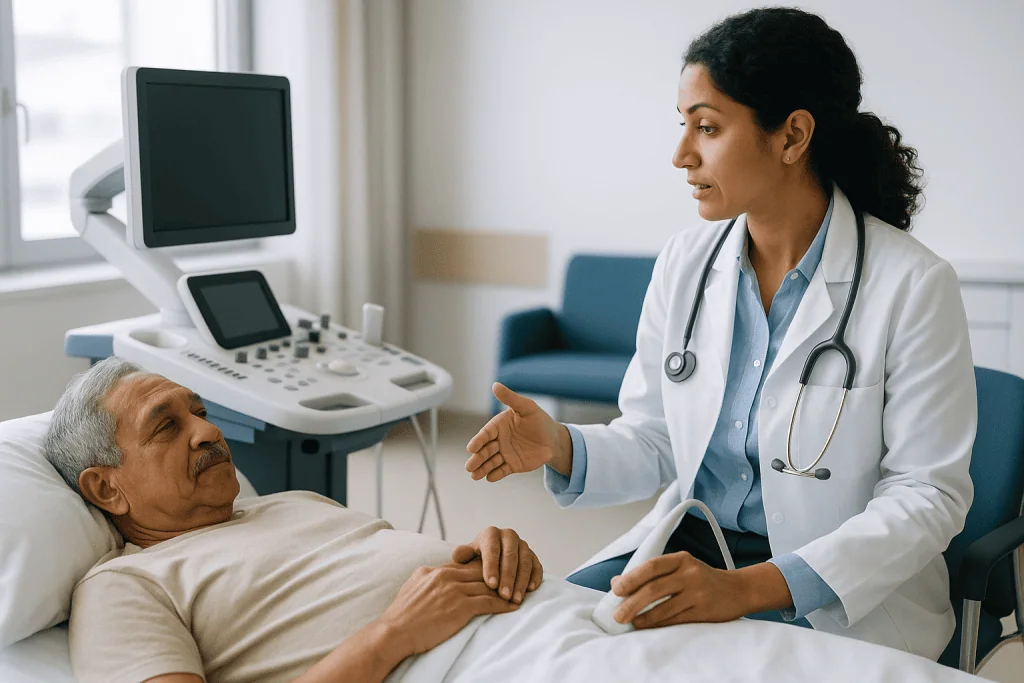
The Mayo Clinic lists HIFU among treatments that use heat or cold to destroy prostate tissue, grouped with cryotherapy, and places them as options for some men with cancer that has not spread beyond the gland. The procedure is usually done under general or spinal anesthesia, and a urinary catheter, a thin tube draining the bladder, is typically left in place for a short period because the treated tissue swells before it shrinks.
Two consequences of this mechanism shape everything afterward. First, destroyed tissue does not vanish overnight; it becomes scar, which MRI can see and which changes the look of the gland for months. Second, because only part of the prostate was treated, cancer can in principle be present in three places: at the edge of the treated zone if the margin was too tight, inside the zone if heating was incomplete, or in untreated tissue where a small, previously invisible focus grows. Each test in the follow-up plan is aimed at one or more of those three possibilities.
Who is usually offered focal HIFU, and who is usually asked to wait
Focal therapy occupies a narrow band between two better-established paths. On one side sits active surveillance, in which low-risk cancer is monitored with PSA tests, MRI and periodic biopsies without treatment. On the other sit whole-gland treatments, chiefly surgery and radiotherapy. The NHS notes that HIFU may be offered to men whose cancer is contained within the prostate and describes it as most often available through specialist centers or trials rather than as a routine first choice.
In practice, the people considered for focal HIFU tend to share a few features: cancer that MRI and biopsy suggest is confined to one region of the gland, a grade in the intermediate range where surveillance alone feels uneasy but whole-gland treatment feels like too much, and a prostate of a size and shape the probe can reach. Men whose disease appears in multiple separate areas, whose grade is high, or whose imaging suggests spread beyond the capsule are usually steered toward other options, because treating one spot would leave the problem elsewhere.
Being asked to wait is common and is not a rejection. Some men are told their cancer is low-risk enough that surveillance is the safer first step; treating it focally would expose them to side effects without a clear benefit. Others are asked to have further imaging or a more detailed biopsy before any decision, because focal therapy only makes sense when the map is accurate. Someone with significant urinary symptoms from an enlarged prostate, or with previous rectal surgery, may also be advised that HIFU is a poor fit anatomically.
Whichever group you fall into, the reasoning should be explained to you, and it should be revisited if new results arrive.
What does PSA after HIFU actually tell you?
PSA is a protein made by prostate cells, both healthy and cancerous, and measured in a simple blood test. MedlinePlus explains that levels rise not only with cancer but with benign enlargement, inflammation of the gland (prostatitis), urinary infection and recent procedures involving the prostate. That list is worth keeping in mind, because after focal therapy every one of those factors can be in play at once.

Immediately after HIFU the treated tissue is inflamed and breaking down, and PSA typically spikes before it settles. Clinicians therefore do not treat the first post-procedure result as meaningful in isolation. Instead they wait for the gland to quiet down and then establish a new baseline, often called the nadir, the lowest stable value your prostate reaches once healing is complete. From then on the question is not whether PSA is low but whether it stays roughly flat.
Because untreated tissue continues producing PSA, the new baseline will usually be well above the near-zero values seen after surgery. How far it falls from your pre-treatment number depends on how much of the gland was treated and how much benign enlargement remains. A man with a large, benignly enlarged prostate and a small treated zone may see only a modest drop; that is expected, not a failure.
What clinicians watch for is a sustained rise over several consecutive tests. A single bump, especially after an infection, vigorous cycling or ejaculation shortly before the blood draw, is usually rechecked rather than acted upon. The Mayo Clinic notes that PSA results are best interpreted in the context of prior values and other findings, and after focal therapy that context is everything.
How often are PSA checks after HIFU?
Ask three focal-therapy programs for their PSA schedule and you may get three slightly different answers, which is itself a useful thing to know. There is no single international standard for follow-up after focal HIFU, and the NHS is candid that the long-term evidence base is still being built. What exists instead is a broadly shared logic.
Early on, tests are closer together. The team wants to see the post-procedure spike come down and identify the new baseline. Once that baseline is stable, the interval usually lengthens. Many programs describe checks that are frequent in the first year or two and then spaced out further if results stay reassuring, mirroring the pattern used in active surveillance and after whole-gland treatment. The precise gaps are set by your team and often written into a trial protocol if you are enrolled in one.
Consistency matters more than any particular calendar. Using the same laboratory each time reduces the small variations between assays that can make a flat line look jagged. Booking the test before, rather than after, activities known to nudge PSA, and mentioning any recent urinary infection, helps the team read the result fairly.
Some programs also calculate PSA density, the PSA value divided by prostate volume from MRI, or note the doubling time, the time it takes for PSA to rise by half again. Both are attempts to squeeze more meaning from a test that, after focal therapy, is inherently noisier than after surgery. Ask which measures your team uses and what pattern would prompt them to bring imaging or biopsy forward. Knowing that threshold in advance takes much of the dread out of opening each result.
What role does MRI play in follow up after prostate HIFU?
Multiparametric MRI, a prostate scan that combines several imaging sequences including one that tracks blood flow, is the workhorse of surveillance after focal therapy. It is the same type of scan most men had before treatment to map the cancer, which gives radiologists a direct before-and-after comparison.
In the months after HIFU the treated zone looks dramatically different. Destroyed tissue loses its blood supply and appears as a dark, non-enhancing area, sometimes with a rim of inflammation that can mimic disease on early scans. Radiologists experienced in focal therapy know to expect this, which is one reason follow-up imaging is generally read by the same team that planned the treatment, or at least with the pre-treatment scan alongside.
MRI serves three purposes in the plan. It confirms that the intended zone was fully treated, with the ablation area covering the original lesion and its margin. It looks for any new enhancing area at the edge of that zone. And it surveys the untreated prostate for lesions that may have been too small to see before or that have grown since. The scan cannot confirm cancer, only flag suspicion; that job still belongs to biopsy.
Timing typically follows the healing curve. A scan too soon after treatment shows swelling and inflammation that obscure the picture, so teams usually wait until the acute changes have settled before the first meaningful scan, then repeat at intervals that stretch out if findings stay stable. As with PSA, the exact intervals differ between programs and protocols. What should not differ is that any suspicious change on MRI, or a rising PSA without an MRI explanation, prompts a conversation about targeted biopsy rather than simply another scan.
Is a repeat biopsy part of the plan?
Here focal therapy departs most sharply from surgery, where a repeat biopsy of the prostate is not possible because there is no prostate left. After HIFU, tissue remains, and many programs schedule a biopsy of the treated zone even when PSA and MRI look reassuring. This is often called a protocol biopsy, meaning it is done according to a pre-agreed plan rather than because something has gone wrong.
The reasoning is straightforward. Imaging can miss small areas of surviving cancer, particularly within scar tissue, and PSA after focal therapy is too blunt to catch them reliably. Only a needle sample can show whether the cells in the treated area are dead, scarred or still active. A biopsy that finds no viable cancer offers stronger reassurance than any scan. One that finds residual disease allows the team to act before the cancer has had time to grow or spread, which is the whole point of surveillance.
Biopsies are usually targeted, meaning the needle is guided to the treated zone and to any area MRI has flagged, often with the ultrasound image fused to the MRI so the two line up. Some teams add systematic samples from the untreated prostate as well. The procedure can be done through the skin between the scrotum and anus (transperineal) or through the rectum (transrectal); the approach, anesthesia and timing are decided by your clinicians.
If your program does not include a routine biopsy, ask why and what would trigger one. Both approaches, routine and for-cause, are in use, and the honest answer is that the evidence has not yet settled which serves men better. Knowing your team’s position lets you plan around it rather than be surprised.
Follow-up after HIFU at a glance
The table below summarizes the elements most programs combine. It is a map of what each test is for, not a schedule; the intervals are set by your treating team and often by a trial protocol.
| Element | What it looks for | What it cannot do | Typical pattern |
|---|---|---|---|
| PSA blood test | A sustained upward trend from your post-treatment baseline | Confirm cancer or tell you where it is; it does not fall to near zero after focal therapy | Closer together early, spacing out once a stable baseline is established |
| Multiparametric MRI | Whether the treated zone has scarred as intended; new enhancing areas at the edge or elsewhere in the gland | Prove or exclude living cancer; early scans are clouded by inflammation | First meaningful scan once acute changes settle, then at intervals that lengthen if stable |
| Targeted biopsy | Living cancer cells in the treated zone or in MRI-flagged areas | Sample every part of the gland; small areas can still be missed | Either planned by protocol or triggered by PSA or MRI change, depending on the program |
| Function review | Urinary flow, control and infections; erections; bowel changes | Detect cancer | At each visit, often using standard questionnaires |
Two threads run through every row. First, no single test carries the decision on its own; a worrying PSA is checked against MRI, and a worrying MRI is checked against biopsy. Second, the function review is not a courtesy. Focal therapy is chosen partly to protect continence and erections, so tracking those outcomes is how you and your team judge whether the trade-off is working for you and whether any support, such as pelvic floor therapy or a referral for sexual health, should be arranged.
Keep your own record of dates and values. Over years, and possibly across more than one hospital, that folder becomes the most reliable version of your history.
Prostate HIFU recovery time: the first days and weeks
Most men go home the same day or the following morning. The catheter is the first hurdle: because heated tissue swells before it shrinks, the urethra running through the prostate can narrow temporarily, and the tube keeps the bladder draining until that risk passes. Your team will tell you how long yours stays in and who removes it; do not remove it yourself.
Once the catheter is out, expect the stream to be slower than usual and expect urgency, frequency and some stinging. Small amounts of blood or debris in the urine are common in the early weeks as dead tissue is shed; clinicians sometimes describe it as the treated area clearing itself out. Ejaculate may be reduced in volume, discolored or absent for a period, and may remain reduced long term because part of the gland that produces seminal fluid has been treated.
Fatigue after the anesthetic usually lifts within days. Many men return to desk work within a week or so, though strenuous exercise, cycling and sexual activity are typically held back for a period your team specifies, both for comfort and to avoid irritating the healing tissue before an early PSA test. Drinking enough fluid to keep urine pale, avoiding constipation with fiber and gentle movement, and taking prescribed medicines as directed cover most of the practical advice.
The gland itself heals on a longer clock than you will feel. Inflammation settles over weeks; scar formation and shrinkage of the treated zone continue for months, which is why the first surveillance MRI is not rushed. When people ask how long the prostate takes to heal after HIFU, the honest answer is that symptoms improve first and imaging appearances catch up later, and the two should not be confused.
Which side effects will the team keep watching for?
Focal therapy is chosen partly because it spares tissue that whole-gland treatments cannot, but sparing is not the same as no risk. The NHS lists urinary problems, erectile dysfunction and, less commonly, injury to the rectum among possible effects of HIFU, and a good follow-up program measures rather than assumes.
Urinary effects come in two forms. Early on, irritation and slow flow are expected and usually ease. Later, a stricture, a narrowing caused by scar tissue in the urethra, can develop and shows up as a stream that worsens rather than improves; that pattern deserves prompt review. Infections are more likely while a catheter is in and shortly afterward. Leakage of urine is uncommon after focal treatment but is asked about specifically at each visit, often with a standard questionnaire so that small changes over time are not lost.
Erections depend on nerve bundles that run along the outer edges of the prostate. A focal zone that sits near one bundle carries more risk to erectile function than a zone in the middle of the gland, and your team will usually have discussed this before treatment. Changes can be temporary while inflammation resolves or longer lasting. Reporting them early matters, because rehabilitation approaches and referrals to a sexual health service are more useful when started sooner. Any medicines considered for erectile function are a decision for the prescribing clinician, weighed against your other health conditions.
Rectal effects are rare but taken seriously because the probe sits in the rectum and the prostate lies against its wall. New bleeding from the back passage, passing urine from the rectum, or persistent rectal pain are red flags covered in the section on when to call.
Can prostate cancer come back after HIFU? Recurrence and repeat HIFU
Yes, it can, and any program that does not say so plainly is doing you a disservice. Cancer may persist in the treated zone if heating was incomplete or the margin too narrow, and it may appear in untreated tissue that harbored a focus too small to see or that develops a new one over years. The NHS states that the long-term effectiveness of HIFU has not been fully assessed, and this article deliberately gives no percentage for recurrence because a trustworthy figure would need to come from a named systematic review or guideline that matches your grade, zone size and follow-up length. Ask your team what their own audited outcomes show and what evidence they are drawing on.
What follow-up buys you is options. Because focal therapy does not burn the bridges that whole-gland treatment does, a recurrence found early can usually still be treated by several routes. Repeat focal HIFU is one, provided the recurrence is confined to a treatable area and the tissue has healed enough to be mapped and targeted; how long a team waits before offering a second session depends on that healing and on the biopsy findings rather than on a fixed rule. Surgery to remove the whole prostate remains possible, though scar tissue can make it technically more demanding. Radiotherapy is also an option, and some men with very low-volume recurrence are offered surveillance instead.
The decision is rarely urgent in the sense of days; it is a considered conversation in a multidisciplinary meeting where urologists, oncologists and radiologists review the whole picture. Your priorities, particularly around continence and sexual function, belong in that conversation, and the choice remains with you and the treating team together.
What people often get wrong about follow-up after focal therapy
The most common misunderstanding is expecting PSA to fall to near zero. It will not, because most of the gland is still there. Men who have read about surgery sometimes see their first post-treatment result and assume the therapy has failed; in reality the number is doing what an untreated remnant of prostate does. What matters is the trend from the new baseline.
A second error runs the other way: treating a stable PSA as proof that all is well and letting the MRI or biopsy appointment slide. PSA after focal therapy is a coarse instrument. A small pocket of surviving cancer can sit quietly inside scar tissue without shifting the number noticeably, which is precisely why imaging and tissue sampling are in the plan.
Third, some men believe that an early, cloudy-looking MRI must mean trouble. Inflammation and healing change the scan for months, and experienced radiologists read early images with that in mind. Panic over a first scan is usually misplaced; so is ignoring a change flagged on a later one.
Fourth, the phrase focal therapy is sometimes heard as a one-time fix that ends the matter. It is better understood as a treatment that trades the finality of whole-gland approaches for tissue preservation and keeps you in a surveillance relationship for the long term, similar in spirit to active surveillance.
Finally, marketing language around any technology can drift toward promises. Be wary of any claim about success that arrives without a named study and a follow-up duration attached. The NHS’s careful wording about unassessed long-term effectiveness is the appropriate benchmark, and a good clinician will speak in the same measured register.
Questions to ask your care team
Follow-up works best when you understand the plan well enough to notice if it slips. These questions are a starting point; write the answers down and bring them to each visit.
- What PSA value do you expect as my new baseline, and roughly when will you consider it established?
- What pattern of PSA change would prompt you to bring forward an MRI or biopsy?
- When is my first surveillance MRI planned, and will it be read alongside my pre-treatment scan?
- Do you perform a routine biopsy of the treated zone, or only if something changes? What is the reasoning behind that approach?
- Am I enrolled in a trial or registry, and does that fix my follow-up schedule?
- Which side effects should I report straight away, and who do I call between appointments?
- How will you measure my urinary and sexual function over time, and what support is available if either changes?
- If cancer is found again, which treatment options would still be open to me, and would repeat HIFU be one of them?
- Should I use the same laboratory for every PSA test, and is there anything I should avoid before the blood draw?
- How long do you intend to keep me under surveillance, and what would allow the intervals to lengthen?
Notice that none of these ask for a promise. They ask for thresholds, reasoning and contingency plans, which are the things a good program can actually give you. If an answer is that the evidence is uncertain, that is a legitimate and honest reply, and it tells you something about how your team thinks.
When to call your doctor
Most of what you feel in the weeks after HIFU is expected and settles. A few things are not, and they should be reported the same day rather than saved for the next appointment.
- You cannot pass urine at all, or you are passing only dribbles with a painful, full bladder. Acute retention needs prompt drainage.
- Fever, shaking chills, or feeling suddenly and severely unwell, especially while a catheter is in or shortly after it comes out. This can signal a urinary infection spreading to the blood.
- Heavy bleeding in the urine, clots that block the flow, or bleeding that is increasing rather than easing.
- New bleeding from the back passage, urine leaking from the rectum, or gas or stool appearing in the urine. These are rare but can indicate injury between the prostate and rectum.
- Severe or worsening pain in the pelvis, lower abdomen or rectum that is not controlled by the measures your team advised.
- Pain, swelling or redness in one calf, or sudden breathlessness or chest pain, which can indicate a blood clot after any procedure with reduced mobility.
Beyond the recovery period, contact your team if your urinary stream is becoming steadily slower over weeks, if you notice a PSA result that has risen and you have not heard from anyone about it, or if any appointment in your plan is missed or delayed. A surveillance program only protects you if it runs on time, and chasing a missed scan is entirely reasonable.
If you cannot reach your urology team and symptoms are severe, use your local urgent or emergency service. Bring your treatment summary so the clinicians seeing you know that part of your prostate has been ablated and that a normal-looking PSA does not rule out a problem.
Frequently asked questions
How long does it take for the prostate to heal after HIFU?
Symptoms usually settle before the gland itself finishes healing. Urinary irritation, slow flow and debris in the urine tend to ease over the early weeks, while the treated tissue continues to scar and shrink for months, which is why the first surveillance MRI is delayed. Your team will give you a timeline specific to how much tissue was treated.
What does PSA after HIFU normally look like?
PSA usually spikes right after treatment as tissue breaks down, then falls to a new baseline that is lower than before but well above the near-zero values seen after surgery, because untreated prostate keeps producing it. Clinicians then watch for a sustained rise across several tests rather than reacting to any single value.
Can prostate cancer come back after HIFU?
Yes. Cancer can persist inside or at the edge of the treated zone, or appear in untreated tissue over time. The NHS notes that long-term effectiveness of HIFU has not been fully assessed. Follow-up with PSA, MRI and biopsy exists to detect this early, when several treatment options typically remain available.
What is the success rate of HIFU treatment for prostate cancer?
No single reliable figure applies to everyone, because outcomes depend on cancer grade, the size of the treated zone and how long men were followed. This article gives no percentage for that reason. Ask your team what their audited results show and which systematic review or guideline they base their counseling on.
How long after HIFU can you do it again?
There is no fixed interval. Repeat HIFU is considered when a biopsy confirms recurrence confined to a treatable area and the tissue has healed enough to be mapped clearly on MRI. That judgment is made by the multidisciplinary team reviewing your imaging, biopsy and function, alongside alternatives such as surgery or radiotherapy.
Is hifu prostate recurrence usually found by PSA or by imaging?
Often by a combination. A rising PSA trend typically prompts an MRI, and a suspicious MRI prompts a targeted biopsy, but some recurrences are found on protocol biopsies when PSA looked stable. Because PSA is a coarse tool after focal therapy, teams avoid relying on it alone and treat the three tests as a set.
What is a realistic prostate HIFU recovery time for returning to work and exercise?
Many men resume desk work within about a week of the catheter coming out, with strenuous exercise, cycling and sexual activity held back for a period the team specifies to protect healing tissue and avoid irritating an early PSA reading. Recovery is slower if a catheter stays in longer or an infection develops.
Do I need a repeat biopsy if my PSA and MRI are normal?
Many programs still perform a planned biopsy of the treated zone, because imaging can miss small areas of surviving cancer within scar and PSA is not sensitive enough after focal therapy. Other programs biopsy only if PSA or MRI changes. Ask which approach your team uses and the reasoning behind it.
Is repeat hifu prostate treatment the only option if cancer returns?
No. Because focal therapy preserves tissue, recurrence can usually still be managed with repeat focal treatment, surgery to remove the prostate, radiotherapy, or in selected low-volume cases continued surveillance. Scar tissue can make surgery more demanding, so the choice is made in a multidisciplinary review with your priorities included.
Why did my first MRI after HIFU look abnormal?
Early scans are expected to look different. The treated zone loses blood supply and appears dark, often with a rim of inflammation that can mimic disease for months. Radiologists experienced in focal therapy read these changes against your pre-treatment scan. A genuinely suspicious finding is one that persists or grows on later imaging.
References
- NHS: Prostate cancer: Treatment
- MedlinePlus: Prostate-Specific Antigen (PSA) Test
- MedlinePlus: Prostate Cancer
This article is for general information only and is not a substitute for professional medical advice. Please consult a qualified doctor about your individual situation.

More from the Blog

What to Expect After Varicocele Repair: How Semen Parameters Are Rechecked Over Months
After varicocele repair, semen is usually rechecked with a laboratory semen analysis around three months later, because sperm take roughly two to three months…

Infection, Stricture or Injury: How Urethra Diseases Are Told Apart and Treated
Urethra diseases fall into three broad groups: infection (urethritis), narrowing from scar tissue (stricture) and physical injury. Clinicians separate them by history, a urine…

When Does Kidney Disease Need Dialysis or Transplant Planning? What Stage-Based Care Means
Kidney disease usually needs dialysis when the kidneys have lost most of their filtering ability, typically an eGFR below 15 (stage 5), and symptoms…

The Post-Vasectomy Semen Analysis: How the Sample Is Checked and What the Report Shows
A post-vasectomy semen analysis is a laboratory check of an ejaculated sample, usually done about 8 to 16 weeks after the procedure, to confirm…

After Torsion Surgery: What to Expect for the Testicle, Fertility and Long-Term Follow-Up
After surgery for testicular torsion, most people go home the same day or the next, return to school or desk work within about a…

Which Tests Shape an Enlarged Prostate Plan? Uroflowmetry, PSA and Residual Urine Explained
An enlarged prostate plan is usually shaped by three measurements working together: uroflowmetry, which records how fast urine leaves the body; a post-void residual…