

What Happens During a Water Birth: Pool Temperature, Monitoring and the Moment of Delivery

Key Takeaways
- NHS guidance caps birthing pool water at 37.5 °C (99.5 °F) because a submerged parent cannot shed heat normally and a warmer fetus develops a faster heart rate and higher oxygen demand.
- The Cochrane review of 15 trials and 3,663 women found first-stage water immersion probably reduces epidural or spinal use, with moderate-certainty evidence, but showed no clear effect on labor length, cesarean rate or serious tears.
- The baby's heartbeat is checked in the pool with a waterproof handheld Doppler, and a concerning pattern means leaving the water and reassessing on a bed.
- A healthy term newborn does not inhale underwater because the lungs are fluid-filled, oxygen still arrives via the placenta, and a laryngeal dive reflex closes the airway until the face meets air.
- Sedating opioids and epidurals rule out staying in the pool, while inhaled nitrous oxide and oxygen is often compatible because it is short acting and does not cause drowsiness.
- Stool in the pool is scooped out with a sieve kept beside it, and the water is changed only if it becomes heavily soiled or too cloudy for the midwife to see clearly.
During a water birth, the laboring person sits or kneels in a deep pool of water kept near body temperature, no warmer than 37.5 °C (99.5 °F), while a midwife or nurse listens to the baby's heartbeat with a waterproof Doppler and checks water and maternal temperature regularly. The baby is born beneath the surface and lifted to the parent's chest within seconds to take a first breath.
Somewhere around the seventh month, a lot of expectant parents end up in the same odd position: perched on the edge of their own bathtub, taps running, trying to picture whether a body in labor could really feel better in water. The leaflet from the birth center makes it sound serene. The comments online swing from “best decision I ever made” to “they made me get out after twenty minutes.” Neither explains what a midwife actually does at the side of the pool.
This article is the missing middle. It walks through what happens during a water birth from the first glance at the thermometer to the moment a wet, blinking baby is lifted onto a parent’s chest, and it is candid about the parts researchers still argue over.
The short version: a water birth is far more managed than the candlelit photographs suggest, and that is precisely why it can be offered at all.
What happens during a water birth, step by step
Most water births begin on dry land. Contractions establish, someone checks the parent’s blood pressure, pulse and temperature, listens to the baby’s heart, and confirms that labor is progressing normally. Only then is the pool filled. Many care teams prefer to wait until labor is well established before immersion, because getting in very early has been linked in some studies with labor slowing, although the Cochrane review on immersion found little or no clear difference in the length of the first stage overall (PubMed).
The pool is deeper than a household bath, typically filled so the water reaches the chest when sitting, which is what lets the body float and change position freely. The parent climbs in with a support person nearby and a midwife or nurse within arm’s reach. From there, labor looks much as it does anywhere else: contractions come and go, positions shift from kneeling to leaning over the rim to squatting, and the person in the water drinks, rests and is encouraged to move.
At set intervals the baby’s heartbeat is listened to with a waterproof handheld Doppler, and the water temperature and the parent’s temperature are written down (NHS). If everything stays reassuring, the pool becomes the place where the second stage, the pushing phase, happens too. The baby is born into the water, brought up to the surface straight away, and placed skin to skin while the cord is still attached.
The third stage, when the placenta is delivered, is usually managed out of the water. That is one of several small, deliberate transitions that make a water birth a supervised clinical procedure rather than a long bath.
Birthing pool temperature: why 37 °C matters and who checks it
The single number most people remember from a water birth is 37. That is body temperature in Celsius, and the pool is kept at or just below it. NHS guidance sets the ceiling plainly: the water should not be hotter than 37.5 °C, roughly 99.5 °F (NHS). Warmer is not more relaxing; it is a risk.
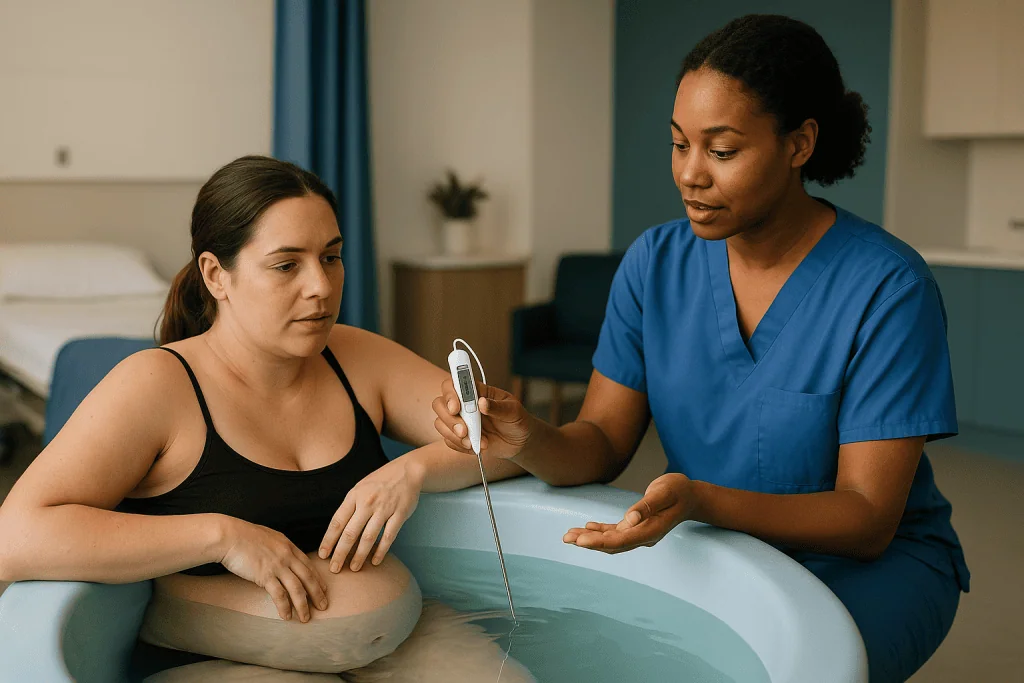
The reason is physiology rather than comfort. An adult sheds heat mostly by sweating and by moving blood to the skin, and both mechanisms are blunted when most of the body is under warm water. If the parent’s core temperature rises, the baby’s rises with it, because the fetus can only offload heat across the placenta. A warmer fetus has a faster heart rate and higher oxygen demand, which can look like distress on monitoring and, at the extreme, contribute to real distress. Keeping the pool near body temperature also means the baby is born into surroundings close to the ones it just left, part of the logic behind those calm first seconds.
So the thermometer is checked and charted alongside the parent’s own temperature at set intervals, and the water is topped up or cooled as needed (NHS). If the parent’s temperature climbs, the response is to leave the pool and assess, not to add cold water and hope. Teams also watch for the opposite problem: water that has drifted lukewarm, which is uncomfortable for the parent and can cool a newborn faster than anyone wants.
Where does the water come from? Ordinary tap water, in a pool cleaned to hospital-grade protocol between uses, or in a single-use liner. Nothing is added: no salts, oils or bath products, because they affect the baby’s skin and first breath and cloud the team’s view of the water.
Who is usually offered a water birth, and who is usually asked to wait
Water immersion is usually offered to people whose pregnancy has been straightforward: a single baby, head down, at term, with labor progressing normally and no complication that calls for continuous electronic monitoring (Cleveland Clinic). “Low risk” is the phrase on most leaflets, and it means the team expects labor to unfold without needing to intervene quickly.
The list of reasons a team may ask someone to labor on land is longer, and most items on it are about monitoring and speed of access rather than about water itself.
- Preterm labor, generally before 37 weeks, because a smaller baby’s transition to breathing needs closer observation (Cleveland Clinic).
- A breech baby, twins or more, or a baby whose growth or heartbeat has already caused concern.
- High blood pressure disorders such as pre-eclampsia, where a change in temperature or blood pressure needs an immediate response.
- Maternal fever, or an infection that could pass to the baby through water, including active herpes lesions or certain bloodborne infections.
- Heavy bleeding, meconium (the baby’s first stool) staining the fluid, or an epidural already in place, since regional anesthesia changes leg strength and blood pressure.
- Sedating opioid pain relief given within the previous few hours, because drowsiness in water is unsafe.
A previous cesarean sits in a gray zone. Some services offer immersion during a planned vaginal birth after cesarean with continuous waterproof monitoring; others do not. A high body mass index is handled similarly, with local policy varying and the deciding factor usually being whether staff can help someone out of the pool quickly in an emergency.
None of these are judgments about the person. They are judgments about how fast help can arrive, and every one of them belongs with the treating team rather than a leaflet.
How is the baby monitored during a water birth?
The worry behind this question is reasonable: if the parent is submerged, how does anyone know the baby is coping? The answer is a device most people already recognize from antenatal visits, adapted for water.
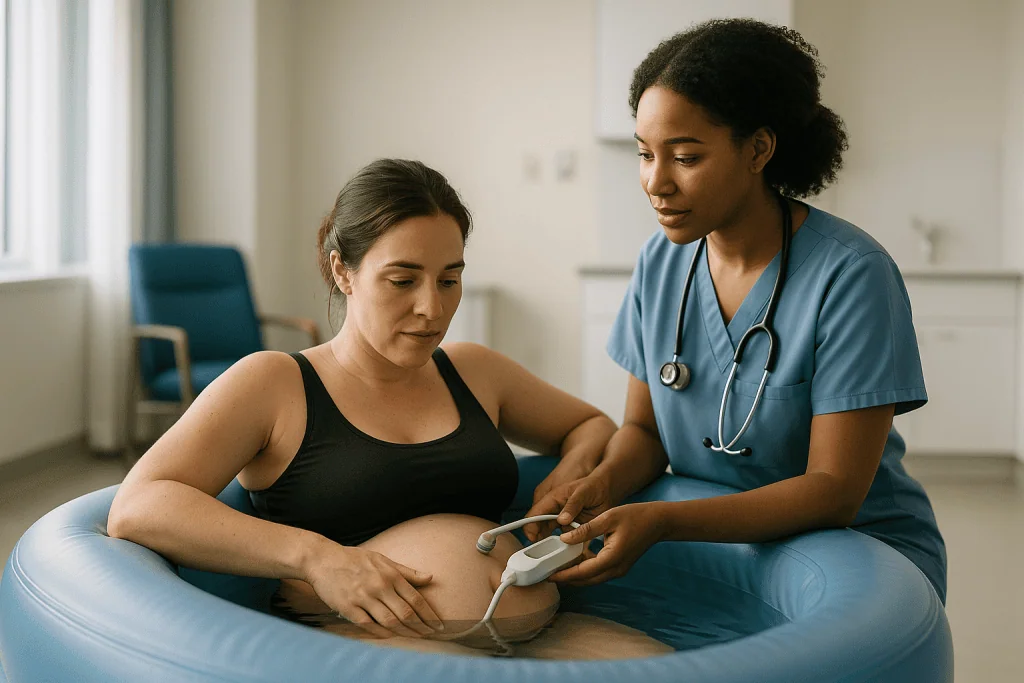
A handheld Doppler is a small ultrasound probe that picks up the baby’s heartbeat and turns it into sound. Waterproof versions can rest against the belly under the surface, so nobody has to climb out for each check. This approach, called intermittent auscultation, means listening for about a minute after a contraction at regular intervals through labor, with checks becoming more frequent once pushing begins. It is the standard way of monitoring any low-risk labor, wet or dry, and it is one reason water birth is restricted to low-risk pregnancies: continuous electronic fetal monitoring, the belt-and-machine kind that prints a trace, has historically required the person to be out of the water.
That is changing in some units, where waterproof wireless sensors stick to the abdomen and transmit a continuous trace. Availability varies widely, and whether a unit has them is often the practical reason it can or cannot offer water to people who need closer monitoring.
The parent is monitored too. Temperature and pulse are recorded at set intervals, blood pressure is usually taken out of the water at the start of labor and when indicated, and the midwife watches for faintness or overheating (NHS). Progress is judged largely by observation: the rhythm of contractions, changes in breathing and behavior, and the parent’s own account. Vaginal examinations can be done in the pool if needed, though many teams keep them to a minimum.
What monitoring cannot do is guarantee anything. It gives early warning. If the heart rate pattern becomes concerning, the plan is simple and rehearsed: out of the water, onto a bed, reassess.
How painful is childbirth in water? Water birth pain relief, honestly
Labor in water still hurts. Anyone who says otherwise is describing an unusually easy labor, not the water. What the evidence supports is narrower and more useful: warm water changes how pain is experienced and lowers the chance that someone will want stronger pharmacological relief.
The mechanism has several strands. Buoyancy takes weight off the hips, spine and pelvic floor, so muscles that would be braced against gravity can release between contractions. Warmth increases blood flow to the uterus and relaxes surrounding muscle. Immersion also appears to reduce circulating stress hormones such as catecholamines, which in high amounts can slow labor and sharpen pain perception, and it gives a strong sense of privacy and control, both known to affect how pain is rated.
The best evidence comes from the Cochrane review of immersion in water during labor and birth, which pooled 15 randomized trials involving 3,663 women. It found that immersion during the first stage probably reduces the use of regional analgesia, meaning an epidural or spinal, compared with laboring on land, graded as moderate-certainty evidence (PubMed). It did not find that water shortened labor, and pain scores were measured too differently across trials to show a consistent reduction.
Water combines with other approaches: breathing techniques, shoulder massage from the poolside, and in many countries inhaled nitrous oxide and oxygen, which is short acting and does not cause the drowsiness that would make water unsafe (NHS). Longer-acting opioid injections and epidurals are not compatible with staying in the pool.
The honest summary: expect pain, expect it to feel more manageable for many people, and keep every other option open. Nobody fails a water birth by getting out.
Water birth vs land birth: what the evidence actually shows
Comparing water and land births is harder than it looks. People who choose water tend to have lower-risk pregnancies to begin with, and randomized trials mostly studied the first stage of labor rather than the birth itself. With those caveats, the Cochrane review offers the clearest picture available, and it is more modest than either enthusiasts or skeptics tend to claim (PubMed).
| Outcome | What the Cochrane review found | Certainty of evidence |
|---|---|---|
| Use of epidural or spinal analgesia | Probably reduced with first-stage immersion | Moderate |
| Length of first stage | Little or no clear difference | Low |
| Instrumental birth (forceps or vacuum) | Little or no difference | Low |
| Cesarean birth | Little or no difference | Low |
| Serious perineal tears | Little or no difference | Low |
| Baby admitted to neonatal unit | No clear increase or decrease | Low |
| Birth in water (second stage) outcomes | Too few trials for firm conclusions | Very low |
Read the middle column carefully. “Little or no difference” is not the same as “harmful,” and it is not the same as “proven safe.” For the second stage, the moment of birth itself, randomized evidence is thin, and much of what clinicians know comes from large observational studies of births in units with strict eligibility criteria and experienced staff. Those studies have generally been reassuring, but they describe carefully selected groups, which is exactly why eligibility rules exist.
The one solid, consistent finding concerns analgesia. If avoiding an epidural matters to you, water is one of the better-supported ways to make that more likely. If your priority is a shorter labor or a lower chance of tearing, the evidence does not currently promise either.
The moment of delivery: what happens when the baby arrives underwater
This is the part people replay in their heads, so it deserves precision. As the baby’s head becomes visible, the midwife’s approach is usually hands-off. Touching the baby’s face underwater is avoided, because stimulation of the face and nose is one of the things that can prompt a breath. The head is born, often followed within one or two contractions by the shoulders and body, and the baby emerges fully into the water.
Then comes the step that defines a water birth: the baby is brought to the surface immediately, face first, and placed on the parent’s chest with the head above the water. There is no lingering underwater, whatever some videos suggest. The midwife or the parent may do the lifting, and it is gentle, but it is never delayed.
Why does the baby not inhale on the way out? Several protective mechanisms overlap. Before birth the lungs are filled with fluid and oxygen arrives through the placenta, so there is no drive to breathe. Newborns also have a dive reflex: receptors around the larynx respond to fluid by closing the airway and triggering swallowing rather than inhalation. A drop in temperature on the face, the pressure of air and the surge of stimulation at the surface are what normally trigger the first breath. Water at body temperature does not deliver those triggers, which is a second reason the pool is never allowed to cool or overheat.
These reflexes are strong in a healthy, unstressed, term baby. They can be overridden in a baby short of oxygen, which is why signs of distress during labor mean leaving the water before the birth (Cleveland Clinic). The umbilical cord stays intact while the baby breathes and pinks up, and clamping is usually delayed, as it would be on land (NHS).
Water birth benefits and risks: the downsides people actually ask about
Every honest leaflet lists drawbacks, and they fall into three groups: common and manageable, rare but serious, and theoretical.
Common and manageable: you may be asked to get out. Slow progress, a change in the baby’s heart rate, a rise in your temperature, or wanting a different kind of pain relief are all ordinary reasons. Feeling faint when standing after a long immersion is common too, so leaving the pool is done slowly with support. Some people simply find the water is not for them once labor intensifies.
Rare but serious: the cord can tear during a rapid lift to the surface if it is short or tightly wound, which is why the lift is gentle and the baby is not raised higher than the parent’s chest. Water inhalation is uncommon in a healthy term baby, for the reasons already described, but it has been reported, particularly where the baby was already compromised. Infection is possible when water is contaminated; isolated case reports have linked serious newborn infections to poorly maintained pools or inadequately cleaned equipment, which is why cleaning protocols are strict and most units use disposable liners or hospital-grade disinfection.
Theoretical or unresolved: some clinicians worry that water increases bleeding after birth, or makes blood loss harder to estimate because it disperses in the pool. Estimation is genuinely harder; whether actual bleeding differs has not been clearly shown. Others have raised concern about perineal tears; the Cochrane review found little or no difference in serious tears, with low-certainty evidence (PubMed).
For the baby, the review found no clear increase in neonatal unit admissions, but the number of births actually completed in water within randomized trials was small (PubMed). That absence of alarm is reassuring. It is not proof of safety in every circumstance, and a thoughtful team will say so.
What happens if I poo in the birthing pool?
It happens, and it is one of the most common things people are too embarrassed to ask out loud. The pushing stage uses the same muscles as opening the bowels, and the baby’s head pressing on the rectum empties it. On land, midwives simply wipe and change the pad. In water, they use a small sieve or net kept beside the pool for exactly this purpose, scoop out anything solid, and carry on. Nobody comments unless you ask.
Is it a hygiene risk for the baby? The water is not sterile in any case, and the baby’s skin and gut are already meeting the parent’s bacteria during a vaginal birth, which is part of how a newborn’s microbiome is seeded. Teams still take contamination seriously: if the water becomes heavily soiled or too cloudy to see through, the pool is drained and refilled, or the parent steps out while it is cleaned. Some units have a lower threshold and change the water at the first sign of stool.
The related worry is vomiting, also common in late labor. The same rule applies: clean up, assess, decide whether the water needs changing. A bowl is kept within reach for this reason.
Blood is a different matter and worth understanding. A small amount of bleeding as the cervix opens and as the baby is born is normal and turns the water pink. Heavier bleeding is a reason a team may ask someone to leave the pool, partly because it can signal a problem and partly because judging how much has been lost in a full pool of water is unreliable.
The practical upshot: use the toilet before getting in, eat lightly in early labor if you feel like it, and let go of the rest. Your midwife has seen it all before, several times this week.
Why do some hospitals not allow water births?
Search this question and you will find frustration on both sides: parents who feel refused something reasonable, and staff who feel misunderstood. The reasons are mostly logistical and legal rather than a verdict on the evidence.
Equipment and staffing come first. A safe water birth needs a pool that can be cleaned to hospital standard, a room with plumbing to fill and drain it quickly, a hoist or a clear evacuation plan for lifting someone out in an emergency, waterproof monitoring, and a midwife or nurse trained in water birth who keeps that training current. A unit with one pool and a busy night cannot always offer it, which is why many people who planned a water birth end up laboring on land for reasons unrelated to their health.
Policy comes second. Some obstetric bodies have taken a cautious position on birth in water, as opposed to immersion during labor, on the grounds that randomized evidence for the second stage is limited. Where a hospital’s leadership follows that view, the compromise is often to allow the pool for labor but ask the parent to get out to push. Other bodies and health systems, particularly where midwifery-led care is the norm, offer birth in water routinely under eligibility criteria. Both camps cite the same Cochrane review; they weigh the uncertainty differently (PubMed).
Liability and infection control matter too. A unit that cannot document its cleaning and water-quality checks may decide the risk is not worth taking. And some centers simply lack experience: water birth is a skill, and units that do it rarely may reasonably be more hesitant than those that do it weekly.
None of this makes a refusal arbitrary. It does mean the question is worth asking early and specifically: is the pool available for labor, for birth, or both, and what would make it unavailable on the day?
After the pool: the first hours and the following days
Most teams ask the parent to leave the water for the third stage, when the placenta is delivered, usually soon after the baby is born or once the cord has been clamped and cut. The reasons are practical: blood loss can be watched properly on land, any medicine used to help the uterus contract can be given, and the baby stays warm on a dry chest under a towel. Some units allow the placenta to be delivered in the water when everything is straightforward; that choice belongs to local policy and the treating team.
Getting out is done slowly. Blood pressure can dip after a long immersion, especially with the sudden loss of buoyancy, so the parent sits on the edge, stands with support, and is dried and wrapped quickly. The baby is checked as any newborn would be: breathing, color, tone and heart rate, then weighed and examined once the first feed and skin-to-skin time allow. There is no special water-birth examination; what changes is that the team pays close attention to the baby’s temperature and breathing in the first hours, because those are the two things water could plausibly affect.
The following days look like any other recovery from a vaginal birth. Bleeding, called lochia, is heaviest in the first few days and tapers over several weeks, often shifting from red to pink to brownish (NHS). Perineal soreness, cramps as the uterus shrinks, and deep tiredness are expected. If there was a tear, the team will explain how it was repaired and what to watch for.
Parents often ask whether water birth changes feeding or bonding. The evidence does not show a measurable difference either way; what many describe is a calmer first hour, which may reflect the environment as much as the water. Treat it as a pleasant possibility rather than a promise.
What people often get wrong about water birth
Myths cluster around this topic, and a few of them can cause real harm if they shape expectations.
“The baby can drown.” A healthy term baby does not attempt to breathe while underwater, for the reasons explained earlier, and is lifted to the surface within seconds. The risk becomes real only if the baby is already compromised or is held under, neither of which happens in a supervised water birth.
“Water birth is painless.” It is not. The Cochrane review found a probable reduction in the use of epidurals, not an absence of pain (PubMed). People who go in expecting painlessness sometimes feel they have failed when it hurts. They have not.
“Hotter water is more soothing.” Above 37.5 °C the risk to parent and baby rises, which is why the temperature is capped rather than chosen for comfort (NHS).
“Once you get in, you have to stay in.” You can get out at any point, for any reason, including simply wanting to. Many people who begin in the pool leave before the birth, for reasons ranging from slow progress to plain preference, and the team will support that without fuss.
“It is a home-birth thing.” Water immersion is offered in many hospitals and birth centers as well as at home, and the safety principles are identical wherever the pool sits.
“Water makes labor faster.” The evidence shows no clear effect on the length of labor (PubMed). It may make labor feel more bearable, which is a different claim.
“You cannot have any pain relief.” Inhaled nitrous oxide and oxygen is often used in the pool; what is excluded is medication that causes drowsiness or numbness, because being alert and mobile is a safety requirement in water (NHS).
The common thread: water is a tool for comfort and mobility inside a monitored labor. It is not a different kind of birth.
Questions to ask your care team
A conversation with your midwife or obstetrician well before labor is worth more than any leaflet, and the right questions tend to reveal how experienced a unit really is with water. These are worth writing down.
- Is the pool available for labor, for birth, or both? Some units allow immersion but ask you to get out to push, and it is better to know now.
- What would make me ineligible on the day, and who decides? Ask specifically about induction, a previous cesarean, and meconium in the fluid.
- How many staff are trained in water birth, and is someone always on shift? A pool with no trained staff on a given night is a pool you cannot use.
- How is the baby’s heart rate monitored in the water, and is waterproof continuous monitoring available if it becomes necessary?
- How is the water temperature checked, how often, and what happens if my own temperature rises?
- What is the plan for getting me out quickly in an emergency? Is there a hoist, and has the team practiced?
- Where is the placenta usually delivered here, and why?
- What pain relief can I use in the pool, and what would mean leaving it?
- For a home birth, what are the requirements for the pool, water supply and room, and how quickly can the midwife arrive?
- How is the pool cleaned, and are liners used?
Listen for specifics. A team that answers with named procedures and honest caveats has done this many times. A team that answers in generalities may still be safe, but it is fair to ask more. Ask, too, what you can do to prepare: a birth plan that states your preference for water, a partner who knows the practical steps, and an open mind about changing course.
Whatever the answers, the decision to use the pool, and to stay in it, rests with you and the team looking after you on the day.
When to call your doctor
Water birth does not add many new warning signs, but it does mean some familiar ones deserve extra attention in the first days.
During labor at home before your midwife arrives, or before you leave for the hospital, seek urgent care for heavy vaginal bleeding, fluid that is green or brown when your waters break, a baby who has stopped moving as usual, a severe headache with visual disturbance, or feeling unwell with a fever. These are reasons not to get into a pool and to call your maternity unit or emergency services straight away (NHS).
After the birth, contact your maternity team or emergency services the same day if you have bleeding that soaks a pad within an hour or passes large clots, a temperature of 38 °C (100.4 °F) or higher, foul-smelling discharge, severe abdominal or perineal pain that is worsening, chest pain or breathlessness, a painful swollen calf, or a persistent headache with vision changes or swelling of the face and hands (NHS). These can signal hemorrhage, infection, a blood clot or a late blood pressure disorder, all of which are treatable and all of which are time-sensitive.
For the baby, seek urgent help if breathing is fast, grunting or labored, if the lips or tongue look blue or gray, if the baby is unusually floppy, very hard to wake, refusing feeds, has a temperature above 38 °C or below 36 °C, or is producing fewer wet diapers than expected (NHS). Because water could plausibly affect temperature and breathing, staff watch these closely in the first hours; keep watching at home.
When in doubt, call. Maternity units expect these calls, and the treating team, not this article, is the right place for every decision about you and your baby.
Frequently asked questions
How painful is childbirth in water?
Labor in water still hurts, but many people find it more manageable. The Cochrane review of 15 trials found immersion during the first stage probably reduces the use of epidurals or spinals, graded as moderate-certainty evidence, though pain scores were not consistently lower across studies. Buoyancy, warmth and a sense of control appear to change how contractions are experienced rather than removing pain.
What are the downsides of a water birth?
The most common downside is being asked to get out, for slow progress, a change in the baby’s heart rate or a rise in your temperature. Rare but serious risks include cord tearing during a rapid lift, water inhalation in an already compromised baby, and infection from a poorly cleaned pool. Blood loss is also harder to estimate in water, which is why heavier bleeding usually means leaving the pool.
Why do hospitals not allow water births?
Usually for logistical reasons: a unit needs a cleanable pool, fast plumbing, an emergency evacuation plan, waterproof monitoring and trained staff on every shift. Some obstetric bodies also take a cautious position on birth in water because randomized evidence for the second stage is limited, so some hospitals allow the pool for labor but ask you to get out to push. Ask early which applies where you plan to give birth.
What happens if I poo in the birthing pool?
Your midwife scoops it out with a small sieve kept beside the pool and carries on; it is expected and nobody comments. The water is not sterile anyway, and the baby is already meeting your bacteria during a vaginal birth. If the water becomes heavily soiled or too cloudy to see through, the pool is drained and refilled or you step out briefly while it is cleaned.
Is water birth safe for baby?
For a healthy term baby in a low-risk pregnancy under trained supervision, the available evidence is reassuring: the Cochrane review found no clear increase in neonatal unit admissions, though the number of births completed in water within trials was small. Safety depends on eligibility rules, water kept near body temperature, and leaving the pool at the first sign of fetal distress, since a compromised baby’s protective reflexes can fail.
What is the right birthing pool temperature?
At or just below body temperature, and never above 37.5 °C (99.5 °F) according to NHS guidance. Warmer water can raise the parent’s core temperature, which raises the baby’s, increasing fetal heart rate and oxygen demand. The midwife checks and records the water temperature and your own at set intervals, topping up with warm or cool water as needed, and asks you to leave if your temperature climbs.
Does the baby breathe underwater during a water birth?
No. Before birth the lungs are filled with fluid and oxygen comes through the placenta, so there is no drive to breathe. A dive reflex around the larynx closes the airway in response to fluid, and the first breath is triggered by air, cooler temperature and stimulation at the surface. The baby is lifted face first to the parent’s chest within seconds of being born.
Can I have a water birth after a previous cesarean?
Sometimes, depending on local policy. Some services offer water immersion during a planned vaginal birth after cesarean when waterproof continuous monitoring is available, because the scar makes closer observation of the baby’s heartbeat important. Others do not offer it. This is a decision for your obstetric and midwifery team, based on your history and what the unit can safely provide.
How long can you stay in the birthing pool?
There is no fixed limit; you stay as long as labor is progressing normally, your temperature and the baby’s heart rate remain reassuring, and you want to be there. Many teams prefer you to enter once labor is well established rather than very early. You will be asked to get out if progress slows, monitoring changes, you feel faint or overheated, or you need pain relief that is incompatible with water.
What pain relief can you have during a water birth?
Inhaled nitrous oxide and oxygen is often used in the pool because it is short acting and does not cause the drowsiness that would make water unsafe. Breathing techniques and massage from the poolside also combine well with immersion. Epidurals, spinals and longer-acting opioid injections are not compatible with staying in the water; choosing one of them means moving to a bed, which is a normal part of many labors.
References
- NHS: Pain relief in labour
- NHS: Your body after the birth
- PubMed (Cochrane): Immersion in water during labour and birth
- MedlinePlus: Childbirth
This article is for general information only and is not a substitute for professional medical advice. Please consult a qualified doctor about your individual situation.

More from the Blog

Putting Water Birth in Your Birth Plan: What to Ask the Maternity Unit Early in Pregnancy
A water birth birth plan records that you would like to labor, and possibly give birth, in a warm pool, and what you prefer…

The Days Before Fetal Surgery: Confirming the Diagnosis, Fasting and Arranging a Longer Stay
Preparing for fetal surgery usually means a compressed week or two of repeat imaging to confirm the diagnosis, counseling about risks and alternatives, written…

Questions to Ask a Fetal Surgery Team: Alternatives, Timing and What Follows the Operation
Before fetal surgery, ask the team to confirm how certain the diagnosis is and how the condition is expected to progress, to explain every…
Pregnancy Monitoring Trimester by Trimester: Which Visits, Scans and Blood Tests Come When
A typical prenatal care schedule begins with a booking visit before about 10 to 12 weeks, then visits roughly every four weeks until 28…

Recovering After a Water Birth: Perineal Care, Rest and the First Six Weeks at a Gentle Pace
Recovery after a water birth follows the same path as any vaginal birth: the perineum heals over roughly the first month, bleeding tapers over…

Before an Epidural Delivery: The Bleeding, Spine and Anesthesia History Your Team Asks About
Before a labor epidural, tell the anesthesiologist about any bleeding tendency, low platelet count, blood thinners or aspirin, spine problems such as scoliosis, fusion,…